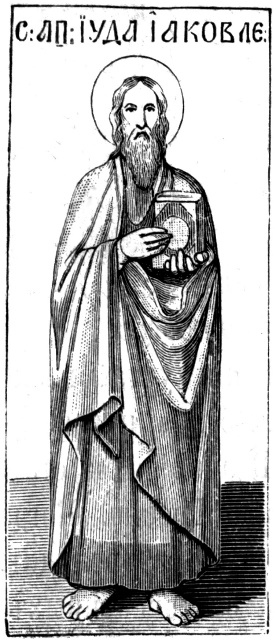
В. Ап. Иуда из племени Давида и Соломона; родился в Назарете от Клеопы, брата Иосифа, которому обручена была Пресв. Дева Мария, и посему называется братом и сродником Господним по плоти (Мф.13:55). Он есть родной брат Симеона, епископа Иерусалимского, сродника Господня Иакова меньшего, и потому называется Иуда Иаковлев (Лк.6:16; Деян.1:13), именуется также Леввеем, Фаддеем иВарсавой (Мф.10:3; Деян.15:22), может быть для отличия от Иуды Искариотского. До Апостольства своего он занимался земледелием. На Тайной Вечери Иуда спросил: Господи, что бысть, яко нам хощеши явитися, а не мирови. Господь ответил: кто любит Мя, слово Мое соблюдет: и Отец Мой возлюбит его, и к нему придем, и обитель у него сотворим (Ин.14:22–23)
The holy Apostle Jude was of the tribe of David and Solomon; he was born in Nazareth of Cleopas, the brother of Joseph, to whom the Most Holy Virgin Mary was betrothed, and therefore he is called the brother and kinsman of the Lord according to the flesh (Mt. 13:55). He is the own brother of Simeon, Bishop of Jerusalem, and of James the Less, a kinsman of the Lord, and therefore he is called Jude of James (Lk. 6:16; Acts 1:13); he is also named Lebbaeus, Thaddaeus and Barsabas (Mt. 10:3; Acts 15:22), perhaps to distinguish him from Judas Iscariot. Before his Apostleship he was occupied with farming. At the Mystical Supper Jude asked: Lord, how is it that Thou wilt manifest Thyself unto us, and not unto the world? The Lord answered: If a man love Me, he will keep My words: and My Father will love him, and We will come unto him, and make Our abode with him (Jn. 14:22–23).
Призванный возделывать виноградник Церкви Христовой, св. Ап. Иуда по сошествии Св. Духа проповедовал Евангелие в Иудее, Галилее, Самарии иИдумее; потом в Аравии, Сирии и Месопотамии, и наконец в Персии иАрмении. Из Персии после 66 или 67 года по Р. X. он написал своё краткое Соборное послание к верующим из Иудеев, бывшим в рассеянии (Иуд. 1:17–18), против николаитов и других еретиков, уверявших, что добрые дела для спасения не нужны. В Армении он мученически скончался, около 80 года по Р. X., быв повешен на кресте и прострелен. Армяне почитают Иуду особенно своим Апостолом. В IX веке Феофан, митрополит Никейский, написал канон на день Ап. Иуды, поемый ныне Прав. Церковью в день преставления сего Апостола.
Called to cultivate the vineyard of the Church of Christ, St. Jude the Apostle, after the descent of the Holy Spirit, preached the Gospel in Judea, Galilee, Samaria and Idumea; then in Arabia, Syria and Mesopotamia, and finally in Persia and Armenia. From Persia, after the year 66 or 67 A.D., he wrote his brief Catholic Epistle to the believers from among the Jews who were in the dispersion (Jude 1:17–18), against the Nicolaitans and other heretics who asserted that good works were not necessary for salvation. In Armenia he suffered a martyr's death, about the year 80 A.D., being hanged on a cross and pierced with arrows. The Armenians especially honor Jude as their Apostle. In the ninth century, Theophanes, Metropolitan of Nicaea, composed a canon for the day of the Apostle Jude, which is now sung by the Orthodox Church on the day of the repose of this Apostle.
Церковь Восточно-кафолическая прославляет Иуду, как «Христова сродника, тверда мученика, собеседника Павлова, проповедника Божественной благодати и тайноглагольника».
The Eastern Catholic Church glorifies Jude as "the kinsman of Christ, the steadfast martyr, the companion of Paul, the preacher of Divine grace and the speaker of mysteries."
«Ненавидя злого, прилепляйтесь к благому». – Эти слова Апостола (Римлян. IX) выполнял пр. Варлаам и в мирской жизни, и в иночестве.
"Abhor that which is evil, cleave to that which is good." – These words of the Apostle (Rom. 9) were fulfilled by the Venerable Barlaam both in his worldly life and in his monastic life.
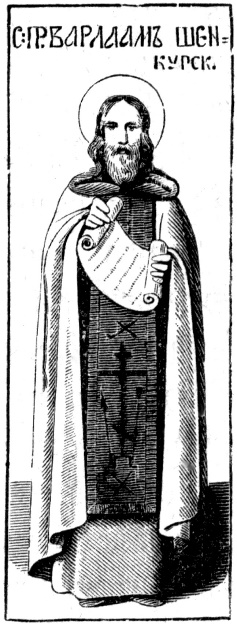
Пр. Варлаам был в мире лицом весьма значительным. Это был Новгородский посадник Василий Степанович Своеземцев, человек весьма богатый и уважаемый великими князьями. Древний повествователь215 пишет о нём: «посадник Василий по наследству («из отечества») владел Заволочьем; р. Вага со всеми её окрестностями была в его владении». По другим сведениям, дед Василия Степановича, Василий Матвеевич Своеземцев, Новгородский посадник, по купчей крепости 1315 г. приобрёл у Чудских старшин Азиса Харитонца (Харитония), Рода (Иродиона) и Игнатца (Игнатия) земли Шенкурские до Ростовских границ за 20,000 белок и за 10 руб. Так образовалась на р. Ваге боярщина Васильевская или земли боярина Василия. Потом явились на Ваге 12 других боярщин, но Васильевская была самая обширная и богатая. Своеземцевы первые завели на Ваге хлебопашество; до того времени Чудь питалась ловлей зверей и рыбы216. Василий Степанович более, чем отец и дед, употреблял огромные средства свои для пользы дикой страны и особенно употреблял меры для нравственного образования жителей её. Живя сам в Новгороде, пишет повествователь его, посылал он в Заволочье управителей; а по временам и сам бывал на Ваге, для личных распоряжений и для надзора за управлением доверенных. Он любил Вагу. По этой любви построил он в Заволочье, на горе над р. Вагой, городок и назвал его «Пинежским городком», как поставленный над р. Пинежкой. «Тогда городки получали имена по рекам и урочищам», замечает древний повествователь. Пинежка впадает в р. Вагу в 16 верстах ниже Шенкурска. В Новгороде Василий, продолжает повествователь, начальствовал честно и ненавидел всё худое. – «Исполняя заповедь Спасителя, он был питателем сирот, одеждой нагим, врачом больных, в доме его находили себе покой все странники». Особенно же расточал он благотворения свои на любимой Ваге. «Он построил здесь много храмов. Им построены храмы Рождества Христова на Химаневе, храм Рождества Богородицы на Усть-Пуе, храм Рождества Предтечи на Леде».
The Venerable Barlaam was in the world a very significant person. He was the Novgorod posadnik Vasily Stepanovich Svoezemtsev, a very wealthy man respected by the great princes. An ancient narrator215 writes of him: "Posadnik Vasily, by inheritance ('from his fatherland'), ruled Zavolochye; the river Vaga with all its environs was in his possession." According to other information, the grandfather of Vasily Stepanovich, Vasily Matveyevich Svoezemtsev, a Novgorod posadnik, by a deed of purchase in 1315 acquired from the Chud elders Azis Kharitonets (Kharitonius), Rod (Herodion) and Ignatets (Ignatius) the Shenkursk lands as far as the Rostov borders for 20,000 squirrel pelts and 10 rubles. Thus was formed on the river Vaga the boyar estate of Vasilyevskaya, or the lands of the boyar Vasily. Later, twelve other boyar estates appeared on the Vaga, but Vasilyevskaya was the most extensive and wealthy. The Svoezemtsevs were the first to introduce arable farming on the Vaga; before that time the Chud lived by hunting animals and fishing216. Vasily Stepanovich, more than his father and grandfather, used his enormous resources for the benefit of the wild country and especially took measures for the moral education of its inhabitants. Living himself in Novgorod, his narrator writes, he sent stewards to Zavolochye; and from time to time he himself visited the Vaga for personal arrangements and for oversight of the administration of his deputies. He loved the Vaga. Out of this love he built in Zavolochye, on a hill above the river Vaga, a small fortress and called it "Pinezhsky gorodok," as being set up over the river Pinezhka. "At that time fortresses received their names from rivers and landmarks," notes the ancient narrator. The Pinezhka flows into the river Vaga 16 versts below Shenkursk. In Novgorod, Vasily, the narrator continues, ruled honorably and hated everything evil. – "Fulfilling the Savior's commandment, he was a nourisher of orphans, clothing for the naked, a physician for the sick; in his house all strangers found rest." He especially poured out his benefactions on his beloved Vaga. "He built many churches here. By him were built the churches of the Nativity of Christ on Khimanevo, the church of the Nativity of the Theotokos at the mouth of the Puya, and the church of the Nativity of the Forerunner on the Leda."
По летописям видим, что на Ваге, при всей любви своей к людям, Василий Степанович вынужден бывал браться за оружие для усмирения дикарей – Вогулов и Остяков, нападавших на его поселения. В 1446 г. «Василий Шенкурский, говорит летопись, и Михаил Яковль, Новгородские воеводы, отправились с 3000 Заволочского войска и захватили множество людей Югорских с их жёнами и детьми. Но они оплошали. Югорцы, подойдя к ним с коварством в сердце, сказали им: «мы хотим давать вам дань, надобно сделать расчисление, – мы покажем вам станы, острова и урочища». А между тем, собравшись, ударили на Васильев острог, перебили много людей, детей боярских и людей отважных, всего человек 80. Жаль было слышать о потере их. Василий с сыном Симеоном и с малой дружиной убежал; иные рассеялись по лесу. Другой воевода Михаил Яковлевич в то время был на другой реке. Прибыв к Васильеву острогу, увидал он, что острог разорён, люди побиты, а другие разбежались; он начал искать их по реке, и собрались к нему Василий с сыном и все другие»217. В том же (1446) г. посадник Василий Степанович являлся послом от Новгорода к Шемяке, причём заключён был договор с Шемякой, новым великим князем218. В 1456 г. посадник Василий Степанович вместе с Новгородским архиепископом просил в Волоке Ламском великого князя Василия дать мир Новгороду219. Его имя вместе с именами других полномочных Новгорода видим в договорных грамотах Новгорода с великим князем того же года220. Это последний год, когда имя воеводы и посадника Василия встречается в истории Новгорода.
From the chronicles we see that on the Vaga, despite all his love for people, Vasily Stepanovich was sometimes forced to take up arms to subdue the savages – the Voguls and Ostyaks – who attacked his settlements. In 1446, "Vasily of Shenkursk, says the chronicle, and Michael Yakovlev, Novgorod voivodes, set out with 3000 troops of Zavolochye and captured many Yugra people with their wives and children. But they grew careless. The Yugra people, approaching them with deceit in their hearts, said to them: 'We wish to pay you tribute; a reckoning must be made – we will show you the camps, islands and landmarks.' Meanwhile, having gathered together, they struck at Vasily's fort, killed many people, boyar children and brave men, in all about 80 men. It was grievous to hear of their loss. Vasily with his son Simeon and a small retinue fled; others scattered through the forest. The other voivode, Michael Yakovlevich, was at that time on another river. Arriving at Vasily's fort, he saw that the fort was destroyed, the people killed, and others scattered; he began to search for them along the river, and Vasily with his son and all the others gathered to him"217. In the same year (1446), Posadnik Vasily Stepanovich appeared as an envoy from Novgorod to Shemyaka, and a treaty was concluded with Shemyaka, the new Grand Prince218. In 1456, Posadnik Vasily Stepanovich together with the Archbishop of Novgorod besought Grand Prince Vasily at Volok Lamsky to grant peace to Novgorod219. His name, together with the names of other plenipotentiaries of Novgorod, is seen in the treaty charters of Novgorod with the Grand Prince of the same year220. This is the last year in which the name of the voivode and posadnik Vasily appears in the history of Novgorod.
Василий Степанович собственным опытом уверился, что дела мира только тревоги и суета, если только не оскорбление для совести. Он совсем удалился из шумного Новгорода в любимый Важский край.
Vasily Stepanovich became convinced by his own experience that the affairs of the world are only anxieties and vanity, if not an offense to the conscience. He withdrew entirely from noisy Novgorod to his beloved Vaga region.
Ещё задолго до того времени, в 1444 г., основал он на Ваге иноческую обитель в честь Евангелиста Иоанна221. Древний повествователь говорит о сём: «перед каждым праздником Василий проводил ночи в молитве. Перед праздником Иоанна Богослова положил обет построить обитель в честь Евангелиста. На утро пошёл осмотреть места, и два места, на западе от городка, показались ему удобными для обители; из них восточное более нравилось ему, но он, не полагаясь на себя, бросил жребий; три раза бросал и каждый раз выходил жребий западного. Василий сказал вслух служителей: «восточное место – место твёрдое, а на этом месте земля не крепка, и однако люди будут жить здесь, – оно им понравится, только много будет хлопот». Блаженный Василий велел строить здесь общежительный монастырь с храмом Евангелиста... Обители своей он дал много земель, утвердив свои пожертвования грамотами». Ныне известны грамоты, которыми Василий Степанович в 1452 г. назначил из своих имений три села с землями в пользу Богословской обители и в тех же грамотах видим игумена обители Серапиона222. Приготовив душу к подвигам самоотречения делами благотворительности и глубоко чувствуя пустоту мирской жизни, Василий Степанович поступил сам в Богословскую обитель – и жил здесь, как самый строгий инок, до кончины своей. «Василий, пишет древний повествователь, оставив жену и детей, сам поселяется в обители Евангелиста и принимает монашество с именем Варлаама. Иноческая жизнь его была весьма строга: смирением и послушанием он ставил себя ниже всех, как будто не был основателем обители и владельцем богатых земель. Сколько знаменит был за оградой обители, столько в обители в одежде инока старался быть известным одними иноческими подвигами. Верный Владыке своему раб, он работал Ему каждый день со всем усердием, упражняясь в посте и молитвах». Достигши глубокой старости, мирно скончался он июня 19-го 1462 г., тогда как с того же года великий князь Иоанн начал покорять Новгород полной своей власти и к 1478 г. весь Важской и Двинской край стал собственностью дома великого князя223, оставившего впрочем имения, подаренные Василием Степановичем Богословской обители, за этой обителью224.
Even long before that time, in 1444, he had founded on the Vaga a monastic community in honor of the Evangelist John221. The ancient narrator says of this: "Before every feast Vasily spent the nights in prayer. Before the feast of John the Theologian he made a vow to build a monastery in honor of the Evangelist. In the morning he went to inspect the sites, and two sites, to the west of the fortress, seemed to him suitable for the monastery; of these, the eastern one pleased him more, but not trusting himself, he cast lots; three times he cast and each time the lot fell on the western one. Vasily said aloud to his servants: 'The eastern site is a firm place, but on this site the ground is not strong, and yet people will live here – it will please them, only there will be much trouble.' The blessed Vasily ordered a cenobitic monastery to be built here with a church of the Evangelist... To his monastery he gave many lands, confirming his donations by charters." Known today are the charters by which Vasily Stepanovich in 1452 assigned from his estates three villages with lands for the benefit of the Bogoslovskaya monastery, and in those same charters we see the abbot of the monastery, Serapion222. Having prepared his soul for the labors of self-denial through works of charity and deeply feeling the emptiness of worldly life, Vasily Stepanovich himself entered the Bogoslovskaya monastery – and lived there as the strictest monk until his end. "Vasily, writes the ancient narrator, having left his wife and children, himself settled in the monastery of the Evangelist and received monasticism with the name Barlaam. His monastic life was very strict: by humility and obedience he placed himself below everyone, as if he were not the founder of the monastery and the owner of rich lands. As renowned as he was outside the monastery walls, so within the monastery, in the garb of a monk, he strove to be known only by his monastic labors. A faithful servant to his Master, he worked for Him every day with all zeal, exercising himself in fasting and prayers." Having reached a deep old age, he peacefully reposed on June 19, 1462, while from that same year Grand Prince John began to subjugate Novgorod to his full authority, and by 1478 the entire Vaga and Dvina region became the property of the house of the Grand Prince223, who, however, left the estates donated by Vasily Stepanovich to the Bogoslovskaya monastery in the possession of that monastery224.
В 1552 г. случился большой разлив реки Ваги. И в прежние годы от напора воды гора, на которой стоял монастырь, была подмываема. В этот же год, перед днём памяти блаженного Варлаама, когда в обитель собралось множество Богомольцев, оторвалась часть горы с самой вершины её, так что едва уцелел храм. – Тогда открылось много гробов, в том числе и гроб блаженного Варлаама. Игумен Герасим с братией перенесли гроб блаженного и положили близ нового храма. Тогда увидели, что мощи блаженного Варлаама совершенно целы, даже иноческие одежды его и гроб не истлели, – тогда как в другом гробе современном увидали прах.
In 1552 there was a great flood of the river Vaga. In previous years as well, the hill on which the monastery stood had been undermined by the pressure of the water. In this same year, before the day of commemoration of the blessed Barlaam, when a multitude of pilgrims had gathered at the monastery, a part of the hill broke away from its very summit, so that the church barely survived. – Then many graves were uncovered, among them the grave of the blessed Barlaam. Abbot Gerasim with the brethren transferred the coffin of the blessed one and placed it near the new church. Then they saw that the relics of the blessed Barlaam were completely intact, and even his monastic garments and his coffin had not decayed – whereas in another coffin from the same period they saw only dust.
Затем случился в Новгородской области голод. По летописи это было в 1557 г. Тогда «голод был по всей земле, а больше по всей Заволочской стране»225. Игумен Паисий и братия, страшась скудости, положили не раздавать хлеба бедным. По завещанию же блаженного Варлаама в день кончины его каждый год кормили всех бедных, сколько бы ни приходило их, да ещё наделяли их зерновым хлебом. В этот раз Паисий и братия положили не делать сего. Блаженный Варлаам, питатель бедных при жизни своей, явился кормителем их и по смерти. Перед праздником после утрени игумен и братия, по обыкновению, заснули. Сперва Паисию, потом старшим из братии, является с жезлом в руке, с тёмно-русой бородой, как пишется он на иконе, и говорит строгим голосом: «вы составляли нечестивый совет, не хотите давать милостыню нищим, затворяете житницы мои для бедности. Ужели не понимаете, что затворяете себе Царствие Небесное? Знайте, что это место разорится в конец. Приказываю вам – завтра в день памяти моей непременно кормите всех бедных и раздайте им милостыню, чтобы простил вам Бог дерзость вашу. То же с грозной строгостью сказал он и старшей братии, прибавив приказание кормить бедных не только в день памяти его, но и во всякое другое время.
Then a famine occurred in the Novgorod region. According to the chronicle, this was in 1557. At that time, “there was a famine throughout all the land, but especially throughout all the Zavolochye country”225. Abbot Paisius and the brethren, fearing scarcity, resolved not to distribute bread to the poor. But according to the testament of the blessed Barlaam, on the day of his death each year they fed all the poor, however many came, and also gave them grain. This time, Paisius and the brethren resolved not to do this. The blessed Barlaam, who had been a nourisher of the poor during his life, appeared as their nourisher even after death. Before the feast, after Matins, the abbot and the brethren, as was their custom, fell asleep. First to Paisius, then to the senior among the brethren, there appears one with a staff in his hand, with a dark-brown beard, as he is depicted on his icon, and he says in a stern voice: “You have formed an ungodly council; you do not wish to give alms to the beggars; you shut up my granaries against the poor. Do you not understand that you are shutting yourselves out of the Kingdom of Heaven? Know that this place will be utterly destroyed. I command you – tomorrow, on the day of my commemoration, you must feed all the poor and give them alms, so that God may forgive you your insolence.” He said the same with threatening severity to the senior brethren, adding a command to feed the poor not only on the day of his commemoration, but at every other time as well.
Древний повествователь описывает затем исцеление весьма многих больных и слепых при гробе преп. Варлаама. Самые замечательные исцеления совершились над Давидом Вертячим и Семёном Тимофеевым. Вертячий, крестьянин Ледской волости, идя по мосткам, осунулся левой ногой в воду. Нога опухла до пояса; сделались нарывы и нагноения, до того, что мясистые части вовсе сгнили и остались одни кости. Долго и сильно страдая, Давид стал каяться в грехах своих и призвал на помощь преп. Варлаама. Это оказалось лучшим лекарством. Вертячий стал наступать на ногу и кое-как добрёл до обители Варлаама. Сюда же пришёл из той же Ледской волости Семён Тимофеев, у которого до того болел правый глаз, что от опухоли и стрельбы страдали половина головы и правая сторона тела. Оба они молились у гроба преподобного Варлаама, и когда ночью заснули, Семёна вдруг кто-то толкает и говорит: встань, разбуди и товарища Давида, – идите и молитесь у гроба Варлаамова, – будете совсем здоровы. Пробудившийся Семён не видел никого, разбудил товарища, и оказалось, что оба они совсем здоровы.
The ancient narrator then describes the healing of very many sick and blind persons at the grave of the Venerable Barlaam. The most remarkable healings were performed upon David Vertyachy and Simeon Timofeev. Vertyachy, a peasant of the Leda volost, while walking on a footbridge, slipped with his left foot into the water. His leg swelled up to the waist; abscesses and suppurations formed, to such a degree that the fleshy parts completely rotted away and only the bones remained. Suffering long and severely, David began to repent of his sins and called upon the Venerable Barlaam for help. This proved to be the best medicine. Vertyachy began to step on his leg and somehow made his way to the monastery of Barlaam. To the same place came Simeon Timofeev, also from the Leda volost, whose right eye had so pained him that from the swelling and shooting pains, half his head and the right side of his body suffered. Both of them prayed at the grave of the Venerable Barlaam, and when they fell asleep at night, someone suddenly nudges Simeon and says: “Arise, wake your comrade David as well – go and pray at the grave of Barlaam, and you will be completely well.” The awakened Simeon saw no one; he woke his comrade, and it turned out that both of them were completely well.
Мощи преп. Варлаама были свидетельствованы в 1630 г. Новгородским митрополитом Киприаном. Тогда же сделано было распоряжение о праздновании памяти преподобному Варлааму – и в его имя построен был придельный храм226. Ныне мощи его почивают в бывшей монастырской, а с 1764 г. приходской Богословской церкви. В день кончины преподобного, июня 19, ежегодно бывает крестный ход из г. Шенкурска на место покоя преп. Варлаама227.
The relics of the Venerable Barlaam were examined in 1630 by Cyprian, Metropolitan of Novgorod. At that time, a decree was also made concerning the celebration of the memory of the Venerable Barlaam, and a side-chapel was built in his name226. Now his relics repose in the former monastery church, which since 1764 has been the parish Church of St. John the Theologian. On the day of the Venerable One’s repose, June 19, a procession of the cross is held annually from the city of Shenkursk to the place of repose of the Venerable Barlaam227.
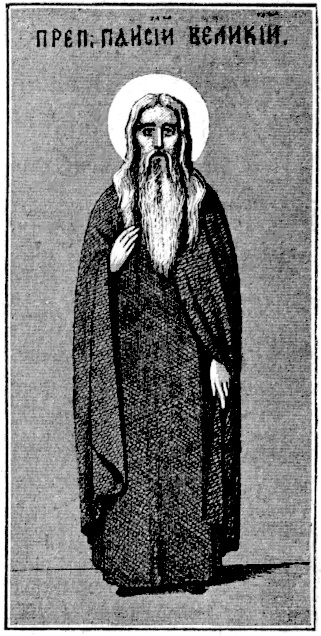
Преп. Паисий родился в Египте, в IV веке. Отец его умер, когда он был ещё в детском возрасте – меньшим из семи сирот, оставшихся на попечении матери. Любящая мать сильно озабочена была будущностью детей своих, особенно тревожилась она о меньшом сыне, недоумевая, как воспитает его без помощи мужа своего, разделявшего её благочестивые попечения о старших детях… Однажды ободрена она была чудным сновидением: – «зачем предаёшься ты безмерной печали и беспокойству о детях твоих? – сказал явившийся ей ангел, – разве ты одна заботишься о них? Не охраняет ли их Сам Бог? Оставь же печаль твою» ...
The Venerable Paisius was born in Egypt, in the fourth century. His father died while he was still a child – the youngest of seven orphans left in the care of their mother. The loving mother was greatly troubled about the future of her children, and especially worried about her youngest son, not knowing how she would raise him without the help of her husband, who had shared her pious concerns for the older children… One day she was encouraged by a wondrous dream: “Why do you give yourself over to immeasurable sorrow and anxiety about your children?” said an angel who appeared to her. “Are you the only one who cares for them? Does not God Himself guard them? Leave off your grief…”
Вся преданная заботам о детях, мать св. Паисия главным образом заботилась об его образовании и воспитывала его неуклонно в духе Христова учения. С детства расположенный к почитанию Бога и любви к нему, Паисий, когда пришёл в возраст, пожелал посвятить свою жизнь на служение Богу. Жизнь в мире не привлекала его, он предпочёл «пустынное житие» и сделался учеником великого подвижника пустыни пр. Памвы (пам. 18-го июля); оставаясь в скиту под его руководством до самой кончины его, Паисий после того удалился в глубь пустыни Нитрийской и поселился в выкопанной им самим пещере. Долго жил он тут в совершенном одиночестве, проводя время в молитве. Потом нашли его искавшие его помощи и советов, и всех с любовью принимал он и многих наставил на спасительный путь. Постепенно собрались вокруг него желавшие проводить подвижническую жизнь под его руководством; это многолюдство было отяготительно для смиренного Паисия, он снова уклонился от внимания людского и три года прожил снова один в никому неведомой пещере; когда же и тут нашли и стали селиться вокруг него нуждавшиеся в нём люди, то он уже больше не уклонялся от служения им, но только тяготился почётом и не любил, чтобы его добрые дела были известны... «Великий вред – похвала людская», – часто говорил он ученикам своим, – а на вопрос их: какая высшая добродетель? он отвечал: «совершаемая тайно» ...
Wholly devoted to the care of her children, the mother of St. Paisius was chiefly concerned for his education and raised him steadfastly in the spirit of Christ’s teaching. From childhood disposed to the worship of God and love for Him, Paisius, when he came of age, desired to dedicate his life to the service of God. Life in the world did not attract him; he preferred “the desert life” and became a disciple of the great ascetic of the desert, the Venerable Pambo (commemorated July 18). Remaining in the skete under his guidance until his death, Paisius afterwards withdrew into the depths of the Nitrian desert and settled in a cave he had dug out himself. He lived there for a long time in complete solitude, spending his time in prayer. Then those who sought his help and counsel found him, and he received all with love and guided many onto the path of salvation. Gradually, those who wished to lead an ascetic life under his guidance gathered around him; this multitude was burdensome to the humble Paisius, and he again withdrew from human attention and lived for three years alone in a cave known to no one. When even there people who needed him found him and began to settle around him, he no longer withdrew from serving them, but was only burdened by honor and did not like his good deeds to be known… “Great harm is human praise,” he often said to his disciples, and when they asked him: “What is the highest virtue?” he answered: “That which is done in secret…”
С любовью, терпением и сверхъестественной прозорливостью Паисий руководил учеников своих особенно в соблюдении ими чистоты веры. Однажды один из любимых учеников его, отправившись в город по какому-то делу, встретился по дороге с Евреем и между ними произошёл разговор. Еврей стал отвергать Божественное достоинство Иисуса Христа и доказывать, что Он вовсе не настоящий Мессия, Которому ещё следует прийти в мир. Инок со вниманием слушал доводы Еврея и потом в неразумной простоте своей, вместо возражения сказал: может быть это и так, как ты говоришь» ... Возвратясь в скит, инок скоро заметил, что Паисий переменился в обращении с ним, что он не только не говорит с ним, как прежде, но даже и не смотрит на него. Огорчённый инок, не сознавая за собой вины, спросил старца о причине такой перемены его. – «Отойди от меня с отрёкшимися от Бога, я не хочу говорить с тобой», гневно отозвался Паисий, но, видя недоумение инока, он мало-по-малу привёл его к сознанию того, что легкомысленной беседой с неверующим он выразил своё отчуждение от Христа и своим ответом Еврею на его богохульные речи исключил себя из числа истинно верующих и подлежит осуждению наравне с теми, которые прямо отреклись от Христа...
With love, patience, and supernatural clairvoyance, Paisius guided his disciples, especially in their preservation of the purity of the faith. Once, one of his beloved disciples, having gone to the city on some business, met a Jew on the road, and a conversation arose between them. The Jew began to deny the Divine dignity of Jesus Christ and to argue that He was not the true Messiah, Who was still to come into the world. The monk listened attentively to the Jew’s arguments and then, in his unwise simplicity, instead of refuting him, said: “Perhaps it is as you say…” Returning to the skete, the monk soon noticed that Paisius had changed in his manner toward him, that he not only did not speak with him as before, but would not even look at him. The grieved monk, not conscious of any fault, asked the elder the reason for such a change. “Depart from me, with those who have renounced God; I do not wish to speak with you,” Paisius answered angrily. But seeing the monk’s bewilderment, he gradually brought him to the realization that by his frivolous conversation with an unbeliever he had expressed his estrangement from Christ, and by his answer to the Jew’s blasphemous speeches had excluded himself from the number of the truly faithful and was subject to condemnation equally with those who had directly denied Christ…
Поражённый таким строгим приговором инок со слезами припал к ногам Паисия и просил его помолиться, чтобы Бог простил ему его грех. Не отказал раскаивающемуся ученику своему любвеобильный учитель и, запершись в своей пещере, молился о нём, пока не узнал в знаменательном сновидении, что Бог простил отрёкшемуся от Него посредством легкомысленного слова...
Struck by such a severe sentence, the monk fell weeping at Paisius’s feet and begged him to pray that God would forgive him his sin. The loving teacher did not refuse his repentant disciple, and, shutting himself in his cave, prayed for him until he learned in a significant dream that God had forgiven him who had denied Him by a frivolous word…
Иоанн Колов, также подвижник, прославившийся святостью жизни, очевидец подвигов Паисия, написавший подробное житие его, говорит, что ему не раз случалось убеждаться, что Паисий прозорливо судил о состоянии души приходивших к нему. Рассказывая, вообще, о чудесах, которыми Бог прославил Паисия, Иоанн прибавляет: – «да не усомнятся, слыша о нём славное и сверхъестественное, и да не подумают, что я что-либо прибавил от себя для большей чести любезного мне отца. Он выше всякой человеческой чести и не требует, от низших, хваления, ибо похваляем в высших от святых ангелов; но рассказываю для пользы слушающих и желающих подражать его добродетелям; передаю же то, что видел своими глазами и слышал своими ушами».
John Kolov, also an ascetic, glorified for the holiness of his life, an eyewitness of Paisius’s struggles, who wrote a detailed life of him, says that he had more than once occasion to be convinced that Paisius judged with clairvoyance the state of soul of those who came to him. Relating in general the miracles by which God glorified Paisius, John adds: “Let no one doubt when hearing of him things glorious and supernatural, and let no one think that I have added anything of my own for the greater honor of my beloved father. He is above all human honor and does not require praise from those beneath him, for he is praised among those on high by the holy angels; but I relate this for the benefit of those who hear and desire to imitate his virtues; and I relate what I saw with my own eyes and heard with my own ears.”
Преп. Паисий скончался в глубокой старости, в 400 г. Преп. Исидор Пелусиот перенёс останки преп. Паисия и Памвы в свою обитель (близ г. Пелузы) и соорудил над их гробницами великолепный храм.
The Venerable Paisius reposed in extreme old age, in the year 400. The Venerable Isidore of Pelusium transferred the remains of the Venerable Paisius and Pambo to his monastery (near the city of Pelusium) and built a magnificent church over their tombs.
Беседуя однажды о значении молитвы, он между прочим сказал: «кто хочет, чтобы Бог скоро услышал молитву его, тот, когда станет перед Богом и прострёт руки свои к Нему, прежде всего, даже прежде молитвы о душе своей, должен от всего сердца молиться о врагах своих. За это доброе дело Бог услышит его, о чём бы он ни молился» ...
Once, conversing about the meaning of prayer, he said among other things: “He who wishes God to hear his prayer quickly, when he stands before God and stretches out his hands to Him, must first of all, even before praying for his own soul, pray from his whole heart for his enemies. For this good deed, God will hear him, whatever he may pray for…”
Говорили о Зиноне, что сначала он не хотел ни от кого ничего принимать. И потому делавшие ему приношения уходили от него, скорбя о том, что он не брал. А другие приходили к нему, нуждаясь получить от него что-нибудь, но ему нечего было им дать, и они также отходили со скорбью. Видя это, старец сказал: – что мне делать? и те скорбят, которые приносят, и те скорбят, кому нечего получить... и решил так; – если кто принесёт – возьму; а если кто попросит – отдам ему... Так делая, и сам был спокоен и другие были довольны.
It was said of Zeno that at first he did not wish to receive anything from anyone. And therefore those who made offerings to him went away grieving that he would not take them. And others came to him, needing to receive something from him, but he had nothing to give them, and they also went away in sorrow. Seeing this, the elder said: “What am I to do? Those who bring are grieved, and those who have nothing to receive are grieved…” And he decided thus: “If someone brings something, I will take it; and if someone asks, I will give it to him…” Doing thus, he himself was at peace and others were satisfied.
Ркп. житие пр. Варлаама по спискам Ундольского № 291. Царского № 88. «Пишу я, говорит биограф, не как самовидец; я – постриженник другого монастыря и живу далеко от обители святого (Варлаама); пишу, что слышал я от иноков обители святого, от оставшихся достоверных свидетелей; но и они – не очевидцы, а слышали от прежних отцов и мне пересказали». Биограф Сийский иеромонах Иона, находясь по послушанию в обители Варлаамовой, в 1589 г., по просьбе игумена Даниила описал жизнь и чудеса пр. Варлаама.
Manuscript life of the Venerable Barlaam according to the copies of Undolsky No. 291, Tsarsky No. 88. “I write,” says the biographer, “not as an eyewitness; I am a tonsured monk of another monastery and live far from the monastery of the saint (Barlaam); I write what I heard from the monks of the saint’s monastery, from the remaining trustworthy witnesses; but even they are not eyewitnesses, but heard from the former fathers and recounted it to me.” The Siya biographer, Hieromonk Jonah, while in obedience at the monastery of Barlaam in 1589, at the request of Abbot Daniel, described the life and miracles of the Venerable Barlaam.
Северный архив 1827 г., ч. 27, стр. 10. 15. 16. 20. Здесь и купчая 1315 г. Закладная Двинского владельца Власия Чухчеменскому монастырю св. Николая 1349 г.: «тое зимы, коли Корела морем Двинян грабили» – в юрпд. акт. № 234, стр. 260–261.
Northern Archive, 1827, part 27, pp. 10, 15, 16, 20. Here also is a deed of sale of 1315. A mortgage deed of the Dvina landowner Vlasius to the Chukhchemen Monastery of St. Nicholas, 1349: “that winter, when the Karelians plundered the Dvina people by sea” – in Juridical Acts, No. 234, pp. 260–261.
Собр. грам. I. 393. Карамз. 9. пр. 849. Сл. в этногр. собрн. V, 1–17 взгляд на удельных крестьян Важско-Двинских.
Sobranie Gramot, I, 393. Karamzin, 9, note 849. Slovo v Etnograficheskom Sbornike, V, 1–17, a survey of the appanage peasants of the Vazhsk-Dvina region.
Север. архив 1827 г., ч. 27, стр. 195. 196. Между рукописями п. Филарета по описи 1630 г. «канун и житие преп. отца нашего Варлаама, иже на Ваге р. Пенежского чудотворца». Иванова опись госуд. архива, стр. 292. М. 1849 г.
Severny Arkhiv, 1827, part 27, pp. 195, 196. Among the manuscripts of Patriarch Philaret according to the inventory of 1630: "kanon and life of our Venerable Father Barlaam, the Wonderworker of Penezh, on the River Vaga." Ivanov's Inventory of the State Archive, p. 292. Moscow, 1849.