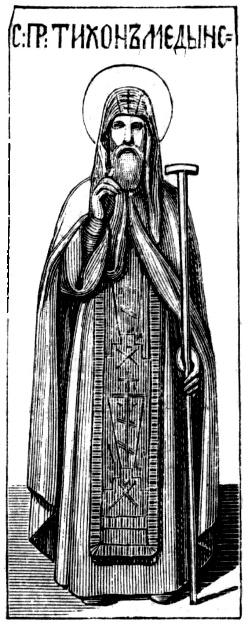
Святой Тихон родился в г. Амаеунте, на острове Кипре, получил христианское воспитание и научен Священному Писанию. С молодых лет отличался благочестием и добротой души, свидетельством чего сохранилось между прочим в предании, что когда однажды отец его, торговавший хлебом, поручил ему продавать хлеб, то он стал раздавать его бедным даром. Когда же отец стал его за это бранить, то он отвечал: – «отец, я не даром раздаю хлеб, а даю его взаймы Богу и знаю из Священного Писания, что дающий Богу примет от Него сторицей» ...
St. Tikhon was born in the city of Amathus, on the island of Cyprus, received a Christian upbringing and was instructed in the Holy Scriptures. From his youth he was distinguished by piety and goodness of soul, evidence of which is preserved, among other things, in the tradition that once, when his father, who traded in bread, entrusted him with selling bread, he began to distribute it to the poor for free. When his father began to rebuke him for this, he answered: "Father, I am not giving away bread for nothing, but am lending it to God, and I know from Holy Scripture that he who gives to God will receive from Him a hundredfold"...
Со временем, заслужив уважение своей примерной жизнью, Тихон был посвящён в сан диакона Амафунтским епископом Мемноном; когда же Мемнон скончался, то Тихон был избран на его место и рукоположен Епифанием, архиепископом Кипрским. В то время на острове Кипре было ещё не мало язычников и святитель Тихон ревностно и успешно обращал их ко Христу. Он скончался в 425 г. в глубокой старости, прославясь чудотворной силой; Между прочими проявлениями её сохранилось в памяти народной следующее: в одном саду вырезывали сухие ветви от виноградных лоз и выбрасывали их вон. Святой Тихон, собрав их, рассадил в своём огороде и помолился, чтобы они принялись, приносили хороший плод и созревали раньше других. И действительно, с благоговением Божиим, безусловно привлекаемым молитвой праведника, образовался большой виноградник, приносивший самые вкусные плоды и созревавшие ранее, чем в других виноградниках.
In time, having earned respect by his exemplary life, Tikhon was ordained to the rank of deacon by Memnon, Bishop of Amathus; and when Memnon reposed, Tikhon was chosen in his place and consecrated by Epiphanius, Archbishop of Cyprus. At that time there were still not a few pagans on the island of Cyprus, and the Hierarch Tikhon zealously and successfully converted them to Christ. He reposed in the year 425 in extreme old age, glorified by wonderworking power; among other manifestations of it, the following has been preserved in the memory of the people: in a certain garden, dry branches were cut from the vines and thrown out. St. Tikhon, gathering them, planted them in his own garden and prayed that they would take root, bear good fruit, and ripen before the others. And indeed, by the blessing of God, which is unfailingly drawn by the prayer of the righteous, a great vineyard grew, yielding the most delicious fruits and ripening earlier than those in other vineyards.
В Греческом стишном прологе197 говорится, что «ветвь виноградная, насажденная св. Тихоном, до сих пор произращает ранние гроздья ко дню памяти святого».
In the Greek verse prologue197 it is said that "the vine branch planted by St. Tikhon still produces early clusters for the day of the saint's memory."
16-го июня, на память св. Тихона, зрелые гроздья этого винограда приносились в церковь и на выжатом из них вине совершалась бескровная жертва во время литургии.
On the 16th of June, for the memory of St. Tikhon, ripe clusters of this grape were brought to the church, and on the wine pressed from them the bloodless sacrifice was offered during the Divine Liturgy.
День св. Тихона на Руси известен под именем «Тихонова дня». «На Тихонов день всё затихает; в этот день тиха добра мать – сыра земля. И солнышко тихо по небу течёт. И певчие пташки с Тихонова дня затихают. Свет тихий святой славы Господней на Тихонов день сияет. От него все травы полным соком наливаются и вплоть до Иванова дня в целебном соку стоят. На Тихоновой росе, старые люди говорят, надо травы рвать, корни копать, цветы собирать»198.
The day of St. Tikhon in Rus' is known by the name "Tikhon's Day." "On Tikhon's Day everything grows quiet; on this day the good mother – the damp earth – is still. And the sun flows quietly across the sky. And the songbirds grow quiet from Tikhon's Day onward. The quiet light of the holy glory of the Lord shines on Tikhon's Day. From it all herbs are filled with full sap and stand in healing juice until Ivan's Day. On Tikhon's dew, old people say, one must gather herbs, dig roots, and collect flowers."198
В ркп. святцах читаем: «преп. Тихон, начальник монастыря, иже на р. Оке, преставился в л. 7000». Здесь же показан «ученик св. Тихона преп. Никифор». По старинной службе преподобному и по местному преданию, пр. Тихон в молодых летах принял пострижение в Москве и по любви к уединению удалился в глухой лес малого Ярославца, бывшего во владении кн. Ярослава Владимировича († 1426 г.), сына кн. Владимира Андреевича Храброго. Здесь, на берегу речки Вопрейки, притока р. Оки, жилищем пустынника служило дупло исполинского дуба, остатки коего сохраняются поныне; пищей была трава («были саморосленные»), а питьём – вода колодезя, выкопанного им. Когда узнали о рабе Божием, то стали приходить к нему одни для духовного совета, другие для пребывания с ним подвижнического. Тяжела была жизнь при лишениях разного рода. Но надобно было, чтобы скорби отягчались ещё особенной бедой; только терпение на этот раз награждено было осязаемой тихостью неба. Князь, владелец лесов Вопрейских, охотился за дикими зверями. Нечаянно или же, что вероятнее, по указанию людей худых напал князь на уединённое пребывание пустынника. «Как ты смел без моей воли поселиться здесь?» сказал с гневом владелец и замахнулся ударить пустынника плетью. Пустынник не трогался, а рука гневного онемела. Князь пришёл в себя и не только позволил пустыннику оставаться на его месте, но обещал помогать ему при устроении обители. Ученики пристали с просьбой к наставнику приступить к устроению обители. Невдали от своего дуба преподобный построил храм Успения Богоматери. По просьбам же учеников преподобный принял на себя сан игумена и был усердным наставником в духовной жизни для поручения себя его руководству. «Управляя ими со смирением, имел кроткий обычай и стяжал незлобивое сердце. Последуя Пастырю Христу питал алчущих и жаждущих, принимал странных, «защищал обижаемых» (икос)
In the manuscript Menologia we read: "The Venerable Tikhon, head of the monastery on the Oka River, reposed in the year 7000." Here also is shown "the disciple of St. Tikhon, the Venerable Nikephoros." According to the ancient service to the venerable one and according to local tradition, the Venerable Tikhon received the tonsure in Moscow in his youth and, out of love for solitude, withdrew into the deep forest of Maly Yaroslavets, which was in the possession of Prince Yaroslav Vladimirovich († 1426), son of Prince Vladimir Andreevich the Bold. Here, on the bank of the river Vopreika, a tributary of the Oka River, the hollow of a giant oak served as the hermit's dwelling; the remains of this oak are preserved to this day. His food was grass ("self-grown herbs"), and his drink was water from a well he had dug. When they learned of the servant of God, people began to come to him – some for spiritual counsel, others to remain with him in ascetic life. Life was hard amid deprivations of various kinds. But it was necessary that sorrows be further burdened by a particular misfortune; only patience this time was rewarded with the tangible stillness of heaven. The prince, the owner of the Vopreya forests, was hunting wild beasts. By chance, or, more likely, at the instigation of evil men, the prince came upon the hermit's solitary dwelling. "How dare you settle here without my permission?" said the owner angrily, and raised his hand to strike the hermit with his whip. The hermit did not flinch, but the hand of the angry man grew numb. The prince came to his senses and not only allowed the hermit to remain in his place, but promised to help him in the establishment of the monastery. The disciples earnestly begged their teacher to begin building the monastery. Not far from his oak, the venerable one built a church of the Dormition of the Mother of God. At the entreaties of his disciples, the venerable one accepted the rank of abbot and was a zealous instructor in the spiritual life for those who entrusted themselves to his guidance. "Governing them with humility, he had a gentle disposition and acquired a guileless heart. Following the Shepherd Christ, he fed the hungry and thirsty, received strangers, and defended the wronged" (ikos).
Во вкладной книге обители записано: «дано в день Пречистые Богородицы честного Ея Успения преподобного отца игумена Тихона великого государя жалованье, царя и вел. кн. Иоанна Васильевича, Евангелие напрестольное». Итак ясно, что уже при царе Грозном (1533–1584 г.) преп. Тихон считался в числе угодников Божиих.
In the donation book of the monastery it is recorded: "Given on the day of the Most Pure Mother of God, Her honorable Dormition, of the venerable father Abbot Tikhon, the great sovereign's grant, of the Tsar and Grand Prince John Vasilievich, a Gospel for the altar." Thus it is clear that already under Tsar Ivan the Terrible (1533–1584), the Venerable Tikhon was counted among the saints of God.
Память его чтится 15 июня значительным стечением народа из окрестностей. Мощи его почивают под спудом в Преображенской обители199.
His memory is honored on June 15 with a considerable gathering of people from the surrounding area. His relics lie hidden beneath a bushel in the Monastery of the Transfiguration199.
Села Бородицка Масальского уезда поселянка вдова Александра Григорьевна Жалкова 72 лет страдала расслаблением тела. В первые 6 лет лечили её разные сельские лекарки, – но от того стало ей ещё хуже. Затем она уже лежала в бесчувствии и узнавала только немногих. «В одно время», так говорила уже исцелённая Александра, «именно 15 июня 1842 г., в полдень, лёжа в избушке, увидела я идущего ко мне старца. Одеяние на нём было чёрное, длинное, на голове полукруглая шапочка, с вышитыми зелёными крестиками (схимник, куколь), росту небольшого, худощавый, с бородой седой и не длинной. Подойдя к постели, старец, взяв за руку, сказал: «что ты лежишь, Александра?» – «Батюшка», отвечала я, «знать прогневила я Бога, все уже отступились от меня». «Нет, сказал старец, – не гневи Бога, вот тебя посещает Алексей Назарович (купец Лядов). Молись Богу! За простоту твою пришёл я полечить тебя. Хочешь ли?» «Желаю, батюшка, но уже не чается, чтобы была здорова, отвечала я». Старец сказал: «вот окроплю тебя водою из моего колодца, и ты будешь здорова». Затем достал из кармана стеклянный кувшинчик, покропил меня веничком, потом дал напиться и сказал: «вот тебе и здоровье». В ту же минуту почувствовала я облегченье – встала и с радостью спросила: «кто ты такой, дядюшка? я буду помнить тебя». Он сказал: «я Тихон из пустыни, живу от Калуги в 19 вер. А ты будешь здорова и станешь питаться своими трудами». И вышел из избы. Вслед затем вошел А. Н. Лядов и, увидав меня здоровой, спросил с удивлением: «ты ли это Александра, кто тебя вылечил?» – «Меня вылечил дядюшка Тихон», отвечала я и рассказала всё, что со мной было. А. Н. сказал: «являвшийся к тебе старец не дядюшка Тихон, а преп. Тихон, чудотворец Тихоновой пустыни, где его мощи».
A peasant woman of the village of Boroditsk, Masalsk district, the widow Alexandra Grigorievna Zhalkova, 72 years old, suffered from paralysis of the body. For the first six years various village healers treated her – but it only made her worse. Then she lay in a state of unconsciousness and recognized only a few people. "On one occasion," said the already healed Alexandra, "namely on June 15, 1842, at noon, while lying in my hut, I saw an elder coming toward me. His clothing was black and long; on his head was a semicircular cap with embroidered green crosses (a schemamonk's koukoulion); he was of small stature, thin, with a gray and not long beard. Approaching the bed, the elder took me by the hand and said: 'Why are you lying there, Alexandra?' – 'Father,' I answered, 'I must have angered God; everyone has already given up on me.' 'No,' said the elder, 'do not anger God; behold, Alexei Nazarovich (the merchant Lyadov) is visiting you. Pray to God! For your simplicity I have come to heal you. Do you wish it?' 'I desire it, Father, but I no longer hope to be well,' I answered. The elder said: 'Behold, I will sprinkle you with water from my well, and you will be well.' Then he took a glass pitcher from his pocket, sprinkled me with a little whisk, then gave me to drink and said: 'Behold, health for you.' At that very moment I felt relief – I got up and joyfully asked: 'Who are you, uncle? I will remember you.' He said: 'I am Tikhon from the hermitage, living 19 versts from Kaluga. And you will be well and will support yourself by your own labors.' And he went out of the hut. Immediately afterward A. N. Lyadov entered and, seeing me well, asked with astonishment: 'Is it you, Alexandra? Who healed you?' – 'Uncle Tikhon healed me,' I answered, and told him everything that had happened to me. A. N. said: 'The elder who appeared to you is not Uncle Tikhon, but the Venerable Tikhon, the Wonderworker of Tikhon's Hermitage, where his relics are.'"
Другое событие: в недавнее время крестьянин Тихоновой слободы Николай Самбуров имел видение, будто пришёл он в церковь Тихоновой пустыни, из алтаря вышел седовласый старец схимник и среди храма начал громко читать «помянник». Крестьянин подошёл и спросил старца: «а мои записаны тут?» – «Да, записаны», отвечал он и прочёл поминовение. Не слыша между именами родных имени сестры, крестьянин спросил: «а сестры нет в помяннике?» «Она была записана, но исключена», отвечал он. Крестьянин понял потом, отчего исключена сестра, и, рассказывая о видении, говорил: «бедная сестра незадолго до смерти совратилась в раскол и в расколе умерла»200.
Another event: in recent times, a peasant of Tikhon's Sloboda, Nikolai Samburov, had a vision, as if he had come to the church of Tikhon's Hermitage; from the altar came forth a gray-haired elder schemamonk and in the midst of the church began to read aloud a "diptych." The peasant approached and asked the elder: "And are my people recorded here?" – "Yes, they are recorded," he answered, and read the commemoration. Not hearing among the names the name of his sister, the peasant asked: "And is my sister not in the diptych?" "She was recorded, but has been removed," he answered. The peasant later understood why his sister had been removed, and, telling of the vision, said: "My poor sister, shortly before her death, fell into schism and died in schism."200
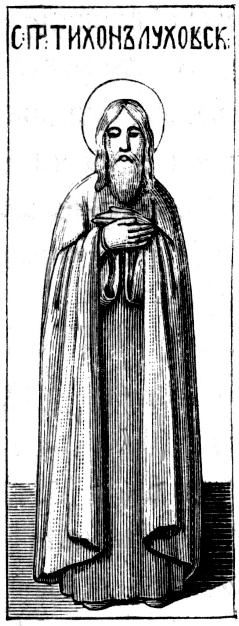
Преп. Тихон, в мире Тимофей201, родился в пределах Литовского княжества и был там в военной службе. В Вильне, столице Литвы, было тогда более православных храмов, чем Римских костёлов. И однако дух Римской гордости сильно стеснил там православных, – открыто перекрещивали жён и детей православных, насильно ставили костёлы по городам Русским и предавали запустению храмы православия202. К скорби искренних друзей православия начинали появляться отступники между православными Литовскими дворянами; для чести и жизни роскошной меняли православие на папизм. – Всё это глубоко оскорбляло блаж. Тимофея. Теснимый изуверством, скорбя о слабых, удалился он в Москву203. Это было в 1482 г., в то самое время, когда поспешно скрылся из Литвы в Москву кн. Феодор Иванович Бельский, оставив там юную супругу, с которой только что обвенчался204. Блаж. Тимофей удалился из Литвы не с тем, чтобы искать честей и денег в православной Москве; он желал одного – свободно служить Господу. С утешением сердечным, посетив обители, где цвело искреннее благочестие, он роздал, какую имел, собственность, принял иночество с именем Тихона и удалился в область Луховскую. Город Лух с несколькими волостями отдан был тогда кн. Феодору Ивановичу Бельскому205, с которым Тимофей прибыл и в Москву. В отчине любимого князя поселился пр. Тихон, не выпрашивая у него ничего, кроме клочка земли; на р. Лухе, в урочище Копытовке, поставил он себе келью, не для покоя, а для трудов полного самоотречения. Копытовка – тогда местность в глухом лесу и такая песчаная, что на ней никакой труд не мог добыть обильного пропитания; Тихону довольно было и очень малого. Когда же прибыли к пустыннику два инока Фотий и Герасим, преподобный, не для себя, а для учеников, перешёл за три версты от Копытовки, на место более удобное для постоянного пребывания, туда, где ныне Луховская обитель. Наставник и ученики его славили Господа с Давидом и приобретали себе пропитание трудами; Тихон искусно писал книги и был хорошим токарем. Плоды трудов его продавались и ценой труда покупались скудные средства к жизни. Мало было и того. Преподобный от болезни желудка едва передвигал ноги и однако сам впрягался в соху, чтобы пахать землю для посева хлеба. Он и при этом видном самоотречении предостерегал душу свою от тщеславия и самоуслаждения. Когда кто из посторонних приходил в пустыню, пустынники немедленно оставляли свою смиренную работу. Тихон не любил разговаривать с мирскими людьми, в том убеждении, что они менее готовы принимать наставления, чем наносить вред неосторожному наставнику своей говорливостью. Так прожил он до глубокой старости, не спрашивая ни у кого подаяния. Он не принял и сана священства до самой кончины, которая последовала 15 июня 1503 г. Бедность старца и учеников его так была велика, что ученики не знали, в чём положить честное тело умершего подвижника; к утешению их, неожиданно Суздальский епископ прислал для старца свитку и в ней похоронили св. тело. Вскоре после смерти преподобного на месте его подвигов устроилась обитель в честь свят. Николая. При игумене Константине, начали совершаться исцеления при гробе преподобного; мощи его оказались нетленными; но игумен, поставивший их поверх земли, поражён был слепотой и получил прозрение тогда, как они опять сокрыты были в землю. С того времени (с 1566 г.) стали торжествовать память преподобного206.
The Venerable Tikhon, in the world Timothy201, was born within the borders of the Lithuanian principality and served there in the military. In Vilna, the capital of Lithuania, there were at that time more Orthodox churches than Roman Catholic churches. And yet the spirit of Roman pride greatly oppressed the Orthodox there—they openly rebaptized the wives and children of the Orthodox, forcibly erected Catholic churches in Russian cities, and consigned Orthodox churches to desolation202. To the grief of sincere friends of Orthodoxy, apostates began to appear among the Lithuanian Orthodox nobles; for the sake of honor and a luxurious life, they exchanged Orthodoxy for papism. All this deeply offended the blessed Timothy. Harassed by fanaticism and grieving for the weak, he withdrew to Moscow203. This was in 1482 A.D., at the very time when Prince Theodore Ivanovich Belsky hastily fled from Lithuania to Moscow, leaving behind his young wife, whom he had only just married204. The blessed Timothy withdrew from Lithuania not in order to seek honors and wealth in Orthodox Moscow; he desired only one thing—to serve the Lord freely. With heartfelt consolation, having visited monasteries where sincere piety flourished, he distributed whatever property he had, received monastic tonsure with the name Tikhon, and withdrew to the Lukh region. The town of Lukh with several volosts was then given to Prince Theodore Ivanovich Belsky205, with whom Timothy had also come to Moscow. The Venerable Tikhon settled in the patrimony of the beloved prince, asking nothing of him except a small plot of land; on the Lukh River, at a place called Kopytovka, he built himself a cell, not for rest, but for the labors of complete self-denial. Kopytovka was then a locality in a dense forest and so sandy that no labor could produce abundant sustenance there; for Tikhon even very little was enough. When two monks, Photius and Gerasimus, came to the hermit, the Venerable one, not for himself but for his disciples, moved three versts from Kopytovka to a place more suitable for permanent dwelling, to where the Lukh monastery now stands. The teacher and his disciples glorified the Lord with David and obtained their sustenance by labors; Tikhon skillfully copied books and was a good turner. The fruits of his labors were sold, and with the price of his labor he purchased the meager means of life. Even that was little. The Venerable one, from a stomach ailment, could barely move his legs, and yet he himself harnessed himself to the plow to till the land for sowing grain. Even with this evident self-denial, he guarded his soul from vainglory and self-complacency. When anyone from outside came to the hermitage, the hermits immediately left their humble work. Tikhon did not like to converse with worldly people, being convinced that they were less ready to receive instruction than to harm a careless instructor by their talkativeness. Thus he lived to a deep old age, asking alms of no one. He did not accept the rank of the priesthood until his very end, which occurred on June 15, 1503 A.D. The poverty of the elder and his disciples was so great that the disciples did not know in what to lay the honorable body of the departed ascetic; to their consolation, the Bishop of Suzdal unexpectedly sent a tunic for the elder, and in it they buried the holy body. Soon after the death of the Venerable one, a monastery was established on the site of his labors in honor of St. Nicholas. Under Abbot Constantine, healings began to occur at the grave of the Venerable one; his relics were found to be incorrupt; but the abbot, who had placed them above ground, was struck with blindness and received his sight only when they were again hidden in the earth. From that time (from 1566 A.D.) they began to solemnly commemorate the Venerable one206.
«Сие глаголет святой, истинный, имеющий ключ Давидов, который отворяет, и никто не затворит, затворяет и никто не отворит: ты немного имеешь силы и сохранил слово Моё и не отрёкся имени Моего. Держи, что имеешь, дабы кто не предвосхитил венца твоего» (Апок.3:7–8). О, когда бы нам сохранить слово Агнца вечного, как сохранил пр. Тихон! Да будет с нами так, его молитвами.
“These things saith the Holy One, the True One, He that hath the key of David, He that openeth and no man shutteth, and shutteth and no man openeth: thou hast a little strength, and hast kept My word, and hast not denied My name. Hold that which thou hast, that no man take thy crown” (Rev. 3:7–8). Oh, that we might keep the word of the eternal Lamb, as the Venerable Tikhon kept it! May it be so with us, through his prayers.
Калуж. епарх. ведом. 1864 г. № 1. Исследов. о древней области Вятичей – в Чтен. Общ. Ист. 1862 г., кн. 2. 46–48. В святцах показание времени кончины преподобного неопределённое: «преставися в л. 7000». поскольку же преподобный поселился в лесу ещё при кн. Ярославе († 1427 г.) и был современником пр. Пафнутия († 1471 г.), то он почил не позже 1460 года. Рукописная служба пр. Тихону в Тихоновой пустыни. Там же книга в 1666 г. списанная с прежней. Чтен. Обиц. Ист. 1865 г. IV, 78.
Kaluga Diocesan Gazette, 1864, No. 1. Research on the ancient region of the Vyatichi—in Readings of the Society of History, 1862, book 2, pp. 46–48. In the saints’ calendars, the indication of the time of the Venerable one’s repose is indefinite: “he reposed in the year 7000.” Since the Venerable one settled in the forest still under Prince Yaroslav († 1427 A.D.) and was a contemporary of the Venerable Paphnutius († 1471 A.D.), he reposed no later than 1460 A.D. Manuscript service to the Venerable Tikhon in Tikhon’s Hermitage. There also a book copied in 1666 A.D. from an earlier one. Readings of the Society of History, 1865, IV, 78.
Ркп. житие: «возненавиде непостоятелный народ Литовского вертения; понежи мнози от них уклоняхуся в Латинство. Прииде вкупе со кн. Феодором».
Manuscript Life: “he hated the inconstant people of the Lithuanian whirl; for many of them turned aside into Latinism. He came together with Prince Theodore.”
Карамз. 6, пр. 264. Если же Тихон прибыл вместе с кн. Феодором в 1482 г. (пр. 136), то неправду пишут, будто он жил некоторое время вместе с пр. Макарием на Лухе. См. сказание о жизни пр. Макария, М. 1852 г., стр. 29. 30.
Karamzin, 6, note 264. If Tikhon came together with Prince Theodore in 1482 A.D. (note 136), then they write falsely that he lived for some time together with the Venerable Macarius on the Lukh. See the account of the life of the Venerable Macarius, Moscow, 1852, pp. 29–30.
В духов, грамоте вел. кн. Иоанна 1504 г. сказано: «а что есьми пожаловал кн. Феодора Иван. Бельского, дал есьми в отчину город Лух с волостями, да волость Ветлугу да Кинешму да Чпхачев; и кн. Феодор и дети его служат сыну моему Василью, а ту отчину держать потому, как было при мне».
In the spiritual testament of Grand Prince John of 1504 A.D. it is said: “and what I have granted to Prince Theodore Ivanovich Belsky, I have given him as a patrimony the town of Lukh with volosts, and the volost of Vetluga, and Kineshma, and Chpkhachev; and Prince Theodore and his children shall serve my son Basil, and shall hold that patrimony as it was under me.”
Пролог 16 июня. Служба пр. Тихону у Царского № 416. 565. Служба на 14 листках и житие на 24 листках XVI в. в сборнике Нижегородского Благовещенского монастыря. В патриаршей грамоте 1678 г.: «преп. отец Тихон Луховский чудотворец». Описание Луховского мон. М. 1836 года, стр. 76. 21. Следованная псалтирь: «св. Тихона чудотворца Луховского, в 1492 г. скончавшегося, иже – собра ученики многи». Последнее было уже после смерти его, которая последовала не в 1492, а в 1503 году.
Prologue, June 16. Service to the Venerable Tikhon in Tsarsky No. 416, 565. Service on 14 leaves and Life on 24 leaves of the 16th century in a miscellany of the Annunciation Monastery of Nizhny Novgorod. In the patriarchal charter of 1678 A.D.: “the Venerable Father Tikhon of Lukh, Wonderworker.” Description of the Lukh Monastery, Moscow, 1836, pp. 76, 21. The Psalter with Commentary: “St. Tikhon the Wonderworker of Lukh, who reposed in 1492 A.D., who—gathered many disciples.” The latter statement was made after his death, which occurred not in 1492, but in 1503 A.D.