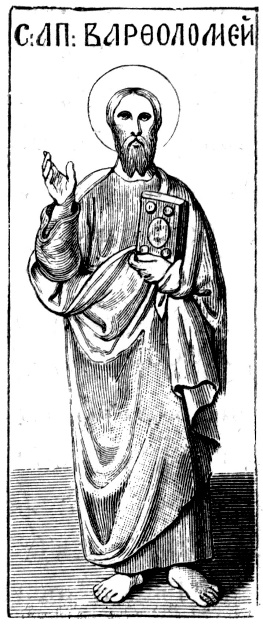
Апостола Варфоломея считают за одно лицо с Нафанаилом (Ин.1:45–51,21:2), который по отцу своему называется Варфоломеем, т. е. сыном Фоломеевым, потому что Еврейское слово вар значит сын. К Иисусу Христу Нафанаил призван был Ап. Филиппом, который находит Нафанаила и говорит ему: Егоже писа Моисей в законе, и пророцы, обретохом Иисуса, Иже от Назарета. Нафанаил возразил Филиппу:от Назарета может ли что добро быти? Прииди и виждь, смиренно и благоразумно отвечал Филипп. Нафанаил пошёл, и когда приблизился, Господь возгласил: се воистину Израильтянин, в немже льсти несть. Како мя знаеши, вопросил Нафанаил. Прежде даже не возгласи тебе Филипп, а суща под смоковницею видех тя, отвечал Господь. Увидев и услышав Господа сердцеведца, Который явил ему и Своё всеведение, Нафанаил тотчас и прежде всех Апостолов исповедал Христа Сыном Божиим, Царём Израилевым. Господь сказал исповеднику: больша сих узриши. Отселе узрите небо отверсто, и Ангелы Божии восходящыя и нисходящыя над Сына Человеческаго (Ин.1:45–51). В третий день после сего Нафанаил был с Господом и с прочими Его учениками на браке в Кане Галилейской (Ин.2:2). Через год Варфоломей избран Господом из множества Его учеников в лик двенадцати Апостолов (Лк.4:13–14).
The Apostle Bartholomew is considered to be the same person as Nathanael (Jn. 1:45–51, 21:2), who is called Bartholomew after his father, that is, the son of Tolmai, for the Hebrew word bar means son. Nathanael was called to Jesus Christ by the Apostle Philip, who found Nathanael and said to him: He whom Moses wrote of in the law, and the prophets, we have found Jesus, who is from Nazareth. Nathanael answered Philip: Can any good thing come from Nazareth?Come and see, Philip answered humbly and wisely. Nathanael went, and when he drew near, the Lord exclaimed: Behold, truly an Israelite, in whom there is no guile. How dost thou know me? asked Nathanael. Before Philip called thee, I saw thee under the fig tree, the Lord answered. Having seen and heard the Lord, the Knower of hearts, who also revealed to him His own omniscience, Nathanael immediately, and before all the Apostles, confessed Christ to be the Son of God, the King of Israel. The Lord said to the confessor: Thou shalt see greater things than these. Henceforth ye shall see the heavens opened, and the Angels of God ascending and descending upon the Son of Man (Jn. 1:45–51). On the third day after this, Nathanael was with the Lord and with His other disciples at the wedding in Cana of Galilee (Jn. 2:2). After a year, Bartholomew was chosen by the Lord from among the multitude of His disciples into the rank of the twelve Apostles (Lk. 6:13–14).
По сошествии Св. Духа Варфоломей для проповеди Евангелия путешествовал из Иудеи в разные страны Востока, часто вместе с Ап. Филиппом. По сказанию св. Иоанна Златоуста, был он в Сирии, Фригии, Ликаонии, Писидии, в Иераполе, куда послан был Промыслом на помощь Ап. Филиппу, которого после мученической его смерти он предал там погребению. По сказанию Евсевия, Варфоломей простёр проповедь слова даже до Индии, которую называют Счастливой Аравией, и для Церкви Индийской оставил Евангелие от Матфея, писанное по-Еврейски и найденное там во II веке Пантеном, знаменитым наставником Александрийского христианского училища. Из Индии Ап. Варфоломей возвратился в Армению и здесь скончался в городе Альбанополе (Альбане) мученической смертью за Евангелие, повешен быв на кресте и потом усечён мечом. Тело св. Варфоломея положено было сначала в Альбанополе; потом врагами веры Христовой ввержено было в море и Божиим промыслом перенесено на Сицилийский остров Липари и там погребено. Феодор чтец пишет: «царь Анастасий (491–518) построил город Дары, и видел во сне св. Ап. Варфоломея, который говорил ему, что он будет сам хранить сей город. По этой причине Анастасий перенёс туда и положил там останки его», вероятно часть мощей. Во дни Феофила – Греческого царя, в 833 году, когда Липара покорена была Агарянами, тело св. Варфоломея перенесено в Беневенто – город Неапольский, а отсюда императором Оттоном II (973–989) в Рим.
After the descent of the Holy Spirit, Bartholomew traveled from Judea to various countries of the East for the preaching of the Gospel, often together with the Apostle Philip. According to the account of St. John Chrysostom, he was in Syria, Phrygia, Lycaonia, Pisidia, and in Hierapolis, whither he was sent by Providence to aid the Apostle Philip, whom he buried there after his martyrdom. According to Eusebius, Bartholomew extended the preaching of the Word even to India, which is called Happy Arabia, and for the Church of India he left the Gospel of Matthew, written in Hebrew, which was found there in the second century by Pantaenus, the renowned teacher of the Alexandrian Christian school. From India, the Apostle Bartholomew returned to Armenia and there ended his life in the city of Albanopolis (Albane) by a martyr's death for the Gospel, having been hung on a cross and then beheaded with a sword. The body of St. Bartholomew was first laid in Albanopolis; later it was cast into the sea by enemies of the Christian faith and, by divine Providence, was carried to the Sicilian island of Lipari and buried there. Theodore the Reader writes: "Emperor Anastasius (491–518) built the city of Dara, and saw in a dream St. Apostle Bartholomew, who told him that he himself would guard this city. For this reason Anastasius transferred and placed his remains there," probably a portion of the relics. In the days of Theophilus, the Greek emperor, in the year 833, when Lipari was conquered by the Hagarenes, the body of St. Bartholomew was transferred to Benevento, a city in Naples, and from there by Emperor Otto II (973–989) to Rome.
Преставление Ап. Варфоломея Церковь воспоминает 11 июня, а перенесение мощей его в Беневенто – 25 августа. В эти дни она прославляет чудесное явление Апостола учений сиянием и чудесы страшными. Преподобный Иосиф, творец канонов, украсил в IX веке празднество св. Ап. Варфоломею церковными гимнами и канонными песнями, ныне возносимыми в честь сего Апостола.
The Church commemorates the repose of the Apostle Bartholomew on June 11, and the translation of his relics to Benevento on August 25. On these days she glorifies the wondrous appearance of the Apostle by the radiance of teachings and by terrible miracles. The Venerable Joseph, the composer of canons, adorned the feast of St. Apostle Bartholomew in the ninth century with church hymns and canon songs, now offered in honor of this Apostle.
Паремии во дни, посвящённые св. Ап. Варфоломею, читаются общие Апостолам, – первая говорит о дерзновении перед Богом, какое имели Апостолы, потому что соблюдали заповеди Божии, и о различении Духа Божия, обитавшего в Апостолах, и духа лестча, коим исполнены были лжепророки (1Ин.3:21,4:1–6); вторая возвещает от лица Апостолов: мы видехом и свидетельствуем, яко Отецпосла Сына Спасителя миру. Иже аще исповесть, яко Иисус есть Сын Божий, Бог в нем пребывает, и той в Бозе (1Ин.4:11–16); третья глаголет о победе, которая через Апостолов совершилась в мире: и сия есть победа, победившая мир, вера наша. Кто есть побеждаяй мир, токмо веруяй, яко Иисус есть Сын Божий (1Ин.4:20,5:5). Евангелие на утрени то же, что и на утрени в день Ап. Петра и Павла. На литургии чтением Апостола Церковь проповедует о гонении на первых учеников Христовых, которое обращено было Промыслом к распространению слова Божия, и о деяниях св. Апостолов к умножению Церкви Христовой (Деян.11:19–30); а в чтении Евангелия Спаситель благовествует, что слушаяй вас – Апостолов, Мене слушает (Лк.10:16–21).
The Paroemiae on the days dedicated to St. Apostle Bartholomew are the common ones for Apostles: – the first speaks of the boldness before God which the Apostles had, because they kept the commandments of God, and of the distinction between the Spirit of God, which dwelt in the Apostles, and the spirit of deceit, with which the false prophets were filled (1 Jn. 3:21, 4:1–6); the second proclaims from the lips of the Apostles: we have seen and testify that the Father sent the Son as the Savior of the world. He who confesses that Jesus is the Son of God, God abides in him, and he in God (1 Jn. 4:11–16); the third speaks of the victory which was accomplished in the world through the Apostles: and this is the victory that conquered the world, our faith. Who is it that conquers the world, if not he who believes that Jesus is the Son of God (1 Jn. 4:20, 5:5). The Gospel at Matins is the same as that at Matins on the day of the Apostles Peter and Paul. At the Divine Liturgy, in the reading of the Apostle, the Church preaches about the persecution of the first disciples of Christ, which was turned by Providence to the spread of the Word of God, and about the deeds of the holy Apostles for the increase of the Church of Christ (Acts 11:19–30); and in the reading of the Gospel, the Savior proclaims that he who hears you – the Apostles, hears Me (Lk. 10:16–21).
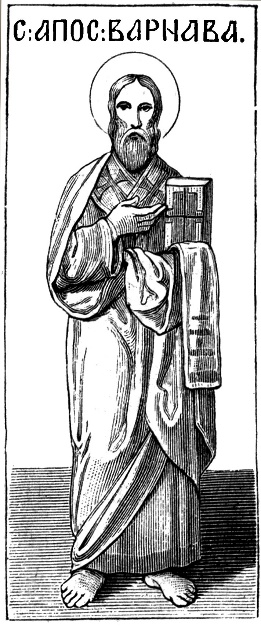
Апостол Варнава произошёл из колена Левиина, родился на острове Кипре, куда переселились его родители. До Апостольства своего он назывался Иосия или Иосиф, а от Апостолов прозван Варнавой – сыном утешения, в знак того, что он, по словам Иоанна Златоустого, имел особенный дар утешать скорбящих. Близ Иерусалима он имел свою землю (Деян.4:36–37).
The Apostle Barnabas was of the tribe of Levi, born on the island of Cyprus, whither his parents had moved. Before his Apostleship he was called Joseph, but was named Barnabas by the Apostles – son of consolation, as a sign that he, according to the words of John Chrysostom, had a special gift for comforting the sorrowful. He owned land near Jerusalem (Acts 4:36–37).
Древние писатели христианские – Климент Александрийский, Евсевий, святой Епифаний, повествуют, что Иосия ещё в юных летах отправлен своими родителями из Кипра в Иерусалим к знаменитому Гамалиилу, и у него воспитывался и вместе с святым Павлом, тогда ещё Савлом. Юноши, лучшие ученики первого в своё время законоучителя, одарённые великими способностями душевными, ревностно искавшие просвещения, сидя вместе у ног Гамалиила, не могли не соединиться тесной между собой дружбой. Но до известного времени Промыслу угодно было вести их разными путями к принятию веры Христовой. Савл долго оставался излхла ревнителем отеческих преданий, по премногу гнал Церковь Божию и разрушал её (Гал.1:13–14). Напротив об Иосии есть предание, что он гораздо ранее Савла познал Господа Иисуса и уверовал в Него. Каждое утро и вечер посещая храм Иерусалимский, Иосия имел случай видеть там Искупителя; слышал Его Божественные поучения, видел чудеса – и глубоко умилялся душой и сердцем. Однажды он, – подобно Апостолу Филиппу (Ин.1:46), сказал родственнице своей Марии, матери Иоанна Марка (Деян.12:12): «в храме учит некий пророк Иисус, творит великие чудеса, и многие думают, что Он есть – ожидаемый Мессия. Увидевши Господа Иисуса, Мария поверглась к ногам Его и умоляла посетить дом её и благословить домашних. Господь не отрёкся, – и с сей поры дом Марии сделался пристанищем Спасителя всякий раз, когда Он бывал в Иерусалиме. Юный Иосия, виденный Искупителем уже в храме и теперь снова благословенный уже в доме тётки, ещё пламеннее прилепился к Господу, и как скоро Господь из Иерусалима возвратился в Галилею, он последовал за ним и потом избран в число 70 учеников.
Ancient Christian writers – Clement of Alexandria, Eusebius, St. Epiphanius – relate that Joseph was sent by his parents from Cyprus to Jerusalem while still in his youth, to the renowned Gamaliel, and was educated by him together with St. Paul, then still Saul. The youths, the best pupils of the foremost teacher of his time, endowed with great mental abilities and zealously seeking enlightenment, sitting together at the feet of Gamaliel, could not but be bound by close friendship. But until a certain time, Providence was pleased to lead them by different paths to the acceptance of the Christian faith. Saul long remained an exceedingly zealous follower of the traditions of his fathers, and exceedingly persecuted the Church of God and destroyed it (Gal. 1:13–14). On the contrary, there is a tradition about Joseph that he knew the Lord Jesus and believed in Him much earlier than Saul. Visiting the Temple of Jerusalem every morning and evening, Joseph had occasion to see the Redeemer there; he heard His divine teachings, saw His miracles – and was deeply moved in soul and heart. Once he – like the Apostle Philip (Jn. 1:46) – said to his relative Mary, the mother of John Mark (Acts 12:12): "A certain prophet, Jesus, is teaching in the temple; He works great miracles, and many think that He is the expected Messiah." Having seen the Lord Jesus, Mary threw herself at His feet and begged Him to visit her house and bless her household. The Lord did not refuse – and from that time, the house of Mary became a refuge for the Savior whenever He was in Jerusalem. The young Joseph, already seen by the Redeemer in the temple and now again blessed in his aunt's house, clung even more fervently to the Lord, and as soon as the Lord returned from Jerusalem to Galilee, he followed Him and was later chosen among the 70 disciples.
По вознесении Иисуса Христа на небо и по получении с неба иного Учителя и Утешителя, когда святые Апостолы вместе с прочими верующими составляли ещё небольшое общество, в коем соблюдалось общежитие, и у кого бе сердце и душа едина, Варнава продал свою землю и полученные за неё деньги принёс и положил к ногам Апостолов (Деян.4:32–37). Вообще Варнава был муж благ и исполнь Духа Свята и веры (Деян.11:24). Своё Апостольское служение, как и прочие Апостолы, совершал он по непосредственному призванию Святого Духа (Деян.13:2).
After the Ascension of Jesus Christ to heaven and after receiving from heaven another Teacher and Comforter, when the holy Apostles together with the other believers still formed a small community in which a common life was observed, and where they had one heart and one soul, Barnabas sold his land and brought the money received for it and laid it at the feet of the Apostles (Acts 4:32–37). In general, Barnabas was a good man, full of the Holy Spirit and of faith (Acts 11:24). He performed his Apostolic service, like the other Apostles, by the direct calling of the Holy Spirit (Acts 13:2).
Говорят, что святой Варнава, часто видясь с Савлом в Иерусалиме, всячески убеждал его обратиться к Евангелию, горько плакал о жестокости друга своего, дышавшего прещением и убийством на христиан, и пламенно молился об его обращении.
It is said that St. Barnabas, often meeting with Saul in Jerusalem, earnestly urged him to turn to the Gospel, wept bitterly over the cruelty of his friend, who breathed threats and murder against Christians, and fervently prayed for his conversion.
По обращении Савла ко Иисусу Христу, когда Савл в 37 году по Рождестве Христовом пришёл в Иерусалим и ученики Господа боялись его, неверующе, яко есть ученик, Варнава возвестил им о событии чудесного его обращения и представил им Савла, как истинного последователя Христова и усердного проповедника Евангелия. С тех пор Савл навсегда соединился с святыми Апостолами для единого с ними служения (Деян.9:26–28).
After the conversion of Saul to Jesus Christ, when Saul came to Jerusalem in the year 37 A.D. and the Lord's disciples feared him, not believing that he was a disciple, Barnabas announced to them the event of his miraculous conversion and presented Saul to them as a true follower of Christ and a zealous preacher of the Gospel. From that time, Saul was forever united with the holy Apostles for their common service (Acts 9:26–28).
Когда Апостолы услышали, что великое число в Антиохии уверовало и обратилось к Господу, послали в Антиохию Варнаву; прибыв туда, он убеждал всех держаться Господа всем сердцем. Проповедью Варнавы приложися в Антиохии народ мног Господеви (Деян. 11:11–24). Но духовная жатва в Антиохии была столь обильна и пространна, что требовала не одного, а многих делателей. Посему Варнава, около 43 года по Рождестве Христовом, призвал в Антиохию Апостола Павла, и был его сотрудником в проповеди, чудесах и страданиях за слово Божие. Целый год собирались они с тамошней Церковью и научили немалое число людей. Ученики в Антиохии, первые стали называться христианами. Во время голода, бывшего по всей земле при кесаре Клавдии, Антиохийские христиане, собравши милостыню, – по елику кто имеяше что, – отправили с ней Павла и Варнаву в Иерусалим (Деян.11:25–30). Совершив своё поручение, Варнава и Савл возвратились в Антиохию, и привели с собой Иоанна, прозванного Марком, племянника Варнавина (Кол.4:10. Деян.12:25). В Антиохии, как они служили Господу и постились, Дух Святой сказал им: отделите Ми Варнаву и Савла от прочих пророков и учителей Церкви Антиохийской на дело, на неже призвах их. Напутствованные постом и молитвой и рукоположенные в Апостолов для язычников, Варнава и Павел посланы были Духом Святым в Селевкию; оттуда отплыли в Кипр, родину Варнавы, из Кипра в Салимин, где проповедовали слово Божие в Иудейских синагогах. Бывши на острове, в городе Пафосе они обратили ко Христу тамошнего проконсула Сергия-Павла. Из Пафоса отправились в Пергию Памфилийскую, из Пергии в Антиохию Писидийскую, где почти весь город собирался слушать их (Деян. XIII). Из Антиохии, пришедши в Иконию, они проповедовали здесь с такой силой и убедительностью, яко веровати Иудеев и Еллинов множеству многу. В Иконии Апостолы Варнава и Павел пробыли довольно долго и безбоязненно проповедовали при помощи Господа, Который во свидетельство слову благодати Своея творил руками их знамения и чудеса. Гонимые врагами веры Христовой, которые хотели побить их камнями, Апостолы удалились из Иконии в города Листру и Дервию, и в окрестности сих городов Ликаонии. В Листре народ, изумлённый чудесным исцелением хромого от рождения, совершённым Апостолом Павлом, поднял крик и говорил по-Ликаонски: боги в человеческом образе сошли к нам. Варнаву, по причине его достопочтенного вида и стройного телесного стана, как замечает святой Златоуст, назвали Зевесом или Юпитером, – верховным божеством языческим; а святого Павла за его красноречие – Меркурием, потому что Меркурий почитался у язычников богом красноречия. Идольский жрец и народ приготовились уже приносить им языческие жертвы и венки; Апостолы с трудом остановили народ не делать этого. Не смотря на почтение народа к Апостолам, враги их – Иудеи, пришедшие из Иконии и Антиохии, возмутили против них Листрян, и Апостолы пошли в Дервию и, приобретши там довольно учеников, предприняли обратный путь. Снова посетили Листру, Иконию, Антиохию Писидийскую или Фригийскую, везде утверждая души учеников своих и для каждой Церкви рукоположив пресвитеров. Прошли через Писидию и Памфилию; проповедали в другой раз слово в Пергии, и из Атталии, города Памфилийского, лежавшего на границах Ликии, отплыли в Антиохию, из которой первоначально вышли и которая была главным городом Сирии (Деян. XIV); а из Антиохии отправились в Иерусалим на Собор. Собор Апостольский, по окончании своём, послал Варнаву и Павла с своими постановлениями опять в Антиохию, выхваляя их, как верных слуг Божиих, предавших души свои за имя Господа нашего Иисуса Христа (Деян.15:1–30). Но теперь в Антиохии около 51 года по Рождестве Христовом Варнава расстался с Павлом. Разлучившись навсегда телом, Апостолы никогда не разлучались духом. Спустя лет шесть или более после разлуки, святой Павел писал в Коринф и оправдывал святого Варнаву, как себя самого (1Кор.9:6). Даже об Иоанне Марке, который отчасти был причиной разлуки (Деян.15:36–39), впоследствии Апостол Павел с любовью упоминал в своих посланиях и заботился об нём, как о своём близком, как о человеке необходимом для себя, и как об одном из лучших сотрудников своих в деле благовестия (Кол.4:10. 2Тим. 4:1. Флм.1:23).
When the Apostles heard that a great number in Antioch had believed and turned to the Lord, they sent Barnabas to Antioch; having arrived there, he urged all to cleave to the Lord with all their heart. Through the preaching of Barnabas a great multitude was added to the Lord in Antioch (Acts 11:11–24). But the spiritual harvest in Antioch was so abundant and extensive that it required not one, but many laborers. Therefore Barnabas, about the year 43 A.D., called the Apostle Paul to Antioch, and was his co-worker in preaching, miracles, and sufferings for the word of God. For a whole year they gathered with the local Church and taught a considerable number of people. The disciples in Antioch were the first to be called Christians. During the famine that occurred throughout the whole earth under Caesar Claudius, the Christians of Antioch, having collected alms—according as each had—sent Paul and Barnabas with it to Jerusalem (Acts 11:25–30). Having fulfilled their commission, Barnabas and Saul returned to Antioch, and brought with them John, surnamed Mark, the nephew of Barnabas (Col. 4:10; Acts 12:25). In Antioch, as they served the Lord and fasted, the Holy Spirit said to them: Separate for Me Barnabas and Saul from the other prophets and teachers of the Church of Antioch for the work to which I have called them. Sent forth with fasting and prayer and ordained as Apostles to the Gentiles, Barnabas and Paul were sent by the Holy Spirit to Seleucia; from there they sailed to Cyprus, the homeland of Barnabas, and from Cyprus to Salamis, where they preached the word of God in the Jewish synagogues. While on the island, in the city of Paphos they converted the proconsul Sergius Paulus to Christ. From Paphos they went to Perga in Pamphylia, and from Perga to Pisidian Antioch, where almost the whole city gathered to hear them (Acts XIII). From Antioch, having come to Iconium, they preached there with such power and persuasiveness that a great multitude both of Jews and of Greeks believed. In Iconium the Apostles Barnabas and Paul remained a considerable time and fearlessly preached with the help of the Lord, Who bore witness to the word of His grace by granting signs and wonders to be done by their hands. Driven by the enemies of the faith of Christ, who wished to stone them, the Apostles withdrew from Iconium to the cities of Lystra and Derbe, and to the surrounding region of Lycaonia. In Lystra the people, amazed at the miraculous healing of a man lame from birth, performed by the Apostle Paul, cried out and said in Lycaonian: The gods have come down to us in the likeness of men. Barnabas, because of his venerable appearance and stately bodily form, as St. John Chrysostom notes, they called Zeus or Jupiter—the supreme pagan deity; and St. Paul, for his eloquence, they called Mercury, because Mercury was honored by the pagans as the god of eloquence. The pagan priest and the people prepared already to offer them pagan sacrifices and garlands; the Apostles with difficulty restrained the people from doing this. Notwithstanding the people’s respect for the Apostles, their enemies—the Jews who came from Iconium and Antioch—stirred up the Lystrans against them, and the Apostles went to Derbe and, having gained a considerable number of disciples there, undertook the return journey. They again visited Lystra, Iconium, and Pisidian or Phrygian Antioch, everywhere strengthening the souls of their disciples and ordaining presbyters for each Church. They passed through Pisidia and Pamphylia; they preached the word a second time in Perga, and from Attalia, a city of Pamphylia lying on the borders of Lycia, they sailed to Antioch, from which they had originally set out and which was the chief city of Syria (Acts XIV); and from Antioch they went to Jerusalem for the Council. The Apostolic Council, after its conclusion, sent Barnabas and Paul again to Antioch with its decrees, commending them as faithful servants of God, who had given their lives for the name of our Lord Jesus Christ (Acts 15:1–30). But now in Antioch, about the year 51 A.D., Barnabas parted from Paul. Though separated in body forever, the Apostles were never separated in spirit. About six years or more after the separation, St. Paul wrote to Corinth and justified St. Barnabas as he did himself (1 Cor. 9:6). Even concerning John Mark, who was partly the cause of the separation (Acts 15:36–39), the Apostle Paul later mentioned him with love in his epistles and cared for him as for one close to him, as a man necessary to himself, and as one of his best co-workers in the work of the Gospel (Col. 4:10; 2 Tim. 4:11; Philem. 1:23).
По разлуке с Апостолом Павлом Варнава прибыл в Кипр (Деян.15:36–39), где он много потрудился в проповеди Евангелия своим единоземцам, и многих из них обратил ко Христу. Распространив и утвердив святую веру в Кипре, Варнава, по сказанию Дорофея Тирского, ходил в Рим, где первый проповедал Христа и озарил верой Христовой Милан, и опять воротился в Кипр; наконец в Саламине получил мученический венец, быв побит камнями. Тело Апостола брошено было в огонь, но осталось невредимо. Святой Иоанн Марк похоронил мощи Варнавы за городом и положил в гробницу Евангелие от Матфея, переписанное собственной рукой святого Варнавы. Из его собственного послания видно, что он окончил свои Апостольские труды после разрушения Иерусалима Титом.
After parting from the Apostle Paul, Barnabas arrived in Cyprus (Acts 15:36–39), where he labored much in preaching the Gospel to his countrymen, and converted many of them to Christ. Having spread and established the holy faith in Cyprus, Barnabas, according to the account of Dorotheus of Tyre, went to Rome, where he first preached Christ and illumined Milan with the faith of Christ, and then returned again to Cyprus; finally in Salamis he received the martyr’s crown, being stoned to death. The body of the Apostle was thrown into the fire, but remained unharmed. St. John Mark buried the relics of Barnabas outside the city and placed in the tomb the Gospel of Matthew, copied by the hand of St. Barnabas himself. From his own epistle it is evident that he ended his Apostolic labors after the destruction of Jerusalem by Titus.
В V веке в царствование Зенона (474–491) св. мощи Варнавы были обретены, открыты и прославлены. Антиохийский патриарх Пётр, заражённый евтихианской ересью, снедаемый властолюбием и неразумной ревностью о распространении своего зловредного учения, вознамерился было подчинить остров Кипр своей власти под тем предлогом, что слово Божие принесено сюда из Антиохии. Ап. Варнава в ночном видении явился и повелел благочестивому Кипрскому архиепископу Анфимию открыть мощи его. Анфимий по повелению Апостола обрёл их в 488 году 11*июня* и на персях мощей Евангелие от Матфея, списанное Варнавой; об этом обретении архиепископ объявил царю и патриарху. Император Зенон с радостью принял известие, что во дни царствования его Бог благоволил явить знамение Своей всесильной благодати. После того постановлено было, чтобы Кипрская Церковь, как Апостольская, имеющая у себя и мощи одного из св. Апостолов, не подчинялась Антиохийскому патриарху, а управлялась самостоятельно, своим священноначалием. Император испросил у архиепископа Евангелие, обретённое на персях Ап. Варнавы, и положил в своей придворной церкви. Своими щедротами Зенон содействовал архиепископу Анфимию соорудить на месте обретения мощей Ап. Варнавы храм Божий для их положения и хранения. Со времени обретения мощей установлено празднование в память св. Ап. Варнавы, и совершается как нашей Прав. Церковью, так и Римской, июня 11 дня. Сирская Церковь издревле чтила св. Варнаву как мученика; во Франции праздник ему установлен в IX веке; Англия с древних времён почитает память св. Варнавы с особенным благоговением; Лигурия и Милан признают его первым епископом и Апостолом своим. Если справедливо мнение наших отечественных изыскателей Славянской древности, что Милан исстари населён был Славянами и был городом Славянским, то мы можем св. Варнаву почитать и Славянским Апостолом, наравне с св. Ап. Андреем Первозванным.
In the fifth century, during the reign of Zeno (474–491), the holy relics of Barnabas were discovered, uncovered, and glorified. Peter, the Patriarch of Antioch, infected with the Eutychian heresy, consumed by love of power and unwise zeal for the spread of his pernicious teaching, intended to subject the island of Cyprus to his authority under the pretext that the word of God had been brought there from Antioch. The Apostle Barnabas appeared in a night vision and commanded the pious Archbishop of Cyprus, Anthemius, to uncover his relics. Anthemius, by the command of the Apostle, found them in the year 488 on June 11, and on the breast of the relics the Gospel of Matthew, copied by Barnabas; the archbishop announced this discovery to the emperor and the patriarch. The Emperor Zeno joyfully received the news that in the days of his reign God had been pleased to manifest a sign of His all-powerful grace. After this it was decreed that the Church of Cyprus, as an Apostolic Church possessing the relics of one of the holy Apostles, should not be subject to the Patriarch of Antioch, but should be governed independently, by its own hierarchy. The emperor requested from the archbishop the Gospel found on the breast of the Apostle Barnabas, and placed it in his imperial church. By his generosity Zeno assisted Archbishop Anthemius to build a church of God at the place of the uncovering of the relics of the Apostle Barnabas for their enshrinement and preservation. From the time of the uncovering of the relics, a feast was established in memory of the holy Apostle Barnabas, and is celebrated both by our Orthodox Church and by the Roman Church on June 11. The Syrian Church from ancient times honored St. Barnabas as a martyr; in France his feast was established in the ninth century; England from ancient times has venerated the memory of St. Barnabas with special reverence; Liguria and Milan acknowledge him as their first bishop and Apostle. If the opinion of our native investigators of Slavic antiquity is correct, that Milan was from ancient times inhabited by Slavs and was a Slavic city, then we may also honor St. Barnabas as a Slavic Apostle, equally with the holy Apostle Andrew the First-Called.
Памятником веры и Апостольского пенечения св. Варнавы о распространении и утверждении христианского учения служит также сохранившееся до нас одно его соборное послание, исполненное духовной мудрости, Апостольской простоты и живого назидания; по духу и направлению весьма близкое к посланию св. Ап. Павла к Евреям. На подлинность Варнавина послания, как на несомненный памятник времён Апостольских, часто указывали знаменитейшие писатели первых веков христианских: Климент Александрийский, Ориген, Тертуллиан.
A monument to the faith and Apostolic care of St. Barnabas for the spread and establishment of Christian teaching is also his one catholic epistle that has come down to us, filled with spiritual wisdom, Apostolic simplicity, and living edification; in spirit and direction it is very close to the epistle of the holy Apostle Paul to the Hebrews. The authenticity of the Epistle of Barnabas, as an undoubted monument of Apostolic times, was often pointed out by the most renowned writers of the first Christian centuries: Clement of Alexandria, Origen, Tertullian.
Св. Церковь, прославляя Варнаву в своих песнопениях, говорит: «прошел еси землю, просвещая якоже солнце, и в Рим славный пришед, первее, славне. Христово проповедал еси спасительное пришествие. Орган добре составлен, деланием духовным, Варнаво, был еси, языком званию ты вверился еси, к познанию Христову наставляя словесы и деянии. Яко сын утешения, иже прежде Павла, седмидесятим учеником быв верх, и с Павлом паки проповедав Евангелие концем».
The Holy Church, glorifying Barnabas in her hymns, says: “Thou didst traverse the earth, enlightening like the sun, and having come to glorious Rome, thou didst first, O glorious one, preach the saving coming of Christ. A well-composed instrument, by spiritual work, O Barnabas, wast thou; thou didst entrust thyself to the calling of the tongues, guiding them to the knowledge of Christ by words and deeds. As a son of consolation, who before Paul was the chief of the seventy disciples, and with Paul again didst preach the Gospel to the ends of the earth.”
Паремии, чтенияЕвангелия иАпостола в день св. Варнавы те же, какие назначены в честь св. Ап. Варфоломея, которого Церковь воспоминает в один день с св. Варнавой.
The Paroemiae, the readings of the Gospel and the Apostle on the day of St. Barnabas are the same as those appointed in honor of the holy Apostle Bartholomew, whom the Church commemorates on the same day as St. Barnabas.
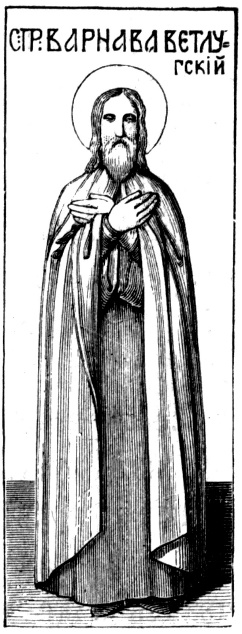
Родиной преп. Варнавы был Великий Устюг107. Здесь он был иереем и во время набегов Черемисских оставил родину. Прибыв на берега реки Ветлуги, поселился он на горе Красной и подвизался здесь уединённо 28 лет. Тогда в окрестности Красной горы, даже в 50 верстах, не было жилья человеческого; пустынник питался травой и редко хлебом; звери дикие не вредили жившему по воле Божией. Когда узнали о нём люди, то стали приходить к нему за наставлениями, и он учил страху Божию. Преп. Макарий пробыл некоторое время у него для бесед о спасении души, когда в 1439 г. проходил на реку Унжу. Блаженный скончался 11 июня 1445 г.108. По кончине его ученики его и вновь пришедшие иноки построили храм во имя Св. Троицы, а другой над гробом преподобного во имя св. Николая и составили обитель, которая пользовалась потом уважением109.
The homeland of the Venerable Barnabas was Veliky Ustyug107. Here he was a priest, and during the incursions of the Cheremis he left his homeland. Arriving on the banks of the Vetluga River, he settled on Krasnaya Hill and asceticised there in solitude for 28 years. At that time, in the vicinity of Krasnaya Hill, even within 50 versts, there was no human habitation; the hermit fed on grass and rarely on bread; wild beasts did not harm him who lived according to the will of God. When people learned of him, they began to come to him for instruction, and he taught them the fear of God. The Venerable Macarius spent some time with him for conversations about the salvation of the soul, when in 1439 he was passing to the Unzha River. The blessed one reposed on June 11, 1445108. After his repose, his disciples and newly-arrived monks built a church in the name of the Holy Trinity, and another over the grave of the venerable one in the name of St. Nicholas, and formed a monastery, which afterwards enjoyed respect109.
Мощи преп. Варнавы были свидетельствованы по распоряжению патр. Иоасафа в 1639 г. по случаю чудес, совершившихся при гробе его. Ветлугские священники Иоанн и Онисифор по совести священнической свидетельствовали, что первый из них тяжко страдал глазной болезнью, а по совету иноков обители помолился на гробе преп. Варнавы и получил зрение; другой там же получил исцеление от болезни. Ныне от древней обители остаётся храм во имя Апостола Варнавы, с мощами преподобного, служащий соборным храмом для образовавшегося здесь города Варнавина Костромской губернии, в 387 верстах от Костромы110.
The relics of the Venerable Barnabas were attested by order of Patriarch Joasaph in 1639, on account of the miracles that had taken place at his grave. The priests of Vetluga, John and Onesiphorus, testified according to their priestly conscience that the first of them had suffered grievously from an eye disease, and, on the advice of the monks of the monastery, prayed at the grave of the Venerable Barnabas and received his sight; the other received healing from an illness in the same place. At present, of the ancient monastery there remains a church in the name of the Apostle Barnabas, with the relics of the venerable one, serving as the cathedral church for the town of Varnavin, which has formed here in the Kostroma Governorate, 387 versts from Kostroma110.
Ркп. святцы: «преп. Варнава пустынник, иже на Лапшанче, на Ветлуге р. новый чудотворец, преставися 7053 (1445) июня в 11 д.»
Manuscript calendar: "The Venerable Barnabas the hermit, who was on the Lapshanga, on the Vetluga River, a new wonderworker, reposed on June 11, 7053 (1445)."