Св. Тимофей был епископом в г. Пруссе (ныне Бруссе). За святость жизни получил от Господа дар чудотворений. Юлиан царь велел заключить его в тюрьму за проповедь слова Божия и обличение неверных.
St. Timothy was bishop in the city of Prusa (now Bursa). For the holiness of his life he received from the Lord the gift of wonderworking. The Emperor Julian ordered him to be imprisoned for preaching the word of God and rebuking the unbelievers.
Святая Антонина из Кродамна (около Александрии, другие же называют г. Кардамом и ищут во Фракии), за то, что отказалась отречься от Христа и принести жертву идолам, была отведена в позорный дом по приговору игемона Фавста; но воин Александр, переодев её в свою одежду, доставил ей возможность спастись от поругания... За это оба после истязаний сожжены 3 мая, 313 года.
St. Antonina, from Krodamnon (near Alexandria; others call the city Kardamom and locate it in Thrace), because she refused to deny Christ and offer sacrifice to idols, was sent to a house of shame by the sentence of the governor Faustus; but the soldier Alexander, having dressed her in his own clothing, gave her the opportunity to escape defilement... For this, both were burned after tortures on May 3, 313 A.D.
Мощи этих мучеников102 впоследствии были перенесены в Константинополь и положены в Максимовом монастыре, где память их чтилась торжественно и мощи их источали чудеса. – Сказание о них – одно из древнейших.
The relics of these martyrs102 were later translated to Constantinople and placed in the Monastery of Maximus, where their memory was solemnly honored and their relics worked miracles. – The account of them is one of the most ancient.
В то же время, как подвизалась блаженная Публия (9 окт.), в Антиохии жил в язычестве сын язычников 103. Пришедши в возраст, он женился, но жена его на третьем году супружества умерла. После смерти её он принял крещение с именем Феофана и, построив себе за городом весьма тесную келью, проводил жизнь Евангельского самоотвержения. Совершая сам строгую подвижническую жизнь, он ревностно учил путям спасения приходивших к нему, особенно же внушал он проводить жизнь чистую, целомудренную.
At the same time that the blessed Publia was asceticising (October 9), there lived in Antioch, in paganism, a son of pagans103. Having come of age, he married, but his wife died in the third year of marriage. After her death he received Baptism with the name Theophanes and, having built for himself a very narrow cell outside the city, he led a life of evangelical self-denial. While himself performing a strict ascetic life, he zealously taught the ways of salvation to those who came to him, and especially he urged them to lead a pure, chaste life.
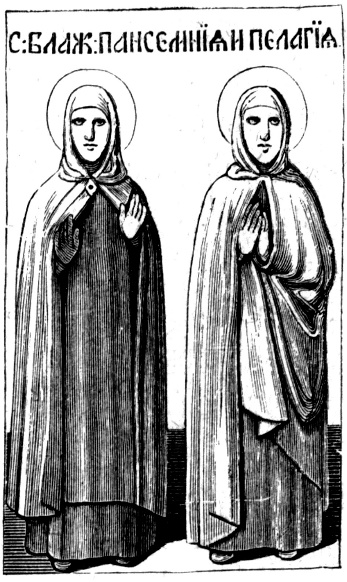
В таком городе, какова роскошная столица Востока, ещё не расставшаяся с грехами грязного язычества, ревность преподобного к чистой жизни оскорблялась многим. Вот слышит он, что в городе женщина, которую называли Пансемнией104, живёт распутно и увлекает многих в жизнь грязную. Он положил возвратить её на путь добра. Апостол Иаков учит: «обративший грешника от пути его спасёт душу от смерти и покроет множество грехов» (своих) (Иак.5:20). Подвиг прекрасный, высокий, – но трудный для выполнения. Подвижник Феофан не доверял себе в успехе, так как знал, что дурные страсти и дух злобы не дёшево продают победу над ними, – не доверял себе и по сознанию своей немощи; он видел, что ему придётся из тихого уединения вступить в шумное общество людей лёгких, рассеянных, где считают забавой завлечь другого в грехи нечистые. Понимая всю опасность предприятия, Феофан долго и горячо молился Господу, чтобы Он или послал ему Свою помощь для выполнения намерения его, или удержал его при самом начале дела.
In such a city as the luxurious capital of the East, which had not yet parted with the sins of filthy paganism, the zeal of the Venerable One for a pure life was offended by many things. Now he hears that in the city there was a woman called Pansemnia104 who lived dissolutely and drew many into a filthy life. He resolved to bring her back to the path of good. The Apostle James teaches: "He who turns a sinner from his way will save a soul from death and cover a multitude of sins" (his own) (Jas. 5:20). A beautiful and lofty feat, but difficult to accomplish. The ascetic Theophanes did not trust himself to succeed, for he knew that evil passions and the spirit of malice do not cheaply sell victory over them; he did not trust himself even from the awareness of his own weakness; he saw that he would have to step from quiet solitude into the noisy society of light-minded, dissipated people, who consider it a sport to entice another into unclean sins. Understanding all the danger of the undertaking, Theophanes prayed long and fervently to the Lord, that He would either send him His help for the fulfillment of his intention, or restrain him at the very beginning of the work.
Покинув свою келью, приходит он к отцу и, сказав, что хочет жениться, выпросил у него нарядное платье и 10 фунтов золота. Язычник отец, очень богатый, охотно дал всё. Одевшись щёголем, Феофан является к Пансемнии, как один из стольких умных поклонников её прелестей. Феофан спрашивает её: «давно ли она так живёт, как живёт?» – «Двенадцать лет», отвечает она с бесстыдством женщин её сорта, «и из всех мужчин, которых видала, ни одного не любила так, как готова любить его». «Прекрасно», сказал он: «но если я с тобой сближусь, то хочу, чтобы сближение наше было честное, а не было бы распутством». Он показал ей и деньги, которыми готов купить супружескую верность её. Пансемния, вовсе не ожидавшая такого счастья для себя, с восторгом объявила, что на всё согласна.
Leaving his cell, he goes to his father and, saying that he wishes to marry, asks him for fine clothes and 10 pounds of gold. The pagan father, being very rich, willingly gave everything. Dressed as a dandy, Theophanes appears to Pansemnia as one of the many clever admirers of her charms. Theophanes asks her: "How long have you been living as you live?" – "Twelve years," she answers with the shamelessness of women of her sort, "and of all the men I have seen, I have not loved one as I am ready to love you." "Excellent," he said; "but if I become close to you, I want our closeness to be honorable, and not debauchery." He showed her also the money with which he was ready to buy her marital fidelity. Pansemnia, who had not at all expected such happiness for herself, declared with delight that she agreed to everything.
Получив слово клятвы, Феофан оставил её и занялся построением кельи вблизи своей кельи. Окончив работу, он опять явился к Пансемнии и объявил, что первое условие его то, что она должна принять христианство. Сперва она очень противилась, но, когда увидела, что намерение его непоколебимо, согласилась принять крещение. В течении семидневного приготовления к крещению открыли ей начальные и основания святой веры и особенно объяснили, как правда Божия не терпит греха и разврата и как любовь Божия щедра к кающимся; блаж. Феофан языком живой веры изобразил ей картины вечности, готовой для кающихся и нераскаянных грешников, и вместе молился за неё с смирением и любовью. Когда совершилось над ней крещение, благодать Божия зажгла в душе грешницы горячую любовь к Господу. Пансемния приняла на себя самые строгие подвиги покаяния. Она отпустила всех своих невольников, раздала на Богоугодные дела всё, что нажила распутством, и заперлась в келье, построенной для неё. Твёрдая и непреклонная борьба её с собой скоро изменила всю душу её. К славе благодати Христовой открылся в Пансемнии дар творить чудеса: она исцеляла бесноватых. Спустя 22 месяца после крещения переселилась она ко Господу в один день с святым наставником своим, преподобным Феофаном105.
Having received her word of oath, Theophanes left her and busied himself with building a cell near his own cell. Having finished the work, he again appeared to Pansemnia and declared that his first condition was that she must accept Christianity. At first she resisted greatly, but when she saw that his intention was unshakable, she agreed to receive Baptism. During the seven-day preparation for Baptism, the first principles of the holy faith were revealed to her, and especially it was explained how the righteousness of God does not tolerate sin and debauchery and how the love of God is generous to the penitent; the blessed Theophanes, with the tongue of living faith, depicted for her the pictures of eternity prepared for penitent and impenitent sinners, and together he prayed for her with humility and love. When Baptism was performed over her, the grace of God kindled in the soul of the sinner a fervent love for the Lord. Pansemnia took upon herself the most severe feats of repentance. She dismissed all her slaves, distributed to God-pleasing works all that she had acquired by debauchery, and shut herself up in the cell built for her. Her firm and unyielding struggle with herself soon changed her whole soul. To the glory of Christ's grace, the gift of working miracles was revealed in Pansemnia: she healed the demon-possessed. Twenty-two months after Baptism, she departed to the Lord on the same day as her holy instructor, the Venerable Theophanes105.
Более поражающий пример обширным действием своим выставлял св. Иоанн Милостивый, архиепископ Александрийский, – пример, бывший в той же Сирии, где подвизались Пансемния и Феофан106.
A more striking example in its extensive effect was set forth by St. John the Merciful, Archbishop of Alexandria, – an example that occurred in the same Syria where Pansemnia and Theophanes asceticised106.
Один отшельник, говорил он, шёл в Тире по улице. И вот распутная женщина останавливает его криком своим: «отец мой! спаси меня, как Иисус Христос спас блудницу». Отшельник, вовсе не думая о том, что подумают, что станут говорить о нём люди, взял её за руку и пошёл с ней в близкий монастырь за город. Видевшие это стали говорить, что он покидает монашество, чтобы жениться на этой женщине. На беду добрым судьям, идя с женщиной в монастырь, отшельник увидал брошенное на дороге дитя, и женщина взяла к себе это дитя из сострадания на воспитание, так что намерение поступить в монастырь осталось до времени не исполненным. Злоязычники не упустили прекрасного для них случая, пустили в ход молву, что дитя прижито от монаха. «Чего же больше?» говорили другие. Дитя так похоже лицом на монаха, как сын на отца! Горько было слушать это невинному отшельнику, но он терпел и терпел. Бывшая Порфирия стала уже доброй монахиней Пелагией. Отшельник лежал больным, и Бог открыл ему, что близка кончина его. Душе подвижника тяжело было и то, что люди так легко грешат к беде своей, так несправедливо судят о других. Он просит Пелагию, чтобы она пришла в Тир с ребёнком, которому уже было семь лет. В Тире, когда лежал он больным, к нему собралось много посетителей, человек до ста. Он просит, чтобы принесли горячих угольев, и когда принесены они были, он ссыпал их на свою одежду. «Видите, друзья мои, огонь не жжёт одежды моей по благодати Божией: так точно Бог сохранил тело моё во всю жизнь от огня похоти, и я не имел плотского сношения ни с одной женщиной». Сказав это, отшельник предал Господу дух свой. Тогда умные судьи чужой совести нехотя сознались, что они были глупы и что у Господа есть тайные рабы Его, до которых если касается дерзкий язык, жестоко обжигается. Тогда и пример Пелагии, оказавшейся искреннею подвижницей, а не осмеиваемой грешницей, сильно подействовал на многих: подобные ей решились омыть грешную жизнь свою тёплым покаянием, оставили мир и вступили в монастырь. Так Пелагия († окт. 502 г.) не только сама спаслась, но и обратила к Господу примером своим очень многих. «Близок Господь ко всем призывающим Его, ко всем призывающим Его во истине. Желание боящихся Его Он исполняет и молитву их слышит и спасает их» (Пс.144:18). «Если бы кто согрешил, то мы имеем ходатая перед Отцом, Иисуса Христа, праведника. Он есть умилостивление за грехи наши и не только за наши, но и за грехи всего мира» (1Ин.2:1–2).
A certain hermit, he said, was walking in Tyre along a street. And behold, a dissolute woman stops him with her cry: "My father! Save me, as Jesus Christ saved the harlot." The hermit, not at all thinking about what people would think or say about him, took her by the hand and went with her to a nearby monastery outside the city. Those who saw this began to say that he was leaving monasticism to marry this woman. To the misfortune of the good judges, as he was going with the woman to the monastery, the hermit saw a child abandoned on the road, and the woman, out of compassion, took the child to raise, so that the intention to enter the monastery remained unfulfilled for the time. The evil-tongued did not miss this excellent opportunity for them; they spread the rumor that the child was conceived by the monk. "What more do you need?" said others. "The child looks so much like the monk in face, as a son to his father!" It was bitter for the innocent hermit to hear this, but he endured and endured. The former Porphyria had already become the good nun Pelagia. The hermit lay ill, and God revealed to him that his end was near. The soul of the ascetic was also burdened by the fact that people so easily sin to their own ruin, and so unjustly judge others. He asked Pelagia to come to Tyre with the child, who was already seven years old. In Tyre, while he lay ill, many visitors gathered to him, up to a hundred people. He asked that hot coals be brought, and when they were brought, he poured them onto his clothing. "See, my friends, the fire does not burn my clothing by the grace of God: so likewise God preserved my body all my life from the fire of lust, and I have had carnal relations with no woman." Having said this, the hermit gave up his spirit to the Lord. Then the clever judges of another's conscience reluctantly confessed that they had been foolish and that the Lord has His secret servants, upon whom if a bold tongue touches, it is cruelly burned. Then the example of Pelagia, who proved to be a sincere ascetic and not a mocked sinner, strongly affected many: those like her resolved to wash away their sinful life with warm repentance, left the world, and entered a monastery. Thus Pelagia († October 502 A.D.) not only saved herself, but also turned very many to the Lord by her example. "The Lord is nigh unto all them that call upon Him, to all that call upon Him in truth. He will fulfill the desire of them that fear Him; He also will hear their cry, and will save them" (Ps. 144:18). "If any man sin, we have an Advocate with the Father, Jesus Christ the Righteous. And He is the propitiation for our sins, and not for ours only, but also for the sins of the whole world" (1 Jn. 2:1–2).
О пр. Феофане и Пансемнии in Act. Sanet, junii II, 275. Синаксарь Греч. Минеи июньской и сказание в сокращённом менологе у Ваната: Thesaurus monum. 3, 439. Перевод последнего сказания в прологе июня 10 д., но не везде точный.
Concerning the Venerable Theophanes and Pansemnia in Act. Sanct., Junii II, 275. The Synaxarion of the Greek Menaion for June and the account in the abbreviated menologion of Vanata: Thesaurus monum. 3, 439. A translation of the latter account is in the Prologue for June 10, but not everywhere accurate.
Пролог: «уведав же о блуднице нарицаемой честная». Пансемния точно значит: честная и даже всечестная; только это имя собственное, а не нарицательное. В служебной Минее Зографской XIII в. (поклонник св. горы, стр. 324) «Пансемния». За то другие имена святых в той же Минее искажены писцом до крайности, напр. 6 февр. Фаросты (Фавсты), 16 февр. Анитропови (иже в Мартирополи), мая 15 Памихха (Пахомия), ноябр. 5 Епимиса (Епистаты), дек. 7 Анидора (Афинодора).
Prologue: "having learned of a harlot called honorable." Pansemnia indeed means: honorable and even all-honorable; only this is a proper name, not a common noun. In the service Menaion of Zographou of the 13th century (Poklonnik sv. gory, p. 324) "Pansemnia." On the other hand, other names of saints in the same Menaion are distorted by the scribe to the extreme, e.g., Feb. 6 Pharosty (Fausty), Feb. 16 Anitropovi (those in Martyropolis), May 15 Pamichha (Pachomius), Nov. 5 Epimisa (Epistata), Dec. 7 Anidora (Athenodorus).
Синаксарь: «прожив год и два месяца переселяется ко Господу вместе с преп. Феофаном». По житию «подвизалась 22 месяца». Последнее показание следует предпочесть.
Synaxarion: "having lived a year and two months, she departs to the Lord together with the Venerable Theophanes." According to the Life, "she asceticised for 22 months." The latter indication should be preferred.
Наставление св. Иоанна в его житии, которое писано современником Леонтием, епископом Неапольским, Четь-Минея ноябр. 12 ч. Acta Sanet, ad 23 iann. Or. chr. 2,443. Patrol. Lat. T. 73. p. 377. Та же повесть в прологе авг. 3.
Instruction of St. John in his Life, which was written by his contemporary Leontius, Bishop of Neapolis, Chet'i-Minei, Nov. 12. Acta Sanct., ad 23 iann. Or. chr. 2,443. Patrol. Lat. T. 73. p. 377. The same story in the Prologue for August 3.