Племянник императора Проба († 282 года), современник Константина Великого. Управлял церковью десять лет с 316 по 326 год. Во дни его происходил первый Вселенский Собор, на котором он не присутствовал по причине старости (ему было около восьмидесяти лет); вместо себя посылал туда пресвитеров своих (из коих один, Александр, был ему преемником). Имел дар прозорливости и за 10 дней предсказал свою кончину.
A nephew of the Emperor Probus († 282 A.D.), a contemporary of Constantine the Great. He governed the Church for ten years, from 316 to 326 A.D. In his days the first Ecumenical Council took place, at which he was not present on account of old age (he was about eighty years old); in his stead he sent his presbyters (one of whom, Alexander, was his successor). He possessed the gift of foresight and predicted his own repose ten days beforehand.
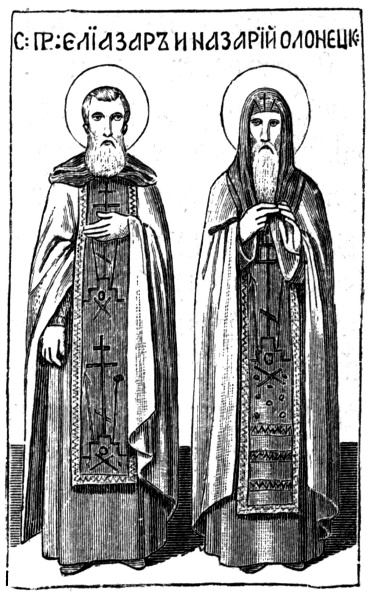
По ркп. святцам преп. Елеазар и Назарий были основателями Предтечева монастыря, находившегося в Олонецком уезде; они называются чудотворцами, и днём кончины их показан 4 день июня. Но в каком году скончались они? Как совершили подвиг жизни? – Остаётся неизвестным. Вероятно, что они были учениками аввы Лазаря Мурманского и подвизались в XV веке, потому что называются также пришедшими из Греции, как и Лазарь. Мощи их почивают под спудом в храме упразднённой обители27.
According to the manuscript Menologia, the Venerable Eleazar and Nazarius were the founders of the Monastery of the Forerunner, which was located in the Olonets district; they are called Wonderworkers, and the day of their repose is given as the 4th day of June. But in what year did they repose? How did they accomplish their ascetic feat? – This remains unknown. It is probable that they were disciples of Abba Lazarus of Murmansk and that they labored in the 15th century, because they are also said to have come from Greece, as did Lazarus. Their relics rest beneath the crypt in the church of the abolished monastery27.
Преподобный Зосима ещё в молодых годах принял иночество в Синайской обители. Посланный своим настоятелем в Александрию по монастырским делам, получил от Александрийского патриарха Аполлинария епископский сан. Под старость возвратился на Синай и там кончил жизнь свою. Жил в VΙ-м веке, во время цветущего состояния подвижничества на Синайской горе.
The Venerable Zosimas received the monastic tonsure in the Monastery of Sinai while still in his youth. Sent by his abbot to Alexandria on monastery business, he received episcopal consecration from Apollinarius, the Patriarch of Alexandria. In his old age he returned to Sinai and there ended his life. He lived in the 6th century, during the flourishing state of asceticism on Mount Sinai.
Из жизни преп. Зосимы передаётся, между прочим, один случай, доказывающий, что если и избегнут иногда совершившие преступление изобличения перед людьми и кары земного правосудия, то не избегнуть им суда своей совести, этого орудия кары Божественной, и не укрыться человеку от Мздовоздаятеля не только в загробной жизни, но, большей частью, и во время существования на земле...
From the life of the Venerable Zosimas, there is related, among other things, an incident proving that even if those who have committed a crime sometimes escape exposure before men and the punishment of earthly justice, they cannot escape the judgment of their own conscience, that instrument of Divine punishment, and that a man cannot hide from the Rewarder not only in the afterlife, but, for the most part, even during his existence on earth...
Однажды, когда преп. Зосима подвизался в Синайской пустыне, пришёл к нему бывший разбойник и, излив перед праведным старцем свою душу, отягощённую многими преступлениями, умолял его принять его в число иноков, чтобы тяжёлым трудом – подвижничеством иноческим и слезами покаяния омыть грехи. Видя искреннее раскаяние пришедшего, испытав его в продолжении некоторого времени, Зосима допустил его принять иночество. По прошествии некоторого времени, старец сказал новопоступившему, что трудно ему будет укрыться от людей даже и здесь, так как многие приходят сюда, между которыми могут встретиться люди, могущие узнать в нём бывшего разбойника; поэтому посоветовал ему уединиться подальше от обители и сам отвёл его в пустынный скит аввы Дорофея, близ Газы.
Once, when the Venerable Zosimas was laboring in the Sinai desert, a former robber came to him and, pouring out his soul, burdened with many crimes, before the righteous elder, besought him to receive him into the number of monks, so that by heavy labor—monastic asceticism and the tears of repentance—he might wash away his sins. Seeing the sincere repentance of the newcomer, and having tested him over some time, Zosimas allowed him to receive the monastic tonsure. After some time had passed, the elder said to the newly-admitted monk that it would be difficult for him to hide from people even here, since many come here, among whom there might be people who could recognize him as a former robber; therefore he advised him to withdraw farther from the monastery and himself led him to the desert skete of Abba Dorotheus, near Gaza.
Девять лет прожил в этом скиту, обрёкший себя на покаяние, разбойник; ревностно и неуклонно исполнял все скитские послушания и после того вдруг, неожиданно ушёл из скита, возвратился к преп. Зосиме и стал просить его – принять от него обратно иноческие одежды и дать ему мирские для возвращения в мир...
The robber, who had condemned himself to repentance, lived in this skete for nine years; he zealously and unfailingly fulfilled all the obediences of the skete, and after that, suddenly, unexpectedly, he left the skete, returned to the Venerable Zosimas and began to beg him—to take back from him the monastic garments and to give him worldly ones so that he might return to the world...
– Да, вот уже девять лет, как я стал жить в скиту, – отвечал ему бывший разбойник, – я трудился, сколько мог; строго соблюдал воздержание, пост и молитву; в молчании, смирении принимал и исполнял всякие послушания, надеясь и моля Бога только об одном, чтобы милосердие Его простило мне мою прежнюю жизнь... чтобы я мог примириться с самим собой... Но нет! не нашёл я ни в чём ни мира, ни отрады... Передо мной всегда неотступно стоит дитя, убитое мной, и говорит: «за что ты убил меня?» Я вижу и слышу это во сне и наяву... Стою ли я на молитве в церкви, вкушаю ли трапезу вместе с братией, иду ли где-нибудь по дороге и даже когда приступаю к Божественным Тайнам – всё оно, всё это дитя стоит передо мной и спрашивает меня: «за что ты убил меня?» Поэтому, отче, хочу идти туда, где я совершал злодеяния... Пусть правосудие покарает меня!
– Yes, it is now nine years since I began to live in the skete, – the former robber answered him, – I labored as much as I could; I strictly observed abstinence, fasting and prayer; in silence and humility I accepted and fulfilled every obedience, hoping and praying to God only for one thing, that His mercy might forgive me my former life... that I might be reconciled with myself... But no! I have found neither peace nor consolation in anything... Before me always stands incessantly the child I killed, and says: “Why did you kill me?” I see and hear this in sleep and in waking... Whether I stand at prayer in church, partake of the meal together with the brethren, walk somewhere along the road, and even when I approach the Divine Mysteries—it is always there, always this child stands before me and asks me: “Why did you kill me?” Therefore, Father, I want to go to the place where I committed my evil deeds... Let justice punish me!
Видя, что не удержать ему человека, душа которого вопиет о казни, как об единственном средстве умиротворения своего, старец отпустил его... и разбойник, предав себя человеческому правосудию, был казнён мечом... очищения своего не достиг слезами, только кровью омыл себя...
Seeing that he could not restrain a man whose soul cried out for execution as the only means of its pacification, the elder let him go... and the robber, having surrendered himself to human justice, was put to the sword... he did not achieve his purification through tears, but washed himself only with blood...
Оптат, епископ в Нумидии, прославился деятельной борьбой с донатистами – во 2-ой половине IV-го века. Он успешно опровергал их в своих сочинениях, о которых с уважением отзываются Иероним, Фульгенций, Августин, епископ Иппонский (память 15-го июня), ставящий Оптата наравне со свв. Киприаном, Иларием и Амвросием. Оптат в своём сочинении против Донатистов определительно раскрывает понятие об истинной Церкви Христовой и доказывает, что «отделяющиеся от Церкви напрасно мечтают о спасении»28.
Optatus, a bishop in Numidia, was renowned for his active struggle against the Donatists – in the second half of the 4th century. He successfully refuted them in his writings, which are spoken of with respect by Jerome, Fulgentius, and Augustine, the Bishop of Hippo (commemorated on June 15th), who places Optatus on a level with Sts. Cyprian, Hilary, and Ambrose. In his work against the Donatists, Optatus definitively expounds the concept of the true Church of Christ and proves that “those who separate themselves from the Church vainly dream of salvation”28.
Кроме сведений о святых Марфе и Марии, изложенных в Евангелии, а именно: в Евангелии от Иоанна, Ин.11:1–45,12:1–8; от Матф. Мф.26:6–13; от Марка Мк.14:3–9, – известно, что по вознесении Иисуса Христа на небо, когда, по убиении архидиакона Стефана, настало гонение на Церковь Иерусалимскую, и св. Лазарь, быв изгнан из Иерусалима, проповедовал Христа в разных странах, то и сёстры его, уверовавшие во Христа ещё до воскрешения Им их брата, помогали Лазарю в благовествовании Евангелия. Время и место их мирной кончины осталось неизвестным.
Besides the information about Sts. Martha and Mary set forth in the Gospel, namely: in the Gospel of John, Jn. 11:1–45, 12:1–8; of Matthew, Mt. 26:6–13; of Mark, Mk. 14:3–9 – it is known that after the Ascension of Jesus Christ into heaven, when, after the murder of the Archdeacon Stephen, persecution arose against the Church of Jerusalem, and St. Lazarus, having been driven out of Jerusalem, preached Christ in various lands, then his sisters also, who had believed in Christ even before the resurrection of their brother by Him, helped Lazarus in the preaching of the Gospel. The time and place of their peaceful repose have remained unknown.
Ркп. святцы: «преп. отцы Елиазар и Назарий игумены Муранского монастыря Рождества св. Иоанна Предтечи, иже в Олонецком уезде, новые чудотворцы, родом Римляне, преставишася в лето 700 мес. июня, в 4 д.» Свед. о монаст., стр. 423. Об авве Лазаре мар. 8. д.
Manuscript Menologia: “the Venerable Fathers Eliazar and Nazarius, abbots of the Muransky Monastery of the Nativity of St. John the Forerunner, which is in the Olonets district, new Wonderworkers, by birth Romans, reposed in the year 700, month of June, on the 4th day.” Information on Monasteries, p. 423. On Abba Lazarus, see March 8th.