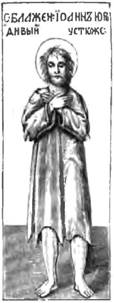
Близ старого Устюга, за рекой Сухоной, в селе Пухове жили благочестивые и зажиточные поселяне Савва и Мария450 – здесь родился у них сын Иоанн; здесь же ещё с юных лет начал отличаться жизнью строгой. По средам и пятницам не ел ничего, а в прочие дни довольствовался хлебом с водой. Когда мать заметила ему: к чему он постится в таких годах? «Чтобы избавиться от грехов, отвечал он; без греха никто, кроме Бога; не станем питать плоти, чтобы не стала врагом нашим». Когда родители переселились в гор. Орлец, на реке Юг, за 40 вер. от Устюга и отец здесь умер, мать постриглась под именем Наталии в Троицком Орлецком монастыре. Отрок Иоанн был при ней, по-прежнему молчаливый. Потом он начал юродствовать и мать оставила его на волю Божию. Перейдя в Устюг, поселился он близ соборной Успенской церкви, в хижине, построенной для него набожным Андреем Мишневым. Здесь он ночи проводил в молитве, а днём бегал по улицам в виде юродивого и отдыхал на навозе. Так жил он зимой и летом. Чего стоило ему выносить в такой одежде северные морозы? Много пришлось ему вытерпеть побоев, насмешек, брани от людей, не понимавших ни себя, ни его. Чтобы выносить столько страданий, надобно было глубоко чувствовать смысл слов Апостола: «нынешнее страдание наше, которое мгновенно и легко, готовит для нас в величайшем избытке вечную славу» (2Кор.4:17). Блаж. Иоанн скрывал свою жизнь от глаз человеческих, опасаясь известности людской, тлетворной для духа. Набожному священнику Григорию захотелось дознать тайные занятия Иоанна; священник смотрел сквозь щель из другой комнаты на блаж. Иоанна. Осмотревшись и не видя никого в комнате, блаж. Иоанн стал молиться с воздетыми к небу руками за творящих неправду, – так молился он не один час; окончив молитву, стал мешать уголья в печке, – тогда была зима жестокая; потом, оградив себя крестным знамением, лёг на уголья, Иерей, испуганный мыслью, не испёкся бы Иоанн, вошёл в комнату. Блаженный вышел из печи и, грозно посмотрев на пытливого, сказал: не смей никому говорить о том до моей смерти. Священник дал слово исполнить волю его с точностью. Жена Устюжского наместника кн. Феодора Красного, княгиня Мария, была больна жестокой горячкой и послала слугу к блаж. Иоанну с просьбой помолиться за неё. Иоанн лежал на навозе, но лишь только увидел слугу, сказал: «здравствуй, добрый князь Феодор и с княгиней своей». Слуга по возвращении нашёл княгиню уже здоровой. Кончина его последовала 29 мая 1494 г. и он был погребён в соборной церкви. В подлиннике писали: «Иоанн юродивый, Устюжский чудотворец, подобием молод, борода только расти зачала, в наусии; волосы просты; риза на нём раздранное рубище, исчерна бело, и свилося по нём; плечо голо, а также и рёбра голы и ноги, выше коленей»451.
Near old Ustiug, across the Sukhona River, in the village of Pukhovo, lived the pious and well-to-do peasants Sabbas and Maria450—there their son John was born; and there, from his early youth, he began to distinguish himself by a strict life. On Wednesdays and Fridays he ate nothing, and on the other days he was content with bread and water. When his mother said to him, 'Why do you fast at such an age?' 'To be delivered from sins,' he answered; 'no one is without sin except God; let us not nourish the flesh, lest it become our enemy.' When his parents moved to the town of Orlets, on the Yug River, forty versts from Ustiug, and his father died there, his mother was tonsured under the name Natalia in the Trinity Orlets Monastery. The youth John was with her, as silent as before. Then he began to play the fool for Christ, and his mother left him to the will of God. Having moved to Ustiug, he settled near the cathedral Church of the Dormition, in a hut built for him by the devout Andrew Mishnev. There he spent his nights in prayer, and by day he ran through the streets in the guise of a fool and rested on a dung heap. Thus he lived both winter and summer. What did it cost him to endure the northern frosts in such clothing? Much did he have to suffer from blows, mockery, and abuse from people who understood neither themselves nor him. To endure so many sufferings, one had to deeply feel the meaning of the Apostle's words: 'For our present affliction, which is momentary and light, prepares for us an eternal weight of glory beyond all measure' (2 Cor. 4:17). The blessed John concealed his life from human eyes, fearing human fame, which is corrupting to the spirit. A devout priest named Gregory desired to learn John's secret occupations; the priest looked through a crack from another room at the blessed John. Having looked around and seeing no one in the room, the blessed John began to pray with his hands raised to heaven for those who do wrong—thus he prayed for more than an hour; having finished his prayer, he began to stir the coals in the stove—for it was a severe winter; then, having made the sign of the cross, he lay down on the coals. The priest, frightened by the thought that John might be burned, entered the room. The blessed one came out of the stove and, looking sternly at the inquisitive man, said: 'Do not dare to tell anyone about this until my death.' The priest gave his word to fulfill his will exactly. The wife of the Ustiug governor, Prince Theodore the Red, Princess Maria, was grievously ill with a fierce fever and sent a servant to the blessed John with a request to pray for her. John was lying on a dung heap, but as soon as he saw the servant, he said: 'Greetings, good Prince Theodore, and with your princess.' The servant, upon his return, found the princess already well. His repose came on May 29, 1494, and he was buried in the cathedral church. In the original it is written: 'John the Fool-for-Christ, the Ustiug Wonderworker, in appearance young, his beard just beginning to grow, in a nauz; his hair plain; his garment a torn rag, blackish-white, and twisted about him; his shoulder bare, and likewise his ribs bare, and his legs, above the knees.'451
Служба блаж. Иоанну написана во время царя Иоанна452. В 1610 г. писали, что услышав о победе царского войска над Сапегой, под Дмитровом, они «воздали славу Богу в Троице славимому – и Устюжским чудотворцам Прокопию и Иоанну»453. В 1613 г. Устюжане, молитвами Устюжских чудотворцев, не только защищали город свой от Поляков, но и разбили их454.
The service to the blessed John was written during the reign of Tsar John452. In 1610, it was written that, having heard of the victory of the tsar's army over Sapieha near Dmitrov, they 'gave glory to God glorified in the Trinity—and to the Ustiug wonderworkers Procopius and John.'453 In 1613, the people of Ustiug, through the prayers of the Ustiug wonderworkers, not only defended their city from the Poles, but also defeated them.454
«Марфа, Марфа, ты заботишься и суетишься о многом; а одно только нужно» (Лк.10:41,42). Не каждая ли христианская душа должна повторять себе эти слова Спасителя, которые так помнил блаж. Иоанн, как видно из всей жизни его?
"Martha, Martha, you are anxious and troubled about many things; but one thing is needful" (Lk. 10:41, 42). Should not every Christian soul repeat to itself these words of the Savior, which the blessed John so remembered, as is evident from his whole life?