Во время гонения на св. иконы, в VIII веке, глава Предтечи перенесена была из Константинополя в Команы, – место ссылки и смерти Златоустого, и там опять сокрылась и неизвестна была до восстановления Православного иконопочитания. В царствование Михаила, в 857 году, честная глава Предтечи в третий раз обретена и вторично перенесена в Константинополь патриархом Игнатием.
During the persecution of holy icons, in the eighth century, the head of the Forerunner was transferred from Constantinople to Comana—the place of exile and death of Chrysostom—and there again lay hidden and was unknown until the restoration of the veneration of Orthodox icons. In the reign of Michael, in the year 857, the precious head of the Forerunner was uncovered for the third time and translated a second time to Constantinople by Patriarch Ignatius.
В день третьего обретения честной главы Предтечи Церковь взывает: «яко Божественное сокровище, сокровенное в земли, Христос откры главу твою нам, Пророче и Предтече. Вси убо сошедшеся в сея обретение, песньми Богоглаголивыми Спаса воспоим, спасающа нас от тления молитвами твоими».
On the day of the third uncovering of the precious head of the Forerunner, the Church exclaims: "Like a divine treasure hidden in the earth, Christ has revealed your head to us, O Prophet and Forerunner. Assembling, therefore, all together for this uncovering, let us sing with God-inspired hymns to the Savior, who saves us from corruption through your prayers."
Епископ Кипрский, совершивший страдальческий подвиг и принявший мученическую смерть во время, как полагают, гонения Диоклитианова. Перед нашествием на о. Кипр Сарацин мощи святителя были перенесены в Константинополь. Во время этого перенесения, в 806 г., как полагают, 25-го мая, в царствование императора Греческого Никифора, совершилось от мощей св. Ферапонта много чудес; они описаны современником и, во многом, очевидцем их, который, повествуя о них, свидетельствует, что он описал «из многих чудес только немногие».
Bishop of Cyprus, who accomplished a feat of suffering and received a martyr's death during, as is supposed, the Diocletian persecution. Before the invasion of the island of Cyprus by the Saracens, the relics of the Hierarch were transferred to Constantinople. During this translation, in the year 806, as is supposed, on the 25th of May, in the reign of the Greek Emperor Nicephorus, many miracles were wrought from the relics of St. Therapontus; they were described by a contemporary and, in many respects, an eyewitness of them, who, in narrating them, testifies that he described "only a few out of many miracles."
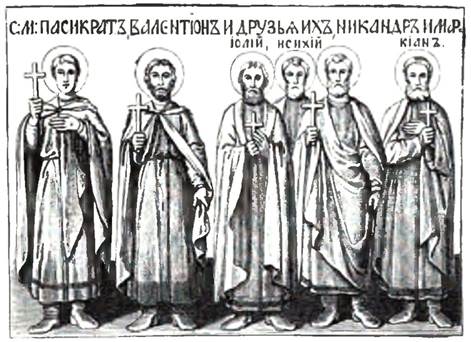
Мученики Христовы Пасикрат иВалентион были, говорит древнее известие419, из города Доростола Македонского, воины, но христиане. Оба они были молоды, Пасикрату было 22 года, а Валентину 30 лет; но оба были зрелы духом. Когда увидали они, что чтители идолов кланяются камням, а слабые из христиан, боясь мук, приносили жертвы; они, одушевясь святой ревностью, свободно исповедали, что только христианский Бог есть истинный Бог, а идолы – вещество бездушное. Быв схвачены, приведены они были к префекту. Когда им сказано было, чтобы принесли жертву богу Аполлону, Пасикрат плюнул на идола. Тогда подошёл к Пасикрату брат его Паниян, отступивший перед тем от Христа по страху мучений, и стал убеждать принести жертву, чтобы избавиться мук. Пасикрат прогнал брата, называя его недостойным родства с ним. Когда спрошен был Валентион, то отвечал, что он одних убеждений с Пасикратом. Потому оба лишены были головы, тогда как тут же стояла мать Пасикрата и склоняла сына к мученичеству.
The Martyrs of Christ Pasicrates and Valentio were, according to an ancient account419, from the city of Dorostolus in Macedonia, soldiers, but Christians. Both were young—Pasicrates was 22 years old, and Valentio 30 years old—but both were mature in spirit. When they saw that the worshippers of idols bowed down to stones, and that the weaker Christians, fearing torments, offered sacrifices, they, animated by holy zeal, freely confessed that only the Christian God is the true God, and that idols are soulless matter. Having been seized, they were brought before the prefect. When they were told to offer sacrifice to the god Apollo, Pasicrates spat on the idol. Then Pasicrates' brother Pinian, who had previously apostatized from Christ out of fear of torments, approached him and began to urge him to offer sacrifice in order to escape torments. Pasicrates drove his brother away, calling him unworthy of kinship with him. When Valentio was questioned, he answered that he was of the same conviction as Pasicrates. Therefore both were beheaded, while Pasicrates' mother stood nearby and urged her son toward martyrdom.
По современному известию420, блаженный Юлий схвачен был служителями и приведён к префекту Максиму. «Правда ли, что говорят о тебе Юлий?» спросил Максим, Юлий отвечал: «правда, я христианин, – за другого не хочу выдавать себя» – Разве ты не знаешь, говорил префект, указа императоров, повелевающего приносить жертву богам? Юлий отвечал: «знаю; но я – христианин, не могу делать то, чего хотите вы; не следует мне отрекаться от Бога живого и истинного». Максим сказал: что за важность покурить ладаном и уйти? Диоклитиан, как известно, первый повелел воздавать ему почести как божеству421. Воин при приёме жалованья курил фимиам перед изображением нового божества. Префект – язычник чувствует странность этой выходки Диоклитиана и думает закрывать её сарказмом индифферентиста. Юлий отвечал префекту: «не могу преступить заповедь Божию. Я служил в военной службе 26 лет и не приводили меня к судье как преступника или как человека вздорного; семь раз выходил я на войну; не был я ослушником перед начальством и сражался не хуже каждого. Не думают ли, что тогда, как был я верным в низшем, окажусь неверным в высшем?» Максим спросил: в каком войске служил Юлий? «Я служил, отвечал Юлий, в лёгком войске и вышел из службы, – я ветеран422. Но я чтил Бога живого, сотворившего небо и землю, и теперь отправляю вечную службу Ему». Максим говорил, что Юлий получит в награду 10 динариев и оставлен будет в покое, если только теперь послушается. «Ни деньги, ни льстивые убеждения не отклонят меня от Господа вечного», отвечал исповедник. – Надобно повиноваться законам, сказал Максим. «Я страдаю за вечные законы», отвечал Юлий. – За те, что преподал вам Распятый? Не умно уважать мертвеца, а не живых императоров, говорил префект. Юлий отвечал: «Он умер за грехи наши, чтобы даровать нам вечную жизнь, но Он же – Бог вечный». Максим сказал: послушайся, принеси жертву, – иначе ты выбираешь себе смерть. «Я выбираю долю умереть на время и жить вечно», отвечал Юлий. Префект произнёс решение: Юлий, не повинующийся указам императоров, должен быть лишён головы.
According to a contemporary account420, the blessed Julius was seized by servants and brought before the prefect Maximus. "Is it true what they say about you, Julius?" asked Maximus. Julius answered: "It is true, I am a Christian—I do not wish to pass myself off as anything else." "Do you not know," said the prefect, "the edict of the emperors commanding sacrifice to the gods?" Julius answered: "I know; but I am a Christian and cannot do what you wish; I must not deny the living and true God." Maximus said: "What importance is there in burning a little incense and leaving?" Diocletian, as is known, was the first to command that honors be paid to him as a divinity421. Soldiers, upon receiving their pay, burned incense before the image of the new divinity. The prefect, a pagan, senses the strangeness of this action of Diocletian and thinks to conceal it with the sarcasm of an indifferentist. Julius answered the prefect: "I cannot transgress the commandment of God. I served in the military for 26 years and was never brought before a judge as a criminal or a quarrelsome man; I went to war seven times; I was not disobedient to my superiors and fought as well as any. Do they think that, having been faithful in the lesser, I will prove unfaithful in the greater?" Maximus asked: in which branch of the army had Julius served? "I served," answered Julius, "in the light infantry and retired from service—I am a veteran422. But I honored the living God, who made heaven and earth, and now I perform eternal service to Him." Maximus said that Julius would receive a reward of 10 denarii and be left in peace, if only he would obey now. "Neither money nor flattering persuasions will turn me from the eternal Lord," answered the confessor. "One must obey the laws," said Maximus. "I suffer for the eternal laws," answered Julius. "For those taught you by the Crucified? It is not wise to honor a dead man rather than the living emperors," said the prefect. Julius answered: "He died for our sins, to grant us eternal life, but He is the eternal God." Maximus said: "Obey, offer sacrifice—otherwise you choose death for yourself." "I choose the lot of dying for a time and living eternally," answered Julius. The prefect pronounced the sentence: Julius, not obeying the edicts of the emperors, must be beheaded.
Когда вели св. Юлия на место казни, Исихий, воин и христианин, находившийся под стражей, говорил мученику Юлию: «прошу тебя, Юлий, выполняй с радостью обещание своё, получишь венец, который обещал Господь исповедникам Своим. По помни и о мне, – я иду за тобой, особенно приветствуй Пасикрата иВалентиона, рабов Божиих, которые прежде нас пришли к Господу добрым исповеданием». Юлий, целуя Исихия, сказал: «спеши прийти, брат; а желания твои услышаны теми, которых ты приветствовал».
When they were leading St. Julius to the place of execution, Hesychius, a soldier and a Christian who was under guard, said to the martyr Julius: "I beg you, Julius, fulfill your promise with joy; you will receive the crown which the Lord promised to His confessors. But remember me as well—I follow you; especially greet Pasicrates and Valentio, the servants of God, who came before us to the Lord by a good confession." Julius, kissing Hesychius, said: "Hasten to come, brother; and your wishes have been heard by those whom you greeted."
Затем Юлий взял платок, завязал им глаза и, протягивая шею, сказал: «Господи Иисусе Христе! за Твоё имя умираю, – удостой принять душу мою в число святых». Служитель отсёк ему голову. Раб Христов пострадал в 6 кален. июня (27 мая).
Then Julius took a handkerchief, bound his eyes with it, and, stretching out his neck, said: "Lord Jesus Christ! For Thy name I die—deign to receive my soul among the saints." The executioner cut off his head. The servant of Christ suffered on the 6th of the Kalends of June (May 27).
Св. Исихий с двумя другими принял мученическую кончину июня 25 дня423. Спустя два дня после того пострадали ещё два воина, также друзья св. Пасикрата, Никандр иИаркиан424.
St. Hesychius with two others received a martyr's end on the 25th day of June423. Two days after that, two more soldiers, also friends of St. Pasicrates, Nicander and Marcian424, suffered.
Когда они представлены были на суд, префект Максим сказал им: если вы не знали указа императоров, повелевающего приносить жертвы богам, то исполните теперь. «Указ, отвечал Никандр, относится к желающим приносить жертву; но мы – христиане, не можем подлежать ему». Максим сказал: почему бы вам не принять награды за вашу заслугу? «Деньги нечестия неприятны для чтителей истинного Бога», отвечал Никандр. – Покури только ладаном богам, сказал Максим. Никандр отвечал: «христианин не может чтить камни и деревья и забыть о Боге, сотворившем всё из ничего и могущем спасти меня и всех надеющихся на Него». Супруга св. Никандра говорила ему: «берегись, господин мой, делать то; берегись отказываться от Господа нашего Иисуса Христа; взирай на небо и там увидишь Его, Кому должен ты сохранить верность». Максим сказал: глупая бабья голова! зачем ты хочешь смерти мужу своему? «Для того, отвечала она, чтобы жил он у Бога и никогда не умирал». – Нет, сказал Максим, тебе хочется добыть более здорового мужа. «Если ты так думаешь о мне, отвечала она, умертви меня за Христа первую, если только у тебя есть указ о женщинах». Максим сказал, что такого указа нет у него, но она будет сидеть в тюрьме, и её отвели в тюрьму.
When they were brought before the court, the prefect Maximus said to them: "If you did not know the edict of the emperors commanding sacrifice to the gods, then obey now." "The edict," answered Nicander, "applies to those who wish to offer sacrifice; but we are Christians and cannot be subject to it." Maximus said: "Why would you not accept a reward for your service?" "The money of impiety is displeasing to worshippers of the true God," answered Nicander. "Only burn incense to the gods," said Maximus. Nicander answered: "A Christian cannot honor stones and trees and forget the God who created everything from nothing and who can save me and all who hope in Him." The wife of St. Nicander said to him: "Beware, my lord, of doing that; beware of denying our Lord Jesus Christ; look to heaven and there you will see Him to whom you must keep faith." Maximus said: "Foolish woman's head! Why do you wish death for your husband?" "So that he may live with God and never die," she answered. "No," said Maximus, "you want to get a healthier husband." "If you think that of me," she answered, "put me to death for Christ first, if only you have an edict concerning women." Maximus said that he had no such edict, but that she would sit in prison, and she was led away to prison.
Максим давал время Никандру подумать о цене жизни. Никандр отвечал, что дело уже обдумано и что он ничего более не желает, как душевного спасения. – Ты что скажешь, Маркиан? сказал префект. «Стою на том же, на чём ратный товарищ мой», отвечал Маркиан. – Итак, вы оба отведены будете в тюрьму и без сомнения понесёте казнь, сказал префект. Спустя 20 дней приводят их из темницы к префекту. – Довольно времени употреблено на увещание, чтобы покорились вы указу императоров, сказал Максим. «Слова твои, отвечал Маркиан, не заставят нас отступить от веры и отказаться от Бога. Он присутствует тут и знаем мы, куда зовёт Он. Не удерживай нас. Ныне вера наша совершенствуется во Христе. Отсылай нас скорее, чтобы узрели мы Распятого; вы нечистыми устами порицаете Его, а мы чтим Его». – По желанию вашему вы преданы будете смерти, сказал префект. «Для здравия императоров просим тебя, отвечал Маркиан, – скорее отпустить нас. Мук мы не боимся, но желаем, чтобы скорее исполнилось наше желание». – Не я вас преследую, сказал Максим, а указы императоров; я невинен в крови вашей. Затем произнёс он смертный приговор. Святые мученики Христовы как бы одними устами сказали: «будь счастлив, человеколюбивый префект!» Они вышли из суда с радостью.
Maximus gave Nicander time to think about the value of life. Nicander answered that the matter was already decided and that he desired nothing more than the salvation of his soul. "What do you say, Marcian?" said the prefect. "I stand by what my comrade in arms says," answered Marcian. "So then, you will both be taken to prison and will undoubtedly suffer execution," said the prefect. Twenty days later they were brought from the dungeon to the prefect. "Enough time has been spent in exhortation for you to submit to the edict of the emperors," said Maximus. "Your words," answered Marcian, "will not make us abandon the faith and deny God. He is present here, and we know where He calls us. Do not detain us. Now our faith is perfected in Christ. Send us quickly, so that we may behold the Crucified; you with impure mouths revile Him, but we honor Him." "By your own wish you will be put to death," said the prefect. "For the health of the emperors we beg you," answered Marcian, "to release us quickly. We do not fear torments, but we desire that our wish be fulfilled as soon as possible." "It is not I who persecute you," said Maximus, "but the edicts of the emperors; I am innocent of your blood." Then he pronounced the death sentence. The holy martyrs of Christ, as with one mouth, said: "Be happy, humane prefect!" They left the court with joy.
За Никандром следовали жена его и Пиниян, брат мученика Пасикрата, нёсший младенца, сына Никандрова. За Маркианом шли родственники и жена его. «Горе мне бедной!» кричала последняя; – «смилостивись надо мной, господин мой, – посмотри на милого сынка твоего; не отвергай нас». Маркиан, строго посмотрев на неё, сказал: «как сатана помрачил ум твой! Уйди от нас; дай мне докончить подвиг мученический». Зотик христианин, поддерживая руку его, говорил: «будь твёрд, господин – брат! Ты совершаешь добрый подвиг. Где нам слабым взять такую веру?» Маркиан сказал Зотику: «подержи жену мою». И Зотик взял её. Когда пришли на место, Маркиан, подозвав жену, поцеловал её и сказал: «иди с Богом; ты не можешь смотреть на славный подвиг мученичества, – мысль твоя смущена лукавым». А сынка целуя и смотря на небо, говорил: «Господи всемощный! попекись о нём». Никандр также простился с женой. «Бог с тобой!» сказал он. Она с радостью говорила: «десять лет была я без тебя на родине и каждый час желала видеть тебя; теперь вижу и радуюсь, что идёшь ты к жизни; радуюсь, что становлюсь женой мученика». Мученикам завязаны были глаза и меч пресёк жизнь их. Мученики Христовы Никандр и Маркиан упокоились в 15 кал. июля (1-го июня).
Behind Nicander followed his wife and Pinian, the brother of the martyr Pasicrates, carrying an infant, the son of Nicander. Behind Marcian went his relatives and his wife. "Woe is me, poor woman!" cried the latter; "have mercy on me, my lord—look at your dear little son; do not reject us." Marcian, looking sternly at her, said: "How has Satan darkened your mind! Go away from us; let me finish my martyr's struggle." Zoticus, a Christian, supporting his hand, said: "Be firm, lord and brother! You are accomplishing a good struggle. Where can we weak ones find such faith?" Marcian said to Zoticus: "Hold my wife." And Zoticus took her. When they came to the place, Marcian, calling his wife, kissed her and said: "Go with God; you cannot look upon the glorious feat of martyrdom—your mind is troubled by the evil one." And kissing his little son and looking to heaven, he said: "All-powerful Lord! Take care of him." Nicander also took leave of his wife. "God be with you!" he said. She said with joy: "For ten years I was without you in my homeland, and every hour I wished to see you; now I see you and rejoice that you are going to life; I rejoice that I am becoming the wife of a martyr." The martyrs' eyes were bound, and the sword cut short their lives. The martyrs of Christ Nicander and Marcian reposed on the 15th of the Kalends of July (June 1).
Так как префект Максим уговаривал исполнить указ «императоров» и не раз упоминал об императорах, то ясно видно, что страдание Дуростольских воинов совершалось в гонение Диоклитиана и Максимиана, в 302 году, а не при императоре Севере, как думал Бароний425.
Since the prefect Maxim was urging them to carry out the decree of the "emperors" and more than once mentioned the emperors, it is clearly evident that the suffering of the soldiers of Durostolum took place during the persecution of Diocletian and Maximian, in the year 302, and not under the emperor Severus, as Baronius thought425.
Известно, что на правом берегу Дуная, где Дуростол, в III веке уже сильными массами жили Славяне426 и они были лучшими воинами империи427. Так св. мученики и по месту жительства, и по службе были из Славян и пример твёрдого самоотвержения их за святую веру конечно возбудил во многих родичах их уважение и любовь к св. вере428.
It is known that on the right bank of the Danube, where Durostolum is located, already in the third century Slavs lived in great numbers426 and they were the best soldiers of the empire427. Thus the holy martyrs, both by their place of residence and by their service, were from the Slavs, and the example of their firm self-sacrifice for the holy faith undoubtedly aroused in many of their kinsmen respect and love for the holy faith428.
Менолог Василия и Четь-Минея. Страдание мучеников помещено здесь под 24 апр., а в прологе – под 21 апр. Но современное описание страданий друзей их Юлия и Исихия показывает, что страдание совершилось в мае и что товарищ Пасикрата назывался Валентионом, а не Валентином, как в менологе. В мартирологе Адона и Усуарда – под 25 мая: «в Мизии, в городе Доростеле, мучение Пасикрата, Валентиона и двух других вместе увенчанных». Patrolog. 124, 86. 87. 94.
The Menologion of Basil and the Cheti-Minei. The passion of the martyrs is placed here under April 24, and in the Prologue under April 21. But the contemporary account of the sufferings of their friends Julius and Hesychius shows that the suffering took place in May and that the companion of Pasicrates was called Valentio, not Valentinus, as in the Menologion. In the Martyrology of Ado and Usuard—under May 25: "In Moesia, in the city of Durostolum, the martyrdom of Pasicrates, Valentio, and two others crowned together." Patrolog. 124, 86. 87. 94.
Выражение: sub arma militavi, поставленное в тексте Руннарта, только в поздние времена стали употреблять, в значении строевой военной службы, так что армия противополагается милиции и казачеству. Потому дозволительно читать в тексте: sub parma militavi. А это значит, что Юлий служил в лёгком войске, для которого круглый щит (parma, παρμη), сделанный из дерева и обтянутый воловьей шкурой, составлял необходимую принадлежность. Лёгкое войско (milites levis armaturæ, leves) отличалось ещё тем, что оно не разделялось на когорты и сражалось рассеянными кучками (Адама Римские древности 2, 179. 180). В пользу такого чтения текста служит и то, что на Дунае нужно было именно иррегулярное, лёгкое войско, всегда готовое отражать Задунайских неприятелей империи, У Адона и Усуарда Юлий изображается так: cum esset veteranus et emeritae militisæ.
The expression: sub arma militavi, placed in the text of Ruinart, began to be used only in later times, in the sense of regular military service, so that the army is contrasted with the militia and the Cossacks. Therefore it is permissible to read in the text: sub parma militavi. And this means that Julius served in the light infantry, for which the round shield (parma, παρμη), made of wood and covered with ox-hide, was a necessary piece of equipment. The light infantry (milites levis armaturæ, leves) was also distinguished by the fact that it was not divided into cohorts and fought in scattered groups (Adam, Roman Antiquities 2, 179. 180). In favor of such a reading of the text also serves the fact that on the Danube what was needed was precisely an irregular, light infantry, always ready to repel the Transdanubian enemies of the empire. In Ado and Usuard, Julius is depicted thus: cum esset veteranus et emeritae militisæ.
Греческие акты мученичества их известны были Аллацию de Symeonum scriptis p. 121. Латинские акты изд. у Руннарта 8, 375–380. Греческий текст изд. у Папеброха act. sanct. jun. 3.247 s. Страдания Никандра и Маркиана совершились в нижней Мизии, там же, где пострадали св. Пасикрат и Юлий; в тех и других деяниях и префект – тот же, и одинаковое действие его и тот же св. Паснкрат с его братом. В минологе Василия сказание о св. Никандре и Маркиане под 7 июля близко к показаниям записи о их мученичестве, но сказание синаксаря под 8 июня выставляет многое, чего вовсе нет в актах.
The Greek acts of their martyrdom were known to Allatius de Symeonum scriptis p. 121. The Latin acts were published by Ruinart 8, 375–380. The Greek text was published by Papebroch act. sanct. jun. 3.247 s. The sufferings of Nicander and Marcian took place in Lower Moesia, in the same place where Sts. Pasicrates and Julius suffered; in both sets of acts the prefect is the same, and his actions are the same, and the same St. Pasicrates with his brother. In the Menologion of Basil, the account of Sts. Nicander and Marcian under July 7 is close to the testimony of the record of their martyrdom, but the account of the Synaxarion under June 8 sets forth many things that are entirely absent from the acts.
О Славянах Дуростола и соседних с ним мест см. июля 18 пр. 10. Дуростол у Птоломея, Дуростен на Пефтингеровой карте, Диристра и Дристра у Византийцев; Дрествин в Русск. летописях, у Турков Силистрия, по древнему названию своему – город Славянский.
On the Slavs of Durostolum and neighboring places, see July 18, note 10. Durostolum in Ptolemy, Durosten on the Peutinger Map, Diristra and Dristra among the Byzantines; Drestvin in the Russian Chronicles, among the Turks Silistria, by its ancient name—a Slavic city.
Адам: «при императорах Римские войска по большей части составлялись из иностранцев и провинции с огорчением видели, что цвет их юношества выводили на бранное поле». Римские древн. 2, 177. В 537 г. к Величару в Рим послано было 1600 Антов и Славян из живших оседло по Дунаю. Прокопий de bello Gothico 1, 27.
Adam: "Under the emperors, the Roman troops were for the most part composed of foreigners, and the provinces saw with grief that the flower of their youth was led out to the field of battle." Roman Antiquities 2, 177. In 537 A.D., 1600 Antes and Slavs from those living settled along the Danube were sent to Belisarius in Rome. Procopius de bello Gothico 1, 27.
На Ефесском соборе 431 г. был епископ Дуростольский; но после того до 10 века не было в Дуростоле епископа. Wiltsch kirch. stat. 1, 175, 428.
At the Council of Ephesus in 431 A.D., there was a bishop of Durostolum; but after that, until the 10th century, there was no bishop in Durostolum. Wiltsch kirch. stat. 1, 175, 428.