Orthodox Translations

May 2424 мая

Old Calendar: civil June 6 · New Calendar: civil May 24

History

Преп. Симеона Столпника, Дивногорца

Venerable Simeon the Stylite, of the Wondrous Mountain

E1.TAI draft

Разнообразны пути, на которых люди могут достичь спасения души своей, хотя на всяком пути для достижения этой цели требуется одно и то же: искренняя любовь к Богу, искреннее стремление послужить Ему – в какой бы форме оно ни проявлялось. А что Бог не отвергает никакого пути, избираемого человеком для выражения усердия послужить Ему по своему крайнему разумению, видно из того, что Бог чудно и неоднократно прославлял людей, подвизавшихся даже на странном, непостижимом вообще пути...

Diverse are the paths by which men may attain the salvation of their souls, although on every path the same thing is required for the attainment of this goal: sincere love for God, a sincere desire to serve Him—in whatever form it may manifest itself. And that God rejects no path chosen by man to express his zeal to serve Him according to his utmost understanding is evident from the fact that God wondrously and repeatedly glorified men who labored even on a strange, generally incomprehensible path...

E1.0AI draft

Одним из таких прославленных Богом угодников был воспоминаемый сегодня св. Симеон Дивногорец, подвизавшийся на столпе, на Дивной горе, названной так потому, что здесь Господь «удивил милость Свою в Симеоне» ...

One of such glorified saints of God was the St. Simeon of the Wondrous Mountain commemorated today, who labored on a pillar, on the Wondrous Mountain, so named because here the Lord "made His mercy wonderful in Simeon"...

E1.1AI draft

Вникая в мысль подвига стояния на столпе, можно обратить внимание в особенности на два обстоятельства: во-первых, подобные подвиги происходили, с одной стороны, во времена живой, пламенной веры, не останавливающейся ни перед какими пределами, изобретающей всевозможные формы для излияния от своего избытка, – с другой стороны, во времена крайнего непросвещения умов, когда большинству людей недоступно было назидаться внутренним духовным подвигом, между тем как созерцаниевнешнего подвига необычайного, сверхъестественного терпения, воздержания и даже самобичевания действовало на них наглядным примером самоотвержения, наглядным образцом силы, проявляемой ради Бога и только при помощи свыше... И промыслом Божиим допускались такие проявления.

Delving into the thought of the feat of standing on a pillar, one may pay attention especially to two circumstances: first, such feats occurred, on the one hand, in times of living, fervent faith, which stops before no limits, inventing all possible forms for pouring forth from its abundance—and on the other hand, in times of extreme ignorance of minds, when the majority of people were unable to be edified by inner spiritual struggle, while the contemplation of an external feat of extraordinary, supernatural patience, abstinence, and even self-chastisement acted upon them as a clear example of self-denial, a clear model of strength manifested for God's sake and only with help from above... And by the providence of God such manifestations were permitted.

E1.2AI draft

Во-вторых, можно заметить, что в более просвещённое время, наставшее для человечества, такие внешние подвиги утратили не только большую долю своего значения, но, может быть, и сама сила совершать их утратилась в отдельных личностях, и вообще с развитием людей прежняя суть добра и подвижничества если даже и не истощилась, то стала выражаться в иных формах, более сообразных разумению и потребностям данного времени; собственно же внешние поразительные подвиги, бывшие данью и выражением известного времени, заменились иным, более соответственным и назидательным подвижничеством. Тем не менее, прежние не теряют своего значения в том смысле, что напоминают и свидетельствуют об изумительной способности страдать, об изумительном усердии приносить в жертву своему высшему, духовному стремлению всё, что почитается удобством, радостью, приятным удовлетворением в земной жизни. Если не сама форма подвига, то сила и чувство, руководившие при совершении подобных внешних подвигов, вот что навсегда останется достойным подражания.

Secondly, one may observe that in a more enlightened time, which has come for mankind, such external feats have lost not only a great share of their significance, but perhaps the very power to perform them has been lost in individual persons, and in general, with the development of men, the former essence of goodness and asceticism, even if it has not been exhausted, has come to be expressed in other forms, more suited to the understanding and needs of the given time; the actual external striking feats, which were a tribute and expression of a certain time, have been replaced by another, more fitting and edifying asceticism. Nevertheless, the former do not lose their significance in the sense that they remind and testify to the astonishing capacity to suffer, to the astonishing zeal to sacrifice to one's higher, spiritual striving everything that is considered comfort, joy, pleasant satisfaction in earthly life. If not the very form of the feat, then the strength and feeling that guided the performance of such external feats—this is what will forever remain worthy of imitation.

E1.3AI draft

Симеон родился в Антиохии Сирийской, в 522 г. Мать его Марфа, благочестивая женщина, по смерти мужа своего, погибшего под развалинами своего дома во время землетрясения (между тем как Марфа и Симеон чудным образом спаслись от погибели), воспитывала сына своего в тёплой привязанности к Богу, которой проникнуто было её собственное сердце. И не бесплодно изливала она в душу своего сына преисполняющие её чувства: воспринятые младенцем, они сделали его сосудом избранным Божией благодати.

Simeon was born in Syrian Antioch, in A.D. 522. His mother Martha, a pious woman, after the death of her husband, who perished under the ruins of his house during an earthquake (while Martha and Simeon were miraculously saved from destruction), raised her son in a warm attachment to God, with which her own heart was filled. And not in vain did she pour into the soul of her son the feelings that filled her: received by the infant, they made him a chosen vessel of God's grace.

E1.4AI draft

Когда Симеону было пять лет, мать поручила его святому старцу Иоанну Столпнику (пам. его 4-го июля), подвизавшемуся в пустыне. Подражая ему, Симеон, будучи семи лет, пожелал подобного же подвига и скоро превзошёл своего учителя истинно-ангельским терпением. Опытный старец Иоанн, опасаясь, чтобы нежный отрок не изнемог от непосильного подвига, уговаривал его не предаваться такому преждевременному труду, но Симеон, подкрепляемый Высшей силой продолжал своё молитвенное предстояние, пред Богом, жить для угождения Которому научила его мать его... Но не удовольствовался он этим стоянием. Прошло шесть лет и он «захотел более высоким столпом к небу приблизиться». Ему построили другой столп в 40 локтей вышиной. Проведя на нём 8 лет, Симеон, по откровению Божественному, удалился на Дивную гору402 в окрестностях Антиохии, и там основал обитель и столп на камне, на высоком холме. – Во время прежнего подвижничества Симеон так проводил время: с утра до девятого часа молился, потом упражнялся в чтении и писании до захождения солнца, после того опять молился и без сна стоял на молитве до самой зари. На рассвете же он «приказывал сну, как рабу своему, приступить к нему ненадолго, а подремав немного, просыпался и начинал свой день».

When Simeon was five years old, his mother entrusted him to the holy elder John the Stylite (his commemoration is July 4), who was laboring in the wilderness. Imitating him, Simeon, at the age of seven, desired a similar feat and soon surpassed his teacher in truly angelic patience. The experienced elder John, fearing that the tender youth might faint from an unbearable feat, urged him not to give himself over to such premature labor, but Simeon, strengthened by a higher power, continued his prayerful standing before God, to please Whom his mother had taught him to live... But he was not satisfied with this standing. Six years passed and he "desired to draw nearer to heaven by a higher pillar." Another pillar was built for him, 40 cubits in height. Having spent 8 years on it, Simeon, by divine revelation, withdrew to the Wondrous Mountain402 in the vicinity of Antioch, and there founded a monastery and a pillar on a rock, on a high hill. – During his former asceticism, Simeon spent his time thus: from morning until the ninth hour he prayed, then he occupied himself with reading and writing until sunset, after which he prayed again and stood without sleep in prayer until dawn. At daybreak he "commanded sleep, as his servant, to approach him for a short time, and having dozed a little, he awoke and began his day."

E1.5AI draft

Великие откровения получал свыше юный подвижник, и исполнился премудростью, и дивился собиравшийся вокруг столпа его народ, слыша его поучения и видя творимые им чудеса... Тяготился славой своей и частыми посещениями народа отвлёкший душу свою от мира столпник; потому и пожелал переселиться в более уединённое место на Дивной горе; но и сюда люди приходили к нему и никому не отказывал он в помощи – добром слове, или исцелении, или предупреждении, предсказывая будущие события. Так, предсказал смерть Антиохийскому архиепископу и землетрясение, разрушившее почти Антиохию.

Great revelations were received from on high by the young ascetic, and he was filled with wisdom, and the people who gathered around his pillar marveled, hearing his teachings and seeing the miracles he performed... The stylite, whose soul was withdrawn from the world, was burdened by his fame and the frequent visits of the people; therefore he wished to move to a more solitary place on the Wondrous Mountain; but even here people came to him, and he refused no one help—with a kind word, or healing, or warning, foretelling future events. Thus, he foretold the death of the Archbishop of Antioch and the earthquake that almost destroyed Antioch.

E1.6AI draft

Св. Симеон принял по откровению свыше сан священства (33-х лет) от Дионисия, епископа Селевкийского, хотя прежде отказывался от него. «Восхваляя Божественного отрока», повели его святители в церковь, там посвятили в иерейский сан и с пением псалмов возвели снова на столп, на котором неизменно и немолчно совершал своё великое служение преп. Симеон до блаженной кончины своей – в полнейшем смирении на 76-м году своей жизни, – в 596 г. Описатель жизни его свидетельствует, что «и по кончине святого чудеса его продолжались потоком» ...

St. Simeon received the rank of priesthood by revelation from above (at age 33) from Dionysius, Bishop of Seleucia, although he had previously refused it. "Praising the divine youth," the hierarchs led him into the church, there ordained him to the priestly rank, and with the singing of psalms led him back up onto the pillar, on which the Venerable Simeon unwaveringly and unceasingly performed his great service until his blessed repose—in complete humility, in the 76th year of his life—in A.D. 596. The writer of his life testifies that "even after the saint's repose, his miracles continued in a stream"...

E1.7AI draft

Во время детства Симеона, – говорит Евагрий, – был такой случай, что во время игр на горе, он, связав шею леопарда своим поясом, привёл к своему наставнику – Иоанну, называя леопарда кошкой... По этому случаю Иоанн, уразумев, каков этот отрок будет в добродетели, и не отказал ему поставить его на столп, сделавшийся в продолжение 70-ти лет прославленным достоянием дивного избранника Божия403...

During Simeon's childhood, says Evagrius, there was such an incident that while playing on the mountain, he bound the neck of a leopard with his belt and led it to his teacher John, calling the leopard a cat... On this occasion John, understanding what this youth would become in virtue, did not refuse to place him on the pillar, which for seventy years became the glorified possession of the wondrous chosen one of God403...
E1.8AI draft

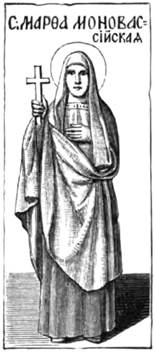
† Св. Марфы Монемвассийской и трёх неизвестных подвижниц

† St. Martha of Monemvasia and Three Unknown Ascetics

E2.TAI draft
Engraving

Св. Марфа была игуменьей Монемвассийской обители св. Богородицы. Морея с VII века занята была Славянами и Монемвасия, которой святители известны с VIII века404, в VIIΙ веке полагалась в Славянской земле405. Блаженной Марфе, как и современным ей проповедникам веры, предстояло между прочим утверждать в вере и благочестии недавних язычников406. Жизнь христианская сама по себе свет; только в точном своём виде не легка она для нас немощных. Св. Василий Великий писал к современной ему, благородной инокине Феодоре: «Не лёгкий подвиг обещающемуся выполнить обещанное. Долг каждого избирать жизнь Евангельского закона. Но выполнять всё до малости и не пренебрегать ничем из написанного в Евангелии, как знаем, не многие успевают. Надобно обуздывать язык и очи, просвещённые Евангельским учением; надобно, чтобы и руки делали в угождение Богу, и ноги двигались и каждый член употреблялся так, как изначала назначил Творец нам. Надобно соблюдать скромность в одежде, осторожность в сношениях с мужчинами, умеренность в пище, не иметь лишнего из вещей нужных. Всё это кажется просто малостью, а требует великого подвига при выполнении, как дознаем на деле. Надобно хранить смирение, чтобы не помнить о знатности предков своих, не гордиться природными дарованиями тела или души, не превозноситься добрыми мнениями о нас других. Всего этого требует жизнь Евангельская; к тому же нужны: постоянство в воздержании, усердие к молитве, сострадание любви к другим, щедрость к нуждающимся, смирение в мыслях, сокрушение сердечное, целость в вере, равнодушие в скорбях; постоянное памятование о том страшном и неизбежном суде, к которому все близимся, и о котором однако не многие помнят, беззаботные о его решении»407. Блаженная Марфа крепко подвизалась сама на пути Евангельского закона, и усердно понуждала сестёр к подвигам благочестия408. Потом удостоилась страдальческой кончины с тремя сёстрами в конце царствования Константина Порфирогенета. Записка о ней, известная ныне только по отрывку, не объясняет, по какому случаю и от кого последовала эта смерть; но так как с одной стороны вместе с св. Марфой и тремя сёстрами пострадали «знаменитые благочестием мужи», как бывает в нападение неприятелей, с другой стороны единственные неприятели Греческой власти в Морее были тогда Славяне, частью ещё язычествовавшие: то более, чем вероятно, что св. Марфа с сёстрами пострадала от Славян-язычников.

St. Martha was the abbess of the Monemvasia monastery of the Most Holy Theotokos. The Morea had been occupied by Slavs since the 7th century, and Monemvasia, whose hierarchs have been known since the 8th century404, was reckoned in the 8th century as being in Slavic territory405. Blessed Martha, like the preachers of the faith contemporary with her, had the task, among other things, of confirming in faith and piety the recent pagans406. The Christian life is itself light; only in its exact form is it not easy for us who are weak. St. Basil the Great wrote to the noble nun Theodora, his contemporary: "No light feat is it for one who promises to fulfill what he has promised. It is the duty of each to choose the life of the Gospel law. But to fulfill everything down to the smallest detail and to neglect nothing written in the Gospel, as we know, not many succeed. One must bridle the tongue and the eyes, enlightened by the Gospel teaching; one must ensure that the hands also work to please God, and the feet move, and every member be used as the Creator originally appointed for us. One must observe modesty in dress, caution in dealings with men, moderation in food, and not have more than is necessary of needed things. All this seems simple and trifling, but requires great effort in its fulfillment, as we learn by experience. One must preserve humility, so as not to remember the nobility of one's ancestors, not to be proud of natural gifts of body or soul, not to be exalted by the good opinions others have of us. All this the Gospel life requires; to this are needed: constancy in abstinence, zeal for prayer, compassion of love for others, generosity to the needy, humility in thoughts, contrition of heart, integrity in faith, indifference in sorrows; constant remembrance of that terrible and unavoidable judgment, to which we all draw near, and of which, however, not many are mindful, being careless about its sentence."407 Blessed Martha herself struggled mightily on the path of the Gospel law, and earnestly urged her sisters to feats of piety408. Afterwards she was deemed worthy of a martyric end together with three sisters at the end of the reign of Constantine Porphyrogennetos. The account of her, known now only from a fragment, does not explain on what occasion or from whom this death came; but since, on the one hand, together with St. Martha and the three sisters, "men renowned for piety" also suffered, as happens in an attack by enemies, and on the other hand, the only enemies of Greek authority in the Morea at that time were the Slavs, some of whom were still pagan: it is more than probable that St. Martha and her sisters suffered at the hands of pagan Slavs.

E2.0AI draft

Тот же блаженный Павел, епископ Монемвассийский, который писал о св. Марфе, оставил следующее известие о трёх современницах св. Марфы409.

The same blessed Paul, Bishop of Monemvasia, who wrote about St. Martha, left the following account of three contemporaries of St. Martha409.

E2.1AI draft

«Был я, говорит он, послан на восток по царскому делу. На дороге встретился мне пустынный монастырь и мне захотелось побывать в нём. Игумен и черноризцы вышли ко мне на встречу и, поздоровавшись, сели мы на горе. Тут были плодовитые деревья. И вот птицы прилетая ломали ветки с плодами и быстро уносили. Я спросил игумена: «отчего это птицы не едят плодов, а уносят куда-то с ветками?» Он отвечал: «вот уже одиннадцатый год, как они тоже делают каждое лето». – «Тут в горах, сказал я по какому-то вдохновению, живут или мужи, или жёны и им-то носят они плоды». Когда говорил я это, прилетевший ворон сломил ветвь с плодом. Я сказал игумену: «пойдём за ним», и пошли. Ворон с плодом летел впереди нас и, долетев до утёса, положил ветку. Когда подходили мы к нему, он, взяв ветку, полетел в провалье и там оставив ветвь, воротился без всего. Придя к провалью, мы бросили вниз камень. И вот кто- то кричит: «если вы христиане, не убивайте нас». – «Кто вы таковы?» спросили мы. «Если хотите, был ответ, видеть нас, бросьте нам три одеяния, – мы – нагие жёны; идя по горе, увидите дорожку и по ней можете сойти к нам». Услышав это, три чернеца сняли с себя одеяния и, обвивши ими камень, пустили вниз. Найдя указанную узенькую дорожку, с трудом сошли мы по ней к святым. Три жены, увидев нас, поклонились нам до земли и, сотворив молитву, сели мы. Одна из них тоже села, а две стояли. Тогда игумен спросил севшую: откуда ты, госпожа-матерь, и как пришла сюда? Я из Константинограда, отвечала она, муж мой служил при императоре и скончался молодым; я осталась вдовой 20-ти лет и горько плакала как о вдовстве, так и о том, что не имела детей. Спустя несколько дней один вельможа присылает ко мне слуг, с тем, чтобы насильно доставить меня к нему. Слуги, ничего не слушая, хотели вести меня. Я помолилась Господу Иисусу, да избавит меня от того, который готов осквернить душу и тело моё. Потом сказала слугам: я рада идти к вашему господину, столько славному; но теперь я очень больна, непрестанно течёт кровь; потерпите, пока выздоровлю, и тогда с радостью пойду. Хорошо, сказали они, господин будет ждать до 40 дней. По удалении их, созвала я слуг моих и, дав им денег, отпустила их на волю, а при себе оставила только двух служанок, которых вы видите. Потом, пригласив одного родственника, человека христолюбивого, под клятвами завещала ему продать сёла мои и дом, и раздать деньги нищим. Так я осталась без забот житейских. Ночью, взяв моих служанок, а теперь моих сестер, вступила я с ними на корабль, и мы пришли на это место, где видите нас. Вот одиннадцатый год, как не видали мы ни одного человека, кроме вас. Одежды наши изветшали и распались. Игумен сказал: «откуда, госпожа, получаете вы пищу?» – «Благой и человеколюбивый Бог, отвечала она, прокормивший народ Свой в пустыне 40 лет, посылает пищу и нам недостойным рабыням Его. Каждое лето птицы приносят всякий овощь, даже до излишества. И нагота не тяготит нас, – ни зимой не боимся холоду, ни летом – зноя, прославляя Святую Троицу». Мы слушали это с изумлением. Игумен сказал: «если прикажешь, госпожа моя, пошлю брата в монастырь принести пищи и мы покушаем с вами». Она отвечала: прикажите прийти священнику, пусть наперёд помолится, и мы причастимся святых Таин, – с того времени, как удалились мы из города, не удостаивались мы принять святые Тайны. Игумен послал чернеца в монастырь позвать пресвитера и принесть пищу. Пресвитер, придя, совершил службу и Божии рабыни причастились святых Таин. Потом покушали они с нами. «Молю святыню твою», сказала святая, «пробыть здесь три дня». Игумен дал обещание. Блаженная, встав, усердно молилась и тихо преставилась ко Господу; совершив надгробное пение, похоронили мы её. На другой день также покойно скончалась другая, а на третий – третья. Похоронив их, возвратились мы, славя Христа Бога, творящего чудеса».

"I was sent, he says, to the East on imperial business. On the road I came upon a desert monastery and desired to visit it. The abbot and the monks came out to meet me, and after greeting one another, we sat down on a hill. There were fruitful trees there. And behold, birds would fly in, break off branches with fruit, and quickly carry them away. I asked the abbot: 'Why is it that the birds do not eat the fruit, but carry it off somewhere with the branches?' He answered: 'For eleven years now they have done the same every summer.' – 'In these mountains,' I said, by some inspiration, 'there live either men or women, and to them they carry the fruit.' As I was saying this, a raven flew in, broke off a branch with fruit. I said to the abbot: 'Let us follow it,' and we went. The raven with the fruit flew ahead of us and, having reached a cliff, laid down the branch. When we approached it, it took the branch, flew into a ravine, and leaving the branch there, returned without anything. Coming to the ravine, we threw a stone down. And then someone cries out: 'If you are Christians, do not kill us.' – 'Who are you?' we asked. 'If you wish,' was the answer, 'to see us, throw us three garments—we are naked women; walking along the mountain, you will see a path and by it you can come down to us.' Hearing this, three monks took off their garments and, wrapping them around a stone, let it down. Finding the narrow path indicated, we descended with difficulty to the holy women. Three women, seeing us, bowed to the ground before us, and having made a prayer, we sat down. One of them also sat down, while two stood. Then the abbot asked the one who sat: 'Whence are you, lady-mother, and how did you come here?' 'I am from Constantinople,' she answered, 'my husband served the emperor and died young; I was left a widow at twenty years of age and wept bitterly both over my widowhood and over the fact that I had no children. After a few days, a certain nobleman sent servants to me, with the intention of forcibly bringing me to him. The servants, listening to nothing, wanted to lead me away. I prayed to the Lord Jesus that He would deliver me from him who was ready to defile my soul and body. Then I said to the servants: I am glad to go to your master, so glorious a man; but now I am very ill, blood flows incessantly; be patient until I recover, and then I will gladly go. "Good," they said, "the master will wait up to forty days." After their departure, I summoned my servants and, giving them money, set them free, keeping with me only two maidservants, whom you see. Then, inviting a certain relative, a Christ-loving man, I charged him under oath to sell my villages and house, and to distribute the money to the poor. Thus I remained free from worldly cares. At night, taking my maidservants, now my sisters, I embarked with them on a ship, and we came to this place, where you see us. For eleven years now we have seen no one except you. Our garments have worn out and fallen apart.' The abbot said: 'Whence, lady, do you receive food?' 'The good and man-loving God,' she answered, 'Who fed His people in the wilderness for forty years, sends food also to us, His unworthy handmaidens. Every summer the birds bring every kind of produce, even in abundance. And nakedness does not burden us—neither in winter do we fear the cold, nor in summer the heat, glorifying the Holy Trinity.' We listened to this with amazement. The abbot said: 'If you command, my lady, I will send a brother to the monastery to bring food and we will eat with you.' She answered: 'Bid a priest come, let him first pray, and we will partake of the Holy Mysteries—since the time we departed from the city, we have not been accounted worthy to receive the Holy Mysteries.' The abbot sent a monk to the monastery to summon a presbyter and bring food. The presbyter, having come, performed the service, and the handmaidens of God partook of the Holy Mysteries. Then they ate with us. 'I entreat your holiness,' said the saint, 'to remain here three days.' The abbot gave his promise. The blessed one, rising, prayed fervently and quietly reposed in the Lord; having performed the funeral chant, we buried her. On the next day the second also peacefully fell asleep, and on the third—the third. Having buried them, we returned, glorifying Christ God, Who works wonders."

E2.2AI draft

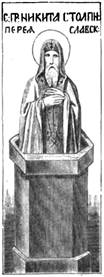
† Преп. Никиты столпника, Переяславского

† Venerable Nikita the Stylite of Pereslavl

E3.TAI draft
Engraving

Преобразования гражданского быта – счастье для людей, – если они выполняются с доброй совестью. Кн. Юрий Долгорукий, преобразовывая Суздальский край, велел перенести (1152 г.) Переяславль с Клещина озера на нынешнее место; земляное укрепление на берегу Трубежа надлежало сделать обширнее прежнего; даже каменный храм Спасителя, заложенный на старом городе, перенесли на новое место; здесь доканчивали его уже при сыне Юрия410. Понятно, что всё это не легко было жителям Переяславля. На покрытие издержек князя потребовался усиленный сбор податей. Новым несчастьем для жителей нового города был уроженец Переяславля Никита, заведовавший сбором податей411. Он был беспощаден к другим, не столько для князя, сколько для своей корысти: грабил бедных, теснил слабых и безнаказанно наживался на счёт других. Против взысканий правды он обезопасил себя связями с знатью. Вместе с тиунами и другими начальниками жил он весело, засыпая их подарками. Несчастные лили слёзы; а он был покоен и доволен. Так жил Никита без страха Божия и так прошло много лет жизни его. Бывает же, что человек всеми силами души живёт для греха, но не видит того: грех прикрывается в его взоре благовидными покровами то нужды житейской, то простительной слабости, то дозволенной рассеянности. Господь никогда не хочет, чтобы погиб кто-нибудь из грешников. Он употребляет разные раздражающие способы, чтобы пробудить заснувшую совесть грешника; употребляет ту или другую меру, смотря по свойствам и расположениям грешника. Для Никиты допущены были две меры и одна чудесная. Раз взошёл он в церковь и услышал проповедь пророка: «измыйтеся и чисти будете». Проповедь поразила Никиту: она так потрясла его душу, что целую ночь провёл он без сна, волнуемый мыслями о прошлой жизни своей. На утро пошёл он к друзьям своим и, желая развлечься, пригласил их к себе на весёлую беседу. Накупив нужное для стола, приказал жене приготовить обед. Та принялась за своё дело. Но когда стала варить, то сперва увидела кровь на верху воды, потом выплывала то рука, то голова. Она пришла в ужас и не знала, что делать? Сказала мужу и тот увидел то же самое. Совесть грешника пробудилась до самой глубины своей. Никита понял, что его промысл – то же, что грабёж и убийство людей. Горе мне, много согрешившему, сказал он с глубоким вздохом и, не сказав более ни слова, вышел из дома с мольбой к Господу: «настави мя, Господи, на путь Твой».

Transformations of civil life are a blessing for people—if they are carried out with a good conscience. Prince Yuri Dolgoruky, transforming the Suzdal region, ordered Pereslavl to be moved (in 1152) from Lake Kleshchino to its present site; the earthen fortification on the bank of the Trubezh was to be made more extensive than before; even the stone church of the Savior, founded in the old city, was moved to the new site; here they were finishing it already under Yuri's son410. It is understandable that all this was not easy for the inhabitants of Pereslavl. To cover the prince's expenses, an intensified collection of taxes was required. A new misfortune for the inhabitants of the new city was Nikita, a native of Pereslavl, who was in charge of tax collection411. He was merciless toward others, not so much for the prince as for his own gain: he robbed the poor, oppressed the weak, and enriched himself with impunity at the expense of others. Against the demands of justice he secured himself by connections with the nobility. Together with the tiuns and other officials, he lived merrily, plying them with gifts. The unfortunate shed tears; but he was calm and content. Thus Nikita lived without the fear of God, and thus many years of his life passed. It happens that a man lives with all the strength of his soul for sin, but does not see it: sin is covered in his eyes by plausible veils—now of worldly necessity, now of pardonable weakness, now of permissible distraction. The Lord never desires that any of sinners should perish. He uses various stirring means to awaken the sleeping conscience of the sinner; He uses one measure or another, according to the properties and dispositions of the sinner. For Nikita two measures were permitted, and one miraculous. Once he entered the church and heard the sermon of the prophet: "Wash yourselves, and you shall be clean." The sermon struck Nikita: it so shook his soul that he spent the whole night without sleep, agitated by thoughts of his past life. In the morning he went to his friends and, wishing to distract himself, invited them to a merry gathering at his home. Having bought what was needed for the table, he ordered his wife to prepare dinner. She set about her work. But when she began to cook, she first saw blood on the surface of the water, then a hand would float up, then a head. She was horrified and did not know what to do. She told her husband, and he saw the same thing. The conscience of the sinner was awakened to its very depths. Nikita understood that his livelihood was the same as robbery and murder of people. "Woe is me, who have sinned much," he said with a deep sigh, and without saying another word, he left the house with a prayer to the Lord: "Lead me, O Lord, in Thy way."

E3.0AI draft

В глубокой скорби о грехах Никита явился в монастырь вм. Никиты, что от Переяславля в 3-х верстах, и, пав к ногам игумена, омывал пол слезами своими. – «Что за скорбь у тебя, сын мой? скажи мне», – спрашивал игумен. Никита рассказал все грехи свои и бывшее видение и умолял принять его в обитель. «Можешь ли ты вдруг подчиниться послушанию, столько лет прожив на своей воле?» сказал игумен Никите. «Готов выполнять всё, что повелишь, отче», отвечал Никита. «Пробудь же три дня при вратах монастырских и исповедуй грехи свои», сказал настоятель. В глубоком раскаянии сел Никита при вратах монастыря и всем входящим и исходящим исповедовал грехи своей жизни. Потом за обителью, сняв с себя одежду, сел ногой в тростниковое болото. Спустя три дня игумен послал посмотреть, что делает Никита? Брат, не найдя его у ворот, нашёл его лежащим в тростнике; пауки и мошки осыпали его, а иные ползали по земле и кровь текла из тела, изъязвлённого ими. Брат рассказал игумену о том, что видел. Игумен и братия пошли и нашли Никиту в положении изумительном. «Что это ты делаешь, сын мой?» сказал игумен. Он едва мог проговорить от изнеможения: «спаси, отче, погибающую душу». Игумен велел принести власяную одежду, облёк его; взяв за правую руку, ввёл в монастырь и учинил достойным обетований, принадлежащих ангельскому образу. Никита в тесной келье проводил ночи в молитве, в пении псалмов, в чтении жития святых. По благословению игумена, он возложил на себя тяжёлые вериги. По ночам выходя из обители, выкопал два колодца, – один близ монастыря св. муч. Бориса и Глеба, другой близ потока студёного412. Разгораясь в любви к св. жизни, построил он себе столп и прокопал небольшой проход под церковь, которым ходил на общественную молитву никем невидимый; мало и того – подвижник носил на голове каменную шапку413.

In deep sorrow for his sins, Nikita appeared at the monastery of the Great Martyr Nikita, which is three versts from Pereslavl, and falling at the feet of the abbot, he washed the floor with his tears. – "What sorrow is upon you, my son? Tell me," the abbot asked. Nikita recounted all his sins and the vision that had occurred, and begged to be received into the monastery. "Can you suddenly submit to obedience, having lived so many years by your own will?" said the abbot to Nikita. "I am ready to fulfill all that you command, Father," answered Nikita. "Remain then for three days at the gates of the monastery and confess your sins," said the superior. In deep repentance, Nikita sat at the gates of the monastery and confessed the sins of his life to all who entered and departed. Then, outside the monastery, having taken off his clothing, he sat with his foot in a reed marsh. After three days, the abbot sent someone to see what Nikita was doing. The brother, not finding him at the gates, found him lying in the reeds; spiders and gnats covered him, and others crawled on the ground, and blood flowed from his body, lacerated by them. The brother told the abbot what he had seen. The abbot and the brethren went and found Nikita in an astonishing state. "What is this you are doing, my son?" said the abbot. He could barely speak from exhaustion: "Save, Father, a perishing soul." The abbot ordered a hair shirt to be brought and clothed him in it; taking him by the right hand, he led him into the monastery and made him worthy of the promises belonging to the angelic habit. Nikita, in a narrow cell, spent his nights in prayer, in the singing of psalms, in reading the lives of the saints. With the blessing of the abbot, he placed heavy chains upon himself. At night, going out from the monastery, he dug two wells—one near the monastery of the holy martyrs Boris and Gleb, the other near the cold stream412. Burning with love for the holy life, he built himself a pillar and dug a small passage under the church, by which he went to the common prayer, unseen by anyone; and even this was not enough—the ascetic wore a stone cap on his head413.

E3.1AI draft

Близок Господь к призывающим Его искренно, кто бы то ни был. Душа блаж. Никиты день от дня очищалась молитвами и подвигами и благодать Божия до того проникла наконец в её сосуды, что обнаруживалась в чудесных явлениях. Юный князь Михаил, сын Всеволода, князя Черниговского, страдал тяжким недугом. Услышав, что в Переяславле есть святой старец Никита, ещё при жизни удостоенный дара исцелений, он с верой прибыл к нему; преподобный послал ему жезл свой и больной, опершись на него, стал здоров. Признательный князь мая 16-го 1186 г. велел поставить, в память милости Божией, каменный столп на том месте, где получил исцеление. И памятник стоит доселе414. Вскоре за тем пришло время переселение Никиты в жизнь другую и правда Божия приготовила ещё очищение для праведника. Преступно возлагавший руку свою на чужую собственность умерщвлён был руками жадными до корысти; родственники преподобного, приходившие для принятия благословения у преподобного, прельстясь блестевшими веригами, которые приняли они за серебряные, умертвили св. столпника. Совершив преступление ночью, убийцы унесли с собой вериги, но, увидав свою ошибку, бросили их в Волгу. Благочестивому старцу Ярославского монастыря св. Апостолов Петра и Павла415 чудесно было указано место, где брошены были вериги св. столпника, и они взяты были иноками Никитской обители. Древний повествователь о св. Никите говорит: «черпающие и вкушающие воду с верой из колодезей получают здравие, что бывает поныне». Мощи преп. Никиты обретены нетленными при митр. Фотии и при Никитском игумене Данииле и прославились множеством чудес. В грамоте 1521 года преп. Никита называется чудотворцем416. Ныне святые мощи его почивают под спудом в каменном храме вм. Никиты, где построен придел во имя столпника в 1564 году417.

The Lord is near to those who call upon Him sincerely, whoever they may be. The soul of the Venerable Nikita was purified day by day through prayers and labors, and the grace of God at last so penetrated its vessels that it was manifested in miraculous signs. The young prince Michael, son of Vsevolod, prince of Chernigov, suffered from a grievous illness. Hearing that in Pereyaslavl there was a holy elder Nikita, who even during his lifetime had been vouchsafed the gift of healings, he came to him with faith; the Venerable one sent him his staff, and the sick man, leaning upon it, became well. The grateful prince, on May 16, 1186 A.D., ordered a stone pillar to be set up on the very spot where he had received healing, in memory of God’s mercy. And that monument stands to this day414. Soon after, the time came for Nikita’s repose and departure to the other life, and the righteousness of God prepared yet further purification for the righteous man. He who criminally laid his hand upon another’s property was slain by hands greedy for gain; the relatives of the Venerable one, who came to receive a blessing from him, were seduced by his gleaming chains, which they took for silver, and they killed the holy Stylite. Having committed the crime by night, the murderers carried off the chains, but seeing their mistake, they threw them into the Volga. To a pious elder of the Yaroslavl monastery of the Holy Apostles Peter and Paul415 the place where the chains of the holy Stylite had been thrown was miraculously revealed, and they were taken by the monks of the Nikita monastery. The ancient narrator concerning St. Nikita says: “Those who draw and drink water from the wells with faith receive health, which happens even to this day.” The relics of the Venerable Nikita were found incorrupt under Metropolitan Photius and under the Nikita abbot Daniel, and were glorified by a multitude of miracles. In a charter of 1521, the Venerable Nikita is called a wonderworker416. Now his holy relics rest under a cover in the stone church of the Great Martyr Nikita, where a chapel was built in the name of the Stylite in 1564417.

E3.2AI draft

«Преподобный отец Никита! ты подаёшь свет слепым, исцеление больным, здравие хромым, милостивым являешься для приходящих с верой в храм твой и просящим помощи твоей. Все верные находим в тебе заступника и предстателя и хвалим тебя честно».

“Venerable Father Nikita! You give light to the blind, healing to the sick, health to the lame; you are merciful to those who come with faith to your church and who ask for your help. All we faithful find in you an intercessor and advocate, and we praise you honorably.”

E3.3AI draft

«Ты, преподобный, присоединился к ликам постническим и украсился жизнью иноческой. И ныне веселишься на небе, там, где ликуют ангелы, осияваемый светом Божиим. Помилуй нас, ублажающих тебя на земле и почитающих успение твое, Никита»418.

“You, O Venerable one, have been joined to the ranks of the ascetics and have been adorned with the monastic life. And now you rejoice in heaven, there where the angels exult, illumined by the light of God. Have mercy on us who bless you on earth and who honor your repose, O Nikita”418.

E3.4AI draft

Св. муч. Мелетия Стратилата и с ним 1218 воинов с жёнами и детьми, – и св. муч. Серапиона и дружины

St. Martyr Meletius the General and with him 1218 soldiers with wives and children, – and St. Martyr Serapion and his company

E4.TAI draft

Св. муч. Мелетия Стратилата и с ним 1218 воинов с жёнами и детьми, – и св. муч. Серапиона и дружины, скончавшихся от различных мук при Антонине императоре, во II веке.

St. Martyr Meletius the General and with him 1218 soldiers with wives and children, – and St. Martyr Serapion and his company, who died from various torments under the emperor Antoninus, in the second century.

E4.0AI draft

Примечания Notes

Дивная гора находилась в треугольнике, образуемом городами Антиохией на Оронте, Селевкией, Пифрией и Росом (Арх. Серг. «Месяцесл. Востока»).

The wondrous mountain was situated in the triangle formed by the cities of Antioch on the Orontes, Seleucia, Pythria, and Rhosus (Arch. Serg. “Mesyatseslov Vostoka”).

N402AI draft

Этого Симеона не следует смешивать с Симеоном первым Столпником, память которого 1-го сентября.

This Simeon should not be confused with Simeon the first Stylite, whose memory is on September 1.

N403AI draft

Монемвассийский епископ подписался под определениями Никейского собора 787 г. Mansi conc. XII, 1109. XIII, 145. 392. Le-Quien ог. chr. II, 216.

The bishop of Monemvasia subscribed to the definitions of the Council of Nicaea in 787 A.D. Mansi conc. XII, 1109. XIII, 145. 392. Le-Quien or. chr. II, 216.

N404AI draft

Морея занята была Славянами со времени нмп. Маврикия (502–602 г.). Путешественник Виллибальд в 723 г. писал: «из Сицилии плывя, прошли за Адриатику к городу Моновасии в Славянскую землю». Tafel de Thessalonica р. 455. 456. Falmerayer Geschichte d. Morea I, 104.

The Morea was occupied by Slavs from the time of the emperor Maurice (502–602 A.D.). The traveler Willibald wrote in 723 A.D.: “sailing from Sicily, we passed beyond the Adriatic to the city of Monovasia in the Slavonic land.” Tafel de Thessalonica p. 455. 456. Falmerayer Geschichte d. Morea I, 104.

N405AI draft

Обращение Морейских майонитов Константин ясно относит ко времени имп. Василия (de admin. imperio р. 134). В то же время, т. е. когда Кириллом и Мефодием переведены были священны книги на Славянский язык, обратились к св. вере и Морейские Славяне. Falmerayer Gesch. d. Morea S. 230.

Constantine clearly relates the conversion of the Morean Mainotes to the time of the emperor Basil (de admin. imperio p. 134). At the same time, i.e., when the sacred books were translated into the Slavonic language by Cyril and Methodius, the Morean Slavs also turned to the holy faith. Falmerayer Gesch. d. Morea S. 230.

N406AI draft

Epist. J73. Op. 4, 646–650.

Epist. J73. Op. 4, 646–650.

N407AI draft

In act. Sanct ad. 24 Maii p. 431. «Павла архиепископа Монемвассийского повествование о св. Марее игумении храма Пресвятой Богородицы, находящегося в Богоспасаемом городе Монемвасии ниже монастыря Одигитрия, и о других знаменитых по добродетели мужах и жёнах и о трёх особенно жёнах, которые все преданы смерти при Константине, сыне Льва и Зои и зяте Романа старшего». В месяцеслове Вершинского нет этой святой.

In act. Sanct ad. 24 Maii p. 431. “The narrative of Paul, archbishop of Monemvasia, concerning St. Maria, abbess of the church of the Most Holy Theotokos, located in the God-protected city of Monemvasia below the monastery of the Hodegetria, and concerning other men and women renowned for virtue, and especially concerning three women, all of whom were put to death under Constantine, son of Leo and Zoe and son-in-law of Romanus the Elder.” In the menologion of Vershinsky this saint is not present.

N408AI draft

Пролог под 10 декабря: «в той же (10) д. память святых триех жен, обретенных на горе, о нихже сказа Павел епископ Моновасийский. Павел, сын Леонов, сказа о святых сих» и проч. Сказатель называется по имени и по отцу. Это – не по-гречески, а по-славянски. Не дивно, что Морейский Славянин был в службе императора, как и то, что после был он епископом на родине, в Моновасии. Не дивно и то, что знал он по-гречески так же, как по-славянски. То же известие в Четь-Минее, только один рассказ начат так: «бувшу ми мирянниу послан бых».

Prologue under December 10: “on the same (10th) day the memory of the three holy women found on the mountain, concerning whom Paul, bishop of Monovasia, told. Paul, the son of Leo, told concerning these holy women,” etc. The narrator is called by name and patronymic. This is not Greek, but Slavonic. It is not surprising that a Morean Slav was in the emperor’s service, just as it is not surprising that he later became a bishop in his homeland, in Monovasia. Nor is it surprising that he knew Greek as well as Slavonic. The same account is in the Chet’i-Minei, only one narrative begins thus: “When I was a layman, I was sent.”

N409AI draft

Летоп. у Карамз. 2, пр. 376. «Того же (1125) лета Юрий Владимирович в Суздальстей стране в Переяславль преведе от Клещина и заложение церкви и заложи (церковь) во имя всемилостивого Спаса». Никон. л. 2, 136. «Град Переяславль от Клещина перснесе и созда больши стараго». В собр. л. 1, 149. Кн. Андрей Боголюбский «церковь сконча, юже бе заложил прежде отец его св. Спаса каменну», по Троицк. еп. «в Переяславли новем». Городище в 5 вер. от Переяславля к северу, на берегу Плещеева озера, – памятник Клещина или старого Переяславля. Внутри городка найдены основания церкви и кладбище. Жури. Мин. Просв. 1857 г. март.

Chronicle in Karamzin 2, pr. 376. “In the same (1125) year, Yuri Vladimirovich in the Suzdal region transferred Pereyaslavl from Kleshchin and founded a church, and founded (a church) in the name of the All-Merciful Savior.” Nikon. l. 2, 136. “He transferred the city of Pereyaslavl from Kleshchin and built it larger than the old one.” In sobr. l. 1, 149. Prince Andrew Bogolyubsky “completed the church which his father had previously founded, the stone church of the Holy Savior,” according to the Trinity ep. “in New Pereyaslavl.” The hillfort, 5 versts from Pereyaslavl to the north, on the shore of Lake Pleshcheyevo, is a monument to Kleshchin or old Pereyaslavl. Inside the fort, the foundations of a church and a cemetery have been found. Zhurn. Min. Prosv. 1857, March.

N410AI draft

Ркп. житие пр. Никиты, по языку XIII в., в минее м. Макария, в Синод. ркп. 1459 г. № 637. XV в. р. № 556, XVI в. № 491. 560. 90. 948.

Manuscript life of the Venerable Nikita, in the language of the 13th century, in the menaion of Metropolitan Macarius, in Synodal manuscripts of 1459, No. 637; 15th century, No. 556; 16th century, Nos. 491, 560, 90, 948.

N411AI draft

О Борисоглебском Переяславльском монастыре летопись упоминает под 1155 г. Он находился на берегу Переяславльского озера, невдали от Ник. монастыря и назывался Борисоглебским на горе. Свед. о мон. 48. Без сомнения его-то остатки недавно открыты на Александровской горе, лежащей в 300 саженях от Городища, – где был древний Переяславль. Найдены основания церкви и келий; плита с именем инока Максима 1512 г. Ж. Μ. Просв. 1857 г. март.

The chronicle mentions the Boris and Gleb monastery of Pereyaslavl under the year 1155. It was located on the shore of Lake Pereyaslavl, not far from the Nikita monastery, and was called Boris and Gleb on the Hill. Sved. o mon. 48. Without doubt, its remains were recently discovered on Alexander’s Hill, lying 300 sazhens from the Hillfort—where ancient Pereyaslavl was. The foundations of a church and cells were found; a slab with the name of the monk Maximus from 1512. Zh. M. Prosv. 1857, March.

N412AI draft

Каменная шапка до 1735 г. оставалась в обители и её вместе с веригами носили на себе Богомольцы, обходя вокруг столпа преподобного. Владимир. сборник 25.

The stone cap remained in the monastery until 1735, and pilgrims wore it together with the chains while walking around the pillar of the Venerable one. Vladimir. sbornik 25.

N413AI draft

Степ. кн. 1, 315. 316. Житие.

Book of Degrees 1, 315. 316. Zhitie.

N414AI draft

Петропавловский Ярославский монастырь стоял на том месте, где ныне Петровская церковь на берегу р. Волги. Опис. муз. 224. В 1214 г. Петровский игумен посвящён в епископа Ростову, пробыв игуменом 13 л. и 5 мес. (Карамз. 3, пр. 171. 208).

The Peter and Paul monastery of Yaroslavl stood on the spot where the Peter’s Church now stands on the bank of the Volga River. Opis. muz. 224. In 1214, the Peter’s abbot was consecrated bishop of Rostov, having been abbot for 13 years and 5 months (Karamz. 3, pr. 171. 208).

N415AI draft

Грамотой 1521 г. «в Переяславль к Никите чудотворцу дано сельцо Микитино на Угличе». Грамота дана Угличским князем Дмитрием Ивановичем. Русск. вивл. 5, 104–126. Собр. грам. 1, № 147. Север. арх. 1823 г. ч. 6. 407. Никита Переяславский в числе святых чудотворцев по грамоте 1563 г. Ист. ак. 1, 320. Служба пр. Никите у Царского № 563 и в минее на май. Μ. 1646 г. Она написана после того, как Грозный царь и п. Настасья посещали обитель пр. Никиты.

By a charter of 1521, “to Pereyaslavl, to Nikita the Wonderworker, the village of Mikitino on the Uglich was given.” The charter was given by the Uglich prince Demetrius Ivanovich. Russk. vivl. 5, 104–126. Sobr. gram. 1, No. 147. Sever. arkh. 1823, part 6. 407. Nikita of Pereyaslavl is among the holy wonderworkers according to a charter of 1563. Ist. ak. 1, 320. The service to the Venerable Nikita is in Tsarsky’s No. 563 and in the menaion for May, M. 1646. It was written after Tsar Ivan the Terrible and Tsarina Anastasia visited the monastery of the Venerable Nikita.

N416AI draft

Ист. иер. 6, 1027–1029. Степ. кн. 2, 269. 270. Надпись на храме во Владим. сборнике стр. 94. 95. Здесь же надпись на покрове: «царь – пожаловал в дом чудотворца Никиты, а на нём вышит образ преподобного и великого чудотворца Никиты самые благов. в. кн. Анастасии Романовны, её руками и благолепными труды».

Ist. ier. 6, 1027–1029. Book of Degrees 2, 269. 270. Inscription on the church in Vladimir. sbornik pp. 94. 95. Here also an inscription on the cover: “the Tsar—granted to the house of the wonderworker Nikita, and on it is embroidered the image of the Venerable and great wonderworker Nikita, by the most blessed Grand Princess Anastasia Romanovna, with her own hands and beautiful labors.”

N417AI draft

Стихиры в минее на май. Μ. 1646 г.

Stichera in the menaion for May, M. 1646.

N418AI draft