Василиск был племянник св. Феодора Тирона; он пострадал вместе с Евтропием и Клеоником (пам. их 3-го марта), но принял смерть от меча после них. Мучения, которым он был подвергнут, сопровождались поразительнейшими чудесами, о чём свидетельствует очевидец их – св. муч. Евсигний (пам. его 5-го авг.). Этот мученик Василиск, как свидетельствуют многие историки, явился св. Иоанну Златоустому перед кончиной его и сказал: «завтра будем вместе».
Basiliscus was a nephew of St. Theodore Tyron; he suffered together with Eutropius and Cleonicus (their commemoration is on March 3rd), but received death by the sword after them. The torments to which he was subjected were accompanied by the most astonishing miracles, as witnessed by an eyewitness of them—the holy Martyr Eusignius (his commemoration is on August 5th). This Martyr Basiliscus, as many historians testify, appeared to St. John Chrysostom before his end and said: "Tomorrow we shall be together."
Василиск пострадал в царствование Максимиана, в 308 году от Агриппы, который впоследствии, получив исцеление от болезни на месте погребения Василиска, источавшем чудеса, сам уверовал во Христа.
Basiliscus suffered in the reign of Maximian, in the year 308, at the hands of Agrippa, who later, having received healing from an illness at the place of Basiliscus's burial, which poured forth miracles, himself believed in Christ.
Происходил в Константинополе, в царствование Феодосия Великого, в 381 году, для утверждения истинного учения о Святом Духе, против ереси Македония, Константинопольского патриарха, и его единомышленников, отвергавших Божество Духа Святого. На сём соборе собравшиеся в числе ста пятидесяти отцы дополнили Символ веры Никейский учением о Божестве Духа.
It took place in Constantinople, in the reign of Theodosius the Great, in the year 381, for the confirmation of the true teaching concerning the Holy Spirit, against the heresy of Macedonius, Patriarch of Constantinople, and his like-minded followers, who denied the Divinity of the Holy Spirit. At this Council, the Fathers, gathered in the number of one hundred and fifty, supplemented the Nicene Symbol of Faith with the teaching on the Divinity of the Spirit.
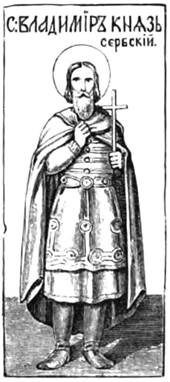
Князь Владимир – Иоанн349 во всю жизнь свою старался жить по воле Божией для блага подданных. Но и порча души нашей требует горького врачевства для её исцеления. И Господь, зная, кому из нас что нужно, посылает иным как дар любви долю не только веровать, но и страдать. Кн. Владимир перенёс много скорбей в жизни своей и умер страдальцем.
Prince Vladimir—John349—throughout his whole life strove to live according to the will of God for the good of his subjects. But even the corruption of our soul requires a bitter medicine for its healing. And the Lord, knowing what is needful for each of us, sends to some, as a gift of love, the portion not only to believe, but also to suffer. Prince Vladimir endured many sorrows in his life and died a sufferer.
Дед его кн. Хвалимир поручал во владение старшему сыну Петриславу Зету (Черногорье), Хвалимиру – Требинье и Хлевну, а младшему сыну Мирославу – Подгорье (Захлумье); но Петрислав остался единственным владетелем всех областей наследственных. В таком виде владел Ссрбией сын Петрислава кн. Владимир350.
His grandfather, Prince Khvalimir, had bequeathed to his eldest son, Petrislav, Zeta (Montenegro); to Khvalimir, Trebinje and Hlevno; and to his youngest son, Miroslav, Podgorje (Zachlumia); but Petrislav remained the sole possessor of all the hereditary regions. In this form, the son of Petrislav, Prince Vladimir350, ruled Serbia.
Между Славянами Сербами были христиане с первых времён христианства, были даже мученики за св. веру; это между оставшимися под властью Римо-Греческой351. Племена их, вытеснявшиеся бурей времён на левый берег Дуная, при имп. Ираклии возвратились в свою древнюю родину и большей частью своей приняли растерянное христианство, или, как выражается имп. Константин, «приняли древнюю веру», т. е. ту, которую и прежде принимали, но потеряли среди Гуннов Аваров. При Василии Македонянине, около 868 г., остальные приняли христианство, а все вообще Сербы усвоили себе Славянскую службу, дар св. Кирилла и Мефодия, подчинившись надзору восточного патриарха352. Имп. Василий, сам Славянин, которому отдались Сербы под защиту от Немцев и папы, «постановил так, что в Сербии будут начальствовать избираемые самими Сербами начальники; люди лучшие, которые должны охранять целость всего отечественного»353. Так и управлял Сербией кн. Владимир, не домогаясь чужого и оберегая всё родное, особенно же православную св. веру.
Among the Slav Serbs there were Christians from the earliest times of Christianity; there were even martyrs for the holy faith; this was among those who remained under the authority of the Roman-Greek351. Their tribes, driven out by the storm of the times to the left bank of the Danube, returned to their ancient homeland under the Emperor Heraclius and for the most part received a scattered Christianity, or, as the Emperor Constantine expresses it, "received the ancient faith," that is, that which they had received before but had lost among the Huns and Avars. Under Basil the Macedonian, around the year 868, the remainder received Christianity, and all the Serbs in general adopted the Slavonic service, the gift of Sts. Cyril and Methodius, submitting themselves to the oversight of the Eastern Patriarch352. The Emperor Basil, himself a Slav, to whom the Serbs gave themselves for protection from the Germans and the Pope, "decreed that in Serbia those chosen by the Serbs themselves should be the rulers; the best men, who should guard the integrity of everything native"353. Thus Prince Vladimir ruled Serbia, not coveting what was another's and safeguarding everything native, especially the holy Orthodox faith.
Владимир был, даже и по сознанию Грека, человек правдивый и добродетельный354. Болгарский царь Самуил, боровшийся с империей за подавляемую свободу Болгарии, решился заставить Владимира стать на его стороне и против империи. Он вывел против Владимира сильное войско. Владимир не хотел нарушать договора с империей. Не быв в состоянии с своими дружинами отражать силой силу, он укрепился на горе Косогоре. Самуил окружил гору многолюдным войском. Владимира встретила и другая беда: на горе оказалось много змей, люди страдали от них, а у него войско и без того было небольшое. Благочестивый князь помолился Господу в своей скорби и змеи перестали быть вредными. После долгой осады, увлечённый обещаниями Самуила, добродушный князь предался в руки царя и попал в тюрьму; любимая дочь Самуила, добрая и сострадательная, знавшая доброго Владимира, просила отца дать Владимиру свободу: не могу я, говорила Коссара, быть супругой другого, кроме Владимира. Самуил, любя дочь, устроил дело по её просьбе. Узнав же ближе Владимира, очень полюбил его355.
Vladimir was, even by the admission of a Greek, a truthful and virtuous man354. The Bulgarian Tsar Samuel, who was struggling with the Empire for the suppressed freedom of Bulgaria, resolved to force Vladimir to take his side and against the Empire. He led a strong army against Vladimir. Vladimir did not wish to violate his treaty with the Empire. Being unable with his own retinues to repel force with force, he fortified himself on Mount Kosogor. Samuel surrounded the mountain with a numerous army. Another misfortune also met Vladimir: on the mountain there turned out to be many snakes; the people suffered from them, and his army was already small. The pious prince prayed to the Lord in his sorrow, and the snakes ceased to be harmful. After a long siege, carried away by Samuel's promises, the good-natured prince gave himself into the hands of the tsar and ended up in prison. Samuel's beloved daughter, good and compassionate, knowing the virtuous Vladimir, begged her father to grant Vladimir freedom: "I cannot," said Kossara, "be the wife of any other than Vladimir." Samuel, loving his daughter, arranged the matter according to her request. Having come to know Vladimir more closely, he grew very fond of him355.
Владимир, став на стороне Болгарии, должен был противодействовать ненавистнику Славян, императору Василию. Греки вступили в пределы Владимира. Но Василий ошибся. «И мужество Иоанна, и сила его оружия, и его упование на помощь Божию, непроходимость гор, недоступность подоблачных вершин, тесные ущелья – всё это вместе окружило Василия, как сеть паука муху; неприятель был рассеян мужественным Владимиром и побеждённый возвратился назад»356. Союз Владимира с наследником Самуила – Радомиром сильно тревожил империю. Коварные Греки уговорили двоюродного брата Радомирова Владислава умертвить Радомира; в надежде на обольстительный Болгарский престол Владислав совершил злодейство357. Но так как боялся он, что Владимир не оставит в покое убийцу и предъявит права на Болгарию, то несчастный решился и на другое убийство. Злость его против Владимира и оттого ещё была сильна, что сколько он с женой предан был учению богомилов, столько Владимир не любил этих антихристиан358. Владислав пригласил к себе Владимира, как будто для мирного совета о границах владений. «Государь мой!» – говорила супругу добрая Коссара, «не езди туда, чтобы не случилось с тобой того же, что с братом; пусти меня, – я узнаю, каков новый властитель. Если ему угодно, пусть он убьёт меня, только бы ты не погиб». С позволения мужа княгиня отправилась. Владислав принял её с почестью, но притворно. Он отправил посольство к Владимиру с прежним приглашением, объявляя готовность поклясться в чувствах любви. Князь отвечал: «Господь наш Иисус Христос, пострадавший за нас, не был пригвождён к золотому или серебряному кресту, а к деревянному; если слова твои искренни, пришли с духовными лицами деревянный крест, перед которым поклянёшься, и я, полагаясь на драгоценное древо, приду к тебе». Владислав призвал к себе двух архиереев и инока, между ними был Давид, архиепископ Болгарии359, – и перед ними поклялся. Посланники передали клятву Владислава, и Владимир спокойно отправился в Болгарию. По воле Владислава убийцы ожидали Владимира на дороге, но он остался цел. Князь Сербский прибыл в Преспу и, когда стоял тут на молитве, явились убийцы. «Что это значит?» сказал он посредникам епископам. «Вы обманули меня, но я умираю невинным». Обманутые молчали от стыда. Страдалец причастился св. Таин и был безжалостно умерщвлён мая 22-го 1015 года.
Vladimir, having taken the side of Bulgaria, was compelled to oppose the hater of the Slavs, the Emperor Basil. The Greeks entered Vladimir's borders. But Basil was mistaken. "Both the courage of John, and the strength of his arms, and his hope in God's help, the impassability of the mountains, the inaccessibility of the cloud-capped peaks, the narrow gorges—all this together surrounded Basil like a spider's web a fly; the enemy was scattered by the courageous Vladimir and returned defeated"356. The alliance of Vladimir with Samuel's heir, Radomir, greatly troubled the Empire. The treacherous Greeks persuaded Radomir's cousin, Vladislav, to murder Radomir; in hope of the alluring Bulgarian throne, Vladislav committed the villainy357. But because he feared that Vladimir would not leave the murderer in peace and would lay claim to Bulgaria, the wretch resolved upon yet another murder. His malice against Vladimir was also strong for this reason: that as much as he and his wife were devoted to the teaching of the Bogomils, so much did Vladimir dislike these anti-Christians358. Vladislav invited Vladimir to come to him, as if for a peaceful council concerning the borders of their domains. "My lord!" said the good Kossara to her husband, "do not go there, lest the same happen to you as to your brother; let me go—I will find out what the new ruler is like. If it pleases him, let him kill me, only that you may not perish." With her husband's permission, the princess set out. Vladislav received her with honor, but deceitfully. He sent an embassy to Vladimir with the former invitation, declaring his readiness to swear an oath of feelings of love. The prince replied: "Our Lord Jesus Christ, Who suffered for us, was not nailed to a golden or silver cross, but to a wooden one; if your words are sincere, send with clergy a wooden cross, before which you will swear, and I, trusting in the precious wood, will come to you." Vladislav summoned to himself two hierarchs and a monk—among them was David, Archbishop of Bulgaria359—and swore before them. The envoys conveyed Vladislav's oath, and Vladimir calmly set out for Bulgaria. By Vladislav's will, murderers awaited Vladimir on the road, but he remained unharmed. The Serbian prince arrived at Prespa, and while he stood there in prayer, the murderers appeared. "What does this mean?" he said to the mediating bishops. "You have deceived me, but I die innocent." The deceived ones were silent from shame. The sufferer partook of the Holy Mysteries and was mercilessly put to death on May 22nd of the year 1015.
Тело св. Владимира похоронено было в храме, и многие больные получали исцеление на гробе его. Коссара перенесла тело страдальца в Краину и здесь, в своей обители, приняв иночество, кончила жизнь свою близ супруга-мученика360. Убийца и клятвопреступник Владислав, спустя два года по совершении злодейства, неожиданно умер в муках совести361. Мироточивые мощи св. князя почивают поныне близ Элбасани362.
The body of St. Vladimir was buried in a church, and many sick people received healing at his tomb. Kossara translated the body of the sufferer to Kraina, and there, in her own monastery, having received the monastic habit, she ended her life near her husband-martyr360. The murderer and oath-breaker Vladislav, two years after committing the villainy, died unexpectedly in the torments of his conscience361. The myrrh-streaming relics of the holy prince repose to this day near Elbasan362.
О св. кн. Владимире: а) житие кн. Владимира, то, которым пользовался Диоклейский священник, оставивший заметку: quantas et quales virtutes et prodigia Deus operare dignatus est per b. Vladimirum famulum Suum dui scire desiderat, librum gestorum eius relegat, quo acta eius per ordinem scripta sunt. 6) Presbyteri Diocleensis regnum Slavorum, где о кн. Владимире Извлечение из его жития – всё сочинение – перевод с Славянского. (В предисловии пишется: libellum Gothorum, quod Latine Slavorum dicitur regnum, quo omnia gesta ac bella eorum scripta sunt, ex Slavonica littera verterem in Latinam.) B) Αϰολουϑεια και βιος Βλαδιμιρου και ϑαυματουργου – сочинение довольно позднее.
Concerning St. Prince Vladimir: a) The Life of Prince Vladimir, that used by the Priest of Dioclea, who left a note: quantas et quales virtutes et prodigia Deus operare dignatus est per b. Vladimirum famulum Suum dui scire desiderat, librum gestorum eius relegat, quo acta eius per ordinem scripta sunt. b) Presbyteri Diocleensis regnum Slavorum, where concerning Prince Vladimir—an extract from his Life—the whole work is a translation from Slavonic. (In the preface it is written: libellum Gothorum, quod Latine Slavorum dicitur regnum, quo omnia gesta ac bella eorum scripta sunt, ex Slavonica littera verterem in Latinam.) c) Αϰολουϑεια και βιος Βλαδιμιρου και ϑαυματουργου—a rather late composition.
О Требиньском храме 4 в. см. апр. 29. О Рашском храме летопись: «крещен бысть (Нееманя) – в храме светих Апостол Петра и Павла иже создана св. Апост. Титом во время оно, наподобие кумирниц ондашних, якоже и нине стоит нерушима и поется в ней и нине». Гласник V, 29. О мучениках янв. 13, мар. 26, июня 24. Имп. Константин говорит о Сербах как Грек, льстя тщеславию Грека, да и ещё при недостатке рассудительности выставляет собранные там и здесь отрывки сведений, не проверенных критикой (Шафарика древн. III, 400–409). Он забыл Венедов, которые ещё при Геродоте с незапамятных времён жили по Адриатике и по Дунаю. В малом числе слов и названий уцелевших, из языка этих Венедов, каждый Славянин узнает свои родные слова. Забыл Багрянородный и слова Тацита о Венедах: domos fingunt, т. е. не бродят туда и сюда, если только не выгоняют их насилием из родных мест. Прокопий тоже говорит: Sclavini in tuguriis sparsis habitant. Потому напрасно слова Константина принимали за свидетельство о первом появлении Сербов на юге при Ираклии. Дело идёт только о нескольких жупах, явившихся с севера с правами независимого гражданского быта и вовлёкших потом в свой независимый круг остававшиеся на юге Славянские племена. Так рассуждал о деле умный Лаоник Халкондил (Hist, de reb. Turcicis p. 34–36. 530–531. ed. Becneri). Шафарик до того увлёкся своими Кельтами – Волохами на ложный путь, что тогда как признаёт путаницу ограниченного смысла в показаниях Багрянородного, тогда как знает южных Венедов, тогда как много раз выставляет памятники пребывания Славян на юге в V веке, всё-таки начинает историю Сербии Ираклием. Надобно ожидать, что учёные южные Славяне соберут новые данные и подвергнут былое южных Славян более верному пересмотру. Кукулевич (в Загребском журнале: Neven 1855 № 17. 18) отыскал в Далмации множество грамот, из которых старшая относится к 837 г., а список известных ему Боснийских начинается с 914 г. К сожалению, папизм – несчастие для Славян – несчастие и для их истории (Arkiv za povestn. jugosl., II, 1.13).
Concerning the church in Trebinje of the 4th century, see April 29. Concerning the church in Raška, the chronicle says: “He (Nemanja) was baptized in the church of the holy Apostles Peter and Paul, which was built by the holy Apostle Titus in that time, in the likeness of the pagan temples of that day, and it stands unshaken even now, and services are sung in it even now.” Glasnik V, 29. Concerning the martyrs, January 13, March 26, June 24. Emperor Constantine speaks of the Serbs as a Greek, flattering the vanity of a Greek, and moreover, with a lack of discernment, he sets forth fragments of information gathered here and there, unchecked by criticism (Šafárik, Slavonic Antiquities III, 400–409). He forgot the Veneti, who, even in the time of Herodotus, lived from time immemorial along the Adriatic and along the Danube. In the few words and names that have survived from the language of these Veneti, every Slav recognizes his own native words. Porphyrogennetos also forgot the words of Tacitus about the Veneti: domos fingunt, i.e., they do not wander hither and thither, unless violence drives them from their native places. Procopius also says: Sclavini in tuguriis sparsis habitant. Therefore, Constantine’s words have been mistakenly taken as testimony of the first appearance of the Serbs in the south under Heraclius. The matter concerns only a few župas that appeared from the north with the rights of an independent civil order and later drew into their independent circle the Slavic tribes remaining in the south. So the intelligent Laonicus Chalcocondyles reasoned about the matter (Hist. de reb. Turcicis, pp. 34–36, 530–531, ed. Becneri). Šafárik was so carried away by his Celts–Vlachs onto a false path that, while he acknowledges the confusion of limited meaning in the testimonies of Porphyrogennetos, while he knows the southern Veneti, while he repeatedly sets forth monuments of the presence of Slavs in the south in the 5th century, he nevertheless begins the history of Serbia with Heraclius. It is to be expected that learned southern Slavs will gather new data and subject the past of the southern Slavs to a more accurate review. Kukuljević (in the Zagreb journal Neven, 1855, Nos. 17, 18) discovered in Dalmatia a multitude of charters, the oldest of which dates to 837, while the list of Bosnian charters known to him begins with 914. Unfortunately, papism—a misfortune for the Slavs—is also a misfortune for their history (Arkiv za povestn. jugosl., II, 1, 13).
Константин de admin. imp. c. 29. сперва показывает, что имп. Ираклий дал переселившимся Сербам и Хорватам учителей христианства, подчинив их Сплетскому архиепископу, причём говорит о Славянах: pietatis opera edocti, fide antiqua accepta. Потом пишет: «после вся Далматия и соседние народы, Краоты, Сербы, Захлумляне, Требиньцы, Канавиты, Дуклейцы, Неретвяне, иначе патаны – некрещённые, отступили от власти империи и стали вольными... Многие из них жили некрещёнными. При им. Василии Македонянине они просили у него крещения; тот послал крестить их. Неретвяне жили в неприступных местах и скалах и те просили и получили крещение». –То же в жизни имп. Василия § 53–55. Здесь сказано и то, что «многие из Славян (при Михаиле Косноязычном) отказались от христианства, чтобы не иметь никакого залога подчинения Грекам». – Даже и в Сплетской епархии до 1058 г. Богослужение совершалось на Славянском языке славянскими священниками. Фома, архидиакон Сплетений, пишет: «собором постановлено и утверждено,чтобы никто не совершал таинств на Славянском языке, а только на Латинском и Греческом и дабы никто из того (Славянского) языка не возводим был на степени... Когда это постановлено собором и утверждено властью (папой), все священники Славян поражены были великой скорбью,все церкви их были заперты и они прекратили служение» (Farlati Illyricum 111,130). Таковы дела романизма!
Constantine, De administrando imperio, ch. 29, first shows that Emperor Heraclius gave the migrating Serbs and Croats teachers of Christianity, placing them under the Archbishop of Spalato, and in this connection he says of the Slavs: pietatis opera edocti, fide antiqua accepta. Then he writes: “Afterwards, all of Dalmatia and the neighboring peoples—the Croats, Serbs, Zachlumians, Trebinjians, Kanavites, Docleans, Narentines, otherwise called Pagans—unbaptized, fell away from the authority of the empire and became free... Many of them lived unbaptized. Under Emperor Basil the Macedonian, they asked him for baptism; he sent to baptize them. The Narentines lived in inaccessible places and rocks, and they asked for and received baptism.” —The same is found in the Life of Emperor Basil, §§ 53–55. There it is also said that “many of the Slavs (under Michael the Stammerer) renounced Christianity, so as to have no pledge of submission to the Greeks.” —Even in the Spalato diocese until 1058, the divine service was performed in the Slavic language by Slavic priests. Thomas, Archdeacon of Spalato, writes: “It was decreed and confirmed by the council, that no one should perform the mysteries in the Slavic language, but only in Latin and Greek, and that no one of that (Slavic) language should be elevated to the orders... When this was decreed by the council and confirmed by the authority (of the pope), all the Slavic priests were struck with great sorrow, all their churches were locked, and they ceased the service” (Farlati, Illyricum, III, 130). Such are the deeds of Romanism!
Диоклейский пресвитер: «Радомир завладел землёй Греческой. Имп. Василий – отправил тайное посольство к двоюродному, брату его Владиславу. – Зачем ты не мстишь за кровь отца своего? так он велел сказать Владиславу, прими от меня, сколько хочешь, золота и серебра и возьми себе царство Самуила, убей, если можешь, сына его Радомира, который владеет престолом».
The Presbyter of Doclea: “Radomir took possession of the Greek land. Emperor Basil sent a secret embassy to his cousin Vladislav. ‘Why do you not avenge your father’s blood?’ he ordered to be said to Vladislav. ‘Take from me as much gold and silver as you wish, and take for yourself the kingdom of Samuel; kill, if you can, his son Radomir, who holds the throne.’”
Так у Кедрина 2, 556. Это один из архиепископов Болгарских, опущенных у Дю-Канжа (Розенкампф о кормчей, ир. 73). Он должен быть признан предшественником Иоанна, посвящённого в 1017 г. (Июль, пр. 17).
Thus in Cedrenus, 2, 556. This is one of the Archbishops of Bulgaria omitted by Du Cange (Rosenkampf, On the Kormchaya, p. 73). He must be recognized as the predecessor of John, consecrated in 1017 (July, pr. 17).