Orthodox Translations

May 2121 мая

Old Calendar: civil June 3 · New Calendar: civil May 21

History

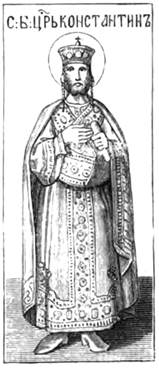
Св. Равноапостольного царя Константина и матери его Елены

Sts. Constantine, the Equal-to-the-Apostles Emperor, and Helen, his Mother
E1.TAI draft
Engraving

При них Церковь христианская, три века гонимая врагами Христа, приобрела мир и восторжествовала над Иудеями и язычниками. Промысл Божий, устрояя это торжество святой Церкви, постепенно приготовил избраннейшие орудия для её распространения, утверждения и славы. Подробные и обстоятельные сведения о Константине и Елене главным образом сообщает Евсевий, епископ Кесарийский, – современник и собеседник Константина и Елены.

Under them the Christian Church, persecuted for three centuries by the enemies of Christ, acquired peace and triumphed over the Jews and pagans. The Providence of God, arranging this triumph of the holy Church, gradually prepared the most chosen instruments for its spread, establishment, and glory. Detailed and circumstantial information about Constantine and Helen is chiefly communicated by Eusebius, Bishop of Caesarea, a contemporary and companion of Constantine and Helen.

E1.0AI draft

Отец Константина Великого, царь Констанций Хлор, управлявший западными частями Римской империи, будучи язычником, не имел и не показывал уже доверия и уважения к язычеству, но являл расположение к христианам, жившим под властью его на западе. Между тем на востоке и в других местах империи, где владычествовали Диоклитиан, Максимиан, Максентий, продолжались ещё гонения на христиан и разные угнетения всех подданных. «Констанций, говорит Евсевий, чуждался [без]нравственной жизни своих соцарственников и стремился выражать любовь к Богу всяческих. Те нападали на Церкви Божии и разрушали их сверху до низу; напротив, Констанций сохранил свои руки чистыми от такого гибельного нечестия. Те оскверняли подчинённые себе области домашними убийствами благочестивых мужей и жён; а он соблюл свою душу незапятнанной таким преступлением. Давая подданным в течение долгого времени испытывать доказательства царской своей добродетели, признавая одного над всеми Бога и презирая образ жизни безбожников, он оградил свой дом молитвами св. мужей и посвящал одному Царю – Богу, так что общество собиравшегося в его дворце народа ничем не отличалось от Церкви Божией». У своего кроткого, добродетельного и благоразумного отца Константин заимствовал первые правила честной жизни; с ранних лет обнаруживал свои преимущества будущего царского величия и перед всеми своими сверстниками отличался красотой тела, роста и крепостью сил. Но гораздо более, нежели совершенствами тела, украшался он добродетелями души, и прежде всего отличался скромностью, образованностью, врождённым умом и дарованной от Бога мудростью. Живя и воспитываясь, подобно Моисею, среди язычников и гонителей истинной веры, Константин сохранил себя от нечестия и злобы. «Тогдашние государи, видя, что этот юноша бодр, силён, велик и богат умом, исполнялись зависти и страха и начали выжидать удобного случая, как бы запятнать его каким-нибудь бесчестием. Но юноша, заметив это, искал спасения в бегстве, через что опять уподобился великому пророку Моисею».

The father of Constantine the Great, Emperor Constantius Chlorus, who ruled the western parts of the Roman Empire, being a pagan, had no trust in or respect for paganism, nor did he show any, but displayed favor toward the Christians living under his authority in the West. Meanwhile, in the East and in other places of the empire, where Diocletian, Maximian, and Maxentius held sway, persecutions against Christians and various oppressions of all subjects still continued. "Constantius," says Eusebius, "shunned the immoral life of his co-rulers and strove to express love for the God of all. They attacked the Churches of God and destroyed them from top to bottom; on the contrary, Constantius kept his hands clean from such ruinous impiety. They defiled the regions subject to them with domestic murders of pious men and women; but he preserved his soul unstained by such a crime. Giving his subjects over a long time to experience proofs of his royal virtue, acknowledging the one God over all and despising the way of life of the godless, he fortified his house with the prayers of holy men and dedicated it to the one King—God, so that the assembly of people gathered in his palace differed in nothing from the Church of God." From his gentle, virtuous, and prudent father, Constantine learned the first rules of an honorable life; from early years he displayed the advantages of his future royal greatness and surpassed all his peers in beauty of body, stature, and strength. But far more than by bodily perfections, he was adorned by the virtues of his soul, and above all was distinguished by modesty, learning, innate intelligence, and wisdom granted by God. Living and being brought up, like Moses, among pagans and persecutors of the true faith, Constantine preserved himself from impiety and malice. "The rulers of that time, seeing that this youth was vigorous, strong, great, and rich in mind, were filled with envy and fear and began to watch for a convenient opportunity to stain him with some dishonor. But the youth, noticing this, sought salvation in flight, through which he again likened himself to the great prophet Moses."

E1.1AI draft

По смерти отца достойный сын и наследник его, любимый народом, всеми единодушно и с радостью провозглашён был царём, на 31 году от рождения. Из бедственной судьбы гонителей христианства и по успехам отца своего – покровителя христиан Константин справедливо заключал, что надобно удаляться многобожного язычества и почитать единого истинного Бога, исповедуемого христианами. Близкий к христианству по расположениям сердца своего, Константин обращён был ко Христу и Богу истинному чудесным явлением на небеси знамения Креста Господня и явлением ему Сына Божия в ночном видении. Константин сделался христианином, и таковым был первый из Римских императоров, принявши от Бога, по гласу Церкви, «багряницу и скипетр. Не от человек звание приим, но яко Божественный Павел, имел сие звание свыше от Христа Бога. Знамение бо Креста на небеси видев, сим уловился яко добрейший лов: о сём и победитель видимых и невидимых врагов явился».

After the death of his father, the worthy son and heir, beloved by the people, was unanimously and joyfully proclaimed emperor by all, in the 31st year from his birth. From the disastrous fate of the persecutors of Christianity and from the successes of his father—the protector of Christians—Constantine rightly concluded that one must turn away from polytheistic paganism and honor the one true God confessed by Christians. Being close to Christianity by the disposition of his heart, Constantine was converted to Christ and the true God by the miraculous appearance in heaven of the sign of the Cross of the Lord and by the appearance to him of the Son of God in a night vision. Constantine became a Christian, and was the first of the Roman emperors to be such, having received from God, according to the voice of the Church, "the purple and the scepter. Receiving his calling not from men, but like the divine Paul, he had this calling from above from Christ God. For having seen the sign of the Cross in heaven, he was caught by it as the best of catches: by this he also appeared a victor over visible and invisible enemies."

E1.2AI draft

Убеждённый в истине Божественного явления, Константин был оглашён христианином, начал прилежно заниматься чтением Священных книг и повелел находиться при себе иереям Божиим, полагая, что Господь, явившийся ему, один достоин Божественного поклонения. И не только сам он в душе своей уверовал во Христа Сына Божия, но и всенародно исповедал Его перед своими подданными. После победы над Максентием Константин, совокупно с Ликинием, своим зятем и со-царственником, объявил в 314 году свободу христианского вероисповедания. «Усмотрев, что свободы Богослужения стеснять не должно, мы ещё прежде повелевали, как всем другим, так и христианам, сохранять веру и Богослужение своего общества. Отныне каждый, решившийся соблюдать Богослужение христианское, пусть соблюдает его свободно и неуклонно, без всякого затруднения. Кроме сего, в пользу христиан мы постановляем и то, чтобы места, где прежде христиане особенно собирались, у казны ли нашей кто купил эти места, или у кого другого, – без возврата заплаченной за них суммы немедленно и беспрекословно отдаваемы были христианам. Равным образом и получивший такие места в дар должен, как можно скорее, возвратить их в собственность христиан. А кто, купив или получив их в дар, захотел бы просить за них от нашей доброты вознаграждения, тот пусть обратится к местному правителю, – и наша милость не оставит его просьбы без внимания. Всё это должно быть возвращено обществу христиан тотчас, без всякого отлагательства».

Convinced of the truth of the divine appearance, Constantine was made a catechumen, began diligently to occupy himself with the reading of the Sacred Books, and commanded that the priests of God should be with him, considering that the Lord who had appeared to him alone was worthy of divine worship. And not only did he himself believe in his soul in Christ the Son of God, but he also confessed Him publicly before his subjects. After the victory over Maxentius, Constantine, together with Licinius, his son-in-law and co-ruler, declared in the year 314 the freedom of the Christian confession. "Having observed that the freedom of worship ought not to be constrained, we have already previously commanded, as to all others, so also to Christians, to preserve the faith and worship of their community. Henceforth, let everyone who has decided to observe Christian worship observe it freely and steadfastly, without any hindrance. Besides this, in favor of Christians we also decree that the places where Christians formerly especially assembled, whether anyone has bought these places from our treasury or from someone else, shall be returned to Christians immediately and without objection, without repayment of the sum paid for them. Likewise, he who has received such places as a gift must, as soon as possible, return them to the ownership of Christians. And if anyone, having bought or received them as a gift, should wish to ask compensation for them from our kindness, let him turn to the local governor—and our mercy will not leave his request unheeded. All this must be returned to the Christian community at once, without any delay."

E1.3AI draft

Благость и щедроты Константина особенно изливалась на церкви Божии; то он расширял и возводил выше молитвенные дома, то весьма многими приношениями украшал св. алтари церквей. «Какая была Божественная у всех радость, говорит Евсевий, когда увидели, что места, незадолго перед тем опустошённые нечестием притеснителей, как бы после продолжительной и смертоносной язвы снова оживают; что храмы, начиная с основания до высоты недосязаемой, опять воздвигаются и получают гораздо лучший вид, нежели прежние, разрушенные. Затем для всех нас открылось умилительное и вожделенное зрелище: по городам начались праздники обновления и освящения вновь устроенных храмов; а для этого стали собираться епископы, стекались издалека чужестранцы, дружелюбно сближались между собой народы, и члены Христова тела сходились в один состав. Богослужение предстоятелей и священнодействие священников стали совершенными, церковные обряды сделались Боголепными. Люди всякого возраста, пола, всей силой души, радуясь умом и сердцем, воссылали молитвы и благодарения к Виновнику настоящих благ – Богу».

The goodness and generosity of Constantine were especially poured out upon the churches of God; at one time he enlarged and raised higher the houses of prayer, at another he adorned the holy altars of the churches with very many offerings. "What divine joy was there among all," says Eusebius, "when they saw that the places, not long before laid waste by the impiety of the oppressors, as if after a long and deadly plague, came to life again; that the churches, from the foundation to an inaccessible height, were again erected and received a far better appearance than the former, destroyed ones. Then there opened before us all a touching and longed-for spectacle: in the cities began festivals of renewal and consecration of the newly built churches; and for this, bishops began to gather, foreigners streamed in from afar, peoples drew near to one another in friendship, and the members of Christ's body came together into one whole. The divine service of the leaders and the sacred rites of the priests became perfect, the church ceremonies became God-befitting. People of every age and sex, with all the strength of their soul, rejoicing in mind and heart, sent up prayers and thanksgivings to the Author of these present blessings—God."

E1.4AI draft

Особенно торжественно и радостно было освящение храма Тирского в 315 году. Этот храм, как и другие, был разрушен; неверные старались обезобразить само место, покрыв его всякого рода нечистотами. Восстановление Тирского храма было торжеством христианства над язычеством. При освящении его Евсевий между прочим произнёс в слове своём в похвалу Константину: «и вот теперь, чего прежде никогда не бывало, верховные цари признают только единого Бога, общего благодетеля всех людей и их самих, исповедуют Христа Сыном Божиим и Царём всяческих, называют Его в обнародуемых указах Спасителем и среди владычествующего над землёй города, для неизгладимой памяти, царски начертывают дела Его и победы над нечестивыми. Теперь единого от вечности Иисуса Христа Спасителя и самые высшие властители на земле почитают не как обыкновенного царя, какие поставляются человеками, но покланяются Ему, как истинному Сыну Бога всяческих и истинному Богу. Украшения и дары этого храма важны и поистине велики, изумительны и достойны удивления, так как служат ясным доказательством царства нашего Спасителя».

Especially solemn and joyful was the consecration of the Church of Tyre in the year 315. This church, like others, had been destroyed; the unbelievers tried to disfigure the very place, covering it with all kinds of filth. The restoration of the Church of Tyre was a triumph of Christianity over paganism. At its consecration, Eusebius, among other things, said in his speech in praise of Constantine: "And behold now, what never before happened, the supreme emperors acknowledge only the one God, the common Benefactor of all men and of themselves, confess Christ as the Son of God and King of all, call Him in published edicts the Savior, and in the city ruling over the earth, for an indelible memorial, royally inscribe His deeds and victories over the impious. Now the one from eternity, Jesus Christ the Savior, even the highest rulers on earth honor not as an ordinary king, such as are appointed by men, but worship Him as the true Son of the God of all and the true God. The adornments and gifts of this church are important and truly great, astonishing and worthy of wonder, since they serve as a clear proof of the kingdom of our Savior."

E1.5AI draft

Константин начал почитать служителей Божиих и оказывать им отличное уважение, словом и делом, как лицам, посвящённым Богу. Делил с ними он трапезу и беседу. В человеке он смотрел не на человека, которого видят многие, а на Бога. Так благочестивый Константин в 315 году писал о священных лицах: «пренебрежение Богопочтения подвергало общественные дела великим опасностям; а законное хранение его, по благоволению Божию, доставляло Римскому государству величайшее благополучие и всем человеческим делам особенное счастье. Посему нам кажется справедливым, чтобы мужи, отличающиеся должной святостью и посвящающие свою службу пользе Божественной веры, получили за свои труды должное воздаяние. Я хочу, чтобы лица кафолической Церкви, посвящающие своё служение св. вере, оставались совершенно свободными от всех гражданских обязанностей, и не отвлекались от служения, подобающего Божеству, и ничем не развлекаемые, тем лучше исполняли свой закон. Если они будут служить Божеству со всей ревностью, то, кажется, и для общественных дел произойдёт от того весьма много пользы».

Constantine began to honor the servants of God and to show them exceptional respect, in word and deed, as persons dedicated to God. He shared his table and conversation with them. In a man he looked not at the man, whom many see, but at God. Thus the pious Constantine wrote in the year 315 concerning sacred persons: "Neglect of the worship of God subjected public affairs to great dangers; but its lawful preservation, by the good pleasure of God, brought the greatest prosperity to the Roman state and particular happiness to all human affairs. Therefore it seems just to us that men who are distinguished by due holiness and who dedicate their service to the benefit of the divine faith should receive due recompense for their labors. I desire that the persons of the Catholic Church, who dedicate their service to the holy faith, remain completely free from all civil obligations, and not be distracted from the service due to the Divinity, and, being distracted by nothing, may the better fulfill their law. If they serve the Divinity with all zeal, then, it seems, very much benefit will also result from this for public affairs."

E1.6AI draft

Царь Константин и для всех был благосклонен, милостив, сострадателен и щедр; для сирот и бедных он был вместо отца. Но имея особенное попечение о мире Церкви Божией, он действовал, как общий, поставленный Богом, блюститель и учреждал Соборы служителей Божиих, напр. в Риме в 313 году, в Арелате ныне – Арле во Франции в 314 году, оба против донатистов, и даже не отказывался иногда являться и заседать сам лично среди сонма их, как общий, постановленный от Бога епископ.

Emperor Constantine was also gracious, merciful, compassionate, and generous to all; for orphans and the poor he was as a father. But having special care for the peace of the Church of God, he acted as a general overseer appointed by God and convened Councils of the servants of God, for example, in Rome in the year 313, in Arelate—now Arles in France—in the year 314, both against the Donatists, and he did not even refuse sometimes to appear and sit personally among their assembly, as a general bishop appointed by God.

E1.7AI draft

Между тем как царь Константин покровительствовал Церкви, Ликиний, напитанный языческими мнениями, по зависти и злобе к нему около 316 года начал гнать христиан в своей области, сначала тайно, а потом и открыто. Желая пресечь гонение Ликиния на христиан, Константин решился (323 г.) низложить его самого. Хорошо зная, что если когда, то теперь особенно нужны ему молитвы, он взял с собою священников Божиих. Войску его предшествовало знамение спасительного страдания – Крест. Повелев в рядах воинских носить знамение Креста, царь и при себе вне лагеря всегда имел походный храм Кресту и, держась непорочного и чистого образа жизни, возносил молитвы к Богу, по примеру того древнего пророка Божия, который имел свою скинию вне полка (Исх.33:7). Во время брани с Ликинием Константин приказывал щадить пленных и удостоился получить особенные знамения Божественного Покровителя. «В подвластных Ликинию городах видели неизъяснимое явление: казалось, будто среди самого полудня через города переходили различные полки Константиновых латников, как бы одержавших победу. И это видели тогда, когда на самом деле нигде и ничего подобного не было. Сим зрелищем Божественная и высшая сила указывала на будущее». Укрепляемый силой Креста и молитвами к Богу истинному и Его благодатью, Константин победил Ликиния и в лице его язычество, и всегда уходил с поля битвы победителем, приписывая победы не себе, а Богу.

While Emperor Constantine protected the Church, Licinius, imbued with pagan opinions, out of envy and malice toward him, around the year 316 began to persecute Christians in his own domain, at first secretly, and then openly. Desiring to put an end to Licinius’ persecution of Christians, Constantine resolved (in 323) to depose him. Knowing full well that if ever, then especially now he needed prayers, he took with him the priests of God. His army was preceded by the sign of the saving Passion—the Cross. Having commanded that the sign of the Cross be borne in the ranks of the soldiers, the emperor also always kept with him, outside the camp, a portable church to the Cross, and, adhering to a blameless and pure way of life, he lifted up prayers to God, following the example of that ancient prophet of God who had his tabernacle outside the camp (Ex. 33:7). During the war with Licinius, Constantine ordered that prisoners be spared, and was deemed worthy to receive special signs of the Divine Protector. “In the cities subject to Licinius, an inexplicable vision was seen: it seemed as if, in the very midst of midday, various regiments of Constantine’s armored soldiers were passing through the cities, as though they had gained a victory. And this was seen at a time when in reality nothing of the sort was happening anywhere. By this spectacle, the Divine and higher power indicated the future.” Strengthened by the power of the Cross and by prayers to the true God and His grace, Constantine defeated Licinius and, in his person, paganism, and always departed from the field of battle a victor, ascribing the victories not to himself, but to God.

E1.8AI draft

После победы над Ликинием, к конце 323 года, доставившей Константину на 49 году его жизни власть над всей обширной Римской империей, он восстановил извне мир и безопасность Церкви во всей империи; исповедникам Христовым возвращены были гражданско-церковные права, должности, преимущества и имение, чего они лишены были гонителями христианства, осуждённые на изгнание за то, что не служили идолам, были вызваны и освобождены от наказаний; имущество св. мучеников, положивших жизнь свою за исповедание веры, предписано было отдавать их родственникам, а за неимением их – Церкви. Особым постановлением своим Константин избавил христиан от гонений и на будущее время, и своим высоким участием утешал страдальцев Христовых и всех христиан. Места, ознаменованные священными событиями и обагрённые кровью христиан. он приобретал для св. Церквей и на этих местах созидал храмы Богу истинному. Старался уничтожить идолопоклонство, запрещал ставить идолов, приносить им жертвы; храмы христианские воздвигал обширнее и великолепнее, такими своими деяниями внушая всем, что Христос есть истинный Бог и Спаситель мира, и успехи в великих делах своих приписывая не себе, а Богу истинному. Для сооружения и великолепия храмов Божиих он приносил щедрые пожертвования. Молился о благоденствии всех своих подданных и желал видеть всех их христианами, но вместе объявлял, что он не хочет принуждать и стеснять свободы совести подданных.

After the victory over Licinius, at the end of 323, which brought Constantine, in the 49th year of his life, authority over the entire vast Roman Empire, he restored from without peace and security to the Church throughout the empire; to the confessors of Christ were returned their civil and ecclesiastical rights, offices, privileges, and property, of which they had been deprived by the persecutors of Christianity, condemned to exile for not serving idols; they were summoned back and freed from punishments; the property of the holy martyrs, who had laid down their lives for the confession of the faith, was ordered to be given to their relatives, and in their absence, to the Church. By a special decree, Constantine delivered Christians from persecution also for the future, and by his lofty participation comforted the sufferers for Christ and all Christians. The places marked by sacred events and stained with the blood of Christians, he acquired for the holy Churches, and on these places he built churches to the true God. He strove to destroy idolatry, forbade the setting up of idols and the offering of sacrifices to them; he erected Christian churches more spacious and magnificent, by such deeds instilling in all that Christ is the true God and Savior of the world, and ascribing the successes in his great works not to himself, but to the true God. For the construction and splendor of the churches of God, he made generous donations. He prayed for the well-being of all his subjects and desired to see them all Christians, but at the same time declared that he did not wish to compel or restrict the freedom of conscience of his subjects.

E1.9AI draft

Употребляя все силы, зависевшие от власти императора, к насаждению, утверждению и прославлению христианства, Константин Великий всемерно заботился и о внутреннем мире Церкви Христовой, которой благотворное и спасительное влияние на нравы народов он видел ясно и ценил высоко. Услышав о тяжком заблуждении Ария, родом из Ливии, священника одного из приходов Александрии, своим лжеучением о Сыне Божием (с 321 года), и Мелетия, своим расколом (с 324 г.), возмущавших Церковь Божию в Египте, Константин, скорбя духом, посылал в Александрию, где Арий начал распространять свои дерзкие и невежественные мысли и Божественное учение подверг оскорбительным глумлениям и насмешкам, сначала письма Александру епископу Александрийскому и Арию и старался примирить его с Церковью. Но Арий не думал вразумиться, и посему благочестивый царь отправил в Александрию Осию епископа Кордовского, 67-летнего старца, для рассмотрения спора на месте рождения лжеучения и водворения мира. Когда ни письмо императора, ни посольство благочестивого Осии не прекратили соблазна Ариева, император, по совету епископов, созывает в 325 году по Р. Хр. Первый Вселенский собор в Никее – городе Вифинии, для уврачевания зла и прекращения смятения и соблазна в Церкви Православной. Чтобы устранить препятствия, которые могли бы замедлить прибытие епископов в назначенное время, Константин повелел приготовить всё необходимое на всех путях для удобнейшего шествия пастырей, и на месте собора для их пребывания. Как истинный сын Церкви, царь сам и со смирением явился на собор, воздал должную честь святителям и всем вместе и особенно тем из них, кои имели на себе знаки страданий за имя Христово. Язвы сих мучеников Христовых, прибывших на собор, он со слезами лобызал. Царь открыл собор 19-го июня 325 года речью к отцам, прося их умирить Церковь Божию и на соборе склонял разномыслящих к единению. По окончании собора царь писал два послания, чтобы объявить о действиях собора и сделать их известными тем, кои не присутствовали на соборе. Первое писано было всем вообще Церквам; второе – Церкви Александрийской, чтобы показать, что определение веры производилось не просто и как-нибудь, но объявлено после долгого испытания и исследования, и что показалось трёмстам епископам, то не иное что есть, как мысль Божия. Кроме сего он обнародовал осуждение Ария и его писаний и последователей.

Using all the efforts dependent on the emperor’s authority for the planting, establishment, and glorification of Christianity, Constantine the Great also cared in every way for the internal peace of the Church of Christ, whose beneficial and saving influence on the morals of the peoples he clearly saw and highly valued. Hearing of the grievous error of Arius, a Libyan by birth, a priest of one of the parishes of Alexandria, who by his false teaching about the Son of God (from 321), and of Meletius, by his schism (from 324), were disturbing the Church of God in Egypt, Constantine, grieving in spirit, sent to Alexandria, where Arius had begun to spread his bold and ignorant thoughts and subjected the Divine teaching to offensive mockeries and jeers, first letters to Alexander, bishop of Alexandria, and to Arius, and tried to reconcile him with the Church. But Arius did not think to be admonished, and therefore the pious emperor sent Hosius, bishop of Corduba, a 67-year-old elder, to Alexandria to examine the dispute at the birthplace of the false teaching and to establish peace. When neither the emperor’s letter nor the embassy of the pious Hosius put an end to the scandal of Arius, the emperor, on the advice of the bishops, convened in the year 325 A.D. the First Ecumenical Council in Nicaea, a city of Bithynia, for the healing of the evil and the cessation of the disturbance and scandal in the Orthodox Church. To remove obstacles that might delay the arrival of the bishops at the appointed time, Constantine ordered that everything necessary be prepared on all the roads for the easier journey of the pastors, and at the place of the council for their lodging. As a true son of the Church, the emperor himself appeared at the council with humility, rendered due honor to the hierarchs, both to all together and especially to those among them who bore the marks of sufferings for the name of Christ. The wounds of these martyrs of Christ, who had come to the council, he kissed with tears. The emperor opened the council on the 19th of June, 325, with a speech to the fathers, asking them to pacify the Church of God, and at the council he inclined those of differing opinions toward unity. At the conclusion of the council, the emperor wrote two epistles to announce the acts of the council and to make them known to those who were not present at the council. The first was written to all the Churches in general; the second to the Church of Alexandria, to show that the definition of the faith was produced not simply and in a haphazard way, but was declared after long examination and investigation, and that what seemed good to three hundred bishops was nothing other than the mind of God. Besides this, he published the condemnation of Arius and his writings and followers.

E1.10AI draft

Заключение собора стеклось с окончанием двадцатилетия царствования Константина Великого, 25-го июля. По сему случаю царь радостно торжествовал с отцами собора двадцатилетие своего царствования; после праздника благодарил их каждого приличными дарами и, прощаясь с ними, убеждал их хранить мир и согласие, поминать его в молитвах; император оказал великие милости и всем своим подданным. Отцы собора обратно отправились также на иждивении царском. По возвращении с собора в 326 году благочестивый самодержец украсил многими св. храмами Палестину, Рим и Константинополь. Прежде всего он приступил к созиданию величайшего памятника в Палестине, чтобы священнейшее место спасительного воскресения Христова в Иерусалиме сделать предметом особенного и общего благоговения. Он повелел немедленно построить там молитвенный дом и писал Макарию, епископу Иерусалимскому, чтобы он с своей стороны принял живое участие в исполнении его благочестивых намерений. Царю угодно было, чтобы этот храм построен был превосходнее и великолепнее всех других церквей вселенной; и по желанию императора действительно сооружён был великолепный храм и богато украшен от царских щедрот. По желанию Константина Великого, усердием матери его Елены построены были храмы Божии в Вифлееме и на горе Масличной, чтобы почтить места рождества и вознесения Господа; у дуба Мамврийского, где некогда Авраам принял и угостил Господа и Ангелов е виде трёх странников; в Никомидии – столице Вифинии; в Антиохии – столице всего востока; в Илиополе и в других местах Финикии.

The conclusion of the council coincided with the end of the twentieth year of the reign of Constantine the Great, on the 25th of July. On this occasion, the emperor joyfully celebrated the twentieth year of his reign with the fathers of the council; after the feast, he thanked each of them with appropriate gifts, and, bidding them farewell, urged them to preserve peace and harmony, and to remember him in their prayers; the emperor also showed great kindnesses to all his subjects. The fathers of the council also returned at the emperor’s expense. Upon returning from the council in the year 326, the pious autocrat adorned Palestine, Rome, and Constantinople with many holy churches. First of all, he set about building the greatest monument in Palestine, to make the most sacred place of the saving resurrection of Christ in Jerusalem an object of special and universal veneration. He ordered a house of prayer to be built there immediately, and wrote to Macarius, bishop of Jerusalem, that he for his part should take an active part in the fulfillment of his pious intentions. The emperor desired that this church be built more excellent and magnificent than all other churches in the universe; and according to the emperor’s wish, a magnificent church was indeed built and richly adorned from the imperial bounty. By the desire of Constantine the Great, through the zeal of his mother Helena, churches of God were built in Bethlehem and on the Mount of Olives, to honor the places of the Lord’s nativity and ascension; at the Oak of Mamre, where once Abraham received and entertained the Lord and the angels in the form of three travelers; in Nicomedia, the capital of Bithynia; in Antioch, the capital of all the East; in Heliopolis and in other places of Phoenicia.

E1.11AI draft

В Риме Константин соорудил храм, названный Константиновским, во имя Спасителя, во дворце императрицы Фавсты, своей супруги; в Ватикане во имя св. Ап. Петра на месте мученической кончины сего Апостола; во имя св.Ап. Павла на месте его мученической смерти; храм в доме Сессория в честь св. Креста, названный Иерусалимским, по части Креста Христова, которая в этом храме положена; во имя св. Агнии (память её 21-го января), по просьбе дочери царя Констанции и сестры его, кои приняли крещение от св. Сильвестра, епископа Римского; св. Лаврентия (10-го августа) за городом на месте погребения сего мученика; во имя мучеников Марцеллина иПетра, где был гроб св. Елены; Остии – во имя Ап. Петра и Павла и св. Предтечи; в Албано в честь св. Иоанна Предтечи; храм в Капуе в честь Апостолов, названный Константиновским, и в Неаполе. Все созданные храмы, по желанию царя Константина, украшены были богато от щедрот его.

In Rome, Constantine built a church, called the Constantinian, in the name of the Savior, in the palace of the empress Fausta, his wife; in the Vatican, in the name of the holy Apostle Peter, on the site of this Apostle’s martyrdom; in the name of the holy Apostle Paul, on the site of his martyrdom; a church in the Sessorian palace in honor of the holy Cross, called Jerusalem, because of the portion of the Cross of Christ which was placed in this church; in the name of holy Agnes (her commemoration on the 21st of January), at the request of the emperor’s daughter Constantia and his sister, who had received baptism from St. Sylvester, bishop of Rome; of holy Lawrence (the 10th of August), outside the city on the site of this martyr’s burial; in the name of the martyrs Marcellinus and Peter, where the tomb of St. Helena was; in Ostia, in the name of the Apostles Peter and Paul and the holy Forerunner; in Albanum, in honor of St. John the Forerunner; a church in Capua in honor of the Apostles, called the Constantinian, and in Naples. All the churches built, according to the desire of Emperor Constantine, were richly adorned from his bounty.

E1.12AI draft

Созидая и украшая храмы Богу истинному, благочестивый царь старался разрушать капища, служившие убежищами гнусных пороков, и запрещать празднества языческие; охранять мир Церкви и смирять мятежных лжеучителей. Опасаясь возникновения споров еретических, император в 330 году постановил против лжеучителей закон, которым запретил им Богуслужебные собрания, – и в местах общественных, и в домах частных, которыми они владели, повелев места их собраний отдать Церкви или обществу.

Building and adorning churches to the true God, the pious emperor strove to destroy the pagan temples that served as refuges for vile vices, and to forbid pagan festivals; to preserve the peace of the Church and to humble rebellious false teachers. Fearing the rise of heretical disputes, the emperor in the year 330 enacted a law against false teachers, by which he forbade them their religious gatherings—both in public places and in private houses which they owned—ordering their places of assembly to be given over to the Church or to the community.

E1.13AI draft

Константин Великий проповедал истинного Бога и Христа не только в своей империи, но даже Персидским язычникам, и свою отеческую всеобъемлющую заботливость простёр на тамошних христиан, о коих просил царя Персидского не притеснять и любить их. Вера Константина была так глубока и жива, что он повелел изображать себя на монетах и портретах молящимся с распростёртыми к небесам руками, и запретил иметь подобные изображения в языческих требищах. Установил во дворце своём чтения молитв и Священного Писания. Предписал святить первый день недели в память воскресения, и пятницу в память смерти Господа, Пасху и дни мучеников, и дал воинам образцы молитвы. Жизнь иноческую считал высоким христианским подвигом, и по сему отменил древние языческие законы против безбрачия. Особенно он удостаивал великой чести людей, предавших всю свою жизнь любомудрию по Боге; благоговел перед сонмом святых девственниц Божиих, будучи убеждён, что в душах их живёт Сам Бог, Которому они себя посвятили. Запретил христианам быть в служении у Евреев: ибо неприлично, говорил он, избившим пророков и распявшим Самого Господа иметь у себя рабами искупленных кровью Спасителя; запретил наказывать смертью на кресте, бывшей в употреблении у древних Римлян. Питая свой ум истинами Божественными, Равноапостольный царь проводил целые ночи без сна, созывал собрания, и когда в продолжение речи ему представлялся случай богословствовать, он вставал и с поникшим лицом, тихим голосом, весьма благоговейно посвящал предстоящих в тайны Божественного учения.

Constantine the Great preached the true God and Christ not only within his own empire, but even to the Persian pagans, and extended his fatherly, all-embracing solicitude to the Christians there, on whose behalf he asked the Persian king not to oppress them but to love them. Constantine’s faith was so deep and living that he ordered himself to be depicted on coins and portraits praying with hands outstretched to heaven, and forbade such images to be placed in pagan sanctuaries. He established the reading of prayers and of Holy Scripture in his palace. He commanded that the first day of the week be kept holy in memory of the Resurrection, and Friday in memory of the Lord’s death, as well as Pascha and the days of the martyrs, and gave the soldiers models of prayer. He regarded the monastic life as a high Christian feat, and therefore abolished the ancient pagan laws against celibacy. He especially honored with great esteem those who had devoted their whole life to the love of wisdom according to God; he revered the company of the holy virgins of God, being convinced that in their souls dwelt God Himself, to Whom they had consecrated themselves. He forbade Christians to be in the service of Jews: for it is unfitting, he said, that those who slew the prophets and crucified the Lord Himself should have as slaves those redeemed by the blood of the Savior; he forbade the punishment of death by crucifixion, which had been in use among the ancient Romans. Nourishing his mind with divine truths, the Equal-to-the-Apostles emperor spent whole nights without sleep, convened assemblies, and when in the course of a speech an opportunity presented itself for him to discourse on theology, he would rise and, with downcast face and a quiet voice, with great reverence initiate those present into the mysteries of divine teaching.

E1.14AI draft

Будучи сам щедр и человеколюбив, Константин строго обличал любостяжателей и хищников; узаконил отказывать по смерти имущество в пользу Церкви. Утверждая всех в вере и благочестии, Равноапостольный старался воспитать и детей своих в духе святой и спасительной веры Христовой.

Being himself generous and philanthropic, Constantine strictly rebuked the covetous and the rapacious; he enacted a law that property might be bequeathed at death in favor of the Church. Confirming all in faith and piety, the Equal-to-the-Apostles strove also to educate his children in the spirit of the holy and saving faith of Christ.

E1.15AI draft

Константин обратил ко Христу весьма многих язычников; иные приняли христианство по сознанию неосновательности и ничтожности своих древних суеверий; другие по желанию пользоваться благоволением царя, который очень почитал и любил христиан, иные, прилежно вникая в учение Христово, привлечены были ко Христу чудесами и видениями. В это время вступили в лоно Церкви Христовой целые города и народы, сами разрушали языческие капища и созидали храмы Господу.

Constantine converted very many pagans to Christ; some embraced Christianity out of recognition of the groundlessness and worthlessness of their ancient superstitions; others out of a desire to enjoy the favor of the emperor, who greatly honored and loved Christians; still others, diligently examining the teaching of Christ, were drawn to Christ by miracles and visions. At this time whole cities and peoples entered the bosom of the Church of Christ, themselves destroying pagan temples and building churches to the Lord.

E1.16AI draft

По основании Константинополя в 330 году благочестивый царь украсил и освятил и этот новый Рим многими христианскими храмами. Желая отличить соимённый себе город, он украсил его многими молельнями, великолепными церквами мученикам и величественными зданиями и, этим почтив память святых, вместе посвятил Богу их и сам свой город. Константин признал справедливым – город, украшенный его именем, очистить от всякого идолопоклонства, чтобы в нём нигде не поражали зрения не только мнимые изображения богов, но и сами жертвенники, обагрённые кровью животных. В новой своей столице он создал и освятил храм вечной Премудрости Божией, отчего храм получил имя Софии; в честь святых 12-ти Апостолов, в котором царь завещал похоронить себя, чтобы по смерти быть участником в молитвах, которые будут приносимы в этом храме; смежный с Софией храм мира во имя св. Ирины (18-го сент.); во имя св. мученицы Евфимии (16-го сентября) в Халкидоне; Мокия (11-го мая) на месте храма Геркулесова; св. Прокопия (8-го июля); св. Акакия (7-го мая); св. Агафоника (22-го авг.); храм св. Иоанна Богослова, названный Евдомом (ἕβδομος – седьмой), потому что он в 7 верстах от города, на Европейском берегу моря, названном анапл (у пристани); церковь св. АрхангелаМихаила, прославившуюся впоследствии многими благодатными знамениями.

After the founding of Constantinople in the year 330, the pious emperor adorned and consecrated this new Rome as well with many Christian churches. Desiring to distinguish the city that bore his name, he adorned it with many oratories, magnificent churches to the martyrs, and majestic buildings, and thus, honoring the memory of the saints, he at the same time dedicated to God both them and his own city. Constantine deemed it just that the city adorned with his name should be cleansed of all idolatry, so that nowhere in it might the eye be struck not only by the supposed images of gods, but even by the altars themselves, stained with the blood of animals. In his new capital he built and consecrated a church to the eternal Wisdom of God, whence the church received the name of Sophia; a church in honor of the holy twelve Apostles, in which the emperor commanded that he be buried, so that after death he might be a participant in the prayers that would be offered in that church; a church of peace adjacent to Sophia, in the name of St. Irene (September 18); a church in the name of the holy martyr Euphemia (September 16) in Chalcedon; a church of Mocius (May 11) on the site of the temple of Hercules; of St. Procopius (July 8); of St. Acacius (May 7); of St. Agathonicus (August 22); a church of St. John the Theologian, called Hebdomon (ἕβδομος – seventh), because it was seven versts from the city, on the European shore of the sea, called Anaplous (at the harbor); a church of the holy Archangel Michael, which was later glorified by many gracious signs.

E1.17AI draft

Кроме церквей Константин воздвигнул в Константинополе в разных местах иные, священные знамения веры: среди площади у фонтанов поставил изображение доброго Пастыря и пророка Даниила во рву львином; среди главной комнаты своего дворца и возвышеннее всего водрузил на столе Крест, составленный из драгоценных камней и оправленный золотом; в другой комнате (вестибуле) на столе поставлено было изображение его с детьми, держащего на главе Крест и поражающего у ног своих дракона – копьём в чрево и низвергающего в море.

Besides churches, Constantine erected in various places in Constantinople other sacred signs of the faith: in the middle of the square, by the fountains, he placed an image of the Good Shepherd and of the prophet Daniel in the lions’ den; in the main hall of his palace, and higher than everything else, he set upon a table a Cross composed of precious stones and set in gold; in another room (the vestibule), on a table was placed an image of himself with his children, holding a Cross on his head and striking a dragon at his feet with a spear in its belly and casting it into the sea.

E1.18AI draft

Для новых храмов в Константинополе нужны были Богослужебные книги. Об них император писал Евсевию, епископу Кесарийскому: «в соимённом нам городе святейшая Церковь приобрела вновь очень много людей. С быстрым же умножением верующих оказывается весьма нужным и умножение храмов. Итак, прикажи опытным, отлично знающим своё искусство писцам написать на выделанном пергаменте 50 томов, удобных для чтения и легко переносимых для употребления. В этих томах должно содержаться Божественное Писание, какое по твоему разумению особенно нужно иметь и употреблять христианам».

For the new churches in Constantinople, liturgical books were needed. Concerning them the emperor wrote to Eusebius, bishop of Caesarea: “In the city that bears our name, the most holy Church has newly acquired very many people. With the rapid multiplication of believers, the multiplication of churches also proves to be very necessary. Therefore, order skilled scribes, excellently versed in their art, to write on prepared parchment fifty volumes, convenient for reading and easily portable for use. In these volumes is to be contained the Divine Scripture, such as in your judgment is especially necessary for Christians to have and to use.”

E1.19AI draft

Желая умирить Церковь, которую продолжали возмущать враги и клеветники истины (ариане) в Египте и в других местах, благочестивый самодержец собрал в 335 году собор в Тире. По окончании собора св. отцы, по желанию императора, отправились из Тира в Иерусалим для освящения церкви, устроенной на месте Гроба и воскресения Христова, которая в это время была кончена построением. В Иерусалиме были уже многие другие епископы, которых Константин хотел собрать в значительном количестве со всех стран. Ибо со временем освящения храма Иерусалимского совпадало торжество тридцатилетия царствования Константина. К празднованию освящения или обновления в 13-й день сентября 335 года стеклось множество народа со всех концов империи. Собравшихся на праздник снабжали и епископов и народ – всем необходимым, на счёт императора; в честь праздника розданы были бедным значительные суммы серебра, множество одежд; богатые дары принесены были императором новому храму. Кругом храма, построенного Константином Великим, возник новый город, который казался для иных новым Иерусалимом, о котором предсказали пророки. С этого времени святой град освободился от имени Елии, которое дал ему император Траян за 200 лет доселе, и стал называться Иерусалимом и привлекать христиан поклонников со всех сторон.

Desiring to pacify the Church, which the enemies and slanderers of the truth (the Arians) continued to disturb in Egypt and elsewhere, the pious autocrat convened a council in Tyre in the year 335. After the conclusion of the council, the holy fathers, at the emperor’s wish, set out from Tyre to Jerusalem for the consecration of the church built on the site of the Lord’s Tomb and Resurrection, which had just been completed. In Jerusalem there were already many other bishops, whom Constantine wished to gather in considerable number from all lands. For the time of the consecration of the Jerusalem church coincided with the celebration of the thirtieth year of Constantine’s reign. For the celebration of the consecration, or renewal, on the 13th day of September, 335, a multitude of people streamed together from all ends of the empire. Those gathered for the feast—both bishops and people—were supplied with all necessities at the emperor’s expense; in honor of the feast, considerable sums of silver and many garments were distributed to the poor; rich gifts were brought by the emperor to the new church. Around the church built by Constantine the Great, a new city arose, which seemed to some to be the new Jerusalem of which the prophets had foretold. From this time the holy city was freed from the name Aelia, which the emperor Trajan had given it two hundred years before, and began to be called Jerusalem, drawing Christian pilgrims from all sides.

E1.20AI draft

Константин Великий, имея около 64 лет жизни, пользовался ещё совершенным здоровьем, способным к усильной деятельности. Отправляясь на войну против Персов, он пригласил с собой епископов и устроил палатку на подобие церкви для молитвы. Наступил праздник Пасхи (337 г.); по обычаю царь провёл всю ночь в бдении молитвенном с верными. Чтобы торжество Пасхи сделать великолепнее, он приказал осветить в продолжение ночи не только церкви, но и улицы во всём Константинополе. Наступил день праздника; император излил великие милости народу, подражая благодеяниям Спасителя. Вступив в 65 лето своей жизни, царь Константин впал в болезнь и из Константинополя поплыл в Еленополь пользоваться тёплыми водами, где часто проводил время во храме мучеников в молитве. Представляя в уме необходимость святого крещения и его благодатную силу, он преклонял колена на землю, изливал молитвы перед Богом, исповедовал в самом храме грехи свои. Чувствуя, что болезнь его усиливается, он из Еленополя отбыл в Ахирон, в предместье Никомидии, и решился принять святое крещение, которое он доселе отлагал, чтобы принять в Иордане. Призвав епископов, говорил им: «пришло вожделенное для меня время, которого я давно жажду и о котором молюсь, как о времени спасения в Боге». Евсевий Никомидийский и другие епископы сообщили царю крещение и прочие таинства, строго выполнив все установленные для сего обряды. Удостоившись Божественного запечатления, Константин обновился и исполнился света Божия; от преизбытка веры душевно радовался, возрождённый действием силы Божией. По совершении священнодействий, он облёкся в торжественную царскую одежду, блиставшую подобно свету. «Теперь сознаю себя истинно блаженным», воскликнул император в восторге благодарности Богу, удостоившему его благодати возрождения.

Constantine the Great, being about sixty-four years of age, still enjoyed perfect health, capable of intense activity. Setting out on a campaign against the Persians, he invited bishops to accompany him and set up a tent in the likeness of a church for prayer. The feast of Pascha arrived (337 A.D.); according to custom, the emperor spent the whole night in prayerful vigil with the faithful. To make the Paschal celebration more splendid, he ordered that not only the churches but also the streets throughout all Constantinople be illuminated during the night. The day of the feast came; the emperor poured out great mercies upon the people, imitating the benefactions of the Savior. Having entered the sixty-fifth year of his life, Emperor Constantine fell ill and sailed from Constantinople to Helenopolis to take the warm waters, where he often spent time in the church of the martyrs in prayer. Setting before his mind the necessity of holy Baptism and its grace-filled power, he bowed his knees to the ground, poured out prayers before God, and confessed his sins in the very church. Feeling that his illness was increasing, he departed from Helenopolis to Achyron, a suburb of Nicomedia, and resolved to receive holy Baptism, which he had hitherto postponed in order to receive it in the Jordan. Summoning the bishops, he said to them: “The longed-for time has come for me, which I have long thirsted for and for which I pray, as for the time of salvation in God.” Eusebius of Nicomedia and the other bishops conferred Baptism and the other mysteries upon the emperor, strictly fulfilling all the established rites for this. Having been vouchsafed the divine seal, Constantine was renewed and filled with the light of God; from the abundance of faith he rejoiced in soul, being reborn by the action of the power of God. After the completion of the sacred rites, he clothed himself in the solemn imperial robe, shining like light. “Now I know myself to be truly blessed,” exclaimed the emperor in a transport of gratitude to God, Who had vouchsafed him the grace of regeneration.

E1.21AI draft

Приняв св. крещение, Равноапостольный венценосец скончался в Никомидии на 65 году своей жизни, на 32 – своего царствования, в самый день Пятидесятницы, около полудня 21 мая 337 года по Р. Хр. Известие о смерти добродетельного монарха повергло всех в глубокую скорбь; печалились все – и народ, и воины, и сенат, и в благодарность усопшему немедленно возведён был на престол сын его. По случаю смерти благочестивейшего царя были прекращены в Риме зрелища и даже закрыты торговые площади. Сделано было изображение, представлявшее умершего покоящимся на небеси. Римляне просили, чтобы тело его перенесено было в Рим и положено в царственном городе, но оно с умилительным великолепием препровождено было воинами, согласно желанию почившего, в Константинополь и поставлено во дворце на возвышении. Кругом гроба горели светильники, стояла почётная стража, и народ непрерывно теснился у гробницы великого монарха. Честное тело его вмещено в золотой раке, на месте, им самим заблаговременно приготовленном в церкви св. Апостолов, им созданной в Константинополе. На медалях, изображавших погребение умершего, Равноапостольный представлен восходящим на небеса.

Having received holy Baptism, the Equal-to-the-Apostles crowned one reposed in Nicomedia in the sixty-fifth year of his life, in the thirty-second of his reign, on the very day of Pentecost, about noon, on May 21, 337 A.D. The news of the virtuous monarch’s death plunged all into deep sorrow; all grieved—both the people, the soldiers, the senate—and in gratitude to the departed, his son was immediately raised to the throne. On the occasion of the death of the most pious emperor, spectacles were stopped in Rome and even the marketplaces were closed. An image was made representing the deceased as resting in heaven. The Romans asked that his body be transferred to Rome and laid in the imperial city, but it was sent with touching magnificence by the soldiers, according to the wish of the departed, to Constantinople and placed in the palace on a raised platform. Around the coffin lamps burned, an honor guard stood, and the people continually thronged at the tomb of the great monarch. His honorable body was placed in a golden reliquary, in the place he himself had prepared beforehand in the church of the holy Apostles, which he had built in Constantinople. On medals depicting the burial of the deceased, the Equal-to-the-Apostles is shown ascending to heaven.

E1.22AI draft

Евсевий, изобразивший жизнь Равноапостольного царя, называет его блаженным. По словам его, «поелику он один из Римских царей с глубочайшим благоговением чтил Царя всех – Бога, один не обинуясь проповедовал всем учение Христа, один столько прославил Церковь Его, сколько никто от века, один ниспроверг все заблуждения многобожия и обличал все виды идолослужения: то один также и при жизни и по смерти удостоился благ, каких не достигал никто другой; он один из всех, когда-либо бывших властителей Рима, соделавшись другом Царя всех – Бога, явил людям разительный пример благочестивой жизни. Бог показал в нём (Константине Великом) мужа, служащего уроком благочестивого назидания; явил его великим светильником и громогласнейшим вестником Богопочтения. Через него Бог очистил смертный мир от множества безбожников и показал в нём народам учителя благочестия. Он открыто называл себя рабом Царя всех и Бог соделал его таким царём, о каком прежде и слухом не слыхивали; явил его столь Боголюбезным, что он без всякого труда овладел гораздо большим числом народов, нежели каким владели прежние государи, и безбедно сохранил свою власть до самой кончины. Разливая светлые лучи благочестия до концов всей вселенной, на жителей целой земли, в такой степени, что они охотно с любовью и радостью посылали ему свои дары и считали высокой честью пользоваться его знакомством и дружбой, так что для воздаяния ему почестей выставляли у себя живописные его изображения, воздвигали статуи и Константина знали и провозглашали, как единственного над всеми самодержца. Ближних он привязывал к себе великодушно оказанными благодеяниями; других ограждал законами человеколюбия и свою власть сделал для подданных лёгкой и вожделенной. Бог давно посредством видений открывал Константину умыслы всех врагов, да и вообще многократно удостаивал его Богоявление, позволяя ему чудесным образом созерцать Лицо своё и даруя предведения различных будущих событий».

Eusebius, who depicted the life of the Equal-to-the-Apostles emperor, calls him blessed. According to his words, “since he alone of the Roman emperors with deepest reverence honored the King of all—God, he alone without hesitation preached the teaching of Christ to all, he alone glorified His Church as no one from ages past, he alone overthrew all the errors of polytheism and denounced all forms of idolatry: therefore he alone also, both in life and after death, was vouchsafed blessings such as no other attained; he alone of all who ever ruled Rome, having become a friend of the King of all—God, showed to men a striking example of a pious life. God showed in him (Constantine the Great) a man serving as a lesson of pious edification; He revealed him as a great luminary and a most loud-voiced herald of the worship of God. Through him God cleansed the mortal world from a multitude of godless men and showed in him a teacher of piety to the nations. He openly called himself a servant of the King of all, and God made him such a king as men had never even heard of before; He revealed him so beloved of God that without any difficulty he gained dominion over far more peoples than former rulers had, and preserved his power without trouble until his very end. Shedding bright rays of piety to the ends of the whole universe, upon the inhabitants of the entire earth, to such a degree that they willingly, with love and joy, sent him their gifts and considered it a high honor to enjoy his acquaintance and friendship, so that to render him honors they set up painted images of him, erected statues, and knew and proclaimed Constantine as the sole autocrat over all. He bound those close to him by generously bestowed benefactions; others he protected with laws of philanthropy, and made his rule light and desirable for his subjects. God long ago, through visions, revealed to Constantine the designs of all his enemies, and in general repeatedly vouchsafed him theophany, allowing him miraculously to behold His countenance and granting him foreknowledge of various future events.”

E1.23AI draft

«Храмину преблаженной его души, прославленную названиемРавноапостольной, сопричисленную к народу Божию, удостоенную постановленного Богослужения и таинственных священнодействий и приявшую плоды св. молитв, Бог сподобил приснопоминания*с Апостолами*». Таким образом празднование св. Равноапостольному царю Константину началось тотчас по смерти его.

“The temple of his most blessed soul, glorified with the name Equal-to-the-Apostles, numbered among the people of God, vouchsafed the established divine service and mystical sacred rites, and having received the fruits of holy prayers, God deemed worthy of perpetual commemoration with the Apostles.” Thus the celebration of the holy Equal-to-the-Apostles Emperor Constantine began immediately after his death.

E1.24AI draft

Великие заслуги царя Константина для христианства не только языческие, но даже и христианские писатели намеренно унижают, вопреки Церкви, которая признаёт его Равноапостольным и святым. Главным образом обвиняют Константина в умерщвлении им сына своего Криспа, по наветам Фавсты, его мачехи, второй супруги Константина, и в умерщвлении её, по наговорам матери его Елены. В этих злодеяниях оклеветал Константина злонамеренный и бессовестный язычник Зосима, написавший свои сказания о деяниях Римских в V веке. Историк Евагрий, изложивший церковные события с 431 года по 594 год, говорит о Зосиме: «он один из тех, которые держались нечистого и скверного служения языческого; человек, ненавидевший Константина за то, что он первый из царей оставил гибельное языческое суеверие и обратился к вере христианской. Зосима высказывает бесчисленное множество хулений на благочестивого и великодарного Константина и при всяком случае изобретает разные, слишком невероятные вещи, например: – будто Константин и сына Криспа предал страшной смерти, и супругу свою Фавсту лишил жизни, заперши её в бане, чрезвычайно натопленной. А что Константин не убивал ни Криспа, ни Фавсты: послушай, что рассказывает о Константине Евсевий Памфил, процветавший во времена Константина и Криспа и обращавшийся с ними. Зосима же писал и не по слухам, и не на основании истинных сказаний». Подобно Евагрию, худо отзывается о Зосиме Англичанин Каве (1637–1713), не очень преданный Христовой вере и Церкви. «Зосима, пишет он, жестоко нападает на религию христианскую и под именем её яростно свирепеет почти на всех знаменитых христиан, и особенно на Константина Великого и Феодосия Старшего».

The great services of Emperor Constantine to Christianity are deliberately belittled not only by pagans but even by Christian writers, contrary to the Church, which acknowledges him as Equal-to-the-Apostles and holy. Chiefly they accuse Constantine of putting to death his son Crispus, through the slanders of Fausta, his stepmother, the second wife of Constantine, and of putting her to death, through the accusations of his mother Helena. In these crimes Constantine was slandered by the malicious and unscrupulous pagan Zosimus, who wrote his accounts of Roman deeds in the fifth century. The historian Evagrius, who set forth church events from the year 431 to the year 594, says of Zosimus: “He is one of those who adhered to the impure and foul service of paganism; a man who hated Constantine because he was the first of the emperors to abandon the pernicious pagan superstition and turn to the Christian faith. Zosimus utters countless blasphemies against the pious and generous Constantine and on every occasion invents various, utterly improbable things, for example: that Constantine both put his son Crispus to a terrible death and deprived his wife Fausta of life, shutting her in a bath heated to an extreme degree. But that Constantine killed neither Crispus nor Fausta: listen to what Eusebius Pamphilus, who flourished in the times of Constantine and Crispus and associated with them, tells about Constantine. Zosimus, however, wrote neither from hearsay nor on the basis of true accounts.” Like Evagrius, the Englishman Cave (1637–1713), not very devoted to the faith of Christ and the Church, speaks ill of Zosimus. “Zosimus,” he writes, “fiercely attacks the Christian religion and under its name rages furiously against almost all famous Christians, and especially against Constantine the Great and Theodosius the Elder.”
E1.25AI draft
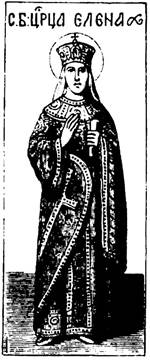
Engraving

ЦарицаЕлена – добродетельная мать Константина Великого, по обращении сына своего не умедлила принять христианство и сделалась благочестивейшей, по выражению историка Руффина, женой несравненной по вере и благочестию, была провозглашена августейшей; издавала монету с собственным изображением и, получив от сына власть над государственными сокровищами, пользовалась ими по собственному усмотрению.

The Empress Helena—the virtuous mother of Constantine the Great—after the conversion of her son did not delay in accepting Christianity and became, in the words of the historian Rufinus, a most pious woman, incomparable in faith and piety; she was proclaimed Augusta; she issued coinage with her own image, and having received from her son authority over the state treasures, she used them at her own discretion.

E1.27AI draft

Желая содействовать благочестивым намерениям сына своего – построить в Иерусалиме на месте распятия и воскресения Господа благолепный храм, и сама имея сердечное желание принести Богу Царю царствующих жертву благоговейного ума и сердца своего, – излить благодарные молитвы за сына своего и внуков, царица Елена, не смотря на преклонные лета свои, решилась посетить священную землю и поклониться св. местам, ознаменованным стопами пречистых ног Спасителя. Царица сама доставила письмо державного сына своего к епископу Иерусалимскому Макарию о построении в Иерусалиме храма Божия. Она взяла сама труды путешествия, презрела немощь старости. Увидев место, принявшее спасительные для всего мира страдания, она тотчас повелела разрушить постыдное капище, на нём построенное, и очистить место, и таким образом обрела животворящий Крест Христов.

Desiring to further the pious intentions of her son—to build in Jerusalem, on the site of the Lord’s crucifixion and resurrection, a magnificent church—and herself having a heartfelt desire to offer to God, the King of kings, the sacrifice of her reverent mind and heart, and to pour forth grateful prayers for her son and grandsons, the Empress Helena, despite her advanced years, resolved to visit the holy land and venerate the holy places marked by the footsteps of the most pure feet of the Savior. The empress herself delivered the letter of her sovereign son to the bishop of Jerusalem, Macarius, concerning the building of a church of God in Jerusalem. She herself undertook the labors of the journey, disdaining the weakness of old age. Having seen the place that received the saving sufferings for the whole world, she immediately commanded the shameful pagan temple built upon it to be destroyed and the place to be cleansed, and thus she found the life-giving Cross of Christ.

E1.28AI draft

Располагая сокровищами царскими, она употребляла их для благодеяний и милостыни. Была весьма усердна к храмам Божиим, снабжала их богатыми украшениями и не оставляла без внимания молитвенных мест и в меньших городах. Она в разных местах, согласно желаниям набожного сына своего, воздвигла христианские храмы, – в Вифлееме, где родился Спаситель; – на горе масличной, откуда Он вознёсся; в Дрепане – над мощами св. Лукиана и в других местах. Палестина доселе исполнена священных преданий о благоверных деяниях Равноапостольной Елены. Её видели в церковных собраниях среди народа в одежде простой и скромной. Пребывая на Востоке, она оказала великие милости разным липам – воинам, гражданам и частным людям, кои обращались к ней. Одних она наделяла деньгами, других – одеждами; иных освобождала из темниц, других от тяжёлых работ, на кои осуждены были; некоторых возвратила из ссылки; оказывала особенную любовь девственницам, посвящённым Богу. Собрав всех их и посадив за стол, она сама отправляла при них должность служанки; подавала им кушанье и питие; держала умывальницу и поливала воду на их руки. Совершив такие и тому подобные дела, она возвратилась к сыну своему; потом, преподав ему много наставлений касательно благочестивой жизни и призвав на него свои последние благословения, мирно преставилась в другую – вечную жизнь.

Having at her disposal the imperial treasures, she used them for benefactions and almsgiving. She was most zealous for the churches of God, furnishing them with rich adornments, and did not neglect places of prayer even in smaller towns. In various places, according to the wishes of her devout son, she erected Christian churches—in Bethlehem, where the Savior was born; on the Mount of Olives, whence He ascended; in Drepana, over the relics of St. Lucian; and in other places. Palestine to this day is filled with sacred traditions of the pious deeds of the Equal-to-the-Apostles Helena. She was seen in church assemblies among the people in simple and modest attire. While residing in the East, she showed great mercy to various persons—soldiers, citizens, and private individuals who turned to her. Some she supplied with money, others with clothing; some she freed from prisons, others from the hard labors to which they had been condemned; some she recalled from exile; she showed especial love to virgins consecrated to God. Gathering them all and seating them at table, she herself performed the office of a servant for them; she served them food and drink; she held the basin and poured water on their hands. Having accomplished such and similar deeds, she returned to her son; then, having given him many instructions concerning a pious life and having invoked her final blessings upon him, she peacefully reposed into the other—eternal—life.

E1.29AI draft

Достигши благословенной старости, она окончила жизнь на руках Равноапостольного своего сына на 80 году своей жизни, в конце 326 года по Р. Хр., почти за 10 лет до блаженной кончины сына своего. Равноапостольная, как выражается летописец, «по-видимому не умерла, а только переменила скоропреходящую и тленную жизнь на небесную и вечно-блаженную. Душа её, разрешившись от тела, перенеслась в мир бессмертный и ангельский для единения со Спасителем. Тело её с великой честью погребено великим монархом и положено в Константинополе. По смерти же она получила ту честь, какую надлежало восприять столь усердно и столь пламенно служившей Богу всяческих. По смерти святой Елены сын её и царь наименовал в честь её небольшой город Вифинии – Дрепану, место своего рождения, – Еленополем.

Having reached a blessed old age, she ended her life in the arms of her Equal-to-the-Apostles son in the eightieth year of her life, at the end of the year 326 A.D., almost ten years before the blessed repose of her son. The Equal-to-the-Apostles, as the chronicler expresses it, “apparently did not die, but only exchanged the transitory and corruptible life for the heavenly and eternally blessed one. Her soul, being released from the body, was transported into the immortal and angelic realm for union with the Savior. Her body was buried with great honor by the great monarch and placed in Constantinople. After death she received that honor which was due to one who had served the God of all so zealously and so fervently. After the death of St. Helena, her son and emperor named in her honor a small city of Bithynia—Drepana, the place of his birth—Helenopolis.”

E1.30AI draft

В песнопениях своих в день памяти Равноапостольных, как и чтением Апостольским, Церковь уподобляет Константина Ап. Павлу. «Креста Твоего образ на небеси видев, и якоже Павел звание не от человек прием, в царях Апостол Твой, Господи», и проч. Господь дал ему «Апостольское православие». Таким образом Церковь взирает на христианские подвиги царя Константина, как на подвиги Апостола и пастыря.

In its hymns on the day of commemoration of the Equal-to-the-Apostles, as also in the Apostolic reading, the Church likens Constantine to the Apostle Paul. “Having seen the image of Thy Cross in heaven, and like Paul receiving a calling not from men, Thine Apostle among emperors, O Lord,” etc. The Lord gave him “Apostolic orthodoxy.” Thus the Church looks upon the Christian labors of Emperor Constantine as upon the labors of an Apostle and a shepherd.
E1.31AI draft

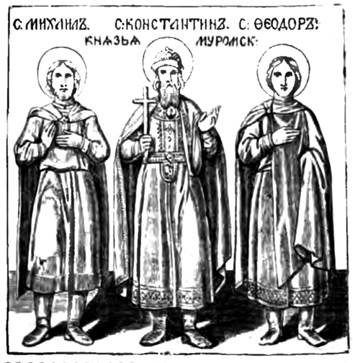
† Св. Константина, князя Муромского, с чадами его Михаилом и Феодором

† St. Constantine, Prince of Murom, with his children Michael and Theodore

E2.TAI draft
Engraving

«Отче! если бы встал и пришёл ко мне отец мой, я не был бы так рад, как рад твоему приходу, и не боялся я его так, как боюсь тебя». Так говорил преп. Феодосию Святослав Ярославич, сперва князь Черниговский, потом, 1067–1077 г., великий князь Киевский. Константин-Ярослав был самый младший сын такого благочестивого отца323; старшие же братья его были Глеб, убитый в Заволочье 1078 г., Олег, известный по тревожному мужеству, Давид, добрый и полный любви, которого уважали в родстве как отца, Роман, скончавшийся в 1079 г.; сестра их Предслава скончалась инокиней в 1116 году324.

“Father! If my own father had risen and come to me, I would not be so glad as I am glad of your coming, and I would not fear him as I fear you.” Thus spoke Svyatoslav Yaroslavich, first Prince of Chernigov, then, 1067–1077, Grand Prince of Kiev, to the Venerable Theodosius. Constantine-Yaroslav was the youngest son of such a pious father323; his elder brothers were Gleb, killed in Zavolochye in 1078; Oleg, known for his restless courage; David, good and full of love, whom they respected in the family as a father; Roman, who died in 1079; their sister Predslava died a nun in 1116324.

E2.0AI draft

Удельная система правления, при всех её невыгодах, приносила много и добра. Получив во владение известную страну, лучший князь старался водворить в ней на место дикости христианскую гражданственность. Муром в древнее время принадлежал к поселениям Финских племён, каковы Мурома, Меря, Мордва. Язычники Финны были весьма дики, грубы и крайне упорны в язычестве своём; кудесники их долго отстаивали суеверия не только для себя самих, но домогались распространять его между Русскими325. Св. Глеб, сын равноапостольного, встретил такое сопротивление христианству в Муроме, что принужден был жить в 12 верстах от города, на реке Ишне. После него Муром долго оставался без князя христианского, и язычество осталось там в силе. Между тем соседи, Болгары, верою Магометане, старались распространить своё влияние на Муром, даже и по видам торговли326. Благоверный князь Константин-Ярослав испросил у отца своего Муром в удел себе. Одна ревность к святой вере могла вызвать его в страну Муромскую, иначе дикая сторона, хотя и богатая лесом, мёдом, зверями не могла быть привлекательной327. Отец не хотел отпустить его в Чудскую сторону, по сильному опасению, как бы не умертвили его. Константин решился на всё для святой веры. Это было, по всей вероятности, в последний год жизни Святославовой, в 1077 году328. По новейшим розысканиям Мерянских курганов, христианство в Мерянской стране является не раньше конца XI века329. Святослав отпустил Константина с женой и сыновьями, Михаилом и Феодором, дав нужное число духовенства, воевод, воинов, слуг с их семьями и имуществом; целая колония христианская отправилась в страну дикую и языческую.

The appanage system of rule, for all its disadvantages, also brought much good. Having received a certain region into his possession, a worthy prince would strive to establish Christian civilization there in place of savagery. Murom in ancient times belonged to the settlements of Finnish tribes, such as the Muroma, the Merya, and the Mordvins. The pagan Finns were very wild, coarse, and extremely stubborn in their paganism; their sorcerers long defended their superstitions not only for themselves, but also sought to spread them among the Russians325. St. Gleb, son of the Equal-to-the-Apostles, encountered such resistance to Christianity in Murom that he was forced to live twelve versts from the city, on the River Ishna. After him, Murom long remained without a Christian prince, and paganism remained in force there. Meanwhile, the neighbors, the Bulgars, followers of the Mohammedan faith, tried to extend their influence over Murom, even for commercial purposes326. The Right-believing Prince Constantine-Yaroslav asked his father for Murom as his own appanage. Only zeal for the holy faith could have drawn him to the land of Murom; otherwise, the wild region, though rich in forest, honey, and game, could not have been attractive327. His father did not want to let him go to the Chud land, out of strong fear that he might be killed. Constantine was resolved to endure everything for the holy faith. This was, in all probability, in the last year of Svyatoslav’s life, in 1077328. According to recent investigations of Meryan burial mounds, Christianity appears in the Meryan land no earlier than the end of the eleventh century329. Svyatoslav let Constantine go with his wife and sons, Michael and Theodore, giving him the necessary number of clergy, voivodes, warriors, servants with their families and property; a whole Christian colony set out for a wild and pagan land.

E2.1AI draft

Приближаясь к Мурому, князь послал сына своего Михаила убеждать Муромцев, чтобы приняли князя без сопротивления. Упорные язычники убили посланного князя и бросили тело его за городом, а сами стали готовиться к бою330. Константин подступил к городу с войском. Муромцы хотели сражаться; потом выслали сказать, что принимают князя, но не желают заменить его верою своей веры. Константин вошёл в город и занял его своей дружиной. Первым делом его было построить церкви Божии, в коих святая вера получала видимость для язычников. Сперва построен был храм Благовещения Пресвятой Богородицы «в старом Вышнем городе»331. Здесь погребено было и тело убиенного князя Михаила, с обрядами христианскими; высокая простота и благоговение христианского погребения казались суетному язычеству неприличными сану князя. Так ли, говорили, следует погребать князя? Ни холм не насыпан над князем, ни тризны весёлой нет, ни курения жертвенного, ни битвы в честь его, – не резали кожи своей, не драли лица и не кричали по умершем!332. Им объяснили, как христианские обряды далеко выше, умнее, назидательнее всего языческого, – передавали понятия о истинном Боге и достойном служении Ему, об Искупителе мира и благодати. Ответом на то, как христиане чтут князей своих, великих перед Богом, а не по мнению людей, служил храм во имя св. князей Бориса и Глеба, построенный Константином. Сердца закоренелых суеверов оставались глухими к голосу истины; князь усердно молил Господа, дабы открыл Он благодатью Своею сердца жалких людей для принятия света истины. Он приглашал к себе старшин города и беседовал с ними о св. вере, склонял их и любовью и угрозами не отвергать необходимого для счастья временного и спасения вечного, – св. веры. Язычники упорствовали. Мало того, фанатики суеверия тайно составили заговор и поклялись убить или выгнать князя – проповедника новой веры. Перед двором князя собрались толпы с оружием и дубинками. Испуганные христиане заперлись в домах и готовы были отражать силу силой. Благоверный князь взялся за другое оружие. С своей семьёй, с духовными и несколькими из добрых слуг он стал на молитву. Затем один явился, с иконой Богоматери на руках, к волновавшейся толпе. Бунтовщики поражены были ужасом и вместо угроз высказывали мольбу просветить их св. крещением. Обрадованный князь воздал благодарение Господу и Пречистой Матери, назначил день, когда все непросвещённые должны явиться на реку Оку. Торжественно было крещение Муромцев. Повторилась сцена, которую видели на Днепре при Владимире. Торжествующий князь осыпал детей Божиих разными подарками, одних – разной одеждой, других деньгами, а лучших – и отчинами. Естественно, что теперь надлежало позаботиться и об умножении храмов. «Заповеда ставити церкви в городе и в селех и монастыря мужеския и женския». По летописи, в 1098 году видим в Муроме Спасский монастырь, построенный, без сомнения, просветителем Мурома333.

Approaching Murom, the prince sent his son Michael to urge the people of Murom to receive the prince without resistance. The stubborn pagans killed the prince’s envoy and cast his body outside the city, and themselves prepared for battle330. Constantine approached the city with his army. The Muromites wanted to fight; then they sent word that they would receive the prince, but did not wish to exchange their faith for his. Constantine entered the city and occupied it with his retinue. His first task was to build churches of God, in which the holy faith might become visible to the pagans. First, a church of the Annunciation of the Most Holy Theotokos was built “in the old Upper City”331. There the body of the slain Prince Michael was also buried with Christian rites; the lofty simplicity and reverence of Christian burial seemed to vain paganism unbecoming to the dignity of a prince. “Is this how a prince should be buried?” they said. “No mound is heaped over the prince, no merry funeral feast, no sacrificial incense, no battle in his honor—they did not cut their skin, nor tear their faces, nor cry out over the dead!”332 They were explained how Christian rites are far higher, wiser, and more edifying than all pagan customs—they were given concepts of the true God and of worthy service to Him, of the Redeemer of the world and of grace. The answer to how Christians honor their princes, who are great before God and not according to human opinion, was the church built by Constantine in the name of the holy princes Boris and Gleb. The hearts of the inveterate superstitious remained deaf to the voice of truth; the prince earnestly prayed to the Lord that He would open by His grace the hearts of these pitiable people for the reception of the light of truth. He invited the city elders to himself and conversed with them about the holy faith, persuading them both by love and by threats not to reject what is necessary for temporal happiness and eternal salvation—the holy faith. The pagans persisted. Moreover, fanatics of superstition secretly formed a conspiracy and swore to kill or drive out the prince—the preacher of the new faith. Crowds gathered before the prince’s court with weapons and clubs. The frightened Christians shut themselves up in their houses and were ready to repel force with force. The Right-believing prince took up a different weapon. With his family, with the clergy, and with several of his good servants, he stood at prayer. Then he appeared alone, with an icon of the Mother of God in his arms, before the agitated crowd. The rebels were struck with terror and, instead of threats, expressed a plea to enlighten them with holy Baptism. The overjoyed prince gave thanks to the Lord and the Most Pure Mother, and appointed a day when all the unenlightened were to appear at the Oka River. The baptism of the Muromites was solemn. The scene witnessed on the Dnieper under Vladimir was repeated. The triumphant prince showered the children of God with various gifts: some with various clothing, others with money, and the best with patrimonial estates. Naturally, it was now necessary to concern oneself also with the multiplication of churches. “He commanded that churches be built in the city and in the villages, and monasteries for men and for women.” According to the chronicle, in 1098 we see in Murom the Spassky Monastery, built, without doubt, by the enlightener of Murom333.

E2.2AI draft

Болгары и Мордва увидели, что успехи христианства в Муроме опасны для их земных выгод и лжеверия. И они со злостью стали нападать на Муром. В 1088 году брали Муром Болгары334. В 1103 году Ярослав бился с Мордвой и потерпел поражение335. Но Константин твёрдо держался в просвещаемой стороне.

The Bulgars and the Mordvins saw that the successes of Christianity in Murom were dangerous for their earthly interests and false faith. And they began to attack Murom with malice. In 1088, the Bulgars took Murom334. In 1103, Yaroslav fought with the Mordvins and suffered defeat335. But Constantine held firmly in the land he was enlightening.

E2.3AI draft

Благочестивый и умный князь деятельно распространял веру и гражданственность в глухой стороне: в 1095 году «заложен был Переславль Рязанский у церкви св. Николы старого», город долго носивший имя своего основателя336.

The pious and wise prince actively spread the faith and civilization in the remote region: in 1095 “Pereyaslavl of Ryazan was founded at the church of St. Nicholas the Old,” a city that long bore the name of its founder336.

E2.4AI draft

Христианский князь должен был испытать скорби за свой Муром не со стороны одних дикарей. Пока Муром оставался городом языческим, местом диким и глухим, никто из князей не предъявлял желания жить в нём. Но вот в 1096 году видим в Муроме князя Изяслава, князя не из рода князей Черниговских, тогда как Муром и Рязань входили в состав княжества Черниговского. Сын доброго Мономаха обманут был, как говорил отец, корыстолюбивыми слугами. Ярославу, конечно, не было это приятно. Но сам по себе не начал он междоусобия, – он был кроткий и Богобоязненный. Не таков был брат его Олег. Князья обязали его клятвой явиться в Киев на совещание, кому чем владеть при новом великом князе? А Олег явился с войском перед Муром и послал сказать Изяславу: «ступай в Ростов, удел твоего отца; здешний принадлежит мне; я хочу рассчитаться с отцом твоим». Изяслав был неправ и пал в сражении. Но Олег был столько же горд, сколько жаден до корысти. Вместо того, чтобы оставить в Муроме брата Ярослава и самому занять Рязань, он захватил Суздаль и Ростов. В открывшейся войне заставил он Ярослава быть участником; великодушный победитель Мстислав оставил Ярослава в Муроме. Любечский съезд князей 1097 года положил: «пусть Давид, Олег и Ярослав владеют уделом Святослава»337.

The Christian prince was to experience sorrows for his Murom not only from the side of savages. As long as Murom remained a pagan city, a wild and remote place, none of the princes expressed a desire to live in it. But in 1096 we see in Murom Prince Izyaslav, a prince not of the line of the princes of Chernigov, whereas Murom and Ryazan were part of the Chernigov principality. The son of the good Monomakh was deceived, as his father said, by covetous servants. This was, of course, not pleasing to Yaroslav. But he himself did not begin an internecine war—he was meek and God-fearing. Not so was his brother Oleg. The princes bound him by oath to appear in Kiev for a council on who should possess what under the new Grand Prince. But Oleg appeared with an army before Murom and sent word to Izyaslav: “Go to Rostov, the appanage of your father; this one belongs to me; I wish to settle accounts with your father.” Izyaslav was in the wrong and fell in battle. But Oleg was as proud as he was greedy for gain. Instead of leaving his brother Yaroslav in Murom and himself occupying Ryazan, he seized Suzdal and Rostov. In the war that broke out, he forced Yaroslav to be a participant; the magnanimous victor Mstislav left Yaroslav in Murom. The Lyubech Congress of Princes in 1097 decreed: “Let David, Oleg, and Yaroslav possess the appanage of Svyatoslav”337.

E2.5AI draft

Ярослав употребил старание загладить следы тревог бранных. Особенно заботился он об утверждении христианского благочестия в народе. По его прошению, митр. Никифор (1104–1122 г.) прислал к нему послание о значении Латинской веры; святитель осуждал Латинян между прочим за то, что они запрещают хвалить Бога на другом языке, кроме Еврейского, Греческого и Римского338. Муромскому князю это открывало ту отрадную истину, что святое дело славить Господа и на Русском, и на Финском, и на всяком другом языке. Полный любви христианской, он с радостью принимал безудельных бесприютных князей и покоил их в Рязани; в 1114 году скончались здесь двое таких князей, под кровом любви Ярославовой339.

Yaroslav made every effort to erase the traces of the disturbances of war. He was especially concerned with the establishment of Christian piety among the people. At his request, Metropolitan Nikephoros (1104–1122) sent him an epistle on the significance of the Latin faith; the Hierarch condemned the Latins, among other things, for forbidding the praise of God in any language other than Hebrew, Greek, and Roman338. This revealed to the prince of Murom the comforting truth that it is a holy work to praise the Lord in Russian, in Finnish, and in every other language. Full of Christian love, he gladly received landless, homeless princes and gave them rest in Ryazan; in 1114, two such princes died there, under the shelter of Yaroslav’s love339.

E2.6AI draft

В 1123 году умер старший брат Ярослава – Давид, князь Черниговский. Ярослав занял старший стол Черниговского княжества, а Муром предоставил племяннику своему Всеволоду Давидовичу340. В Чернигове похоронил он свою супругу. В последние годы жизни благов. Константину пришлось испытать довольно горечи. В 1127 г. другой племянник Всеволод Ольгович, нечаянно напав на Чернигов, захватил Ярослава, перерезал дружину его и заграбил имущество. Великий князь Мстислав и брат его собрали войско, чтобы идти против мятежного Ольговича, но Мстислава уговорили не проливать крови христианской и дать мир Ольговичу; Ярославу осталось со скорбью идти в Муром341. Благоверный скончался в Муроме 1129 г.342 родоначальником князей Муромских и Рязанских343. Св. тело его положено было в Благовещенском соборе, близ чад его Михаила и Феодора. В 1351 г. Юрий Ярославич, возобновитель Мурома, возобновил Благовещенский храм, основанный Константином. Тогда начали являться чудеса от св. князей344. В 1547 г. установлено праздновать в Муроме 21 мая св. князю Константину с чадами его345. В 1552 году царь Иоанн на пути в Казань, быв в Муроме, поклонялся благоверным князьям, испрашивая их помощи346; а в следующем году открыты мощи их и освящён новый храм, построенный царём, по обету, для их мощей, с приделом в их имя347.

In 1123, Yaroslav’s elder brother David, Prince of Chernigov, died. Yaroslav occupied the senior throne of the Chernigov principality, and granted Murom to his nephew Vsevolod Davidovich340. In Chernigov he buried his wife. In the last years of his life, the Right-believing Constantine had to experience considerable bitterness. In 1127, another nephew, Vsevolod Olgovich, unexpectedly attacking Chernigov, seized Yaroslav, cut down his retinue, and plundered his property. Grand Prince Mstislav and his brother gathered an army to march against the rebellious Olgovich, but Mstislav was persuaded not to shed Christian blood and to grant peace to Olgovich; Yaroslav was left to go in sorrow to Murom341. The Right-believing one reposed in Murom in 1129342, the progenitor of the princes of Murom and Ryazan343. His holy body was placed in the Annunciation Cathedral, near his children Michael and Theodore. In 1351, Yuri Yaroslavich, the restorer of Murom, restored the Annunciation church founded by Constantine. Then miracles began to appear from the holy princes344. In 1547, it was established to celebrate on May 21 in Murom the feast of the holy Prince Constantine with his children345. In 1552, Tsar John, on his way to Kazan, being in Murom, venerated the Right-believing princes, asking for their help346; and in the following year their relics were uncovered and a new church, built by the Tsar according to a vow, was consecrated for their relics, with a side-chapel in their name347.

E2.7AI draft

† Страдание преп. Агапита Маркушевского

† The Passion of the Venerable Agapit of Markushevo

E3.TAI draft
Engraving

Преп. Агапит долго подвизался в Сольвычегодском Борисоглебском монастыре. Раз он был тяжко болен. Явившийся в сонном видении св. Николай указал ему идти на р. Маркушу и основать там монастырь; больной в то же время исцелел и отправился в путь. На речках Маркуше и Тарнахе (в 100 верстах к северо-востоку от Тотьмы) поставил он часовню и потом в 1578 году два храма, один в честь св. Николая, другой во имя Прокопия Устюжского. В том же году выпросил он у царя для обители землю и место для мельницы на р. Лахте, а у митрополита – благословение освятить храм. Возвратясь из Москвы, он жил подвижником Божиим. Не довольствуясь трудами по устроению обители, он тайно носил на теле своём вериги. Жители села Кашнина, по жадности к корысти, злясь за землю, отведённую для обители, решились убить заботливого основателя обители. Мая 21, 1584 года они напали на преподобного на мельнице, убили и бросили в р. Уфтюгу. Иноки нашли тело убиенного преподобного и схоронили в часовне, между построенными им храмами, а найденные на теле его вериги повесили над его гробом. Мощи его почивают под спудом в храме упразднённой (1764 г.) Маркушевской обители348.

The Venerable Agapit struggled for a long time in the Boris and Gleb Monastery of Solvychegodsk. Once he fell gravely ill. St. Nicholas, appearing to him in a dream, directed him to go to the Markusheva River and found a monastery there; the sick man was healed at that same time and set out on his journey. On the Markusheva and Tarnakha Rivers (100 versts to the northeast of Totma) he erected a chapel and then, in 1578, two churches: one in honor of St. Nicholas, the other in the name of Procopius of Ustiug. In the same year he obtained from the Tsar land for the monastery and a place for a mill on the Lakhta River, and from the Metropolitan a blessing to consecrate the church. Returning from Moscow, he lived as an ascetic of God. Not content with the labors of establishing the monastery, he secretly wore chains on his body. The inhabitants of the village of Kashnino, out of greed for gain and anger over the land allotted to the monastery, resolved to kill the solicitous founder of the monastery. On May 21, 1584, they attacked the Venerable One at the mill, killed him, and threw him into the Uftyuga River. The monks found the body of the murdered Venerable One and buried it in the chapel, between the churches he had built, and the chains found on his body they hung over his grave. His relics rest hidden beneath a bushel in the church of the abolished (in 1764) Markushevo monastery348.

E3.0AI draft

Празднование Владимирской иконе Богоматери

The Feast of the Vladimir Icon of the Mother of God

E4.TAI draft
Engraving

Владимирская икона Богоматери знаменитейшая в нашем отечестве. Она написана Евангелистом Лукой и принесена была им к Пресвятой Деве, во время земной её жизни. Богоматерь, видя изображение лица своего на иконе, повторила пророческое своё изречение: «отныне ублажат мя вси роди», и присовокупила: «благодать Родшегося от меня и моя с сею иконою да будет». В половине V столетия, при императоре Феодосие Младшем, икона принесена из Иерусалима в Константинополь; а в половине XII века из Константинополя привезена в Киев к великому князю Юрию Владимировичу Долгорукову, вместе с другой иконой, – названною Пирогощей, и поставлена была в девичьем монастыре – в Вышгороде. В 1155 году великий князь Юрий отдал Вышгород в удел сыну своему князю Андрею. Но Андрей уже замышлял удалиться с юга России на север в Ростовскую область и там утвердить новое независимое от Киева владение. Князь Андрей, который «многу веру и любовь имяше ко Пресв. Богородице», и на устах коего всегда было имя Христово и Пречистой Его Матери, услышав рассказ о Владимирской иконе, что ей не угодно место, на котором она поставлена, подумал: не в Суздальской ли земле место, на котором угодно ей пребывать? Князь усердно молился перед иконой, отслужил перед ней молебен и благоговейно взял её, вместо всяких сокровищ, без ведома отца, и ночью уехал из Вышгорода. На пути совершал перед иконой молебствия и от неё были многие чудеса. Князь прибыл во Владимир на Клязьме и встречен был жителями с великой радостьй. Продолжая свой путь, князь отправился к Ростову. В 10 верстах от Владимира вниз по течению реки Клязьмы, лошади, вёзшие чудотворную икону, остановились и не шли далее. Запряжены были новые и также не шли вперёд. Князь в трепете повергся с молитвой перед иконой Богоматери, и она явилась и повелела ему поставить икону её во Владимире. По сему случаю 8 апреля 1158 года Андрей немедленно заложил во Владимире храм для пребывания чудотворной иконы, который через два года окончен и великолепно украшен. Боголюбивый князь украсил и св. икону. Он обложил её окладом из золота, серебра с драгоценными камнями. Совершив храм во Владимире, Андрей перенёс в него чудотворную икону, и с тех пор она стала называться Владимирской. Торжество перенесения совершилось в 1160 году 21 сентября. По постановлении иконы в Успенском Владимирском храме она снова просияла многими и великими чудесами.

The Vladimir Icon of the Mother of God is the most renowned in our fatherland. It was painted by the Evangelist Luke and was brought by him to the Most Holy Virgin during her earthly life. The Mother of God, seeing the image of her face on the icon, repeated her prophetic utterance: “From henceforth all generations shall call me blessed,” and added: “May the grace of Him Who was born of Me and My grace be with this icon.” In the middle of the fifth century, under the Emperor Theodosius the Younger, the icon was brought from Jerusalem to Constantinople; and in the middle of the twelfth century it was brought from Constantinople to Kiev to the Grand Prince Yuri Vladimirovich Dolgoruky, together with another icon—called the Pyrogozhcha—and was placed in a convent in Vyshgorod. In 1155, Grand Prince Yuri gave Vyshgorod as an appanage to his son, Prince Andrew. But Andrew was already planning to depart from the south of Russia to the north, to the Rostov region, and there to establish a new dominion independent of Kiev. Prince Andrew, who “had great faith and love for the Most Holy Theotokos,” and on whose lips the name of Christ and His Most Pure Mother were ever present, hearing the account of the Vladimir Icon—that the place where it had been set was not pleasing to it—thought: Is it not in the Suzdal land that the place where it is pleased to dwell is to be found? The prince prayed fervently before the icon, served a moleben before it, and reverently took it, instead of any treasures, without his father’s knowledge, and departed from Vyshgorod by night. On the way he performed molebens before the icon, and many miracles were wrought from it. The prince arrived at Vladimir on the Klyazma and was met by the inhabitants with great joy. Continuing his journey, the prince set out for Rostov. Ten versts from Vladimir, downstream along the Klyazma River, the horses drawing the wonderworking icon stopped and would go no further. Fresh horses were harnessed, and they too would not go forward. The prince, trembling, prostrated himself in prayer before the icon of the Mother of God, and She appeared and commanded him to place Her icon in Vladimir. On this occasion, on April 8, 1158, Andrew immediately laid the foundation in Vladimir of a church for the dwelling of the wonderworking icon, which was completed two years later and magnificently adorned. The God-loving prince also adorned the holy icon. He covered it with a riza of gold and silver with precious stones. Having completed the church in Vladimir, Andrew transferred the wonderworking icon into it, and from that time it began to be called Vladimir. The solemnity of the transfer took place in the year 1160, on September 21. After the icon was placed in the Dormition Cathedral of Vladimir, it again shone forth with many and great miracles.

E4.0AI draft

Владимирская икона Богоматери, яко Апостольская, в Прав. отечестве нашем стяжала великую славу. Церковь во Владимире, в которой первоначально поставлена была икона, называется в летописях преименитой*.* Эта св. икона, по вере в неё князей, воевод и воинов, участвовала во многих походах Русского войска и многие иные священные воспоминания соединены с нею и свидетельствуют о благодати Божией, действующей посредством её. В 1164 году Владимирская икона находилась в походе Андрея Боголюбского против Волжских Болгар, коих победил он заступлением Богоматери.

The Vladimir Icon of the Mother of God, as an Apostolic one, has acquired great glory in our Orthodox fatherland. The church in Vladimir in which the icon was first placed is called in the chronicles most renowned. This holy icon, by the faith of princes, voivodes, and warriors, participated in many campaigns of the Russian army, and many other sacred memories are connected with it and bear witness to the grace of God working through it. In 1164, the Vladimir Icon was present in the campaign of Andrew Bogolyubsky against the Volga Bulgars, whom he conquered through the intercession of the Mother of God.

E4.1AI draft

По убиении Боголюбского в 1173 году, народ, подстрекаемый безначалием и убийцами, грабил Боголюбов и Владимир. Священник Николай, прибывший с Боголюбским из Вышгорода, в полном облачении открыл хождение с Владимирской иконой по улицам города, и мятеж утих. После Боголюбского решено было во Владимире отдать престол княжения Северского Ярополку и Мстиславу Ростиславичам, племянникам Боголюбского. Они в первый день своего княжения захватили себе серебро и золото Владимирского храма и отобрали на себя волости и дани, пожертвованные ему Боголюбским. Ярополк саму икону Владимирскую отдал зятю своему Глебу Рязанскому. Это возбудило всеобщее негодование в жителях Владимира: решились изгнать Ростиславичей, коих воины, шедшие для одоления Михаила Юрьевича, призываемого на престол Владимирский, не вступив в бой, бросили княжеское знамя и обратились в бегство, «гонимые гневом Божиим и св. Богородицы». Глеб Рязанский, коему отдана была икона Владимирская, сам со смирением возвратил её. «Я виноват во всём», говорил он. «Мы же да подивимся, говорит летописец, чуду новому и великому и преславному Матери Божия, како заступи град свой от великих бед и гражданы своя укрепляет. Утеши их Бог и св. Богородица Володимерская. Се бо Володимерцы прославлены Богом по всей земле за их правду, Богови им помогающу». И неоднократно охраняла и осеняла своим покровом Владимирская икона Суздальцев и Владимирцев. Во время пожара в 1185 г. 13 апреля, истребившего во Владимире соборный храм, со всем его богатством, Владимирская икона сохранилась невредима; во время нашествия Татар, под предводительством Батыя, февраля 7 в 1237 году, икона лишилась драгоценного оклада, но сама осталась невредима, «по благодати Богоматери, неотъемлемой от её иконы, в уверение благочестия и на соблюдение земли Русской». В 1380 году 8 сентября, Димитрий Иоаннович Донской помощью Богоматери Владимирской одержал победу над Мамаем.

After the murder of Bogolyubsky in 1173, the people, incited by anarchy and the murderers, plundered Bogolyubovo and Vladimir. The priest Nicholas, who had come with Bogolyubsky from Vyshgorod, in full vestments began processing with the Vladimir Icon through the streets of the city, and the rebellion subsided. After Bogolyubsky, it was decided in Vladimir to give the throne of the principality of Severia to Yaropolk and Mstislav Rostislavich, nephews of Bogolyubsky. On the first day of their reign, they seized for themselves the silver and gold of the Vladimir cathedral and took for themselves the districts and tributes that had been donated to it by Bogolyubsky. Yaropolk even gave the Vladimir Icon itself to his son-in-law Gleb of Ryazan. This aroused universal indignation among the inhabitants of Vladimir: they resolved to expel the Rostislavichi, whose warriors, having gone to overcome Michael Yurievich, who was being called to the throne of Vladimir, without entering battle abandoned the prince’s banner and fled, “driven by the wrath of God and of the holy Mother of God.” Gleb of Ryazan, to whom the Vladimir Icon had been given, himself returned it with humility. “I am guilty in everything,” he said. “Let us marvel,” says the chronicler, “at a new and great and most glorious miracle of the Mother of God, how She defended Her city from great evils and strengthened Her citizens. God and the holy Vladimir Mother of God comforted them. For behold, the Vladimirites are glorified by God throughout all the land for their righteousness, God helping them.” And repeatedly the Vladimir Icon protected and overshadowed with its veil the Suzdalians and Vladimirites. During the fire in 1185, on April 13, which destroyed the cathedral church in Vladimir with all its wealth, the Vladimir Icon remained unharmed; during the invasion of the Tatars under the leadership of Batu, on February 7, 1237, the icon lost its precious riza, but itself remained unharmed, “by the grace of the Mother of God, which is inseparable from Her icon, for the assurance of piety and for the preservation of the Russian land.” In 1380, on September 8, Demetrius Ioannovich Donskoy, by the help of the Vladimir Mother of God, gained victory over Mamai.

E4.2AI draft

Слава города Владимира, можно сказать, возрастала и распространялась в продолжение 242 лет, в кои обитала в нём Владимирская икона Богоматери, и миновала, когда в Москве воздвигнут был храм Богоматери и св. икона Владимирская перенесена туда: с этого времени начала возвышаться Москва над всеми княжествами Русскими. В Москве, как и во Владимире, чудотворная икона прославилась многими благодатными чудесными знамениями для спасения Москвы и всего отечества. О благодати Божией, от сего образа явленной в то время, как он перенесён был в Москву, свидетельствуют особенно празднования, совершаемые Православной Церковью в честь Владимирской иконы Богоматери.

The glory of the city of Vladimir, one might say, grew and spread during the 242 years in which the Vladimir Icon of the Mother of God dwelt in it, and it passed away when a church of the Mother of God was raised up in Moscow and the holy Vladimir Icon was transferred there: from that time Moscow began to rise above all the Russian principalities. In Moscow, as in Vladimir, the wonderworking icon was glorified by many gracious miraculous signs for the salvation of Moscow and the entire fatherland. Of the grace of God manifested from this image at the time when it was transferred to Moscow, the feasts celebrated by the Orthodox Church in honor of the Vladimir Icon of the Mother of God bear particular witness.

E4.3AI draft

Православная Церковь три раза в году совершает празднование Божией Матери иконы Владимирской. В первый раз, 26 августа, положено праздновать во всей России память сретению Владимирской иконы Божией Матери, для избавления России помощью и заступлением её от нашествия Тамерлана в 1395 году. – Во второй раз празднование Владимирской иконе Божией Матери совершается 23 июня в благодарение за избавление отечества, невидимым заступлением Богородицы, от Ордынского царя Ахмата в 1480 году, при великом князе Иоанне III Васильевиче, и окончательное освобождение России от ига Монгольского.

The Orthodox Church celebrates the feast of the Mother of God of the Vladimir Icon three times a year. The first time, on August 26, it is appointed to commemorate throughout all Russia the meeting of the Vladimir Icon of the Mother of God, for the deliverance of Russia by Her help and intercession from the invasion of Tamerlane in 1395. — The second time, the feast of the Vladimir Icon of the Mother of God is celebrated on June 23, in thanksgiving for the deliverance of the fatherland, by the invisible intercession of the Theotokos, from the Horde Tsar Akhmat in 1480, under Grand Prince John III Vasilievich, and the final liberation of Russia from the Mongol yoke.

E4.4AI draft

В 21 день мая Прав. Церковь совершаетв третий раз праздник сретению чудотворной Владимирской иконы Пресвятой Богородицы по двум событиям. Первое было в 1514 году – ради поновления иконы Владимирской в доме митрополита Варлаама. В память этого поновления установлен был крестный ход из Успенского собора в Сретенский монастырь мая 21 числа.

On the 21st day of May, the Orthodox Church celebrates for the third time the feast of the meeting of the wonderworking Vladimir Icon of the Most Holy Theotokos, on account of two events. The first was in 1514—on account of the renovation of the Vladimir Icon in the house of Metropolitan Barlaam. In memory of this renovation, a procession of the cross was established from the Dormition Cathedral to the Sretensky Monastery on May 21.

E4.5AI draft

С воспоминанием поновления соединено празднование другого священного события – избавления заступлением Владычицы в 1521 году от татар Крымских, Ногайских и Казанских, под предводительством Казанского царя Махмет-Гирея, который вторгся в пределы Московские с такой быстротой, что великий князь Василий Иоаннович едва успел вывести войска свои на берега Оки, чтобы удержать стремление врагов. Предав огню селения от Нижнего Новгорода и Воронежа до берегов Москвы-реки, враги пленили множество жителей, в числе их многих жён и девиц, бросая грудных младенцев на землю; продали невольников толпами в Казани, в Астрахани; слабых, престарелых морили голодом, оскверняли святыню храмов. Государь удалился в Волок собирать полки. Всё трепетало. Хан 29 июля, среди облаков дыма, под заревом пылающих деревень, стоял уже в нескольких верстах от Москвы, куда стекались жители окрестностей с своими семействами и драгоценнейшим имением. Улицы заперлись обозами, пришельцы и граждане, дети, старцы искали спасения в Кремле, теснились в воротах, давили друг друга. Митрополит Варлаам усердно молился с народом. Бог внял молитвам бедствующих, и Москва сверхъестественно, заступлением Божией матери Владимирской и св. преподобных Сергия Радонежского и Варлаама Хутынского, спасена и спасла всю Россию. Рассказывают, что татары хотели было выжечь Московские посады, но увидели вокруг города бесчисленное христолюбивое Русское воинство, и с ужасом прискакали к хану и известили его о чудесном видении. Хан не поверил им и послал других: «и другие видеша того сугубейшее воинство Русское, и сказаша ему; и третие посла некоего из ближних уведати истину, и трепеща прибеже и вопия: о царю! что косниши? побегнем! грядет бо на нас безмерное множество войска от Москвы и побегоша». Таким образом, предстательством Богородицы, Москва и отечество избавились от врагов. В память сего чудесного избавления совершается в Москве 21 мая крестный ход в Сретенский монастырь.

With the remembrance of the renovation is joined the celebration of another sacred event—the deliverance by the intercession of the Lady in 1521 from the Tatars of the Crimea, the Nogai, and Kazan, under the leadership of the Kazan Tsar Makhmet-Girei, who invaded the borders of Moscow with such swiftness that Grand Prince Basil Ioannovich barely had time to lead his troops to the banks of the Oka to check the onslaught of the enemies. Having set fire to settlements from Nizhny Novgorod and Voronezh to the banks of the Moscow River, the enemies took captive a multitude of inhabitants, among them many wives and maidens, casting nursing infants to the ground; they sold the captives in crowds in Kazan and Astrakhan; the weak and the aged they starved to death, and they defiled the sanctuary of the churches. The sovereign withdrew to Volok to gather regiments. All trembled. On July 29, amidst clouds of smoke, in the glow of burning villages, the Khan already stood several versts from Moscow, whither the inhabitants of the surrounding areas were flocking with their families and most precious possessions. The streets were blocked by wagons; newcomers and citizens, children and elders sought salvation in the Kremlin, crowding at the gates and crushing one another. Metropolitan Barlaam prayed fervently with the people. God hearkened to the prayers of the suffering, and Moscow, supernaturally, through the intercession of the Mother of God of Vladimir and the holy Venerables Sergius of Radonezh and Barlaam of Khutyn, was saved and saved all Russia. It is related that the Tatars intended to burn the Moscow suburbs, but they saw around the city an innumerable Christ-loving Russian army, and in terror they galloped to the Khan and informed him of the miraculous vision. The Khan did not believe them and sent others: “and the others saw that same Russian army, even more numerous, and told him; and a third time he sent one of his close associates to ascertain the truth, and he ran back trembling and cried out: ‘O Tsar, why do you delay? Let us flee! For an immeasurable multitude of troops is coming upon us from Moscow,’ and they fled.” Thus, through the intercession of the Theotokos, Moscow and the fatherland were delivered from the enemies. In memory of this miraculous deliverance, a procession of the cross is held in Moscow on May 21 to the Sretensky Monastery.

E4.6AI draft

Во дни троекратного избавления Москвы заступлением Богоматери, от Тамерлана, Ахмата и Махмет-Гирея, Церковь при Богослужении радостно вопиет: «днесь светло красуется славнейший град Москва, яко зарю солнечную восприемши, Владычице, чудотворную твою икону, к ней же мы, ныне притекающе и молящеся тебе, взываем сице: о пречудная Владычице Богородице, молися из тебе воплощенному Христу, Богу нашему, да избавит град сей, и вся грады и страны христианския невредимы от всех навет вражиих и спасет души наши, яко милосерд».

On the days of the threefold deliverance of Moscow through the intercession of the Mother of God, from Tamerlane, Akhmat, and Makhmet-Girei, the Church at divine service joyfully cries out: “Today the most glorious city of Moscow shines brightly, for it hath received, O Lady, thy wonderworking icon as the dawn of the sun, to which we, now hastening and praying to thee, cry out thus: O most wondrous Lady Theotokos, pray to Christ our God, who was incarnate of thee, that He may deliver this city and all Christian cities and countries unharmed from all the assaults of the enemy and save our souls, for He is merciful.”

E4.7AI draft

После событий, празднуемых Церковью в честь Владимирской иконы Богоматери, летописи говорят, что эта св. икона служила благословением для великих князей во всех важнейших обстоятельствах их жизни, наприм. привосшествиях на престол и коронациях; перед нею князья брали с подданных клятву в верности отечеству. В 1598 году икона Владимирская вместе с другими всенародно принесена была в Московский Новодевичий монастырь, куда уединилась, отрёкшись от престола, царица Ирина, чтобы присутствием св. чудотворной иконы побудить её благословить брата и его самого взойти на Российский престол. Выйдя в сретение чудотворному Владимирскому образу Богоматери, Борис Феодорович, как повествует грамота об избрании его на царство, «слез многих исполнився, гласом великим возопив, глаголя: о милосердная Царица, Пречистая Богородица, Мати Христа Бога нашаго, почто толик подвиг сотворила еси и чудотворный свой образ воздвиже? Тем, Пречистая Богородица, помолися о мне и помилуй мя. И сия вопия и глаголя со многим рыданием и плачем, паде на землю перед чудотворным образом пречистыя Богородицы Владимирские». После сего царица благословила брата на царство. Издревле доселе православные Всероссийские монархи приемлют священное венчание и миропомазание на царство перед ликом Владимирской иконы, в Успенском Московском соборе. Молебен при вшествии Государя в собор для венчания на царство совершали древле Кресту, Пречистой и Петру чудотворцу.

After the events celebrated by the Church in honor of the Vladimir Icon of the Mother of God, the chronicles relate that this holy icon served as a blessing for the grand princes in all the most important circumstances of their lives, for example, at their accessions to the throne and coronations; before it the princes administered the oath of loyalty to the fatherland from their subjects. In 1598, the Vladimir Icon, together with others, was brought publicly to the Moscow Novodevichy Monastery, where Tsarina Irene, having renounced the throne, had secluded herself, so that by the presence of the holy wonderworking icon she might be moved to bless her brother and that he himself might ascend the Russian throne. Going out to meet the wonderworking Vladimir Image of the Mother of God, Boris Theodorovich, as the charter of his election to the throne relates, “filled with many tears, cried out with a loud voice, saying: ‘O merciful Queen, Most Pure Theotokos, Mother of Christ our God, why hast Thou undertaken such a labor and raised up Thy wonderworking image? Therefore, O Most Pure Theotokos, pray for me and have mercy on me.’ And crying out and speaking thus with much sobbing and weeping, he fell to the ground before the wonderworking image of the Most Pure Theotokos of Vladimir.” After this, the tsarina blessed her brother for the kingdom. From ancient times until now, the Orthodox All-Russian monarchs receive the sacred crowning and anointing for the kingdom before the face of the Vladimir Icon, in the Moscow Dormition Cathedral. In ancient times, the moleben at the sovereign’s entry into the cathedral for the crowning was performed to the Cross, the Most Pure One, and Peter the Wonderworker.

E4.8AI draft

При выступлении своём против врагов великие князья и цари молились перед иконой Богоматери и взирали на неё как на заступление России. При набегах, в 1541 году, хана Крымского Саип-Гирея и Казанского Сафа-Гирея на Россию, царь Иоанн Васильевич, отправляясь против врагов, на коленях со слезами молился перед иконой о помощи против них, и враги отражены были. В 1552 году 16 июня великий князь Иоанн Васильевич, собираясь в поход, приходит во храм Успения и там «слёзно припадает чудотворному образу Богоматери, с плачем, на долг час молитвы простирающи». Молитва царя услышана: Казань взята, и он торжественно встречен был при возвращении в столицу после победы духовенством с чудотворной Владимирской иконой. Иоанн, сойдя с коня, пал перед ней, помолился и облобызал.

At their march against enemies, the grand princes and tsars prayed before the Icon of the Mother of God and looked upon it as the intercession of Russia. During the incursions, in 1541, of the Crimean Khan Saip-Girei and the Kazan Khan Safa-Girei against Russia, Tsar John Vasilyevich, setting out against the enemies, on his knees with tears prayed before the icon for help against them, and the enemies were repelled. In 1552, on June 16, Grand Prince John Vasilyevich, preparing for the campaign, came to the Dormition Church and there “with tears falls down before the wonderworking image of the Mother of God, with weeping, for a long hour extending his prayers.” The tsar’s prayer was heard: Kazan was taken, and he was solemnly met upon his return to the capital after the victory by the clergy with the wonderworking Vladimir Icon. John, dismounting from his horse, fell down before it, prayed, and kissed it.

E4.9AI draft

Цари благоговейно чтили праздники и крестные ходы, установленные в честь Владимирской иконы Богоматери. Царь Михаил Феодорович во дни сих праздников неопустительно слушал Божественную службу у Рождества Богородицы на сенях. Цари Иоанн Васильевич и Алексей Михайлович усердно посещали крестные ходы в честь Богородицы.

The tsars reverently honored the feasts and processions of the cross established in honor of the Vladimir Icon of the Mother of God. Tsar Michael Theodorovich, on the days of these feasts, unfailingly attended the divine service at the Church of the Nativity of the Theotokos at the Palace. Tsars John Vasilyevich and Alexis Michaelovich zealously attended the processions of the cross in honor of the Theotokos.

E4.10AI draft

Великие князья молебствовали пред иконой при разных обстоятельствах своей жизни; молились пред нею о детях своих; при конце жизни своей вверялись предстательству Владимирской Богоматери. Великий князь Василий Иоаннович, лежа на смертном одре, пожелал, чтобы к нему принесли Владимирскую икону Богоматери, и последние взоры и молитва его обращены были на её священный лик.

The grand princes offered molebens before the icon on various occasions of their lives; they prayed before it for their children; at the end of their lives they entrusted themselves to the intercession of the Vladimir Mother of God. Grand Prince Basil Ioannovich, lying on his deathbed, desired that the Vladimir Icon of the Mother of God be brought to him, and his last glances and prayer were directed toward her sacred face.

E4.11AI draft

При избрании Всероссийских митрополитов и патриархов Владимирская икона Богоматери служила поручительницей и благословением. Имена избираемых, по древнему обычаю, запечатанные царём, полагали в панагии на пелену в киоте Владимирской иконы Богоматери, предоставляя ей: «кого изволит избрать она сама». После молебствия царь сам или старейший из святителей снимал печать и объявлял собору имя избранного.

At the election of All-Russian metropolitans and patriarchs, the Vladimir Icon of the Mother of God served as a guarantor and blessing. The names of the candidates, according to ancient custom, sealed by the tsar, were placed in a panagia on a cloth in the icon case of the Vladimir Icon of the Mother of God, leaving it to her: “whom she herself shall choose.” After a moleben, the tsar himself or the senior of the hierarchs removed the seal and announced the name of the chosen one to the council.

E4.12AI draft

При общественных бедствиях святители с молитвой обращались к Владимирской иконе Божией Матери, например, во время войны, пожара и при других случаях. В 1547 году, когда сильный пожар истреблял Москву, митрополит молился во храме Успения, объятом пламенем. Икону Владимирскую хотели вынести, но никак не могли сдвинуть с места. «Сама Богоматерь, говорит летопись, соблюдала не только свой образ, но и всю церковь и весь мир, покрывая и защищая его». Многие сподобились узреть над соборным Успенским храмом Жену в светозарном одеянии, молящуюся за город и осеняющую храм. «И таковым её милостивым заступлением», говорит летопись, «гнев Божий начал утоляться, и пожар утих, не причинив вреда храму».

In public calamities, the hierarchs turned with prayer to the Vladimir Icon of the Mother of God, for example, during war, fire, and on other occasions. In 1547, when a great fire was destroying Moscow, the metropolitan prayed in the Dormition Church, which was engulfed in flames. They wished to carry out the Vladimir Icon, but could not move it from its place. “The Mother of God herself,” says the chronicle, “preserved not only her image, but also the whole church and the whole world, covering and protecting it.” Many were vouchsafed to see above the cathedral Dormition Church a Woman in a radiant garment, praying for the city and overshadowing the church. “And by such her merciful intercession,” says the chronicle, “the wrath of God began to be appeased, and the fire subsided, causing no harm to the church.”

E4.13AI draft

В несчастиях святители избирали икону ходатайницей*перед царями и гонителями*. Когда император Петр I-й в 1698 году определил предать стрельцов смертной казни, патриарх Адриан ходатайствовал об них перед царём, держа в руках Владимирскую икону Богоматери. Когда клевреты самозванца хотели низложить патриарха Иова и стали рвать с него святительские одежды во время Богослужения, он, сняв с себя панагию и положив её к образу Владимирской Богоматери, сказал: «Владычице Богородице! перед сею святою иконою Твоею возложена на меня панагия святительская; с нею исправлял я слова Сына Твоего и Бога нашего; 19 лет хранил целость веры святой; ныне ради грехов наших видим: бедствует царство, обман и ересь торжествуют. Спаси и утверди православие, молитвами к Сыну Твоему».

In misfortunes, the hierarchs chose the icon as an intercessor before tsars and persecutors. When Emperor Peter I in 1698 decreed that the streltsy be put to death, Patriarch Adrian interceded for them before the tsar, holding in his hands the Vladimir Icon of the Mother of God. When the minions of the Pretender wished to depose Patriarch Job and began to tear the hierarchal vestments from him during divine service, he, taking off his panagia and placing it before the image of the Vladimir Mother of God, said: “O Lady Theotokos! Before this holy icon of Thine was the hierarchal panagia placed upon me; with it I fulfilled the words of Thy Son and our God; for nineteen years I preserved the integrity of the holy faith; now, for our sins, we see: the kingdom is in distress, deceit and heresy triumph. Save and establish Orthodoxy, through prayers to Thy Son.”

E4.14AI draft

Впрочем, не только цари и святители питали высокое благоговение к Владимирской иконе Богоматери, но и все христиане православные. В 1598 году Русский полководец, извещая патриарха Иова о прекращении неприязненных действий Крымского хана, писал: «сподобил бы Бог нас возвратиться в царствующий град Москву с победой и Пречистые Богородицы Владимирские чудотворный образ видеть». В 1605 г. 17 мая, перед низвержением самозванца, Василий Иоаннович Шуйский прибыл во храм Успения, приложился к св. иконе Владимирской и воскликнул к народу: «во имя Божие идите на злого еретика». Перед изгнанием Поляков из Москвы Пожарским и Мининым, Русские говорили: «яко уне есть нам умрети, нежели дати на поругавие Пречистыя Богородицы образ Владимирския». По изгнании врагов, узрев чудную икону, воеводы и воины не могли удержать радостных слёз; с умилением взирали на лик Богоматери, о имени которой одержана победа; все молились и каждый желал освятить себя прикосновением к чудотворной иконе.

Moreover, not only tsars and hierarchs cherished high reverence for the Vladimir Icon of the Mother of God, but also all Orthodox Christians. In 1598, a Russian commander, informing Patriarch Job of the cessation of hostile actions by the Crimean Khan, wrote: “Would that God vouchsafe us to return to the reigning city of Moscow with victory and to see the wonderworking image of the Most Pure Theotokos of Vladimir.” In 1605, on May 17, before the overthrow of the Pretender, Basil Ioannovich Shuisky arrived at the Dormition Church, venerated the holy Vladimir Icon, and exclaimed to the people: “In the name of God, go against the evil heretic.” Before the expulsion of the Poles from Moscow by Pozharsky and Minin, the Russians said: “For it is better for us to die than to give up to mockery the image of the Most Pure Theotokos of Vladimir.” After the expulsion of the enemies, upon beholding the wondrous icon, the commanders and soldiers could not restrain their joyful tears; with compunction they gazed upon the face of the Mother of God, in whose name the victory had been won; all prayed, and each desired to sanctify himself by touching the wonderworking icon.

E4.15AI draft

При нашествии Французов на Россию в 1812 году, икона Владимирская по Высочайшему повелению отправлена была во Владимир преосвященным Августином, 2-го сентября. По прибытии во Владимир св. икону ежедневно носили с крестным ходом по городу. Из Владимира преосвященный Августин отправился с иконой в Муром, а оттуда 20-го октября возвратился в Москву. Жители Мурома провожали св. икону с крестным ходом более пяти вёрст. В 1813 году, по возобновлении Московского Успенского собора, Владимирская икона в неделю Ваий торжественно перенесена была из Сретенского монастыря в собор.

At the invasion of the French into Russia in 1812, the Vladimir Icon, by the Highest command, was sent to Vladimir by His Grace Augustine, on September 2. Upon its arrival in Vladimir, the holy icon was carried daily in a procession of the cross through the city. From Vladimir, His Grace Augustine set out with the icon to Murom, and from there, on October 20, returned to Moscow. The inhabitants of Murom accompanied the holy icon in a procession of the cross for more than five versts. In 1813, after the restoration of the Moscow Dormition Cathedral, the Vladimir Icon was solemnly transferred from the Sretensky Monastery to the cathedral on Palm Sunday.

E4.16AI draft

Образ Владимирской Богоматери стоит в Московском Успенском соборе по левую сторону царских врат в створчатом киоте; вышиной 1 аршин и 7 вершков, шириной с небольшим 15 вершков. Риза на иконе из чистого золота, древней Греческой работы, украшена драгоценными камнями, ценится около 60,000 руб. сер.

The image of the Vladimir Mother of God stands in the Moscow Dormition Cathedral on the left side of the Royal Doors in a folding icon-case; it is 1 arshin and 7 vershoks in height, and a little over 15 vershoks in width. The riza on the icon is of pure gold, of ancient Greek workmanship, adorned with precious stones, and is valued at about 60,000 rubles in silver.

E4.17AI draft

Празднование Оранской иконе Богоматери

Commemoration of the Oran Icon of the Mother of God

E5.TAI draft
Engraving

В царствование Михаила Феодоровича, при патриархе Филарете Никитиче в 1629 г. в окрестностях Нижнего Новгорода жил один благочестивый человек, по имени Пётр Гладков. Он служил в военной службе и имел вотчину в окрестностях нынешнего Оранского монастыря. Имея великую веру к образу Владимирской Богоматери, находящемуся в Московском Успенском соборе, он снял для себя точный с него список и отвёз в свою отчину, в село Бочеево. Здесь в церкви св. Николая и в доме помещика икона находилась пять лет. В 1634 году на пятой неделе Великого поста с пятницы на субботу Похвалы Богородицы, Гладков слышал во сне голос: «иди семо». Ему казалось, что он пошёл и увидел себя на какой-то горе и услышал новый глас, повелевающий ему построить на сём месте храм в честь Владимирской иконы Богоматери, а прежде создания храма водрузить на горе крест. Такой сон Гладков видел три раза. Проведя в посте и молитве остальные дни Великого поста и благочестно встретив св. Пасху, Гладков в субботу на Святой неделе вышел из дому своего отыскивать ту гору, которую видел во сне. Он шёл густым, дремучим лесом по полю, называемомуОрано-поле, зашёл в лес непроходимый и увидел огонь на так называемой Славенской горе. Предполагая, что там люди, и боясь заблудиться, Гладков пошёл к той горе. День тогда был дождливый и всё небо покрыто было густыми облаками, но на Славенской горе видно было как бы солнечное сияние, столбом восходящее до небес. Взойдя на гору, Гладков увидел то самое местоположение, которое представлялось ему в сонном видении. После сего он немедленно отправился в Москву к патриарху Иоасафу, рассказал ему обо всём бывшем и просил у него грамоты на сооружение храма в честь Владимирской иконы Богоматери, на Славенской горе. Получив грамоту и возвратившись в своё село, Гладков водрузил на указанном для храма месте мраморный крест, и вскоре приступил к сооружению храма, в котором поставлена была икона Богоматери, получившая название Оранской, и прославилась многими чудесами. Архимандриту Печерского монастыря Рафаилу велено было удостовериться о них. Он донёс об истине чудес патриарху, а патриарх доложил царю Михаилу Феодоровичу: царь повелел устроить на Оранском поле монастырь, который называется Оранским.

In the reign of Michael Feodorovich, under Patriarch Philaret Nikitich, in the year 1629, there lived in the vicinity of Nizhny Novgorod a certain pious man named Peter Gladkov. He served in the military and held an estate in the vicinity of the present Oran Monastery. Having great faith in the image of the Vladimir Mother of God, which is in the Moscow Dormition Cathedral, he had an exact copy made from it for himself and brought it to his patrimony, to the village of Bocheyevo. Here, in the church of St. Nicholas and in the house of the landowner, the icon remained for five years. In 1634, in the fifth week of Great Lent, from Friday to Saturday of the Praise of the Theotokos, Gladkov heard a voice in his sleep: "come hither." It seemed to him that he went and found himself on a certain mountain, and he heard a new voice commanding him to build on that place a church in honor of the Vladimir Icon of the Mother of God, and before the building of the church, to set up a cross on the mountain. Such a dream Gladkov saw three times. Having spent the remaining days of Great Lent in fasting and prayer, and having piously met holy Pascha, Gladkov on Saturday of Bright Week went out from his house to seek that mountain which he had seen in his dream. He walked through a dense, impenetrable forest by a field called Orano-field, entered an impassable forest, and saw a fire on the so-called Slaven Mountain. Supposing that there were people there, and fearing to lose his way, Gladkov went toward that mountain. The day was then rainy, and the whole sky was covered with thick clouds, but on Slaven Mountain there was visible as it were a solar radiance, rising in a pillar to the heavens. Having ascended the mountain, Gladkov saw the very location which had appeared to him in his dream-vision. After this he immediately set out for Moscow to Patriarch Joasaph, told him of all that had happened, and asked of him a charter for the construction of a church in honor of the Vladimir Icon of the Mother of God, on Slaven Mountain. Having received the charter and returned to his village, Gladkov set up a marble cross on the place indicated for the church, and soon proceeded to the construction of the church, in which was placed the icon of the Mother of God, which received the name Oran, and was glorified by many miracles. Archimandrite Raphael of the Pechersk Monastery was ordered to verify them. He reported the truth of the miracles to the patriarch, and the patriarch reported to Tsar Michael Feodorovich: the Tsar commanded that a monastery be established on the Oran field, which is called the Oran Monastery.

E5.0AI draft

Эта досточтимая икона ежегодно на Фоминой неделе приносится из монастыря в Нижний Новгород и после хождений с нею в разные места возвращается в монастырь.

This venerable icon is brought annually, on Thomas Sunday, from the monastery to Nizhny Novgorod, and after processions with it to various places, returns to the monastery.

E5.1AI draft

Память св. епископов и исповедников Аммония, Евлогия, Филона, Пафнутия

Memory of the holy bishops and confessors Ammonius, Eulogius, Philo, Paphnutius

E6.TAI draft

Память св. епископов и исповедников Аммония, Евлогия, Филона, Пафнутия и других, в царствование Констанция (338–361) за несогласие на ересь арианскую лишённых престолов своих в Египте, Ливии и Пентаполе, и сосланных в заточение.

Memory of the holy bishops and confessors Ammonius, Eulogius, Philo, Paphnutius and others, who in the reign of Constantius (338–361), for their refusal to agree to the Arian heresy, were deprived of their thrones in Egypt, Libya, and Pentapolis, and sent into exile.

E6.0AI draft

Примечания Notes

Тождество кн. Константина-Ярослава доказано в ист. Рус. Ц. 1, 35. 36. По летописи (собр. л. VII, 244) первый князь Мурома – Ярослав, сын Черниг. князя Святослава. По житию, первый кн. Мурома – Константин, внук великого Ярослава. Константин – имя крещения, Ярослав – имя мирское. Повесть о св. кн. Константине нап. в памят. старин. литер. Кушелева I, 229–239, но по рецензии поздней, где иное сокращено, а другое дополнено. Житие написано при ц. Иоанне не совсем искусной рукой, но по преданию, твёрдо сохранившемуся в Муроме.

The identity of Prince Constantine-Yaroslav is proven in Hist. of the Russ. Church 1, 35, 36. According to the chronicle (Coll. of Chron. VII, 244), the first prince of Murom was Yaroslav, son of the Chernigov prince Svyatoslav. According to the Life, the first prince of Murom was Constantine, grandson of the great Yaroslav. Constantine is the baptismal name, Yaroslav the secular name. The Tale of the holy Prince Constantine is printed in Kushelev's Monuments of Ancient Literature I, 229–239, but according to a later recension, where some things are abbreviated and others supplemented. The Life was written under Tsar John by a not entirely skillful hand, but according to tradition firmly preserved in Murom.

N323AI draft

Сыновья Святослава изображены на картине Святославова изборника. Последний, Ярослав, ещё отрок, с лицом круглым, как и отец; Святослав и Роман с усами, но без бороды. На Святославе сверх кафтана, видного и на всех сыновьях, – княжеский корень – мантия с опушкой и подбоем, застёгнутая на правом плече, так что правая рука остаётся свободной. Древн. Росс. гл. IV, 7–10. На другой картине изборника святые – с четвероконечными крестами.

The sons of Svyatoslav are depicted in the picture of the Svyatoslav Miscellany. The last, Yaroslav, is still a youth, with a round face like his father; Svyatoslav and Roman have moustaches but no beard. On Svyatoslav, over the kaftan, which is visible on all the sons, is the princely mantle — a cloak with trimming and lining, fastened on the right shoulder, so that the right arm remains free. Ancient Russ. chap. IV, 7–10. In another picture of the Miscellany, the saints bear four-pointed crosses.

N324AI draft

О ересях и расколах. Μ. 1839 г. О г. Муроме и Строус в 1669 г. писал: «Муром – Мордовское имя, ибо город основан этим племенем».

On Heresies and Schisms. M. 1839. Concerning the city of Murom, Strous in 1669 wrote: "Murom is a Mordvinian name, for the city was founded by that tribe."

N325AI draft

Ркп. житие: «престаша (Муромцы) скверного Моамефа пророком нарицати». В начале: «церковь – возопи к Богу: помилуй мя, зле укоряются и заколяются чада моя от идолопоклонников и извергов Агарян, живущих в велицем Муроме».

Manuscript Life: "they (the Muromians) ceased to call the foul Moameth a prophet." At the beginning: "the church cried out to God: have mercy on me, for my children are grievously reproached and slain by idolaters and outcasts of the Hagarenes, dwelling in great Murom."

N326AI draft

Житие: «кн. Константин, слыша о Муроме, яко велик и славен и множество людей живущих в нем и богатством всяким кипящий, сиречь лесы пчелиными, реками и озеры рыбными и пожитьми сенокосными и в лесах зверьми, от их же кож господские кожухи учреждахуся» ... По летописи, в 1019 г. Финский Муром в Киеве считали ссыльным местом. В 1019 г. в. к. Ярослав, прогневавшись на Новгор. посадника Константина Добрынича, заточил его в Ростов, «на третие лето повеле его убити в Муроме на р. Оке». Собр. л. V, 134.

Life: "Prince Constantine, hearing of Murom, that it was great and glorious, and that a multitude of people dwelt in it, abounding in every wealth — that is, in bee-forests, rivers and lakes full of fish, and hay-meadows, and beasts in the forests, from whose skins lordly fur-coats were made" ... According to the chronicle, in 1019 Finnish Murom was regarded in Kiev as a place of exile. In 1019, Grand Prince Yaroslav, angered at the Novgorod posadnik Constantine Dobrynich, imprisoned him in Rostov, "and on the third year commanded that he be slain in Murom on the river Oka." Collection of Chronicles V, 134.

N327AI draft

По изданию Кушелева, «от создания мира 6731 (1123) году посла Бог Своего верного слугу – блаж. к. Константина». Это – год кончины кн. Давида, брата Ярославова. – После смерти Давидовой Ярослав во второй раз пришёл из Чернигова в Муром.

According to Kushelev's edition, "in the year 6731 from the creation of the world (1123), God sent His faithful servant — the blessed Prince Constantine." This is the year of the death of Prince David, Yaroslav's brother. — After David's death, Yaroslav came a second time from Chernigov to Murom.

N328AI draft

По раскопкам Мерянских курганов открывается, что кресты и разные привески с изображениями христианскими встречаются в курганах вместе с монетами XI в. и начала XII в. Записки археолог. общ. 8, 103.

From the excavations of the Merian burial mounds it is revealed that crosses and various pendants with Christian images are found in the mounds together with coins of the XI century and the beginning of the XII century. Notes of the Archaeological Society 8, 103.

N329AI draft

На том месте, где лежало выброшенное тело св. к. Михаила, поныне стоит часовня; это при везде в Московскую заставу, перед мостом, переброшенным через овраг. Владимир. древн. стр. 84.

On the very place where the cast-out body of the holy Prince Michael lay, a chapel stands to this day; this is at the entrance to the Moscow gate, before the bridge thrown across the ravine. Vladimir Antiquities, p. 84.

N330AI draft

Это говорит писатель XVI в., когда городская крепость была уже при Рождественском соборе, где мощи кн. Петра и к. Февронии. Писцовая книга 1687 г.: «напосаде в осыпи, где бывал острог, монастырь Благовещенский». – Владимир. сборн. 155. Ц. Феодор в грамоте от 26 мая 1595 г. «пожаловал есми Благовещение Прес. Богород., что в Муроме на посаде старого городища, где лежат Муромские чудотворцы кн. Константин» и пр. муз. Рум. 99.

This is said by a writer of the XVI century, when the city fortress was already at the Nativity Cathedral, where the relics of Prince Peter and Princess Fevronia lie. The Scribe Book of 1687: "on the posad, in the earthen rampart, where the stockade used to be, the Annunciation Monastery." — Vladimir Collection, 155. Tsar Theodore, in a charter of May 26, 1595, "granted to the Annunciation of the Most Holy Theotokos, which is in Murom on the posad of the old fortification, where lie the Murom wonderworkers Prince Constantine" etc. Rum. Museum 99.

N331AI draft

Житие: «невернии же людие, видяще сия, дивляхуся, еже не по их обычаю творимо бе погребение, яко погробаему сыну самодержцеву в зник, на восток лицем, могилы верх холмом не сыпаху, но равно с землею, ни тризнища, ни дани (по др. сп. дымы), ни битвы, ни кожекроения, ни лице-драния, ни плача безмерного не творяху. И о том безумвии ругающеся и смеющеся вопрошаху христианы: что не по их обычаю погребение?» – Ниже Муромский оратор, славя перемену, совершившуюся в Муроме по принятии христианства, говорит: «идеже древия дуплеватая почитаеми беху ту ныне реки Богословия; идеже сквером злосмрадия, там ныне ливанная благовония... Где рекам и озерам требы кладущий? Где дуплинам древянным ветви убрусцами обвешающии и сим поклоняющийся? Где кладезем и поникам поклоняющейся, очные ради немощи умывающейся и сребреницы в ня поверзающеи? Где кони закаляющей по мертвым и ременная плетения древолазная с ними в землю покоповающеи и битвы и кроения и лиц настрекания и драния творящей? Где свирелия и горкая согрешения восклицающей?.. Идеже бо в Муромстей стране пройдеши, нигде не услышишя проклятых многобожных имен, ни Перуна, ни Ждабога, ни Мокоша, им же погании требы творяху». – В Муромских курганах IX и X в., разрытых в недавнее время, находили непременно коня, изображения змей, сожжённые кости зверей и птиц, идола из глины. О курганах Владпмир. губ. в запис. археол. общ. 8. 102. 103. – О крещении Муромцев (см. 321 стр. текста) в житии говорится: «священницы мазаху их хризмою, чело, очи, уста, ноздри, уши. И надета на ня венцы червленые, на главы их объяваша; на них же крест и белы ризы и ногавицы и сапоги и даша всем свещи горящи в руце и повелеша ити в церковь».

Life: "the unbelieving people, seeing this, marveled, for the burial was not performed according to their custom, in that when the son of a sovereign was buried in a grave, facing the east, they did not heap the top of the grave into a mound, but level with the ground; neither did they hold funeral feasts, nor tributes (in other copies: smoke-signals), nor battles, nor leather-cutting, nor face-lacerations, nor immoderate weeping. And in their folly they mocked and laughed, asking the Christians: why is the burial not according to their custom?" — Further, the Murom orator, glorifying the change that took place in Murom upon the acceptance of Christianity, says: "where hollow trees were venerated, there now flow rivers of theology; where there was the stench of filth, there now is the fragrance of frankincense... Where are those who offered sacrifices to rivers and lakes? Where are those who hung branches on tree-hollows with cloths and bowed down to them? Where are those who bowed to wells and springs, washing themselves for eye ailments and casting silver coins into them? Where are those who slaughtered horses over the dead, and buried leather plaited tree-climbing gear with them in the earth, and performed battles and cuttings and face-prickings and lacerations? Where are the pipes that proclaimed bitter sins?.. For wherever you go in the Murom land, you will nowhere hear the accursed polytheistic names, neither Perun, nor Zhdabog, nor Mokosh, to whom the pagans offered sacrifices." — In the Murom burial mounds of the IX and X centuries, excavated in recent times, they invariably found a horse, images of serpents, burnt bones of beasts and birds, and an idol of clay. On the mounds of Vladimir province in Notes of the Archaeol. Society 8, 102, 103. — Concerning the baptism of the Muromians (see p. 321 of the text), the Life says: "the priests anointed them with chrism — the forehead, eyes, mouth, nostrils, ears. And they placed upon them crimson crowns, wrapping their heads; on them were a cross and white garments and leggings and boots, and they gave all burning candles into their hands and commanded them to go into the church."

N332AI draft

Собр. л. I, 108.

Collection of Chronicles I, 108.

N333AI draft

Собр. л. I, 89. VII, 4. Татищев 2, 140.

Collection of Chronicles I, 89. VII, 4. Tatishchev 2, 140.

N334AI draft

Собр. л. I, 119. III, 3.

Collection of Chronicles I, 119. III, 3.

N335AI draft

Ркп. Рязанские достоп. По словам Герберштейна (Rer. Maxorit р. 48), древняя крепость, около которой современен образовался гор. Переяславль Рязанский, первоначально называлась Ярославлем, то есть по имени своего основателя. По грамоте 1485 г., «Никола старый стоит на Быстром озере на берегу и то есть озеро святое». Быстрое озеро на западной стороне Переяславльского (Рязанского) кремля.

Manuscript. Ryazan Antiquities. According to the words of Herberstein (Rer. Moscov. p. 48), the ancient fortress, around which the city of Pereyaslavl of Ryazan later formed, was originally called Yaroslavl, that is, after the name of its founder. According to a charter of 1485, "St. Nicholas the Old stands on the shore of Bystroye Lake, and that lake is holy." Bystroye Lake is on the western side of the Pereyaslavl (Ryazan) kremlin.

N336AI draft

Собр. л. I, 98–109. Никоп. л. II, 12.

Collection of Chronicles I, 98–109. Nikon Chron. II, 12.

N337AI draft

Μ. Никифора послание к к. Ярославу – у преосв. Макария (ист. Р. Ц. 2, 153–155. 320–326), во по списку неисправному, с пропусками и описками.

Metropolitan Nicephorus's epistle to Prince Yaroslav — in the work of His Grace Macarius (Hist. of Russ. Church 2, 153–155, 320–326), but according to an incorrect copy, with omissions and slips.

N338AI draft

Никон. л. II, 44. Карамз. 2, пр. 256.

Nikon Chronicle II, 44. Karamzin 2, note 256.

N339AI draft

Собр. л. II, 9. 10. I, 128.

Collection of Chronicles II, 9, 10. I, 128.

N340AI draft

Собр. л. I, 130. II, 10. 11. Никон. л. II, 60.

Collection of Chronicles I, 130. II, 10, 11. Nikon Chronicle II, 60.

N341AI draft

Собр. л. I, 131. II, 12. Никон. л. II, 64.

Collection of Chronicles I, 131. II, 12. Nikon Chronicle II, 64.

N342AI draft

Родословная кн. стр. 32. 34. 191. 194 в X кн. временника Μ. общ. ист.

Genealogical Book, pp. 32, 34, 191, 194 in Book X of the Chronographer of the M. Soc. of Hist.

N343AI draft

Карамз. 4, пр. 370. Ркп. житие.

Karamzin 4, note 370. Manuscript Life.

N344AI draft

А. э. I, № 213.

Acts of Expeditions I, No. 213.

N345AI draft

Никон. л. VII, 130. 141. Собр. л. VI, 305.

Nikon Chronicle VII, 130, 141. Collection of Chronicles VI, 305.

N346AI draft

Пролог 21 мая. Житие: «государь царь у чудотворных гробниц поклонился и молился им со слезами, помощи прося на супостаты, и нача глаголати: аще Господь Бог и Пресв. Богородица и Муромские чудотворцы подадут мне победу на безбожного Казанского царя, повелю зде устроити храм Благовещения и придел Муромских чудотворцев каменные». В святцах устава XVI в. (Толстого I, 100): «мая 21 св. новоявленных кн. Муромских Константина и чад его». Сл. прим. 328.

Prologue, May 21. Life: "the sovereign Tsar bowed down at the wonderworking tombs and prayed to them with tears, asking help against the adversaries, and began to speak: if the Lord God and the Most Holy Theotokos and the Murom wonderworkers grant me victory over the godless Kazan Tsar, I will command that here be built a church of the Annunciation and a chapel of the Murom wonderworkers, of stone." In the calendar of a XVI-century Typicon (Tolstoy I, 100): "May 21, the holy newly-revealed princes of Murom, Constantine and his children." Cf. note 328.

N347AI draft

Описание жизни и чудес пр. Агапита составлено было в 1715 г. по воле Варнавы епископа Холмогорского, во время вынужденного пребывания его со свитой в обители. Волог. губ. вед. 1849 г. № 44. 45. Сведен. о монас. 78. Ист, иер. V, 51.

A description of the life and miracles of the Venerable Agapitus was compiled in 1715 by the will of Barnabas, Bishop of Kholmogory, during his forced stay with his retinue at the monastery. Vologda Provincial Gazette, 1849, Nos. 44, 45. Information on Monasteries, p. 78. History of the Hierarchy, V, 51.

N348AI draft