Исидор, в воинской службе опцион (т.-е. унтер-офицер), в гонение Декиево был представлен воеводе, как христианин, и на повеление принести жертву богам отвечал: «да кто ж ваши боги? не идолы ли
Isidore, who served in the military as an optio (that is, a non-commissioned officer), was brought before the voivode during the Decian persecution as a Christian, and to the command to offer sacrifice to the gods he replied: "And who are your gods? Are they not idols?"
бесчувственные?» Воевода сначала велел бить его воловьими жилами, потом отрезать язык и наконец обезглавить. Тело его унёс Аммоний, потаённый христианин, и похоронил честно. Это было в 250 году. Впоследствии над мощами его устроена церковь.
idols?" The voivode first ordered him to be beaten with ox sinews, then to have his tongue cut out, and finally to be beheaded. His body was taken by Ammonius, a secret Christian, and buried honorably. This occurred in the year 250. Later, a church was built over his relics.
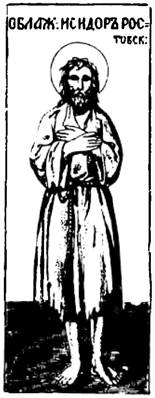
Блаж. Исидор родился где-то в Германии216 и вероятно около Бранибора (Бранденбурга), где бедные Славяне теснимы и угнетаемы были Немцами с бесчеловечной жестокостью. Сострадательная любовь его к купцам мореплавателям указывает на то, что и сам он родился на морском берегу и знаком был с опасностями моря217. По житию его, родители его были люди богатые. Сын оставил дом их и Римское исповедание по глубокому убеждению в несостоятельности последнего перед судом совести и здравого рассуждения218. По примеру праведных Симеона и Иоанна, принял он на себя юродство и пришёл в Ростов. Здесь в виде юродивого переносил он насмешки и побои безответно. Подвиг тяжёлый для самолюбия, всегда щекотливого! Много надобно бороться с собой, чтобы достигнуть полной победы над щекотливой гордостью. Это значит стать как бы мёртвым для себя. По воле великого Макария, ученик его сперва бранил, потом хвалил мертвецов и те не отвечали ему ни слова. «Так и ты будь мёртв, сказал великий авва, если хочешь спастись. Когда ругают тебя, молчи и не сердись; а когда хвалят, не возносись; – даже не думай, как не думает мертвец, ни об оскорблениях, ни о похвалах, и спасёшься». Так вёл себя блаж. Исидор, когда осыпали его насмешками и побоями. На топком месте устроив себе хижину из хвороста, удалялся он в неё на ночь; хижина не защищала его ни от холода, ни от зноя; она закрывала только от глаз людских молитвенные подвиги его, которые совершал он по ночам, с вечера до утра. Днём он, если и давал покой измученному телу своему, то не иначе как на куче навоза или на жестокой земле. Крепка была любовь его к Господу. И Господь возлюбил его. Он ещё на земле облёк Исидора даром чудес. Купцы плыли по морю и во время страшной бури решились умилостивить небо, как спутники Ионы: положили жребием узнать самого тяжкого преступника и бросить его в море. Так брошен был Ростовский купец и он уже близок был к тому, чтобы быть поглощённым в море, как является блаж. Исидор и переносит его на корабль. Спутники, увидав товарища на корабле, поражены были страхом; а незримый ими Исидор строго запретил спасённому говорить о нём. Только по смерти Исидора купец рассказал в Ростове, как спасён он был блаженным. Ростовским князем был тогда князь Владимир Андреевич, продавший потом часть свою из наследственного княжества великому князю Иоанну219. Дворецкий князя Владимира, готовивший богатый обед для князя и гостей, с бранью отказал Исидору, когда тот просил утолить жажду и голод его. Во время обеда князь приказал подносить питье гостям; но к изумлению и ужасу, питья не оказалось в сосудах. Является Исидор с просфорой для бывшего тут епископа и сосуды наполнились вином на вразумление жестокосердия. Во время кончины блаж. Исидора, проходивший мимо хижины его почувствовал особое благовоние и возбуждённый тем посмотрел в хижину. Исидор лежал, как увидел он, со сложенными на груди руками, почив на веки от трудов своих. Блаженная кончина его последовала мая 14-го 1484 г. Ростовцы тогда же построили на месте хижины деревянный храм в честь Вознесения Господня, так как день погребения Исидора, 18 мая, был тогда накануне сего праздника.
The blessed Isidore was born somewhere in Germany216 and probably near Branibor (Brandenburg), where the poor Slavs were oppressed and persecuted by the Germans with inhuman cruelty. His compassionate love for merchant seafarers indicates that he himself was born on the seacoast and was familiar with the dangers of the sea217. According to his Life, his parents were wealthy people. The son left their home and the Roman confession out of deep conviction of the latter's untenability before the judgment of conscience and sound reason218. Following the example of the righteous Simeon and John, he took upon himself foolishness for Christ and came to Rostov. Here, as a fool-for-Christ, he endured mockery and beatings without complaint. A heavy struggle for self-love, which is always sensitive! One must struggle much with oneself to attain complete victory over touchy pride. This means becoming as if dead to oneself. According to the will of the great Macarius, his disciple first reviled, then praised the dead, and they answered him not a word. "So you also be dead," said the great abba, "if you wish to be saved. When they revile you, be silent and do not become angry; and when they praise you, do not be exalted—do not even think, as a dead man does not think, either of insults or of praises, and you will be saved." Thus did the blessed Isidore conduct himself when he was showered with mockery and blows. Having built himself a hut of brushwood on a marshy spot, he would withdraw into it for the night; the hut protected him neither from cold nor from heat; it only concealed from human eyes his prayerful labors, which he performed at night, from evening until morning. By day, if he gave rest to his tormented body, it was only on a pile of dung or on the hard ground. Strong was his love for the Lord. And the Lord loved him. Even on earth He endowed Isidore with the gift of miracles. Merchants were sailing on the sea, and during a terrible storm they decided to appease heaven, like the companions of Jonah: they cast lots to find the greatest sinner and throw him into the sea. Thus a Rostov merchant was thrown overboard, and he was already close to being swallowed up by the sea, when the blessed Isidore appeared and carried him onto the ship. His companions, seeing their comrade on the ship, were struck with fear; and Isidore, invisible to them, strictly forbade the saved man to speak of him. Only after Isidore's death did the merchant relate in Rostov how he had been saved by the blessed one. The prince of Rostov at that time was Prince Vladimir Andreevich, who later sold his portion of the hereditary principality to Grand Prince John219. The steward of Prince Vladimir, who was preparing a rich dinner for the prince and his guests, angrily refused Isidore when he asked to quench his hunger and thirst. During the dinner, the prince ordered drink to be served to the guests; but to astonishment and horror, there was no drink in the vessels. Isidore appeared with a prosphora for the bishop who was present, and the vessels were filled with wine for the admonition of hard-heartedness. At the time of the blessed Isidore's death, a man passing by his hut sensed a special fragrance and, stirred by it, looked into the hut. Isidore lay, as he saw, with his hands folded on his chest, having reposed forever from his labors. His blessed repose occurred on May 14, 1484. The people of Rostov at once built a wooden church on the site of the hut in honor of the Ascension of the Lord, since the day of Isidore's burial, May 18, was then the eve of that feast.
В рукоп. житии Исидора записано 6 чудес, совершившихся при гробе его. Один от пьянства лишился ума и бил людей; связанного привели его ко гробу блаженного и во время пения молебна больному возвратился рассудок его. По службе Исидору, священник, хотевший открыть святое тело Исидору внезапно поражён был болезнью и исцелился при гробе блаженного220. Мощи блаженного доселе покоятся под спудом. Над нами при царе Иоанне, на место деревянного, построен был каменный храм221.
In the manuscript Life of Isidore, six miracles that occurred at his grave are recorded. A man lost his mind from drunkenness and beat people; they brought him bound to the grave of the blessed one, and during the singing of a moleben, the sick man's reason returned to him. According to the service to Isidore, a priest who wished to open the holy body of Isidore was suddenly struck with illness and was healed at the grave of the blessed one220. The relics of the blessed one still rest hidden. Over them, under Tsar John, a stone church was built in place of the wooden one221.
«Просветясь благодатию Божиею, премудрый, прекрасно совершал ты течение жизни временной, в целомудрии и терпении крепком. Святость жизни твоей прославила тебя и по смерти, ибо источаешь ты исцеления притекающим ко гробу твоему. Блаженный Исидор! моли Христа Бога о спасении душ наших»222.
"Enlightened by the grace of God, O wise one, thou didst beautifully complete the course of temporal life, in chastity and steadfast patience. The holiness of thy life glorified thee even after death, for thou pourest forth healings to those who draw near to thy grave. Blessed Isidore, pray to Christ God for the salvation of our souls!"222
Память первого открытия мощей святого Тихона Задонского. В Задонском монастыре, где открыто почивают моща святителя, 14-го мая совершается праздничное воспоминание первого негласного открытия их в 1846 году архиепископом Воронежским Антонием, вследствие особенного видения.
Commemoration of the first uncovering of the relics of St. Tikhon of Zadonsk. In the Zadonsk Monastery, where the relics of the Hierarch lie openly, on May 14 a festive remembrance is held of the first non-public uncovering of them in 1846 by Archbishop Anthony of Voronezh, as a result of a particular vision.
В Ярославле мещанка Александра Димитриевна Добычкина 17 лет страдала весьма жестокой болезнью, сначала внутреннею тоской, потом ломотой в руках и во всех составах; мучительная боль исторгала у ней страшные вопли. В 1823 году видела она во сне некоторый храм с изображением в нём иконы Богоматери. Ходя по церквам, она везде искала сего храма. Мая 1-го пришла она в Ярославский архиерейский дом и, увидя здесь под колокольней церковь Происхождения честных древ, узнала в ней виденный ею во сне храм. С радостным предчувствием вошла и, как скоро увидела написанную на стене икону Божией Матери Печерской, вдруг повержена была на пол с необыкновенными корчами всего тела. Пришедши в себя и питаясь несомненной надеждой получить исцеление своих многолетних недугов от иконы Богоматери, виденной ею во сне, она и на другой день мая 2-го пришла в сию церковь и, помолясь перед иконой Богоматери, хотела подойти и приложиться к ней; но вдруг почувствовала внутри себя какое-то сильное и непонятное движение и вместе с сим получила совершенное исцеление от болезни. С того времени от сей иконы благодатью Богоматери начали источаться бесчисленные чудеса всем, с верой к ней притекающим.
In Yaroslavl, a tradeswoman, Alexandra Dimitrievna Dobychkina, suffered for 17 years from a very severe illness: first an inner anguish, then aches in her arms and in all her joints; excruciating pain tore terrible cries from her. In 1823 she saw in a dream a certain church with an icon of the Mother of God depicted in it. Walking through churches, she sought this temple everywhere. On May 1 she came to the Yaroslavl bishop's house, and seeing there the church of the Origin of the Precious Cross under the bell tower, she recognized in it the temple she had seen in her dream. With joyful anticipation she entered, and as soon as she saw the icon of the Mother of God of the Kiev Caves painted on the wall, she was suddenly thrown to the floor with extraordinary convulsions of her whole body. Coming to herself and nourished by the unshakeable hope of receiving healing from her many-year ailments from the icon of the Mother of God she had seen in her dream, she came again on the next day, May 2, to this church, and having prayed before the icon of the Mother of God, she wished to approach and venerate it; but suddenly she felt within herself a certain strong and incomprehensible movement, and together with this she received complete healing from her illness. From that time, by the grace of the Mother of God, countless miracles began to flow from this icon to all who draw near to it with faith.
Ни одно из слов, заповеданных Божественным Учителем, не невозможно для исполнения, – и как ни трудно осуществимы некоторые из них, всё же встречаются примеры, подтверждающие, что и самое трудное – исполнимо для истинных последователей Слова Божия. Нестяжательность, и сострадание, и полная любви забота о ближнем проявились, например, в такой крайней степени у инока Серапиона, память которого чествуется сегодня, что после того никто не может извинять себя, если отказывается поделиться с неимущим хотя от избытка своего...
Not one of the words commanded by the Divine Teacher is impossible to fulfill—and however difficult some of them are to realize, examples are still encountered confirming that even the most difficult is attainable for true followers of the Word of God. Non-acquisitiveness, and compassion, and love-filled care for one's neighbor were manifested, for example, to such an extreme degree in the monk Serapion, whose memory is honored today, that after this no one can excuse himself if he refuses to share even from his abundance with one who has nothing...
Инок Серапион, избравший путь странничества (он переходил с места на место по Египту, Елладе, Италии), достиг того, что не имел привязанности ни к какому земному предмету. Ещё в молодости роздал он имение своё нищим, оставив себе лишь одежду да Евангелие, и, бесприютно скитаясь, не имел даже постоянного жилища, к которому бы он мог привязаться. Таким образом, ещё существуя в земной оболочке, расторг он все узы, которые могли бы его прикреплять к земле...
The monk Serapion, who chose the path of wandering (he moved from place to place through Egypt, Hellas, and Italy), attained such a state that he had no attachment to any earthly object. Even in his youth he distributed his property to the poor, keeping for himself only his clothing and the Gospel, and, homelessly wandering, he had not even a permanent dwelling to which he might become attached. Thus, while still existing in an earthly body, he broke all the bonds that could fasten him to the earth...
– Вот, я почитаю себя постником и прикрыт одеждой – подумал он, смотря на скудные лохмотья нищего, – а этот раб Христов терпит холод... Если бедный человек замёрзнет, то, по правде, это я буду его убийцей... И, сняв с себя одежду, он отдал её нищему, а сам, обнажённый, сидел на распутье, держа в руках последнее своё достояние – Евангелие...
"Behold, I consider myself a faster and am covered with clothing," he thought, looking at the poor man's scanty rags, "but this servant of Christ suffers cold... If the poor man freezes to death, then, in truth, I will be his murderer..." And taking off his garment, he gave it to the poor man, while he himself, naked, sat at a crossroads, holding in his hands his last possession—the Gospel...
Потом он встретил человека, которого вели за долг в темницу. Не имея средств выкупить его, Серапион продал Евангелие и заплатил долг за того человека. Когда он возвратился в хижину, где пребывал временно, ученик спросил его: «Где же твоя одежда?»
Later he met a man who was being led to prison for debt. Having no means to ransom him, Serapion sold the Gospel and paid the debt for that man. When he returned to the hut where he was temporarily staying, his disciple asked him: "Where is your clothing?"
По этим проявлениям Божьего человека, сохранившимся в памяти у людей, можно судить, что это был истинный, высокий в простоте своей – исполнитель слова Божия, и что возможное для одного не может быть невозможным, особенно же – в менее крайнем проявлении – для других.
From these manifestations of the man of God, preserved in the memory of men, one can judge that he was a true, lofty in his simplicity—fulfiller of the word of God, and that what is possible for one cannot be impossible, especially—in a less extreme manifestation—for others.
Но отрешённый от земной жизни полнейшим беспристрастием к каким-либо благам земным, Серапион был связан с людьми любовью к ним, той любовью, которая на земле есть начало вечного рая; любовью, спасающею души людей, под покровом которой все люди составляют единое (духовное, бессмертное) тело в Единородном Сыне Божием (1Кор.12:27). Вразумление заблуждающихся было делом встречавшегося постоянно на своём странническом пути с заблуждениями человеческими. Для достижения этой цели Серапион не отступил и перед продажей своей свободы и самоотверженно жертвовал этим благом, не располагая больше никаким другим. Так, придя в Лакедемон, он узнал, что один человек, ведущий вообще добродетельную жизнь, держится опасной ереси. Преподобный продал ему себя в рабство и в течение двухлетнего пребывания у него в доме успел своей святой жизнью обратить его со всем его семейством к православию. В другой раз Серапион подобным же образом, поступив рабом в дом одного Эллинского комедианта – язычника, обратил его к Христу со всем его семейством. Он скончался в глубокой старости – в пустыне Египетской. Синдонитом назван, как полагают, потому, что не носил ничего кроме синдона – одежды льняной.
But detached from earthly life by the most complete indifference to any earthly goods, Serapion was bound to people by love for them—that love which on earth is the beginning of eternal paradise; love that saves the souls of men, under whose shelter all people constitute one (spiritual, immortal) body in the Only-begotten Son of God (1 Cor. 12:27). The correction of the erring was the work of one who constantly encountered human errors on his wandering path. To achieve this goal, Serapion did not shrink even from selling his freedom, and self-sacrificingly sacrificed this good, having no other at his disposal. Thus, having come to Lacedaemon, he learned that a certain man, who generally led a virtuous life, held to a dangerous heresy. The Venerable One sold himself into slavery to him, and during a two-year stay in his house, he succeeded by his holy life in converting him, together with all his household, to Orthodoxy. On another occasion, Serapion, in like manner, having entered as a slave into the house of a certain Hellenic comedian—a pagan—converted him to Christ with all his household. He reposed in extreme old age—in the Egyptian desert. He is called Sindonites, it is thought, because he wore nothing but a sindon—a linen garment.
Ркп. житие св. Исидора в Минее Макария под 15 мая, в Синод. б. 90. Сокращение его в ч. минее св. Димитрия.
Manuscript Life of St. Isidore in the Menaion of Macarius under May 15, in the Synodal Library, No. 90. Its abridgment in the Menology of St. Demetrius.
Пролог 14 мая: «поведают непыи, бяше Латынска языка, земли же Немецкия, – от славна и богата рода бе, яко же глаголют местерскаго». Догадка о происхождении Исидора из Немецкого магистерского рода не принята св. Димитрием, да она мало и вероятна, тогда как известны многие роды Славянские, перешедшие с Славянского поморья в Россию от притеснения Немцев. Лакьера геральдика 2, 479–492.
Prologue, May 14: “Some relate that he was of the Latin tongue, of the German land—of a glorious and rich family, as they say, of a master’s rank.” The conjecture about Isidore’s origin from a German master’s family was not accepted by St. Demetrius; indeed, it is hardly probable, whereas many Slavic families are known who moved from the Slavic Pomerania to Russia because of oppression by the Germans. Lakier’s Heraldry, 2, 479–492.
Пролог: «возненавидев богомерзкую веру Латинскую, возлюби христианскую веру православную». То же в ркп. житии. – В службе, написанной при ц. Иоанне, говорится: «отеческаго небрегл еси неверствия и еже идолом приношения гнушася». – Это выдумка очень неудачная! В XV в. и Славяне и Немцы Германии были христианами.
Prologue: “Having hated the abominable Latin faith, he loved the Christian Orthodox faith.” The same in the manuscript Life. — In the service composed under Tsar John, it is said: “Thou didst neglect thy fathers’ unbelief and didst abhor the offerings to idols.” — This is a very unfortunate invention! In the 15th century, both Slavs and Germans of Germany were Christians.
В. к. Иоанн в 1474 г. купил половину (одна уже принадлежала ему) Ростова и Ростовского княжества у князей Владимира Андреевича и Ивана Ивановича (Карамз. VI. 113, пр. 293). Последний был владетельным князем Пужбольским (Родосл. кн.).
Grand Prince John in 1474 bought half (the other half already belonged to him) of Rostov and the Rostov principality from Princes Vladimir Andreevich and Ivan Ivanovich (Karamzin, VI, 113, note 293). The latter was the appanage prince of Puzhbol (Genealogical Book).
Уже в уставе 1522 г. положена мая 14 «память св. Исидора Христа ради юродивого, Ростовского чудотворца». Опис. муз. Рум. стр. 713. Служба Исидору (в муз. Рум. 595, у Царского № 563) написана при ц. Иоанне в 1548 г. Исидор юродивый святой – в грам. 1563 г., ист. акт. I, 320.
Already in the Typicon of 1522, under May 14, is appointed “the memory of St. Isidore, Fool-for-Christ, Wonderworker of Rostov.” Description of the Rumyantsev Museum, p. 713. The service to Isidore (in the Rumyantsev Museum, No. 595, at Tsarsky’s No. 563) was composed under Tsar John in 1548. Isidore the Fool-for-Christ is a saint—in a charter of 1563, Historical Acts, I, 320.