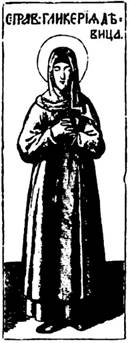
Пострадала около 177 года во время гонения на христиан при императоре Антонине. Она была дочь анфипата (губернатора), христианка. Назначено было языческое празднество, во время которого должны были все жители города (Гераклеи Фракийской) участвовать в жертвоприношении богам; Гликерии, как знатнейшей по своему происхождению, предложили быть во главе торжества. Но она явилась на него без светильника, с которым открывались обыкновенно подобные шествия.
She suffered around the year 177 during the persecution of Christians under the Emperor Antoninus. She was the daughter of the anthypatos (governor), a Christian. A pagan festival was appointed, during which all the inhabitants of the city (Heraclea in Thrace) were to participate in the sacrifice to the gods; Glyceria, as the most noble by birth, was asked to be at the head of the celebration. But she appeared at it without the lamp with which such processions were usually opened.
– Я ношу при себе неугасимый светильник, – отвечала христианка, – если все погасят свои светильники, то увидят, какую жертву я принесу Богу моему...
"I carry within me an unquenchable lamp," the Christian woman answered. "If all extinguish their lamps, they will see what sacrifice I will offer to my God..."
– Господи! – воззвала она, воздев руки к небу, – Ты, Который явился отрокам в печи Вавилонской и избавил их от огня, и заградил уста львам, и показал победителем раба Твоего Даниила, Иисус Христос, Агнец Божий, прииди в помощь рабе Твоей! Сокруши этого идола, разори жертвоприношения ему...
"O Lord!" she cried, raising her hands to heaven, "Thou Who didst appear to the youths in the Babylonian furnace and didst deliver them from the fire, and didst shut the mouths of the lions, and didst show Thy servant Daniel victorious, Jesus Christ, the Lamb of God, come to the aid of Thy handmaiden! Shatter this idol, destroy the sacrifices to him..."
Внезапный гром раздался в отзыв на веру молящейся... Каменный идол упал и разбился на мелкие части... Жрецы пришли в негодование, народ в ярости начал бросать каменьями в христианку, но камни не долетали до неё и образовали груду вокруг... Не признавая в этом чудной силы Божией, язычники кричали, что это – волшебство... Гликерию приказано было отвести в темницу.
A sudden clap of thunder resounded in response to the faith of the praying woman... The stone idol fell and shattered into small pieces... The priests were indignant; the people in fury began to throw stones at the Christian woman, but the stones did not reach her and formed a heap around her... Not recognizing in this the wondrous power of God, the pagans cried out that it was sorcery... Glyceria was ordered to be taken to prison.
Не замедлили испытания и истязания сокрушившей идолов помощью Божией; но не преодолели они чудную мощь подвига ради Христа...
Trials and torments for her who had shattered the idols with God's help were not long in coming; but they did not overcome the wondrous power of her feat for Christ's sake...
После страшных истязаний Гликерия была снова брошена в темницу. Лаодикий, сторож тюремный, поражённый её терпением в муках, уверовал во Христа.
After terrible tortures, Glyceria was again thrown into prison. Laodiceus, the prison guard, struck by her endurance in sufferings, believed in Christ.
– Верую в Бога Гликерии! хочу быть участником смерти её! – воскликнул он в порыве охватившего его стремления к постигнутому Богу.
"I believe in the God of Glyceria! I want to be a partaker of her death!" he exclaimed in a rush of the striving that had seized him toward the God he had come to know.
Вскоре затем, после различных мук, мирно среди молитвы предала душу свою Богу и Гликерия. Епископ Дометий предал погребению останки мученицы на живописном месте за городом.
Soon after, after various torments, Glyceria also peacefully surrendered her soul to God in prayer. Bishop Dometius committed the remains of the martyr to burial in a picturesque place outside the city.
«От гробницы её истекло миро, чему очевидец был император Маврикий (582–602). При нём было ещё следующее чудо: епископ Гераклейский, желая заменить медный сосуд, в который истекало св. миро, серебряным, купил его в Константинополе. Но, когда он поставлен был при гробе святой, Миро остановилось. После усиленных молитв, после отнятия сосуда и заменения его старым, оно опять потекло. Оказалось, что серебряный сосуд принадлежал прежде человеку, занимавшемуся волхвованием, и употребляем был им на дела нечестия. Виновники наказаны были императором Маврикием смертью. Об этом пишет современник Феофилакт Симокатта около 629 г. в истории Маврикия. Об истечении мира от св. мощей муч. Гликерии свидетельствует также историк Никифор. Мощи её перенесены были в Лемнос». (См. «Месяцеслов Востока» архим. Сергия, т. II, ч. 2, стр. 134).
"From her tomb flowed myrrh, of which the Emperor Maurice (582–602) was an eyewitness. In his time the following miracle also occurred: the bishop of Heraclea, wishing to replace the copper vessel into which the holy myrrh flowed with a silver one, bought it in Constantinople. But when it was placed at the tomb of the saint, the myrrh stopped. After fervent prayers, after the removal of the vessel and its replacement with the old one, it flowed again. It turned out that the silver vessel had previously belonged to a man who practiced sorcery and was used by him for deeds of impiety. The guilty were punished with death by the Emperor Maurice. This is written by the contemporary Theophylact Simocatta around 629 in his history of Maurice. The historian Nikephoros also testifies to the flowing of myrrh from the holy relics of the Martyr Glyceria. Her relics were translated to Lemnos." (See "Menaion of the East" by Archimandrite Sergius, vol. II, part 2, p. 134).
Преподобный Иоанн Грузин, княжеского рода из города Артануча (близ Карса), оставив военную службу, семейство и стяжания, поступил в один из Имеретинских монастырей, а отсюда, взяв сына Евфимия, перешёл в монастырь горы Олимпа, в Греции, и наконец в Афонскую лавру св. Афанасия. Он исполнял безропотно все послушания, на него возлагаемые, вёл строгую и трудолюбивую жизнь; по его примеру, прибывали и другие Грузины в лавру Афанасия. Рассудив, что неудобно многочисленной Грузинской братии жить между Греками, Иоанн по общему совету купил место на восточной стороне Афонской горы и, построив церковь во имя Иоанна Крестителя, положил основание Иверскому монастырю, которого был первым настоятелем (в 982 году). Во дни его обитель удостоилась благодатного посещения Божией Матери через чудотворную икону Её, именуемую Иверской. Скончался 998 года, передав игуменство, с общего выбора братии, Евфимию.
The Venerable John of Georgia, of princely lineage from the city of Artanuji (near Kars), having left military service, family, and possessions, entered one of the monasteries of Imereti, and from there, taking his son Euthymius, he moved to the monastery on Mount Olympus in Greece, and finally to the Athonite Lavra of St. Athanasius. He fulfilled without complaint all the obediences placed upon him, leading a strict and industrious life; following his example, other Georgians also came to the Lavra of Athanasius. Reasoning that it was inconvenient for a numerous Georgian brotherhood to live among the Greeks, John, by common counsel, purchased a place on the eastern side of Mount Athos and, having built a church in the name of John the Baptist, laid the foundation of the Iveron Monastery, of which he was the first abbot (in 982). In his days the monastery was vouchsafed the gracious visitation of the Mother of God through Her wonderworking icon, called the Iveron Icon. He reposed in the year 998, having handed over the abbacy, by the common choice of the brotherhood, to Euthymius.
Преподобный Евфимий ещё при жизни своего родителя провёл много лет в трудах над переводами книг священного Писания и Богослужебных с Греческого на Грузинский язык, а в продолжении 12-летнего настоятельства с ревностью продолжал дело, начатое отцом его, по устройству обители и братства, установил порядок и чиноположение в отправлении церковного Богослужения и написал устав общежития, в исполнении коего служил примером для братии. Так как с принятием игуменства, он невольно прекратил труды свои по переводу священных книг, то многие высшие духовные и мирские сановники Грузинские убедили его сложить с себя бремя настоятельства и продолжать начатые им труды для блага Церкви и своего народа. Евфимий передал игуменство родственнику своему иноку Георгию и снова принялся за прерванные было труды; скончался на 65 году Богоугодной жизни своей, в 1028 году, обессмертив своё имя в памяти благодарного народа Грузинского.
The Venerable Euthymius, even during the lifetime of his parent, spent many years in labors over translations of the books of Holy Scripture and liturgical books from Greek into the Georgian language, and during his 12-year abbacy he zealously continued the work begun by his father for the establishment of the monastery and brotherhood, established order and rubrics in the celebration of church services, and wrote a rule of the cenobitic life, in the fulfillment of which he served as an example for the brotherhood. Since, with the acceptance of the abbacy, he involuntarily ceased his labors on the translation of sacred books, many high-ranking spiritual and secular dignitaries of Georgia persuaded him to lay down the burden of the abbacy and continue the works he had begun for the good of the Church and his people. Euthymius handed over the abbacy to his relative, the monk George, and again took up his interrupted labors; he reposed in the 65th year of his God-pleasing life, in the year 1028, having immortalized his name in the memory of the grateful Georgian people.
Преподобный Георгий, племянник Иоанна, был шестым игуменом Иверской обители, которая при .Георгии, третьем игумене, и его двух непосредственных преемниках не свободна была от некоторых неурядиц. Он родился в Грузии 1014 года и на 25 году жизни пострижен в Хахульском монастыре, откуда потом посещал святые места Сирии и Палестины, и наконец, по убеждению старцев, отправился на св. гору Афонскую продолжать труды Евфимия по переводу книг на Грузинский язык. Семь лет провёл он в безусловном послушании братству и, удостоенный сана пресвитерского, тогда только начал приводить к концу начатое Евфимием. В 1047 году братия избрала его в игумены, и он воздвигнул по ныне существующий соборный храм в честь Успения Богоматери, и перенёс сюда же мощи Иоанна и Евфимия. Через 10 лет сложил с себя игуменство, чтобы иметь больше времени для просветительной деятельности, посетил Дивную гору близ Антиохии, где было тогда много монахов Грузин, и по приглашению царя Баграта IV четыре года прожил в Грузии для устройства дел церковных. Скончался на обратном в Афон пути, в Константинополе в 1066 году, на 52 году своей жизни.
The Venerable George, the nephew of John, was the sixth abbot of the Iveron Monastery, which under George, the third abbot, and his two immediate successors was not free from some disorders. He was born in Georgia in the year 1014 and in the 25th year of his life was tonsured in the Khakhuli Monastery, from whence he later visited the holy places of Syria and Palestine, and finally, at the persuasion of the elders, set out for the Holy Mountain of Athos to continue the labors of Euthymius on the translation of books into the Georgian language. He spent seven years in absolute obedience to the brotherhood and, having been deemed worthy of the rank of presbyter, only then began to bring to completion what Euthymius had begun. In 1047 the brotherhood elected him as abbot, and he erected the cathedral church that exists to this day in honor of the Dormition of the Theotokos, and translated thither the relics of John and Euthymius. After 10 years he laid down the abbacy in order to have more time for his enlightening activity, visited the Wonderful Mountain near Antioch, where there were then many Georgian monks, and, at the invitation of King Bagrat IV, lived for four years in Georgia for the ordering of church affairs. He reposed on his return journey to Athos, in Constantinople, in the year 1066, in the 52nd year of his life.
Максимиан, Римский император (285–305 г.), устроивши близ Рима новое капище в честь Юпитера, на день открытия его назначил торжество и народный праздник. При трубных звуках глашатаи ходили по городу и взывали: «кто любит богов, завтра утром идите вместе с государем в храм Юпитера». И утром действительно пошло туда много народу частью для поклонения, частью для торга. Некий трибун Тивериан приглашал туда и подчинённых ему воинов, но один из этих воинов, именем Александр, ответил: «если б ты приглашал идти и поклониться истинному Богу, то хорошо сделал бы; а теперь вот зовёшь воздать честь Юпитеру, который, как и все ваши боги, не имеет в себе ничего доброго и поклонников своих учит только беззаконию и мерзостям». И пошёл в дом свой.
Maximian, the Roman Emperor (285–305 A.D.), having built a new temple near Rome in honor of Jupiter, appointed a celebration and a public festival for the day of its dedication. To the sound of trumpets, heralds went through the city and proclaimed: "Whoever loves the gods, go tomorrow morning together with the sovereign to the temple of Jupiter." And in the morning, indeed, many people went there, partly for worship, partly for trade. A certain tribune, Tiberian, also invited the soldiers under his command to go there, but one of these soldiers, named Alexander, answered: "If you were inviting us to go and worship the true God, you would do well; but now you call us to give honor to Jupiter, who, like all your gods, has nothing good in him and teaches his worshippers only lawlessness and abominations." And he went to his house.
Когда же император приносил жертвы, то стоявший при нём Тивериан трибун донёс ему, что Александр не слушает царского повеления, а богов порицает и осуждает. Император тотчас велел привести к себе ослушника. Был в это время шестой час дня, и Александр почивал в доме своём. И явился ему Ангел Господень в сонном видении, говоря: «будь мужествен и крепись! Много имеешь пострадать за имя Христово, и уже идут за тобой воины; но не страшись! Восстань и помолись Богу; а я буду с тобой, пока не скончаешь подвига твоего». И, пробудившись, Александр начал петь псалом Живый*в помощи Вышняго*.., а выйдя из дома, встретил воинов, которые наложили на него оковы и повели к царю.
When the emperor was offering sacrifices, the tribune Tiberian, who stood near him, reported that Alexander did not obey the emperor's command, but reviled and condemned the gods. The emperor immediately ordered the disobedient one to be brought before him. It was the sixth hour of the day, and Alexander was resting in his house. And an Angel of the Lord appeared to him in a dream, saying: "Be courageous and strong! You have much to suffer for the name of Christ, and soldiers are already coming for you; but fear not! Arise and pray to God; and I will be with you until you finish your feat." And awakening, Alexander began to sing the psalm He that dwelleth**in the help of the Most High..., and coming out of the house, he met the soldiers, who put chains on him and led him to the emperor.
Александр имел от роду восемнадцать лет, был высок ростом, красив и цвёл здоровьем. Царь спросил его: «ты ли, безумец, оскорбляешь власть мою, не повинуешься начальнику своему и не пришёл поклониться великому богу Юпитеру?»
Alexander was eighteen years old, tall in stature, handsome, and flourishing in health. The emperor asked him: "Are you the madman who insults my authority, disobeys your commander, and did not come to worship the great god Jupiter?"
Александр же стал обличать безумие язычников, обоготворивших пороки и порочных людей, и укорил царя, находящего удовольствие в мерзостях и не познающего Бога, давшего ему и честь и царство.
But Alexander began to denounce the folly of the pagans, who had deified vices and vicious men, and reproached the emperor, who took pleasure in abominations and did not know the God Who had given him both honor and a kingdom.
Тогда Максимиан отдал его во власть Тивериану трибуну, и самому трибуну поручил идти во Фракию изыскивать и преследовать христиан. Тивериан же, подвергши его сначала пыткам (строганию железом) на дереве (equuleus – деревянная кобыла), велел вести за собой во Фракию. Мать святого, Пимения, извещённая о подвиге сына, с упованием на Бога последовала за ним в путном шествии его.
Then Maximian handed him over to the authority of the tribune Tiberian, and charged the tribune himself to go to Thrace to seek out and persecute Christians. Tiberian, having first subjected him to tortures (scraping with iron) on the wooden horse (equuleus), ordered him to be led after him to Thrace. The mother of the saint, Pimenia, having been informed of her son's feat, followed him in his journey with hope in God.
Шествие трибуна из Италии к Византии было продолжительно; следовавшего за ним Александра подвергал он мукам и пыткам в разных местах своих остановок (особенно в Сардике, Филиппополе, Веррее) и наконец, пройдя Адрианополь, близ города Дризипера, у реки Еригона сделан последний допрос ему. «Александр! вот смерть перед тобой; говори, принесёшь жертву богам или нет? Ибо иначе здесь казнят тебя и тело бросят в реку». Святый отвечал: «никогда не принесу жертвы богам твоим, хотя бы ты грозил мне и тысячами смертей». Тогда трибун приговорил отсечь ему голову и тело бросить в реку. Воины остались исполнить приговор, а сам Тивериан отправился в путь.
The journey of the tribune from Italy to Byzantium was lengthy; he subjected Alexander, who followed him, to torments and tortures in various places where he halted (especially in Sardica, Philippopolis, and Beroea), and finally, having passed Adrianople, near the city of Drizipara, at the river Erigon, the final interrogation was made of him. "Alexander! Behold death before you; speak, will you offer sacrifice to the gods or not? For otherwise you will be executed here and your body thrown into the river." The saint answered: "I will never offer sacrifice to your gods, even if you threaten me with a thousand deaths." Then the tribune sentenced him to be beheaded and his body thrown into the river. The soldiers remained to carry out the sentence, while Tiberian himself set out on his journey.
Множество народа из окрестностей сошлось туда, – большей частью христиане. Святой просил спекулатора (палача, исполнителя казни) повременить и позволить совершить молитву. И, умыв руки и лицо, оградил себя крестным знамением и, помолившись, сказал предстоявшим христианам: «отцы и братия! Поминайте труды мои; потому что я не ленился страдать за Господа нашего, да будет милостив ко мне и всем христианам. Сами знаете, как я прошёл от Рима до сего места в узах и оковах, с лишениями, муками и пытками; и всё это я мужественно претерпел не моей силой, а помощью Господа нашего Иисуса Христа. Теперь же отхожу предстать Владыке моему, а вы помолитесь о мне, чтоб я обрёл милость у Него».
A great multitude of people from the surrounding area gathered there—for the most part Christians. The saint asked the speculator (the executioner, the one who carries out the sentence) to wait and to permit him to offer a prayer. And having washed his hands and face, he made the sign of the cross over himself, and having prayed, said to the Christians who stood before him: "Fathers and brethren! Remember my labors; for I have not been slothful in suffering for our Lord, that He may be merciful to me and to all Christians. You yourselves know how I have come from Rome to this place in bonds and chains, with deprivations, torments, and tortures; and all this I have endured courageously, not by my own strength, but by the help of our Lord Jesus Christ. Now I depart to stand before my Master, and do you pray for me, that I may find mercy with Him."
После казни тело мученика брошено в реку. По смотрению же Божию, четыре пса извлекли тело на берег и сидели при нём, отгоняя зверей и птиц, пока не прибыла мать святого. Она предала его честному погребению, а верные создали на том месте, уже в царствование Константина, и церковь. См. об этой церкви сказанное под 20 августа в житии св. Филиппа Ираклийского.
After the execution, the martyr's body was thrown into the river. But by the providence of God, four dogs drew the body onto the bank and sat by it, driving away beasts and birds, until the saint's mother arrived. She gave it honorable burial, and the faithful, already in the reign of Constantine, built a church on that spot. See concerning this church what is said under August 20 in the life of St. Philip of Heraclea.
По летописи, 1572 г. июня 14 дня в Новгороде у церкви св. Флора и Лавра обретены нетленными мощи святой девицы Гликерии, скончавшейся за 50 лет перед тем; это была дочь старосты Легощинской улицы Пантелеймона; архиепископом Леонидом и собором духовенства мощи положены были в самом храме. В тот же день получил исцеление при гробе праведницы четырёхлетний сын подьячего Богдана Суворова214. Память праведницы местно чтится мая 13 дня215.
According to the chronicle, in the year 1572, on June 14, in Novgorod, at the church of Sts. Florus and Laurus, the incorrupt relics of the holy maiden Glyceria were uncovered, who had reposed 50 years before; she was the daughter of Panteleimon, the elder of the Legoshchina Street. By Archbishop Leonid and a council of the clergy, the relics were placed in the church itself. On the same day, the four-year-old son of the clerk Bogdan Suvorov received healing at the tomb of the righteous one214. The commemoration of the righteous one is locally venerated on May 13215.
Праведница изображена на старинном образе Новгородских чудотворцев, который ныне находится в ризнице Черниговской кафедры. Образ – достойный внимания! Вверху – св. София с предстоящими Богоматерью и Предтечей. В первом ряду: «Никита, Нифонт, Иоанн, Евфимий, Иона, Моисей, Серапион, Григорий, Феоктист, Лука»; во втором ряду: «Иоаким, Симеон. Мартирий, Василий, Антоний (святители), Варлаам (Хутын.), Савва (Вишер.), Михаил (Клоп.), Александр (Свир.)». В 3 ряду: «Александр (Ошев.), Зосима и Савватий (Солов.), Нил (Столб.), Арсений (Кон.), Никодим (Кожеоз.), Ефрем (Новот.), Антоний (Римл.), Антоний (Сийск.)». В 4 ряду: «Антоний (Леохн.), Ефрем (Перек.), Варлаам (Шенк.), Сергий и Герман (Валаам.), Евфросин (Синоз.), Владимир (кн.), Анна (кн.), Феодор (юрод.), Николай (юрод.)». В 5 ряду: «Арсений (Новг.), Афанасий (Череп.), Корнилий (Палеос.), Антоний (Дым.), Ксенофонт (Робейс.), Никита, Кирилл, Никифор, Климент, Исаакий (Алфановы)». В 6 ряду: «Мартирий (Зелен.), Феофил и Иаков (Омуч.), Кирилл (Челм.), Феодор (кн.), Мстислав (кн.), Иоанн Логгин (Ярен.), Диодор (Юрьег.), Елиазар (Анз.), Макарий (Оред.), Артемий (Верк.), Иаков и Иоанн (Менюж.), Гликерия».
The righteous one is depicted on an ancient icon of the Novgorod Wonderworkers, which is now located in the sacristy of the Chernigov cathedral. The icon is worthy of attention! At the top—St. Sophia with the Mother of God and the Forerunner standing before her. In the first row: "Nikita, Niphon, John, Euthymius, Jonah, Moses, Serapion, Gregory, Theoctistus, Luke"; in the second row: "Joachim, Simeon, Martyrius, Basil, Anthony (Hierarchs), Barlaam (of Khutyn), Sabbas (of Visher), Michael (of Klopsk), Alexander (of Svir)." In the 3rd row: "Alexander (of Oshevensk), Zosimas and Sabbatius (of Solovki), Nilus (of Stolobny), Arsenius (of Konevits), Nicodemus (of Kozheozero), Ephraim (of Novotorzhok), Anthony (the Roman), Anthony (of Siya)." In the 4th row: "Anthony (of Leokhnovo), Ephraim (of Perekom), Barlaam (of Shenkursk), Sergius and Herman (of Valaam), Euphrosynus (of Sinozero), Vladimir (Prince), Anna (Princess), Theodore (Fool-for-Christ), Nicholas (Fool-for-Christ)." In the 5th row: "Arsenius (of Novgorod), Athanasius (of Cherepovets), Cornelius (of Paleostrov), Anthony (of Dymsk), Xenophon (of Robeika), Nikita, Cyril, Nicephorus, Clement, Isaac (the Alfanovs)." In the 6th row: "Martyrius (of Zelenets), Theophilus and James (of Omuch), Cyril (of Chelmogory), Theodore (Prince), Mstislav (Prince), John Longinus (of Yarensk), Diodorus (of Yuriev Monastery), Eleazar (of Anzersk), Macarius (of Oredesh), Artemius (of Verkola), James and John (of Menyuzh), Glyceria."
Св. Сергия исповедника, скончавшегося в изгнании при императоре Феофиле (829–842). Он известен как песнописец и описатель событий от времён Копронима до Михаила Заики.
St. Sergius the Confessor, who reposed in exile under the Emperor Theophilus (829–842). He is known as a hymnographer and a chronicler of events from the time of Constantine Copronymus to Michael the Stammerer.
Макария Новгор. древн. I. 221. Тихомирова сказание о чудотв. иконе знамения Богородицы и Новгор. святых, стр. 96, 97. Новгор. 1861 г.
Macarius, Antiquities of Novgorod I. 221. Tikhomirov's Account of the Miraculous Icon of the Sign of the Mother of God and the Novgorod Saints, pp. 96, 97. Novgorod, 1861.