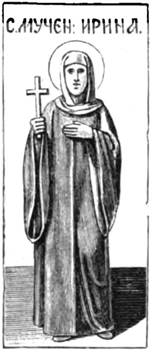
По житию святой Ирины, составленному не в раннее время, святая Ирина, дочь князя Ликиния, крещена была св. Тимофеем († 93 г.), учеником Апостола Павла; проповедовала св. веру на своей родине и по её проповеди принял св. веру отец её князь Ликиний со всем двором своим; на родине своей продолжала она проповедь о Христе три года, много вытерпела истязаний от защитников язычества и успела обратить ко Христу всего до 11,000 человек. Потом с Евангельской проповедью была она во Фракийских городах и скончалась мученицей в Солуне99.
According to the Life of Saint Irene, composed at a later time, Saint Irene, the daughter of Prince Licinius, was baptized by Saint Timothy († 93 A.D.), a disciple of the Apostle Paul. She preached the holy faith in her homeland, and through her preaching her father, Prince Licinius, together with all his court, received the holy faith. In her homeland she continued the preaching of Christ for three years, endured many tortures from the defenders of paganism, and succeeded in converting up to 11,000 people to Christ. Afterwards, with the Gospel preaching, she was in the Thracian cities and died a martyr in Thessalonica99.
Где жил князь Ликиний? Где была родина святой Ирины, оглашённая Евангельской проповедью мученицы? В Магеддоне крещена Ирина, в Магеддоне проповедовала, говорит позднее житие. Хотя с таким именем ни страны, ни города не видно в Греко-Римской империи, по известным памятникам100; но известно, что южные города не раз переменяли свои имена101. Соседняя Фракия, оглашавшаяся проповедью св. Ирины после её родины, указывает на то, что родиной св. Ирины был Иллирик. Надобно сказать более: с проповедью своей святая обратилась во Фракию, страну Славян, собственно потому, что сама она была Славянка Иллирийская, или, говоря тогдашним языком, как во Фракии, так и в Иллирике жили тогда Фраки, говорившие одним и тем же Славянским языком102.
Where did Prince Licinius live? Where was the homeland of Saint Irene, enlightened by the Gospel preaching of the martyr? In Mageddon Irene was baptized, in Mageddon she preached, says the later Life. Although neither a country nor a city with such a name is known in the Greco-Roman Empire from extant records100, it is known that southern cities changed their names more than once101. Neighboring Thrace, which was enlightened by the preaching of Saint Irene after her homeland, indicates that the homeland of Saint Irene was Illyricum. It must be said further: with her preaching the saint turned to Thrace, a land of the Slavs, precisely because she herself was an Illyrian Slav, or, speaking in the language of that time, both in Thrace and in Illyricum there lived then Thracians, who spoke one and the same Slavic language102.
Такое понимание жития св. Ирины оправдывается и даже точнее определяется Сербской историей. Сербские летописи, когда касаются вопроса о начале христианства в Сербии, признают за несомненное, что Евангельское учение проповедано было в Сербии во времена Апостольские. Напр. в одной летописи XV в. сказано: «первая проповедь о благочестии проповедана была Апостолами, но от ересей угасала»103. То же писал о начале Сербского христианства папа IX века104. Другие Сербские летописи, говоря о Сербском жупане Неемане, называют его потомком того Ликиния, которого дочь св. Ирина страдала за св. веру, и «плод многих чудес се многу тьмы приведе в Христову веру»; они же говорят, что тот Ликиний был «Тривалийский господин, родом Србин»105. Троношская летопись говорит ещё: «крещен бысть (Нееманя) в Рассии во храме св. Апостол Петра и Павла, иже создан св. Апостолом Титом наподобие кумирниц*ондашних*, яко же и ныне стоит нерушимо»106. Тут вид святого храма, похожего на идольский храм, сам по себе говорит о глубокой древности его, видевшей в силе язычество; а то известие, что храм освящён св. Титом, который и по свидетельству Апостола Павла был в Далматии (2Тим.4:10), подкрепляет сведения жития о крещении Ирины другим учеником Павла, Тимофеем. Храмом Расы определяется ещё и место, где жили князь Ликиний и дщерь его. Это была Раса. В оправдание такой мысли о Расе служит при древности Расы уважительное внимание к Расе, оказанное императором Управдой в его распоряжении о Славянских епархиях107; в этом распоряжении видна мысль о Расе, как о колыбели Сербского христианства.
Such an understanding of the Life of Saint Irene is justified and even more precisely defined by Serbian history. The Serbian chronicles, when they touch upon the question of the beginning of Christianity in Serbia, acknowledge as certain that the Gospel teaching was preached in Serbia in Apostolic times. For example, in one chronicle of the 15th century it is said: "The first preaching of piety was preached by the Apostles, but it was extinguished by heresies"103. A 9th-century pope wrote the same about the beginning of Serbian Christianity104. Other Serbian chronicles, speaking of the Serbian župan Nemanja, call him a descendant of that Licinius whose daughter, Saint Irene, suffered for the holy faith, and "the fruit of many miracles brought many thousands to the faith of Christ"; they also say that this Licinius was "a lord of Tribalia, a Serb by birth"105. The Chronicle of Tronoša further says: "He (Nemanja) was baptized in Ras in the church of the Holy Apostles Peter and Paul, which was built by the Holy Apostle Titus in the likeness of the pagan temples of that time, and it stands to this day unshaken"106. Here the appearance of a holy church, resembling a pagan temple, itself speaks of its great antiquity, which saw paganism in power; and the information that the church was consecrated by Saint Titus, who, according to the testimony of the Apostle Paul, was in Dalmatia (2 Tim. 4:10), supports the information of the Life about the baptism of Irene by another disciple of Paul, Timothy. The church of Ras also determines the place where Prince Licinius and his daughter lived. This was Ras. In justification of such a thought about Ras, the respectful attention shown to Ras by Emperor Upravda in his decree concerning the Slavic dioceses serves, given the antiquity of Ras107; in this decree the idea of Ras as the cradle of Serbian Christianity is evident.
Святая вера, насаждённая св. Ириной в Сербии, не погасла после её мученической кончины, а ещё распространилась в Сербии. По мартирологам известны мученики восточной Триваллии: в Дадоеване заклинатель Гермес иЕвентий, в Прахове Аггей, Гай и другие108; в западной Триваллии в Далматии, в городе Соленом, пострадал епископДамиан с 8 воинами, а через неделю за пастырем последовали диакон Септим и Виктурик 109. В южной Иллирии Драчский епископ Астий перед подвигом своим имел во сне видение: стоит он на камне, покрытом смолой и маслом. Проснувшись, рассказал он клирикам сон и прибавил: «братия! я должен пострадать за Христа, а вы можете бежать, где кто надеется быть целым». Это было при императоре Траяне в 110 году110. Следовательно, тогда были в Иллирике христиане и ревностные пастыри их. Известны и особые обычаи Иллирийских христиан относительно Великого поста111. Предание о построении Константином Великим храмов в Твердоше, Стоне, Завале, Добричеве основано на памятниках112. Известны и подвижники уединения, блаженные Мартин и Иларий, страдавшие в Иллирике за православие от ариан113. С Готфскими королями Далматии арианство поднимало жестокие гонения против православия в Триваллии, но Славянская стихия взяла верх над пришлой немецкой и в начале V века православие стало господствующей верой в Триваллии114. В 760 году Дуклянскому митрополиту подчинены были епископы: Будвы, Котора, Бара, Слатывы, Скутаря, Драча, Палат, Сербии, Баснии, Травупии и Захмулья115.
The holy faith, planted by Saint Irene in Serbia, did not die out after her martyric death, but spread further in Serbia. According to the martyrologies, martyrs of eastern Tribalia are known: in Dadoevan, the exorcists Hermes and Eventius; in Prahovo, Aggaeus, Gaius and others108; in western Tribalia, in Dalmatia, in the city of Salona, Bishop Damian suffered with eight soldiers, and a week later the deacon Septimus and Victuric followed the shepherd109. In southern Illyricum, Bishop Astius of Dyrrachium, before his feat, had a vision in a dream: he stood on a stone covered with pitch and oil. Waking up, he told the dream to the clergy and added: "Brethren! I must suffer for Christ, but you may flee, each where he hopes to be safe." This was under the Emperor Trajan in the year 110110. Consequently, there were then Christians and their zealous pastors in Illyricum. Special customs of the Illyrian Christians concerning Great Lent are also known111. The tradition of the building of churches by Constantine the Great in Tvrdoš, Ston, Zavala, and Dobričevo is based on monuments112. Hermits are also known, the blessed Martin and Hilary, who suffered in Illyricum for Orthodoxy from the Arians113. With the Gothic kings of Dalmatia, Arianism raised cruel persecutions against Orthodoxy in Tribalia, but the Slavic element prevailed over the foreign German one, and at the beginning of the 5th century Orthodoxy became the dominant faith in Tribalia114. In the year 760, the bishops of Budva, Kotor, Bar, Slaćevo, Shkodër, Durrës, Palača, Serbia, Bosnia, Trebinje, and Zahumlje were subordinated to the Metropolitan of Duklja115.
Так быв первой лучшей христианкой Сербского народа, св. Ирина Апостольскою проповедью своей прочно утвердила святую веру между Сербами.
Thus, having been the first and best Christian of the Serbian people, Saint Irene, by her Apostolic preaching, firmly established the holy faith among the Serbs.
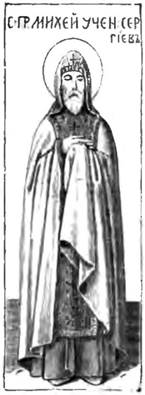
Преподобный Михей жил в одной келье с преподобным Сергием; под руководством великого подвижника он взошёл на высокую степень духовного совершенства. Чистые сердцем узрят Бога. Кроткая душа келейника Сергиева очистилась послушанием и слезами и стала созерцать небожителей на земле. Мера участия его в созерцании явления Богоматери великому наставнику показывает и меру усовершенствования его в духовной жизни. Раз св. Сергий, совершив правило молитвы, сел немного отдохнуть, но вдруг сказал ученику своему Михею: «бодрствуй, чадо, мы будем иметь чудное посещение». Едва произнёс он эти слова, как услышан был голос: «Пречистая грядёт». Внезапно осветил свет ярче солнечного. По удалении Богоматери, Сергий нашёл Михея без движения: от страха он лежал как бы мёртвый. Сергий поднял его, и он спрашивал: «скажи мне, отче, что это за чудное видение? От ужаса душа моя едва не разлучилась от тела». Сергий не мог говорить от радости. «Потерпи немного, сказал он, пока успокоится дух мой». Итак, великий наставник свободно видел Небесную Царицу и слышал слова Её; а ученик поражён был ужасом, не видел всего, но видел свет небесный. По рукоп. святцам «препод. отец Михей, келейник и ученик св. Сергия чудотворца, преставися в лето 6893 (1385) месяца мая в 6-й день», следовательно, за 6 лет до смерти наставника своего. Мощи его почивают под спудом в церкви, устроенной над местом погребения его, в честь явления Богоматери преподобным Сергию и Михею116.
The Venerable Micah lived in the same cell as the Venerable Sergius; under the guidance of the great ascetic, he ascended to a high degree of spiritual perfection. The pure in heart shall see God. The meek soul of Sergius's cell-attendant was purified by obedience and tears and began to contemplate the heavenly inhabitants on earth. The measure of his participation in the contemplation of the appearance of the Mother of God to the great teacher shows also the measure of his advancement in the spiritual life. Once, Saint Sergius, having completed the rule of prayer, sat down to rest a little, but suddenly said to his disciple Micah: "Be watchful, child, for we shall have a wondrous visitation." He had scarcely uttered these words when a voice was heard: "The Most Pure One is coming." Suddenly a light brighter than the sun shone forth. After the departure of the Mother of God, Sergius found Micah motionless: from fear he lay as if dead. Sergius raised him up, and he asked: "Tell me, father, what was that wondrous vision? From terror my soul almost parted from my body." Sergius could not speak for joy. "Wait a little," he said, "until my spirit is calmed." Thus, the great teacher freely saw the Heavenly Queen and heard Her words; but the disciple was struck with terror, did not see everything, but saw the heavenly light. According to the manuscript Menologia: "The Venerable Father Micah, cell-attendant and disciple of Saint Sergius the Wonderworker, reposed in the year 6893 (1385), on the 6th day of May," consequently, six years before the death of his teacher. His relics rest under a covering in the church built over the place of his burial, in honor of the appearance of the Mother of God to the Venerables Sergius and Micah116.
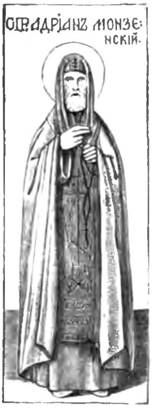
Родиной Адриана, в мире Амоса, была Кострома. Родители его желали, чтобы сочетался он браком, и даже нашли ему невесту. Но не того желал Амос, и сделался болен. В болезни виделся ему одинокий храм между двух рек, и он слышал голос: «здесь – твоё место». Оправясь от болезни, Амос тайно ушёл из дома родительского в Толгский монастырь и в Геннадиевой обители принял пострижение с именем Адриана. Здесь прожил он несколько лет; потом жил на Каменном острове в Спасской обители и в Павловой Обнорской пустыни. Его не оставляла мысль найти виденный храм между двух рек. В Павловой пустыни полюбил его старец Пафнутий, и Адриан рассказал ему давнее видение своё. В одно время вечером Пафнутий после правила лёг отдохнуть. Является ему неизвестный человек и говорит: «пошли друга твоего Адриана к востоку; место не дальше 50 вёрст отсюда; там увидит он преподобного мужа». Пафнутий спросил: кто он и как знает то место? Неизвестный отвечал: «то место не тебе назначено». Пафнутий рассказал об этом Адриану. Адриан, по рассказу престарелого священника Евпла, нашёл в глухом месте запустелый храм, тот самый, который представлялся ему в видении. Он возвратился к Пафнутию с радостью и они условились жить там вместе. Но неожиданно царский указ потребовал Пафнутия в Москву, где он (1595 г.) поставлен в архимандрита Чудова монастыря. Адриан оставался при храме с тремя иноками. Место было самое пустынное, тихое и приятное. Но открылось и неудобство: полая вода подмывала берег и была в виду опасность, что подроется она под храм. Один старец сказал при том Адриану, что и прежний игумен хотел перенести храм с опасного места на другое, и указал то место. Адриан и братия положили переселиться на то место. Но явился неизвестный человек и сказал: «не беспокойся о месте; место тебе назначено на берегу реки Монзы; ты узнаешь о нём по исцелении двух больных». По этим указаниям, Адриан перенёс храм и обитель на берег реки Монзы; это в 35 верстах от Галича и в 20 от Костромы, при впадении Монзы в р. Кострому. Здесь Адриан пользовался один год наставлениями и примером жизни преп. Ферапонта. – Пропитание доставали себе земледелием, и строитель Адриан был первым на работах. – В страшный голод 1601 г. обитель Адрианова неистощимо питала страдавших от голода. Наученные примером тружеников пустыни в те времена говорили: «не веянный хлеб – не голод, а посконная рубашка – не нагота». Но в 1601 г. хлеб был убит летним морозом, и целые тысячи умирали от голода. Преподобный Адриан, по наставлению чудного наставника своего Ферапонта, до голодного времени наполнил монастырские житницы хлебом и во время бедствия общего с полной любовью помогал страдавшим беднякам. Потом Литовцы напали на пустынную обитель и оставили посредине её огонь, с злостным намерением истребить её; но удалившиеся иноки нашли обитель целой. Блаж. Адриан скончался 5 мая 1619 г. По ркп. святцам называется он чудотворцем. Мощи его почивают в Благовещенском храме обители его, упразднённой с 1764 г.117.
The homeland of Adrian, in the world Amos, was Kostroma. His parents desired that he should enter into marriage, and even found him a bride. But Amos did not desire this, and fell ill. In his illness he saw a solitary church between two rivers, and he heard a voice: "here — is thy place." Recovering from his illness, Amos secretly departed from his parental home to the Tolga Monastery, and in the Gennadius monastery he received the tonsure with the name Adrian. Here he lived for several years; afterwards he lived on Kamenny Island in the Spassky monastery and in Paul's Obnora hermitage. The thought of finding the seen church between two rivers did not leave him. In Paul's hermitage, the elder Paphnutius came to love him, and Adrian told him of his long-ago vision. On one occasion, in the evening, after the rule, Paphnutius lay down to rest. An unknown man appeared to him and said: "send thy friend Adrian to the east; the place is not farther than 50 versts from here; there he will see a venerable man." Paphnutius asked: who he was and how he knew that place? The unknown one answered: "that place is not appointed for thee." Paphnutius told this to Adrian. Adrian, according to the account of the aged priest Euplus, found in a wild place a desolate church, the very one which had appeared to him in the vision. He returned to Paphnutius with joy, and they agreed to live there together. But unexpectedly a royal decree summoned Paphnutius to Moscow, where he (in the year 1595) was appointed archimandrite of the Chudov Monastery. Adrian remained at the church with three monks. The place was most desolate, quiet, and pleasant. But an inconvenience also became apparent: the flood waters were undermining the bank, and there was a visible danger that they would undermine the church. On that occasion, one elder said to Adrian that even the former abbot had wanted to move the church from the dangerous place to another, and pointed out that place. Adrian and the brethren resolved to move to that place. But an unknown man appeared and said: "be not anxious about the place; the place appointed for thee is on the bank of the Monza River; thou shalt learn of it by the healing of two sick persons." According to these indications, Adrian moved the church and the monastery to the bank of the Monza River; this is 35 versts from Galich and 20 from Kostroma, at the confluence of the Monza with the Kostroma River. Here Adrian enjoyed for one year the instructions and the example of the life of the Venerable Therapont. — They obtained their sustenance by agriculture, and the builder Adrian was first in the labors. — During the terrible famine of 1601, Adrian's monastery inexhaustibly fed those suffering from hunger. Taught by the example of the toilers of the hermitage, in those times people said: "unwinnowed bread is not hunger, and a hempen shirt is not nakedness." But in 1601 the grain was killed by summer frost, and whole thousands died of hunger. The Venerable Adrian, according to the instruction of his wonderful instructor Therapont, before the time of famine filled the monastery granaries with grain, and during the general calamity with full love helped the suffering poor. Afterwards the Lithuanians attacked the hermitage monastery and left fire in its midst, with the malicious intention of destroying it; but the monks who had withdrawn found the monastery intact. Blessed Adrian reposed on May 5, 1619. According to the manuscript saints' calendars he is called a wonderworker. His relics repose in the Annunciation church of his monastery, abolished since 1764.117
В Новгородском Юрьевом монастыре, у южной стены собора, вровень с правым клиросом находится гробница, на которой положена плита из белого мрамора с надписью: «лета 1244 мая 5-го в Великом Новгороде почи о Господе блаженная великая княгиня Феодосия, честнейшая супружница великого князя Ярослава Всеволодовича, с ним же благоговейно пожи и богоугоди, от него породи св. благоверных князей Феодора и Александра Невского и иных седмь сынов, и на конец жития иноческий образ восприимши, в нем же дано бысть ей имя Евфросиния; положена же бысть в обители св. Георгия подле сына своего, св. благоверного князя Феодора, на сем месте в каменном гробе».
In the Novgorod Yuriev Monastery, at the southern wall of the cathedral, level with the right kliros, there is a tomb upon which is laid a slab of white marble with the inscription: "In the year 1244, May 5, in Great Novgorod reposed in the Lord the blessed Grand Princess Theodosia, most honorable spouse of Grand Prince Yaroslav Vsevolodovich, with whom she lived reverently and pleased God, from whom she bore the holy Right-believing princes Theodore and Alexander Nevsky and seven other sons, and at the end of her life received the monastic habit, in which she was given the name Euphrosyne; she was laid in the monastery of St. George beside her son, the holy Right-believing Prince Theodore, in this place in a stone coffin."
Четь-минея и пролог мая 5. Выписка из Греческого жития святой Ирины у Геншения. Act Sanet, ad 5 Maii p. 4, 5. В менологе Василия – краткое известие. Здесь Ликиний называется Βασιλικός цариком, но какой страны не сказано. Особенность ещё та здесь: «задержанная воеводой Ампелианом была много мучима, но, не согласившись отказаться от Христа, предана мечу и была погребена». По житию, упокоилась в погребальной пещере. В Иеронимовом мартирологе: «мая 5 в Солуне мученическая кончина св. Иринея, Перегрина и Ирины»; у Адона, «мая 5 в Солуне страдание св. Иринея, Перегрина и Ирины, сожжённых огнём». С тем же прибавлением – в мартирологе Усуарда и Ноткера. Издатель Усуарда справедливо заметил, что Адо внёс добавление о роде смерти из древних деяний, теперь потерянных. Бароний замечает: «у Греков в менологе (5 мая) упоминается один Ириней». Нынешнее «житие» св. Ирины – поздняя и неискусная переделка потерянных деяний. Это видно по его многословию и по недостатку точных указаний на время подвигов, равно и по несогласию с мартирологами. – Извлечение из жития синаксарь Греческой минеи на 5 мая.
Chet'i-Minei and Prologue for May 5. Extract from the Greek Life of St. Irene in Henschenius. Act. Sanet., ad 5 Maii p. 4, 5. In the Menologion of Basil — a brief notice. Here Licinius is called Βασιλικός, a petty king, but of what country is not said. There is also this peculiarity here: "detained by the voivode Ampelianus she was much tormented, but, not consenting to renounce Christ, she was given over to the sword and was buried." According to the Life, she reposed in a burial cave. In the Hieronymian martyrology: "May 5 in Thessalonica the martyric end of St. Irenaeus, Peregrinus, and Irene"; in Ado, "May 5 in Thessalonica the suffering of St. Irenaeus, Peregrinus, and Irene, burned with fire." With the same addition — in the martyrology of Usuard and Notker. The editor of Usuard rightly observed that Ado introduced the addition about the manner of death from ancient acts, now lost. Baronius remarks: "among the Greeks in the menologion (May 5) only Irenaeus is mentioned." The present "Life" of St. Irene is a late and unskillful reworking of the lost acts. This is evident from its verbosity and from the lack of precise indications of the time of her struggles, as well as from its disagreement with the martyrologies. — The synaxarion of the Greek Menaion for May 5 is an extract from the Life.
См. О Фракии июня 24, августа 20 и окт. 12. О Тривал ах – Вендах говорено мар. 26 пр. 233, мая 22 пр. 347, окт. 12 пр. 23, 24. Здесь укажем на Диона Кассия. Он в своё время, в 3 в., знал Тривалов там же, где были они в 7 и в последующих веках, и там же, по его известию, жили они в 29 г. до Рожд. Хр. (LI, 22–27). Аппион тут же показывает равные племена Иллиров (De bello Illyr. 1, 2, 3). Порфирогенет (ed admin. imp. § 30) откуда-то занял заметку о том, что Славяне в 449 г. выгнали Греческих колонистов из некоторых городов Далматии; но он и не заметил, что эта заметка не вяжется с его повестью о появлении Славян на юге при Ираклие. Древние поселения Сербов: а) В восточной полосе: Пищь, Козль, Равьный, Сверлевый, Средец, Ведряна, Еревана, Медока, Запара, Лесковац, Златая гора, Рассова, Водина (Aquæ, Видин), Радоевац (Retiaria), Прахово (Bononia), Костолац, Смедереио (на Мораве – Морге), Выменячий (Vimenacius, производящий мену, после Браничево, Чехов дом (Белград); б) В средней полосе (Рассин и Босне): Раса, Пожега (Incera), Призрень, Врана, Скопль, Топлица, Десница, Добрунь, Которица, Лешница, Дрежняк, Галич, Сеница, Тешань, Медюречь, Выроевач, Паньтино, Звечано, Черна-буча, Будимль, Плевле, Лугомирь, Горица, Лавы, Травник, Радешить, Столац, Миятовац, Валко, Соленая, Яйце; в) В южной (Зете) – Дукля, Скутарь, Будва, Цетина. Лента (Лецинь); Граднт, Река (Recatina), Черник, Пропатна, Слатива (Свачь), Облачить, Лета, Драч, Бар, Дрнвост, Дань, Рыбница; г) В юго-западной (Требивье, Конавле, Захлумье и Неретве): Котор; Рисан, Лука, Виталица, Рудине, Любомир, Драчево, Урме, Сокол, Обод, Завала, Требине, Твердошь, Добричево, Хлум, Дубровник, Стон, Мокьрск, Осле, Дабар, Невесень, Глумник, Далмен, Неретва, Затон, Острог, Вруля, Олмшь, Млет; д) На северо-западе в Хорватии: Скрадено, Белград, Беличин, Хлевно, Столпы, Кори, Гламоч, Плива, Нин, Книв, Сплет, Трогирь, Бребер, Стридон, Соленая. См. Весселинга замечания на Синекдема, Бандурия – на Порфирогенета, Шафарика древн. III, 525–543. Черткова библиот. 2, 82, 84, 118. Стефаново житие св. Нееманя и Жичская грамота, Edrisi у Тафеля de ргоѵипс. р. 31–33. Tubingæ 1847.
See On Thrace, June 24, August 20, and October 12. On the Triballi — the Wends, it has been said March 26, note 233, May 22, note 347, October 12, notes 23, 24. Here we shall point to Dio Cassius. He in his time, in the 3rd century, knew the Triballi in the same place where they were in the 7th and in subsequent centuries, and in the same place, according to his account, they lived in the year 29 B.C. (LI, 22–27). Appian in the same place shows equal tribes of the Illyrians (De bello Illyr. 1, 2, 3). Porphyrogenitus (ed. admin. imp. § 30) borrowed from somewhere the note that the Slavs in 449 drove out the Greek colonists from some cities of Dalmatia; but he did not notice that this note does not cohere with his account of the appearance of the Slavs in the south under Heraclius. The ancient settlements of the Serbs: a) In the eastern strip: Pišć, Kozlj, Ravnyj, Sverlevyj, Sredets, Vedryana, Erevana, Medoka, Zapara, Leskovac, Zlataya gora, Rassova, Vodina (Aquæ, Vidin), Radojevac (Retiaria), Prahovo (Bononia), Kostolac, Smederevo (on the Morava — Morge), Vymenyachiy (Vimenacius, producing exchange, later Braničevo, Čehov dom (Belgrade); b) In the middle strip (Rassin and Bosnia): Rasa, Požega (Incera), Prizren, Vrana, Skoplje, Toplica, Desnica, Dobrunj, Kotorica, Lešnica, Drežnjak, Galič, Senica, Tešanj, Medjureč, Vyrojevač, Pantino, Zvečano, Černa-buča, Budimlj, Plevlje, Lugomir, Gorica, Lavy, Travnik, Radešić, Stolac, Mijatovac, Valko, Solenaya, Jajce; c) In the southern (Zeta) — Duklja, Skutari, Budva, Cetina. Lenta (Lecinj); Gradnt, Reka (Recatina), Černik, Propatna, Slativa (Svač), Oblačić, Leta, Drač, Bar, Drnvost, Danj, Rybnica; d) In the southwestern (Trebivje, Konavlje, Zahumlje and Neretva): Kotor; Risan, Luka, Vitalica, Rudine, Ljubomir, Dračevo, Urme, Sokol, Obod, Zavala, Trebine, Tvrdoš, Dobričevo, Hlum, Dubrovnik, Ston, Mokrsk, Osle, Dabar, Nevesenj, Glumnik, Dalmen, Neretva, Zaton, Ostrog, Vrulja, Olmš, Mlet; e) In the northwest in Croatia: Skradeno, Belgrade, Beličin, Hlevno, Stolpy, Kori, Glamoč, Pliva, Nin, Kniv, Splet, Trogir, Breber, Stridon, Solenaya. See Wesseling's remarks on the Synecdemus, Banduri — on Porphyrogenitus, Šafárik's Antiquities III, 525–543. Chertkov's Bibliot. 2, 82, 84, 118. Stephen's Life of St. Nemanja and the Žiča charter, Edrisi in Tafel de provinc. p. 31–33. Tubingæ 1847.
Летописи в гласнике I, 163. V, 21. У Григоровича стр. 65. Шафарика в памяти. 2, 55–57. «Глаголют истинны сьписателе, яко Ливию Срьбину быти родом Еллину мудрованием». Ошибка тут одна. Смешали Триваллского Ликиния с Ликинием, зятем Константина, тогда как зять Константина не был и властителем запада. Ещё св. Димитрий замечал об отце св. Ирины: «не той бе Ликиний, иже послежде бяше сцарственник ц. Константина, имевый в супружестве сестру Константинову, но иный, царь единого града, Македонии сопредельного. Той име в супружестве Константию, а сей Ликинию. Той в несчастии погибе, а сей в христианстве честно скончался. Той бяше по трех стех летех, а сей близ дней Апостольских».
Annals in Glasnik I, 163. V, 21. In Grigorovich p. 65. Šafárik in Památky 2, 55–57. "True writers say that Licinius the Triballian was by birth a Greek in wisdom." There is only one error here. They confused the Triballian Licinius with Licinius, the son-in-law of Constantine, whereas the son-in-law of Constantine was not a ruler of the West either. Moreover, St. Demetrius remarked about the father of St. Irene: "he was not that Licinius who afterwards was co-emperor with Emperor Constantine, having in marriage Constantine's sister, but another, a king of a single city adjacent to Macedonia. That one had in marriage Constantia, and this one Licinia. That one perished in misfortune, and this one honorably ended his life in Christianity. That one was after three hundred years, and this one near the days of the Apostles."
См. ноября 14 д. Порфирогенет упоминает о Расе в описании событий 842 г. (De admin. imp. § 32). Древность Расы и Расских жупанов можно видеть из сличения другого места Константинова с грамотой Санковичей. В последней читаем: «я жупан Бельячь и воевода Радичь с братьями Санковичами дознали доподлинно из старых бумаг и от старожилов, людей добрых, которые хранят сведения, переходившие от поколения к поколению, также из межевых знаков и памятников, следующее: при море был город старый Дубровник в соседстве с Конавльской жупой, и этому городу принадлежала Конавльская жупа, составляя потомственное владение его, как и другие земли и места. Но тот старый город пал и запустел. Владетели Раисские и Холмские засели тут кривдой и насилием взяли Конавльскую жупу и другие места того города. Граждане перешли в безопасное место и построили город Дубровник, который ныне существует» (У Майкова стр. 69). поскольку же основание нового Дубровника у Порфирогенета относится к 449 г., то выходит, что Раисские владетели с их стольным городом Расой были сильными ещё прежде 449 г.
See November 14. Porphyrogennetos mentions Ras in his description of events of 842 (De admin. imp. § 32). The antiquity of Ras and the Ras župans can be seen from a comparison of another passage of Constantine with the charter of the Sankovići. In the latter we read: "I, župan Beljač and voivode Radič with the brothers Sankovići, have ascertained with certainty from old papers and from elders, good people who preserve knowledge handed down from generation to generation, as well as from boundary markers and monuments, the following: by the sea there was an old city of Dubrovnik in the neighbourhood of the Konavle župa, and this city owned the Konavle župa, it being its hereditary possession, as well as other lands and places. But that old city fell and became desolate. The Raisian and Hum rulers settled there by falsehood and violence and seized the Konavle župa and other places of that city. The citizens moved to a safe place and built the city of Dubrovnik, which now exists" (In Maikov, p. 69). Since the founding of New Dubrovnik is dated by Porphyrogennetos to 449, it follows that the Raisian rulers with their capital city of Ras were powerful even before 449.
Мартиролог Иеронима под 31 дек.: Retia Hermetis exorcistae. Усуард: Retiariae s. Hermetis exorcistse. По одному списку Усуарда; Retia provincia, civitate Reciaria s. Hermetis exorcistæ. Мартиролог Иеронима янв. 1. In Retia Eventii, Hermetis; Bononiæ Gaii, Heraclii. Янв. 4. In oriente Bononia civitate Hermitis, Aggei, Gaii, Petri, Marci, Sereni. Senni, Anastasiæ. Усуард под 4 янв. Civitate Bononia Hermetis, Aggei et Gai. У Баровия в мартирологе прибавлено о последних: «пострадали при имп. Макснмине». По картам старого мира Reciaria там, где ныне Радоевац, а Bononia вблизи Прахова.
The Martyrology of Jerome under December 31: Retia Hermetis exorcistae. Usuard: Retiariae s. Hermetis exorcistae. According to one copy of Usuard: Retia provincia, civitate Reciaria s. Hermetis exorcistæ. The Martyrology of Jerome, January 1: In Retia Eventii, Hermetis; Bononiæ Gaii, Heraclii. January 4: In oriente Bononia civitate Hermitis, Aggei, Gaii, Petri, Marci, Sereni, Senni, Anastasiæ. Usuard under January 4: Civitate Bononia Hermetis, Aggei et Gai. In Baronius' Martyrology it is added concerning the latter: "suffered under the Emperor Maximinus." According to maps of the ancient world, Reciaria is where Radojevac now is, and Bononia is near Prahovo.
Мартиролога Иеронима и Усуарда под 11 и 18 апр. св. епископ Елевферий, по менологам (дек. 16) «епископ Иллирика», последовавший при имп. Адриане (97–117 г.), по мартирологам Ноткера и Рабана (апр. 18) был епископом Аквилеи и пострадал в Риме (о месте страдания то же в Иеронимовом мартир.); в мартирологах Адона и Усуарда должно бы стоять: in Moesia Aquileiæ, вместо: Apud Messanam Apuliiæ, чему трудно приискать смысл; равно напрасно писали в Греческих известиях, что Елевферий поставлен в епископа Аникитой (154–169).
In the Martyrologies of Jerome and Usuard under April 11 and 18, St. Eleutherius, bishop; according to the menologia (December 16) "bishop of Illyricum," who lived under the Emperor Hadrian (97–117 A.D.); according to the martyrologies of Notker and Raban (April 18) he was bishop of Aquileia and suffered in Rome (the same regarding the place of suffering is in the Hieronymian Martyrology); in the martyrologies of Ado and Usuard it should read: in Moesia Aquileiæ, instead of: Apud Messanam Apuliiæ, for which it is difficult to find a meaning; likewise it was wrongly written in the Greek accounts that Eleutherius was appointed bishop by Anicetus (154–169).
Menolog. Basilii ad 6 Julii. Act. Sanet Julii II, 284. Пролог июн. 4. Baronins ad an. 110. Мощи св. Петра, замученного в Которе, перенесены были в Дубровин в 1026 г., говорит Майков (о Сер. языке стр. 82). Тут не всё верно. В договорной грамоте с Михаилом Ясенем Дубровинчане говорят: «клянёмся – св. мучениками Василием, Лаврентием, Петром и Андреем, нашими ходатаями» (Майков стр. 8). Как св. Лаврентий есть известный мученик и архидиакон Римский и св. Василий епископ, покровитель Дубровичан, замучен в Севастии в 306 г. (Lat. Patrol. 123,725. 726): так в св. Петре и Андрее надобно признать Лампсакских мучеников, воспоминаемых церковью мая 18 и в мартирологах мая 15. На монетах Которских изображался св. Трифон; это – мученик Никейский времён Декия, празднуемый февр. 1. Он – покровитель Котора (Martyrol. Usuardi. р. 726. 727). Всё это значит то, что мощи помянутых мучеников в давние времена перенесены были в Сербские поселения.
Menolog. Basilii ad 6 Julii. Act. Sanet Julii II, 284. Prologue June 4. Baronius ad an. 110. The relics of St. Peter, martyred in Kotor, were translated to Dubrovnik in 1026, says Maikov (On the Serbian Language, p. 82). Not everything here is correct. In the treaty with Michael Asen, the people of Dubrovnik say: "we swear – by the holy martyrs Basil, Laurence, Peter and Andrew, our intercessors" (Maikov p. 8). As St. Laurence is the well-known martyr and archdeacon of Rome, and St. Basil the bishop, patron of the people of Dubrovnik, was martyred in Sebaste in 306 (Lat. Patrol. 123,725. 726): so in Sts. Peter and Andrew we must recognise the martyrs of Lampsacus, commemorated by the Church on May 18 and in the martyrologies on May 15. On the coins of Kotor was depicted St. Tryphon; he is a martyr of Nicaea from the time of Decius, celebrated on February 1. He is the patron of Kotor (Martyrol. Usuardi. p. 726. 727). All this means that the relics of the aforementioned martyrs were translated in ancient times to Serbian settlements.
Созомева ист. IV, 14. Изгнание блаженных из Иллирика надобно отнести ко времени Готфских королей Сербии, потому что в 373 г. собор Иллирийский подтвердил веру Никейского собора. Хрон. Георгия Амарт. р. 456. 460.
Sozomen, Hist. IV, 14. The expulsion of the blessed from Illyricum must be referred to the time of the Gothic kings of Serbia, because in 373 the Council of Illyricum confirmed the faith of the Council of Nicaea. Chron. of George the Chronicler, p. 456. 460.
История Сербского христианства доселе нимало не разработана. Бедный Раич то говорит, что христианство началось в Сербии при Ираклие, то относит начало его ко времени Будимира (I, 301. 318. 320. II. 204–207). «Поглед на историю Србске Церкве прваго периода» (в X ч. Гласника) вышел неудачным оттого, что сочинителя увлёк за собой Шафарик, слишком много занявшийся Балтийскими Вендами и слишком мало – Адриатическими. Но не трудно отыскать правду и у Дуклянца. Если Поислав XIV, король Дуклянца, и Болеслав первый, король Порфирогенета, был современником Аттилы († 453 г.), то Светмир X и Будимир XI король, первые христианские короли Дуклянца, жили конечно не позже первой четверти пятого века. – Далее, так как Готфы поселились во Фракии в 375 г., в угоду Валенту приняв арианство (Сократа ист. IV, 33–35), той гонение, бывшее в Триваллии при четырёх Готфских королях Далматии, происходило с 375 г. и оно было гонением арианской, а не языческой власти. – Таким образом язычество после 5 века вносимо было в Сербию только приходившими с севера Аварами и отрядами Балтийских Вендов. Новые сведения о Славянах и Аварах времени Тиверия и Маврикия – у Иоанна Ефесского: Kirchengeschichte В. VI. с. 25.27. 30–38. Münch. 1862. Regnum Siavorum, переведённое Дуклянцем с Славян, яз., издано Лусичем: De regno Dalmatiæ et Croatiæ. Amstelod. 1666. Здесь же другой Латинский перевод Марула. Kronika Hrvatska iz XII veka изд. в 4 кн. Arkiva za povestnicu jugoslavensku, – v Zagrebu 1851. При сличении Латинского текста Дуклянца с текстом kroniki оказывается в большей части буквальное сходство между ними, – но встречаются и разности, которые объясняют тем, что у Дуклянца был другой список древней хроники (Ж. Μ. Прос. ч. 22, стр. 104–106); вероятнее же Дуклянец при переводе древней хроники дозволял себе делать прибавления и поправки, не всегда удачные. Отступая от текста хроники, он пишет: rex Bladinus cernens, quod maxima multitudo populi esset cum eis (Yulgaris), fecit pacem coeperuntque se utrique populi valde inter se diligere, i. e. Cothi, qui et Slavi, et Vulgari, et maxime, quod ambo populi gentiles essent et un lingua esset omnibus (vire i iezika byli iednoga). Прибавка: «Готфы, они же и Славяне», означает только то, что Готфская народность, поглощённая силой Славянской, дала первое место в жизни Славянскому народу. Это – верно. Выражение же: ampo populi gentiles essent, отступая от древнего текста, грешит против истории.
The history of Serbian Christianity has hitherto been in no way developed. The poor Raič sometimes says that Christianity began in Serbia under Heraclius, sometimes refers its beginning to the time of Budimir (I, 301. 318. 320. II, 204–207). "A View of the History of the Serbian Church of the First Period" (in X part of Glasnik) turned out unsuccessful because the author was carried away by Šafárik, who occupied himself too much with the Baltic Wends and too little with the Adriatic ones. But it is not difficult to find the truth also in Diocleas. If Poislav XIV, king of Diocleas, and Boleslav the First, king of Porphyrogennetos, was a contemporary of Attila († 453), then Svetimir X and Budimir XI, kings, the first Christian kings of Diocleas, lived certainly no later than the first quarter of the fifth century. – Further, since the Goths settled in Thrace in 375, accepting Arianism to please Valens (Socrates, Hist. IV, 33–35), the persecution that took place in Triballia under four Gothic kings of Dalmatia occurred from 375 and it was a persecution by Arian, not pagan, authority. – Thus paganism after the 5th century was brought into Serbia only by the Avars coming from the north and by bands of Baltic Wends. New information about the Slavs and Avars of the time of Tiberius and Maurice – in John of Ephesus: Kirchengeschichte B. VI. c. 25.27. 30–38. Münch. 1862. Regnum Siavorum, translated by Diocleas from the Slavonic language, was published by Lucius: De regno Dalmatiæ et Croatiæ. Amstelod. 1666. Here also another Latin translation by Marulus. Kronika Hrvatska iz XII veka published in 4 books of Arkiva za povestnicu jugoslavensku, – v Zagrebu 1851. Upon comparing the Latin text of Diocleas with the text of the kronika, a literal similarity is found for the most part between them, – but differences also occur, which are explained by the fact that Diocleas had another copy of the ancient chronicle (J. M. Prosv. part 22, pp. 104–106); more probably, however, Diocleas, in translating the ancient chronicle, allowed himself to make additions and corrections, not always successful. Departing from the text of the chronicle, he writes: rex Bladinus cernens, quod maxima multitudo populi esset cum eis (Yulgaris), fecit pacem coeperuntque se utrique populi valde inter se diligere, i. e. Cothi, qui et Slavi, et Vulgari, et maxime, quod ambo populi gentiles essent et un lingua esset omnibus (vire i iezika byli iednoga). The addition: "the Goths, who are also Slavs," means only that the Gothic nationality, absorbed by the force of the Slavonic, gave the first place in life to the Slavonic people. This is correct. The expression: ambo populi gentiles essent, departing from the ancient text, sins against history.
Mansi Т. XII, 723. Епископы Дуклянский и Чехова дома были на Средечском соборе 347 г., Скутарский известен с 384 г. Последний при св. Григории Двоеслове был также митрополитом (Lib. VII, ер. 70). По письму и. Иоанна 8 (872–882 г.) вся Далматия, равно епископы Рагузы, Скраденного, Сплетя, Ядеры и Белграда состоят в ведении Констант. патриарха. Wilt**sch,kirchl. Statist 1, 122, 127–129. 399. 400. Дукля стала митрополией со времени кор. Будимира, который похоронен был в кафедральном храме Дукли. Так говорит Дуклянец.
Mansi T. XII, 723. The bishops of Dioclea and of Čehovo House were at the Council of Serdica in 347; the bishop of Scutari is known from 384. The latter, under St. Gregory the Dialogist, was also a metropolitan (Lib. VII, ep. 70). According to a letter of Pope John VIII (872–882 A.D.), all Dalmatia, as well as the bishops of Ragusa, Scardona, Spalato, Zara, and Belgrade, are under the jurisdiction of the Patriarch of Constantinople. Wilt**sch,kirchl. Statist 1, 122, 127–129. 399. 400. Dioclea became a metropolis from the time of King Budimir, who was buried in the cathedral church of Dioclea. So says Diocleas.
Ркп. сказание о Монзенском монастыре – у Царского № 118. Сведен. о монаст. 162. 163. Ист. иер. 6, 10. 25. Ркп. святцы: «преп. священноинок Адриан чудотворец, строитель Благовещенского мон. на Монзе р. преставися в л. 7127 мая в 5 день».
Manuscript account of the Monza Monastery – in Tsarsky's collection No. 118. Information on Monasteries, 162. 163. History of the Hierarchy, 6, 10. 25. Manuscript menologion: "Our Venerable Hieromonk Adrian, Wonderworker, builder of the Annunciation Monastery on the Monza River, reposed in the year 7127, on the 5th day of May."