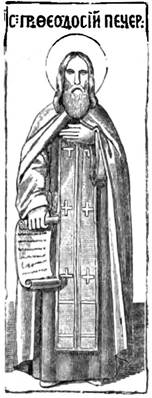
Неисповедимы судьбы милосердия Божия! Так говорит преп. Нестор в начале своей повести о преп. Феодосии. Вот Бог избрал пастыря и учителя иноков не из мудрых философов и не из городских властелинов: но да прославится имя Господне, – грубый, необразованный явился мудрее философов. О сокровенная тайна! отколе нельзя было ожидать, оттоле воссияла пресветлая зарница, так что видев светение её, со всех сторон, оставив всё, спешили к ней, чтобы насладиться её светом67.
Inscrutable are the ways of God's mercy! Thus speaks the Venerable Nestor at the beginning of his narrative concerning the Venerable Theodosius. Behold, God chose a shepherd and teacher of monks not from among the wise philosophers nor from the city rulers: but that the name of the Lord might be glorified—a coarse, unlearned man appeared wiser than philosophers. O hidden mystery! From whence no one could expect it, from there shone forth a most bright lightning-flash, so that, seeing its radiance, from all sides, leaving everything, they hastened to it, to delight in its light67.
Феодосий родился в Василеве, в 50 поприщах от Киева68; но ещё в детстве стал жить с родителями в Курске69. Он с юных лет стремился душой к Господу, не любя детских игр, ни нарядов. Каждый день ходил в церковь Божию и со всем вниманием слушал священные книги. Сам он «упросил родителей отдать его к какому-либо учителю для обучения его чтению святых книг»; он учился быстро и отличался притом кротостью, – был «послушен не только учителю своему, но и всем учащимся с ним». При прекрасных дарованиях и прилежании он весьма скоро выучил преподаваемую науку, так что дивились разуму дитяти и скорому его обучению.
Theodosius was born in Vasilev, fifty versts from Kiev68; but still in childhood he came to live with his parents in Kursk69. From his youth he yearned in soul for the Lord, loving neither childish games nor fine attire. Every day he went to the church of God and listened with all attention to the sacred books. He himself "begged his parents to give him to some teacher for instruction in reading the holy books"; he learned quickly and was distinguished moreover by meekness—he was "obedient not only to his teacher, but also to all who studied with him." With excellent gifts and diligence, he very soon mastered the science taught him, so that they marveled at the child's understanding and his rapid learning.
На 14 г. лишившись отца и оставшись под надзором матери, женщины строгой и упорной, хотя и любившей сына страстно, Феодосий рано узнал горечи жизни. Он горел любовью к Господу; а мать его была не такова, думала более о земле, чем о небе. Наследник значительного имущества, носил он одежду более чем простую и ходил с слугами на работу. Мать побоями приказывала ему жить, как живут равные ему. Благоговейный юноша думал с собою, как и каким путём спастись ему? Раз случилось ему видеть странников: услышав от них о святых местах Палестинских, он неотступно просил взять его с собой и тайно от матери ушёл за ними. Мать догнала его, – здоровая женщина с гневом и яростью била его и, бросив в запертой комнате, два дня оставляла его без пищи; потом накормив, ещё на несколько дней оставляла ноги его связанными, чтобы не ушёл. Любя сына страстно, она от гнева и жестокости переходила к ласкам, упрашивая сына не оставлять её. Феодосий по-прежнему ходил в церковь. Заметив, что литургия совершается редко, по недостатку просфор, он стал печь просфоры. Матери его не нравилось и это занятие сына. Сперва она ласково просила его – оставить печение просфор: «ты наносишь, говорила она, бесчестие роду своему; не могу слышать, как смеются над тобой за это занятие». Смышлёный, добрый сын почтительно объяснил матери высокое назначение просфор. Мать успокоилась на время. Но на другом году видя, что сын почернел от печи и огня, опять стала запрещать ему печение просфор, иногда с угрозами, а иногда с жестокими побоями. Добрый юноша не знал, что делать. Чтобы избавить мать и себя от тревог, он тайно ушёл из Курска в соседний город и там у священника продолжал святые занятия. Мать нашла его и здесь, привела домой и решительно запретила печь просфоры. Благочестивой жизнью и кротостью нрава обратил он на себя внимание начальника города, и тот захотел, чтобы Феодосий служил в его церкви, вероятно домовой; не раз дарил ему начальник хорошую одежду, но каждый раз Феодосий отдавал её нищим, а сам оставался в рубище. За то добрый начальник ещё более полюбил Феодосия. Ревнуя об умерщвлении плоти, Феодосий возложил на себя железные вериги и терпеливо носил их, хотя скоро изранили они тело его. Случилось, что начальник города давал пир знаменитостям города. Феодосию нужно было явиться в чистой одежде, для служения гостям. При перемене белья мать увидела кровь на рубашке. Это открыло ей, что сын носил вериги. С яростью сорвала она их с сына и жестоко избила его. Но напрасно мать старалась погасить в сыне любовь к подвижнической жизни. Раз слушал он слова Евангелия: иже любит отца или матерь паче Мене, несть Мене достоин, и иже любит сына или дщерь паче Мене, несть Мене достоин (Мф.10:37). Эти слова на этот раз сильно потрясли Феодосия: он увидел, что любовь матери к нему не служит ни ей, ни ему на пользу, и решился непременно удалиться из дома, чтобы вполне посвятить себя Богу.
At the age of fourteen, having lost his father and remaining under the supervision of his mother, a strict and stubborn woman, although she loved her son passionately, Theodosius early came to know the bitterness of life. He burned with love for the Lord; but his mother was not such, thinking more of earth than of heaven. Heir to a considerable estate, he wore clothing more than plain and went with the servants to work. His mother, with beatings, commanded him to live as those equal to him lived. The devout youth thought within himself, how and by what path might he be saved? Once it happened that he saw pilgrims: hearing from them about the holy places of Palestine, he insistently begged them to take him with them and secretly from his mother went after them. His mother overtook him—a healthy woman, with anger and fury she beat him and, throwing him into a locked room, left him without food for two days; then, having fed him, she kept his feet bound for several more days, so that he would not run away. Loving her son passionately, she passed from anger and cruelty to caresses, begging her son not to leave her. Theodosius continued to go to church. Noticing that the Divine Liturgy was celebrated rarely, due to a lack of prosphora, he began to bake prosphora. His mother did not like even this occupation of her son. At first she gently asked him to leave the baking of prosphora: "You bring dishonor," she said, "upon your family; I cannot hear how they mock you for this occupation." The sensible, good son respectfully explained to his mother the lofty purpose of the prosphora. The mother was calmed for a time. But the following year, seeing that her son had grown black from the oven and fire, she again began to forbid him to bake prosphora, sometimes with threats, and sometimes with cruel beatings. The good youth did not know what to do. To free his mother and himself from anxiety, he secretly left Kursk for a neighboring town and there, with a priest, continued his holy labors. His mother found him even there, brought him home, and decisively forbade him to bake prosphora. By his pious life and meekness of disposition, he drew the attention of the city governor, and he wanted Theodosius to serve in his church, probably a domestic one; more than once the governor gave him fine clothing, but each time Theodosius gave it to the poor, while he himself remained in rags. For this the good governor loved Theodosius even more. Zealous for the mortification of the flesh, Theodosius placed iron chains upon himself and patiently wore them, although they soon wounded his body. It happened that the city governor gave a feast for the city's notables. Theodosius needed to appear in clean clothing, to serve the guests. When changing his undergarment, his mother saw blood on his shirt. This revealed to her that her son wore chains. With fury she tore them from her son and cruelly beat him. But in vain did the mother try to extinguish in her son the love for the ascetic life. Once he heard the words of the Gospel: He that loveth father or mother more than Me is not worthy of Me: and he that loveth son or daughter more than Me is not worthy of Me (Mt. 10:37). These words at that time deeply shook Theodosius: he saw that his mother's love for him served neither her nor him for good, and he resolved without fail to depart from the house, in order to devote himself wholly to God.
На несколько дней мать отлучилась из дома. Феодосий воспользовался тем и отправился в Киев, где, как слышал он, есть монастыри. Не зная сам дороги в Киев, он догнал обоз, тянувшийся в Киев, и за ним в три недели дошёл до Киева. Здесь обошёл он все монастыри и просил иноков, чтобы приняли его; но они, видя простого отрока, одетого в худые одежды, не хотели принять его. Услышав о блаж. Антонии пещернике, Феодосий «окрылател духом» и поспешил к нему. Со слезами пал он к ногам подвижника и просил его принять к себе. «Чадо, сказал ему Антоний, видишь ли, как эти пещеры мрачны и тесны! Ты молод и, как думаю, не можешь переносить скорбей на этом месте». Феодосий отвечал: «ты знаешь, честный отче, всевидящий Бог привёл меня к твоей святыне, да спасусь тобою; потому, что прикажешь мне делать, то буду исполнять». Тогда блаж. Антоний сказал: «благословен Бог, укрепляющий тебя, чадо, на такой подвиг!» И Никон, по повелению св. старца, постриг Феодосия. Это было в 1032 г. на 24 г. жизни Феодосиевой70. Новый инок со всем жаром предался трудам подвижничества, посту, молитве, послушанию, смирению, так что Антоний и Никон дивились крепости юноши и славили Бога за него. Но Феодосию ещё раз надлежало вытерпеть борьбу с материнской любовью. Спустя четыре года пришла она в Киев, долго и напрасно искав его в Курске. Явись к Антонию, просила она свидания с сыном. Феодосий сказал, что он – инок пещерник. Мать предалась скорби исступлённой. Отчаяние её и совет Антония склонили Феодосия согласиться на свидание. Но напрасно мать убеждала возвратиться в её дом. Феодосий отвечал ей, что, если желает она по временам видеть его, пусть вступит в женскую обитель. Мать долго не соглашалась на то; наконец решилась посвятить себя Богу в обители св. Николая. Феодосий благодарил Господа за мать и с радостью обратился к подвигам своим.
For several days his mother was away from home. Theodosius took advantage of this and set out for Kiev, where, as he had heard, there were monasteries. Not knowing the road to Kiev himself, he caught up with a wagon train heading for Kiev, and with it in three weeks reached Kiev. Here he went around all the monasteries and asked the monks to receive him; but they, seeing a simple youth dressed in poor clothes, did not wish to receive him. Hearing of the blessed Anthony the Cave-dweller, Theodosius "took wing in spirit" and hastened to him. With tears he fell at the feet of the ascetic and begged him to receive him. "Child," Anthony said to him, "do you see how dark and narrow these caves are? You are young and, I think, cannot bear the sorrows of this place." Theodosius replied: "You know, honorable father, that the all-seeing God has brought me to your holiness, that I might be saved through you; therefore, whatever you command me to do, I will fulfill." Then the blessed Anthony said: "Blessed is God, Who strengthens you, child, for such a struggle!" And Nikon, by the command of the holy elder, tonsured Theodosius. This was in the year 1032, in the 24th year of Theodosius's life70. The new monk gave himself with all fervor to the labors of asceticism, fasting, prayer, obedience, humility, so that Anthony and Nikon marveled at the youth's strength and glorified God for him. But Theodosius had yet once more to endure a struggle with motherly love. Four years later she came to Kiev, having long and vainly sought him in Kursk. Appearing to Anthony, she begged for a meeting with her son. Theodosius said that he was a monk and cave-dweller. The mother gave herself over to frantic grief. Her despair and Anthony's counsel inclined Theodosius to agree to a meeting. But in vain did the mother urge him to return to her home. Theodosius answered her that, if she wished to see him from time to time, let her enter a women's monastery. The mother long did not agree to this; at last she resolved to dedicate herself to God in the monastery of St. Nicholas. Theodosius thanked the Lord for his mother and with joy turned again to his own struggles.
Жизнь пещерян была вообще строга, а Феодосий не щадил себя. Пищей их был ржаной хлеб, а в субботу и воскресенье – сочиво; когда же не доставало и того, готовили и ели зелень. Чтобы иметь хлеб, занимались простым рукодельем, продавали его, а себе покупали зёрна, и потом, разделив, сами мололи. По окончании утрени шли в огород и копали землю до часов; после литургии трудились в своей келье. Феодосий трудился более других. Крепкий телом, брал он на себя часть трудов чужих: носил другим воду, рубил дрова, молол рожь и относил каждому муку. Иногда в знойную ночь ногой отдавал тело своё в пищу комарам и мошкам; кровь текла по нему, а он покойно прял волну и пел псалом. В храме являлся он прежде других и, став на месте, не сходил с него; чтение совершал со вниманием, не развлекаясь ничем. Подвиги Феодосия представляли его вполне достойным сана священства и он облечён был им, по удалении Никона в Тмутаракань (1054 г.).
The life of the cave-dwellers was generally strict, and Theodosius did not spare himself. Their food was rye bread, and on Saturday and Sunday—kutia; when even that was lacking, they prepared and ate greens. To have bread, they occupied themselves with simple handiwork, sold it, and bought grain for themselves, and then, having divided it, ground it themselves. After the end of Matins they went to the garden and dug the earth until the hours; after the Divine Liturgy they labored in their cell. Theodosius labored more than the others. Strong in body, he took upon himself a portion of others' labors: he carried water for others, chopped wood, ground rye and brought each one his flour. Sometimes on a sultry night he gave his body as food to mosquitoes and gnats; blood flowed over him, while he calmly spun wool and sang a psalm. In church he appeared before the others and, standing in his place, did not leave it; he performed the reading with attention, distracted by nothing. The struggles of Theodosius showed him fully worthy of the rank of priesthood, and he was invested with it, after Nikon's departure to Tmutorakan (1054).
В 1057 г. братия избрали Феодосия в игумена, и св. Антоний одобрил избрание71. «Отец наш Феодосий, хотя и принял начальство, не переменил своего смирения и правила: на труды выходил прежде всех, равно как и к службе храма». С сего времени место стало цвести молитвой праведника, число братий умножалось. Феодосий построил более обширный, деревянный храм Успения; престол его сложен был из камня на глине и однако в 17 стол. едва могли сдвинуть его с места, чтобы заменить новым72. Бдительный игумен, окончательно устроив братию на новом месте монастыря, стал вводить (1062 г.) порядок иноческого жития по уставу Студийскому73. Он не отвергал никого из тех, кто желал быть черноризцем, ни бедного, ни богатого, зная по опыту, как тяжело душе, когда не принимают в обитель; но постригал не вдруг, а «повелевал пришедшему ходить в своей одежде, пока привыкнет к монастырскому порядку; после того облекал в монастырскую одежду и испытывал во всех послушаниях; потом постригал и облекал в мантию; когда же оказывался кто добрым иноком, то удостаивал и святой схиме». Ночью обходил он кельи иноков, чтобы видеть житие их; кого заставал на молитве, благодарил Господа, а если слышал беседу двух или трёх, ударял в двери и на утро давал кроткое наставление о внимании к своей душе. «Отец наш Феодосий запретил привратнику, чтобы после обеда ни для кого не отворял ворот до вечерни». Строгость этого правила испытал на себе и вел. кн. Изяслав. Раз пришёл он с своими отроками перед вечерней к обители, – ворота были заперты. Сторож не хотел пустить его. «Разве ты не знаешь меня? я князь». «Не велено пускать и князя», сказал привратник. «Так ступай и спроси игумена». Привратник пошёл спрашивать позволения у Феодосия, а Изяслав спокойно дождался ответа у ворот. Какая точность в выполнении правил обители! Какая скромность в великом князе!
In 1057 the brethren chose Theodosius as abbot, and St. Anthony approved the choice71. "Our father Theodosius, although he had received authority, did not change his humility and rule: he went out to labors before all, and likewise to the service of the temple." From this time the place began to flourish through the prayer of the righteous man, and the number of brethren increased. Theodosius built a more spacious wooden church of the Dormition; its altar was built of stone on clay, and yet in the 17th century they could barely move it from its place to replace it with a new one72. The vigilant abbot, having finally settled the brethren in the new location of the monastery, began to introduce (1062) the order of monastic life according the Rule of Stoudios73. He did not reject anyone who desired to be a monk, neither poor nor rich, knowing from experience how heavy it is for the soul when it is not received into the monastery; but he did not tonsure at once, but "commanded the newcomer to go about in his own clothing until he became accustomed to the monastic order; after that he clothed him in the monastic garment and tested him in all obediences; then he tonsured him and clothed him in the mantle; when someone proved to be a good monk, he deemed him worthy also of the holy schema." At night he would go around the cells of the monks to see their manner of life; whom he found at prayer, he thanked the Lord, but if he heard a conversation of two or three, he would knock on the door and in the morning give a gentle instruction about attention to one's own soul. "Our father Theodosius forbade the gatekeeper to open the gates for anyone after dinner until Vespers." The Grand Prince Izyaslav himself experienced the strictness of this rule. Once he came with his retinue before Vespers to the monastery—the gates were locked. The watchman did not wish to let him in. "Do you not know me? I am the prince." "It is not commanded to let even a prince in," said the gatekeeper. "Then go and ask the abbot." The gatekeeper went to ask permission from Theodosius, while Izyaslav calmly waited for the answer at the gate. What exactness in the fulfillment of the monastery's rules! What modesty in the Grand Prince!
Феодосий каждый день трудился наряду с братией. «Часто ходил он в пекарню, наряду с пекарями и весёлый духом, месил тесто и пёк хлебы. Раз перед праздником келарь говорил, что некому носить воду. Блаженный поспешно встал и начал носить воду из колодца. Один увидел это и поспешил сказать братиям; те побежали делить труд с игуменом. В другой раз некому было нарубить дров. «Я празден, сказал игумен, и пойду». Братии велел он идти в трапезу, так как было время тому, а сам стал рубить дрова. По окончании стола братия увидели, что преподобный игумен их рубит дрова и трудится. Тогда каждый взял топор и наготовили столько дров, что стало их надолго». Присутствуя за трапезой братской, Феодосий обыкновенно вкушал только сухой хлеб и варёную зелень без масла. Смирение его было изумительно. Раз великий князь Изяслав, любивший и уважавший его, приказал, по случаю позднего времени, отвести его в обитель в покойной тележке. Слуга видит инока в худой одежде и говорит: «ты, чернец, каждый день без дела, а я живу в хлопотах и труде; садись на лошадь, а я лягу на твоём месте и сосну». Преподобный, не сказав ни слова, обменялся местом со слугою. С наступлением утра вельможи, ехавшие к князю, при встрече с Феодосием слезали с коней и кланялись ему. Слуга сробел, но преподобный только предложил ему сесть опять на коня. Перед вратами обители иноки встретили игумена с честью, и слуга, увидев это, совсем растерялся. Игумен приказал угостить его как можно лучше.
Theodosius labored every day alongside the brethren. "Often he went to the bakery, and together with the bakers, cheerful in spirit, he kneaded dough and baked bread. Once, before a feast, the cellarer said that there was no one to carry water. The blessed one quickly rose and began to carry water from the well. Someone saw this and hastened to tell the brethren; they ran to share the labor with the abbot. Another time there was no one to chop firewood. 'I am idle,' said the abbot, 'and I will go.' He bade the brethren go to the refectory, for it was time for that, and he himself began to chop wood. When the meal was over, the brethren saw that their venerable abbot was chopping wood and laboring. Then each took an axe, and they prepared so much firewood that it sufficed for a long time." When present at the common meal of the brethren, Theodosius usually partook only of dry bread and boiled vegetables without oil. His humility was astonishing. Once the Grand Prince Izyaslav, who loved and respected him, ordered that, on account of the lateness of the hour, he be taken back to the monastery in a comfortable cart. The servant, seeing a monk in poor clothing, said: "You, monk, are idle every day, while I live in cares and labor; sit on the horse, and I will lie down in your place and take a nap." The venerable one, without saying a word, exchanged places with the servant. When morning came, noblemen traveling to the prince, upon meeting Theodosius, dismounted from their horses and bowed to him. The servant grew timid, but the venerable one only bade him mount the horse again. Before the gates of the monastery, the monks met the abbot with honor, and the servant, seeing this, was utterly bewildered. The abbot ordered that he be entertained as well as possible.
Никто не видал Феодосия, чтобы он лежал на рёбрах, а засыпал он сидя; никогда не мыл он тела, кроме рук. «Одеждой его была жёсткая власяная рубашка, надетая прямо на тело; сверху её была другая свитка и та – весьма худая».
No one ever saw Theodosius lying on his side; he would fall asleep sitting up. He never washed his body, except his hands. "His clothing was a coarse hair shirt worn directly on the body; over it was another tunic, and that one very shabby."
На время Великого поста удалялся он в пещеру, где после и положен умершим. Иногда же уходил и отселе в другую пещеру, что близ монастырского села, где подвизался, никем незримый. Он оставлял монастырь вечером сырного воскресения, а возвращался накануне Лазаревой субботы74. Ночи проходили у преп. Феодосия и в обители без сна, в молитве за себя и за обитель, что много раз замечали церковные будильники, хотя подвижник Божий и старался скрыть свой подвиг от людей. Не раз служитель, когда надлежало будить к утреннему пению, тихо подойдя к двери преподобного, слышал, что он молится, сильно плачет и часто ударяет головой о землю. Когда же служитель подходил обыкновенным образом, блаженный, слыша приход его, не только прекращал молитву, но молчал, пока тот до трёх раз не совершал молитвы громко.
For the time of Great Lent he would withdraw to a cave, where after his death he was also laid. Sometimes he would also go from there to another cave, near the monastery village, where he struggled, unseen by anyone. He would leave the monastery on the evening of Cheesefare Sunday and return on the eve of Lazarus Saturday74. The nights of the Venerable Theodosius also passed in the monastery without sleep, in prayer for himself and for the monastery, which the church watchmen noticed many times, although the man of God strove to hide his ascetic labor from people. More than once, when the server had to wake him for Matins, approaching quietly to the door of the venerable one, he would hear him praying, weeping bitterly, and often striking his head against the ground. But when the server approached in the usual manner, the blessed one, hearing his coming, would not only cease his prayer but remain silent until the server had thrice recited the prayer aloud.
Преподобный Феодосий внушал инокам более всего охранять себя от гордости и любить смирение. Когда идёте, говорил он, имейте руки сложенными на груди; проходя один мимо другого, кланяйтесь друг другу со смирением. Когда делал он обличение братии, слёзы текли из глаз его. Всегда поучал он братию со смирением, тихо, с любовью, без гнева. «Молю вас, братия, говорил он инокам, особенно перед наступлением поста, будем подвизаться в посте и молитве. Попечёмся о спасении душ наших; возвратимся от злобы и от путей греха, каковы любодеяние, татьба, клевета, празднословие, пьянство, объедение, неприязнь к брату. Взыщем Бога рыданием, слезами, пощением, бдением, покорностью, послушанием Не будем возвращаться к прежним грехам, как псы на блевотину... Назвавшись чернецами, должны мы каждый день каяться о своих грехах. Покаяние есть путь, приводящий к царству; оно есть ключ к царству; без него никому нельзя войти в Царство Небесное».
The Venerable Theodosius exhorted the monks above all to guard themselves against pride and to love humility. "When you walk," he said, "have your hands folded on your chest; when passing one another, bow to each other with humility." When he made a reproof to the brethren, tears flowed from his eyes. He always taught the brethren with humility, quietly, with love, without anger. "I beseech you, brethren," he said to the monks, especially before the onset of the fast, "let us strive in fasting and prayer. Let us take thought for the salvation of our souls; let us turn back from malice and from the paths of sin, such as fornication, theft, slander, idle talk, drunkenness, gluttony, enmity toward a brother. Let us seek God with weeping, with tears, with fasting, with vigil, with submission, with obedience. Let us not return to our former sins, like dogs to their vomit... Having called ourselves monks, we must repent daily of our sins. Repentance is the path that leads to the kingdom; it is the key to the kingdom; without it no one can enter the Kingdom of Heaven."
Когда слышал, что кто-нибудь видит бесовские мечтания, то, призывая того, расспрашивал, что и как было с ним; потом давал правило ограждать себя крестным знамением и молитвой, не уступать нападениям и не сходить с места своего, так как иначе будет тяжелее. Для укрепления брата в борьбе указывал он и на собственный опыт. «Вот что со мной было однажды, говорил он раз. Я стоял в келье на молитве и пел обычные псалмы. Вдруг предо мной стал чёрный пёс, так что не мог я поклониться. Так как он долго стоял предо мной и мешал мне, то я хотел ударить его и он стал невидим. Тогда объял меня страх и трепет, так что я хотел бежать с того места. Но Господь помог мне; опомнившись от ужаса, я начал прилежно молиться Богу, делать частые земные поклоны и преклонять колена. Тогда страх оставил меня и с того времени я уже не боялся того, что являлось перед глазами моими». Когда нападения духов тьмы, незаметные, или совсем неизвестные людям, живущим рассеянно, но очень ощутительные для проходящих духовную жизнь, становились так сильны, что инок ослабевал от них, Феодосий помогал силой своей молитвы. Инок Иларион столько страдал от пакостей бесовских в своей келье, что наконец сказал Феодосию: «не могу более оставаться в своей келье». «Никак не оставляй, брат, своей кельи, отвечал ему Феодосий, дабы злые духи не похвалились, что победили тебя: раз победив, они будут более делать пакостей и возьмут власть над тобой». Потом, перекрестив его, сказал: «иди, ты не будешь более видеть их». Иларион точно более не видел их.
When he heard that someone was seeing demonic phantasms, he would summon that person and ask what had happened and how; then he would give a rule to guard oneself with the sign of the cross and prayer, not to yield to the attacks and not to leave one's place, for otherwise it would be worse. To strengthen the brother in the struggle, he also pointed to his own experience. "This is what once happened to me," he said on one occasion. "I was standing in my cell at prayer and singing the customary psalms. Suddenly a black dog stood before me, so that I could not make a prostration. Since it stood before me for a long time and hindered me, I wanted to strike it, and it became invisible. Then fear and trembling seized me, so that I wanted to flee from that place. But the Lord helped me; coming to my senses from the terror, I began to pray fervently to God, to make frequent prostrations and to bend my knees. Then fear left me, and from that time I no longer feared what appeared before my eyes." When the attacks of the spirits of darkness, unnoticed or entirely unknown to people living in distraction, but very perceptible to those pursuing the spiritual life, became so strong that a monk grew weak from them, Theodosius helped with the power of his prayer. The monk Hilarion suffered so much from the assaults of demons in his cell that he finally said to Theodosius: "I can no longer remain in my cell." "By no means leave your cell, brother," Theodosius answered him, "lest the evil spirits boast that they have conquered you; having conquered once, they will do more harm and gain power over you." Then, having made the sign of the cross over him, he said: "Go, you will no longer see them." And Hilarion indeed saw them no more.
Преподобный начальник общежития не терпел того, чтобы инок держал у себя собственность. Обходя по кельям, если находил у кого пищу, или одежду сверх устава, или из имения что-нибудь; то бросал найденное в печь, как часть вражью, приобретённую непослушанием. Он говорил ученикам своим: «будучи монахами, отрекшись от мирского, не должны мы собирать имения, ничего не должны иметь в келье, чтобы со всем усердием и всей полнотой мыслей совершать служение Богу». Один брат, удалявшийся из монастыря, принёс с собой, при возвращении в обитель, небольшое имение, приобретённое ремеслом швеца. Феодосий всегда рад был, когда уходивший из обители возвращался в неё. Но теперь сказал он брату: «если хочешь быть совершенным иноком, брось это дело своеволия в печь». Инок исполнил волю Феодосия и, как сказал о нём Феодосий, уснул потом в обители.
The venerable founder of the cenobitic life could not bear that a monk should keep any property for himself. Going around the cells, if he found with anyone food, or clothing beyond the rule, or anything from possessions, he would throw what he found into the oven, as a portion of the enemy, acquired through disobedience. He said to his disciples: "Being monks, having renounced the world, we ought not to gather possessions; we should have nothing in our cell, so that with all zeal and the full concentration of our thoughts we may perform the service of God." One brother, who had withdrawn from the monastery, brought with him, upon his return to the monastery, a small property acquired by the craft of a tailor. Theodosius was always glad when one who had left the monastery returned to it. But now he said to the brother: "If you wish to be a perfect monk, throw this work of self-will into the oven." The monk fulfilled the will of Theodosius and, as Theodosius said of him, afterwards fell asleep in the monastery.
Преподобный игумен не допускал, чтобы что-нибудь делали без благословения его. Не терпел, чтобы святое стадо его вкушало и пищу, которая была плодом преслушания, и повелевал бросать её в воду или в огонь. Случилось, что, когда шёл он на праздник св. Димитрия, принесли ему очень чистые хлебы. Он велел келарю предложить их на трапезе для оставшейся братии. Келарь пожалел и оставил их на следующий день. Когда преподобный увидел на трапезе эти хлебы, то позвал келаря и сказал: лучше бы не заботиться о завтрашнем дне и сделать по моему приказанию. Потом велел одному из братий собрать куски того хлеба в короб и выбросить в реку; а келарю за преслушание назначил епитимию.
The venerable abbot did not allow anything to be done without his blessing. He could not bear that his holy flock should eat even food that was the fruit of disobedience, and he commanded that it be thrown into water or fire. It happened that, when he was going to the feast of St. Demetrius, very fine loaves of bread were brought to him. He ordered the cellarer to offer them at the meal for the remaining brethren. The cellarer took pity and kept them for the next day. When the venerable one saw these loaves at the meal, he summoned the cellarer and said: "It would be better not to be anxious about tomorrow and to do as I commanded." Then he ordered one of the brethren to gather the pieces of that bread into a basket and throw them into the river; and for the cellarer's disobedience he assigned a penance.
Собрав множество иноков, преп. игумен не любил собирать запасы для обители, а, заботясь прежде всего о спасении душ, во всём возлагал упование на Господа.
Having gathered a multitude of monks, the venerable abbot did not like to accumulate supplies for the monastery, but, caring first of all for the salvation of souls, placed his hope in the Lord in all things.
Раз вечером приходит эконом к Феодосию. (Так рассказывал инок Иларион, который, умея хорошо писать, каждый день и ночь писал книги в келье блаженного, тогда как Феодосий тихо читал псалмы и прял волну.) «Завтра», говорил эконом, «не на что купить хлеба и других потребностей». Блаженный отвечал: «теперь вечер, а завтрашний день далеко, а потому иди и молись Богу. Ужели Он не помилует и не попечётся о нас, как знает?» Эконом вышел. Блаженный помолился по обыкновению и после молитвы взялся за келейное дело. Эконом снова пришёл с докладом. «Я сказал тебе, отвечал Феодосий, иди, молись Богу. Завтра ты можешь идти в город и возьмёшь у продавцов в долг что нужно для братии. Но если Господь сказал: не заботьтесь о завтрашнем дне (Мф.6:34), то Он не оставит нас». Когда эконом вышел, вошёл молодой статный воин, поклонился и, не сказав ни слова, положил на стол золотую гривну и опять молча вышел. Блаженный, взяв золото, со слезами помолился Богу. Призванный привратник, на вопрос: не приходил ли кто к воротам? с клятвой отвечал, что никого не видал. Тогда блаженный призвал эконома и, отдавая ему золотую гривну, сказал: «брат Анастасий! Теперь ты не скажешь, – не на что купить хлеба; ступай, покупай!» Эконом, узнав о происшедшем, поклонился. Блаженный присовокупил: «никогда не отчаивайся, будь твёрд в вере; возложи на Господа бремя твоё. Он печётся о нас. Приготовь же для братии большой праздник».
Once in the evening the steward came to Theodosius. (Thus related the monk Hilarion, who, being skilled in writing, every day and night copied books in the cell of the blessed one, while Theodosius quietly read the psalms and spun wool.) 'Tomorrow,' said the steward, 'there is nothing with which to buy bread and other necessities.' The blessed one answered: 'Now it is evening, and tomorrow is far off; therefore go and pray to God. Will He not have mercy and take thought for us, as He knows how?' The steward went out. The blessed one prayed as usual, and after prayer took up his cell work. The steward came again with his report. 'I told you,' answered Theodosius, 'go, pray to God. Tomorrow you can go into the city and take from the merchants on credit what is needed for the brethren. But if the Lord said: “Take no thought for the morrow” (Mt. 6:34), then He will not forsake us.' When the steward went out, a young, stately warrior entered, bowed, and without saying a word placed a gold grivna on the table, and again silently went out. The blessed one, taking the gold, prayed to God with tears. The gatekeeper, being summoned, answered with an oath to the question whether anyone had come to the gates that he had seen no one. Then the blessed one summoned the steward and, giving him the gold grivna, said: 'Brother Anastasius! Now you will not say—there is nothing with which to buy bread; go, buy!' The steward, learning what had happened, bowed. The blessed one added: 'Never despair; be firm in faith; cast your burden upon the Lord. He cares for us. Prepare then a great feast for the brethren.'
В другой раз келарь доносит Феодосию, что нечего предложить братии на трапезе. «Потерпи немного, сказал Феодосий, и молись Богу. Тот, Кто непокорным людям послал с неба хлеб и крастелей, может и нам ныне подать пищу». И вот, чтивший Феодосия боярин, по внушению Божию, наполнив три воза хлебом, сыром, рыбой, сочивом, пшеном, мёдом, послал в монастырь к блаженному. Феодосий прославил Бога.
Another time the cellarer reported to Theodosius that there was nothing to offer the brethren at the meal. "Endure a little," said Theodosius, "and pray to God. He Who sent bread and quails from heaven to disobedient people can also provide food for us today." And behold, a boyar who honored Theodosius, by the inspiration of God, filled three carts with bread, cheese, fish, pulse, millet, and honey, and sent them to the monastery to the blessed one. Theodosius glorified God.
Из города пришёл священник просить у Феодосия церковного вина. Пономарь донёс Феодосию, что у них самих едва ли станет вина на три дня. Феодосий велел отдать всё священнику. «Бог не оставит нашей церкви без службы», говорил Феодосий. И на другой день ключница великого князя прислала три воза с вином.
A priest came from the city to ask Theodosius for church wine. The sexton reported to Theodosius that they themselves had scarcely enough wine for three days. Theodosius ordered that it all be given to the priest. 'God will not leave our church without the service,' said Theodosius. And the next day the housekeeper of the Grand Prince sent three carts of wine.
Однажды перед праздником Успения Богоматери оказался недостаток в деревянном масле. Пономарь предложил приготовить масло из льняного семени; Феодосий согласился; но, когда хотели лить это масло в лампады, увидели утопшую мышь. «Мы согрешили, сказал Феодосий, нам надлежало надеяться на Бога и верить, что Он силён подать нам нужное; иди же, вылей это масло; а мы подождём, и Бог нам подаст». Вечером привезли большой сосуд с маслом.
Once, before the feast of the Dormition of the Theotokos, there was a shortage of olive oil. The sexton proposed to prepare oil from flaxseed; Theodosius agreed; but when they wished to pour this oil into the lamps, they saw a drowned mouse in it. "We have sinned," said Theodosius, "it behooved us to hope in God and to believe that He is mighty to supply us with what we need; go then, pour out this oil; and we shall wait, and God will supply us." In the evening, a large vessel of oil was brought.
Вера Феодосия являлась осязаемо-чудодействующей. Великий князь Изяслав, однажды придя в монастырь, долго пробыл в обители, слушал вечерню и после вечерни наслаждался беседой с Феодосием. Приблизилось время вечерней трапезы. Феодосий велел приготовить князю трапезу. Келарь доложил, что нет мёда для князя и его свиты, – бывшие с мёдом сосуды лежат опрокинуты. «Ступай, сказал Феодосий, во имя Господа Иисуса ты найдёшь мёд». Келарь пошёл и нашёл полную бочку мёда. В другое время начальник хлебопекарей донёс, что нет муки для хлебов, кроме нескольких горстей отрубей. «Тот, Кто умножил горсть муки для вдовы, сказал Феодосий, может и из пригоршни сделать много муки. Иди и посмотри, не будет ли благословения Божия на нас!» Пекарь с ужасом увидел, что в закроме, прежде пустом, мука сыплется через край.
The faith of Theodosius appeared tangibly wonder-working. Grand Prince Izyaslav, once coming to the monastery, remained long in the cloister, listened to Vespers, and after Vespers delighted in conversation with Theodosius. The time of the evening meal drew near. Theodosius ordered a meal to be prepared for the prince. The cellarer reported that there was no honey for the prince and his retinue—the vessels that had held honey lay overturned. "Go," said Theodosius, "in the name of the Lord Jesus you shall find honey." The cellarer went and found a full barrel of honey. At another time, the head of the bakers reported that there was no flour for the loaves, save a few handfuls of bran. "He Who multiplied the handful of flour for the widow," said Theodosius, "can also make much flour from a handful. Go and see whether the blessing of God will not be upon us!" The baker with horror saw that in the bin, formerly empty, the flour was pouring over the edge.
Такова была преданность преподобного Богу! Не надеясь ни на что земное, не имея никакой опоры на земле, он всей душой был при Господе своём. И надежда его не оставляла его в стыде.
Such was the devotion of the Venerable One to God! Hoping in nothing earthly, having no support on earth, he was with his whole soul at the side of his Lord. And his hope did not leave him in shame.
Под руководством такого наставника образовались подвижники, достойные великого учителя. «Они, говорит очевидец, как земля, жаждущая воды, принимали слово его и приносили Богу плоды, кто в 100, кто в 60, кто в 30 раз. Можно было здесь на земле видеть ангелов и между ними Феодосий сиял светлее солнца своими добродетелями. Одни из них были великие постники, другие отличались бдением, третьи коленопреклонённой молитвой. Одни принимали пищу через день или через два, другие питались только хлебом и водой; иные довольствовались варёной зеленью, а иные и не варёной. Низшие покорялись старшим, не смея говорить перед ними, а если что нужно было сказать, то говорили кротко и с готовностью к послушанию. Старшие любили младших, наставляя их, как любимых детей»75.
Under the guidance of such a teacher there were formed ascetics worthy of the great instructor. "They," says an eyewitness, "like earth thirsting for water, received his word and brought forth fruit to God, some a hundredfold, some sixtyfold, some thirtyfold. One could here on earth see angels, and among them Theodosius shone brighter than the sun by his virtues. Some of them were great fasters, others were distinguished by vigil, others by kneeling prayer. Some took food every other day or every two days, others nourished themselves only on bread and water; some were content with boiled greens, and others even with unboiled. The lesser submitted to the elder, not daring to speak before them, and if anything needed to be said, they spoke meekly and with readiness for obedience. The elder loved the younger, instructing them as beloved children"75.
Многие из знатных мирян избрали Феодосия в духовного отца себе. И о них заботился он, учил и наставлял их, когда приходили к нему, а иногда и сам ходил в их дома. Так он бывал в доме у воеводы Яна Вышатича. Феодосий любил и его супругу Марию, потому что она и он жили по заповедям Господа. Он предлагал им наставления о любви к бедным, о Царстве Небесном и о вечной муке, готовой для грешников76. Особенное благоговение имел к Феодосию варяг Шимон. Свидетель святой жизни Антония и Феодосия, свидетель многих чудес, совершённых ими, потрясённый тем, что сам видел и слышал, он с 3,000 домочадцев и с священниками оставил Римское исповедание и присоединился к православию. «Дай мне слово, говорил раз Шимон Феодосию, что благословит меня душа твоя в жизни и по смерти; помолись о мне и о моём сыне Георгии и о всём потомстве, как молишься ты о черноризцах». Феодосий обещался ему молиться, если будет иметь милость у Господа, и прибавил: «я молюсь не только о черноризцах, но и о всех любящих святое место сие»77. Боярина Климента Гецевича не раз обличал он в скупости, и тот наконец исправился, стал щедрым для Господа. Не только бояре, но и князья любили наслаждаться беседой Феодосия и более всех Изяслав. Он часто приходил в обитель, слушал беседу Феодосия в храме и келье, а иногда приглашал к себе Феодосия. В одно время вместе с боярами был он на трапезе монашеской. Отчего у Феодосия так вкусна пища, как не бывает вкусна на столе великого князя? спросил Изяслав. «Оттого, отвечал Феодосий, что здесь братия с благоговением и молитвой готовят всё; когда хотят варить что-нибудь или печь хлебы, один идёт и берёт благословение у игумена; после того кладёт три поклона перед святым алтарём, зажигает свечу у алтаря и ею разводит огонь; когда вливают воду в котёл, говорят старшему: благослови, отче, и тот отвечает: Бог тебя благословит, брат. Твои же слуги, готовя пищу, ссорятся между собой, бранят один другого, осыпая клеветой; часто получают побои от надзирателей не по правде. Итак, вся служба их идёт со грехом». Истинно так, сказал добрый князь. Когда Святослав и Всеволод выгнали старшего брата Изяслава из Киева, это было 22 марта 1073 года78, Феодосий строго обличал Святослава, севшего на столе великого князя; на словах и на бумаге говорил он ему, что поступил незаконно. В молитве церковной велел поминать только Изяслава, как законного великого князя, и только по просьбе братии согласился, чтобы поминали вместе с Изяславом Святослава за любовь его к Церкви. Когда Святослав, с честью встреченный Феодосием за воротами обители, сказал Феодосию: «я думал, что, гневаясь на меня, не пустишь ты меня в обитель», Феодосий отвечал: «какую пользу принесёт нам гнев наш на державу твою? Наш долг – говорить вам нужное для спасения души, а вам – слушать; власть же – в вашей воле». И Святослав после того часто приходил к Феодосию. Сильна была неприязнь Святослава к брату; Феодосий погашал её страхом Божиим. Раз Феодосий пришёл к Святославу, а у него песни и музыка оглашают дворец его. Феодосий с потупленным взором сел возле князя и потом, взглянув на князя, сказал: будет ли так на том свете? Святослав прослезился и сказал, чтобы вперёд не было того никогда при Феодосии.
Many of the noble laymen chose Theodosius as their spiritual father. And he cared for them, taught and instructed them when they came to him, and sometimes he himself went to their homes. Thus he visited the house of the voivode Yan Vyshatich. Theodosius loved also his wife Maria, because she and he lived according to the commandments of the Lord. He offered them instruction on love for the poor, on the Kingdom of Heaven, and on the eternal torment prepared for sinners76. The Varangian Shimon had especial reverence for Theodosius. A witness of the holy life of Anthony and Theodosius, a witness of many miracles wrought by them, shaken by what he himself saw and heard, he with 3,000 household members and with priests abandoned the Roman confession and joined Orthodoxy. "Give me your word," Shimon once said to Theodosius, "that your soul will bless me in life and after death; pray for me and for my son George and for all my posterity, as you pray for the monks." Theodosius promised to pray for him, if he should have mercy before the Lord, and added: "I pray not only for the monks, but also for all who love this holy place"77. The boyar Clement Hetsevich he more than once reproved for avarice, and the latter at last corrected himself, becoming generous for the Lord's sake. Not only boyars, but also princes loved to delight in conversation with Theodosius, and above all Izyaslav. He often came to the cloister, listened to the discourse of Theodosius in the church and in the cell, and sometimes invited Theodosius to himself. On one occasion, together with the boyars, he was at the monastic meal. "Why is the food at Theodosius' so tasty, as it is not tasty on the table of the Grand Prince?" asked Izyaslav. "Because," answered Theodosius, "here the brethren prepare everything with reverence and prayer; when they wish to boil something or bake loaves, one goes and takes a blessing from the abbot; after that he makes three prostrations before the holy altar, lights a candle at the altar, and with it kindles the fire; when they pour water into the cauldron, they say to the elder: bless, father, and he answers: God bless you, brother. But your servants, preparing food, quarrel among themselves, revile one another, heaping up slander; often they receive blows from the overseers unjustly. And so all their service goes on with sin." "Truly so," said the good prince. When Svyatoslav and Vsevolod drove out their elder brother Izyaslav from Kiev, this was on 22 March 107378, Theodosius sternly reproved Svyatoslav, who had sat upon the throne of the Grand Prince; in word and in writing he told him that he had acted unlawfully. In the church prayer he ordered that only Izyaslav be commemorated, as the lawful Grand Prince, and only at the request of the brethren did he agree that Svyatoslav be commemorated together with Izyaslav, for his love for the Church. When Svyatoslav, honorably received by Theodosius at the gates of the cloister, said to Theodosius: "I thought that, angered at me, you would not let me into the cloister," Theodosius answered: "What profit will our anger bring us against your dominion? Our duty is to speak to you what is needful for the salvation of the soul, and yours to listen; the power, however, is in your will." And Svyatoslav after that often came to Theodosius. Strong was the enmity of Svyatoslav toward his brother; Theodosius quenched it with the fear of God. Once Theodosius came to Svyatoslav, and at his house songs and music filled the palace. Theodosius, with downcast eyes, sat beside the prince, and then, looking at the prince, said: "Will it be so in the next world?" Svyatoslav wept and said that henceforth it should never be so in the presence of Theodosius.
Притесняемые в суде обращались к Феодосию за защитой и находили в нём помощника себе, – сами судьи уважали праведника79. Одна вдова, обиженная в суде, пришла в Печерский монастырь и, встретив Феодосия, спросила: «где найти игумена?» – «Чего ты ждёшь от него, сказал Феодосий; он – грешный человек». Жена отвечала: «грешен ли он, или нет – не знаю; а знаю, что многих избавляет он от бед; потому и я пришла просить его о защите». Феодосий расспросил, в чём состоит дело её, и, дав слово сказать о ней игумену, отпустил её, а сам пошёл в суд, и несправедливо отнятое у вдовы возвращено было ей.
Those oppressed in court turned to Theodosius for defense and found in him a helper—the judges themselves respected the righteous man79. A certain widow, wronged in court, came to the Kiev-Pechersk monastery and, meeting Theodosius, asked: "Where can I find the abbot?" —"What do you expect from him," said Theodosius, "he is a sinful man." The woman answered: "Whether he is sinful or not, I do not know; but I know that he delivers many from misfortunes; therefore I too have come to ask his protection." Theodosius inquired what her case consisted in, and, giving his word to speak of her to the abbot, dismissed her, and he himself went to the court, and what had been unjustly taken from the widow was returned to her.
По временам Феодосий ходил и к жидам беседовать с ними о христианской вере. Вероятно, беседы его не вовсе оставались бесплодными в них.
At times Theodosius also went to the Jews to converse with them about the Christian faith. Probably his conversations were not altogether fruitless among them.
Особенно же любил он бедных. Для них построил он в монастыре особый двор. И здесь кормилась бедность всякого рода. Для бедных отделил он десятую часть монастырских доходов. Каждую субботу отсылал он воз хлебов в темницы. Любовь его обнимала и преступников. Раз привели к нему воров, пойманных в монастырском селе. Увидав их связанными, он заплакал, велел развязать и накормить их, потом преподал им наставление – не обижать других и, снабдив нужным, отпустил с миром.
Especially did he love the poor. For them he built in the monastery a special courtyard. And here poverty of every kind was fed. For the poor he set aside a tenth part of the monastic revenues. Every Saturday he sent a cart of loaves to the prisons. His love embraced even criminals. Once thieves were brought to him, caught in a monastic village. Seeing them bound, he wept, ordered them to be unbound and fed, then gave them instruction not to wrong others, and, supplying them with what was needful, dismissed them in peace.
Заботясь о нравственном благоустройстве чад своих, преподобный Феодосий не оставлял без внимания и внешнего состояния обители. Когда очень умножилось число братии, он распространил монастырь, поставил новые кельи, обнёс монастырь оградой. Печерский монастырь при конце Феодосиевой жизни уже владел сёлами, и Феодосий ввёл порядок в управлении имениями80. Когда деревянная церковь становилась ветхой и тесной, он решился построить каменный храм Богоматери. Место для нового храма подарил Святослав, и сам первый начал копать ров для основания храма. И храм, при разных чудесах и знамениях, заложен был в 1073 г.
Caring for the moral well-being of his children, the Venerable Theodosius did not leave without attention the external condition of the cloister. When the number of the brethren greatly increased, he enlarged the monastery, set up new cells, and enclosed the monastery with a fence. The Kiev-Pechersk monastery at the end of Theodosius' life already possessed villages, and Theodosius introduced order in the management of the estates80. When the wooden church became dilapidated and cramped, he resolved to build a stone church of the Theotokos. The place for the new church was given by Svyatoslav, and he himself first began to dig the trench for the foundation of the church. And the church, amid various miracles and signs, was founded in the year 1073.
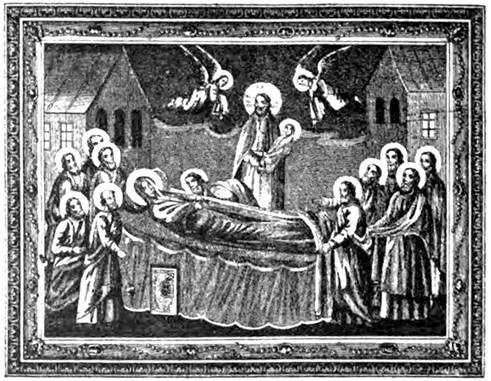
Наконец Феодосий приблизился к дню блаженного покоя своего. Узнав наперёд о близкой смерти своей, велел он собрать всю братию, находившуюся на послушаниях в сёлах или других местах. Когда все собрались, он говорит тиунам, приставникам и слугам, чтобы каждый из них выполнял порученную службу с усердием и страхом Божиим; потом учил всех со слезами спасению души и Богоугодной жизни, пощению, усердию к Церкви и благоговейному стоянию в ней, братолюбию и покорности. Преподав наставление, благословил и отпустил всех. Братия на первый раз не поняли, почему собирал их Феодосий; они думали, не хочет ли он скрыться от них в уединение, как и прежде того не раз хотел он удалиться в безмолвное место, но был удерживаем братией и вельможами. Между тем Феодосий лежал в сильном лихорадочном изнеможении; то томил его холод, то огонь сильно жёг его, так что не мог он говорить. В продолжении трёх дней был он в таком положении, что думали, не умер ли он. Затем встал он и, когда собрались к нему братия, он сказал: «братия и отцы! вот я знаю, что время жизни моей оканчивается, как открыл мне Господь ещё во время поста в пещере. Вы же подумайте, кого хотите, чтобы назначил я в игумена». Братия отвечали, что предоставляют это воле его. Феодосий велел им самим посоветоваться о том между собой. Когда снова предоставили они ему избрание игумена, он указал им на Иакова. Братия, сказав, что Иаков пострижен не в их обители, обратили выбор свой на доместика81. Феодосий, согласясь с их желанием, преподал наставление новому настоятелю и братии. Братия рыдали. Феодосий, утешая их, говорил: «обещаюсь вам, братия и отцы, всегда быть с вами духом... О дерзновении моём перед Богом вы сами узнаете: когда увидите, что все блага умножаются в обители, то поймёте, что близок я к Небесному Владыке». Отпустив всех, пал он на землю и залился слезами, – это видел сквозь щель брат, всегда служивший ему. Помолившись, лёг на постель, взглянул на небо и с весёлым лицом громко сказал: «благословен Бог! если так, то я уже не боюсь, а с радостью отхожу из сего света». Затем предал дух свой Господу, мая 3-го 1074 года, 65 лет от роду82.
At last Theodosius drew near to the day of his blessed repose. Having learned beforehand of his imminent death, he commanded that all the brethren who were on obediences in the villages or other places be gathered together. When all were assembled, he spoke to the stewards, overseers, and servants, that each of them should fulfill the service entrusted to him with zeal and the fear of God; then he taught all with tears concerning the salvation of the soul and a life pleasing to God, concerning fasting, zeal for the Church and reverent standing therein, brotherly love, and obedience. Having given instruction, he blessed them and dismissed them all. The brethren at first did not understand why Theodosius had gathered them; they thought that perhaps he wished to hide himself from them in solitude, as before this he had more than once desired to withdraw to a place of silence, but was restrained by the brethren and the nobles. Meanwhile, Theodosius lay in great feverish exhaustion; at times cold tormented him, at times fire burned him fiercely, so that he could not speak. For three days he remained in such a condition that they thought he had died. Then he arose, and when the brethren gathered to him, he said: “Brethren and fathers! Behold, I know that the time of my life is ending, as the Lord revealed to me even during the fast in the cave. Do you consider whom you wish that I should appoint as abbot.” The brethren answered that they left this to his will. Theodosius bade them take counsel among themselves concerning it. When again they left the choice of abbot to him, he pointed them to James. The brethren, saying that James had been tonsured not in their monastery, turned their choice to the domestic81. Theodosius, agreeing with their desire, gave instruction to the new superior and to the brethren. The brethren wept. Theodosius, comforting them, said: “I promise you, brethren and fathers, always to be with you in spirit… Concerning my boldness before God you yourselves shall know: when you see that all good things are multiplied in the monastery, then you will understand that I am near to the Heavenly Master.” Having dismissed all, he fell to the ground and burst into tears—this was seen through a crack by the brother who always served him. Having prayed, he lay down on his bed, looked up to heaven, and with a cheerful face said loudly: “Blessed is God! If it be so, then I no longer fear, but with joy I depart from this world.” Then he gave up his spirit to the Lord, on May 3rd of the year 1074, at the age of 6582.
В год кончины преподобного в Печерской обители было необыкновенное обилие во всём. Это уже уверило учеников его, что наставник их близок к Господу благому. Были ещё и другие знамения. «По смерти блаженного один боярин подвергся сильному гневу князя. Он усердно молился Богу и призывал на помощь преп. Феодосия. В один день, во время полуденного сна, явился ему отец наш Феодосий и сказал: «зачем ты так печалишься и думаешь, что я отошёл от вас? Вот завтра призовёт тебя князь, без всякого гнева на тебя». Он видел это не как во сне, но пробудясь видел блаженного выходящим вон из двери. За словом последовало исполнение. – Один человек, отправясь в путь, отдал серебро своё на сохранение иноку Конону, а другой украл его. Конон в скорби о том со слезами молился Богу и призывал на помощь Феодосия, чтобы не остаться в стыде перед доверителем. Когда он уснул, явившийся Феодосий говорит ему: «о чём ты скорбишь? Инок Николай, по наущению диавола, взял отданное тебе серебро и скрыл его в пещере»; указав ему место, прибавил: «иди, не говоря никому, и возьми своё». И тот действительно нашёл серебро там, где показал Феодосий. – Клирик великой Софийской церкви был сильно болен, горел как в огне; он молил Бога и преп. Феодосия о своём выздоровлении. После того, едва уснул он, видит, Феодосий даёт ему палку и говорит: возьми ты эту палку и ходи; когда взял он, то почувствовал облегчение. Об этом рассказал он явись сам в монастырь».
In the year of the Venerable One’s repose, there was an extraordinary abundance of everything in the Pechersk monastery. This already assured his disciples that their teacher was near to the good Lord. There were also other signs. “After the death of the blessed one, a certain boyar fell under the great wrath of the prince. He prayed fervently to God and called upon the Venerable Theodosius for help. One day, during his midday sleep, our father Theodosius appeared to him and said: ‘Why are you so sorrowful and think that I have departed from you? Behold, tomorrow the prince will summon you, without any anger against you.’ He saw this not as in a dream, but, waking, saw the blessed one going out through the door. The word was followed by its fulfillment. – A certain man, setting out on a journey, gave his silver for safekeeping to the monk Conon, and another stole it. Conon, in grief over this, prayed to God with tears and called upon Theodosius for help, that he might not remain in shame before the one who had entrusted it to him. When he fell asleep, Theodosius appeared and said to him: ‘Why are you sorrowful? The monk Nicholas, at the instigation of the devil, took the silver entrusted to you and hid it in a cave’; and pointing out the place, he added: ‘Go, tell no one, and take what is yours.’ And he indeed found the silver where Theodosius had shown. – A cleric of the great Church of St. Sophia was grievously ill, burning as if in fire; he prayed to God and to the Venerable Theodosius for his recovery. After that, as soon as he fell asleep, he saw Theodosius give him a staff and say: ‘Take this staff and walk’; when he took it, he felt relief. He told of this when he himself came to the monastery.”
«В 1091 г., пишет летописец, игумен и братия Печерского монастыря составили совет и положили: неприлично отцу нашему Феодосию лежать вне церкви монастырской, – он основал её и собрал черноризцев. Вслед затем приготовлено было в церкви место, где бы положить его». Самому Нестору игумен поручил отыскать мощи и св. летописец описывает их так: «составы не распались и только волосы присохли на голове». На следующий день «собрались епископы: Ефрем Переяславский, Стефан Владимирский, Иоанн Черниговский, Марин Юрьевский; пришли и игумены монастырей с черноризцами и много православного народа; взяли Феодосиевы мощи с фимиамом и свечами, принесли их в великую церковь и поставили в притворе на правой стороне в 14-й д. августа83. В 1108 г., по просьбе блаженного игумена Феоктиста и по согласии великого князя Святополка, митрополит Никифор постановил на соборе «вписать Феодосия в синодик по всем епископиям»84. Это значило тоже, что с того времени начали праздновать везде, как преставление преп. Феодосия, так и перенесение мощей его. Так показывают и другие памятники85.
“In the year 1091,” writes the chronicler, “the abbot and brethren of the Pechersk monastery held counsel and resolved: it is unseemly for our father Theodosius to lie outside the monastery church—he founded it and gathered the monks. Thereupon a place was prepared in the church where they might lay him.” The abbot entrusted Nestor himself with the task of finding the relics, and the holy chronicler describes them thus: “the joints had not fallen apart, and only the hair had dried on the head.” On the following day “the bishops assembled: Ephraim of Pereyaslavl, Stephen of Vladimir, John of Chernigov, Marin of Yuriev; the abbots of monasteries also came with monks, and many Orthodox people; they took the relics of Theodosius with incense and candles, brought them into the great church, and placed them in the narthex on the right side on the 14th day of August83. In the year 1108, at the request of the blessed abbot Theoctistus and with the consent of the Grand Prince Svyatopolk, Metropolitan Nicephorus decreed at a council ‘to inscribe Theodosius in the synodicon for all episcopacies’84. This meant the same as that from that time they began to celebrate everywhere both the repose of the Venerable Theodosius and the translation of his relics. Other monuments also show this85.
В 1130 г. Ростовский тысяцкий Георгий, сын известного Шимона, наследовавший усердие отца своего к преподобному, прислал в Печерскую обитель для окования раки преподобного 500 гривен (фунтов) серебра и 50 гривен золота, и великолепная рака была устроена86.
In the year 1130, George, the Tysyatsky of Rostov, son of the renowned Simon, who had inherited his father’s zeal for the Venerable One, sent to the Pechersk monastery for the adornment of the Venerable One’s shrine 500 grivnas (pounds) of silver and 50 grivnas of gold, and a magnificent shrine was made86.
Преп. Феодосий назидает и отдалённые времена своей высокой, святой жизнью. Но назидательны и письменные наставления, к сожалению, не все дошедшие до нас.
The Venerable Theodosius edifies even distant times by his lofty, holy life. But his written instructions are also edifying, though, unfortunately, not all have come down to us.
Преп. Нестор писал, что преп. Феодосий «поучал братию в церкви духовными словами. В одной рукописи отысканы 6 поучений преп. Феодосия, написанные наряду с поучениями преп. Феодора Студита, которого так любил Феодосий. Все они кратки, дышат кротостью, простотой и силой духа. «Что внесли мы, возлюбленные, в этот мир?» так говорит первое поучение, «и что можем вынести из него? Не оставили ли мы мира и всего, что в мире, по заповеди Христа: «иже не возненавидит всего и не последует Ми, несть Ми ученик (Лк.14:25). Иже аще любит Мя, слово Мое сохранит (Ин.14:23). Иже душу свою погубит Мене ради, обрящет ю» (Мф.10:39)? Любовь к Богу совершается не на словах, а в делах. Господь сказал: «иже пребудет в заповедях Моих, Аз возлюблю его и явлюся ему Сам» (Ин.14:21) ... Кто не удивится, возлюбленные, тому, что нашими делами может прославляться Бог? И сколько любви Его излилось на нас недостойных! «якоже возлюби Мя Отец, сказал Он, и Аз возлюбих вы; больше сея любви никтоже имать, да кто душу свою положит за други своя» (Ин.15:9,13). Каковы же должны быть мы, слыша всё это? Не горит ли в нас сердце? Не возбуждает ли нас совесть? Что доброго сделали мы для Него? За что избрал Он нас и вывел из короткого жития? Не все ли мы уклонились и не хотели работать Ему? Не все ли мы ходили вслед похотей своих? И Он не презрел нас, столько нечестивых, не возгнушался естеством нашим?» ...
The Venerable Nestor wrote that the Venerable Theodosius “taught the brethren in church with spiritual words.” In one manuscript, six homilies of the Venerable Theodosius have been found, written alongside the homilies of the Venerable Theodore the Studite, whom Theodosius so loved. They are all brief, breathing with meekness, simplicity, and power of spirit. “What did we bring, beloved, into this world?” thus speaks the first homily, “and what can we take out of it? Did we not leave the world and all that is in the world, according to the commandment of Christ: ‘He that hateth not all and followeth Me, is not My disciple’ (Lk. 14:25). ‘He that loveth Me, will keep My word’ (Jn. 14:23). ‘He that loseth his soul for My sake, shall find it’ (Mt. 10:39)? Love for God is perfected not in words, but in deeds. The Lord said: ‘He that abideth in My commandments, I will love him and will manifest Myself to him’ (Jn. 14:21)… Who would not marvel, beloved, that by our deeds God may be glorified? And how great is His love poured out upon us who are unworthy! ‘As the Father hath loved Me, so have I loved you; greater love hath no man than this, that a man lay down his life for his friends’ (Jn. 15:9,13). What then ought we to be, hearing all this? Does not our heart burn within us? Does not our conscience stir us? What good have we done for Him? Why did He choose us and lead us out of this brief life? Have we not all turned aside and been unwilling to serve Him? Have we not all walked after our own lusts? And yet He did not despise us, so ungodly as we are, nor did He abhor our nature?”…
В другом поучении преподобный показывает, что некоторые роптали на него за то, что питал в обители бедных. Таким говорит: «прилично было бы нам своими трудами кормить убогих и странников, но уже вовсе не жить в праздности и переходить из кельи в келью. Вы слышали слова Павла: «нигде туне хлеба не ядох, но нощь делах, а в дне проповедах и руце мои послужили мне и тем» (2Фес.3:8). А мы ничего такого не делали. Если бы не покрывала нас благодать Божия и не кормила нас через Боголюбивых людей, что приобрели бы мы своими трудами? Скажем ли, что за наше пение, за наш пост и бдение всё то приносят нам? Но мы ни за кого из приносящих не хотим молиться... Не следует нам, возлюбленные, беречь только для себя, что посылается Богом через Боголюбивых людей на пользу душевную и телесную. Мы должны подавать и иным нуждающимся. «Лучше даяти, неже приимати» (Деян.20:35). Блажен, сказано, призираяй на нища и убога: в день лют избавит его Господь (Пс.40:2). И ещё: «блажени милостивии, яко тии помиловани будут» (Мф.5:7). Не будем подобны тем строптивым, которые за чрево пали в пустыни... Что принесли вы из имений в это место? Или чего требовал я от вас, принимая вас в обитель? Человеколюбие Божие подаёт нам бедным всё, по молитвам св. Богородицы».
In another homily the Venerable One shows that some murmured against him because he fed the poor in the monastery. To such he says: “It would be fitting for us to feed the needy and strangers by our own labors, but certainly not to live in idleness and to go from cell to cell. You have heard the words of Paul: ‘Neither did we eat any man’s bread for nought, but wrought with labor night and day, and my hands have ministered unto me and to them’ (2 Thess. 3:8). But we have done nothing of the kind. If the grace of God did not cover us and feed us through God-loving people, what would we have gained by our own labors? Shall we say that it is for our singing, for our fasting and vigil that all these things are brought to us? But we are unwilling to pray for any of those who bring them… It is not fitting for us, beloved, to keep for ourselves alone what is sent by God through God-loving people for the benefit of soul and body. We ought to give also to others who are in need. ‘It is more blessed to give than to receive’ (Acts 20:35). Blessed, it is said, is he that considereth the poor and needy: the Lord will deliver him in the day of trouble (Ps. 40:2). And again: ‘Blessed are the merciful, for they shall obtain mercy’ (Mt. 5:7). Let us not be like those stubborn ones who fell in the wilderness because of the belly… What did you bring from your possessions into this place? Or what did I require of you when I received you into the monastery? The love of God for mankind supplies all things to us who are poor, through the prayers of the holy Theotokos.”
В третьем поучении учит терпению, напоминая инокам начальную ревность их к подвигам и обеты.
In the third homily he teaches patience, reminding the monks of their initial zeal for ascetic labors and their vows.
В четвёртом преподаются наставления усердно ходить в церковь, благоговейно стоять в ней и петь скромно.
In the fourth, instructions are given to attend church diligently, to stand in it with reverence, and to sing modestly.
В пятом обличает иноков в нерадении.
In the fifth, he reproves the monks for negligence.
В шестом говорит об отделении Господу десятины из годового времени. Это поучение повторяет Нестор в летописи87.
In the sixth, he speaks of setting apart a tithe of the year’s time for the Lord. Nestor repeats this homily in the chronicle87.
Кроме того известны еще два–три поучения преп. Феодосия и два послания к князю Изяславу88. Самое замечательное поучение – «о казнях», которое говорено было, как видно, не для одних иноков, а для народа. Оно сохранилось и в летописи Нестора и было говорено после несчастной битвы с Половцами в 1067 г.89. Повторим его здесь.
Besides these, two or three more homilies of the Venerable Theodosius are known, and two epistles to Prince Izyaslav88. The most remarkable homily is “On the Punishments,” which, as is evident, was spoken not for monks alone, but for the people. It is preserved also in Nestor’s chronicle and was spoken after the unfortunate battle with the Polovtsy in the year 106789. Let us repeat it here.
«Бог наводит на нас казни, каковы язычники, по гневу Своему, за то, что не обращаемся к Нему. Междоусобия бывают по наущению диавола и от злых людей. Бог не хочет зла людям, а желает только добра. Но диавол радуется всему худому между людьми. Он – враг наш исконный. Он хочет убийств и кровопролития и поднимает ссоры, убийство, зависть, ненависть к брату, клеветы. Когда страна тяжко согрешила, Бог наказывает смертью, или голодом, или нападением язычников, или бездождием, или другой казнью. Не принесём ли покаяния, как велит Он? Он говорит через пророка: «обратитесь ко Мне сердцем вашим, постом и плачем» (Иоил.2:12). Если бы пребывали мы в заповедях Божиих, то и здесь наслаждались бы земными благами и там, по выходе из света, получили бы жизнь вечную. Но мы всегда, как свиньи, валяемся в грязи греховной, прилагая грехи ко грехам, прогневляя во всём Бога, творя злое перед очами Его. Потому-то говорит нам пророк: «разумел, яко жестоци и лениви и каменосерди есте творити волю, того ради удержах от вас дождь и предел един одождих, изсше земля нив ваших и поразил вы различными казньми. То и тако не обратистеся ко Мне (Амос.4:7,8). Сего ради винограды ваша и древа всякая, носящая плод, и нивы и все исторг, глаголет Господь, а злоб ваших не могу истерти». Посылает различные напасти, не удержитесь ли от злоб ваших в раскаянии. «Послах на вы смерти тяжкия и на скот ваш и отъях от вас утеху всяку пищи вашея: но и ту не обратистеся ко Мне, но ресте: мужаемся еще. Доколе не насытитеся злоб ваших?.. Обратитеся ко Мне и обращуся к вам» (Ис.29:13). Потому-то не получаете, чего просите. «Будет бо, сказано, егда призовете Мя и не послушаю вас; взыщут Мене злии и не обращут» (Притч.1:28). Вот почему затворяет Бог небо и не посылает дождя, или отверзает, но на вред; пущая град, погубляет плоды морозом, томит землю зноем, за беззакония наши. Если раскаиваемся в злобах наших, то как детям Своим подаёт Бог и всё благое, – посылает дождь ранний и поздний, гумна наполняются пшеницей. «Пролиются точила винная и масльная и воздам вам за лета, яже пояша прузи, и хрустове, и гусеница» (Иоил.2:23–25). Слыша это, подвинемся на доброе. Взыщите суда правого, избавьте обиженного. Покаемся. Не будем воздавать злом за зло, ни клеветой за клевету. Прилепимся к Богу любовью; постом, рыданием, слезами будем омывать все грехи наши. Мы называемся христианами, а живём, как язычники. Не язычески ли поступаем, веря во встречи? Если кто встретит чернца или черницу, то возвращается назад; то же, если встретим свинью или лысого коня. Не дело ли это языческое? По наущению диавола держатся этой ворожбы. Другие верят чиханию, тогда как это часто бывает на здоровье голове. – Диавол обольщает нас и другими обычаями, отклоняя от нас Бога, – как-то волхвованием, чародейством, блудом, пьянством, страстью к ростам, воровством, ложью, завистью, клеветой, трубами, скоморохами, гуслями и русальями. Вот на игрищах толчётся многое множество народа, пихают друг друга, выставляют зрелище дела бесовского, а церкви – стоят пустые, – когда бывает время молитвы, их там мало». Далее говорится, что в церкви надобно стоять благоговейно. «Вот, когда стоим в церкви, как осмеливаемся мы смеяться или шептать? Окаянный диавол внушает нам творить смех и шёпот, тогда как стоим мы перед Царём Небесным. Не достойны ли мы мук за то?.. Молю вас, други, будем стоять на молитве со страхом и с любовью друг ко другу. Будем достойно говорить в молитве: «да исправится молитва моя, яко кадило перед Тобою, воздеяние руку моею». Если руки твои не совершали никакого грабежа, ты хорошо говоришь – «воздеяние руку моею». Осматривай же руки твои, чисты ли они от грабежа и хапания ростов. Если же ты грабил, или брал лихву и корчемный прикуп, или чем-либо обидел другого, что запрещено святым писанием; то не говори о воздеянии и не воздевай рук твоих прежде, чем очистишься от зла. Ведайте и то, возлюбленные чада, что св. отцы наши как уставили дни поста по научению Господню и по заповеди Апостолов, так заповедали праздновать св. праздники, но праздновать не телесно, а духовно, чтобы мы работали не чреву в пьянстве, а молились Богу о своих грехах и кормили нищих... О! горе и ещё скажу – горе пребывающим в пьянстве! Пьянством отгоняем от себя ангела хранителя и призываем на себя беса; пьянством удаляемся от Святого Духа и приближаемся к аду... Диавол, радуясь, говорит: никогда я столько не был доволен жертвами языческими, сколько пьянством христиан, – в пьянстве совершаются все дела моей воли... Слыша это, постараемся, братия, работать Господу и исполнять заповеди Его... Ему слава»90.
“God brings down punishments upon us, such as the pagans, according to His wrath, because we do not turn to Him. Civil strife occurs by the instigation of the devil and from evil men. God does not desire evil for men, but only good. But the devil rejoices in everything evil among men. He is our ancient enemy. He desires murders and bloodshed and stirs up quarrels, murder, envy, hatred of a brother, slanders. When a country has grievously sinned, God punishes with death, or famine, or an incursion of pagans, or drought, or some other punishment. Shall we not offer repentance, as He commands? He says through the prophet: ‘Turn ye to Me with all your heart, with fasting and with weeping’ (Joel 2:12). If we had abided in the commandments of God, we would have enjoyed earthly blessings here, and there, after departing from this light, we would have received eternal life. But we always, like swine, wallow in the mire of sin, adding sin to sin, angering God in everything, doing evil before His eyes. Therefore the prophet says to us: ‘I know that ye are stubborn and slothful and hard of heart to do My will; therefore have I withheld the rain from you, and I have rained upon one city, and the land of your fields is dried up, and I have smitten you with various plagues. Yet even so ye have not returned unto Me’ (Amos 4:7,8). ‘Therefore your vineyards and all fruit-bearing trees, and your fields, all have I plucked up, saith the Lord, but your evils I cannot blot out.’ He sends various calamities, that you might refrain from your evils in repentance. ‘I have sent upon you grievous deaths, and upon your cattle, and I have taken from you every comfort of your food: but even then ye turned not to Me, but ye said: Let us still be strong. How long will ye not be filled with your evils?.. Turn ye unto Me, and I will turn unto you’ (Is. 29:13). Therefore ye receive not what ye ask. ‘For it shall be, when ye call upon Me, I will not hearken unto you; the wicked shall seek Me and shall not find Me’ (Prov. 1:28). This is why God shuts heaven and sends no rain, or opens it but to our harm; sending hail, destroying fruits with frost, tormenting the earth with heat, because of our iniquities. If we repent of our evils, then as to His children God grants everything good—He sends the early and the latter rain, the threshing floors are filled with wheat. ‘The vats shall overflow with wine and oil, and I will restore to you the years which the locust hath eaten, and the cankerworm, and the caterpillar’ (Joel 2:23–25). Hearing this, let us be moved to good. Seek righteous judgment, deliver the oppressed. Let us repent. Let us not render evil for evil, nor slander for slander. Let us cleave to God with love; with fasting, lamentation, and tears let us wash away all our sins. We call ourselves Christians, but we live like pagans. Do we not act like pagans, believing in omens? If someone meets a monk or a nun, he turns back; likewise if we meet a pig or a bald horse. Is this not a pagan practice? By the instigation of the devil they hold to this sorcery. Others believe in sneezing, though this often happens for the health of the head. — The devil deceives us also with other customs, turning God away from us—such as sorcery, witchcraft, fornication, drunkenness, passion for usury, theft, falsehood, envy, slander, trumpets, buffoons, psalteries, and rusaliya93. Lo, at the games a great multitude of people jostle, push one another, presenting a spectacle of the devil’s work, while churches stand empty—when it is time for prayer, there are few of them there.” Further it is said that one must stand reverently in church. “Behold, when we stand in church, how dare we laugh or whisper? The accursed devil prompts us to laughter and whispering, while we stand before the Heavenly King. Are we not worthy of torments for this?.. I beseech you, friends, let us stand at prayer with fear and with love for one another. Let us worthily say in prayer: ‘Let my prayer be set forth as incense before Thee, the lifting up of my hands.’ If thy hands have committed no robbery, thou sayest well—‘the lifting up of my hands.’ Examine then thy hands, whether they are clean from robbery and the snatching of usury. But if thou hast robbed, or taken interest and tavern profit, or in any way wronged another, which is forbidden by holy Scripture; then speak not of the lifting up, nor lift up thy hands, until thou hast cleansed thyself from evil. Know also, beloved children, that as our holy fathers established days of fasting according to the Lord’s teaching and the commandment of the Apostles, so they commanded to celebrate the holy feasts, but to celebrate not bodily, but spiritually, that we might serve not the belly in drunkenness, but pray to God for our sins and feed the poor... O! woe, and again I say—woe to those who abide in drunkenness! By drunkenness we drive away from us the guardian angel and call upon ourselves the demon; by drunkenness we withdraw from the Holy Spirit and draw near to hell... The devil, rejoicing, says: Never was I so pleased with pagan sacrifices as with the drunkenness of Christians—in drunkenness all the deeds of my will are accomplished... Hearing this, let us strive, brethren, to serve the Lord and fulfill His commandments... To Him be glory”90.
Для монастырских сёл писано преп. Феодосием прекрасное «слово христолюбца», с обличением двуверным христианам91, тем, которые, исповедуя христианскую веру, выполняли и обряды язычества.
For the monastery villages, the Venerable Theodosius wrote a fine “word of a Christ-lover,” with a rebuke to double-believing Christians91, to those who, while professing the Christian faith, also performed pagan rites.
«Как Илия Фесвитянин ревновал по Господе Вседержителе и заклал жрецов идольских, числом до 300; так и сей христолюбец (пишущий эти строки) не может терпеть христиан, живущих во двуверии. Веруют в Перуна, в Хорса, в Мокоии, в Сима, в Регла92, в Вилы93, которых считают 30 сестёр. Невежды говорят и думают, что это богини; кладут им жертвы, режут кур94. Молятся огню, называя его Сварожичем95. Даже чеснок считают за божество: когда бывает пир, то кладут (его) в вёдра и в чаши и пьют, веселясь о идолах своих96. Не лучше еретиков и жидов те, которые поступают так, будучи в вере и в крещении. Не только невежды, но и верующие священники и книжные люди поступают так. Хотя же ведущие не делают того, но пьют питьё и вкушают ту жертвенную пищу; если же не пьют и не едят, но видят худые дела тех, или не видят, но слышат о них, и однако не хотят вразумлять тех. О таких говорит пророк: «окаменело сердце людей сих, ушами с трудом слышат и смежили очи свои». Павел говорит Римлянам: «открывается гнев Божий на всякое нечестие и неправду тех, которые содержат истину в неправде». Сам Господь сказал: многие пастыри погубили виноградник Мой. Пастыри – люди книжные, виноградник – вера, худыми пастырями – учителями неразумными люди погибают в вере. Если не отстанут от проклятой мольбы и диавольской службы, то наследят огонь вечный, а худые пастыри будут поджогой им, если не отвращают их от того сатанинского дела... Сказано: горе человеку тому, которым соблазняется мир. Господь сказал: кто научит добру, назовётся великим в Царстве Небесном. Павел говорит Римлянам: «хотя вы многих имеете наставников, но не многих отцов; я благовествованием родил вас; потому молю: будьте подобны мне». Священники и люди книжные! уподобляйтесь Павлу, великому учителю. Учите людей добру; отвращайте их от диавольской прелести, чтобы в истинной вере служили истинному Богу. Пусть и вы скажете перед Богом с пророком: вот я и дети мои, которых Ты дал мне, я родил их ученьем, за это вы пользуетесь от них пищей, питьём и дарами. Если не хотите учить их, то не присоединяйтесь к ним... Какое общение Христу с бесом? Какое общение с служащими бесам? Павел говорит Коринфянам: «писал я вам, братия, – не имейте общения с любителем процентов, ни с грабителем, ни с корчемником, ни с служащим кумирам». Сердце их в неистовом пьянстве. Пили и ели и стали плясать. Не следует христианам совершать бесовских игр, пляски, пения на гудке, мирских песней и жертв идольских, приносимых под овином Огню, Вилам, Мокошу, Симу, Реглу, Перуну, Роду иРожаницам97 и прочим подобным тому. Такое преподано нам учение в конце веков. Пусть не напрасно говорили мы, отрицаясь от сатаны и от всех дел его при крещении. Если мы дали обещание Христу, почему не служим Ему, а служим бесам и творим всё угодное им, на пагубу душам своим? Не просто делаем худое, но смешиваем чистые молитвы с проклятым идольским молением. Предлагают кутью, другие кушанья, обед законный Роду или Рожаницам, на гнев Богу... Господь сказал: «не может слуга услуживать двум господам, одного полюбит, а другого возненавидит». Так и мы, братия, возненавидим диавола и возлюбим Христа. Мы во Христа крестились, в Него облеклись, Его едим хлеб и Его чашу пьём и бываем здравы. Павел говорит: «запрещаю вам участвовать в трапезе бесовской, иначе не можете пить чашу Господню и участвовать в трапезе Господней. Если кто скажет вам: это жертва идольская, не вкушайте её. Ядите ли, пьёте ли, всё совершайте в славу Божию, Господня земля и все концы её» ... Зачем не принимать предлагающих разумное наставление ко спасению нашему? Надеюсь на ум ваш, что не напрасно говорю. Советую изучить сию беседу, дабы и для других быть полезными. Освободитесь из сети диавольской. Приступим к чистому свету Господа нашего Иисуса Христа. Беззаконники, непокорные, противящиеся здравому учению, порицающие отца и мать не наследят славы Божией».
“As Elijah the Tishbite was zealous for the Lord Almighty and slew the priests of idols, to the number of 300; so also this Christ-lover (who writes these lines) cannot endure Christians who live in double faith. They believe in Perun, in Khors, in Mokosh, in Sim, in Regl92, in Vily93, whom they count as thirty sisters. The ignorant say and think that these are goddesses; they offer them sacrifices, slaughter chickens94. They pray to fire, calling it Svarozhich95. They even consider garlic a deity: when there is a feast, they put (it) into buckets and cups and drink, rejoicing in their idols96. Those who act thus, being in the faith and in baptism, are no better than heretics and Jews. Not only the ignorant, but also believing priests and book-learned men act thus. For though the knowing do not do this, they drink the drink and taste that sacrificial food; and if they neither drink nor eat, yet they see the evil deeds of those, or do not see them, but hear of them, and yet do not wish to admonish them. Of such the prophet says: ‘The heart of this people is hardened, they hear with difficulty with their ears, and they have closed their eyes.’ Paul says to the Romans: ‘The wrath of God is revealed against all ungodliness and unrighteousness of those who hold the truth in unrighteousness.’ The Lord Himself said: Many shepherds have destroyed My vineyard. The shepherds are the book-learned men, the vineyard is the faith; by evil shepherds—unwise teachers—people perish in the faith. If they do not forsake the accursed prayer and devilish service, they shall inherit eternal fire, and the evil shepherds shall be the kindling for them, if they do not turn them away from that satanic work... It is said: Woe to that man by whom the world is offended. The Lord said: He who teaches good shall be called great in the Kingdom of Heaven. Paul says to the Romans: ‘Though you have many instructors, yet not many fathers; I have begotten you through the gospel; therefore I beseech you: be imitators of me.’ Priests and book-learned men! Imitate Paul, the great teacher. Teach the people good; turn them away from devilish delusion, that in true faith they may serve the true God. Let you also say before God with the prophet: Behold, I and the children whom Thou hast given me, I have begotten them by teaching, and for this you receive from them food, drink, and gifts. If you do not wish to teach them, then do not join with them... What fellowship has Christ with a demon? What fellowship with those who serve demons? Paul says to the Corinthians: ‘I wrote to you, brethren—have no fellowship with a lover of interest, nor with a robber, nor with a tavern-keeper, nor with a server of idols.’ Their heart is in frantic drunkenness. They drank and ate and began to dance. Christians ought not to perform demonic games, dancing, singing to the gudok, worldly songs, and idolatrous sacrifices offered under the barn to Fire, Vily, Mokosh, Sim, Regl, Perun, Rod and Rozhanitsy97 and others like them. Such teaching has been given to us at the end of the ages. Let not our words be in vain, when we renounced Satan and all his works at baptism. If we have given a promise to Christ, why do we not serve Him, but serve demons and do everything pleasing to them, to the destruction of our souls? Not simply do we evil, but we mix pure prayers with accursed idolatrous supplication. They offer kutia, other dishes, a lawful meal to Rod or Rozhanitsy, to the anger of God... The Lord said: ‘No servant can serve two masters; he will love one and hate the other.’ So also we, brethren, let us hate the devil and love Christ. We have been baptized into Christ, we have put on Christ, we eat His bread and drink His cup and are made whole. Paul says: ‘I forbid you to partake of the table of demons, otherwise you cannot drink the cup of the Lord and partake of the table of the Lord. If anyone says to you: This is an idol sacrifice, do not eat it. Whether you eat or drink, do all to the glory of God; the earth is the Lord’s, and all its ends’... Why not accept those who offer reasonable instruction for our salvation? I trust in your understanding, that I do not speak in vain. I advise you to study this discourse, that you may be useful also to others. Free yourselves from the snare of the devil. Let us draw near to the pure light of our Lord Jesus Christ. The lawless, the disobedient, those who oppose sound teaching, who revile father and mother shall not inherit the glory of God.”