Имена их: Феогний*, Руф, Антипатр, Феостих, Артема, Магн, Феодот, Фамвасий* иФилимон. Уроженцы разных местностей, они пострадали в городе Кизике за распространение веры и исповедание Христа в конце III века; после пыток обезглавлены. Через несколько лет, когда воцарился Константин Великий, христиане вырыли из земли свящ. тела их и, найдя их нетленными, положили в ковчеге и внесли в церковь, посвящённую их имени. От святых мощей совершались многие чудеса и исцеления, так что и неверные, видя благодать Божию, обращались к вере.
Their names are: Theognius, Rufus, Antipater, Theostichus, Artemas, Magnus, Theodotus, Thamvasius* and Philemon. Natives of various places, they suffered in the city of Cyzicus for spreading the faith and confessing Christ at the end of the third century; after tortures they were beheaded. Several years later, when Constantine the Great reigned, Christians dug the sacred bodies out of the earth and, finding them incorrupt, placed them in a reliquary and brought them into a church dedicated to their name. Many miracles and healings were performed from the holy relics, so that even unbelievers, seeing the grace of God, turned to the faith.
В 1687 году свирепствовала в городе Казани горячка, и митрополит Адриан после молитвы дал обет устроить монастырь в честь Кизических мучеников, если прекратится болезнь. Он исполнил обет, уже будучи патриархом Московским (1690 г.), и приложил старание приобрести из Кизика частицы мощей св. мучеников, которые и принёс в дар монастырю. – Служба святым написана в 1694 году св. Димитрием Ростовским.
In the year 1687 a fever raged in the city of Kazan, and Metropolitan Adrian, after prayer, made a vow to build a monastery in honor of the Cyzicus martyrs if the illness ceased. He fulfilled the vow, already being Patriarch of Moscow (1690), and took pains to acquire from Cyzicus particles of the relics of the holy martyrs, which he presented as a gift to the monastery. – The service to the saints was written in 1694 by St. Demetrius of Rostov.
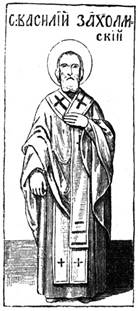
По преданию святой Василий родился в Поповой волости, что в Герцеговине; родители его были люди благочестивые, но страдавшие от Турецкой власти. Ещё в юном возрасте любил он посещать храм Божий. Когда же пришёл в зрелый возраст, то, оставив дом родительский, удалился в Требинскую обитель Успения Богоматери и здесь принял монашество. Обитель эта, увы! давно разорена нечестивыми Турками.
According to tradition, St. Basil was born in Popova volost, in Herzegovina; his parents were pious people, but suffering under Turkish rule. Even at a young age he loved to visit the church of God. When he reached mature age, leaving his parental home, he withdrew to the Trebinje Monastery of the Dormition of the Mother of God and there received monastic tonsure. This monastery, alas! was long ago destroyed by the impious Turks.
Господь, узрев чистое житие Василия, возвёл его на высокий степень архиерейский, после того как прошёл он низшие служения; Василий был пастырем для православных Захолмия и Скендерии. В этом служении умножил он труды и подвиги свои на пользу православной Церкви. Его уединённые славословия, молитвы, воздыхания и слёзы кто перескажет? Святитель усердно посещал верных своей паствы и наставлениями побуждал их не лениво идти по путям спасения. Господь подкреплял слово его различными чудесами, так что Василий был предметом общего удивления, – а для страдающей паствы своей был утешением. Пусть же хулители православия знают, что Господь посылает нам угодников Своих, являет и мучеников, столько же твёрдых, как тверды были мученики времён язычества Римского... Св. Василий был терпелив в отношении к врагам, кроток и незлобив в отношении к обижавшим, милостив к нищим, добр и мужествен, когда надобно было защищать стадо своё от волков. Для освежения души подвижническою мудростью путешествовал он на Афон; Господь возвратил пастыря стаду его, дабы и по смерти охранял он православие, которому служил в жизни земной. Покоясь в Остроге, новоявленный Василий подаёт исцеления приходящим к раке мощей его. Как в жизни милостив он был к немощным по телу и душе, так и по смерти помогает не только верным, но и простодушным магометанам.
The Lord, having beheld the pure life of Basil, raised him to the high rank of bishop, after he had passed through the lower ministries; Basil was a shepherd for the Orthodox of Zahumlje and Skenderia. In this ministry he multiplied his labors and struggles for the benefit of the Orthodox Church. Who can recount his solitary praises, prayers, sighings and tears? The Hierarch diligently visited the faithful of his flock and by his instructions urged them not to be slothful in walking the paths of salvation. The Lord strengthened his word with various miracles, so that Basil was an object of universal wonder—and for his suffering flock he was a consolation. Let the blasphemers of Orthodoxy know, then, that the Lord sends us His saints, and manifests martyrs as steadfast as the martyrs of the times of Roman paganism were steadfast... St. Basil was patient toward enemies, meek and without malice toward those who offended him, merciful to the poor, kind and courageous when it was necessary to defend his flock from wolves. To refresh his soul with ascetic wisdom, he traveled to Mount Athos; the Lord returned the shepherd to his flock, that even after death he might guard the Orthodoxy which he served in earthly life. Reposing in Ostrog, the newly-revealed Basil grants healings to those who come to the reliquary of his relics. As in life he was merciful to those weak in body and soul, so after death he helps not only the faithful, but also simple-hearted Mohammedans.
Таковы известия синаксаря о св. Василии. Не показан в них год блаженной кончины его. Остаётся только догадываться о том. поскольку сказано, что св. Василий иночески подвизался в Требинском Успенском монастыре; а известно, что этот монастырь разрушен был в 1695 г.380, то значит подвизался он иночески прежде 1690 г.; поскольку же родился он тогда, как Герцеговина уже страдала под властью Турецкой, то ясно, что жил он долго после времён независимости Сербии и правления Неманичей. Острог ныне входит в округ Черногории, находясь на границе её с Герцеговиной. В службе поют св. Василию: «радуйся, Захолмии и Скендерии хранителю, Черные горы и примория столпе непреоборимый и председателю... Яко учитель Захолмский и Черногорский наставлявши стадо твое». – По этим данным следует положить, что св. Василий был тот Черногорский митрополит Василий, который жил во второй половине XVI в. быв преемником по кафедре Павла и предшественником Никодима381. Не можем не прибавить здесь нескольких слов о Требинском Богородичном монастыре, где иночески подвизался св. Василий. Требинье – такое место, где христианство цвело, по местному преданию, с IV века; в Требинском Богородичном монастыре со времён Неманичей была кафедра митрополитов. Запись, очень древняя по языку, говорит: «1270 – обновлена церковь Успения Пресвятые Богородице, еже есть в Требину; прежде от основания воздвижена благочестивым царем Константином с материю Еленою и тем многим днем обветшала бисть. – Обновлен би сьи храм благочестивим и трудолюбивим кралем Стефаном, си есть Милутинь, праунук Немане Стефана, § мироточивого Симеона, всеосвященном митрополитом кир. Василием игумену Василию»382.
Such are the accounts of the synaxarion concerning St. Basil. The year of his blessed repose is not shown in them. One can only conjecture about it. Since it is said that St. Basil ascetically struggled in the Trebinje Dormition Monastery, and it is known that this monastery was destroyed in 1695380, this means he struggled as a monk before 1690; and since he was born when Herzegovina was already suffering under Turkish rule, it is clear that he lived long after the times of Serbia's independence and the rule of the Nemanjić dynasty. Ostrog now belongs to the district of Montenegro, being on its border with Herzegovina. In the service they sing to St. Basil: "Rejoice, guardian of Zahumlje and Skenderia, unshakable pillar and president of Montenegro and the coastland... As a teacher of Zahumlje and Montenegro, you guide your flock." – According to these data, one should suppose that St. Basil was that Montenegrin Metropolitan Basil who lived in the second half of the 16th century, being the successor to the see of Paul and the predecessor of Nicodemus381. We cannot refrain from adding here a few words about the Trebinje Monastery of the Mother of God, where St. Basil ascetically struggled. Trebinje is a place where Christianity flourished, according to local tradition, from the 4th century; in the Trebinje Monastery of the Mother of God, from the times of the Nemanjić dynasty, there was the see of the metropolitans. An inscription, very ancient in language, says: "1270 – the church of the Dormition of the Most Holy Theotokos, which is in Trebinje, was renewed; it was formerly raised from its foundation by the pious Emperor Constantine with his mother Helena, and over many days it had fallen into decay. – This temple was renewed by the pious and labor-loving King Stephen, that is Milutin, great-grandson of Stephen Nemanja, § of the myrrh-streaming Simeon, by the most-holy Metropolitan kyr Basil, with Abbot Basil"382.
Зап. геогр. общ. XIII, 660. Здесь же, стр. 662. 663: „митрополити монастира Требиня“, числом 25. Неверно объяснение Порфирогенита слову Тервунии, по столько же не согласно с местностью и объяснение Шафарика (Древи. III, 445. 446). Треби – не нет требы, нет языческой жертвы, тогда как прежде Требинье было местом требища, языческого жертвоприношения.
Notes of the Geographical Society XIII, 660. Here also, pp. 662, 663: "Metropolitans of the Monastery of Trebinje," numbering 25. The explanation of the word Terbunia by Porphyrogenitus is incorrect, just as Šafárik's explanation is also inconsistent with the locality (Antiquities III, 445, 446). Trebi – is not "no treba," no pagan sacrifice, whereas formerly Trebinje was a place of trebište, of pagan sacrifice.