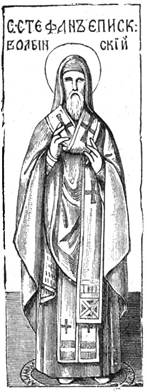
Блаженный Стефан с молодых лет подвизался под руководством пр. Феодосия Печерского и был искренним учеником его. Он был в обители Феодосия доместиком или главным уставщиком по клиросу. Пр. Феодосий столько отличал его своим вниманием, что по временам поручал ему вместо себя говорить поучения братии. Перед смертью Феодосия братия просили назначить им в игумена Стефана доместика: «он вырос под твоей рукой, говорили они, послужил тебе, дай нам его». И Феодосий, соглашаясь на желания братии, сказал Стефану: «се, чадо, вручаю тебе монастырь; блюди его с опасением и храни, что я устроил относительно службы, не изменяй преданий монастырских»359. Блаж. Стефан с ревностью исполнял заповеди наставника своего. Ему надлежало заботиться о построении храма, который заложен был пр. Феодосием. Спустя три года огромный храм вчерне окончен постройкой. Так как новый храм сей от древнего монастыря стоял почти на двести сажен в юго-западном направлении, то необходимость требовала перевести туда и монастырь. Блаж. Стефан построил вблизи нового храма деревянные кельи и перевёл в них братию из старого монастыря. В последнем оставлены только немногие для погребения умирающих и для ежедневного совершения литургии за усопших братий. Старый и новый монастыри разделялись теперь двором, который устроен был Феодосием для странных. Стефан обнёс и монастыри, и двор деревянной стеной. Блаж. Стефан не успел окончательно устроить нового храма. Братия, которые сами выпросили его в игумена, неизвестно с чего и по какому случаю до того восстали на него, что он принуждён был отказаться от игуменства и оставить монастырь. Это было в 1078 г.360. Блаж. Стефан благодушно перенёс скорбь изгнания из обители, которая поручена ему была отцом и наставником его Феодосием. Многие из вельмож и людей богатых были духовными его детьми и очень жалели о его скорбном положении. Привязанный сердечной любовью к Печерской обители, он не хотел далеко уходить от неё. На другом отроге Печерской горы он основал новый монастырь в честь Пр. Богородицы, в память положения ризы её во Влахерне, который по месту называли Кловским, а по храму Влахернским361. Это был памятник благодеянию Богоматери к любимой Печерской обители. Стефан видел, пишет блаж. Симон, как пришли из Греции мастера каменного дела, с иконой Богоматери, и рассказали видение Царицы Небесной во Влахерне, и потому сам создал на Клове Влахернскую церковь. Приношения духовных детей дали Стефану средства выстроить и украсить сей монастырь. Он собрал в новую обитель много братии и ввёл в ней устав Печерского монастыря362. В 1091 г. видим его епископом Владимира Волынского; он был при перенесении мощей пр. Феодосия из пещеры в лавру. Блаженная кончина его последовала 27 апр. 1094 г.363.
The blessed Stephen from his youth asceticised under the guidance of the Venerable Theodosius of the Kiev Caves and was his sincere disciple. In the monastery of Theodosius he was the domestikos, or chief chanter, in the choir. The Venerable Theodosius so distinguished him with his attention that at times he entrusted him to deliver teachings to the brethren in his stead. Before the death of Theodosius, the brethren asked that Stephen the domestikos be appointed as their abbot: "He has grown up under your hand," they said, "he has served you; give him to us." And Theodosius, agreeing to the desire of the brethren, said to Stephen: "Behold, child, I entrust the monastery to you; guard it with care and keep what I have established concerning the services; do not alter the monastic traditions."359 The blessed Stephen zealously fulfilled the commandments of his teacher. It fell to him to care for the building of the church which had been founded by the Venerable Theodosius. After three years, the vast church was completed in the rough. Since this new church stood almost two hundred sazhens to the southwest of the ancient monastery, necessity demanded that the monastery be moved there as well. The blessed Stephen built wooden cells near the new church and transferred the brethren there from the old monastery. In the latter, only a few were left for the burial of the dying and for the daily celebration of the Divine Liturgy for the departed brethren. The old and new monasteries were now separated by the courtyard which Theodosius had built for strangers. Stephen enclosed both the monasteries and the courtyard with a wooden wall. The blessed Stephen did not succeed in fully completing the new church. The brethren, who had themselves requested him as abbot, for some unknown reason and occasion rose up against him to such a degree that he was compelled to resign the abbacy and leave the monastery. This occurred in 1078.360 The blessed Stephen bore the grief of exile from the monastery, which had been entrusted to him by his father and teacher Theodosius, with good cheer. Many of the nobles and wealthy people were his spiritual children and greatly grieved over his sorrowful situation. Bound by heartfelt love to the Monastery of the Caves, he did not wish to go far from it. On another spur of the Caves hill he founded a new monastery in honor of the Most Holy Theotokos, in commemoration of the Placing of Her Robe at Blachernae, which from its location was called the Klov Monastery, and from its church, the Blachernae Monastery.361 This was a monument to the benefaction of the Mother of God toward the beloved Monastery of the Caves. Stephen saw, writes the blessed Simon, how the stoneworkers came from Greece with an icon of the Mother of God and related the vision of the Queen of Heaven at Blachernae, and therefore he himself built the Blachernae church at Klov. The offerings of his spiritual children gave Stephen the means to build and adorn this monastery. He gathered many brethren into the new monastery and introduced in it the rule of the Monastery of the Caves.362 In 1091 we see him as Bishop of Vladimir in Volhynia; he was present at the translation of the relics of the Venerable Theodosius from the cave to the Lavra. His blessed repose occurred on April 27, 1094.363