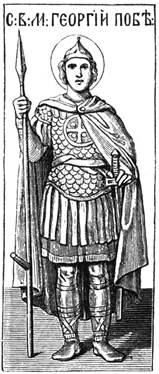
Святойвеликомученик Георгий родился в Бейруте от христианских, богатых и благородных родителей. Образованный, красивый наружностью и крепкий телом, он был любим и возведён царём Диоклитианом (284–304) в почётное звание воинского трибуна, а потом тысяченачальника. Но воспитанный в благочестии христианском, он не мог быть счастлив при царе язычнике и гонителе христианства. Находясь однажды в судилище и слыша беззаконный, бесчеловечный суд о истреблении христиан, Георгий воспылал св. ревностью за веру Христову. Раздав имущество своё бедным и отпустив рабов на волю, Георгий восстал среди беззаконного собрания и, обличив нечестие и злоумышление царя, его вельмож и советников, исповедал себя перед ними христианином и истину Евангелия. Объятый гневом, царь повелел оруженосцам выгнать св. обличителя из собрания копьями и заключить в темницу. В темнице повергли Георгия на землю спиною, ноги его забили в колоды, а грудь сдавили тяжёлым камнем, положенным на неё. В этом тяжком страдании Георгий, подкрепляемый молитвой к Богу и упованием на Него, пробыл до другого дня, но который озарил его не для радостей, а для новых, тягостнейших страданий. Когда, после вторичных убеждений отречься от Христа, мученик остался непреклонен в вере своей, его, едва уже говорившего от сдавления груди тяжёлым камнем, нагого привязали к большому колесу, изобретённому для казни, под которым устроены были доски, из коих торчали железные острия, обращённые вверх к колесу. На этом страшном колесе кругом вращали мученика над остриями, которые, вонзаясь в ногое беззащитное тело страдальца, изрезали его как трость. Бог сохранил жизнь Георгия и среди столь ужасных мучений. Но мучители не вразумились силой Божией, которая так ясно открылась в страдании и терпении его, что обратила ко Христу и соделала мучениками за имя Его – некоторых язычников, видевших страдания великомученика; таковы были двое преторов – Анатолий и Протолион – преторианцы и сама царица Александра, супруга Диоклитиана. Ожесточённые против Георгия мучители, связав его, закопали в нерастворённую известь, думая, что он сгорит в ней. Но Бог и здесь сохранил жизнь св. исповедника для славы Своей. Извлечённому из извести Георгию надели на ноги смоги, внутри коих торчали острием кверху раскалённые гвозди, и в этой обуви гнали его в темницу с побоями и ругательствами. На другой день после сих истязаний, побоев и насмешек, снова вывели Георгия перед судилище, и царь, слыша от него прежние обличительные слова, с гневом приказал бить его по устам и сечь воловьими жилами, доколе плоть его с кровью не прильнёт к земле. Считая величайшее терпение Георгия действием волхвования, царь велел одному волхву – Афанасию употребить своё искусство против него, чтобы его или совратить с пути истины, или умертвить. Но волхв, видя благодать Божию, столь ясно чудодейственную в Георгии, сам обратился ко Христу и пострадал за Него. Темница, в которой содержался великомученик, прославленная пребыванием его, соделалась училищем благочестия и благодатной врачебницей. К Георгию стекались в темницу многие для спасительной с ним беседы, услаждавшей сердца слушателей, и для получения от него исцелений силою благодати Божией, в нем действующей. Некоторые из приходивших к Георгию в темницу исповедали Иисуса Христа и приняли венец мученический. Великие страдания Георгия кончились лишением его жизни: подозревая, что он своими беседами в темнице возмущает народ, св. узнику отсекли голову. Мощи св. великомученика положены были в Палестине – городе Лидде, на родине матери его, потом во храме, построенном в Лидде во имя великомученика. Вместе с Георгием пострадала в 304 году и царица Александра, которую Церковь и прославляет купно с Георгием.
The holy Great Martyr George was born in Beirut to Christian, wealthy, and noble parents. Educated, handsome in appearance, and strong in body, he was beloved and was raised by the Emperor Diocletian (284–304) to the honorable rank of military tribune, and later to that of chiliarch. But having been raised in Christian piety, he could not be happy under a pagan emperor and persecutor of Christianity. Once, being present in the court and hearing the lawless, inhuman decree for the destruction of Christians, George was inflamed with holy zeal for the faith of Christ. Having distributed his property to the poor and set his slaves free, George rose up in the midst of the lawless assembly and, denouncing the impiety and evil intent of the emperor, his nobles, and his counselors, confessed himself before them as a Christian and the truth of the Gospel. Seized with anger, the emperor commanded the guards to drive the holy accuser out of the assembly with spears and to cast him into prison. In the prison they threw George to the ground on his back, clamped his feet in stocks, and pressed his chest with a heavy stone placed upon it. In this grievous suffering, strengthened by prayer to God and hope in Him, George remained until the next day, which dawned for him not for joys, but for new, more grievous sufferings. When, after repeated exhortations to renounce Christ, the martyr remained unyielding in his faith, they bound him, barely able to speak from the crushing of his chest by the heavy stone, naked to a great wheel devised for execution, beneath which were arranged boards with iron points protruding upward toward the wheel. On this terrible wheel they rotated the martyr over the points, which, piercing the defenseless body of the sufferer, cut it like a reed. God preserved George's life even amidst such horrific torments. But the tormentors were not admonished by the power of God, which was so clearly revealed in his suffering and patience that it converted some pagans who witnessed the Great Martyr's sufferings to Christ and made them martyrs for His name; such were the two prefects, Anatolius and Protolion, the Praetorians, and the very Empress Alexandra, the wife of Diocletian. Hardened against George, the tormentors, having bound him, buried him in unslaked lime, thinking that he would be consumed by it. But God preserved the life of His holy confessor even here for His own glory. Having been pulled from the lime, they put on George's feet boots with red-hot nails protruding upward inside, and in this footwear they drove him to prison with beatings and insults. On the next day after these tortures, beatings, and mockeries, they again brought George before the court, and the emperor, hearing from him the same words of reproof, angrily commanded that he be struck on the mouth and flogged with ox sinews until his flesh and blood clung to the ground. Considering George's greatest patience to be the effect of sorcery, the emperor ordered a certain sorcerer, Athanasius, to use his art against him, either to pervert him from the path of truth or to kill him. But the sorcerer, seeing the grace of God so clearly miraculous in George, himself converted to Christ and suffered for Him. The prison in which the Great Martyr was kept, glorified by his presence, became a school of piety and a gracious infirmary. Many flocked to George in prison for saving conversation with him, which sweetened the hearts of his listeners, and to receive healings from him by the power of the grace of God working in him. Some of those who came to George in prison confessed Jesus Christ and received the martyr's crown. The great sufferings of George ended with the loss of his life: suspecting that he was stirring up the people by his conversations in prison, the holy prisoner was beheaded. The relics of the holy Great Martyr were placed in Palestine, in the city of Lydda, the homeland of his mother, and later in a church built in Lydda in the name of the Great Martyr. Together with George, the Empress Alexandra also suffered in the year 304, whom the Church glorifies together with George.
Таким образом Георгий «победы красен венец приял», и называется великомучеником ипобедоносцем, ибо он одержал славную победу над своими мучителями во время своих страданий, изумлявших их и обративших ко Христу многих из неверующих, и по преставлении своём явился славным победоносцем для блага христиан.
Thus George "received the fair crown of victory," and is called the Great Martyr and Victory-bearer, for he achieved a glorious victory over his tormentors during his sufferings, which amazed them and converted many of the unbelievers to Christ, and after his repose he appeared as a glorious victory-bearer for the good of Christians.
Предание говорит, что в странах Ливии жил страшный змий, который похищал и пожирал людей, заражая воздух своим дыханием и причиняя болезни. Жители этой страны, язычники, почитая его грозным божеством, удовлетворяли его жертвами из людей по очереди. Когда таким образом назначенная в жертву этому божеству, царская дочь-девица, обливаясь горькими слезами, стояла, приготовленная к неизбежной, страшной смерти, вдруг является на белом коне молодой всадник. Это был св. Георгий и, как скоро чудовище выползло, великомученик устремляется на него, вонзает острие копия в пасть его, прижимает к земле, и конь топчет его ногами. Змий убит. Идолопоклонники возблагодарили Бога Георгиева и приняли христианскую веру.
Tradition says that in the lands of Libya there lived a terrible serpent which seized and devoured people, infecting the air with its breath and causing diseases. The inhabitants of that country, pagans, revering it as a fearsome deity, appeased it with human sacrifices in turn. When, in this manner, the king's daughter, a maiden appointed as a sacrifice to this deity, stood bathed in bitter tears, prepared for inevitable, terrible death, suddenly a young horseman appeared on a white horse. This was St. George, and as soon as the monster crawled out, the Great Martyr rushed upon it, thrust the point of his spear into its mouth, pressed it to the ground, and the horse trampled it underfoot. The serpent was killed. The idolaters gave thanks to the God of George and received the Christian faith.
На основании этого древнего предания, великомученика Георгия изображают сидящим на белом коне, под ногами коего лежит страшный змий, зияющий на св. всадника, который мужественно поражает чудовище копьём в пасть. Сие изображение победы принадлежит гербу победоносной Российской империи и Российскому знаку отличия, возлагаемому на грудь воинов за их службу и подвиги.Кавалерский праздник ордена во имя великомученика Георгия установлен в 26 день ноября 1731 года, и кавалерский праздник этого ордена бывает в день освящения храма во имя сего великомученика в Киеве, 26 ноября.
On the basis of this ancient tradition, the Great Martyr George is depicted sitting on a white horse, under whose feet lies a terrible serpent, gaping at the holy rider, who courageously strikes the monster in the mouth with his spear. This image of victory belongs to the coat of arms of the victorious Russian Empire and to the Russian decoration of distinction placed on the chest of warriors for their service and exploits. The Cavalier Feast of the Order in the name of the Great Martyr George was established on the 26th day of November 1731, and the Cavalier Feast of this Order occurs on the day of the consecration of the church in the name of this Great Martyr in Kiev, November 26.
Великомученик Георгий почитается также особенным покровителем пастухов и стад, потому что он при жизни своей и по своём преставлении неоднократно оказывал им помощь, и для блага ближних являлся на коне. Итак, жители сёл и городов России имеют благочестивое обыкновение в Георгиев, или, по просторечию, Егорьев день, совершать молебствие великомученику и, окропивши пастухов и собранный скот св. водой, выпускать впервые после зимы на пастбище, с благословением Божиим и надеждой на особенное покровительство великомученика. Св. великомученик в великом уважении не только у христиан, но даже и у магометан.
The Great Martyr George is also revered as a special patron of shepherds and flocks, because during his life and after his repose he repeatedly rendered them aid, and appeared on horseback for the good of his neighbors. Thus, the inhabitants of villages and cities of Russia have the pious custom on George's Day, or, in common speech, Egoriev Day, to perform a moleben to the Great Martyr and, having sprinkled the shepherds and the gathered cattle with holy water, to release them for the first time after winter to pasture, with God's blessing and hope for the special protection of the Great Martyr. The holy Great Martyr is held in great respect not only by Christians, but even by Mohammedans.
В V веке сооружена в Риме в честь великомученика Георгия церковь, в коей хранятся часть мощей его, ратное копье и хоругвь. В V веке также Анатолий Константинопольский, в VIII Косьма Маиумский, в IX – Феофан Никейский, Студит, на день великомученика Георгия написали многие хвалебные песни, ныне поемые Церковью на этот день. В сих песнопениях св. Георгий прославляется твёрдым страдальцем: «ни зверие, ни колеса, ни ина мука не могли разлучить его от Христа. Он явился помощником душ и телес; память его всемирная».
In the 5th century, a church was built in Rome in honor of the Great Martyr George, in which are preserved a portion of his relics, his battle spear, and a banner. Also in the 5th century, Anatolius of Constantinople, in the 8th, Cosmas of Maiuma, in the 9th, Theophanes of Nicaea and the Studite, wrote many hymns of praise for the day of the Great Martyr George, now sung by the Church on this day. In these hymns, St. George is glorified as a steadfast sufferer: "neither beasts, nor wheels, nor any other torment could separate him from Christ. He has appeared as a helper of souls and bodies; his memory is universal."
Паремии в день великомученика Георгия те же, какие произносятся 9 марта в день 20 мучеников. Евангелие утреннее благовествует об обязанности небоязненно исповедать Сына Человеческого перед человеки: не убойтеся от убивающих тело, и потом не могущих лишше что сотворити (Лк.12:2–12). Чтением Апостольским Церковь проповедует о гонении Ирода на Церковь Апостольскую (Деян.12:1–11). Евангелие литургийное благовествует о пророческих словах Господа, коими Он предсказывал о гонениях от мира на проповедников и исповедников веры Христовой (Ин.15:17,16:2).
The Paroemiae on the day of the Great Martyr George are the same as those read on March 9, the day of the 20 Martyrs. The Matins Gospel proclaims the duty to fearlessly confess the Son of Man before men: "Be not afraid of them that kill the body, and after that have no more that they can do" (Lk. 12:2–12). By the Apostolic reading, the Church preaches about Herod's persecution of the Apostolic Church (Acts 12:1–11). The Liturgical Gospel proclaims the prophetic words of the Lord, by which He foretold the persecutions from the world against the preachers and confessors of the faith of Christ (Jn. 15:17, 16:2).