Усиление христианства в Персидском государстве не и могло не обращать на себя внимания правительства. Христианство коренилось в лучших провинциях (по Тигру и Евфрату), колебало древнюю веру огнепоклонников и вводило Персидских подданных в тесное религиозное общение с Римлянами и Армянами, непрестанно враждовавшими с Персией. И вот умножение христиан в Персиде подвигло магов на гнев и ярость, а Евреи, всегдашние недоброжелатели Христиан, приметивши настроение магов, с свойственной им ловкостью начали возбуждать против них общественное мнение. Со стороны Римского правительства нельзя было опасаться заступничества; там царствовали три сына Константина Великого, не отличавшиеся силой духа и мудростью правления. И вот царь Сапор решился на первый раз ограничить права Христиан и наложил на них дани тяжкие и неудобоносимые, а сборщиками даней приставил людей суровых (вероятно жидам же дал на откуп). Неожиданное лишение общих гражданских прав имело целью побудить Христиан отречься от своей веры, как ведущей к унижению в обществе; Христиане становились не гражданами, а рабами и невольниками. Лишние против иных соотчичей подати, притом тяжкие и невыносимые, влекли за собой обиды, взыскания, продажу имуществ. Тогда епископ Селевкии Ктезифона, Симеон, как первенствующий епископ и представитель церкви, не мог оставаться безучастным к судьбе пасомых и взял на себя письменно обратить внимание царя на несправедливое отношение к Христианам и незаконные требования; а царь жил тогда в Леде, замке близ Сузы. Письмо такого содержания:
The strengthening of Christianity in the Persian state could not but attract the attention of the government. Christianity was taking root in the best provinces (along the Tigris and Euphrates), was shaking the ancient faith of the fire-worshippers, and was bringing the Persian subjects into close religious communion with the Romans and Armenians, who were in constant enmity with Persia. And so the increase of Christians in Persia stirred the Magi to wrath and fury, while the Jews, always ill-disposed toward Christians, perceiving the mood of the Magi, with their characteristic cunning began to incite public opinion against them. From the Roman government no intercession could be feared; there reigned the three sons of Constantine the Great, who were not distinguished by strength of spirit or wisdom in governance. And so King Shapur resolved, for the time being, to restrict the rights of Christians and imposed upon them grievous and unbearable tributes, and appointed harsh men as collectors of these tributes (likely leasing the collection to the Jews). The unexpected deprivation of common civil rights was intended to induce Christians to renounce their faith, as one leading to humiliation in society; Christians were becoming not citizens, but slaves and bondsmen. The additional taxes, heavier than those of other subjects, and grievous and unbearable, brought with them insults, exactions, and the sale of property. Then the bishop of Seleucia-Ctesiphon, Symeon, as the presiding bishop and representative of the Church, could not remain indifferent to the fate of his flock and took it upon himself to address in writing the king's attention to the unjust treatment of Christians and the unlawful demands; the king was then living in Leda, a fortress near Susa. A letter of the following content:
«Христос искупил Церковь Свою смертью Своею, кровью Своею извёл людей в свободу и, снявши с вый наших иго рабства, облегчил нас от тяжкого бремени. И пообещав нам светлые награды в будущем веке, Он укрепил упования наши, потому что власть Его вечна и никогда не прекратится. И так как Христос есть Царь царей, мы положили не допускать на себя ига, которое вы задумали возложить на нас. Бог да отвратит нас от такого преступления и предпочтения рабства существам смертным свободе, дарованной нам. Господь, Которому мы повинуемся и покоряемся, есть Творец и Покровитель вашего начальствования, но несправедливого господства со-рабов наших мы не терпим. И так как Бог наш есть Создатель и Устроитель того, что вы почитаете за божество, мы считаем делом нечестивым и непотребным сотворённые Им вещи и нам равные равнять с Богом. Кроме того, вы требуете от нас золота, а у нас недостаёт для того ни золота, ни имений, и Господь воспретил нам копить золото и серебро, и Апостол Его заповедал: «вы куплены дорогою ценою; не делайтесь рабами человеков» (1Кор.7:23).
"Christ redeemed His Church by His death; by His blood He led men into freedom, and, having removed the yoke of slavery from our necks, He lightened us of a heavy burden. And having promised us bright rewards in the future age, He strengthened our hopes, because His power is eternal and shall never cease. And since Christ is the King of kings, we have resolved not to allow upon ourselves the yoke which you intend to lay upon us. May God turn us away from such a crime and from preferring slavery to mortal beings over the freedom granted to us. The Lord, Whom we obey and submit to, is the Creator and Protector of your authority, but we do not endure the unjust dominion of our fellow slaves. And since our God is the Creator and Ordainer of that which you honor as a deity, we consider it impious and unseemly to equate with God the things created by Him and equal to ourselves. Moreover, you demand gold from us, but we have neither gold nor estates for that purpose, and the Lord has forbidden us to amass gold and silver, and His Apostle commanded: 'You were bought with a high price; do not become slaves of men' (1 Cor. 7:23)."
Царь с крайним негодованием принял заявление епископа и через нарочного вестника велел сказать ему: «до того ли обезумел ты, что своей дерзостью подвергаешь опасности жизнь свою и единоверцев своих, и навлекаешь смерть на себя и своих? Потому что в своей гордости и безумной притязательности ты возмущаешь народ свой против меня. Я разрушу этот умысел, искореню эту язву, истреблю вас от общества человеческого и изглажу имя ваше из памяти людской». На угрозу царя последовал такой ответ: «я желаю лучше умереть, чем предать своих на рабство; да и нет пользы в жизни, если нельзя жить без преступления. А что грозишь гибелью единоверцам моим, то вина в их бедствиях падёт не на меня, а на царя». Раздражение царя не знало пределов и поддерживалось приближёнными; маги винили Симеона в неуважении к богам Персидским, а Евреи распространяли слух, что он благоприятствует больше Римскому императору, чем своему государю. «Если ты, государь», – говорили клеветники – «шлёшь грамоты к императору, то как бы они ни были разумны и почтительны, или подарки ценны, он их мало ценит и почти за ничто считает, а когда императору случится получить от Симеона и маленькое письмецо, даже почти обрывок письма, тотчас встаёт, оказывает уважение ничтожной грамотке и повелевает исполнять то, что в ней означено». Тогда, под влиянием собственного гнева и посторонних внушений, царь издал указ немедленно брать под стражу епископов, священников и диаконов, храмы Христианские разорять, имущество конфисковать, а «Симеона, главу вредных людей, презрителя царской моей власти, повинующегося императору, почитающего только его Бога, а моим пренебрегающего», представить себе лично для допроса.
The king received the bishop's declaration with extreme indignation and, through a special messenger, ordered him to be told: "Have you so lost your mind that by your insolence you endanger your own life and that of your fellow believers, and bring death upon yourself and yours? For in your pride and insane pretentiousness you are stirring up your people against me. I will destroy this plot, I will eradicate this plague, I will exterminate you from human society and erase your name from the memory of men." To the king's threat came the following reply: "I would rather die than betray my people to slavery; and there is no use in life if one cannot live without transgression. And as for your threatening my fellow believers with destruction, the blame for their calamities will fall not on me, but on the king." The king's irritation knew no bounds and was fed by his courtiers; the Magi accused Symeon of disrespect toward the Persian gods, and the Jews spread the rumor that he favored the Roman emperor more than his own sovereign. "If you, O king," said the slanderers, "send letters to the emperor, however wise and respectful they may be, or valuable gifts, he esteems them little and considers them almost nothing; but when the emperor happens to receive from Symeon even a small letter, even almost a scrap of a letter, he immediately rises, shows respect to the insignificant missive, and orders that what is indicated in it be carried out." Then, under the influence of his own anger and of outside instigations, the king issued a decree to immediately arrest bishops, priests, and deacons, to destroy Christian churches, to confiscate their property, and to bring before him personally for interrogation "Symeon, the head of the harmful people, the despiser of my royal authority, who obeys the emperor, honors only his God, and scorns mine."
Вследствие сего маги, при содействии Евреев, усердно разрушали молитвенные дома Христиан, а Симеон отправлен в оковах к царю. С ним, также в оковах, ведены были два старика священника (из двенадцати, бывших в Ктезифоне – Селевкии), Авделай и Анания. Когда солдаты при отправлении направились по той части города, где находилась построенная Симеоном церковь, за несколько дней перед тем обращённая в Еврейскую синагогу, то Симеон просил избавить его от необходимости видеть её, и просьба была уважена.
In consequence of this, the Magi, with the assistance of the Jews, zealously destroyed the Christian houses of prayer, and Symeon was sent in chains to the king. With him, also in chains, were led two elderly priests (from among the twelve who were in Ctesiphon-Seleucia), Abdela and Ananias. When the soldiers, upon setting out, headed toward that part of the city where the church built by Symeon was located, which a few days before had been turned into a Jewish synagogue, Symeon asked to be spared the necessity of seeing it, and his request was granted.
Симеон, приведённый к царю под стражей, не поклонился ему. Царь был сильно разгневан этим и сказал: «теперь собственными очами уверяюсь в справедливости слухов о тебе. Почему не хочешь кланяться мне, тогда как прежде кланялся?» Симеон: «потому что меня прежде не вводили к тебе узником для отречения от истинного Бога, как теперь, и я, нисколько не сомневаясь, исполнял подобающее царскому достоинству; теперь же непристойно делать это, потому что я иду страдать за благочестие и наше учение». Окружавшие царя маги сказали ему, что Симеон должен быть казнён, как заговорщик и противник царской воли. Симеон заметил, что они, оставивши Бога и разоряя государство, желают и Христиан увлечь к своему непотребству. Царь прервал его слова требованием – поклониться солнцу. Симеон: «если я не боготворю тебя, который выше солнца, потому что имеешь жизнь и разум, то как стану кланяться существу бездушному и неразумному?» – Наконец царь велел заключить его в тюрьму до следующего дня, надеясь, что он переменит свой образ мыслей.
Symeon, brought before the king under guard, did not bow to him. The king was greatly angered by this and said: "Now with my own eyes I am convinced of the truth of the rumors about you. Why do you refuse to bow to me, when before you did bow?" Symeon: "Because before I was not brought before you as a prisoner to renounce the true God, as now, and I, having no doubt, performed what was fitting for the royal dignity; but now it is unseemly to do so, because I am going to suffer for piety and for our teaching." The Magi surrounding the king told him that Symeon ought to be executed as a conspirator and opponent of the royal will. Symeon remarked that they, having abandoned God and being destroyers of the state, wished also to draw Christians into their unseemliness. The king interrupted his words with a demand to worship the sun. Symeon: "If I do not deify you, who are higher than the sun because you have life and reason, how shall I bow to a soulless and irrational being?" Finally the king ordered him to be imprisoned until the next day, hoping that he would change his way of thinking.
У ворот дворца сидел старый евнух, воспитатель царя и теперь смотритель царского дома, бывший прежде христианином, но из-за сохранения своего высокого положения при дворе перешедший в язычество. Имя ему – Усфазад. Когда мимо его проводили Симеона, он пал на колени из уважения к исповеднику; но Симеон прошёл молча, отворотив от него лицо своё. При этом в евнухе так живо пробудилось чувство виновности в отступничестве, что без дальнейшего размышления он поспешил в дом свой, переменил свою драгоценную должностную одежду на траурную и сел опять на своё место у дворца. Это возбудило говор и удивление; сам царь велел позвать его и спросил: «отчего это переодевание? К чему ты облёкся в печальную и чёрную одежду, когда я ещё жив и ношу венец на голове? Умер ли у тебя кто из твоих сынов, или перед тобой бездыханное тело супруги, и о ней то горюешь ты?» Царь получил неожиданный ответ и не понял его, так как Усфазад объявил себя повинным смерти. Посему удивлённый царь сказал: «не овладел ли тобой злой дух, что ты говоришь такие глупости в моём присутствии?» Евнух: «нет, я старик с разумением и сознанием. Я поступил так потому, что виноват и перед Богом и перед тобой. Я солгал Богу и отпал от Его истинного учения, и исполнил волю твою. Я и тебя обманул и только внешним образом, а не от сердца, кланялся солнцу». Тогда царь назвал его обезумевшим стариком и грозил казнью, если не отстанет от своего соблазнительного убеждения. Но старец объявил, что он христианин и никогда больше в угоду обманчивым людям не отринется от истинного Бога. Всё-таки царь желал сохранить ему жизнь за верную службу ему и его отцу, и кротостью довести его до перемены мыслей; но когда евнух повторил, что «ни за что не станет кланяться твари и презирать Творца», то велел тотчас обезглавить его. Усфазад просил единственной милости – обнародовать, что он осуждается не за иное какое-нибудь преступление, а только за непреклонность в своей вере, на что царь и согласился. Смерть мученика последовала в тот же день, в пяток страстной седмицы, 15 апреля.
At the gate of the palace sat an old eunuch, the king's tutor and now overseer of the royal household, who had formerly been a Christian but, to preserve his high position at court, had gone over to paganism. His name was Usthazad. When Symeon was led past him, he fell to his knees out of respect for the confessor; but Symeon passed by in silence, turning his face away from him. At this, the sense of guilt for his apostasy awakened so vividly in the eunuch that, without further reflection, he hastened to his house, changed his precious official garments for mourning clothes, and sat down again in his place by the palace. This caused talk and astonishment; the king himself ordered him to be summoned and asked: "What is this change of clothes? Why have you clad yourself in sorrowful and black garments, while I am still alive and wear a crown on my head? Has one of your sons died, or is the lifeless body of your wife before you, and is it for her that you grieve?" The king received an unexpected answer and did not understand it, for Usthazad declared himself deserving of death. Therefore the astonished king said: "Has an evil spirit taken possession of you, that you speak such foolishness in my presence?" The eunuch: "No, I am an old man with understanding and consciousness. I acted thus because I am guilty both before God and before you. I lied to God and fell away from His true teaching, and I fulfilled your will. I deceived you as well, and only outwardly, not from the heart, did I worship the sun." Then the king called him a mad old man and threatened him with execution if he did not abandon his seductive conviction. But the elder declared that he was a Christian and would never again, to please deceitful men, deny the true God. Nevertheless, the king wished to spare his life for his faithful service to him and his father, and to bring him to a change of mind by gentleness; but when the eunuch repeated that "I will never bow to a creature and despise the Creator," he ordered him to be beheaded immediately. Usthazad asked for a single mercy—to make it known that he was condemned not for any other crime, but solely for steadfastness in his faith, to which the king agreed. The martyr's death followed that same day, on Friday of Holy Week, April 15.
Симеон был извещён об этом в темнице, радовался об обращении и славе евнуха, и молил Бога укрепить его самого до конца. В третьем часу следующего дня он вновь был представлен царю. И на сей раз отказался он преклониться перед царём. Сапор, назвавши его возмутителем, потребовал прямого объявления: желает ли он воспользоваться его снисхождением и согласиться на требование, или предпочитает смерть? Симеон отвечал, что вражду его предпочитает его милостям. Несмотря на это, царь всё ещё пытался переубедить его и советовал один раз только поклониться солнцу и затем никогда более. Симеон с презрением отверг убеждение, и царь, обратясь к окружающим и указывая на Симеона, сказал: «видел я разные народы, далёкие земли и все мои владения, но не встречал более приятного и благородного лица. Рассудите, не следует ли мне пощадить его жизнь, не смотря на его заблуждения?» В этих словах можно усматривать порыв благородства души царя, который чувствовал жестокость и несправедливость всего дела, но не мог открыто обнаружить это перед теми, которые думали только об уничтожении христианства. Посему, едва царь окончил свою речь, последовало единогласное осуждение епископа на смерть от меча.
Simeon was informed of this in prison, rejoiced at the eunuch’s conversion and glory, and prayed God to strengthen him to the end. At the third hour of the following day he was again brought before the king. And this time too he refused to bow before the king. Shapur, calling him a rebel, demanded a direct declaration: did he wish to avail himself of the king’s leniency and agree to the demand, or did he prefer death? Simeon answered that he preferred the king’s enmity to his favors. Despite this, the king still tried to persuade him and advised him to bow to the sun only once and then never again. Simeon rejected the persuasion with contempt, and the king, turning to those around him and pointing to Simeon, said: “I have seen various peoples, distant lands, and all my dominions, but I have never met a more pleasant and noble face. Judge whether I ought not to spare his life, despite his errors?” In these words one may discern a surge of nobility in the king’s soul, who felt the cruelty and injustice of the whole affair, but could not openly reveal this before those who thought only of destroying Christianity. Therefore, scarcely had the king finished his speech when a unanimous sentence of death by the sword was passed upon the bishop.
В одно почти время с Симеоном были схвачены в разных местах многие из высшего и низшего духовенства, как возмутители народа, виновные в отказе христиан уплачивать дополнительные налоги; осуждённые, они представлены в Леду для совместной с Симеоном казни. В числе их находилось пять епископов, а всех до ста. И здесь от них требовали поклонения солнцу, но они прямо объявили главе магов, председательствовавшему на суде: «солнцу мы не кланяемся и совету твоему не повинуемся. Исполняй, что приказано тебе, гнусный враг народа нашего». Вместе с Симеоном они были приведены на место казни, и как царь всё ещё надеялся преклонить Симеона, то и велел осуждённых казнить по одиночке перед глазами его. Но мужество исповедника не поколебалось; спокойно стоял он перед теми, которые ещё ожидали от него слова утешения и ободрения, и говорил им: «братья мои по Богу, будьте мужественны и не страшитесь... Умерщвлён был наш Господь, но Он жив, и ваша смерть сделается жизнью с Ним» – и, приведши им на память места Писания Мф.10:28,39; Ин.15:13; 2Тим.2:8,11, заключил речь словами: «наша любовь, а Его воздаяние; наш труд, а у Него награда; наши страдания, а у Него воскрешение; наша кровь, а Его царство. Успокоение и жизнь, утешение и блаженство подаст Он нам, воззвавши громко: придите, верные рабы, войдите в радость Господа вашего; вы верно воспользовались одним талантом, возьмите в награду десять» (Матф. XXV). По совершении казни над прочими, дошла очередь до Симеона и его двух священников. Анания стал дрожать при снятии одежды. Приметил это стоявший в толпе начальник придворных художников Фузик и, приблизясь, ободрил его словами: «не бойся, Анания; зажмурь на краткое время глаза свои и потом увидишь свет Христов». Эти слова сами собой указывали в произнесшем их на христианина. Царь, извещённый о поступке его, потребовал его к себе и выговаривал тем суровее, что именно на этот день ему поручены были дела, имевшие занять всё его время; притом же недавно только он возвышен был в свой чин. На упрёки царя Фузик отвечал: «дело моё освящено их казнью, и смертью их дана мне жизнь. Я слагаю достоинство, которое ты дал мне, и открыто говорю, что вся моя радость – в мучениях и смерти, которые ты им приготовил». И как царь представлялся не понявшим сих слов, то Фузик прибавил о себе, что он христианин и честь умереть за Христа предпочитает всем почестям от царя. Разгневанный царь тотчас велел казнить его; ему вырвали язык и пронзили мечом затылок. Это было в тот же день, когда пострадали Симеон и другие, то есть 14 апреля 344 года.
At almost the same time as Simeon, many of the higher and lower clergy were seized in various places as instigators of the people, guilty of the Christians’ refusal to pay additional taxes; condemned, they were brought to Ledu for execution together with Simeon. Among them were five bishops, and in all up to a hundred. Here too they were required to worship the sun, but they declared directly to the chief of the magi, who presided over the court: “We do not bow to the sun and do not obey your counsel. Do what you are commanded, vile enemy of our people.” Together with Simeon they were led to the place of execution, and since the king still hoped to sway Simeon, he ordered the condemned to be executed one by one before his eyes. But the courage of the confessor did not waver; calmly he stood before those who still awaited from him a word of comfort and encouragement, and said to them: “My brothers in God, be courageous and fear not... Our Lord was put to death, but He lives, and your death will become life with Him”—and, bringing to their remembrance the passages of Scripture Mt. 10:28, 39; Jn. 15:13; 2 Tim. 2:8, 11, he concluded his speech with the words: “Our love, and His reward; our labor, and with Him the recompense; our sufferings, and with Him the resurrection; our blood, and His kingdom. Rest and life, comfort and blessedness He will give us, crying aloud: Come, faithful servants, enter into the joy of your Lord; you have faithfully used one talent, take ten as a reward” (Mt. 25). After the execution of the others, the turn came for Simeon and his two priests. Ananias began to tremble when his clothing was removed. Phusik, the chief of the court artists, who was standing in the crowd, noticed this and, drawing near, encouraged him with the words: “Fear not, Ananias; close your eyes for a brief time and then you will see the light of Christ.” These words themselves indicated that the one who spoke them was a Christian. The king, informed of his action, summoned him and reproached him all the more severely because on that very day he had been entrusted with affairs that were to occupy all his time; moreover, he had only recently been elevated to his rank. To the king’s reproaches Phusik answered: “My deed is sanctified by their execution, and by their death life has been given to me. I lay aside the dignity which you gave me, and declare openly that all my joy is in the torments and death which you have prepared for them.” And as the king pretended not to understand these words, Phusik added concerning himself that he was a Christian and preferred the honor of dying for Christ to all honors from the king. The enraged king immediately ordered him executed; they tore out his tongue and pierced his neck with a sword. This happened on the same day that Simeon and the others suffered, that is, on April 14, 344 A.D.
В этот же день Сапор издал указ о всеобщем преследовании христиан на всём пространстве государства, и так как умы народа, уже были подготовлены к сему, да и ревность христиан усилилась, так что многие добровольно отдавались в руки палачей, то и случилось, что в первые же десять дней по кончине Симеона в царской резиденции и окрестностях избито христиан до шестнадцати тысяч без всякого судебного разбирательства; маги и жрецы старательно разыскивали укрывавшихся, извлекали из домов и мест потаённых и умерщвляли. Казни следовали одна за другой так быстро, что имён казнимых не спрашивали, мечи притуплялись и руки палачей отказывались служить. Тогда и многие из служивших в палатах царских убиты, а с ними и Азад евнух, весьма любимый царём. Когда узнал об этом царь, то велел остановить такое истребление народа без суда и следствия, а разыскивать и предавать суду только вождей и учителей веры христианской, то есть преимущественно епископов и священников.
On this same day Shapur issued a decree for a general persecution of Christians throughout the entire extent of the state, and since the minds of the people were already prepared for this, and the zeal of Christians had increased so that many voluntarily gave themselves into the hands of the executioners, it happened that in the first ten days after Simeon’s death, up to sixteen thousand Christians were slain in the royal residence and its environs without any judicial process; the magi and priests diligently sought out those in hiding, dragged them from houses and secret places, and put them to death. Executions followed one another so rapidly that the names of those executed were not asked, swords were blunted, and the hands of the executioners refused to serve. Then many of those who served in the royal palace were also killed, and with them Azad the eunuch, who was greatly beloved by the king. When the king learned of this, he ordered such indiscriminate slaughter of the people without trial and investigation to be stopped, and commanded that only the leaders and teachers of the Christian faith, that is, chiefly bishops and priests, be sought out and brought to trial.
Что одновременно с тем не были щадимы и посвятившие себя Богу девы, особенно те из них, которые отличались учительностью (ибо на них лежали обязанности обучения девочек) или близким родством с мучениками, на то имеем два примера. Дочь помянутого выше Фузика представлена была на суд и, как твёрдо отказалась воздать божескую почесть солнцу, была обнажена, жестоко бичёвана, палима горящими факелами, затем повешена, железными крючьями изъязвлена по всему телу и наконец обезглавлена. Сестра Симеона, Тарба, с другой сестрой своей, вдовой Фервуфой, и её рабыней пострадали около года спустя при следующих обстоятельствах. Случайно заболела царица, и пронырливые Евреи, уже так заявившие себя в деле Симеона, распустили при дворе слух, что царица заболела вследствие чар Тарбы, желающей на семействе царском отмстить смерть брата (Созом. Ист. Церк. XI, 12). Царь поручил главе магов с двумя из своих подчинённых произвести дознание над обвиняемыми, и так как последние пребыли непреклонными в своей вере и целомудрии, то и были осуждены на смерть за чародейство и отраву. Но царь не согласился с мнением судей, потому что сомневался в их виновности, и велел освободить их, если только поклонятся солнцу. Мужественные христианки отвергли предложение царя, и магам предоставлено избрать для них род казни. И маги по связи с обвинением присудили тела их рассечь на две равные части, между коими образовать пространство для прохода царицы с целью выздоровления последней. И четвёртого апреля 345 года совершилась казнь мучениц. Именно, за городом были поставлены для каждой два кола, из коих к одному привязали каждую за голову, а к другому за ноги, и пилой перепилили их на двое. Так св. мученицы скончались 4 апреля 345 года. Потом мучители поставили шесть больших столбов, три с одной стороны дороги и три с другой, и повесили на них перепиленные части тел. Царица в сопровождении воинского отряда пронесена была между висящими телами. Так изуверство соединялось с самым глубоким суеверием!
That at the same time virgins who had consecrated themselves to God were not spared, especially those who were distinguished by their teaching (for upon them lay the duties of instructing girls) or by close kinship with the martyrs, we have two examples. The daughter of the aforementioned Phusik was brought to trial, and as she firmly refused to render divine honor to the sun, she was stripped, severely scourged, burned with flaming torches, then hanged, torn all over her body with iron hooks, and finally beheaded. Simeon’s sister, Tarba, together with her other sister, the widow Pherbutha, and her maidservant, suffered about a year later under the following circumstances. The queen happened to fall ill, and the crafty Jews, who had already distinguished themselves in the affair of Simeon, spread a rumor at court that the queen had fallen ill because of the sorcery of Tarba, who wished to avenge her brother’s death on the royal family (Sozom. Hist. Eccl. XI, 12). The king entrusted the chief of the magi with two of his subordinates to conduct an inquiry into the accused, and since the latter remained steadfast in their faith and chastity, they were condemned to death for sorcery and poisoning. But the king did not agree with the judges’ opinion, because he doubted their guilt, and ordered them to be released if only they would worship the sun. The courageous Christian women rejected the king’s offer, and the magi were allowed to choose the manner of their execution. And the magi, in connection with the accusation, sentenced their bodies to be cut into two equal parts, with a space formed between them for the queen to pass through for the sake of her recovery. And on April 4, 345 A.D., the execution of the martyresses took place. Specifically, outside the city two stakes were set up for each, to one of which each was tied by the head, and to the other by the feet, and they were sawn in two with a saw. Thus the holy martyresses died on April 4, 345 A.D. Then the tormentors set up six large pillars, three on one side of the road and three on the other, and hung the sawn parts of the bodies upon them. The queen, accompanied by a military detachment, was carried between the hanging bodies. Thus did fanaticism unite with the deepest superstition!
Всё описанное происходило в непосредственной близости и присутствии царя; само собой разумеется, что вести об этом разносились повсюду и для провинциальных судов столичные события служили обязательным примером и поощрением усердия к истреблению христиан.
All that has been described took place in close proximity to and in the presence of the king; it goes without saying that news of this spread everywhere and that for the provincial courts the events in the capital served as a binding example and an encouragement of zeal for the extermination of Christians.
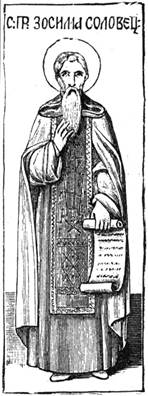
Великий светильник глубокого севера России, начальник общежития в стране сурового холода, преп. Зосима родился в Новгородской области, в селе Толвуе, на берегу озера Онежского221. Родители его Гавриил и Варвара, не богатые и не бедные, воспитали его в страхе Божием, обучив и грамоте. – Они желали, чтобы сын вступил в брачную жизнь; но он отказался, желая служить одному Господу. Исполняя это желание, удалился он из дома и стал жить наедине, отшельником, в посте и молитвах; приняв монашеское одеяние, он горел желанием жить монашески. Хотя чтение книг доставляло пищу душе его и озаряло ум сведениями о пути спасения, но он желал иметь руководителя в духовной жизни. В его время в родной стороне его принимавшие обет монашеский оставались жить среди мирских людей. Это не нравилось Зосиме: близость к родным и знакомым невольно нарушала покой отшельника. Скорбя о себе и других, он желал лучшего, желал видеть иноков собранными в общежитии и вдали от людей мирских. Когда родители его скончались, он отдал им последний долг, раздал имение их бедным и отправился на север искать желаемого безмолвия.
The great luminary of the deep north of Russia, the founder of the cenobitic life in the land of harsh cold, the Venerable Zosimas was born in the Novgorod region, in the village of Tolvuya, on the shore of Lake Onega221. His parents, Gabriel and Barbara, neither rich nor poor, raised him in the fear of God, also teaching him letters. They desired that their son should enter into married life; but he refused, wishing to serve the Lord alone. Fulfilling this desire, he withdrew from home and began to live alone, as a hermit, in fasting and prayers; having received the monastic habit, he burned with the desire to live as a monk. Although the reading of books provided food for his soul and illumined his mind with knowledge of the way of salvation, he wished to have a guide in the spiritual life. In his time, those in his native region who took the monastic vow remained living among worldly people. This displeased Zosimas: closeness to relatives and acquaintances involuntarily disturbed the hermit’s peace. Grieving for himself and for others, he desired something better, he wished to see monks gathered in a cenobitic community and far from worldly people. When his parents died, he paid them the last duty, distributed their property to the poor, and set out for the north to seek the desired silence.
На поморье, на устье р. Сумы, преп. Зосима нашёл инока Германа, который прежде того жил с пр. Савватием на Соловецком острове. Тот рассказал ему о житии пр. Савватия и о том, как удобен для безмолвной жизни Соловецкий остров. – Зосима обрадовался и просил Германа довести его до острова. – Герман охотно согласился, и в ладье отправились они по Белому морю на остров. Прибыв безбедно на желаемое место, пустынники ходили по острову с мыслью, где бы Бог благословил устроить обитель, и остановились не вдали от морского берега, на берегу озера с приятной водой. Они поставили себе кущи и провели ночь в молитве. Это было в 1436 году222. На утро пр. Зосима вышел из хижины и увидел над местом их необыкновенный свет и на воздухе церковь. – Незнакомый ещё с видениями, он ужаснулся и в страхе поспешил в кущу. Старец Герман, увидев изменившееся лицо его, понял, что он видел что-нибудь особенное, и спросил: «что случилось с тобой, брат мой? Ты видел что-то необыкновенное!» Зосима рассказал ему, что было. Старец рассказал ему в свою очередь, как ещё при Савватии прогнаны были с этого места мирские люди и как оно назначено было для пребывания иноков. – Обрадованный уверением небесным о назначении места, Зосима утвердился в намерении основать здесь обитель. Помолясь Господу, отшельники начали рубить деревья для сооружения кельи; днём они занимались работой, а ночь проводили в молитве. В исходе лета Герман отправился на Сумский берег, чтобы запастись хлебом, и надеялся возвратиться осенью. Но ветры и потом снег не дозволили ему пуститься в море, и он остался на зиму на сухом берегу. Зосима остался один, но возложил упование на Господа. Он удвоил молитвенные бдения свои. Ещё цела псалтирь с восследованием, по которой, как говорит св. Филипп в надписи, «правил правила сам Зосима чудотворец». Духи злобы стали тревожить отшельника разными призраками, домогаясь прогнать его с места. Зосима подвизался твёрдо. «Если дана вам, говорил он, власть надо мной, делайте, что хотите; если же нет, напрасно трудитесь». Призраки исчезли. Но стала грозить голодная смерть: скудный запас хлеба исчезал. Зосима скорбел, но обратился с молитвой к Господу о помощи. – И вот приходят к нему два человека с запасом хлеба, муки и масла и говорят: «возьми это и положи у себя; – если будешь иметь нужду, можешь употреблять в пищу до нашего возвращения». Зосима не успел спросить, кто они и как зимой попали на остров? Напрасно прождав их немалое время, он понял, что это – помощь от Господа, и возблагодарил Его. – Весной Герман привёз с собой запас хлеба и рыболова Марка с
On the Pomor coast, at the mouth of the River Suma, the Venerable Zosimas found the monk Herman, who had previously lived with the Venerable Sabbatius on Solovetsky Island. He told him about the life of the Venerable Sabbatius and how suitable Solovetsky Island was for a life of silence. Zosimas rejoiced and asked Herman to take him to the island. Herman willingly agreed, and they set out in a boat across the White Sea to the island. Having arrived safely at the desired place, the hermits walked about the island, pondering where God might bless them to establish a monastery, and they stopped not far from the seashore, on the shore of a lake with pleasant water. They set up shelters for themselves and spent the night in prayer. This was in the year 1436222. In the morning, the Venerable Zosimas came out of his hut and saw an extraordinary light over their place and a church in the air. Unaccustomed as yet to visions, he was terrified and hastened in fear to the shelter. The elder Herman, seeing his altered countenance, understood that he had seen something unusual, and asked: “What has happened to you, my brother? You have seen something extraordinary!” Zosimas told him what had occurred. The elder in turn told him how, even in Sabbatius’ time, worldly people had been driven from this place and how it had been appointed for the dwelling of monks. Reassured by the heavenly confirmation of the place’s destiny, Zosimas was strengthened in his intention to found a monastery there. Having prayed to the Lord, the hermits began to cut trees for the construction of a cell; by day they labored, and by night they spent in prayer. At the end of summer, Herman set out for the Suma coast to procure bread, hoping to return in autumn. But winds and later snow prevented him from putting out to sea, and he remained for the winter on the mainland. Zosimas was left alone, but he placed his hope in the Lord. He doubled his prayerful vigils. A Psalter with the Order of Services is still preserved, by which, as St. Philip says in an inscription, “Zosimas the Wonderworker himself recited the rule.” Spirits of malice began to trouble the hermit with various phantoms, striving to drive him from the place. Zosimas struggled steadfastly. “If power over me has been given to you,” he said, “do what you will; if not, you labor in vain.” The phantoms vanished. But death by starvation began to threaten: the meager supply of bread was dwindling. Zosimas grieved, but turned with prayer to the Lord for help. And behold, two men came to him with a supply of bread, flour, and oil and said: “Take this and put it by you; if you have need, you may use it for food until our return.” Zosimas did not have time to ask who they were and how they had come to the island in winter. Having waited for them in vain for a considerable time, he understood that this was help from the Lord, and he gave thanks to Him. In the spring, Herman brought with him a supply of bread and the fisherman Mark with
Имя твёрдого подвижника Соловецкого стало приходить в известность; начали являться к Зосиме с желанием делить с ним безмолвную жизнь. Преподобный принимал с любовью и радостью. На месте дивного видения построен был небольшой храм Преображения Господня и при нём трапеза. Послали одного в Новгород испросить благословение архипастыря и антиминс для нового храма. Святитель Евфимий, представив себе опасности со стороны диких Лопарей и со стороны суровой местности, усомнился на первый раз, достанет ли сил бороться с такими трудностями; но потом возблагодарил Господа за благодать Его, одушевившую таким мужеством рабов Его. Он послал игумена Павла с антиминсом для освящения храма и для управления новой обителью223. Преп. Зосима и Герман с радостью приняли благословение архипастыря; храм и обитель освящены. Так началась обитель Соловецкая! Для содержания своего братия рубили дрова, копали под огород землю, доставали из озёр соль. Последнюю по времени продавали они и для сторонних людей, которые стали ездить на остров; а взамен того покупали хлеб. – Приобретая трудами рук средства к жизни, иноки по наставлению и примеру Зосимы ревностно славили Бога в храме и довольны были малым. Но жадная зависть подняла войну против пустынников. Боярские люди являлись на остров и отнимали у иноков рыбную ловлю. «Это – отчина бояр наших», говорили они, тогда как дотоле никто не жил на острове. Лопари также жестоко обижали иноков. Эти нападения злости сильно тревожили Зосиму. Старец Герман успокаивал его: «нужны терпение и молитва», говорил он. Между тем игумен Павел недолго мог вытерпеть трудности жизни на суровом и глухом острове. После него были Феодосий и Иона, но ещё скорее возвратились в Новгород.
The name of the steadfast ascetic of Solovki began to become known; people began to come to Zosimas, desiring to share the life of silence with him. The Venerable One received them with love and joy. On the site of the wondrous vision, a small church of the Transfiguration of the Lord was built, and with it a refectory. They sent one of their number to Novgorod to ask the archpastor’s blessing and an antimension for the new church. Hierarch Euthymius, considering the dangers from the wild Lapps and from the harshness of the region, at first doubted whether they would have strength enough to struggle with such difficulties; but then he gave thanks to the Lord for His grace, which had inspired His servants with such courage. He sent Abbot Paul with an antimension for the consecration of the church and for the governance of the new monastery223. The Venerable Zosimas and Herman joyfully received the archpastor’s blessing; the church and monastery were consecrated. Thus began the Solovetsky Monastery! For their sustenance, the brethren cut firewood, dug the ground for a garden, and extracted salt from the lakes. The latter they sold to outsiders who began to travel to the island, and in exchange they bought bread. Gaining the means of life by the labor of their hands, the monks, according to the instruction and example of Zosimas, zealously glorified God in church and were content with little. But greedy envy raised war against the hermits. Boyars’ servants came to the island and took away the monks’ fishing grounds. “This is the patrimony of our boyars,” they said, though until then no one had lived on the island. The Lapps also grievously insulted the monks. These attacks of malice greatly troubled Zosimas. The elder Herman calmed him: “Patience and prayer are needed,” he said. Meanwhile, Abbot Paul could not long endure the difficulties of life on the harsh and desolate island. After him came Theodosius and Jonah, but they returned to Novgorod even more quickly.
Так как сторонние игумены не уживались на Соловецком острове, то братия положили избрать в игумена одного из среды себя. – Блажен. Зосима имел в виду брата Игнатия и предложил его; братия просили преп. Зосиму принять на себя сан игумена, но он никак не хотел для себя высокого звания. Братия пришли к Герману и сказали: «мы собрались сюда для подвижника Божия Зосимы, из нас никто не может быть игуменом; игумен должен быть тот, кому мы поручили сердца свои». Затем тайно отправили послав Новгород, чтобы архипастырь вызвал и посвятил в игумены Зосиму. Архипастырь согласился и, вызвав Зосиму, убедил его принять сан священства и игуменства. В Новгороде уже слышали о чудном подвижнике Соловецком и у нового игумена Соловецкого желали многие получить благословение в своих домах. Преп. игумену Зосиме дарили для обители церковную утварь и хлеб; другие вызывались помогать обители в возможных нуждах. У новой обители много было нужд, особенно надобно было оградить покой пустынников от своеволия людей боярских. Преподобный Зосима без сомнения просил о том знаменитых Новгорода. – Но в Новгороде происходили тогда, по милости Шемяки, сильные смуты, повлёкшие за собой войну с в. князем. Любитель пустыни не мог долго оставаться в Новгороде; он просил бывшего игумена своего Иону продолжать хлопоты о покое обители, а сам возвратился на остров, чтобы устроять душевное спасение своё и других224. – С радостью встретили братия своего игумена. И не одни иноки нетерпеливо ожидали его. На остров прибыли и благочестивые миряне принять благословение подвижника игумена. – На другой день пр. Зосима в первый раз совершал литургию в своей обители, и братия заметили, что лицо его сияло необыкновенным светом, а в храме ощущалось особенное благовоние. Это утешило братию и усилило доверенность к настоятелю. – Бывшим в то время купцам преподобный дал просфору. Но они по неосторожности потеряли её на дороге. Инок Макарий (бывший Марк) увидел пса, стоявшего над чем-то и напрасно покушавшегося схватить то, что лежало перед ним. Оказалось, что это была просфора, потерянная купцами. Можно представить себе, какие чувства возбудило это в купцах.
Since outside abbots did not settle on Solovetsky Island, the brethren resolved to choose an abbot from among themselves. The blessed Zosimas had in mind the brother Ignatius and proposed him; but the brethren asked the Venerable Zosimas to take upon himself the rank of abbot, though he by no means desired such a high office for himself. The brethren came to Herman and said: “We have gathered here for the sake of God’s ascetic Zosimas; none of us can be abbot; the abbot must be he to whom we have entrusted our hearts.” Then they secretly sent to Novgorod, so that the archpastor would summon and consecrate Zosimas as abbot. The archpastor agreed and, summoning Zosimas, persuaded him to accept the rank of priesthood and abbacy. In Novgorod they had already heard of the wondrous ascetic of Solovki, and many desired to receive the blessing of the new Solovetsky abbot in their homes. They gave the Venerable Abbot Zosimas church vessels and bread for the monastery; others offered to help the monastery in its possible needs. The new monastery had many needs, especially the need to protect the hermits’ peace from the willfulness of the boyars’ men. The Venerable Zosimas undoubtedly petitioned the famous men of Novgorod about this. But at that time, through the mercy of Shemyaka, great disturbances were taking place in Novgorod, which led to war with the Grand Prince. The lover of the desert could not long remain in Novgorod; he asked his former abbot Jonah to continue his efforts for the monastery’s peace, and himself returned to the island to arrange for the salvation of his own soul and that of others224. The brethren joyfully met their abbot. And it was not only the monks who awaited him impatiently. Pious laymen also arrived on the island to receive the blessing of the ascetic abbot. The next day, the Venerable Zosimas celebrated the Divine Liturgy in his monastery for the first time, and the brethren noticed that his face shone with an extraordinary light, and a special fragrance was felt in the church. This comforted the brethren and strengthened their trust in their superior. The Venerable One gave a prosphora to some merchants who were there at the time. But they carelessly lost it on the way. The monk Macarius (formerly Mark) saw a dog standing over something and vainly trying to seize what lay before it. It turned out to be the prosphora the merchants had lost. One can imagine what feelings this aroused in the merchants.
Преподобный с ревностью занялся устроением внутреннего быта обители. Постановив непременным правилом для неё общежитие, он внушил братии вести жизнь иноческую так, как заповедали великие отцы общежития: не желать и не искать ничего для себя, а заботиться об общем покое; в храме стоять со страхом Божиим, не сходить с места до конца службы, не разговаривать с другим; в трапезе сохранять молчание и внимать назидательному чтению. Поныне ещё известен устав его о жизни братии. «Игумен, говорится в нём, священники, старцы, вся братия едят и пьют в трапезе; кушанье для всех одинаково; по кельям, за исключением больных, нет стола; из трапезы не выносить кушанья и питья. Одежда и обувь выдаются из казны. Если кто может, покупает себе келью; иначе живут в кельях обители. Дохода нет никакого ни священникам и братии, ни служащим в монастыре и за монастырём: всё нужное для каждого выдаётся из казны225.
The Venerable One zealously set about arranging the internal life of the monastery. Having established the cenobitic rule as an inviolable principle for it, he instructed the brethren to lead the monastic life as the great fathers of the cenobium had commanded: to desire and seek nothing for oneself, but to care for the common peace; to stand in church with the fear of God, not to leave one’s place until the end of the service, not to converse with another; to keep silence in the refectory and attend to the edifying reading. His rule for the life of the brethren is still known. “The abbot,” it says, “the priests, the elders, and all the brethren eat and drink in the refectory; the food is the same for all; there is no table in the cells, except for the sick; food and drink are not to be taken out of the refectory. Clothing and footwear are issued from the treasury. If anyone is able, he buys his own cell; otherwise they live in the monastery’s cells. There is no income whatsoever for the priests and brethren, nor for those serving in the monastery and outside it: everything necessary for each is issued from the treasury225.
Так как начальный храм, при умножении братии, стал тесен, то преподобный начал строить новый. Но лишь началась постройка, как пожар испепелил её. Преподобный не смутился и велел скоро начинать обширный храм. Построили храм в честь Преображения Господня с приделом свят. Николая, потом братскую трапезу и при ней храм в честь Успения Богоматери, далее кельи и службы; все постройки были деревянные. К общей духовной радости храмы были освящены, и явились новые ревнители пустынного общежития.
Since the original church, with the increase of the brethren, became cramped, the Venerable One began to build a new one. But no sooner had construction begun than a fire consumed it. The Venerable One was not dismayed and ordered them to begin a spacious church quickly. They built a church in honor of the Transfiguration of the Lord with a side-chapel of St. Nicholas, then a fraternal refectory and with it a church in honor of the Dormition of the Mother of God, and then cells and outbuildings; all the structures were wooden. To the common spiritual joy, the churches were consecrated, and new zealots of the desert cenobium appeared.
Бог благословлял обитель по молитвам преподобного. Бывший игумен Иона получил одну за другой грамоты для Соловецкой обители. – Владычная грамота замечательна и по историческому значению лица, кем дана она. «Вот я Марфа, жена Исаака Андреевича, и сын мой Феодор Исаакович дали в дом св. Спаса и Пречистой Матери Его и св. Николая, что на Соловках, игумену Ионе и старцам, на море при р. Суме у часовни два лука земли, где живут Парфений и Порфирий, и на той земле давнюю деревню, пожни, лес, рыбные ловли и солёные озера; эти два лука отдаются в дом св. Спаса и Пречистой Матери Его и св. Николая; ими владеть будут по этой грамоте игумен и старцы во веки. А поминать им мужа моего Исаака, родителей и детей моих, поставлять обед в Димитриев день»226. Другая грамота более важна. Этой грамотой, за печатями архиепископа Ионы, посадника, тысяцкого и пяти концев Новгорода, предоставлялось обители владеть Соловецким островом со всеми его угодьями, заливами, озёрами, ближними островками227.
God blessed the monastery through the prayers of the Venerable One. The former abbot Jonah obtained one charter after another for the Solovetsky Monastery. The vladyka’s charter is remarkable also for the historical significance of the person by whom it was given. “Behold, I, Martha, wife of Isaac Andreevich, and my son Theodore Isaakovich have given to the house of the Holy Savior and His Most Pure Mother and St. Nicholas, which is on Solovki, to Abbot Jonah and the elders, on the sea at the Suma River near the chapel, two measures of land, where Parfenius and Porphyrius live, and on that land an ancient village, hayfields, forest, fishing grounds, and salt lakes; these two measures are given to the house of the Holy Savior and His Most Pure Mother and St. Nicholas; the abbot and elders shall possess them forever according to this charter. And they are to commemorate my husband Isaac, my parents and children, and to serve a memorial meal on St. Demetrius’ day”226. Another charter was more important. By this charter, sealed by Archbishop Jonah, the posadnik, the tysyatsky, and the five districts of Novgorod, the monastery was granted possession of Solovetsky Island with all its lands, bays, lakes, and nearby islets227.
Слух о высокой духовной жизни пр. Зосимы привлекал на остров ревнителей вечного спасения со всех сторон. Приходили священники, диаконы, причетники, иноки, желая жить с преподобным и пользоваться наставлениями его; старец принимал их с любовью. – Даже Лопари и Чудь, даже Норвежцы приходили к пр. Зосиме и поучались душевному спасению. Мало зная язык Русский, они слушали язык сердца чистого, которое без слов говорит сердцам о Боге и вечности228. – Мы видим этих учеников Зосимы по их собственной грамоте, писанной при преемнике Зосимы, – «Я Феодор Иванович, воевода Каянского войска, так говорит грамота, и под-воеводы Елевферий и Феодор, Новгородцы и дети Карельские, Вымольцы и Тиврульцы и все Каянское войско, дали колокол св. Спасу на Соловки, игумену Арсению, священникам и старцам монастыря Соловецкого на веки»229.
The fame of the lofty spiritual life of the Venerable Zosima drew zealots of eternal salvation to the island from all sides. Priests, deacons, chanters, and monks came, desiring to live with the Venerable One and to benefit from his instructions; the elder received them with love. Even the Lapps and the Chud, even the Norwegians came to the Venerable Zosima and were taught concerning the salvation of the soul. Though they knew little of the Russian tongue, they hearkened to the language of a pure heart, which speaks without words to hearts of God and eternity228. We see these disciples of Zosima from their own charter, written under the successor of Zosima: “I, Theodore Ivanovich, voivode of the Kayan army,” so the charter reads, “and the sub-voivodes Eleutherius and Theodore, Novgorodians and Karelian children, Vymoltsy and Tivrul’tsy and all the Kayan army, have given a bell to the Holy Savior on Solovki, to Abbot Arsenius, the priests and elders of the Solovetsky Monastery, forever”229.
В 1465 г. преп. Зосима перенёс мощи преп. Савватия с р. Выги в свою обитель. Это было и утешением, и уроком для обители. Преподобный наставник поставил перед взором учеников своих пример строгой жизни, пример не дальнего востока, а родного своего севера. Прославленный подвижник Соловецкий одушевлял мужеством последователей его230.
In the year 1465, the Venerable Zosima translated the relics of the Venerable Sabbatius from the River Vyg to his monastery. This was both a consolation and a lesson for the monastery. The venerable instructor set before the eyes of his disciples an example of strict life, an example not from the distant East, but from their own native North. The glorified Solovetsky ascetic inspired his followers with courage230.
Преп. Зосима неутомимыми подвигами поста и молитвы сам уже достиг высокого совершенства. – Но люди мира грешного не переставали делать по временам оскорбления Соловецким инокам. Преподобный отправился в Новгород ходатайствовать за обитель. Это было при архиепископе Феофиле. «Часто приходят к нам боярские дети, говорил игумен владыке, и много делают оскорблений, не позволяя ловить рыбу и угрожая даже совсем выгнать нас из нашей пустыни: заступись за нас». Владыка обещал помощь. Старец обратился с просьбой и к Новгородским боярам. Боярыня Марфа, вдова посадника, была тогда лицом сильным в Новгороде. К ней более, чем к кому-нибудь, нужно было обратиться с просьбой, потому что жившие на её землях, близких к острову, более чем кто-нибудь, делали оскорбления послушникам обители. Преподобный явился к ней. Гордая боярыня, возмущённая своими слугами, сочла за оскорбление себе жалобы иноков и приказала выгнать Зосиму из её дома. И Преподобный спокойно перенёс оскорбление и сказал со вздохом ученикам: «настают дни, когда обитатели сего дома не станут ходить в нём, затворятся двери его и более не отворятся, дом их будет пустым». – Прочие бояре почтительно принимали преподобного, у кого только он был. – Марфа почувствовала затем вину свою и пригласила к себе св. старца. Встретив его с детьми своими, просила она простить её вину перед ним и обителью. – Она вручила ему новую вкладную и грамоту на землю и рыбные ловли231. – За обедом, к которому приглашено было несколько бояр, Зосима сидел молча и по обыкновению мало кушал. Взглянув на сидевших с ним, он увидел, что шестеро из бояр сидят без голов; в другой и третий раз смотрел он на всех, и видел одно и тоже. Слёзы жалости потекли из глаз его, и он уже более не касался пищи. Ученик его Даниил, когда вышли они из дома боярыни, спросил его: что значит, отче! Что во время стола три раза смотрел ты на сидевших и потом с поникшим лицом плакал? Св. старец открыл ученику, что видел он, и не велел говорить о том до времени другим. За обедом у Марфы был вместе с другими Богобоязненный боярин Памфил; на следующий день пригласил он преподобного к своей трапезе; по его усиленной просьбе святой открыл и ему своё видение, под тем же условием; Памфил впоследствии был Соловецким иноком Пахомием. Преподобный возвратился в обитель. Пророчество и видение его скоро исполнились. В 1471 г. вел. князь вынужден был смирять оружием Новгород, возмущённый страстями Марфы и других. Дмитрий Исаков, сын Марфы, Василий Селезнев – Губа, Киприан Арбузеев, Иеремия Сухощек и двое других, как главные бунтовщики, были казнены. Это те, которых видел св. Зосима без головы. Боярыня Марфа с сыном Феодором и дочерями заточены в Нижний Новгород, и сбылись слова преподобного о запустении дома Марфы232.
The Venerable Zosima, by his unwearying labors of fasting and prayer, had himself already attained high perfection. But the people of the sinful world did not cease from time to time to offer insults to the Solovetsky monks. The Venerable One set out for Novgorod to intercede for the monastery. This was under Archbishop Theophilus. “Often do the boyars’ children come to us,” said the abbot to the vladyka, “and they do us many injuries, forbidding us to fish and even threatening to drive us entirely from our hermitage: intercede for us.” The vladyka promised help. The elder also turned with a petition to the Novgorod boyars. The boyarina Martha, widow of the posadnik, was at that time a powerful person in Novgorod. To her more than to anyone else it was necessary to turn with a petition, because those living on her lands, near the island, more than anyone else, offered insults to the novices of the monastery. The Venerable One appeared before her. The proud boyarina, incited by her servants, considered the monks’ complaints an insult to herself and ordered Zosima to be driven from her house. And the Venerable One calmly bore the insult and said with a sigh to his disciples: “The days are coming when the inhabitants of this house shall no longer walk in it, its doors shall be shut and shall not be opened again, their house shall be empty.” The other boyars received the Venerable One with respect, wherever he went. Martha then felt her guilt and invited the holy elder to her. Meeting him with her children, she asked him to forgive her guilt before him and the monastery. She gave him a new deed of gift and a charter for land and fishing rights231. At dinner, to which several boyars were invited, Zosima sat in silence and, as was his custom, ate little. Glancing at those sitting with him, he saw that six of the boyars were sitting without heads; a second and a third time he looked at them all, and saw the same thing. Tears of pity flowed from his eyes, and he no longer touched the food. His disciple Daniel, when they had left the boyarina’s house, asked him: “What does this mean, father? That during the meal you looked three times at those sitting there and then wept with downcast face?” The holy elder revealed to the disciple what he had seen, and commanded him not to speak of it to others until the time. At Martha’s dinner there was, together with others, the God-fearing boyar Pamphilus; the next day he invited the Venerable One to his table; at his earnest request, the saint revealed his vision to him as well, under the same condition; Pamphilus later became the Solovetsky monk Pachomius. The Venerable One returned to the monastery. His prophecy and vision were soon fulfilled. In 1471, the Grand Prince was compelled to subdue Novgorod by arms, stirred up by the passions of Martha and others. Demetrius Isakov, Martha’s son, Basil Seleznev-Guba, Cyprian Arbuzeev, Jeremiah Sukhoshchek, and two others, as chief rebels, were executed. These were those whom St. Zosima had seen without heads. The boyarina Martha, with her son Theodore and her daughters, was imprisoned in Nizhny Novgorod, and the words of the Venerable One concerning the desolation of Martha’s house came to pass232.
Под. руководством великого аввы образовались крепкие подвижники благочестия. Таковы были свещеносец и ученик его Иоанн, Василий ученик, Онуфрий ученик и пустынник, Герасим ученик и отшельник233.
Under the guidance of the great abba, strong ascetics of piety were formed. Such were the torch-bearer and his disciple John, Basil the disciple, Onuphrius the disciple and hermit, Gerasimus the disciple and recluse233.
Преподобный Зосима всегда помнил о смерти и суде Божием; а дожив до глубокой старости, приготовил он себе гроб и оплакивал себя как мертвеца, смотря на гроб. Убелённый сединами, чувствуя близость кончины, созвал он братию и сказал: «дети, я иду в путь отцов, изберите себе наставника». – Они зарыдали о разлуке с ним. «Не плачьте, сказал преподобный, поручаю вас милостивому Спасителю и Матери Божией». Братия с скорбью объявили, что только он, наставник их, может назначить им вместо себя наставника. Преподобный указал на Арсения и, обратясь к последнему, сказал: «ты строитель и питатель обители сей; смотри, чтобы сохранялось всё установленное по храму и трапезе и соблюдался чин, введённый смирением моим. Заповедую ученикам моим соблюдать устав киновии; опьяняющее питье и женские лица не должны быть на этом острову; даже и дающия млеко животные не должны быть здесь. Телесно разлучаюсь я с вами, но духом с вами пребывать буду». Сказав последнее: мир всем, осенил себя крестным знамением и предал душу свою Господу 17 апр. 1478 г.
The Venerable Zosima always remembered death and the judgment of God; and having lived to a deep old age, he prepared a coffin for himself and wept over himself as over a dead man, looking upon the coffin. White-haired, feeling the nearness of his end, he called the brethren together and said: “Children, I am going the way of the fathers; choose for yourselves a teacher.” They wept at the thought of parting from him. “Weep not,” said the Venerable One, “I entrust you to the merciful Savior and the Mother of God.” The brethren sorrowfully declared that only he, their teacher, could appoint a teacher in his place. The Venerable One pointed to Arsenius and, turning to him, said: “You are the builder and nourisher of this monastery; see that everything established concerning the church and the refectory is preserved, and that the order introduced by my humility is kept. I command my disciples to keep the rule of the cenobitic life; intoxicating drink and female faces shall not be on this island; even milk-giving animals shall not be here. In body I part from you, but in spirit I shall abide with you.” Having said the last words: “Peace to all,” he made the sign of the cross over himself and gave up his soul to the Lord on April 17, 1478.
Скоро ученики преподобного уверились, что авва их с ними и Господь принял его как своего. Ученик его Герасим, придя в монастырь из пустыни, где подвизался отшельником, шёл помолиться над гробницей преп. Савватия и встретил преп. Зосиму, который сказал ему: «подвизайся, чтобы получить награду за труды». В великий четверток, когда братия подходили приобщаться св. Таин, преп. Зосима сказал Герасиму: «иди и ты, приобщись» и за тем стоял у св. Таин, пока все приобщились. Другой ученик Досифей, который был потом игуменом, молился за болящего брата; явившийся преподобный сказал: «не полезно для тебя просить о брате; он ещё останется в болезни».
Soon the disciples of the Venerable One were assured that their abba was with them and that the Lord had received him as His own. His disciple Gerasimus, coming to the monastery from the hermitage where he had struggled as a recluse, went to pray at the tomb of the Venerable Sabbatius and met the Venerable Zosima, who said to him: “Strive, that you may receive the reward for your labors.” On Great Thursday, when the brethren were approaching to receive the Holy Mysteries, the Venerable Zosima said to Gerasimus: “Go, and you also, commune,” and then stood by the Holy Mysteries until all had communed. Another disciple, Dositheus, who later became abbot, was praying for a sick brother; the Venerable One appeared and said: “It is not profitable for you to pray for that brother; he shall yet remain in his illness.”
Пловцы Белого моря много раз испытывали дивную помощь в страшных опасностях, когда призывали на помощь преподобного Зосиму. Больные разного рода получали исцеление и в обители и вдали от обители, когда просили о том угодившего Господу Зосиму.
Sailors of the White Sea many times experienced wondrous help in terrible dangers when they called upon the Venerable Zosima for aid. The sick of various kinds received healing both in the monastery and far from the monastery, when they asked Zosima, who had pleased the Lord, for it.
Молодая женщина, дочь Иеремии, бывшего служителем преподобного Зосимы, в сумасшествии изрезала себе ножом грудь и горло. Родители с горькими слезами молились о ней Зосиме. В следующую ночь явились ей преп. Зосима и Савватий и, подавая сосуд с мастью, сказали: помажь этим раны, – для слёзной молитвы родителей пришли мы исцелить тебя. Она, как казалось ей, помазала раны и пробудилась, быв дотоле мёртвой, а через три дня стала совсем здоровой.
A young woman, the daughter of Jeremiah, who had been a servant of the Venerable Zosima, in a fit of madness cut her chest and throat with a knife. Her parents, with bitter tears, prayed to Zosima for her. The following night the Venerable Zosima and Sabbatius appeared to her and, handing her a vessel with ointment, said: “Anoint these wounds with this; for the tearful prayer of your parents we have come to heal you.” She, as it seemed to her, anointed the wounds and awoke, having been as dead until then, and after three days became completely well.
Житель наволока Унежмы Никон, тогда как два кудесника ссорились между собой, услужил одному из них. Другой, озлясь, стал «бить в кудесы», бить в барабан с заклинаниями; испуганный Никон стал болен. В тревоге мыслей послал он сына за помощью к кудеснику, которому услужил, но пользы не было. Соловецкий старец, случившийся в наволоке, придя к больному, вразумлял его в греховности доверия его к кудесникам и убедил его обратиться с молитвою к преп. Зосиме и Савватию. Тот послушался и выздоровел. – Преподобные, как видно по многим опытам, ревновали ослаблять силу кудесников в народе и наводили простые сердца на лучшие мысли. – Вот замечательный опыт и тому. Церковный дьяк с. Шуи Онисим был человек набожный, Жена его Мария исцелена была Зосимой в обители. Потом сам он впал в болезнь («еже френчуг наречется»). Общее доверие к кудесникам так было сильно, что и добрый Онисим призвал к себе кудесника. Когда сидели они за столом, кудесник вдруг стал кричать страшно; а Мария, жена Онисима, видит Зосиму, Савватия и ещё старца Иоанна, ученика Зосимина; Зосима жезлом бьёт кудесника и говорит: «за чем ты пришёл сюда? Не след тебе приходить к рабу Божию». Преподобный помазал больного кистью из сосуда по главе и лицу. Онисим почувствовал облегчение, но стал сильно скорбеть, что допустил тяжкий грех, – призывал кудесника и тем оскорбил Зосиму и Савватия. Явившийся Зосима сказал: не унывай, Онисим, читай или слушай псалтирь и будешь совсем здоров.
A dweller of the cape of Unezhma, Nikon, while two sorcerers were quarreling with each other, rendered service to one of them. The other, enraged, began “to beat the sorcerer’s drum,” to beat a drum with incantations; frightened, Nikon fell ill. In the turmoil of his thoughts, he sent his son for help to the sorcerer he had served, but there was no benefit. A Solovetsky elder, who happened to be at the cape, coming to the sick man, admonished him concerning the sinfulness of his trust in sorcerers and persuaded him to turn with prayer to the Venerable Zosima and Sabbatius. He heeded and recovered. The Venerable Ones, as is evident from many experiences, were zealous to weaken the power of sorcerers among the people and to lead simple hearts to better thoughts. Here is a remarkable instance of this as well. The church clerk of the village of Shuya, Onesimus, was a pious man. His wife Mary was healed by Zosima in the monastery. Later he himself fell into an illness (“called frenzied”). The general trust in sorcerers was so strong that even the good Onesimus summoned a sorcerer to himself. When they were sitting at table, the sorcerer suddenly began to cry out terribly; and Mary, the wife of Onesimus, saw Zosima, Sabbatius, and another elder John, a disciple of Zosima; Zosima struck the sorcerer with his staff and said: “Why have you come here? It is not fitting for you to come to the servant of God.” The Venerable One anointed the sick man with a brush from a vessel on his head and face. Onesimus felt relief, but began to grieve greatly that he had committed a grievous sin—he had summoned a sorcerer and thereby offended Zosima and Sabbatius. The appearing Zosima said: “Do not despair, Onesimus; read or listen to the Psalter, and you shall be completely well.”
В 1547 г. собором предписано чтить во всех церквах память преп. Зосимы и написана служба ему; а в 1566 г. авг. 8 мощи его перенесены в придел соборного храма, посвящённый преп. Зосиме и Савватию234.
In 1547, a Council decreed that the memory of the Venerable Zosima be honored in all churches, and a service was written for him; and in 1566, on August 8, his relics were translated into a side-chapel of the cathedral church, dedicated to the Venerable Zosima and Sabbatius234.
Постоянно обуреваемые бедами и страстями, прибегаем к тебе, преп. Зосима, и молим быть молитвенником за нас пред Богом. Посещай милостиво, отче наш, да тобою спасаемые поём: благословен Бог отцов наших»235.
Constantly tossed by troubles and passions, we flee to you, Venerable Zosima, and pray that you be an intercessor for us before God. Visit us mercifully, O our father, that, saved by you, we may sing: “Blessed is the God of our fathers”235.
Жил в V веке, был членом Ефесского собора, на котором он был обличителем ереси Нестория. Преподобный Акакий оказал великую услугу Церкви тем, что в это время волнений и споров, возникавших по поводу различных Богословских вопросов и еретических учений, он защищал православие и содействовал примирению между пастырями.
He lived in the fifth century and was a member of the Council of Ephesus, at which he was an accuser of the heresy of Nestorius. The Venerable Acacius rendered a great service to the Church in that, at a time of disturbances and disputes arising over various theological questions and heretical teachings, he defended Orthodoxy and promoted reconciliation among the pastors.
Преп. Акакий ещё при жизни был прославлен от Бога даром чудотворений, посредством которых многие язычники были обращены к истинному Богу. Между прочими чудесами повествуется о том, как однажды в церкви Божией Матери, построенной преп. Акакием на месте разорённого им идольского капища, в ту минуту как непрочно устроенный свод готов был обрушиться во внутренность церкви и народ, присутствовавший при Богослужении, с ужасом устремился к выходу, святитель Акакий воскликнул:
The Venerable Acacius, even during his lifetime, was glorified by God with the gift of wonderworking, through which many pagans were converted to the true God. Among other miracles, it is related how once, in the church of the Mother of God built by the Venerable Acacius on the site of a pagan temple he had destroyed, at the very moment when an unsteady vault was about to collapse into the interior of the church and the people present at the divine service rushed in terror toward the exit, Hierarch Acacius cried out:
«Господь – защитник жизни моей! Кого убоюся?» – и свод, готовый упасть, продержался в воздухе, пока служба не кончилась, и святитель с народом невредимо вышли из церкви, вслед за этим свод разрушился...
“The Lord is the defender of my life! Of whom shall I be afraid?” — and the vault, ready to fall, remained suspended in the air until the service ended, and the Hierarch with the people came forth unharmed from the church; immediately thereafter the vault collapsed...
Источники: а) житие пр. Зосимы и Савватия, описанное учеником Зосимы, игуменомДосифеем, и поправленное в изложении м. Спиридоном († 1503 г.), известное по минее м. Макария и спискам: с немногими переменами оно в минее св. Димитрия под 17 апр., а сокращённо в прологе. „Написано спустя 30 лет после преставления блаженного отца игумена Зосимы“, говорит Досифей, след. в 1508 г. б) Серба Льва Филолога, пересмотренное иноком Зиновием, слово на память пр. Зосимы, напеч. в Правосл. Собеседнике. К. 1859 г., ч. 2. Оно повторяет Досифея, но по местам поясняет не ясное у Досифея.
Sources: a) The Life of the Venerable Zosimas and Sabbatius, written by Zosimas’ disciple, Abbot Dositheus, and corrected in its composition by Metropolitan Spyridon († 1503), known from the Menaion of Metropolitan Macarius and from manuscripts: with few changes it appears in the Menaion of St. Demetrius under April 17, and in abbreviated form in the Prologue. “Written thirty years after the repose of the blessed father Abbot Zosimas,” says Dositheus, therefore in 1508. b) A discourse by the Serb Leo the Philologist, revised by the monk Zinovy, in memory of the Venerable Zosimas, printed in Pravoslavny Sobesednik, Kazan, 1859, part 2. It repeats Dositheus, but in places clarifies what is obscure in Dositheus.
По словам Досифея, архиепископ, которым послан игумен Павел, был св. Иона; но это непримиримо с историей св. Зосимы и с жизнью св. Ионы. – Св. Иона только с 1458 г. архиепископ (см. нояб. 8 д.). Даже и посвящение Зосимы в игумена, если оно происходило в 1452 году, как говорит Соловецкая летопись, совершено не св. Ионой, а св. Евфимием. – Так несомненно, что основание обители совершилось при св. Евфимии (1429–1457 г.). Неточности в повествовании Дорофея – естественны: он пришёл в обитель на последнем году жизни преп. Зосимы и писал не в XIX в.
According to Dositheus, the archbishop by whom Abbot Paul was sent was St. Jonah; but this is irreconcilable with the history of St. Zosimas and with the life of St. Jonah. — St. Jonah became archbishop only in 1458 (see November 8). Even the consecration of Zosimas as abbot, if it took place in 1452, as the Solovki Chronicle says, was performed not by St. Jonah but by St. Euthymius. — Thus it is certain that the foundation of the monastery occurred under St. Euthymius (1429–1457). Inaccuracies in Dositheus’ narrative are natural: he came to the monastery in the last year of the life of the Venerable Zosimas and did not write in the 19th century.
Грамота о предоставлении всего Соловецкого острова обители Соловецкой не могла быть написана раньше 1458 г., с которого начал управлять Новгородскою паствой св. Иона, подписавшийся на ней. Но она же по спискам считается грамотой чудотворца Зосимы (описание Соловец. монаст., стр. 59). Последнее конечно означает участие преподобного в получении её у Новгорода. Так примиряется показание памятников обители с верной хронологией. О смутах Новгородских см. в житии свят. Евфимия марта 11 дня.
The charter granting the entire Solovetsky Island to the Solovki Monastery could not have been written before 1458, when St. Jonah, who signed it, began to govern the Novgorod flock. Yet according to the manuscripts it is considered a charter of the Wonderworker Zosimas (Description of the Solovki Monastery, p. 59). The latter, of course, indicates the Venerable One’s involvement in obtaining it from Novgorod. Thus the testimony of the monastery’s records is reconciled with accurate chronology. On the Novgorod disturbances, see the Life of St. Euthymius, March 11.
Изд. в опис. монаст., стр. 47. М. 1836 г. Год грамоты не означен: но она дана уже тогда, как при трапезе построен храм Богоматери, чего не было до игуменства Зосимы. Лука по старинному измерению содержала две обжи, а обжа в длину 126 и в ширину 32 сажени.
Published in the Description of the Monastery, p. 47. Moscow, 1836. The year of the charter is not indicated; but it was given after a church of the Mother of God had been built at the refectory, which did not exist before Zosimas’ abbacy. A luka by the old measurement contained two obzhas, and an obzha was 126 sazhens in length and 32 sazhens in width.
Грам. изд. в Ист. Иер. 2, 386–389. Точнее в описании Соловецкого монаст. 48–51. О времени её – выше прим. 206.
Charter published in History of the Hierarchy 2, 386–389. More precisely in the Description of the Solovki Monastery, pp. 48–51. On its date — see above, note 206.
Они поставлены в числе святых в ркп. описании святых. В описании одного чуда преп. Зосимы современник чуда, сказав, что вместе с Зосимой и Савватием явился старец Иоанн, продолжает: „той же Иоанн всеми знаем бе, Соловецкий постриженик и жилец; мнози о нем свидетельствуют, яко великий подвижник бысть в монастыри, – пустынное бо отхождение и жительство любя, всяким послушанием и смирением и кротостью украшен; много же и монастырю поработа в рыбной ловитве“.
They are numbered among the saints in a manuscript description of the saints. In the account of one miracle of the Venerable Zosimas, a contemporary of the miracle, having said that together with Zosimas and Sabbatius the elder John appeared, continues: “This John was known to all, a Solovki tonsured monk and dweller; many testify of him that he was a great ascetic in the monastery — for he loved the solitary withdrawal and life in the wilderness, adorned with every obedience, humility, and meekness; and he labored much for the monastery in fishing.”