Евтихий, архимандрит монастыря Амасийской митрополии, послан был вместо себя Амасийским митрополитом для участия в деяниях предположенного Пятого Вселенского Собора, и весьма дружелюбно принят был патр. Миною и Имп. Юстинианом. Когда же патриарх умер до открытия собора, то Евтихий (в авг. 552) призван был занять Конст. престол на сороковом году своей жизни, и председательствовал на Вселенском Соборе, осудившем продолжателей ереси Несторианской.
Eutychius, archimandrite of a monastery of the Metropolis of Amasea, was sent in place of the Metropolitan of Amasea to participate in the proceedings of the proposed Fifth Ecumenical Council, and was received most cordially by Patriarch Menas and Emperor Justinian. When the patriarch died before the opening of the council, Eutychius (in August 552) was summoned to occupy the throne of Constantinople in the fortieth year of his life, and presided over the Ecumenical Council which condemned the continuators of the Nestorian heresy.
Под конец жизни своей Юстиниан увлёкся заблуждением одной из монофизитских сект, будто тело Христово было нетленное и, следовательно, не могло подвергаться страданиям. Когда же патр. Евтихий обличил такое лжеучение и показал, что в таком случае и вся земная жизнь Христова была бы призрачной, то в январе 565 года был сослан в Амасию, в прежний свой монастырь. Жил он тут в посте и молитвах и приобрёл общую любовь благотворительностью, творя много исцелений благодатью Христовой. Через двенадцать лет имп. Тиверий возвратил его на престол. Жители столицы приняли его (2-го окт., в субботу) с необычайным торжеством: его посадили на ослицу, окружили с пальмовыми ветвями и устилали путь одеждами; всю ночь город был освещён. В воскресенье, 3 октября, он совершал литургию в Софийском храме и желавших приобщиться из его рук было так много, что приобщение продолжалось три часа. Святитель патриаршествовал вторично четыре года и шесть месяцев и скончался в 582 году. – Во время господства Латинян в Константинополе мощи его (в 1246 г.) увезены в Венецию.
Toward the end of his life, Justinian was carried away by the error of one of the Monophysite sects, that the body of Christ was incorruptible and therefore could not have been subject to suffering. When Patriarch Eutychius denounced this false teaching and showed that in such a case the entire earthly life of Christ would have been illusory, he was exiled in January 565 to Amasea, to his former monastery. He lived there in fasting and prayer and won universal love through his charity, working many healings by the grace of Christ. After twelve years, Emperor Tiberius restored him to the throne. The inhabitants of the capital received him (on October 2, a Saturday) with extraordinary triumph: they seated him on a donkey, surrounded him with palm branches, and strewed garments in his path; the city was illuminated all night. On Sunday, October 3, he celebrated the Divine Liturgy in the Church of Hagia Sophia, and those who wished to receive Communion from his hands were so numerous that Communion continued for three hours. The Hierarch held the patriarchate a second time for four years and six months, and reposed in the year 582. – During the dominion of the Latins in Constantinople, his relics (in 1246) were taken to Venice.
Во второй Сирии, иначе в Месопотамии, отшельническая жизнь явилась рано. В горах, соседних с Низибией, называемых Синьджар (у Греков Сигорон), пещеры служили жилищами для отшельников и отшельниц35. К числу подвижников принадлежал св. Иаков, епископ Низибийский (314–350 г.), известный как подвигами отшельничества, так великим даром учения. Он уже писал наставления «чадам обета» и «о девстве»36. Древнейший из мужеских монастырей Низибии находился под управлением пр. Маркелла в 300 г. В то же время тут же была община 50 девственниц.
In Second Syria, otherwise called Mesopotamia, the hermitic life appeared early. In the mountains neighboring Nisibis, called Sinjar (by the Greeks, Sigoron), caves served as dwellings for hermits and female hermits35. Among the ascetics was St. James, Bishop of Nisibis (314–350), known both for his hermitic labors and for his great gift of teaching. He already wrote instructions "to the children of the vow" and "on virginity"36. The most ancient of the men's monasteries of Nisibis was under the direction of the Venerable Marcellus in the year 300. At the same time, there was also a community of fifty virgins there.
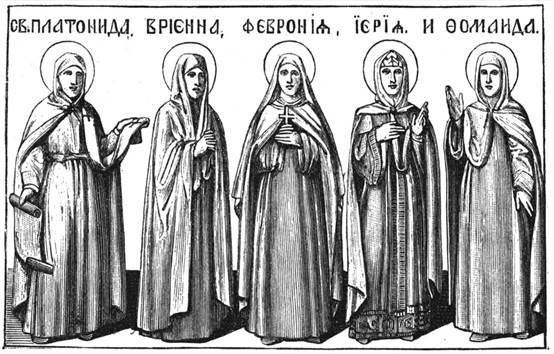
Основательницей Низибийской общины дев была диаконисса Платонида, и она же была для неё примером Богоугодной жизни. Церковная надпись говорит о ней:
The foundress of the Nisibian community of virgins was the deaconess Platonida, and she was also an example of a God-pleasing life for it. An ecclesiastical inscription says of her:
Платонида прославилась обителью своею. Устав её был особенный и замечательный. Сёстры принимали пищу раз в день. В пятницу они не должны были заниматься рукоделиями, а с утра до вечера не выходили из дома молитвы; после молитв и пения читалось и объяснялось св. Писание38. В Сирской Церкви долго и после того сохранялась любовь к разумению св. Писания. Известно, как много св. Ефрем Сирский занимался объяснением св. Писания. Он же усилил в общинах дев пение св. песней39. Так уставила св. Платонида и для своей общины.
Platonida was glorified by her monastery. Her rule was distinctive and remarkable. The sisters took food once a day. On Friday they were not to occupy themselves with handiwork, but from morning until evening they did not leave the house of prayer; after prayers and singing, Holy Scripture was read and explained38. In the Syrian Church, love for the understanding of Holy Scripture was preserved long afterward. It is known how much St. Ephraim the Syrian labored in explaining Holy Scripture. He also intensified the singing of sacred hymns in the communities of virgins39. Thus did St. Platonida also establish for her community.
По правилам её образовались высокие подвижницы Вриенна, Фомаида, Иерия. Самый же великолепный цветок в этом саду Божием была св. дева Феврония40.
According to her rules, the exalted ascetics Bryenna, Thomais, and Hieria were formed. But the most magnificent flower in this garden of God was the holy virgin Febronia40.
Феврония с детства жила в блаженной общине. Она на третьем году жизни отдана была тётке своей блаж. Вриенне, и та надзирала за ней со всей нежной любовью. Красота Февронии была поразительная ещё в детском возрасте. Вриенна принимала все меры для сохранения цветка своего. Едва девочка достигла возраста, допускавшего воздержание, ей приказано было принимать пищу через день. Входя в благочестивые мысли тётки своей и замечая, что здоровье нисколько не страдает от поста, Феврония скоро стала употреблять самое малое количество хлеба и воды. К этому она присоединила жизнь самую тесную: спала на узкой и короткой доске; если тревожили ночью мечты, вставала и читала св. Писание или становилась на молитву.
Febronia lived in the blessed community from childhood. At the third year of her life she was given to her aunt, the blessed Bryenna, and she watched over her with all tender love. Febronia's beauty was striking even in childhood. Bryenna took every measure to preserve her flower. As soon as the girl reached an age permitting abstinence, she was ordered to take food every other day. Entering into the pious thoughts of her aunt and noticing that her health suffered not at all from fasting, Febronia soon began to consume the smallest amount of bread and water. To this she added a most confined life: she slept on a narrow and short board; if dreams troubled her at night, she would rise and read Holy Scripture or stand at prayer.
Когда по смерти Платониды Вриенна стала настоятельницей общины, Февронии приказано было читать по пятницам св. Писание. поскольку же из города собиралось много посетительниц слушать слово Божие, то Феврония читала за занавесью, чтобы скрыть свою красоту даже и от особ своего пола.
When, after the death of Platonida, Bryenna became the abbess of the community, Febronia was ordered to read Holy Scripture on Fridays. Since many visitors from the city gathered to hear the word of God, Febronia read from behind a curtain, to conceal her beauty even from persons of her own sex.
Чтение обыкновенно сопровождалось кратким объяснением, и Феврония так ясно и отчётливо говорила о смысле того или другого отделения Писания, что в целом городе стали говорить об уме толковницы. К этим случаям присоединялись похвалы сестёр добродетелям и красоте Февронии. От того любопытство городских жительниц было раздражено, и они спешили слушать Февронию.
The reading was usually accompanied by a brief explanation, and Febronia spoke so clearly and distinctly about the meaning of one or another passage of Scripture that the whole city began to talk of the interpreter's wisdom. To these occasions were added the praises of the sisters for Febronia's virtues and beauty. Thus the curiosity of the city's female inhabitants was aroused, and they hastened to hear Febronia.
Особенно сильно заинтересована была Февронией Иерия, вдова сенатора, лишившаяся мужа на восьмом месяце замужества. Она была ещё язычница, но искала истину и добро. Рассказы о Февронии воспламенили её желанием – познакомиться с редкой девушкой. Она явилась в обитель; Вриенна встретила её с почестью, приличной её сану; но она бросилась к ногам её и со слезами просила дозволить ей язычнице видеться и поговорить с Февронией; при этом объяснилась она, что родные вынуждают её избрать другого супруга, потому имеет она душевную нужду в совете искренно-доброй души. Вриенна отвечала, что племянница её не может видеться ни с кем; – таково правило жизни её! Я приняла её, говорила настоятельница, от родителей на третьем году её жизни, теперь ей 18 лет и по редкой красоте её она доселе не показывалась никому из светских людей. Иерия со слезами уверяла в чистоте своих намерений. На слёзную, настойчивую просьбу её Вриенна согласилась, но предложено условие: Иерия снимет у свой богатый светский убор и явится в одежде послушницы, так как Феврония никогда не видала светских нарядов. Иерия с радостью приняла условие. Они вошли к девственнице. Феврония, приняв Иерию за странницу-отшельницу, пала к её ногам и обняла её как сестру о Христе. После краткого разговора Феврония начала читать, и Иерия с такою жаждой слушала поучения, что вся ночь прошла в святом упражнении. На следующее утро настоятельнице стоило большего труда убедить Иерию расстаться с Февронией. Нежно обняв свою юную наставницу, Иерия возвратилась к себе. Сообщив родным о небесных поучениях, слышанных ею, она упрашивала их покинуть язычество и принять христианскую веру. Сама она тогда же приняла христианство и стала самой искренней исповедницей Христовой. И родители её, по её убеждению, также были крещены, со всеми домашними их.
Hieria, a widow of a senator who had lost her husband in the eighth month of her marriage, was especially strongly interested in Febronia. She was still a pagan, but she sought truth and goodness. The stories about Febronia inflamed her desire to become acquainted with the rare maiden. She appeared at the monastery; Bryenna met her with the honor befitting her rank; but she threw herself at her feet and with tears begged permission to see and speak with Febronia, though she was a pagan; at the same time she explained that her relatives were forcing her to choose another husband, and therefore she had a spiritual need for the counsel of a sincerely good soul. Bryenna replied that her niece could see no one—such was the rule of her life! "I received her," said the abbess, "from her parents in the third year of her life; she is now eighteen years old, and because of her rare beauty she has not yet shown herself to any worldly person." Hieria with tears assured her of the purity of her intentions. At her tearful, insistent request, Bryenna consented, but a condition was proposed: Hieria should remove her rich worldly attire and appear in the garb of a novice, since Febronia had never seen worldly adornments. Hieria joyfully accepted the condition. They went in to the virgin. Febronia, taking Hieria for a wandering hermit, fell at her feet and embraced her as a sister in Christ. After a brief conversation, Febronia began to read, and Hieria listened to the teachings with such thirst that the whole night passed in holy exercise. The next morning, the abbess had great difficulty persuading Hieria to part from Febronia. Tenderly embracing her young instructress, Hieria returned home. Having told her relatives of the heavenly teachings she had heard, she begged them to abandon paganism and accept the Christian faith. She herself then accepted Christianity and became a most sincere confessor of Christ. And her parents, at her persuasion, were also baptized, with all their household.
Между тем Феврония расспрашивала у Фомаиды, занимавшей второе место после Вриенны, кто была посетительница, которая так горячо плакала при объяснении св. Писания? Фомаида призналась, что это вдова сенатора Иерия. Феврония с изумлением заметила, что напрасно не предварили её о том; – в незнании говорила она так доверчиво, как говорят только с сестрой о Христе. Фомаида сказала, что посетительница желала того сама и что ей нельзя было отказать по её значению в обществе.
Meanwhile, Febronia asked Thomais, who held the second place after Bryenna, who the visitor was who had wept so fervently during the explanation of Holy Scripture. Thomais confessed that it was Hieria, the widow of a senator. Febronia remarked with astonishment that they should not have failed to inform her of this beforehand—in ignorance she had spoken as trustingly as one speaks only with a sister in Christ. Thomais said that the visitor herself had wished it, and that it was impossible to refuse her because of her standing in society.
Иерия часто бывала в общине и, когда Феврония была опасно больна, она прислуживала ей со всем усердием любви, не отходила от неё до её выздоровления.
Hieria often visited the community, and when Febronia was dangerously ill, she served her with all the zeal of love, not leaving her until her recovery.
В таком состоянии была эта святая община, когда император Диоклитиан послал (в 310 г.) в провинцию второй Сирии Лизимаха, сына знаменитого Анфима, и Селения, брата Анфимова, для преследования христиан. Селений был человек в высшей степени жестокий и ненавидевший христиан столько же, как и сам император. Лизимах был совсем другой человек. Мать его христианка на смертном одре завещала ему со всей настойчивостью – покровительствовать христианам. Диоклитиан, очень уважавший Анфима, не хотел по уважению к отцу лишить сына его почётного места, но вместе, подозревая его в благосклонности к христианам, дал место в виде испытания; Селений был назначен более в руководителя, чем в товарища Лизимаху. С ними послан был ещё граф Примус, также родственник их.
Such was the state of this holy community when the Emperor Diocletian sent (in the year 310) to the province of Second Syria, Lysimachus, the son of the famous Anthemius, and Selenius, the brother of Anthemius, for the persecution of Christians. Selenius was a man of extreme cruelty, hating Christians as much as the emperor himself. Lysimachus was a completely different man. His mother, a Christian, on her deathbed had bequeathed to him with all insistence to protect Christians. Diocletian, who greatly respected Anthemius, did not wish, out of respect for the father, to deprive the son of his honorable position, but at the same time, suspecting him of favor toward Christians, gave him the post as a test; Selenius was appointed more as a guide than as a companion to Lysimachus. With them was also sent Count Primus, likewise their relative.
Город скоро узнал об ожидавших его ужасах. Низибийцы услышали о жестокостях, совершенных Селением в Месопотамии и Сирии Пальмирской; там Селений истреблял огнём и мечом столько христиан, сколько попадалось в его руки; оставшихся от пламени и железа предавал на растерзание диким зверям. Лизимах терзался от этих жестокостей. Он не раз говорил наедине Примусу: тебе известно, что мать моя была христианка и сильно склоняла к своей вере; я удержался лишь из боязни прогневить императора и отца, но на смертном одре я дал ей слово не предавать смерти ни одного христианина и обращаться с ними дружелюбно. Но что делает дядя с христианами, попадающимися в его руки? Умоляю тебя – не предавай их ему, а сколько можешь, помогай тому, чтобы спасались они бегством. Примус склонился на сторону добрых чувств, сдерживал преследование и давал знать христианским общинам, чтобы бежали, кто куда может.
The city soon learned of the horrors awaiting it. The Nisibians heard of the cruelties committed by Selenius in Mesopotamia and Palmyrene Syria; there Selenius destroyed with fire and sword as many Christians as fell into his hands; those who survived the flame and the sword he gave over to be torn apart by wild beasts. Lysimachus was tormented by these cruelties. He said more than once in private to Primus: "You know that my mother was a Christian and strongly inclined me to her faith; I held back only out of fear of angering the emperor and my father, but on her deathbed I gave her my word not to put any Christian to death and to treat them kindly. But what is my uncle doing with the Christians who fall into his hands? I implore you—do not hand them over to him, but as much as you can, help them to save themselves by flight." Primus inclined to the side of good feelings, restrained the persecution, and gave word to the Christian communities to flee wherever they could.
Мучители приближались к Низибии. При вести о их близости, пресвитеры, отшельники, сам епископ скрылись, где кто мог. Инокини монастыря Вриенны хотели последовать примеру их и просили её дозволения. «Враг далеко, говорила Вриенна, вы ещё не видели его, и уже хотите бежать. Борьба не началась, а вы уже падаете духом. Бедные дети мои! будьте тверды. Останемся здесь, – примем смерть из любви к Тому, Кто за нас пострадал и умер».
The tormentors drew near to Nisibis. At the news of their proximity, the presbyters, hermits, and even the bishop hid themselves wherever they could. The nuns of Bryenna's monastery wished to follow their example and asked her permission. "The enemy is far away," said Bryenna; "you have not yet seen him, and already you wish to flee. The struggle has not begun, and you are already losing heart. My poor children! Be steadfast. Let us remain here—let us accept death out of love for Him Who suffered and died for us."
Увещание матери на первый раз подействовало на сестёр общины, но потом одна из сестёр сильно смутила их, и они трепетали грубых воинов. Настоятельница дозволила им скрыться. Они уговаривали и Февронию бежать вместе с ними, но св. девственница лежала больной и предала себя воле Божией.
The mother’s exhortation had an effect on the sisters of the community at first, but afterwards one of the sisters greatly troubled them, and they trembled at the coarse soldiers. The abbess allowed them to hide. They urged Febronia to flee together with them, but the holy virgin lay ill and committed herself to the will of God.
Настоятельница, оставшись с Февронией и Фомаидой, молила Господа с воплем и слезами о защите. Фомаида успокаивала её надеждами на Господа, Который, если не найдёт нужным избавить от смерти, подаст силы и крепость пострадать для славы имени Его и для вечного блаженства. Вриенна несколько успокоилась. Но, смотря на больную племянницу, она опять заскорбела. Феврония спрашивала, о чём скорбит она? «О тебе тоска её, сказала Фомаида: смотря на молодость и представляя жестокость мучителей, наша мать не может не содрогаться». «Прошу вас, отвечала Феврония, молиться за меня грешную, дабы Бог обратил милостивый взор Свой на меня; уповаю, что Он не откажет в помощи Своей при ваших молитвах».
The abbess, remaining with Febronia and Thomais, besought the Lord with cries and tears for protection. Thomais calmed her with hopes in the Lord, Who, if He did not see fit to deliver them from death, would grant strength and fortitude to suffer for the glory of His name and for eternal blessedness. Bryenna grew somewhat calmer. But, looking at her sick niece, she again became sorrowful. Febronia asked why she was grieving. “She is distressed for you,” said Thomais; “looking at your youth and imagining the cruelty of the tormentors, our mother cannot but shudder.” “I beg you,” answered Febronia, “pray for me a sinner, that God may turn His merciful gaze upon me; I trust that He will not refuse His help at your prayers.”
Вриенна и Фомаида со всей нежностью уговаривали её приготовиться к твёрдой борьбе. Они указывали ей, что их схватят враги и предадут смерти, а её красота и молодость заставят предлагать ей разные обольщения – и богатство, и молодого жениха, и жизнь роскошную, лишь бы она отреклась от Христа Господа. Но пусть помнит Феврония, что девство – дорогой дар Господу, обет сохранять девство страшно нарушить, а отрекаться от Христа – ещё страшнее. «Ты всегда была покорной дочерью моей», говорила Вриенна, «ты знаешь, что взяла я тебя с рук кормилицы и, нежно воспитав, берегла чистоту души твоей!.. Утешь же старость мою верностью Господу. Помни, как весело страдали другие за Господа. Ливии отсекли голову, а другую сестру нашу Леонию сожгли; Евтропия на 12 году замучена вместе с матерью. Ты сама восхищалась тем, что Евтропия, тогда как решили пронзить её стрелами, могла убежать, но предпочла страдать за Христа41.
Bryenna and Thomais with all tenderness urged her to prepare for a steadfast struggle. They pointed out to her that the enemies would seize them and put them to death, but her beauty and youth would cause them to offer her various allurements—both wealth, and a young bridegroom, and a life of luxury—only that she might deny Christ the Lord. But let Febronia remember that virginity is a precious gift to the Lord, that it is terrible to break the vow of preserving virginity, and that to deny Christ is even more terrible. “You have always been an obedient daughter to me,” said Bryenna; “you know that I took you from the arms of your nurse and, having tenderly raised you, preserved the purity of your soul!… Comfort my old age by your faithfulness to the Lord. Remember how joyfully others suffered for the Lord. Livia was beheaded, and another sister of ours, Leonia, was burned; Eutropia, at twelve years of age, was tortured together with her mother. You yourself admired that Eutropia, when they decided to pierce her with arrows, could have fled, but chose to suffer for Christ41.”
Феврония благодарила за наставления, внушавшие ей мужество. «Господу Иисусу посвятила я девство моё», сказала она; «Ему отдам и жизнь мою». Ночь прошла в трогательных беседах.
Febronia thanked them for the instructions, which inspired her with courage. “To the Lord Jesus I have consecrated my virginity,” she said; “to Him I will give my life as well.” The night passed in touching conversations.
С восходом солнца город был взволнован. Многие христиане были схвачены и отведены в темницу. Язычники донесли Селению об общине Вриенны. Воины выломали двери, схватили настоятельницу и подняли мечи над её головой; Феврония бросилась к их ногам и умоляла сперва умертвить её, чтобы не видать смерти матери-воспитательницы. Прибыл граф Примус и велел воинам удалиться. Узнав, что отшельницы скрылись, советовал и остальным бежать. Примус, возвратясь из обители, сказал Лизимаху, что в обители остались только две старухи и одна девушка. «Клянусь богами», прибавил он, «девушка – такая красавица, что, если бы не была бедна, лучшей невесты не видать тебе во всю жизнь». Лизимах напомнил, что по наставлению матери не может он деву обета отнимать для себя у её Господа. Он умолял графа спасти жизнь трёх дев.
At sunrise the city was in turmoil. Many Christians were seized and led away to prison. The pagans reported Bryenna’s community to Selenius. Soldiers broke down the doors, seized the abbess, and raised their swords over her head; Febronia threw herself at their feet and begged them to kill her first, so that she might not see the death of her mother and teacher. Count Primus arrived and ordered the soldiers to withdraw. Learning that the recluses had fled, he advised the others also to flee. Primus, returning from the monastery, said to Lysimachus that only two old women and one young girl remained in the monastery. “I swear by the gods,” he added, “the girl is such a beauty that, were she not poor, you could not find a better bride in all your life.” Lysimachus reminded him that, according to his mother’s instruction, he could not take a virgin consecrated to her Lord for himself. He implored the count to save the lives of the three maidens.
Воин слышал разговор друзей и передал Селению. Селений тотчас послал захватить в обители Февронию и объявить в городе, что завтра Феврония будет судима.
A soldier overheard the conversation of the friends and reported it to Selenius. Selenius immediately sent men to seize Febronia in the monastery and to announce in the city that Febronia would be tried on the morrow.
Воины надели на шею Февронии железное кольцо, сковали её оковами и повели из обители. Вриенна и Фомаида упрашивали взять и их; но те отвечали, что приказано представить в суд одну Февронию. Со слезами ещё раз Вриенна упрашивала Февронию быть твёрдой для Господа.
The soldiers placed an iron ring around Febronia’s neck, bound her in chains, and led her out of the monastery. Bryenna and Thomais begged them to take them as well; but they answered that they had been ordered to bring only Febronia to trial. With tears, Bryenna once again implored Febronia to be steadfast for the Lord.
Все в городе скорбели о том, что схватили дорогую для них наставницу. Особенно же Иерия громко рыдала. Она с большой свитой отправилась в судебную палату; а на дороге узнала Фомаиду и в мирской одежде с ней пришла на место. Явились Селений и Лизимах. Феврония введена с связанными за спиной руками и с железным ошейником. По желанию Селения Лизимах стал делать допросы.
All in the city grieved that their beloved teacher had been seized. Especially did Ieria weep loudly. She set out with a large retinue for the judgment hall; and on the way she recognized Thomais and, in secular dress, came with her to the place. Selenius and Lysimachus appeared. Febronia was brought in with her hands bound behind her back and with an iron collar. At Selenius’s wish, Lysimachus began the interrogation.
«Свободная ли ты или раба?» был первый вопрос. «Раба», отвечала святая. «Чья же раба?» – «Раба Господа моего Иисуса Христа». «Твоё имя?» – «Я христианка и зовут меня Февронией», отвечала святая.
“Are you free or a slave?” was the first question. “A slave,” answered the saint. “Whose slave?”—“The slave of my Lord Jesus Christ.” “Your name?”—“I am a Christian and am called Febronia,” answered the saint.
Селений сказал св. деве: клянусь богами, Феврония, что я не должен бы быть снисходительным к тебе; но твоя красота и скромность берут верх над моим гневом. Слушай же, дочь моя: боги свидетели, что брат мой Анфим и я избрали для Лизимаха невесту богатую и знатную; но я готов соединить твою руку с рукой Лизимаха. Посмотри на него: он молод, красив, знатен, богат; всё состояние моё будет твоим приданым, – детей у меня нет. Император прольёт милости на Лизимаха. Ты будешь самой счастливой женой. Но знай и то, что если не примешь предложения моего, клянусь всеми же богами, – ты не проживёшь долее трёх часов. Выбирай.
Selenius said to the holy virgin: I swear by the gods, Febronia, that I ought not to be lenient with you; but your beauty and modesty overcome my anger. Listen then, my daughter: the gods are witnesses that my brother Anthemius and I have chosen for Lysimachus a rich and noble bride; but I am ready to join your hand with the hand of Lysimachus. Look at him: he is young, handsome, noble, rich; all my fortune shall be your dowry—I have no children. The emperor will pour out favors upon Lysimachus. You will be the happiest of wives. But know also that if you do not accept my proposal, I swear by all the gods—you shall not live longer than three hours. Choose.
«Жених мой, отвечала Феврония, – бессмертен. На Него не променяю никого. Никакие лестные обещания и никакие угрозы не переменят моего решения. Не нужно вам и тратить слов».
“My Bridegroom,” answered Febronia, “is immortal. I will not exchange Him for anyone. Neither flattering promises nor threats will change my decision. There is no need for you to waste words.”
Не ожидавший такого твёрдого ответа, гордый Селений приказал сорвать с Февронии одежды её и набросить лохмотья. Сквозь дырявую ветошь видна была нагота Февронии. Селений с хохотом сказал: «не стыдно ли быть в таком виде перед нами?»
Not expecting such a firm answer, the proud Selenius ordered Febronia’s garments to be torn off and rags thrown over her. Through the tattered rags Febronia’s nakedness was visible. Selenius said with a laugh: “Are you not ashamed to appear in such a state before us?”
«Если ты к этому оскорблению, отвечала Феврония, присоединишь пытки железом и огнём, я готова и на них. Он, Господь мой, столько страдал за меня. Мне ли не терпеть за Него».
“If to this insult,” answered Febronia, “you add tortures with iron and fire, I am ready for them as well. He, my Lord, suffered so much for me. Should I not endure for Him?”
«Нет, отвечала Феврония твёрдо, нет, доселе ни одному мужчине не дозволяла я видеть лица моего; теперь же решаюсь терпеть и пытки – только для Господа моего».
“No,” answered Febronia firmly, “no, until now I have allowed no man to see my face; now I resolve to endure even tortures—only for my Lord.”
– «Хорошо! закричал рассвирепевший Селений. Пусть узнает пытки! Он приказал привязать её между четырьмя столбами и разложить тут же огонь, и в то же время, как будет жечь её огонь, осыпать её градом ударов. Это выполняли с такой зверской жестокостью, что кровь полилась ручьями и тело падало клочками. Многие из зрителей падали без чувств, другие громко требовали прекратить зверство. Но Селений был бесчеловечен. Уже тогда, как сказали, что Феврония умерла, приказал он остановить мучение.
“Very well!” cried the enraged Selenius. “Let her know tortures!” He ordered her to be tied between four posts and a fire to be lit there, and at the same time, while the fire burned her, to shower her with a hail of blows. This was carried out with such savage cruelty that blood flowed in streams and her flesh fell away in shreds. Many of the spectators fell unconscious; others loudly demanded that the brutality be stopped. But Selenius was inhuman. Only when they said that Febronia had died did he order the torture to cease.
Фомаида лежала без чувств; Иерия громко кричала: «Феврония – наставница моя! тебя отнимают у меня; и Фомаиды лишаюсь я». Страдалица приведена была в чувство водой. Судья сурово сказал: «удачен ли твой первый бой, Феврония? Как находишь ты его?» «Ты можешь сам судить», отвечала Феврония, «жестокость твоя победила ли мою слабость?»
Thomais lay unconscious; Ieria cried out loudly: “Febronia—my teacher! They are taking you from me; and I am losing Thomais as well.” The sufferer was revived with water. The judge said sternly: “Was your first battle successful, Febronia? How do you find it?” “You may judge for yourself,” answered Febronia; “has your cruelty overcome my weakness?”
– «Повесить её, сказал мучитель, драть бока её железными когтями и жечь до костей». Палачи принялись за работу. Тело лилось вместе с кровью, огонь проникал до внутренностей. Святая сперва говорила: «Спаситель мой! не покинь меня в страшный час». Потом страдала молча.
“Hang her,” said the tormentor, “tear her sides with iron claws and burn her to the bones.” The executioners set to work. Flesh flowed together with blood; fire penetrated to her entrails. At first the saint said: “My Savior! forsake me not in this terrible hour.” Then she suffered in silence.
Многие из присутствовавших поспешили выйти из судебной палаты. Другие говорили страшному судье, чтобы приказал, по крайней мере, отнять огонь. Селений согласился и потом стал допрашивать мученицу. Феврония не в состоянии была отвечать. Судья велел за дерзость отрезать язык. Но судью остановили. Селений приказал вырвать зубы, и это исполнили.
Many of those present hastened to leave the judgment hall. Others said to the terrible judge that he should at least order the fire to be removed. Selenius agreed and then began to interrogate the martyr. Febronia was unable to answer. The judge ordered her tongue to be cut out for insolence. But the judge was stopped. Selenius ordered her teeth to be pulled out, and this was done.
«Поклонишься ли ты богам?» кричал Селений. Он велел отрезать груди её. Святая молилась: «Господи! Ты видишь, как страдаю; прими душу мою к Себе».
“Will you bow down to the gods?” cried Selenius. He ordered her breasts to be cut off. The saint prayed: “Lord! Thou seest how I suffer; receive my soul unto Thyself.”
– «Она умерла», сказал граф Лизимаху, когда Феврония лежала без чувств на земле. «Нет, отвечал тот, она ещё будет бороться за веру, для спасения других, – ты увидишь. Такова христианская твёрдость!»
“She is dead,” said Count Primus to Lysimachus, when Febronia lay unconscious on the ground. “No,” he answered, “she will yet struggle for the faith, for the salvation of others—you shall see. Such is Christian steadfastness!”
Иерия, личность много значившая в гражданском быту, сказала Селению, что жестокость его оскорбляет человечество и гражданское приличие. Селений, побледнев от гнева, велел представить её к допросу. «Не отринь и меня, Бог Февронии – наставницы моей! соедини меня с нею», сказала благая Иерия и спешила подойти к судье. Тиран начал было допрашивать Иерию. Но ему сказали, что мучение аристократки слишком опасно, народ и без того взволнован. Оставив Иерию в покое, он велел отсечь Февронии руки и ноги. Исполнили и это.
Ieria, a person of great standing in civil life, said to Selenius that his cruelty offended humanity and civil propriety. Selenius, pale with anger, ordered her to be brought for interrogation. “Reject not me either, O God of Febronia my teacher! unite me with her,” said the good Ieria, and hastened to approach the judge. The tyrant began to interrogate Ieria. But they told him that torturing an aristocrat was too dangerous, and the people were already agitated. Leaving Ieria in peace, he ordered Febronia’s hands and feet to be cut off. This too was done.
«Довольно», сказал Лизимах Селению; пойдём обедать. «Нет, пока не увижу последнего вздоха её, не уйду», говорил Селений, и велел отрубить Февронии голову.
“Enough,” said Lysimachus to Selenius; let us go to dinner. “No, until I see her last breath, I will not leave,” said Selenius, and ordered Febronia’s head to be cut off.
Придя к обеду, Селений в ярости бешенства размозжил себе голову о столб. Лизимах, узнав о страшной смерти дяди, просил Примуса устроить почётное погребение страдалицы Февронии. Остатки мученицы собраны и погребены были в обители с почестями. Примус и Лизимах приняли христианство. В честь страдалицы начали строить храм в Низибии, и он освящён был на шестом году после её кончины.
Coming to dinner, Selenius, in a fury of rage, dashed his head against a pillar. Lysimachus, learning of his uncle’s terrible death, asked Primus to arrange an honorable burial for the sufferer Febronia. The remains of the martyr were gathered and buried in the monastery with honors. Primus and Lysimachus embraced Christianity. A church began to be built in Nisibis in honor of the sufferer, and it was consecrated in the sixth year after her repose.
Если славной смертью св. Февронии произведено было сильное действие на сторонних людей и на граждан Низибии; то, понятно, как много значила эта смерть для сподвижниц – сестёр её. В лучших из них, каковыми оказались и во время страшного испытания – блаженная Вриенна, Иерия и Фомаида, смерть Февронии усилила ревность к подвигам благочестия и одушевила надежды на сильную благодать Божию. Блаженная старица Вриенна окончила подвижническую жизнь свою спустя два года, после освящения храма в честь мученицы – питомицы её (318 г.). После неё осталась настоятельницей обители блаженная Фомаида. Пламенная Иерия почила при гробе Февронии. В 322 г. окончила подвиги свои св. Фомаида42.
If the glorious death of St. Febronia produced a powerful effect upon outsiders and upon the citizens of Nisibis, then, it is understandable, how much this death meant for her fellow sisters – her companions. In the best of them, who proved themselves even during the terrible trial – the blessed Bryenna, Ieria, and Thomais – the death of Febronia strengthened zeal for the labors of piety and inspired hopes for the mighty grace of God. The blessed elder Bryenna ended her ascetic life two years after the consecration of the church in honor of the martyr – her charge (A.D. 318). After her, the blessed Thomais remained as abbess of the monastery. The fervent Ieria reposed at the tomb of Febronia. In A.D. 322, St. Thomais ended her labors42.
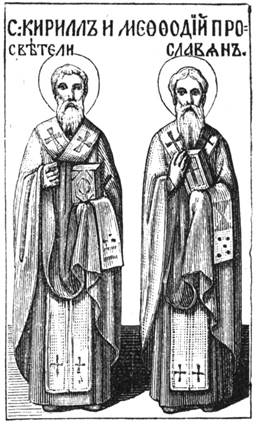
В начале IX века в Солуни43, городе тогда населённом и особенно окружённом Славянами, жил муж почтенный по душевным качествам, богатству и званию Лев, родом Болгарин, но служивший при Греч. императоре44. Супруга его Мария была также благочестивая жена. От этой доброй четы произошли просветители Славян. – Мефодий и самый младший, Константин, родившийся в 827 г.
At the beginning of the ninth century in Thessalonica43, a city then populous and especially surrounded by Slavs, there lived a man honorable in his spiritual qualities, wealth, and station, Leo by name, a Bulgarian by birth, but serving under the Greek emperor44. His wife Mary was also a pious woman. From this good couple came the Enlighteners of the Slavs – Methodius and the youngest, Constantine, who was born in A.D. 827.
Семи лет Константин обнаружил в себе сильную любовь к учению и быструю память; но особенно любил он изучать творения Григория Богослова. От неудовлетворяемой жажды учения он стал скорбеть; желал он учиться грамматике у Солунского инока, но тот отказался. Родственник его логофет Феоктист, опекун малолетнего имп. Михаила, узнав о его дарованиях, вызвал его ко двору– учиться вместе с царём. После изучения грамматики и начал Гомеровой поэзии у знаменитого Льва, начальника училища Бардина, и у даровитого Фотия, впоследствии патриарха, учился он словесности, философии, астрономии и музыке. Блестящие дарования привязали к нему логофета, так что тот хотел выдать за него свою крестницу, но Константин отказался. Логофет предложил царице: «вот у нас молодой философ, не любит мирской жизни; чтобы не потерять его для общества, посвятив его священству, поручим ему службу» библиотекаря Софийского. Так и устроилось45. Но Кирилл не долго пробыл на этой должности хлопотливой. Он скрылся в монастыре Золотого Рога и только спустя полгода узнали о месте пребывания его. – Тогда уговорили его принять должность учителя. По воле царя имел он публичный спор с низложенным патриархом Иоанном, известным по упорству, с каким поддерживал он иконоборную ересь, и – блаженный пристыдил гордого упрямца.
At seven years of age, Constantine revealed in himself a strong love for learning and a quick memory; but he especially loved to study the works of Gregory the Theologian. From an unsatisfied thirst for knowledge, he began to grieve; he wished to study grammar from a monk of Thessalonica, but the latter refused. His relative, the logothete Theoctistus, guardian of the minor Emperor Michael, learning of his gifts, summoned him to court – to study together with the emperor. After studying grammar and the beginnings of Homer's poetry under the famous Leo, head of the Bardinas school, and under the gifted Photius, later patriarch, he studied literature, philosophy, astronomy, and music. His brilliant gifts attached the logothete to him, so that the latter wished to give him his goddaughter in marriage, but Constantine refused. The logothete proposed to the empress: "Here we have a young philosopher who does not love worldly life; so as not to lose him for society, let us ordain him to the priesthood and entrust him with the service" of librarian of Hagia Sophia. And so it was arranged45. But Cyril did not remain long in this troublesome position. He hid himself in the monastery of the Golden Horn, and only after six months was his place of abode discovered. – Then they persuaded him to accept the office of teacher. By the will of the emperor, he held a public disputation with the deposed Patriarch John, known for the stubbornness with which he supported the iconoclast heresy, and – the blessed one put the proud obstinate man to shame.
На 24 году жизни своей, в 851 г., философ вместе с Георгием асикритом послан был к Милитинскому эмиру для прений о христианской вере: преемники Аль-Рашида любили спорить о Коране. Поручение исполнено с успехом.
In the 24th year of his life, in A.D. 851, the philosopher, together with George the asecretis, was sent to the emir of Melitene for disputations concerning the Christian faith: the successors of Al-Rashid loved to dispute about the Koran. The commission was carried out with success.
По возвращении в столицу Кирилл удалился на Олимп – Афон, где жил иноком брат Мефодий, и в любезном уединении предался со всей ревностью иноческим подвигам.
Upon his return to the capital, Cyril withdrew to Olympus – Athos, where his brother Methodius lived as a monk, and in beloved solitude he devoted himself with all zeal to monastic labors.
Старший брат, получив образование в Солуни, поступил в военную службу и был 10 лет правителем Струмской Славянской области, подвластной тогда императору. Соскучив мирской жизнью, Мефодий удалился в иноческую обитель и покорился всем строгостям иночества: «выполнял безответное послушание, пребывал в бдениях и молитве, посещал каждую службу Божию, хранил пост и духовное трезвение, очищал душу плачем; не давал себе покоя ни днём, ни ночью». Такая подвижническая жизнь обратила на него внимание прочих подвижников, которые, с согласия патриарха, желали видеть его митрополитом знаменитого места, вероятно Солуня; но он не согласился на избрание, и едва могли убедить его принять игуменство в Полихрониевом монастыре46, одном из самых богатых, находившемся на Мраморном море.
The elder brother, having received his education in Thessalonica, entered military service and was for 10 years the governor of the Slavic region of Strymon, then subject to the emperor. Growing weary of worldly life, Methodius withdrew to a monastic community and submitted himself to all the strictnesses of monasticism: "he performed unquestioning obedience, abided in vigils and prayer, attended every divine service, kept fast and spiritual sobriety, cleansed his soul with weeping; he gave himself no rest either by day or by night." Such an ascetic life drew the attention of the other ascetics, who, with the consent of the patriarch, wished to see him as metropolitan of a famous place, probably Thessalonica; but he did not agree to the election, and they could scarcely persuade him to accept the abbacy of the Polychronius Monastery46, one of the richest, situated on the Sea of Marmara.
В 858 г. послы Хозар просили императора прислать к ним учёного мужа, который бы научил их истинной вере, так как, прибавляли они, «то Иудеи, то магометане домогаются обратить их к своей вере». Император, как и другие, знал в блаженном Кирилле особенную способность к изучению языков и обширную учёность. Потому назначил его в миссию к Хозарам; пусть, прибавил император, помощником тебе будет брат твой игумен Мефодий47. Ревностные проповедники успели по крайней мере столько сделать между Хозарами, что Каган принял христианство и каждому дозволено было исповедывать св. Веру, а жившим там Грекам запрещено под угрозой смертной казни принимать иудейство или магометанство48.
In A.D. 858, envoys of the Khazars asked the emperor to send them a learned man who would teach them the true faith, since, they added, "both Jews and Mohammedans are striving to convert them to their faith." The emperor, like others, knew in the blessed Cyril a particular ability for the study of languages and extensive learning. Therefore he appointed him to the mission to the Khazars; "let your brother, Abbot Methodius, be your helper," added the emperor47. The zealous preachers succeeded at least in accomplishing this among the Khazars, that the Khagan accepted Christianity and everyone was permitted to confess the holy Faith, while the Greeks living there were forbidden, under threat of the death penalty, to accept Judaism or Mohammedanism48.
Едва возвратились св. братья из этой миссии, как в конце 862 г. Славяно-Паннонские князья, не имея истинного учителя (хотя Латинские священники были у них), а ещё более чувствуя нужду слышать на родном языке Богослужение и учение о вере, просили импер. Михаила и патр. Фотия прислать к ним нужных для них учителей. «Другой никто не в состоянии исполнить такого дела», говорил опять император Кириллу, «как ты с братом». Св. Кирилл, понимая важность и трудность перевода св. книг на народный язык, с благоговейным приготовлением сделал первый опыт перевода. Царь и патриарх с радостью поспешили отправить благочестивых братьев. На этом пути Мефодий утверждал Болгарского князя в решимости бороться с язычеством49, а блаж. Кирилл, говорит древний синаксарь, «пошёл в Брегальницу и, найдя тут некоторых из Славянского народа некрещёнными, привёл их в православную веру и крестил, написав им на Славянском языке книги; всего обратил в христианскую веру до 4500 человек»50. Составив Славянские письмена в Константинополе, блаж. Константин прежде всего обрадовал своим изобретением Славян, с юности знакомых ему, живших не вдали от Солуня51. Столько дорогих ему родичей, доселе не бывших христианами особенно от того, что не знали они Греческого языка, на котором толковали им о Христе, – родною Славянскою проповедию легко обратил он ко Христу Господу.
No sooner had the holy brothers returned from this mission than, at the end of A.D. 862, the Slavic-Pannonian princes, having no true teacher (although Latin priests were among them), and even more feeling the need to hear the divine service and the teaching of the faith in their native tongue, asked Emperor Michael and Patriarch Photius to send them the teachers they needed. "No one else is capable of carrying out such a task," the emperor again said to Cyril, "as you and your brother." St. Cyril, understanding the importance and difficulty of translating the holy books into the vernacular, made a first attempt at translation with reverent preparation. The emperor and patriarch gladly hastened to dispatch the pious brothers. On this journey, Methodius confirmed the Bulgarian prince in his resolve to struggle against paganism49, while the blessed Cyril, says an ancient synaxarion, "went to Bregalnica and, finding there some of the Slavic people unbaptized, brought them into the Orthodox faith and baptized them, having written books for them in the Slavic language; in all, he converted up to 4,500 people to the Christian faith"50. Having composed the Slavic alphabet in Constantinople, the blessed Constantine first of all gladdened with his invention the Slavs known to him from youth, who lived not far from Thessalonica51. So many of his dear kinsmen, who until then had not been Christians especially because they did not know the Greek language in which they were told about Christ, – he easily converted to the Lord Christ by his native Slavic preaching.
В Моравии Кирилл и Мефодий с Апостольским усердием совершали дело, для которого были призваны: обучали детей, устрояли Богослужение, то и другое на Славянском языке 52. Им надлежало бороться и с остатками язычества и с страстями невежественного Латинского духовенства. Они переходили из области одного князя к другому с проповедью о чистой Евангельской истине, на понятном для всех языке. Четыре года с половиной (с 863 по 867 г.) Кирилл и Мефодий исполняли распоряжение восточного патриарха, во славу Божию. «И ради быша Словене, слышаще величья Божья своим языком». Но слишком не рады были тому питомцы Рима, Немецкие священники. Они осыпали бранью Славянских проповедников за Славянское Богослужение. Надпись Пилата на кресте, говорили, написана была только на трёх языках; так должно и ныне молиться только на трёх языках (Еврейском, Греческом, Латинском). «Стало быть», отвечали им проповедники истины, «вы ученики Пилата? Стыдитесь». – Но у Немца для денег нет стыда. Немцы сделали донос в Рим на Славянских проповедников. Папе, каков был Николай, очень не нравилось, что проповедники, покоряя сердца вере Христовой, не имеют в виду папы; он потребовал Греческих проповедников в Рим.
In Moravia, Cyril and Methodius carried out with apostolic zeal the work for which they were called: they taught children, they established divine services, both in the Slavic language52. They had to struggle both with the remnants of paganism and with the passions of the ignorant Latin clergy. They passed from the domain of one prince to another with the preaching of the pure Gospel truth, in a language understandable to all. For four and a half years (from A.D. 863 to 867), Cyril and Methodius carried out the commission of the Eastern patriarch, to the glory of God. "And the Slavs rejoiced, hearing the greatness of God in their own tongue." But the nurslings of Rome, the German priests, were far too displeased with this. They heaped abuse upon the Slavic preachers for the Slavic divine service. The inscription of Pilate on the Cross, they said, was written only in three languages; so now one should pray only in three languages (Hebrew, Greek, Latin). "Therefore," the preachers of truth replied to them, "you are disciples of Pilate? Shame on you." – But for a German, there is no shame where money is concerned. The Germans made a denunciation to Rome against the Slavic preachers. The pope, such as Nicholas was, was very displeased that the preachers, conquering hearts for the faith of Christ, had no regard for the pope; he summoned the Greek preachers to Rome.
На дороге в Венеции Кирилл и Мефодий должны были выдержать жестокий спор о правоте дела своего. «Сколько народов, говорили умные учители тупым людям, славят Бога на своих языках! мы можем указать на Армян, Персов, Авазгов, Грузин, Готфов, Казаров, Арабов, Египтян, Сирийцев!» П. Адриан (с 4 декабря 867 г.), преемник Николая, опасаясь потерять влияние на Моравию, оказался довольным просветителями Славян, покорными древним правилам о патриархах. Он оправдал Славянскую службу особым посланием. Св. Кирилл скончался в Риме, февраля 14-го 869 г.53.
On the road, in Venice, Cyril and Methodius had to endure a fierce dispute about the rightness of their cause. "How many peoples," said the wise teachers to the dull-witted men, "praise God in their own languages! We can point to the Armenians, Persians, Abasgians, Georgians, Goths, Khazars, Arabs, Egyptians, Syrians!" Pope Adrian (from December 4, A.D. 867), the successor of Nicholas, fearing to lose influence over Moravia, showed himself satisfied with the Enlighteners of the Slavs, who were obedient to the ancient rules concerning patriarchs. He justified the Slavic service by a special epistle. St. Cyril reposed in Rome, on February 14, A.D. 86953.
Св. Мефодий, согласно с завещанием св. брата, решился продолжать трудиться для Славян. Безуспешные в Риме Немцы взволновали Славян междоусобиями и погубили Ростислава, – Мефодий, уклоняясь от смут, прибыл (в 870 г.) с учениками своими в Паннонию, и кн. Котел с любовью принял его в Мосбурге (болотном замке). Котел просил папу посвятить Мефодия в архиепископа Паннонского, и желание его исполнено. – В священники посвящались теперь только Славяне и к утешению родичей совершали службу на понятном для них языке. Латинской службы никто не хотел слушать. Немецкое духовенство, оставшись без доходов, раздражилось в высшей степени. – Оно (872 г.) стало преследовать Мефодия со всем ожесточением, восстановило против него и Германского императора и Моравского князя Святополка; дело доведено до того, что Мефодий отправлен в заточение, где пробыл целые два года с половиной.
St. Methodius, in accordance with the testament of his holy brother, resolved to continue laboring for the Slavs. Having been unsuccessful in Rome, the Germans stirred up the Slavs with internecine strife and destroyed Rastislav – Methodius, withdrawing from the disturbances, arrived (in A.D. 870) with his disciples in Pannonia, and Prince Kocel received him with love in Mosburg (the castle in the marsh). Kocel asked the pope to consecrate Methodius as Archbishop of Pannonia, and his wish was fulfilled. – Now only Slavs were ordained to the priesthood, and to the consolation of their kinsmen they performed the service in a language understandable to them. No one wished to hear the Latin service. The German clergy, left without income, became irritated to the highest degree. – They (A.D. 872) began to persecute Methodius with all ferocity, stirred up against him both the German emperor and the Moravian Prince Svatopluk; the matter was carried so far that Methodius was sent into captivity, where he remained for a full two and a half years.
Немецкое духовенство, действуя так против св. Мефодия, вдвойне оскорбляло власть папы, к которой для денег обращалось оно под защиту: оскорбляло тем, что удалило из Моравии того, кто посвящён туда папой; оскорбляло тем, что самовольно распоряжалось в той области, которая по давнему распоряжению принадлежала к епархии папы и где дозволено было Немцам действовать только под зависимостью папы. Потому папа Иоанн VIII не только возвратил Мефодию (874 г.) иерархическую власть над Моравией и не только писал к Людовику и Карломану о невинности Мефодия и виновности Немецких бискупов; но запретил последним само Богослужение. Потому и Славянские князья не только выгнали всё Немецкое из своей страны, но по их просьбе Мефодий объявлен был со стороны папы архиепископом Моравского государства. Всего более поразительно было в это время то, что четыре бискупа, злодействовавшие против св. Мефодия, поражены были судом Божиим, как предсказывал Мефодий, – все четверо умерли в один и тот же год. «С того времени, говорит очевидец, Божественное учение стало быстро распространяться, язычество и суеверия исчезали» и государство Святополка цвело.
The German clergy, acting thus against St. Methodius, doubly offended the authority of the pope, to whom they had turned for money and protection: they offended him by removing from Moravia the one who had been consecrated there by the pope; they offended him by arbitrarily disposing of that region which, by a long-standing decree, belonged to the pope’s diocese and where the Germans were permitted to act only under the pope’s authority. Therefore Pope John VIII not only restored to Methodius (in 874) hierarchical authority over Moravia and not only wrote to Louis and Carloman concerning the innocence of Methodius and the guilt of the German bishops, but even forbade the latter to celebrate the Divine Service. Therefore also the Slavic princes not only drove out everything German from their country, but at their request Methodius was declared by the pope to be Archbishop of the Moravian state. Most striking of all at this time was that four bishops who had plotted evil against St. Methodius were struck down by the judgment of God, as Methodius had foretold—all four died in the same year. “From that time,” says an eyewitness, “the Divine teaching began to spread rapidly, paganism and superstitions vanished,” and the state of Svatopluk flourished.
Счастливые успехи Славянской проповеди в Моравии имели влияние и на соседние Славянские страны. Святополк в 871 г. вступил в брак с Богемской княжной. Эта связь двора Моравского с Богемским открыла удобства для Евангельской проповеди св. Мефодия вБогемии. Насилия Немцев, заставив Боривоя, Богемского князя, вступить в политический союз с Святополком, ещё более сблизили Боривоя с Мефодием, и св. Мефодий в 874 г. крестил кн. Боривоя и супругу его Людмилу в Велеграде; а вслед за князем владетельным крестилась и значительная часть народа в Богемии: Славянская проповедь, понятная для каждого Чеха, легко открыла Богемцам святость христианской веры. Храм св. Климента под Прагой и храм св. Георгия в замке, построенный Боривоем, остались памятниками чистой веры в Богемии54.
The happy successes of the Slavic preaching in Moravia also had an influence on the neighboring Slavic lands. In 871 Svatopluk entered into marriage with a Bohemian princess. This connection between the Moravian and Bohemian courts opened the way for the Gospel preaching of St. Methodius in Bohemia. The violence of the Germans, which compelled Borivoj, the Bohemian prince, to enter into a political alliance with Svatopluk, brought Borivoj even closer to Methodius; and St. Methodius baptized Prince Borivoj and his wife Ludmila in Velehrad in 874; and following the ruling prince, a significant part of the people in Bohemia were also baptized: the Slavic preaching, understandable to every Czech, easily opened to the Bohemians the holiness of the Christian faith. The church of St. Clement near Prague and the church of St. George in the castle, built by Borivoj, remained monuments of the pure faith in Bohemia54.
«Языческий князь, сидевший на Висле, ругался над христианами и причинял им разные обиды. Мефодий послал сказать ему, что хорошо бы ему было креститься волей на своей земле, чтобы, попавшись в плен, не принуждён был креститься по неволе, на чужой, и вспомянуть его. «Действительно всё так и случилось», говорит свидетель жизни Мефодиевой. Ученики Мефодия, согласно с желанием образумленного князя, насадили в Польше православное учение о христианстве и Богослужение Славянское.
“A pagan prince who sat on the Vistula mocked the Christians and caused them various injuries. Methodius sent word to him that it would be well for him to be baptized of his own will in his own land, lest, being taken captive, he be forced to be baptized against his will in a foreign land, and remember him. ‘Indeed everything happened just so,’ says the witness of the Life of Methodius. The disciples of Methodius, according to the desire of the prince who had come to his senses, planted in Poland the Orthodox teaching concerning Christianity and the Slavic Divine Service.”
О Далматии говорит древний её историк: «Мефодий учредил литургию по уставу Греков». – Иначе и не могло быть: Мефодий на пути в Рим и из Рима бывал в Далматии55.
Concerning Dalmatia, an ancient historian of that land says: “Methodius established the Divine Liturgy according to the rule of the Greeks.” – It could not have been otherwise: Methodius, on his way to Rome and from Rome, had been in Dalmatia55.
Хорваты и Сербы в то же время и по бедствиям политическим просили и получили помощь от императора Василия, а вслед за тем приняли проповедников Восточной Церкви; из них даже те, которые были язычниками, слушая проповедь и Богослужение на понятном языке, охотно крестились56.
The Croats and Serbs at the same time, and because of political calamities, asked for and received help from the Emperor Basil, and thereupon accepted preachers of the Eastern Church; even those among them who were pagans, hearing the preaching and the Divine Service in an understandable language, were willingly baptized56.
Как ни благотворна была деятельность св. Мефодия для св. Церкви и всех Славян, Немцам не было дела до веры и спасения людей, – им нужны были свои доходы, – а гордость их волновалась от успехов Славянского проповедника. – Они донесли в Рим, что Мефодий отступник от веры, не исповедует исхождения Св. Духа и от Сына, не проповедует не только вселенской власти папы, но даже зависимости своей от папы, – совершает службу на Славянском, а не на Римском языке. Папа Иоанн покоен был относительно догмата о Св. Духе, исповедуя его согласно с патр. Фотием; но он встревожился за свою власть над Моравией и вопреки прежнему распоряжению своему запретил (в 879 г.) Славянскую службу. Немцы торжествовали; они явились в Моравию и объявили, что Мефодий лишён власти, и Моравия передана им. Св. Мефодий вынужден был отправиться в Рим. На Римском соборе (880 г.) св. Мефодий признан учителем Евангельским по всем отношениям. Папа писал в Моравию, что он утверждает Мефодия в правах архиепископа, признаёт веру его чистой и «так как сказано: всяк язык да исповесть, яко Господь наш Иисус Христос в славу Бога Отца (Флп.2:11), не находит противоречия здравой вере в том, что поют литургию на Славянском языке, или читают на нём святое Писание». Св. Мефодий возвратился в Моравию, спокойный, с торжеством истины над ложью. Но Немецкая изобретательность неистощима на зло; она распустила слух, будто патриарх и император в гневе на Мефодия за его согласие с папою. Св. Мефодий не имел причин тревожиться слухами злости, да и он получил от императора письмо, дышавшее любовью. Тем не менее для рассеяния вредных толков он отправился в Византию. Здесь и патриарх, и император приняли его с уважением. Памятником высоких мнений православия о подвигах Мефодия служило и то, что император оставил для придворного причта священника и диакона, посвящённых св. Мефодием, и в Славянском переводе книги.
However beneficial the activity of St. Methodius was for the holy Church and all Slavs, the Germans had no concern for the faith and salvation of men—they needed their own income—and their pride was agitated by the successes of the Slavic preacher. They reported to Rome that Methodius was an apostate from the faith, that he did not confess the procession of the Holy Spirit also from the Son, that he did not preach the universal authority of the pope, nor even his own dependence on the pope—that he celebrated the service in Slavic, not in the Roman language. Pope John was at peace concerning the dogma of the Holy Spirit, confessing it in accordance with Patriarch Photius; but he became troubled for his authority over Moravia and, contrary to his former decree, forbade (in 879) the Slavic service. The Germans triumphed; they appeared in Moravia and announced that Methodius had been deprived of authority and that Moravia had been handed over to them. St. Methodius was compelled to go to Rome. At the Roman Council (880), St. Methodius was acknowledged as a teacher of the Gospel in every respect. The pope wrote to Moravia that he confirmed Methodius in the rights of an archbishop, acknowledged his faith as pure, and “since it is said: that every tongue should confess that Jesus Christ is Lord, to the glory of God the Father (Phil. 2:11), he finds no contradiction to sound faith in the fact that they sing the Divine Liturgy in the Slavic language or read the Holy Scripture in it.” St. Methodius returned to Moravia, at peace, with the triumph of truth over falsehood. But German inventiveness is inexhaustible in evil; it spread a rumor that the patriarch and the emperor were angry with Methodius for his agreement with the pope. St. Methodius had no reason to be troubled by the rumors of malice, and he also received a letter from the emperor breathing with love. Nevertheless, to dispel the harmful rumors, he set out for Byzantium. There both the patriarch and the emperor received him with respect. A monument to the high regard of Orthodoxy for the labors of Methodius was also the fact that the emperor retained for the court clergy a priest and a deacon consecrated by St. Methodius, and also the books in Slavic translation.
Когда и при дворе папы и при дворе императора интриги Немцев не достигли своей цели, Немцы обратились к Святополку. Они пустили в ход и низкую лесть и низкую клевету. Святополк плохо понимал св. веру и давал волю страстям своим. Немцы всё прощали ему, – не требуя от него подвигов покаяния. Мефодий говорил о грешнике, как говорит Евангелие. Отселе Святополк стал оказывать явное нерасположение к Мефодию и благосклонность к льстецам Немцам. Викарный епископ, Шваб Вихинг, поборник заблуждения о Св. Духе, человек мало дороживший совестью, стал любимцем Святополка и злейшим врагом св. Мефодия. Так до самого гроба св. Мефодий терпел скорби за Апостольские труды свои. Он блаженно почил 6 апреля 885 г. и похоронен был в Велеграде, «в великой Моравской церкви, на левой стороне за алтарём св. Богородицы»57.
When even at the court of the pope and at the court of the emperor the intrigues of the Germans did not achieve their goal, the Germans turned to Svatopluk. They set in motion both base flattery and base slander. Svatopluk poorly understood the holy faith and gave free rein to his passions. The Germans forgave him everything—not requiring from him deeds of repentance. Methodius spoke of the sinner as the Gospel speaks. From then on Svatopluk began to show clear disfavor toward Methodius and favor toward the flattering Germans. The suffragan bishop, the Swabian Wiching, a champion of the error concerning the Holy Spirit, a man who little valued his conscience, became the favorite of Svatopluk and the bitterest enemy of St. Methodius. Thus even to the grave St. Methodius endured sorrows for his apostolic labors. He reposed blessedly on April 6, 885, and was buried in Velehrad, “in the great Moravian church, on the left side behind the altar of the Holy Theotokos”57.
По точным исследованиям, св. Кирилл изобрёл Славянскую азбуку, или, как говорит монах Храбр, «сътвори 30 письмен и 8, ово убо по чину Гречьских письмен, ово же по Словенстей речи». По словам Храбра, Кириллова азбука была Греко-Славянская не только по подбору звуков, но и по рисунку букв, – в ней отличались от Греческих, по рисунку, не более 14 букв58.
According to precise research, St. Cyril invented the Slavic alphabet, or, as the monk Khrabr says, “he made 30 letters and 8, some according to the order of Greek letters, others according to the Slavic speech.” According to the words of Khrabr, Cyril’s alphabet was Greco-Slavic not only in the selection of sounds, but also in the design of the letters—in it no more than 14 letters differed from the Greek in design58.
Св. Кирилл, по Паннонскому житию его, «весь церковный чин предложи (преложи, перевёл) и научи своих учеников утрени и годинам (часам), обедни и навечерници и тайней службе». «Мефодий, по его житию, псалтырь бе токмо и Евангелие с Апостолом и избранными службами с философом преложил первее». Соединяя эти известия с другими, убеждаемся, что Константину принадлежит перевод: Евангельских чтений, Апостольских чтений, псалтири, парамейника, служебника, требника и октоиха.
St. Cyril, according to his Pannonian Life, “translated the entire church order and taught his disciples Matins and the Hours, the Liturgy and Vespers and the secret service.” “Methodius, according to his Life, first translated only the Psalter and the Gospel with the Apostle and selected services together with the Philosopher.” Combining these accounts with others, we are convinced that Constantine’s translations include: the Gospel readings, the Apostolic readings, the Psalter, the Paroemiarion, the Service Book, the Trebnik, and the Octoechos.
В списке XV века сохранилось «написание о правой вере изущенное Константином блаженным философом, учителем о Бозе Славенскому языку». В конце исповедания сказано: «сице аз свою веру исповедаю и с присным моим братом Мефодием». Исповедание столько же несомненное по подлинности, сколько драгоценное по содержанию. Оно основательно обличает Немецкое заблуждение о Св. Духе59.
In a 15th-century manuscript there is preserved “a writing concerning the right faith, taught by Constantine, the blessed philosopher, teacher in God to the Slavic tongue.” At the end of the confession it is said: “Thus I confess my faith, together with my own brother Methodius.” The confession is as undoubted in its authenticity as it is precious in its content. It thoroughly refutes the German error concerning the Holy Spirit59.
Составитель жития Константина философа, излагая сокращённо разговоры Константина с Иудеями и магометанами Хозарскими, прибавляет: «иже хощете с вершеных бесед сих святых, в книгах обрящете я, еже преложи учитель наш и архиепископ Мефодий, брат Константина философа, разрешив е на осмь словес». В статье о книгах полезных и вредных между первыми после Кирилла Иерусалимского поставлен «Кирилл Словенский». Ныне книга бесед св. Кирилла неизвестна, и остаётся довольствоваться только извлечениями из неё; но и тут много мыслей высоких о человеке и христианстве, много обличений неотразимых Иудейству60!
The compiler of the Life of Constantine the Philosopher, briefly setting forth the conversations of Constantine with the Jews and the Khazar Muslims, adds: “Whoever desires these complete discourses of the saints, you will find them in the books which our teacher and Archbishop Methodius, the brother of Constantine the Philosopher, translated, dividing them into eight discourses.” In the article on useful and harmful books, among the first after Cyril of Jerusalem is placed “Cyril the Slav.” Today the book of the discourses of St. Cyril is unknown, and one must be content only with extracts from it; but even here there are many lofty thoughts concerning man and Christianity, many irrefutable refutations of Judaism60!
Св. Мефодий продолжал, после брата своего, переводить на Славянский язык как книги св. Писания, так и некоторые другие, более других нужные. На последнем году жизни он заставил способных писцов переписать труды свои и таким образом оставил в переводе «вся книги исплънь, разве макковеи и номоканон рекше закону правило и отчиные книгы» – (патерик), так говорит житие его; а по словам Иоанна экзарха, «преложи вся уставныя книгы 60 от Еллинска языка в Словеньск». По тому и другому известию св. Мефодием оставлены в переводе а) все канонические книги св. Писания, но не были переведены апокрифические; б) номоканон и патерик.
St. Methodius, after his brother, continued to translate into the Slavic language both the books of Holy Scripture and certain others that were more necessary than the rest. In the last year of his life he had capable scribes copy his works, and thus he left in translation “all the books complete, except Maccabees and the Nomocanon, that is, the Rule of Law, and the Patericon”—so says his Life; and according to the words of John the Exarch, “he translated all the liturgical books, 60, from the Greek language into Slavic.” According to both accounts, St. Methodius left in translation: a) all the canonical books of Holy Scripture, but the apocryphal books were not translated; b) the Nomocanon and the Patericon.
Так св. Кирилл и Мефодий подвизались в проповедании чистой, св. веры (восточного православия) Славянским народам, страдая за то мужественно, до гроба. Если являются такие, которым хочется выдавать св. мужей за поклонников своеволия людского, то остаётся жалеть о том, что дозволяют себе лгать на св. истину61.
Thus Sts. Cyril and Methodius labored in preaching the pure, holy faith (Eastern Orthodoxy) to the Slavic peoples, suffering for it courageously, even to the grave. If there appear those who wish to represent the holy men as worshippers of human self-will, one can only regret that they permit themselves to lie concerning the holy truth61.
Память Славянских просветителей священна для Славянских племён, как память о проповедниках чистой истины. Её торжествовали не раз в году Славянские племена62. Известны и древние службы св. Кириллу и Мефодию63.
The memory of the Slavic enlighteners is sacred for the Slavic tribes, as the memory of preachers of the pure truth. The Slavic tribes celebrated it more than once in the year62. The ancient services to Sts. Cyril and Methodius are also known63.
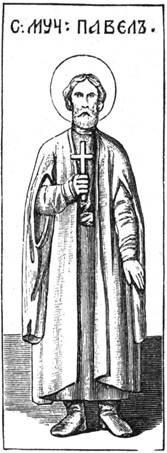
Блаженный Павел ещё в юных летах уведён был из России татарами, – и потом продан был в Константинополь. Сколько страданий вытерпели Русские от Крымских разбойников-татар! Хищники не в одной честной войне, но в воровских, тайных наездах захватили Русских и потом насмехались в лице их над человечеством. «Корабли, приходящие к Крымским татарам из Азии, говорит современник, привозят им оружие, одежды и лошадей, а отходят от них нагруженные рабами... Они всегда имеют в запасе рабов не только для торговли, но и для потехи своей дома и для удовлетворения своим наклонностям к жестокости. Те, которые посильнее из этих несчастных, – связанные или скованные мучатся днём на работе, ночью в темнице, и жизнь их поддерживается малостью пищи, состоящей в мясе дохлых животных64. Павел, измученный варварами, мог быть куплен только христианином. Прослужив несколько лет господину, он отпущен был на волю и вступил в брак с Русской девушкой, подобно ему попавшейся в плен и также получившей свободу. Супруги вели жизнь христианскую, быв испытаны тяжёлыми скорбями. От страданий в плену, Павел стал сильно страдать падучей болезнью. Припадки её по временам бывали так жестоки, что больной впадал в безумие. Супруга и соседи положили отвести его в храм Богородицы Муглунийской, где подобные больные получали исцеление. Больной, не понимая, что хотят с ним делать, никак не хотел идти; принуждены были связать его и вести против воли. Дорогой встретились Турки и спросили: «куда тащат его?» Больной в исступлении ума закричал: «я Агарянин, я стал Агарянином». Больного довели до церкви. Между тем Турки спустя два дня надумались. «Как? говорили они между собой, брат наш магометанин просил нашей помощи, и мы оставили его в руках неверных». Один из них, исступлённый фанатик, разжёг других и склонил явиться к великому визирю с жалобой на христиан. «Неверные, доносили они визирю на словах и на бумаге, неверные в столице магометанства осмеливаются принявшего магометанство тащить в церковь», и рассказали о Павле. Разгневанный визирь велел немедленно представить к себе мнимого нового магометанина, а священников церкви и кого найдут в ней связать и привесть к нему. К счастью, один из слышавших это решение визиря немедленно дал знать о том в церкви. Когда поднялась тревога и больного вели из храма, больной внезапно выздоровел, и ему рассказали, в чём дело его? Едва успели сообщить ему об общей опасности, как посланные визирем схватили его и священников и привели к визирю. Приказав бросить священников в глубокую темничную яму, визирь ласково спросил Павла: «правда ли, что ты принял магометанство?» «Никогда не хотел ничего подобного», отвечал Павел. Доносчики говорили, что когда тащили его в церковь, сам он называл себя магометанином, вслух их. «Вы хотите только мучить христиан, сказал Павел, и выдумываете неправды». Визирь спросил: «зачем тащили тебя в церковь?» «Меня тащили в дом, господин мой, а не в церковь, говорил Павел, я страдаю до безумия в новолуние и в этом-то состоянии волокли меня в дом; но христианином я был, христианин я теперь и христианином останусь». «Так как эти правоверные, сказал визирь, слышали от тебя самого, что ты – магометанин; то тебе остаётся или быть магометанином, или же быть осуждену на смерть; выбирай любое – или магометанство и почести, или позорную смерть». Позади исповедника стояла добрая супруга его и говорила ему по-русски: «не бойся смерти, добрый супруг мой; будь твёрд в святой вере: умереть не долго, а потом станешь веселиться с Христовыми мучениками, и как я буду счастлива! Меня станут называть женой мученика». Визирь спросил: «что это за женщина? О чём говорит она?» Один из присутствовавших, знавший Русский язык, сказал: «это жена его, и она уговаривает его не отрекаться от христианской веры». Визирь велел привязать жену к столбу и бить без пощады, а мужа бросить в тюрьму. Как жена, так и священники также заключены были под стражу. Спустя три дня Павел снова представлен был к визирю. Сколько ни уговаривали его, он смело повторял одно: «я – христианин». Визирь велел казнить его и – ему отсекли голову на ипподроме, в самый день страданий Господа нашего Иисуса Христа, в 1683 г. апреля 6-го дня. Священники и супруга мученика за деньги освобождены были из темницы65.
Blessed Paul was carried off from Russia by the Tatars while still in his youthful years, and was afterwards sold in Constantinople. How much suffering did the Russians endure from the Crimean Tatar brigands! The predators seized Russians not only in honorable warfare, but in thieving, secret raids, and then mocked humanity in their persons. "The ships that come to the Crimean Tatars from Asia," says a contemporary, "bring them weapons, clothing, and horses, and depart from them laden with slaves... They always keep slaves in reserve, not only for trade, but also for their own amusement at home and for the satisfaction of their inclinations to cruelty. Those of these unfortunates who are stronger, bound or chained, are tormented by day at labor, by night in prison, and their life is sustained by a small amount of food, consisting of the meat of dead animals64. Paul, tormented by the barbarians, could be bought only by a Christian. Having served his master for several years, he was set free and entered into marriage with a Russian girl who, like him, had fallen into captivity and had likewise received her freedom. The spouses led a Christian life, having been tried by heavy sorrows. From his sufferings in captivity, Paul began to suffer severely from the falling sickness. Its fits at times were so cruel that the sufferer fell into madness. His wife and neighbors resolved to take him to the church of the Mother of God of Muglunia, where those afflicted in like manner received healing. The sick man, not understanding what they wished to do with him, absolutely refused to go; they were compelled to bind him and lead him against his will. On the way, Turks met them and asked: "Where are they dragging him?" The sick man, in the frenzy of his mind, cried out: "I am an Agarene, I have become an Agarene." The sick man was brought to the church. Meanwhile, the Turks, after two days, bethought themselves. "How is this?" they said among themselves, "our brother, a Mohammedan, asked for our help, and we left him in the hands of the infidels." One of them, a frenzied fanatic, inflamed the others and persuaded them to appear before the Grand Vizier with a complaint against the Christians. "The infidels," they reported to the vizier orally and in writing, "the infidels in the capital of Mohammedanism dare to drag one who has embraced Mohammedanism to church," and they told of Paul. The enraged vizier ordered the supposed new Mohammedan to be brought before him immediately, and the priests of the church and whomever might be found in it to be bound and brought to him. Fortunately, one of those who heard this decision of the vizier immediately gave notice of it to the church. When the alarm was raised and the sick man was being led from the temple, the sick man suddenly recovered, and they told him what his case was. Scarcely had they informed him of the common danger, when the vizier's messengers seized him and the priests and brought them to the vizier. Having ordered the priests to be cast into a deep prison pit, the vizier asked Paul kindly: "Is it true that you have embraced Mohammedanism?" "I never wished anything of the sort," answered Paul. The accusers said that when he was being dragged to the church, he himself called himself a Mohammedan, in their hearing. "You only want to torment Christians," said Paul, "and you invent falsehoods." The vizier asked: "Why were you dragged to the church?" "I was dragged to a house, my lord, and not to a church," said Paul, "I suffer to the point of madness at the new moon, and in that state they dragged me to a house; but a Christian I was, a Christian I am now, and a Christian I shall remain." "Since these faithful," said the vizier, "heard from your own mouth that you are a Mohammedan; then it remains for you either to be a Mohammedan, or to be condemned to death; choose either — Mohammedanism and honors, or a shameful death." Behind the confessor stood his good wife, and she said to him in Russian: "Fear not death, my good husband; be firm in the holy faith: to die is not long, and then you will rejoice with Christ's martyrs, and how happy I shall be! I shall be called the wife of a martyr." The vizier asked: "What woman is this? What is she saying?" One of those present, who knew the Russian language, said: "This is his wife, and she is urging him not to renounce the Christian faith." The vizier ordered the wife to be bound to a pillar and beaten without mercy, and the husband to be cast into prison. Both the wife and the priests were likewise placed under guard. After three days, Paul was again brought before the vizier. However much they urged him, he boldly repeated one thing: "I am a Christian." The vizier ordered him to be executed, and — his head was cut off at the Hippodrome, on the very day of the sufferings of our Lord Jesus Christ, on April 6, 1683. The priests and the martyr's wife were released from prison for money65.
Горел желанием, как говорит писатель жития его66, всю а вселенную обогатить знанием восхождения на высоту делания и созерцания, стремился он возжечь во всех пламенную любовь к этому восхождению»... «Удивлял самих подвижников своей почти бесплотной ангельскою жизнью: пост его, бдения, всенощные стояния, непрестанные псалмопения и молитвы превосходили всякое описание. Казалось, он спорил с природой, желая вещественное тело своё сделать невещественным» ...
Burning with desire, as the writer of his life says66, to enrich the whole universe with the knowledge of ascent to the height of action and contemplation, he strove to kindle in all a fiery love for this ascent"... "He amazed even the ascetics themselves by his almost incorporeal, angelic life: his fasting, vigils, all-night standings, unceasing psalmody and prayers surpassed all description. It seemed he contended with nature, wishing to make his material body immaterial"...
«Когда душа употребляет всё своё усердие и подвизается посредством деятельных добродетелей, при должном рассуждении, тогда она низлагает все страсти и подчиняет их себе. А если страсти покорены, то её окружают естественные добродетели и следуют за ней, как тень за телом; и не только следуют, но и учат её и наставляют тому, что выше естества, учат как бы восхождению по духовной лестнице.
When the soul employs all its zeal and struggles by means of active virtues, with due discernment, then it casts down all the passions and subjects them to itself. And if the passions are subdued, then the natural virtues surround it and follow it, as a shadow follows the body; and not only follow, but also teach it and instruct it in that which is above nature, teaching as it were the ascent by the spiritual ladder.
Когда же ум, благодатью Христовой, взойдёт к тому, что выше естества, тогда просвещаемый Св. Духом, он простирается к ясному видению; тогда, сделавшись выше самого себя, по мере данной ему от Бога благодати, весьма ясно, и чисто видит сущность вещей, и уже совсем не так, как умствуют о том внешние мудрецы, кидающиеся только за тенью вещей, а не старающиеся как должно следовать существенному действию природы. Ведь и Божественное Писание говорит: осуетилось несмысленное их сердце и, называя себя мудрыми, обезумели... (Рим.1:21–22). Потом душа, принявшая благодать Св. Духа, по причине множества видений, какие ей открываются, мало-помалу, оставляет прежние и переходит к высшим и Божественнейшим, как говорит Апостол Павел: задняя забывая и простираясь вперёд (Флп.3:13), – и таким образом, поистине отбрасывает всякую боязнь и страх и, прилепившись любовью к Христу, видит, что природные её помыслы совершенно умолкают и, по писанию св. отцов, остаются назади. Достигнув безвидной и неизреченной красоты, она теперь, осияеваемая сиянием и благодатью Св. Духа, беседует только с Богом, а просветившись этим беспредельным светом и имея стремление к одному Богу, она, по причине своего нового и чудного изменения, совсем уже не чувствует своего смиренного, земного и вещественного тела, ибо является чистой и светлой – без всякой примеси вещественного пристрастия, является существом собственно умным, каким был до грехопадения первородный Адам. Он сперва был покрыт благодатью беспредельного света, а потом, по причине горького преступления, обнажился от светоносной этой славы».
When the mind, by the grace of Christ, ascends to that which is above nature, then, being enlightened by the Holy Spirit, it stretches out toward clear vision; then, having become higher than itself, according to the measure of grace given it from God, it sees very clearly and purely the essence of things, and not at all as the external wise men reason about it, who chase only after the shadow of things, and do not strive as they ought to follow the essential action of nature. For Divine Scripture also says: their foolish heart was darkened, and professing themselves to be wise, they became fools... (Rom. 1:21–22). Then the soul that has received the grace of the Holy Spirit, by reason of the multitude of visions that are revealed to it, little by little leaves the former ones and passes to higher and more Divine ones, as the Apostle Paul says: forgetting those things which are behind, and reaching forth unto those things which are before (Phil. 3:13) — and thus, truly casts away all fear and dread, and having cleaved with love to Christ, sees that its natural thoughts become completely silent and, according to the writings of the holy fathers, remain behind. Having attained the formless and ineffable beauty, it now, being illumined by the radiance and grace of the Holy Spirit, converses only with God, and having been enlightened by this boundless light and having its striving toward God alone, it, by reason of its new and wondrous change, no longer feels its humble, earthly, and material body at all, for it appears pure and luminous — without any admixture of material attachment, it appears as a properly intellectual being, such as the first-created Adam was before the fall. He was at first covered by the grace of boundless light, and then, by reason of the bitter transgression, was stripped of this light-bearing glory."
«Человек, через трудолюбивое упражнение в умной молитве достигший столь дивной высоты и увидевший ясно своё собственное устроение, в какое он пришёл благодатью Христовой, уже увидел и воскресение души своей прежде чаемого общего воскресения, так что душа, очистившаяся таким образом, может говорить вместе с св. Апостолом Павлом: в теле ли, не знаю, вне ли тела, не знаю... (2Кор.12:2). Но вместе с тем душа и недоумевает, и изумляется тому, и взывает с удивлением: о, бездна богатства, и премудрости, и ведения Божьего! Как непостижимы судьбы Его и неисследимы пути Его (Рим.11:33)!»
"A man who, through diligent exercise in noetic prayer, has attained such a wondrous height and has clearly seen his own constitution, into which he has come by the grace of Christ, has already seen the resurrection of his soul before the expected general resurrection, so that the soul thus purified can say together with the holy Apostle Paul: whether in the body, I cannot tell; or whether out of the body, I cannot tell... (2 Cor. 12:2). But at the same time the soul is perplexed and marvels at this, and cries out with wonder: O the depth of the riches both of the wisdom and knowledge of God! how unsearchable are His judgments, and His ways past finding out! (Rom. 11:33)!"
Светоносная жизнь в мире св. Григория светоносными лучами отразилась и в прославившихся учениках его: св. Герасиме, Иосифе, авве Николае, чудном Марке, Иакове, Аароне, Моисее, Лонгине, Корнилии, Исаии и Клименте.
The luminous life of St. Gregory in the world was reflected in luminous rays also in his glorified disciples: St. Gerasimus, Joseph, Abba Nicholas, the wondrous Mark, James, Aaron, Moses, Longinus, Cornelius, Isaiah, and Clement.
Житие св. Февронии, описанное наставницею её св. Фомаидой, in act. Sanct. 24 Junii р. 687–806. В Четь-Минее июня 25. Другое Греческое описание – у Фабриция bibl. Gr. X, 229. В конце сказано: „я Фомаида, по смерти Вриенны, приняла на себя начальство над монастырём и, зная всё случившееся, с Февронией, отчасти и от Лисимаха, описала всю её жизнь и историю, во славу мученицы“. По современности св. Фомаиды с святителем Низибийским Иаковом более чем вероятно, что Фомаида писала свои записки о Февронии по воле св. Иакова, и они были им пересмотрены. Вероятно и то, что Фомаида писала записки на Сирском языке, а на Греческий переведены они впоследствии.
The life of St. Febronia, written by her instructress, St. Thomais, in Act. Sanct. 24 Junii pp. 687–806. In the Chet'i-Minei for June 25. Another Greek account — in Fabricius, Bibl. Gr. X, 229. At the end it is said: "I, Thomais, after the death of Brienne, took upon myself the leadership of the monastery and, knowing all that happened with Febronia, partly also from Lysimachus, described her whole life and history, to the glory of the martyr." By the contemporaneity of St. Thomais with the Hierarch of Nisibis, James, it is more than probable that Thomais wrote her notes about Febronia at the will of St. James, and that they were reviewed by him. It is also probable that Thomais wrote her notes in the Syriac language, and that they were translated into Greek afterwards.
Св. Вриенна, Иерия и Фомаида прославляются Церковью в Сырную субботу; св. Феврония кроме того славится 25 июня. У Абиссинцевь дева Кефрония или Афрония – июля 1 (июня 25).
Sts. Brienne, Hieria, and Thomais are glorified by the Church on Cheese Saturday; St. Febronia, besides that, is glorified on June 25. Among the Abyssinians, the virgin Cephronia or Aphronia — July 1 (June 25).
Паннонское житие св. Кирилла по 6 списк. нап. в Чтен. общ. ист. 1863 и 1864 г. Паннонское житие св. Мефодия – у Шафарика: Pamatki drevnïho pìsemnistwi, Praha 1851. Критическое сличение свидетельств о просветителях – в ист. учении об отцах 3, 351–381. Переложение древних житий с дополнениями и замечаниями – у Платонова: жизнь и подвиги Кирилла и Мефодия, Харьк. 1862 г. Обзор неточных сведений – у Бодянского: о времени происхождения Славян. письмен, М. 1855 г. Кирилл и Мефодий – православные проповедники, Лавровского. Харьков. 1863 г. (Опровержение несовестливых толков с историей о их папизме). В Кирилло-Мефодиевском сборнике (М. 1865 г.) помещено несколько исследований о житии святых, напр.Невоструева о переводе Евангелия,Викторова „о новых источниках и новых трудах“ относительно Славянских просветителей; Викторов особенно старался определить значение Италианской легенды.
The Pannonian Life of St. Cyril has been published from six manuscripts in Readings of the Society of Russian History and Antiquities for 1863 and 1864. The Pannonian Life of St. Methodius is in Šafárik: Památky dřevního písemnictví, Prague 1851. A critical comparison of the testimonies concerning the enlighteners is found in The History of the Teaching of the Fathers 3, 351–381. A rendering of the ancient Lives with additions and remarks is in Platonov: The Life and Labors of Cyril and Methodius, Kharkov 1862. A survey of inaccurate information is in Bodyansky: On the Time of the Origin of Slavic Writing, Moscow 1855. Cyril and Methodius – Orthodox Preachers, by Lavrovsky, Kharkov 1863 (a refutation of unscrupulous rumors with a history of their alleged papism). In the Cyril and Methodius Collection (Moscow 1865) several studies on the Life of the Saints are included, e.g., by Nevostruyev on the translation of the Gospel, by Viktorov “on new sources and new works” concerning the Slavic enlighteners; Viktorov especially endeavored to determine the significance of the Italian legend.
„Вы еста Селуняна, да Селуняне вси чисто Славянски беседуют“, говорит император братьям, посылая их в Моравию. В синаксаре XV в. о Кирилле: „рожденным бысть от Солуня града, родом бе Болгарин». Изв. акад. VI, 383. О Славянах, живших около Солуня в VI в. см. в статье: им. Димитрий и Славяне, М. 1847 г. О славянстве Кирилла и Мефодия Погодин в обозрении 1864 г. 2, 1–30.
“You are Thessalonians, and all Thessalonians speak pure Slavic,” said the emperor to the brothers, sending them to Moravia. In a Synaxarion of the 15th century concerning Cyril: “He was born in the city of Thessalonica, and by race he was a Bulgarian.” Proceedings of the Academy VI, 383. On the Slavs living near Thessalonica in the 6th century, see the article: St. Demetrius and the Slavs, Moscow 1847. On the Slavic origin of Cyril and Methodius, see Pogodin in Survey 1864, 2, 1–30.
Слова Феоктиста: „постригше и на поповство“, в связи с словами о нелюбви Кирилла к мирской жизни, означают посвящение в священно иночество; св. Константин своей жизнью подтверждает такое значение: он по принятии сана спешит уйти в монастырь; потом, возвратясь из миссии, опять живёт в монастыре. Так понимал и св. Димитрий.
The words of Theoctistus: “having tonsured him and [ordained him] to the priesthood,” in connection with the words about Cyril’s dislike of worldly life, signify his consecration to the holy monastic priesthood; St. Constantine confirms this meaning by his own life: after receiving the rank, he hastens to withdraw to a monastery; then, returning from his mission, he again lives in a monastery. St. Demetrius also understood it thus.
На пути к Козарам около Херсона Константин „обрете Еуангелие и псалтырь Рушкыми письмены писано и человека обрете глаголюща тою беседою“. – Г. Платонов справедливо замечает, что в Крыму найден был Ульфилоф Готфский перевод Евангелия и псалтыри, составленный в IV в.; только напрасно впутывают сюда Варягов. Дело легко обходится и без них. Вместе с Готфами жили в Крыму ещё в IV в. Русские Славяне; впоследствии первые большей частью разбрелись по Европе, а остались Славяне Русские. Русский, живший в Крыму вместе с Готфами, легко мог: читать и объяснять философу Ульфилоф перевод, тем более, что в этом переводе много слов Славянских. – Письмена названы Русскими только потому, что их объяснял Русский. – Слова: „беседова с ним и силу речи прием“, вовсе не требуют того смысла, что будто Константин беседовал по Готфски, – беседа была Русского Славянина с Македонским – о переводе Ульфилы. На возвратном пути в Царьград св. опять были в Херсоне. Константин предсказал близкую смерть Херсон. епископа. Тогда же были они в Фулле. В XIII в. архиепископ Сугдеи назывался Сугдео-Фулльским. Так видно и по заметкам Сугдейского Грека (Херсон. Епар. Вед. 1865 г. № 4). След. Сугдея, иначе Судак и Сурож, не вдали была от Фуллы. А так как Херсонский архиепископ раз хотел было включить Фуллу в округ своей епархии, то Фуллу надобно полагать не вдали и от Херсона. Жители Фуллы, по житию св. Кирилла, хотя были христиане, боготворили огромный дуб. Св. Константин, доказав им нечестие суеверия их, довёл до того, что дуб был срублен и сожжён самими Фуллянами.
On the way to the Khazars, near Cherson, Constantine “found a Gospel and Psalter written in Rus letters, and found a man speaking in that language.” – Mr. Platonov rightly observes that in the Crimea was found the Gothic translation of the Gospel and Psalter by Ulfilas, composed in the 4th century; only it is wrong to bring the Varangians into this. The matter is easily explained without them. Together with the Goths, Russian Slavs lived in the Crimea as early as the 4th century; later the former for the most part scattered throughout Europe, while the Russian Slavs remained. A Russian living in the Crimea together with the Goths could easily read and explain Ulfilas’ translation to the philosopher, especially since this translation contains many Slavic words. – The letters were called Rus only because a Russian explained them. – The words: “he conversed with him and received the power of speech” do not at all require the meaning that Constantine conversed in Gothic – the conversation was between a Russian Slav and a Macedonian – about Ulfilas’ translation. On the return journey to Constantinople, the saints were again in Cherson. Constantine foretold the imminent death of the bishop of Cherson. At that time they were also in Phulla. In the 13th century, the archbishop of Sugdea was called the Archbishop of Sugdea and Phulla. This is also evident from the notes of a Greek of Sugdea (Cherson Diocesan Gazette, 1865, No. 4). Consequently, Sugdea, otherwise Sudak and Sourozh, was not far from Phulla. And since the archbishop of Cherson once wished to include Phulla in the district of his diocese, Phulla must be supposed not far from Cherson as well. The inhabitants of Phulla, according to the Life of St. Cyril, although Christians, worshipped a huge oak. St. Constantine, having proved to them the impiety of their superstition, brought them to the point that the oak was cut down and burned by the Phullans themselves.
Древняя служба св. Кириллу: „сонм Еврейский, присоединившийся к Казарам в градах северных, рассеян острым оружием твоего слова“. Припомним то, что по житию проповедники были в Крыму на пути в Козарию и из Козарии; по словам канона видим, что Козары, у которых были проповедники, жили на севере от Крыма.
The ancient service to St. Cyril: “The assembly of the Hebrews, who had joined the Khazars in the northern cities, was scattered by the sharp weapon of your word.” Let us recall that according to the Life, the preachers were in the Crimea on the way to Khazaria and from Khazaria; from the words of the canon we see that the Khazars, among whom the preachers were, lived to the north of the Crimea.
Житие Климента: „ещё прежде (до пребывания в Моравии) сотворил он учеником своим владетеля Болгарского Бориса, возбудил любовь к прекрасному отечественному языку и тогда же одарил его дарами наставлений, которые твердил ему непрестанной – Переводчик (стр. 7) тут неверно понял и передал слова подлинника. Сл. Шафарика древн. IV, 330.
The Life of Clement: “Even earlier (before his stay in Moravia) he made the Bulgarian ruler Boris his disciple, aroused love for the beautiful native language, and at that same time gifted him with the gifts of instruction, which he constantly impressed upon him.” – The Translator (p. 7) here incorrectly understood and rendered the words of the original. Cf. Šafárik, Antiquities IV, 330.
Текст синаксаря в Изв. акад. VI, 384. Действительность и время этого события оправдываются и повествованием о перенесении мощей Струмницких мучеников в Брегальницу (см. мая 2). По Латинской легенде Кирилл и Мефодий явились в Моравию уже с переведённым Евангелием. Cognoscentes loci illius indigenae adventum illorum, valde gavisi sunt, quia – et evangelium in eorum linguam a philosopho translatum secum ferre audierant. Легенда о Людмилле: sanctus Cyrillus, postquam Bulgariam ad fidem Iesu Christi convertisset, Moraviam est ingressus. Г. Срезневский мирит Храбра с другими свидетелями о годе изобретения букв той мыслью, что Храбр считал до Рожд. Хр. 5500 лет. Иного ничего и не остаётся делать, при несомненности известий о изобретении букв в 862 году.
The text of the Synaxarion is in Proceedings of the Academy VI, 384. The reality and time of this event are also justified by the narrative of the translation of the relics of the Strumica Martyrs to Bregalnica (see May 2). According to the Latin legend, Cyril and Methodius appeared in Moravia already with the translated Gospel. Cognoscentes loci illius indigenae adventum illorum, valde gavisi sunt, quia – et evangelium in eorum linguam a philosopho translatum secum ferre audierant. The legend of Ludmila: sanctus Cyrillus, postquam Bulgariam ad fidem Iesu Christi convertisset, Moraviam est ingressus. Mr. Sreznevsky reconciles Khrabr with other witnesses concerning the year of the invention of the letters by the idea that Khrabr counted 5500 years before the Birth of Christ. Nothing else remains to be done, given the undoubted nature of the reports about the invention of the letters in the year 862.
Брегальница – город с округом на р. Брегальнице, впадающей в Вардар (Аксий), в расстоянии 5 часов пути от Струмницы, на северо-западе от последней, тогда как Струмница в 5 часах пути от Солуня на севере. Григорович: „выехал я на безводную долину, которой название Овчеполе... Доехав до Истиба, города лежащего на мысообразном склоне горы, на реке Брегальнице. – Ветхий замок на одном из возвышений, прочные красивые мосты ставят его в число красивейших городов Македонии... Внимание моё обратилось на епископскую церковь св. Николая... От Истиба начинаются тучные долины, обрабатываемые Болгарами“ (Путеш. 141). Нынешний Истиб – древний город Брегальница.
Bregalnica – a city with its district on the river Bregalnica, which flows into the Vardar (Axius), at a distance of 5 hours’ journey from Strumica, to the northwest of the latter, while Strumica is 5 hours’ journey from Thessalonica to the north. Grigorovich: “I rode out onto a waterless plain, whose name is Ovche Pole... Having reached Istib, a city lying on a cape-like slope of a mountain, on the river Bregalnica. – An old castle on one of the heights, solid beautiful bridges place it among the most beautiful cities of Macedonia... My attention was drawn to the episcopal church of St. Nicholas... From Istib begin fertile valleys, cultivated by Bulgarians” (Travels, 141). The present-day Istib is the ancient city of Bregalnica.
Житие Кирилла: „ученики събравъ и вьдасть их учити; вьскоре же вьсь црьковный чинь премь, научи е утрьницы и часовом и вечерни и павечернице и таинеи службе“.
The Life of Cyril: “Having gathered the disciples, he gave them to be taught; and soon, having mastered the entire church order, he taught them Matins, the Hours, Vespers, Compline, and the Mystical Service.”
Свидетельства в учении об отцах 3, 362. 363. Сл. тетр. 9. древн. Прохорова 1864 г., стр. 114–116. 126–128. Свидетельство хроники Андрея Дандолы не совсем точное: „по проповеди бл. Кирилла Зверопол, король Далматский, произшедший от Одрилла, родственника царя Тотилы, принял православную веру со всем своим народом“. – Reiskir notæ ad Orphyr. p. 357.
Testimonies in The History of the Teaching of the Fathers 3, 362, 363. Cf. Notebook 9 of Antiquities by Prokhorov, 1864, pp. 114–116, 126–128. The testimony of the chronicle of Andrew Dandolo is not entirely accurate: “After the preaching of blessed Cyril, Zveropol, the Dalmatian king, descended from Odryllus, a relative of King Totila, accepted the Orthodox faith with all his people.” – Reiskii notae ad Orphyr. p. 357.
Имп. Константин о жизни имп. Василия § 29. De administr. imperio § 31. 42. Сочинитель службы седмочисленникам поёт: „радуйся, хор седмочисленников – спасение Болгар и радость Далматов (Сербов)... На седмочисленниках Бог, как на седмистолпах, основал всю Церковь диких Болгар и Далматов (Сербов), подчинив их закону словами писания и изобретением письмен“ (Русск. бес. 11, 130. 134). Сербская летопись: „Константин философ и брат его Мефодие преложише св. книги от Грчьски езыка на Словенски. Блгаре же и Словени и Срьби и Арбанаси и Богиняни и Руси, во всех тех, един език. Светы же Константинь философь, многи книги преложивь, отьиде прежде речение езики учити и предати св. Писание по их езику“. Гласник X, 255. Без сомнения и из Брегальницы разнеслась Славянская служба между соседними Сербами. После Мефодия были в Сербских краях сперва св. Горазд, которого мощи близ Берата, потом св. Климент. О времени события Лавровский, стр. 357. 503–509.
Emperor Constantine, On the Life of Emperor Basil § 29. De administrando imperio § 31, 42. The composer of the service to the Seven-numbered Saints sings: “Rejoice, O choir of the Seven-numbered Saints – the salvation of the Bulgarians and the joy of the Dalmatians (Serbs)... Upon the Seven-numbered Saints, as upon seven pillars, God has founded the whole Church of the wild Bulgarians and Dalmatians (Serbs), subjecting them to the law by the words of Scripture and the invention of letters” (Russkaya Beseda 11, 130, 134). The Serbian Chronicle: “Constantine the Philosopher and his brother Methodius translated the holy books from the Greek language into Slavic. The Bulgarians, and the Slavs, and the Serbs, and the Albanians, and the Boginyani, and the Rus – among all these there is one language. St. Constantine the Philosopher, having translated many books, went forth to teach the aforementioned peoples and to deliver to them the Holy Scripture in their language.” Glasnik X, 255. Without doubt, from Bregalnica also the Slavic service spread among the neighboring Serbs. After Methodius, there were in the Serbian lands first St. Gorazd, whose relics are near Berat, and then St. Clement. On the time of the event, see Lavrovsky, pp. 357, 503–509.
Болгарский синаксарь 1340 г. у Калайдовича, стр. 90, в гласнике XI, 34. Так мог говорить о погребении только очевидец, справедливо замечает г. Бодянский (О происх. письм. 78). В житии св. Мефодия: „положити и в соборной церкви“. – Это – храм Велегра̀да.
The Bulgarian Synaxarion of 1340, in Kalaydovich, p. 90, in Glasnik XI, 34. Only an eyewitness could speak thus of the burial, Mr. Bodyansky rightly observes (On the Origin of Writing, 78). In the Life of St. Methodius: “to place him in the cathedral church.” – This is the church of Velehrad.
Недавно Гинцель усиливался выставить св. Кирилла и Мефодия поклонниками романизма: Geschichte d. Slawenapostel Cyrili u. Method. u. d. slawisch. Liturgie. Leitmeritz. 1857. Против него и других подобных пространно г. Лавровский: Кирилл и Мефодий православные проповедники. Харьк. 1861.
Recently Ginzel endeavored to present Sts. Cyril and Methodius as adherents of Romanism: Geschichte d. Slawenapostel Cyrill u. Method. u. d. slawisch. Liturgie. Leitmeritz, 1857. Against him and others like him, Mr. Lavrovsky has written at length: Cyril and Methodius, Orthodox Preachers. Kharkov, 1861.
В Болгарском синаксаре XIII в. под 25 авг. память св. Кирилла и Мефодия. И здесь же сказано: „и творить же память его 6 апр. м. и вельми церкви празднует в день память его“ (Калайдович, стр. 90). В Синодальной апрельской Минее XII века память обоим 6 апреля. В харат. Евангелии Московск. Архангельск. соб. под 6 апреля память „св. Мефодия архиеп. и Кирилла брата его“. В Остромировом и Ассемановом Евангелии под 14 февраля память „преп. Константина философа“, под 6 апреля „св. Мефодия“. Житие св. Кирилла помещалось под 14 октября, житие св. Мефодия – под 6 апреля. Чехи и Моравцы с 1380 г. празднуют Кириллу и Мефодию 9 марта. Acta sanet, mart. 2.
In the Bulgarian Synaxarion of the 13th century, under August 25, is the memory of Sts. Cyril and Methodius. And here it is also said: “And his memory is celebrated on April 6, and the church greatly celebrates on the day of his memory” (Kalaydovich, p. 90). In the Synodal April Menaion of the 12th century, the memory of both is on April 6. In the parchment Gospel of the Moscow Archangel Cathedral, under April 6, the memory is “of St. Methodius the Archbishop and Cyril his brother.” In the Ostromir and Assemani Gospels, under February 14, the memory is “of the Venerable Constantine the Philosopher,” under April 6, “of St. Methodius.” The Life of St. Cyril was placed under October 14, the Life of St. Methodius under April 6. The Czechs and Moravians, from 1380, celebrate Cyril and Methodius on March 9. Acta sanctorum, March 2.
В Синодальной апрельской минее XII века под 6 апреля канон Кириллу и Мефодию. Здесь в 7 песни о Мефодии: „Моравска страна вели заступ и стълп имея к Богу, тобою просвещена, научи(ся) възвати в свои язык: отец наших Боже“... Совсем другой канон в Болгарской минее XIII века: „яко солнце светлость (с) востока тя всияв к западу, отче, посла мудра учителя всем“. Изв. акад. VI, 191. 192. Одна служба напечатана Григоровичем в зап. Казанск. универс. и отдельно под заглавием: древле-Славянский памятник, Казань 1862 г. Здесь в 9 п.: „тя, блаженне, земе Моравска поет, тело твое имущи, и Панонска, просвещена тобою. Людие сшедшеся празднуют твою память“. Несколько песней св. Кириллу – у поклонника св. Горы, стр. 339. 340. К. 1864 г.
In the Synodal April Menaion of the 12th century, under April 6, is a canon to Cyril and Methodius. Here, in Ode 7, concerning Methodius: “The Moravian land, having you as a great protector and pillar before God, enlightened by you, learned to cry out in its own tongue: O God of our fathers”... A completely different canon is in the Bulgarian Menaion of the 13th century: “Like the sun’s brightness shining from the east to the west, O father, He sent you, a wise teacher to all.” Proceedings of the Academy VI, 191, 192. One service was printed by Grigorovich in the Notes of Kazan University and separately under the title: An Ancient Slavic Monument, Kazan 1862. Here, in Ode 9: “You, O blessed one, the Moravian land sings, having your body, and the Pannonian, enlightened by you. The people, having gathered, celebrate your memory.” Several hymns to St. Cyril are in The Devotee of the Holy Mountain, pp. 339, 340. Kazan 1864.
Страдание св. Павла помещено между житиями новых мучеников, издано на Греческом языке в Венеции 1799 г. Пасха 1683 г. была 8 апреля. След. Великий Пяток, день страданий Господа и день кончины св. Павла, был 6 апреля, а не 3, как показывают другие.
The passion of St. Paul is placed among the lives of the new martyrs, published in Greek in Venice in 1799. Pascha in 1683 was on April 8. Consequently, Great Friday, the day of the Lord's sufferings and the day of the end of St. Paul, was on April 6, and not on the 3rd, as others indicate.