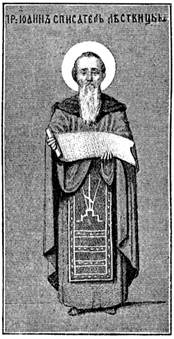
О месте рождения и воспитания преподобного Иоанна нет достоверных известий, как говорит писатель его жития инок Раифский Даниил. Существует, между прочим, предположение, что он значительное образование своё получил в Константинополе, и что он и брат его Георгий были сыновьями того благочестивого вельможи Ксенофонта и жены его Марии, о которых вспоминается 26-го января.
Concerning the place of birth and upbringing of the Venerable John, there is no reliable information, as the writer of his life, the monk Daniel of Raithu, says. There exists, among other things, a supposition that he received his considerable education in Constantinople, and that he and his brother George were sons of that pious nobleman Xenophon and his wife Mary, who are commemorated on the 26th of January.
Известно же, что на 16-м году своего возраста Иоанн оставил мир и прибыл на гору Синай, где процветало в и то время (в конце V в.) подвижничество.
It is known, however, that in the sixteenth year of his age John left the world and arrived at Mount Sinai, where asceticism flourished at that time (at the end of the 5th century).
«В стране, которая прежде называлась Аравией, а теперь называется Третьей Палестиной, – говорит историк Прокопий, живший во времена императора Юстиниана, – есть обширная пустыня безводная и лишённая плодоносных растений. В этой пустыне, недалеко от Чермного моря, одиноко возвышается гора, по имени Синай, на которую очень трудно восходить».
"In the country which was formerly called Arabia, and is now called Third Palestine," says the historian Procopius, who lived in the time of the Emperor Justinian, "there is a vast waterless desert, deprived of fruitful plants. In this desert, not far from the Red Sea, a mountain rises in solitude, by name Sinai, which is very difficult to ascend."
Эта пустынность и безмолвие всегда привлекали к себе отшельников; привлекали их также и воспоминания о великих событиях, совершившихся здесь в древние времена. Наконец, в половине IV-го века, когда в Египте утвердилось и чрезвычайно усилилось иночество и распространилось отсюда по всем странам, из Египта и из других стран во множестве приходили на Синай подвижники, искавшие ещё большего уединения и безмолвия, и любили там жить и умирать о Господе.
This desert solitude and silence always attracted hermits; they were also attracted by the remembrance of the great events which took place here in ancient times. Finally, in the middle of the 4th century, when monasticism was established in Egypt and grew exceedingly strong and spread from there to all lands, ascetics from Egypt and from other countries came in great numbers to Sinai, seeking even greater solitude and silence, and loved to live and die there in the Lord.
«На этой-то горе, Синае, – продолжает Прокопий, – живут пустынники, которые проводят жизнь в суровых трудах, в подвигах покаяния и непрестанного памятования смерти. Здесь беспрепятственно наслаждаются они глубоким уединением, которым дорожат более всего в мире. Император Юстиниан, не находя, что бы сделать для них, потому что они ничего не желали, всего более заботясь о снискании духа совершенной нестяжательности, об умерщвлении тела и об удалении себя от всякой привязанности ко всему тленному и преходящему, – построил для них храм во имя Пресвятой Богородицы, чтобы они возносили в нём свои молитвы и совершали таинства».
"On this mountain, Sinai," continues Procopius, "live hermits who spend their life in severe labors, in deeds of repentance and unceasing remembrance of death. Here they undisturbed enjoy the deep solitude which they value above all else in the world. The Emperor Justinian, not finding what he might do for them, because they desired nothing, caring above all for the acquisition of the spirit of perfect non-acquisitiveness, for the mortification of the body, and for the removal of themselves from every attachment to all that is corruptible and transitory, built for them a church in the name of the Most Holy Theotokos, that they might offer up their prayers in it and perform the Mysteries."
И прославились в Синайской пустыне дивные подвижники. Во второй половине IV века (370–373) был на Синае Египетский монах Аммоний и оставил сохранившееся до нашего времени свидетельство о жизни и подвигах Синайских пустынников. По его сказанию, эти отцы вели жизнь очень суровую и по своим подвигам более могли быть названы ангелами, нежели людьми. Тела их были иссушены постом и бдением. Они не вкушали ни вина, ни масла, ни хлеба и питались только финиками и желудями. Только для приходящих странников и Богомольцев хранилось у настоятеля несколько хлеба. Шесть дней недели иноки безмолвно проводили в кельях, рассеянных по горам и долинам. В субботу вечером собирались они в кириакон, т. е. храм Господень, построенный на месте явления Неопалимой Купины, совершали всенощное бдение и утром причащались Св. Таин. Потом расходились каждый в свою келью. Были между ними и молодые подвижники, которые по добродетелям своим равнялись с опытными и умудрёнными в иноческой жизни старцами.
And wondrous ascetics were glorified in the Sinai desert. In the second half of the 4th century (370–373), the Egyptian monk Ammonius was on Sinai and left a testimony, preserved to our time, about the life and labors of the Sinai hermits. According to his account, these fathers led a very severe life and, by their deeds, could more be called angels than men. Their bodies were dried up by fasting and vigil. They tasted neither wine, nor oil, nor bread, and fed only on dates and acorns. Only for arriving strangers and pilgrims was a little bread kept by the superior. Six days of the week the monks passed in silence in their cells, scattered over the mountains and valleys. On Saturday evening they gathered in the kyriakon, that is, the church of the Lord, built on the site of the appearance of the Burning Bush, performed the All-night Vigil, and in the morning partook of the Holy Mysteries. Then they dispersed, each to his own cell. There were among them also young ascetics who, by their virtues, equaled the experienced and wise elders in monastic life.
Сюда-то, на Синай, прибыл и юный Иоанн, привлечённый славой иноческого жития Синайских пустынников. Прежде всего он позаботился вверить себя руководству одного опытного подвижника, по имени Мартирия, и, относясь к этому руководству с безусловным послушанием, стал быстро преуспевать в духовной жизни. Собственным опытом изведав и пройдя через все степени послушания, вот что писал впоследствии Иоанн об этой добродетели: – «исшедшие из Египта имели вождём Моисея, а бежавшие из Содома – ангела. Так и желающие выйти из духовного Египта и избегнуть мысленного фараона имеют нужду в некоем Моисее, в ходатае к Богу, который воздевал бы о них к Богу свои руки, чтобы они перешли через греховное море и обратили в бегство духовного Амалика. Дитя, не имеющее сил подняться в гору, на руках отца может достигнуть самой и вершины её» ...
Hither, to Sinai, the young John also came, drawn by the fame of the monastic life of the Sinai hermits. First of all, he took care to entrust himself to the guidance of an experienced ascetic, by name Martyrius, and, relating to this guidance with absolute obedience, he began to advance quickly in the spiritual life. Having himself experienced by experience and passed through all the degrees of obedience, John later wrote thus concerning this virtue: "Those who came out of Egypt had Moses as their leader, and those who fled from Sodom had an angel. So also those who wish to come out of spiritual Egypt and escape the mental Pharaoh have need of a certain Moses, an intercessor with God, who would lift up his hands to God for them, that they might cross the sea of sin and put to flight the spiritual Amalek. A child, having no strength to climb a mountain, can reach even its summit in the arms of its father." ...
Скоро прозорливые старцы стали провидеть в Иоанне будущего великого подвижника. Когда, через три года по прибытии его на Синай, совершилось пострижение его в иноческий сан, то авва Стратегий, игумен обители преп. Феодосия, присутствовавший при обряде погребения, пророчески сказал об Иоанне, что это будет великая звезда вселенной.
Soon the clairvoyant elders began to foresee in John a future great ascetic. When, three years after his arrival at Sinai, his tonsure into the monastic rank took place, Abba Strategius, the abbot of the monastery of the Venerable Theodosius, who was present at the rite of burial, prophetically said of John that he would be a great star of the universe.
Ещё случилось, что Мартирий пришёл с Иоанном к Иоанну Савваиту в пустыню Гуддийскую; тогда Иоанн умыл ноги не Мартирию, а ученику его Иоанну и поцеловал руку его. Стефан, ученик Иоанна Савваита, спросил учителя: – почему ты умыл ноги не учителю, а ученику?
It also happened that Martyrius came with John to John of Sabbas in the Guddian desert; then John washed not the feet of Martyrius, but of his disciple John, and kissed his hand. Stephen, the disciple of John of Sabbas, asked his teacher: "Why did you wash not the teacher's feet, but the disciple's?"
Девятнадцать лет Иоанн жил вместе с Мартирием. По прошествии этого времени Мартирий скончался, и Иоанн решился подвизаться в самом строгом уединении и, посоветовавшись с преподобным Георгием Арселаитом, после продолжительной молитвы, удалился в самую уединённую пустыню, называвшуюся Фола, бывшую в углублении долины, при подошве Синая. Отсюда он ходил в храм, бывший в двух часах пути от его кельи, каждую субботу и воскресенье – для приобщения святых Таин. Трудно было бы изобразить все подвиги Иоанна в этой пустыне, где он проводил жизнь истинно ангелоподобную. Без сомнения, он сам в это время проходил все те степени нравственного усовершенствования и восхождения к Бого-подражательному бесстрастию, какие он показал и начертал в своём творении, называемом «Лествица, возводящая на небо».
For nineteen years John lived together with Martyrius. After this time Martyrius reposed, and John resolved to struggle in the strictest solitude and, having taken counsel with the Venerable George Arselaites, after prolonged prayer, he withdrew into the most secluded desert, called Thola, which was in the hollow of a valley at the foot of Sinai. From there he went to the church, which was two hours' journey from his cell, every Saturday and Sunday—for the communion in the Holy Mysteries. It would be difficult to depict all the labors of John in this desert, where he led a life truly angel-like. Without doubt, he himself at this time passed through all those degrees of moral perfection and ascent to God-imitating dispassion which he showed and delineated in his work called "The Ladder, which leads up to heaven."
Покаяние и сердечное умиление были так сильны в преподобном Иоанне, что молитва его была постоянно сопровождаема слезами277. Эти святые слёзы производили в его душе чудные последствия, как это видно из его собственных слов; в одном месте своей «Лествицы» он говорит: – «как огонь сожигает и уничтожает хворост, так чистая слеза омывает все нечистоты, наружные и внутренние». И ещё: «те, которые получили дар слёз, проводят каждый день своей жизни в духовном празднестве, и печаль их заключает в себе утешение и облегчение так же неизбежно, как воск в соте заключает в себе мёд».
Repentance and compunction of heart were so strong in the Venerable John that his prayer was constantly accompanied by tears277. These holy tears produced wondrous effects in his soul, as is evident from his own words; in one place of his "Ladder" he says: "As fire burns and consumes brushwood, so a pure tear washes away all impurities, outward and inward." And again: "Those who have received the gift of tears spend each day of their life in a spiritual feast, and their sorrow contains within it consolation and relief as inevitably as wax in the honeycomb contains honey."
Иоанн постоянно бодрствовал над сердцем своим, над малейшими его движениями и возбуждениями, не допуская войти в него никакому чувственному пожеланию, а это делало доступным для него – беспрепятственно и на полной свободе возноситься к Богу в непрестанной молитве. И сильна, и действенна была его святая молитва. Вот один из тех случаев, когда замечательно выразилось влияние Богоугодной молитвы праведника... У Иоанна был ученик, по имени Моисей. Однажды Иоанн приказал ему переносить в саду землю с одного места на другое, более удобное для растительности. Исполняя это однажды в полдень летнего знойного дня, Моисей, страдая от чрезмерного жара, прилёг отдохнуть под тенью большого утёса. Преподобный Иоанн находился в это время в своей келье, и после молитвенного труда отдыхал в лёгкой дремоте. И вот, ему представилось, будто подошёл к нему муж почтенного вида, который его будил и с упрёком говорил ему: «как ты, Иоанн, спокойно отдыхаешь здесь, а Моисей находится в опасности?» Иоанн тотчас пробудился и стал молиться за своего ученика. Когда вечером ученик его возвратился, то Иоанн спросил его: не случилось ли с ним чего-нибудь худого? Тот отвечал: – нет, но я подвергался большой опасности; меня чуть не раздавил большой обломок камня, оторвавшийся от утёса, под которым я в полдень уснул; к моему счастью, мне представилось во сне, что ты зовёшь меня, я вскочил и бросился в сторону от этого места, а в это время с шумом упал огромный камень на то самое место, откуда я убежал» ...
John constantly kept watch over his heart, over its slightest movements and stirrings, not allowing any sensual desire to enter it, and this made it possible for him, without hindrance and in full freedom, to ascend to God in unceasing prayer. And his holy prayer was powerful and effective. Here is one of those instances in which the influence of the God-pleasing prayer of a righteous man was remarkably manifested... John had a disciple, by name Moses. Once John ordered him to carry earth in the garden from one place to another, more suitable for vegetation. Fulfilling this one day at noon on a hot summer day, Moses, suffering from excessive heat, lay down to rest in the shade of a large cliff. The Venerable John was at that time in his cell, and after his prayerful labor was resting in a light slumber. And behold, it seemed to him that a man of venerable appearance approached him, who awakened him and said to him with reproach: "How is it, John, that you rest peacefully here, while Moses is in danger?" John immediately awoke and began to pray for his disciple. When in the evening his disciple returned, John asked him: "Did anything bad happen to you?" He answered: "No, but I was in great danger; I was almost crushed by a large fragment of rock that broke off from the cliff under which I fell asleep at noon; fortunately for me, it seemed to me in a dream that you were calling me; I jumped up and rushed aside from that place, and at that moment a huge stone fell with a crash onto the very place from which I had fled."
Об образе жизни преподобного Иоанна известно, что он уклонялся от всяких особенностей. В пищу он употреблял всё то, что не запрещалось уставом постнической жизни, но – умеренно. Не проводил ночей без сна, хотя спал не более того, сколько нужно для поддержания сил, чтобы непрестанным бодрствованием не погубить ума. – «Я не постился, – говорит он сам о себе, – и не предавался усиленному ночному бдению, не лежал на земле, но смирялся... и Господь скоро спас меня».
Concerning the manner of life of the Venerable John, it is known that he avoided all peculiarities. For food he used everything that was not forbidden by the rule of the ascetic life, but in moderation. He did not spend nights without sleep, although he slept no more than was necessary to maintain his strength, lest by unceasing vigil he should destroy his mind. "I did not fast," he says of himself, "nor did I give myself to intense night vigil, nor did I lie on the ground, but I humbled myself... and the Lord soon saved me."
В жизнеописании преподобного Иоанна замечательна следующая черта смирения. Одарённый высоким умом, умудрённый опытом, он с любовью поучал всех приходящих к нему, руководя их к спасению. Но когда явились некоторые, по зависти упрекавшие его во многоглаголании, которое объясняли они в смысле тщеславия, то Иоанн наложил на себя молчание: чтобы не подавать повода к осуждению, он вовсе и безмолвствовал в течение целого года: соблазнявшиеся о нём завистники сознали тогда своё заблуждение и сами приступили к нему с мольбой не лишать их духовной пользы, которую доставляла беседа его.
In the life of the Venerable John, the following trait of humility is remarkable. Endowed with a lofty mind, made wise by experience, he lovingly taught all who came to him, guiding them to salvation. But when some appeared who, out of envy, reproached him for much speaking, which they explained as vainglory, then John imposed silence upon himself: so as not to give occasion for judgment, he remained completely silent for a whole year. The envious ones who were offended at him then recognized their error and themselves came to him with entreaty not to deprive them of the spiritual benefit which his conversation provided.
Чтобы лучше упражняться в подвигах добродетели и вместе с тем, чтобы удобнее скрывать их от людей, Иоанн по временам уединялся в пещере; но, как он ни скрывал себя от человеческой славы, молва об его святости распространилась; к нему приходили посетители всех званий и состояний, жаждущие и назидающиеся его беседой.
In order to better exercise himself in the feats of virtue and at the same time to more conveniently conceal them from men, John would from time to time withdraw into a cave; but however much he hid himself from human glory, the report of his holiness spread; visitors of every rank and station, thirsting for and edified by his conversation, came to him.
40 лет провёл таким образом Иоанн в пустыне. Ему было уже 75 лет, когда братия, по смерти Синайского игумена, приступили к нему с мольбой оставить уединение и быть игуменом горы Синайской. Приняв это единодушное избрание, преп. Иоанн всей душой заботился о духовном благе братий и сам – в этом служении благу других приобретал все высшие совершенства. В «житии» его говорится, что он, «подобно Моисею, взошёл на гору (Синай), воспринял непостижимости Божии и, так сказать, приблизился к Богу посредством восхождений ума и получил Богоначертанный закон; отверз уши свои для принятия слова Божия; привлёк к себе дух и из благого сокровища сердца своего излил благие слова спасения. Водами Богомудрого учения своего напаял души с обилием, и текли они не по одной Синайской пустыне, но орошали и окрестные и оросили потом всю Церковь: по просьбе современника своего Иоанна, игумена Раифского, он изложил письменно истины учения и в назидание Церкви и на пользу её оставил после себя прекрасное творение, называемое «Лествица, возводящая на небо». Преподобный Иоанн управлял монастырём Синайским около четырёх лет, но незадолго до кончины он снова уединился в своей пустыне (Фоле), где и отошёл с миром к Богу, имея около 80-ти лет (около 563-го г.).
Thus John spent 40 years in the wilderness. He was already 75 years old when the brethren, after the death of the Sinaite abbot, approached him with entreaty to leave his seclusion and be the abbot of Mount Sinai. Accepting this unanimous election, the Venerable John cared with all his soul for the spiritual good of the brethren, and himself—in this service to the good of others—acquired all higher perfections. In his "Life" it is said that he, "like Moses, ascended the mountain (Sinai), received the incomprehensible things of God and, so to speak, drew near to God through ascents of the mind and received the God-inscribed law; he opened his ears to receive the word of God; he drew the Spirit to himself and from the good treasure of his heart poured forth good words of salvation. With the waters of his God-wise teaching he abundantly watered souls, and they flowed not only through the Sinaite wilderness, but also irrigated the surrounding regions, and afterwards watered the whole Church: at the request of his contemporary John, the abbot of Raithu, he set forth in writing the truths of doctrine, and for the edification of the Church and for her benefit left after him a beautiful work, called 'The Ladder, Leading to Heaven.'" The Venerable John governed the monastery of Sinai for about four years, but shortly before his end he again withdrew into his wilderness (Thola), where he reposed in peace unto God, being about 80 years old (about A.D. 563).
Сочинение преподобного Иоанна – «Лествица», представляющее в себе истинный путь к достижению высшего христианского совершенства, сделало имя его известным повсюду и дало ему название Лествичника. Цель этого сочинения – научить, что достижение спасения требует со стороны человека труда, самоотвержения и усиленных подвигов. Лествица заключает в себе тридцать степеней или подвигов: во 1-х, очищения греховной нечистоты, искоренения пороков и страстей в ветхом человеке; во 2-х, восстановления в человеке образа Божия. К ним присоединяется ещё несколько степеней приготовительных или начальных подвигов. Лествица, хотя и написана собственно для иноков и потому всегда была настольной книгой для иноков, живущих в общежитии, и отцы иноческой жизни, между прочими и Иосиф Волоколамский и другие, ссылались в своих наставлениях на Лествицу, как на лучшую книгу, тем не менее в ней может найти спасительное руководство и христианин, живущий в мире. Первой ступенью лествицы поставляется отречение от земных пристрастий, а на самой высоте её указывается союз трёх добродетелей – веры, надежды и любви.
The work of the Venerable John—"The Ladder," which presents the true path to the attainment of the highest Christian perfection—made his name known everywhere and gave him the name of Climacus. The purpose of this work is to teach that the attainment of salvation requires from man labor, self-denial, and intense struggles. The Ladder contains thirty steps or struggles: first, the cleansing of sinful impurity, the eradication of vices and passions in the old man; second, the restoration of the image of God in man. To these are added several preparatory or initial steps of struggle. Although the Ladder was written specifically for monks and therefore has always been a handbook for monks living in community, and the fathers of monastic life, among them Joseph of Volokolamsk and others, referred in their instructions to the Ladder as the best book, nevertheless a Christian living in the world can also find saving guidance in it. The first step of the ladder is set as renunciation of earthly attachments, and at its very summit is indicated the union of the three virtues—faith, hope, and love.
«Тщеславие высказывается при каждой добродетели. Когда напр. храню пост – тщеславлюсь, и когда, скрывая пост от других, разрешаю на пищу, опять тщеславлюсь, – благоразумием. Одевшись в светлую одежду, побеждаюсь любочестием, и переодевшись в худую, тщеславлюсь. Говорить ли стану? Попадаю во власть тщеславия. Молчать ли захочу? опять предаюсь ему. Куда ни поверни это терние, оно всё станет спицами к верху. Тщеславный есть идолопоклонник христианский. На взгляд он чтит Бога, а на деле более старается угодить людям, чем Богу... Ублажающий бо нас прельщают ны, говорит пророк (Исаия III). Люди высокого духа сносят обиду благодушно и охотно; а слушать похвалы и не ощущать никакой приятности могут только святые и непорочные... Когда услышишь, что ближний или друг твой, в глаза или за-глаза, злословит тебя, похвали и полюби его... Не тот показывает смирение, кто сам себя бранит: как быть несносным самому себе? но кто, обесчещенный другим, не уменьшает своей любви к нему.... Кто превозносится природными дарованиями – счастливым умом, высокой образованностью, чтением, приятным произношением и другими подобными качествами, которые легко приобретаются, тот никогда не приобретёт даров сверхъестественных. Ибо кто в малом не верен, тот и во многом будет не верен и тщеславен. Часто случается, что Сам Бог смиряет тщеславных, насылая неожиданное бесчестие... Если молитва не истребит тщеславного помысла, – приведём на мысль исход души из этой жизни. Если и это не поможет, устрашим его позором страшного суда. Возносяйся смирится даже здесь, прежде будущего века. Когда хвалители, или лучше – льстецы начнут хвалить нас, тотчас приведём себе на память все беззакония свои и – найдём, что вовсе не стоим мы того, что нам приписывают».
"Vainglory manifests itself with every virtue. For example, when I keep a fast, I become vainglorious; and when, concealing the fast from others, I allow myself food, I again become vainglorious—through prudence. Clothed in bright raiment, I am overcome by love of honor; and having changed into poor clothing, I become vainglorious. Shall I speak? I fall into the power of vainglory. Shall I wish to be silent? Again I give myself up to it. Wherever you turn this thorn, it will always stand with its spikes upward. The vainglorious man is a Christian idolater. In appearance he honors God, but in deed he strives more to please men than God... For they that bless us lead us astray, says the prophet (Is. 3:12). Men of lofty spirit bear an insult with good will and readiness; but to hear praises and feel no pleasure is possible only for the holy and pure... When you hear that your neighbor or friend, to your face or behind your back, slanders you, praise him and love him... Not he who reproaches himself shows humility: for how can one be unbearable to oneself? but he who, being dishonored by another, does not diminish his love for him... He who prides himself on natural gifts—a happy mind, high education, reading, pleasant speech, and other similar qualities which are easily acquired—will never acquire supernatural gifts. For he who is unfaithful in little will also be unfaithful and vainglorious in much. It often happens that God Himself humbles the vainglorious by sending unexpected dishonor... If prayer does not destroy the vainglorious thought, let us bring to mind the departure of the soul from this life. If this does not help, let us frighten him with the shame of the dread judgment. He that exalteth himself shall be humbled even here, before the future age. When praisers, or rather flatterers, begin to praise us, let us immediately call to mind all our iniquities, and we shall find that we are not at all worthy of what is ascribed to us."
О подвиге уклонения от мира (степ. III) преп. Иоанн Лествичник между прочим говорит: «мы отходим в пустыню не потому, чтобы ненавидели домашних своих или места, нами обитаемые, нет, но убегая происходящего от них вреда. Как во всех случаях, так и в этом особенно – Учителем нашим есть Сам Христос; так как и Он плотских Своих родителей, как видно, многократно оставлял. Он, услышав от некоторых: Мать Твоя и братия Твои ищут Тебя, – как добрый наш Владыка и Учитель, немедленно показал непорочную Свою ненависть к ним такими словами: Мать Моя и братия Мои суть творящие волю Отца Моего, Иже на небесех... Да будет же и тебе отцом тот, кто может или хочет трудиться вместе с тобой для снятия с тебя твоих согрешений. Матерью тебе да будет сердечное сокрушение, могущее обмыть тебя от нечистоты твоей. Братом тебе да будет тот, кто помогает тебе в путешествии твоём на небо и вместе с тобой на нём подвизается. Неразлучную при себе служительницу имей память смертную. Любезные дети да будут у тебя сердечные стенания. Слугой имей своё тело, а друзьями – умные Небесные силы. Пристрастие к кому-нибудь из домашних или чужих... может опять привлечь к миру и мало по малу погасить огонь сердечного сокрушения о грехах.
Concerning the struggle of withdrawal from the world (step III), the Venerable John Climacus says, among other things: "We depart into the wilderness not because we hate our household or the places we inhabit, no, but fleeing the harm that comes from them. As in all cases, so especially in this, our Teacher is Christ Himself; for He also, as is evident, repeatedly left His fleshly parents. He, having heard from some: 'Thy mother and Thy brethren seek Thee,' as our good Master and Teacher, immediately showed His blameless hatred for them with these words: 'My mother and My brethren are they that do the will of My Father which is in heaven'... Let him who can or wishes to labor together with you for the removal of your sins be a father to you. Let heartfelt compunction, which can wash you from your uncleanness, be a mother to you. Let him who helps you in your journey to heaven and struggles together with you on it be a brother to you. Have the remembrance of death as an inseparable servant with you. Let heartfelt groanings be your beloved children. Let your body be your servant, and the intelligent Heavenly powers your friends. Attachment to anyone of your household or strangers... can again draw you to the world and little by little quench the fire of heartfelt compunction for sins.
Примеры из жизни преп. Иоанна Лествичника служат образцом той святой ревности о своём душевном спасении, которая необходима каждому человеку, желающему жить благочестиво, – а письменное изложение его мыслей, составляющих плод многих и утончённых наблюдений его над своею душой и глубокого опыта, заключающееся в оставшемся после него сочинении «Лествица рая», служит руководством и великим пособием на пути к истине и добру. Степени Лествицы – это перехождение из силы в силу на пути стремления человека к совершенству, которое не вдруг, но только с постепенностью может быть достигаемо, подобно тому, как и «Царствие Божие силою берётся, и только употребляющие усилие восхищают его» ... (Евангелие от Мф.11:12).
Examples from the life of the Venerable John Climacus serve as a model of that holy zeal for one's own spiritual salvation which is necessary for every man who desires to live piously—and the written exposition of his thoughts, which constitute the fruit of many and subtle observations of his own soul and of deep experience, contained in the work left after him, "The Ladder of Paradise," serves as a guide and great aid on the path to truth and goodness. The steps of the Ladder are a passing from strength to strength on the path of man's striving toward perfection, which is attained not suddenly, but only gradually, just as "the Kingdom of God suffereth violence, and the violent take it by force" (Gospel of Mt. 11:12).
Небольшого повода бывает достаточно, чтобы воспламенить вечно возбуждённое настроение магометан против христианского населения, но в настоящем случае, без всякого повода, единственно только пастырскими своими добродетелями возбудил ненависть мусульманского населения «добрый и Богобоязненный пастырь стада Христова, сиявший на кафедре своей, как лампада на свещнике», как выражается о нём описатель жизни его.
A small occasion is sufficient to inflame the ever-excited disposition of the Mohammedans against the Christian population, but in this case, without any occasion, solely by his pastoral virtues, did the "good and God-fearing shepherd of the flock of Christ, who shone on his cathedra like a lamp on a lampstand," as the writer of his life expresses it, arouse the hatred of the Muslim population.
Турки оклеветали его в тайной переписке с «Франками», которых будто бы епископ призывал в Коринф и обещал помочь им завладеть городом. С яростью набросился взволновавшийся такими вестями народ на жилище христианского епископа и, закованный в цепи, осыпаемый побоями и проклятиями, Захария был приведён к судье.
The Turks slandered him, accusing him of secret correspondence with the "Franks," whom the bishop was supposedly summoning to Corinth and promising to help them take possession of the city. With fury the people, agitated by such reports, rushed upon the dwelling of the Christian bishop, and, bound in chains, showered with blows and curses, Zacharias was brought before the judge.
– Сохрани меня Бог от такого безумия! – отвечал епископ, – избави Боже, чтобы я отрёкся от Господа моего Иисуса Христа, Бога истинного! Нет, я верую в Него, Бога всемогущего, Творца всего мира, и готов пролить кровь мою за святое имя Его!
"God preserve me from such madness!" answered the bishop. "God forbid that I should deny my Lord Jesus Christ, the true God! No, I believe in Him, the Almighty God, the Creator of the whole world, and I am ready to shed my blood for His holy name!"
Возобновление побоев было ответом на эти слова нового исповедника Христова; потом его заключили в тюрьму, где подвергли таким жестоким пыткам, на которые только способен изощриться магометанский фанатизм. Терпение мученика оказалось однако же выше даже жестокости мучителей, которые наконец придумали мучительнейшую смерть для своей жертвы – пронзить вертелом страдальца и жарить его как агнца на огне...
The renewal of blows was the answer to these words of the new Confessor of Christ; then they cast him into prison, where they subjected him to such cruel tortures as only Mohammedan fanaticism is capable of devising. The patience of the martyr, however, proved to be higher even than the cruelty of the tormentors, who at last devised a most painful death for their victim—to pierce the sufferer with a spit and roast him like a lamb on the fire...
Однако же, с помощью большего выкупа, удалось возмущённым таким приговором, преданным своему святителю христианам избавить его от такой лютой смерти. Приговор был смягчён и епископ Захария был обезглавлен в своей епархии в третье воскресенье после Крестопоклонной недели, в 1684-м году.
However, with the help of a large ransom, the Christians, devoted to their Hierarch and outraged by such a sentence, succeeded in delivering him from such a cruel death. The sentence was commuted, and Bishop Zacharias was beheaded in his diocese on the third Sunday after the Sunday of the Veneration of the Cross, in the year 1684.
Рукоположен во епископа папой Феодором (641–649) из настоятелей одного монастыря, в котором он был тридцать лет иноком, а потом в продолжение сорока лет – настоятелем и пресвитером. В епископстве преп. Зосима отличался в особенности милосердием, так что однажды снял с себя одежду, чтобы вырученные за неё деньги отдать бедным; руководил паству свою и словом и примером; украсил храм Божией Матери. Поражённый предсмертной болезнью, он лежал на грубой подстилке, покрытый худой одеждой, и когда постельничий императора Константа II (642–668), последние шесть лет царствования жившего в Сиракузах, Евпраксий подарил больному богатую постель, то он, немного полежав на ней, велел продать её и деньги употребить на призреваемых бедных. После 13-ти-летнего управления своей паствой, св. Зосима скончался около 662 г. Многие больные исцелены были при кончине его, при одном прикосновении к его гробнице.
He was consecrated bishop by Pope Theodore (641–649) from among the abbots of a monastery in which he had been a monk for thirty years, and then for forty years—abbot and priest. In his episcopacy, the Venerable Zosimas was distinguished especially by mercy, so that once he took off his own clothing in order to give the money obtained for it to the poor; he guided his flock both by word and example; he adorned the church of the Mother of God. Stricken with a mortal illness, he lay on a coarse mat, covered with a poor garment, and when the chamberlain of Emperor Constans II (642–668), who lived the last six years of his reign in Syracuse, Eupraxius, gave the sick man a rich bed, he, after lying on it a little while, ordered it to be sold and the money used for the poor under care. After a 13-year governance of his flock, St. Zosimas reposed around the year 662. Many sick were healed at his death, at the mere touch of his tomb.
Святого Апостола Кифы, от семидесяти. По преданию, епископствовал в Икопии. О нём упоминает Апостол Павел, говоря, что Христос по воскресении явился Кифе, потом двенадцати (1Кор.15:5). См. 4 янв. в соборе 70.
Of the Holy Apostle Cephas, of the Seventy. According to tradition, he was bishop in Icopia. The Apostle Paul makes mention of him, saying that Christ after the resurrection appeared to Cephas, then to the twelve (1 Cor. 15:5). See January 4, in the Council of the Seventy.
Преподобной Монаки Александрийской. IV века. Это – девственница, вразумлённая в своей гордости и любостяжании Макарием, надзирателем богадельни увечных. См. 3 марта о святой Пиаме.
Of the Venerable Monaca of Alexandria. IV century. She was a virgin, admonished in her pride and love of gain by Macarius, the overseer of the almshouse for the crippled. See March 3 concerning St. Piama.
Долго после его кончины показывали очень тесную пещеру, место его тайных подвигов, прозванную слезоточной, потому – что она была орошена слезами преподобного.
Long after his repose, they would show a very narrow cave, the place of his secret struggles, called the tearful cave, because it was bedewed with the tears of the Venerable One.