О Марке, епископе города Аретузы в Сирии, говорит Григорий Богослов (в первом слове на Юлиана), что «при императоре Констанции, по данной тогда христианам власти, он разрушил одно демонское жилище· и многих от языческого заблуждения обратил на путь спасения не менее своей светоносной жизнью, как и силой слова. За это жители Аретузы, приверженные к почитанию демонов, негодовали на него. И когда дела христиан поколебались, а язычество начало воздыматься при Юлиане Отступнике, то Марк, видя против себя движение толпы, сначала решается бежать, не столько по малодушию, сколько последуя заповеди, которая повелевает бегать из города в город (Мф.10:23) и уклоняться от гонителей; но узнавши, что многих за него влекут и гонят, не захотел жизнью других искупать свою безопасность, возвратился из бегства и выдал себя народу – делать с ним что хотят. С него потребовали или построить вновь разрушенное капище, или заплатить положенную ими высокую цену за него; и когда он отказал, то подвергли самым неистовым пыткам: влекли его по улицам, сталкивали в нечистые ямы, волочили за волосы, не оставили ни одной части тела, над которою бы не наругались. Язычники, наконец, сбавили цену до самого малого количества и вынуждали уплаты, применяя самые изысканные пытки: уши резали нитками, облитого мёдом выставляли на зной и снедение осам и пчёлам. Но святой старец, не о деньгах помышляя, а о святой вере ревнуя, мужественно терпел пытки». И видя твёрдость дивного старца, говорит историк (Феодорит III, 6), Арефузяне умилились и пустили его свободным; затем от него же поучались и были все христианами. Скончался мирно в глубокой старости.
Concerning Mark, the bishop of the city of Aretusa in Syria, Gregory the Theologian says (in his first oration against Julian) that "during the reign of the Emperor Constantius, when Christians then had authority, he destroyed a certain dwelling-place of demons, and turned many from pagan error to the path of salvation no less by his radiant life than by the power of his word. For this, the inhabitants of Aretusa, who were devoted to the worship of demons, were indignant against him. And when the affairs of Christians were shaken, and paganism began to rise again under Julian the Apostate, Mark, seeing the movement of the crowd against him, at first resolved to flee, not so much out of cowardice as in obedience to the commandment which bids us flee from city to city (Mt. 10:23) and to withdraw from persecutors; but learning that many were being dragged and persecuted on his account, he did not wish to purchase his own safety at the cost of others' lives, and so he returned from flight and gave himself up to the people, to do with them as they wished. They demanded of him either to rebuild the temple he had destroyed, or to pay the high price they had set upon it; and when he refused, they subjected him to the most savage tortures: they dragged him through the streets, cast him into filthy pits, pulled him by the hair, and left no part of his body uninsulted. At last the pagans reduced the price to a very small amount and forced him to pay, applying the most exquisite tortures: they cut his ears with threads, and having smeared him with honey, they exposed him to the heat and to the stinging of wasps and bees. But the holy elder, not thinking about money but zealous for the holy faith, courageously endured the torments." And seeing the steadfastness of the wondrous elder, the historian (Theodoret III, 6) says, the people of Aretusa were moved to compassion and let him go free; then they were instructed by him and all became Christians. He reposed peacefully in extreme old age.
Кирилл был диаконом Илиопольской Церкви в Финикии, где сокрушил много идолов при Константине Великом; а в царствование Юлиана язычники умертвили его и мёртвому разрезавши живот в ярости кусали зубами. Тогда в Газе и Аскалоне много мучеников обоего пола умерло среди мук; изуверы рассекали на части тела их, пожирали сырые печени их, а другие посыпали внутренности ячменём и отдавали на съедение свиньям.
Cyril was a deacon of the Church of Heliopolis in Phoenicia, where he destroyed many idols under Constantine the Great; but in the reign of Julian, the pagans put him to death, and when he was dead, they cut open his belly in their rage and bit him with their teeth. At that time, in Gaza and Ascalon, many martyrs of both sexes died amid torments; the fanatics cut their bodies into pieces, devoured their raw livers, and others sprinkled their entrails with barley and gave them to swine to eat.
Будучи ещё отроком, Иоанн вместе с матерью своею, христианкой Иулианией и сестрой Фимистией, во время гонения на христиан, бывшего в IV-м веке, скрывался в Кивистре в Малой Армении. В это время благочестивая Иулиания всю душу свою полагала на дело воспитания детей своих в христианском разуме. Она тщательно поучала их закону Божию и постоянно беседовала с ними об Иисусе Христе и о святых Божиих. Из тайного убежища их Иоанн уходил иногда молиться в киновию. Здесь встретился он однажды с одним Боголюбивым человеком, который посоветовал ему поселиться на одной уединённой горе, вероятно, имея в виду для мальчика и более верное убежище от мучителей и вместе с тем – избавление от мирских людей, которые могли бы совратить с пути молодую, неопытную, не укрепившуюся его душу...
While still a youth, John, together with his mother, the Christian Juliana, and his sister Themistia, hid in Cybistra in Lesser Armenia during the persecution of Christians that took place in the fourth century. At that time, the pious Juliana devoted her whole soul to the work of raising her children in the Christian understanding. She diligently taught them the law of God and constantly conversed with them about Jesus Christ and the saints of God. From their secret hiding place, John would sometimes go to pray at a cenobium. Here he once met a certain God-loving man, who advised him to settle on a solitary mountain, probably having in mind for the boy both a more secure refuge from the tormentors and, at the same time, deliverance from worldly people who might lead astray his young, inexperienced, and unstrengthened soul...
Иоанн сообщил этот совет своей матери, попросил её помолиться, чтобы Бог помог ему исполнить его... Мать отпустила сына, надеясь, что он скоро возвратится. Иоанн же, поцеловав мать и сестру, ушёл в пустыню, где, встретив отшельника, по имени Фармуфия (пам. 11 апр.), поселился близ него в глубоко-вырытом пустом колодце и стал там жить, питаясь тем, что доставлял ему Фармуфий.
John shared this advice with his mother and asked her to pray that God would help him fulfill it... His mother let her son go, hoping that he would soon return. John, having kissed his mother and sister, went into the wilderness, where, meeting a hermit named Pharmuthius (commemorated April 11), he settled near him in a deeply dug empty well and began to live there, nourished by what Pharmuthius brought him.
Десять лет прожил Иоанн в этом колодце... Неизобразима та жизнь, которою жилось тут отроку – истинно в сообществе ангелов, охранявших его, и которым он был подобен... Слава Божия совершалась в таком образе жизни человеческого создания.
John lived in this well for ten years... Inexpressible is the life that the youth lived there—truly in the company of angels, who guarded him, and to whom he was like... The glory of God was accomplished in such a manner of life of a human creature.
Дивная борьба между отроческой беспомощностью и той силой, которая кроется в глубине человеческого духа – даже в душе отрока, не достигшего полного разума – совершалась перед очами Единого Всевидящего... Дивное провидение Божие вело и охраняло эту молодую, всецело вверившуюся Ему душу – и сила духа восторжествовала над слабостью телесного естества.
A wondrous struggle between youthful helplessness and that power which lies hidden in the depths of the human spirit—even in the soul of a youth who has not attained full reason—took place before the eyes of the One All-Seeing... The wondrous providence of God led and guarded this young soul, which had wholly entrusted itself to Him—and the strength of the spirit triumphed over the weakness of the bodily nature.
Нередко страх и одиночество должны были угнетать молодую душу; нередко образы плачущих матери и сестры манили к себе отрока. Но он отступал перед ними, удерживаемый другим образом, образом Бога, населившим его уединение, образом Бога, присущим непорочной душе...
Not infrequently, fear and loneliness must have oppressed the young soul; not infrequently, the images of his weeping mother and sister beckoned to the youth. But he drew back from them, held back by another image—the image of God, which filled his solitude, the image of God present in his pure soul...
Дитя благочестивой матери, перелившей в него свою Боголюбивую душу, Иоанн соделался благодатным сосудом молитвы и стремления к единому Богу, предвосхитивших для него Царствие Небесное прежде конца земной жизни.
A child of a pious mother, who had poured her God-loving soul into him, John became a grace-filled vessel of prayer and striving toward the one God, which anticipated for him the Kingdom of Heaven before the end of his earthly life.
«Слава Тебе, Владыко, что любящих Тебя Ты Сам знаешь и соделываешь их причастниками Небесного Твоего Царствия!» воскликнул некто Хрисихий, бывший инок, но с давних лет обитатель пустыни, которому Господь привёл обрести и узнать короткую, но полную беспредельного содержания повесть юноши, пожившего и скончавшегося в подземном колодце, – и который передал рассказ о нём, чтобы он был записан для памяти людей во славу Господа, дивного во святых Своих.
"Glory to Thee, O Master, that Thou Thyself knowest those who love Thee and makest them partakers of Thy Heavenly Kingdom!" exclaimed a certain Chrysichius, a former monk but for many years an inhabitant of the wilderness, whom the Lord led to find and learn the short but infinitely full story of the youth who had lived and reposed in an underground well—and who related the account of him, that it might be written down for the remembrance of people, to the glory of the Lord, who is wondrous in His saints.
Преподобный Иона, в мире Иоанн, был священником в г. Юрьеве (Дерпте), куда прислан был из Москвы. По последнему обстоятельству Псковичи называли его шестником (переселенцем). В Юрьеве прожил он два года с половиною, усердно исправляя дела звания своего для Русских, населявших Русский конец Дерпта. – Немцы, тогда усердные слуги папы, стали принуждать его и его детей к унии. Благочестивый пастырь терпел разные оскорбления, но в 1470 г. он вынужден был удалиться в Псков вместе с супругой и детьми. – Узнав здесь, что товарищ его, блаженный Исидор, мужественно претерпел страдальческую смерть за святую веру, он решился на страдания пустынной жизни. – Дошло до него сведение, что на границе Лифляндии, на реке Камянке, есть природная пещера; он пошёл, осмотрел её и полюбил уединённую местность, тем более, что здесь надеялся он иметь сношения и с гонимыми чадами православия. – Взяв супругу и детей из Пскова и поместив их у владельца земли, где была пещера, сам начал копать в горе за пещерой место для храма Божия. Вскоре супруга его, в иночестве Васса, умерла и положена была в пещере. Иоанн принял иночество с именем Ионы. Окончив пещерный храм и при нём две кельи, испросил он у архиепископа Феофила благословение на освящение храма, и храм освящён был в 1477 г. Псковскими священниками, в честь Успения Богоматери. При освящении храма перед храмовой иконой исцелела слепая; это утешило искреннего подвижника. Владелец места Иоанн Дементьевич уступил под монастырь землю, на версту вокруг обители. Блаженный Иона усердно подвизался в пещере и здесь свято почил около 1480 года. По смерти его на его теле найден кольчатый панцирь, который носил он на себе тайно, для усмирения плоти; панцирь повесили над гробом его; Немцы в одно из нападений своих унесли и эту собственность святого старца. – Мощи его честно положены в пещере274.
The Venerable Jonah, in the world John, was a priest in the city of Yuriev (Dorpat), to which he was sent from Moscow. Because of this latter circumstance, the people of Pskov called him a shestnik (a settler). He lived in Yuriev for two and a half years, diligently fulfilling the duties of his calling for the Russians who inhabited the Russian end of Dorpat. The Germans, then zealous servants of the pope, began to force him and his children into union. The pious pastor endured various insults, but in 1470 he was compelled to withdraw to Pskov together with his wife and children. Learning there that his companion, the blessed Isidore, had courageously suffered a martyr's death for the holy faith, he resolved upon the sufferings of the hermit life. Word reached him that on the border of Livonia, on the river Kamenka, there was a natural cave; he went, examined it, and loved the solitary place, all the more because he hoped here to have contact also with the persecuted children of Orthodoxy. Taking his wife and children from Pskov and placing them with the owner of the land where the cave was, he himself began to dig in the mountain behind the cave a place for a church of God. Soon his wife, who in monasticism was named Vassa, died and was buried in the cave. John received monastic tonsure with the name Jonah. Having completed the cave church and two cells beside it, he asked the blessing of Archbishop Theophilus for the consecration of the church, and the church was consecrated in 1477 by Pskov priests in honor of the Dormition of the Mother of God. At the consecration of the church, a blind woman was healed before the church icon; this comforted the sincere ascetic. The owner of the place, John Dementievich, ceded the land for the monastery, for a verst around the monastery. The blessed Jonah zealously struggled in the cave and there reposed in holiness around the year 1480. After his death, a chain-mail armor was found on his body, which he had secretly worn to subdue the flesh; the armor was hung over his tomb. The Germans, during one of their attacks, carried away even this possession of the holy elder. His relics were honorably placed in the cave274.
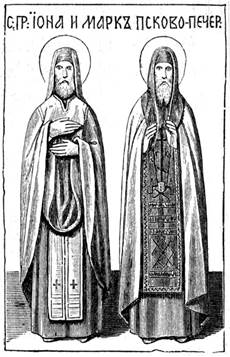
Прежде преподобного Ионы подвизался в той же природной пещере преподобный Марк. Звероловы видели его то у трёх камней на горе, то на потоке Каменке, близ того места, где после найдена пещера; два из этих камней и теперь ещё видны близ кровли Успенской церкви, обросшие мхом, под вековыми дубами; один весь на поверхности, другой глубоко опустился в землю, но третий уже совсем ушёл в неё. Летопись передаёт рассказ очевидца зверолова Изборского: «раз случайно пришли мы с отцом на край горы (где теперь церковь Богородицы) и слышим как будто церковное пение; пели стройно, благоговейно, а певцов не видно было, и воздух наполнен был благоуханием фимиама». Без сомнения, это были пустынники, совершавшие в пещере вечернее Богослужение, – блаженный Марк с одним или двумя учениками. – Преемник преподобного Ионы внёс блаженного Марка в Синодик, как первого подвижника Псковской пещеры. Преподобный Корнилий в своё время усомнился в верности записи, так как не найдено письменного памятника о его подвигах, и велел изгладить имя его из Синодика. Но внезапно поражённый болезнью, он известился в духе о причине болезни и велел несть себя к гробу старца. Здесь, испросив себе прощение слёзной молитвой, он получил исцеление и повелел опять внести преподобного Марка в Синодик275.
Before the Venerable Jonah, the Venerable Mark struggled in the same natural cave. Hunters saw him sometimes at three stones on the mountain, sometimes on the stream Kamenka, near the place where the cave was later found; two of these stones are still visible near the roof of the Dormition Church, overgrown with moss, under age-old oaks; one is entirely on the surface, another has sunk deep into the earth, but the third has already completely disappeared into it. The chronicle transmits the account of an eyewitness, a hunter from Izborsk: "Once, by chance, my father and I came to the edge of the mountain (where the church of the Mother of God now is) and heard what seemed like church singing; they sang harmoniously, reverently, but the singers were not visible, and the air was filled with the fragrance of incense." Without doubt, these were the hermits performing the evening service in the cave—the blessed Mark with one or two disciples. The successor of the Venerable Jonah entered the blessed Mark into the Synodicon as the first ascetic of the Pskov Cave. The Venerable Cornelius, in his time, doubted the accuracy of the record, since no written memorial of his struggles was found, and he ordered his name to be erased from the Synodicon. But suddenly struck by illness, he was informed in spirit of the cause of his illness and ordered himself to be carried to the elder's tomb. There, having asked forgiveness with tearful prayer, he received healing and commanded that the Venerable Mark be again entered into the Synodicon275.
В 1642 году по грамоте Псковского епископа Геннадия устроены были новые гробницы с покрывалами, и в них с пением псалмов положены были мощи первых подвижников пещеры; гробница преподобного Марка и преподобного Ионы поставлены были на прежних местах: первая под образом Спасителя, вторая – при входе в пещеру на правой стороне; гробница же преподобной Вассы с левой стороны перенесена на правую276.
In 1642, by a charter of Gennadius, Bishop of Pskov, new tombs with coverings were made, and the relics of the first ascetics of the cave were placed in them with the singing of psalms; the tomb of the Venerable Mark and that of the Venerable Jonah were set in their former places: the first under the icon of the Savior, the second at the entrance to the cave on the right side; the tomb of the Venerable Vassa was moved from the left side to the right276.
О начале Печерск. монаст., стр. 25. Μ. 1831. Ркп. святцы: „преподобные отцы Печерские, первоначальник Марк и Иона священноинок и строитель, в л. 6900 месяца марта в 29 день“. По Отен. сп. „память их марта 20 дня“. Между рукоп. п. Филарета, по описи 1630 г., „повесть о Печерском монаст. и о первом старце Марке и о чудесех Пресв. Богородицы“; ещё две книги „о Печерском монастыре, что во Пскове“. Иванова опис. государ. арх. 292. 293. Μ. 1849 года.
O nachale Pechersk. monast., p. 25. M. 1831. Rkp. svyatsy: "the Venerable Fathers of the Caves, the founders Mark and Jonah, hieromonk and builder, in the year 6900, month of March, on the 29th day." According to the Oten. sp. "their commemoration is March 20." Among the manuscripts of p. Philaret, according to the inventory of 1630, "the story of the Pechersk Monastery and of the first elder Mark and of the miracles of the Most Holy Theotokos"; also two books "about the Pechersk Monastery, which is in Pskov." Ivanov's description of the state archive. 292. 293. M. 1849.