Уроженец Селевкии Писидийской, он просвещён св. Павлом Апостолом около 45 года по Р. Хр. (Деян.14) и поставлен во епископа тому городу. Богоугодно правя вручённой ему паствой, в старости глубокой преставился ко Господу.
A native of Seleucia of Pisidia, he was enlightened by St. Paul the Apostle around the year 45 A.D. (Acts 14) and was appointed bishop of that city. Having piously governed the flock entrusted to him, he reposed in the Lord in extreme old age.
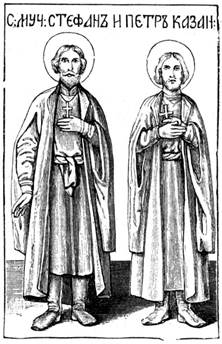
«Не бойтесь убивающих тело, но не могущих убить души; а бойтесь паче могущего и душу и тело погубить в геенне» (Мф.10:28), так учил Спаситель. Но так не учил и не мог учить Магомет. Нравственность Магометова низка и грязна: она растлевает душу и тело здесь ещё, в жизни земной; такова же и вечность Магометова. Кто бы стал слушать Магомета, если бы и стал он требовать жертвования жизнью временной за его веру? Его грязной вечностью может ли дорожить душа, созданная по образу Божию? Другое дело вечность христианская: она столько же возвышенна, чиста, духовна, как чиста и духовна нравственность христианская. Это видит, это чувствует душа бессмертная. Это увидели блаженные Стефан и Пётр, бывшие магометане Казанские, и пожертвовали жизнью за высокое учение христианское.
"Fear not those who kill the body, but who cannot kill the soul; rather fear the one who can destroy both soul and body in Gehenna" (Mt. 10:28), so taught the Savior. But not so did Mohammed teach, nor could he. The morality of Mohammed is base and filthy: it corrupts the soul and body even here, in earthly life; and such also is the eternity of Mohammed. Who would listen to Mohammed, even if he were to demand the sacrifice of temporal life for his faith? Can a soul created in the image of God value his filthy eternity? Another matter is Christian eternity: it is as exalted, pure, and spiritual as Christian morality is pure and spiritual. This the immortal soul sees and feels. This the blessed Stephen and Peter, former Mohammedans of Kazan, saw, and they sacrificed their lives for the high Christian teaching.
Когда Тимофей, протопоп Кремлёвского собора, находился в Свияжске, быв послан туда с посланием митрополита к войску (это было в 1552 г.)229; то пришёл к нему татарин из Арской стороны и объявил, что желает он креститься. Протоиерей спросил его: не от бедности ли, или не от страха ли ищет он крещения? В ответ на это татарин рассказал следующее: «я лет 30 был болен ногами, так что не мог твёрдо стоять на них. Когда власть Московского царя стала сильной в нашей стороне, и с ней стал известным Бог христианский, я начал думать: велик Бог, в Которого веруют христиане; Он может дать здоровье и моим больным ногам; буду же веровать Ему и крещусь со всем домом. И внезапно, в самый день решимости моей, ноги мои стали здоровы. И вот я пришёл исполнить моё обещание. Прошу вас, крестите меня». Протоиерей сказал ему: «по твоей вере Господь Иисус дал тебе здоровье, ты видишь благодать Его на тебе; если хочешь получить жизнь вечную, ничто не мешает тебе креститься. Только смотри – не возвратись, как пёс на свою блевотину; будь твёрд и против обольщений и против гонений со стороны неверных христианину надобно многими скорбями достигать Царствия Небесного». Татарин вырвал клок из бороды своей и, разорвав его на мелкие части, сказал: «я так убеждён в могуществе и благости Бога вашего, в превосходстве вашей веры, что не только готов терпеть скорби, но если бы разорвали меня на части, как разорвал я мои волосы, – и тогда не откажусь от Бога вашего». После того он оглашён был в вере и крещён во имя Отца и Сына и Св. Духа, с именем Стефана. Спустя немного времени восстали против него свои и долго заставляли то увещаниями, то угрозами отступить от христианской веры. Твёрдый верой Стефан не только не хотел следовать их убеждениям, но напротив обличал нечестие их веры и смело проповедовал имя Христово. Нечестивые, не терпя слышать проповедь его, напали на него с оружиями, изрубили тело его в куски, разметали кости его, а дом разграбили. Так скончался раб Божий Стефан, пострадавший за имя Христово230.
When Timothy, the protopope of the Kremlin cathedral, was in Sviyazhsk, having been sent there with a message from the metropolitan to the army (this was in 1552),229 a Tatar from the Arsk side came to him and declared that he wished to be baptized. The archpriest asked him: was it not from poverty, or from fear, that he sought baptism? In answer to this, the Tatar related the following: "For 30 years I was ill in my legs, so that I could not stand firmly upon them. When the power of the Moscow Tsar became strong in our region, and with it the Christian God became known, I began to think: great is the God in whom the Christians believe; He can give health even to my ailing legs. I will believe in Him and be baptized with my whole household. And suddenly, on the very day of my resolve, my legs became well. And so I have come to fulfill my promise. I beg you, baptize me." The archpriest said to him: "By your faith the Lord Jesus has given you health; you see His grace upon you. If you wish to receive eternal life, nothing hinders you from being baptized. Only take heed—do not return like a dog to its vomit; be steadfast both against temptations and against persecutions from the unbelievers; a Christian must attain the Kingdom of Heaven through many sorrows." The Tatar tore a lock of hair from his beard and, tearing it into small pieces, said: "I am so convinced of the power and goodness of your God, of the superiority of your faith, that I am ready not only to endure sorrows, but if I were torn to pieces, as I have torn my hair—even then I would not renounce your God." After that he was instructed in the faith and baptized in the name of the Father and the Son and the Holy Spirit, with the name Stephen. A short time later, his own people rose up against him and for a long time, by both entreaties and threats, compelled him to renounce the Christian faith. Stephen, firm in faith, not only would not follow their persuasions, but on the contrary denounced the impiety of their faith and boldly preached the name of Christ. The impious, unable to bear hearing his preaching, fell upon him with weapons, cut his body into pieces, scattered his bones, and plundered his house. Thus reposed the servant of God Stephen, who suffered for the name of Christ.230
«Когда Шейх-Алий, поставленный в царя Казанского волей царя Иоанна, удалился из Казани в Свияжск (это было в 1552 г.)231, и многие из людей Шейх-Алия и царя Иоанна, не успев благовременно удалиться из Казани, задержаны были в городе по неволе, то в числе последних Казанцы узнали одного новокрещенца из татар. Отыскались его отец и мать, братья, сёстры и многие знакомые из их племени. Они взяли его в свой дом; отец и мать стали называть его своим сыном, а родные – родственником, и все звали его татарским именем. Но новокрещенный отказался от всех своих родных и говорил: у меня мать и родные – только Отец, Сын и Св. Дух; вашу нечистую веру и вашего Магомета я презираю; моё имя – Пётр. Они долго старались и ласками и страхом отклонить его от святой христианской веры, но не успели; наконец целой толпой напали на него и убили, тогда как он повторял одно: я – христианин. Этот новокрещённый Пётр похоронен на том самом месте, где ныне стоит храм Воскресения Христова, что на житном торгу232. Так писал в своём донесении преп. Иову блаженный Гермоген, архиепископ Казанский. – В ркп. святцах сказано: «святии великомученицы и новые страдальцы Петр и Стефан пострадати от Казанских татар, убиени быша – марта в 24 день».
When Sheikh-Ali, appointed Tsar of Kazan by the will of Tsar John, withdrew from Kazan to Sviyazhsk (this was in 1552),231 and many of the men of Sheikh-Ali and Tsar John, not having managed to withdraw from Kazan in time, were detained in the city against their will, among the latter the people of Kazan recognized a certain newly-baptized convert from the Tatars. His father and mother, brothers, sisters, and many acquaintances from their tribe were found. They took him into their house; his father and mother began to call him their son, and his relatives—his kinsmen, and all called him by his Tatar name. But the newly-baptized one renounced all his relatives and said: I have a mother and relatives only—the Father, the Son, and the Holy Spirit; your impure faith and your Mohammed I despise; my name is Peter. For a long time they tried, by both caresses and threats, to turn him away from the holy Christian faith, but did not succeed; finally they fell upon him in a whole crowd and killed him, while he repeated only one thing: I am a Christian. This newly-baptized Peter was buried on the very spot where now stands the church of the Resurrection of Christ, at the grain market.232 So wrote in his report to the Venerable Job the blessed Hermogenes, Archbishop of Kazan. — In the manuscript menologia it is said: 'The holy Great Martyrs and new Passion-bearers Peter and Stephen suffered from the Kazan Tatars, and were slain—on March 24.'
Родившись в благочестивом семействе на острове Митилене, Парфений, с детства отличавшийся любознательностью и усердием к научным занятиям, достиг замечательного образования. Преимущественно же изучал он св. Писание и вообще отличался благочестием. Во внимание к его духовному настроению, он был сначала поставлен церковным чтецом, потом прошёл степени диакона, иерея, а по смерти епископа Хиоского возведён на архиерейскую кафедру.
Born into a pious family on the island of Mytilene, Parthenius, who from childhood was distinguished by his inquisitiveness and diligence in scholarly pursuits, attained a remarkable education. Above all, however, he studied Holy Scripture and was generally distinguished by his piety. In consideration of his spiritual disposition, he was first appointed a church reader, then passed through the degrees of deacon and priest, and upon the death of the Bishop of Chios was elevated to the episcopal see.
В 1657 г. членами Константинопольского Синода Парфений был единодушно избран на патриарший престол. Но не долго привелось сиять этому светильнику на общее благо: мученический венец достойно увенчал его высокую пастырскую деятельность.
In 1657, Parthenius was unanimously elected to the patriarchal throne by the members of the Synod of Constantinople. But this luminary was not destined to shine long for the common good: a martyr's crown worthily crowned his lofty pastoral activity.
Случилось в это время, что Крымский хан послал к казацкому гетману своего посла с важными поручениями. Посол встретился у гетмана с бывшим митрополитом Никейским, который пользовался там большим почётом и влиянием на дела. Это возбудило подозрительность ханского посла; возвратившись, он сообщил хану свои предположения, что митрополит послан Константинопольским патриархом ради целей, враждебных для Турции... Хан сообщил эту весть визирю, который вызвал к себе патриарха для объяснений. По тщательном исследовании дела, разумеется, не оказалось предполагаемой измены и предательства, но для прикрытия лжи хана и для отклонения от самого себя подозрения в лицеприятии, визирь решился пожертвовать владыкой и предал его, как государственного изменника, градоначальнику для исполнения над ним смертного приговора. При этом визирь дал однако же тайный приказ оставить святителю жизнь, если он, ради того, чтобы засвидетельствовать свою преданность Турции, согласится сделаться мусульманином...
It happened at this time that the Crimean Khan sent his envoy to the Cossack hetman with important commissions. The envoy met at the hetman's with the former Metropolitan of Nicaea, who enjoyed great honor there and influence over affairs. This aroused the suspicion of the khan's envoy; upon his return, he communicated to the khan his suppositions that the metropolitan had been sent by the Patriarch of Constantinople for purposes hostile to Turkey... The khan communicated this news to the vizier, who summoned the patriarch to him for explanations. After a thorough investigation of the matter, of course no supposed treason or betrayal was found, but in order to cover up the khan's lie and to deflect from himself any suspicion of partiality, the vizier decided to sacrifice the vladyka and handed him over, as a state traitor, to the city prefect for the execution of the death sentence. At the same time, however, the vizier gave a secret order to spare the hierarch's life if he, in order to testify to his loyalty to Turkey, should agree to become a Muslim...
В исполнение такого приказа градоначальник предложил православному патриарху принять исламизм, присоединив к этому обещание всевозможных почестей.
In execution of such an order, the city prefect proposed to the Orthodox patriarch that he accept Islam, adding to this a promise of every possible honor.
– Я не изменник государству и не причастен никаким честолюбивым замыслам, – отвечал ему Парфений, – это вы сами увидите, если пожелаете открыть истину. Что же касается до предложения вашего, чтобы я принял исламизм, то я готов лучше умереть, чем отречься от моей веры. Христос один – моя радость и моё прибежище!
"I am not a traitor to the state and am not party to any ambitious designs," Parthenius answered him; "you will see this yourselves if you wish to uncover the truth. As for your proposal that I accept Islam, I am ready rather to die than to renounce my faith. Christ alone is my joy and my refuge!"
Видя безуспешность влияния блистательных обещаний, градоначальник надеялся вернее подействовать на святителя жестокими истязаниями, но ошибся и в этом расчёте своём... С непоколебимым терпением перенёс мученик все мучения; мужественно принимая тяжкие раны, он только благодарил Бога, что сподобился пострадать ради святого имени Его и молил Его подкрепить его до конца...
Seeing the ineffectiveness of brilliant promises, the city prefect hoped to act more surely upon the hierarch by cruel tortures, but he was mistaken in this calculation as well... With unshakable patience the martyr endured all torments; courageously receiving grievous wounds, he only thanked God that he had been deemed worthy to suffer for His holy name and prayed to Him to strengthen him to the end...
О мученичестве блаженного патриарха Парфения написал Мелетий, епископ Сигирийский. О нём упоминает Досифей в своей книге о патриархах Иерусалимских и Мелетий в III-м томе своей церковной истории.
Concerning the martyrdom of the blessed Patriarch Parthenius, Meletius, Bishop of Sigiria, wrote. He is mentioned by Dositheus in his book on the Patriarchs of Jerusalem and by Meletius in the third volume of his Church History.
По Никон. лет. (7, 107. 129) Архангельский протоиерей Тимофей „муж изрядный и наученный Богодухновенному писанию был послан в Свияжск с посланием м. Макария к войску и с словесными поручениями по делам веры. Тоже – по царственной книге, стр. 210–217.
According to the Nikon Chronicle (7, 107. 129), the Archangel Cathedral archpriest Timothy, "a man of excellent character and learned in the divinely-inspired Scripture," was sent to Sviyazhsk with a message from Metropolitan Macarius to the army and with verbal commissions concerning matters of faith. Likewise—according to the Tsar's Book, pp. 210–217.
Степен. кн. 2, 265. 266. В печатной „истории о Казанском царстве“, изд. СПб. 1791 г. мученик назван Александром, но это ошибка издания: в ркп. истории он назван Стефаном.
Book of Degrees 2, 265. 266. In the printed "History of the Kazan Tsardom," published St. Petersburg 1791, the martyr is called Alexander, but this is a mistake of the edition: in the manuscript history he is called Stephen.
Грамота Гермогена нап. в Зап. Казан. университета, кн. 4, стр. 157–159. К. 1839 г. и в опис. Зилантова мон. Казань 1840 г.
The letter of Hermogenes is published in the Notes of Kazan University, book 4, pp. 157–159. Kazan, 1839, and in the Description of the Zilantov Monastery, Kazan 1840.