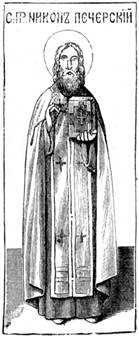
«Сейте доброе семя в сердцах детей ваших... Не смущайтесь медленностью всхода его... Сейте и веруйте, что, хотя и невидимо, но тем не менее зреет оно в глубине души детской... Придёт пора – семя взойдёт!» Утешительны эти слова одного опытного деятеля на поприще воспитания душ человеческих. Справедливость их подтверждается многими примерами из прошедшей жизни человечества. Один из таковых представляется в жизни воспоминаемого сегодня святого Никона, жившего в III столетии. По званию своему он состоял воином; отец его был язычником, а мать – христианка, которая, хотя и старалась расположить сына своего к принятию христианства, но, не имея в муже-язычнике помощника в деле христианского воспитания своего сына, не имела и желательного успеха в этом. Не успела она в этом и позже, когда Никон, среди занятий по службе и среди рассеянной жизни в кругу товарищей, не имел ни достаточно времени, ни охоты вникать в спасительные внушения своей матери. Тем не менее, не пропали бесследно добрые семена... и, хотя Никон, по-видимому, относился поверхностно к христианским внушениям своей матери, иные из них запечатлелись в душе его, и настала та минута, когда они сказались и произвели спасительный переворот в судьбе его настоящей и будущей жизни...
“Sow good seed in the hearts of your children… Be not troubled by the slowness of its growth… Sow and believe that, though invisibly, yet nonetheless it ripens in the depths of the child’s soul… The time will come—the seed will sprout!” How comforting are these words of one experienced worker in the field of the education of human souls. Their truth is confirmed by many examples from the past life of mankind. One such is presented in the life of St. Nikon, commemorated today, who lived in the third century. By his calling he was a soldier; his father was a pagan, and his mother a Christian, who, although she tried to incline her son toward the acceptance of Christianity, yet, having no helper in her pagan husband in the matter of the Christian upbringing of her son, she had no desired success in this. She did not succeed in this even later, when Nikon, amid the occupations of his service and amid a dissipated life in the circle of his comrades, had neither sufficient time nor inclination to heed the saving admonitions of his mother. Nevertheless, the good seeds did not perish without a trace… and, although Nikon apparently treated his mother’s Christian admonitions superficially, some of them were imprinted upon his soul, and there came that moment when they manifested themselves and wrought a saving change in the destiny of his present and future life…
Так, именно, однажды, заботливо рассуждая с сыном о всяких случайностях и опасностях, которые представляются во время войны, мать Никона сказала ему: – «сын мой любезный! если случится тебе во время войны впасть в какую либо смертную опасность, то огради себя крестным знамением, и ты избавишься от руки врагов: не поразят тебя ни стрела, ни копьё, ни меч, и среди кровавой резни ты останешься невредим» ...
Thus, on one occasion, while solicitously discussing with her son the various accidents and dangers that present themselves during war, Nikon’s mother said to him: “My beloved son! If it should happen to you during war to fall into some mortal danger, then protect yourself with the sign of the cross, and you will be delivered from the hand of your enemies: neither arrow, nor spear, nor sword shall strike you, and amid bloody slaughter you shall remain unharmed.”
Случилось однажды Никону, во время кровопролитной битвы, при нападении врагов, увлечённому храбрым порывом, остаться одному, окружённому врагами. Гибель его, казалось, была неизбежна. Готовый пасть под ударами врагов, он вдруг вспомнил слова своей матери и, с верой оградив себя крестным знамением, воскликнул: – «Христе Боже всесильный! покажи на мне в этот час силу креста Твоего, чтобы и я был рабом Твоим!» И внезапно, непобедимым порывом вырвался из среды врагов своих, удержал их натиск и, дав в это время товарищам своим собраться с новыми силами, содействовал таким образом окончательной победе над врагами... Поражённые его мужеством, товарищи начали прославлять его подвиг, но, Никон, дитя умолившей о нём Бога матери, озарённый свыше, начал прославлять Единого истинного Бога, восклицая:
It happened once to Nikon, during a bloody battle, when the enemy attacked, that, carried away by a brave impulse, he remained alone, surrounded by enemies. His destruction seemed inevitable. Ready to fall under the blows of his enemies, he suddenly remembered his mother’s words and, with faith protecting himself with the sign of the cross, cried out: “O Christ God Almighty! Show upon me at this hour the power of Thy cross, that I also may be Thy servant!” And suddenly, with an irresistible impulse, he burst forth from the midst of his enemies, checked their onslaught, and, giving his comrades time to gather new strength, thus contributed to the final victory over the enemy… Struck by his courage, his comrades began to glorify his feat, but Nikon, the child of a mother who had prayed to God for him, illumined from on high, began to glorify the One true God, crying out:
Велика; неизреченна была радость матери Никона, когда, возвратясь домой, он рассказал ей о случившемся с ним и, вслушиваясь теперь внимательным сердцем в её христианские наставления, воспринимал их теперь как бы на созревшую почву для такого благодатного семени. Однажды, припав к ногам матери, он воскликнул: «молись обо мне, мать моя, молись, чтобы я познал истину, чтобы я научился поступать по воле Божией, чтобы Бог причислил меня к избранному Своему стаду! Твои наставления указали мне путь спасения, молись обо мне, чтобы я не уклонился от него, чтобы я не ослабел!»
Great and inexpressible was the joy of Nikon’s mother when, returning home, he told her what had happened to him, and now, listening with an attentive heart to her Christian instructions, he received them as if upon soil made ready for such a grace-filled seed. Once, falling at his mother’s feet, he cried out: “Pray for me, my mother, pray that I may know the truth, that I may learn to act according to the will of God, that God may number me among His chosen flock! Your instructions have shown me the way of salvation; pray for me, that I may not turn aside from it, that I may not grow weak!”
Мать Никона посоветовала ему обратиться к священнику, который бы просветил его и окрестил. Но не легко было в то время найти священника, так как все почти христиане, по причине гонения, скрывались в горах и пустынях. Никон не нашёл священника в городе. Простившись с матерью и напутствуемый ей благословением и просьбой не оставлять её на долгое время, так как она больна и стара, он отправился на Восток. Корабль, на котором он поехал, пристал к острову Хиосу. Никон сошёл на берег и провёл несколько дней один на горе, в постоянной и пламенной молитве, чтобы Господь указал ему руководителя на пути спасения. Потом, сев снова на корабль, после двухдневного плавания, он вышел на берег у горы, называемой Ганос208. Тут, в горных пещерах встретился он с Феодосием, епископом Кизическим, поселившимся тут с своими учениками. У него нашёл приют и Никон, научился от него закону Божию, принял св. крещение и стал вести жизнь иноческую, предаваясь с таким рвением молитве, посту и трудам, что братия и сам Феодосий удивлялись ему. Так прошло три года. Феодосий, почувствовав приближение своей кончины, возвёл Никона в сан диакона, потом в священника и наконец, рукоположив в епископа, поручил ему 190 иноков, дал ему наставления и велел удалиться на остров Сицилию. По кончине Феодосия, все братия, вместе с Никоном, отправились в Италию. Никон поспешил тогда побывать в отечественном своём городе – Неаполе, чтобы повидаться с матерью своей. Он застал её ещё в живых, но она как будто ожидала его для того, чтобы – проститься с ним в этой жизни... Увидев сына, услышав, как он провёл эти последние годы разлуки с нею, она, упав на колена, воскликнула: «благодарю Тебя, Господи, что Ты дал мне увидеть сына моего, посвятившего себя Твоему служению!
Nikon’s mother advised him to turn to a priest, who would enlighten and baptize him. But it was not easy at that time to find a priest, since almost all Christians, on account of the persecution, were hiding in the mountains and deserts. Nikon did not find a priest in the city. Having taken leave of his mother and being sent on his way by her blessing and her request not to leave her for long, since she was ill and old, he set out for the East. The ship on which he sailed put in at the island of Chios. Nikon went ashore and spent several days alone on a mountain, in constant and fervent prayer, that the Lord might show him a guide on the path of salvation. Then, boarding the ship again, after a two-day voyage, he came ashore at a mountain called Ganos208. There, in mountain caves, he met Theodosius, Bishop of Cyzicus, who had settled there with his disciples. Nikon also found shelter with him, learned the law of God from him, received holy Baptism, and began to lead a monastic life, devoting himself with such zeal to prayer, fasting, and labors that the brethren and Theodosius himself marveled at him. Thus three years passed. Theodosius, sensing the approach of his end, raised Nikon to the rank of deacon, then to that of priest, and finally, having consecrated him bishop, entrusted him with 190 monks, gave him instructions, and bade him depart for the island of Sicily. After the repose of Theodosius, all the brethren, together with Nikon, set out for Italy. Nikon then hastened to visit his native city—Neapolis—to see his mother. He found her still alive, but she seemed to be waiting for him only to take leave of him in this life… Seeing her son and hearing how he had spent these last years of separation from her, she fell to her knees and cried out: “I thank Thee, O Lord, that Thou hast granted me to see my son, who has dedicated himself to Thy service!
Встретившись в Неаполе с прежними своими друзьями и товарищами, Никон обратил многих из них ко Христу, рассказав им, каким образом сам был приведён к Богу. Девять воинов решились последовать за ним в Сицилию и вместе с 190 иноками, пребывавшими с Никоном, поселились в одном пустынном месте, при реке Асинос – ныне Алькантара. И стали все жить трудами рук своих. Но когда правитель страны узнал о них, то потребовал к себе и увещевал их отречься от Христа. Иноки с твёрдостью отказались, и все они были преданы смерти, кроме Никона, который был подвергнут страшным мучениям. Его опаляли огнём, привязывали к бешеным коням, которые влачили израненное тело его. Наконец уже правитель Квинтиан, тот, от которого пострадала также св. Агафия (пам. 5 февр.), велел отсечь мученику голову мечом. Это было в царствование Деция, в 250 г. – Игемон Квинтиан, по предречению пр. Никона, погиб ужасной смертью: он был, искусан, потоптан и сброшен конями при переправе через р. Псимиф – (что ныне Гиаретта, на восточной стороне острова).
Meeting in Neapolis with his former friends and comrades, Nikon converted many of them to Christ, telling them how he himself had been led to God. Nine soldiers resolved to follow him to Sicily and, together with the 190 monks who remained with Nikon, settled in a desert place on the river Asinos—now Alcantara. And they all began to live by the labor of their hands. But when the ruler of the country learned of them, he summoned them and urged them to renounce Christ. The monks firmly refused, and all of them were put to death, except Nikon, who was subjected to terrible torments. He was scorched with fire, tied to wild horses, which dragged his wounded body. Finally, Quintian, the governor—the same one from whom St. Agatha also suffered (commemorated Feb. 5)—ordered the martyr’s head to be cut off with a sword. This occurred in the reign of Decius, in the year 250. Quintian, the governor, according to the prophecy of St. Nikon, perished by a terrible death: he was bitten, trampled, and thrown off by horses while crossing the river Psimmith—(now Giarretta, on the eastern side of the island).
Блаженный Никон пришёл к преподобному Антонию в пещеру уже иереем и иноком; вероятно, пострижен он был при кафедре; под влиянием высоких подвигов Антония, Никон зрел в духовном совершенстве; по воле святого старца, Никон, как священник и как стоявший твёрдой стопой на лествице духовной, постригал приходивших подвизаться в той же пещере. Когда по приказанию преп. Антония пострижен был после Варлаама Вышатича казначей и любимец великого князя Ефрем, великий князь в сильном гневе на то, призвал Никона к себе. «Ты ли постриг их без моего повеления?» спросил он Никона. Никон отвечал: «благодатью Божьею я постриг, по повелению Царя Небесного, Иисуса Христа, призвавшего их на такой подвиг». Ответ, столько же твёрдый перед лицом сильного земли, сколько полный любви к духовному наставнику, которого не ставит он в опасность вместо себя. «Так ступай, сказал князь, и уговори их воротиться домой: иначе пошлю тебя и всех живущих с тобой в заточение, а пещеру велю раскопать». «Твори, что угодно тебе, отвечал Никон; но я не могу отнимать воинов у Царя Небесного». Изяслав послал разогнать иноков; но потом, по увещанию супруги своей, послал упросить Антония остаться покойно в пещере. – Любовь к безмолвию, при гневе князя, не совсем успокоившемся, заставила Никона оставить пещеру Антония. – Вместе с иноком монастыря св. Мины пошёл он (1054 г.) искать другого безмолвного места.
Blessed Nikon came to Venerable Anthony in the cave already as a priest and a monk; he was probably tonsured at the cathedral; under the influence of Anthony’s lofty ascetic labors, Nikon matured in spiritual perfection; by the will of the holy elder, Nikon, as a priest and as one standing with a firm foot on the ladder of spiritual life, tonsured those who came to struggle in the same cave. When, by the command of Venerable Anthony, after Barlaam, Vyshata’s son, the treasurer and favorite of the Grand Prince, Ephraim, was tonsured, the Grand Prince, in great anger at this, summoned Nikon to him. “Was it you who tonsured them without my command?” he asked Nikon. Nikon answered: “By the grace of God I tonsured them, by the command of the Heavenly King, Jesus Christ, who called them to such a feat.” An answer as firm before the face of the mighty one of the earth as it was full of love for his spiritual guide, whom he does not place in danger instead of himself. “Then go,” said the prince, “and persuade them to return home; otherwise I will send you and all who live with you into exile, and I will order the cave to be dug up.” “Do what seems good to you,” answered Nikon; “but I cannot take away soldiers from the Heavenly King.” Izyaslav sent to disperse the monks; but afterwards, at the entreaty of his wife, he sent to beg Anthony to remain peacefully in the cave. — Love of silence, while the prince’s anger had not yet fully subsided, caused Nikon to leave Anthony’s cave. — Together with a monk of the monastery of St. Menas, he went (in 1054) to seek another place of silence.
Дойдя до моря Азовского, Никон полюбил близ Тмутаракани (Тамани) уединённое место и здесь стал подвизаться. «Место это, говорит преп. Нестор, благодатью Божией процвело; великий Никон основал здесь церковь св. Богородицы, и составился великий монастырь, который и поныне сохраняет сходство с Печерским монастырём»209. Препод. Никон приобрёл у Таманцев высокое уважение. Когда коварный Грек убил доблестного князя Ростислава, что было в 1065 г., Таманцы просили блаж. Никона отправиться послом их к князю Святославу в Чернигов, чтобы князь прислал к ним сына своего Глеба на княжение. Никон согласился. Исполнив поручение в Чернигове, он посетил Печерскую обитель. Феодосий, постриженный преп. Никоном, а теперь игумен Печерский, принял Никона с духовной радостью и глубоким уважением; великие подвижники при встрече пали друг другу в ноги, потом обнявшись долго плакали от радости свидания. Феодосий просил Никона не разлучаться с ним. Никон дал слово, устроив дела в своём монастыре, прийти в обитель Феодосия210. Проводив князя Глеба в Тмутаракань, Никон сделал распоряжение в своей обители, и затем прибыл в Киев. Феодосий оказывал Никону самую почтительную любовь, принимал его за отца. «Когда отлучался он куда либо, то Никону поручалась вся братия в ведение. Иногда предоставлял он великому Никону вместо себя предлагать поучение братии. Много раз, когда великий Никон сидел и переплетал книги, блаж. Феодосий сидел при нём и прял нитки, нужные для сего дела211. Вот высокий образец любви христианской и христианской простоты! Приятно было Никону жить с Феодосием; но (1068 г.) в Киеве поднялись гражданские тревоги и смуты: Изяслав был выгнан из Киева, и престол великого князя занят был младшим братом Святославом. Это возмущало совесть многих. – Никон, начавший иноческую жизнь жизнью пещерной, любил жизнь тихую, недоступную для житейских тревог. Потому с двумя иноками удалился он опять в Тмутаракань. – Здесь заботливый князь Глеб измерял тогда расстояние Тмутаракани от Керчи, оставив и запись на камне212, а в 1069 году уже княжил в Новгороде. – Вероятно, блаж. Никон принимал участие в том, что в Тмутаракани спокойно принят был на место Глеба брат его Роман Святославич. – Но тревоги князей и здесь не дали ему покоя, – Бурный Олег после кровопролитного сражения с великим князем прибежал (1078 г.) в Тмутаракань и возбуждал брата идти воевать с Всеволодом. Преподобный не ожидал ничего доброго от того для самих князей, что и оправдалось; Роман был убит теми самими, которых водил на войну; а бурного Олега Козары схватили и отправили в Царьград. – Никон, не дожидаясь этих печальных последствий мирского мятежа, оставил Тмутаракань (1078 г.)213.
Having reached the Sea of Azov, Nikon came to love a solitary place near Tmutorakan (Taman) and there began to struggle. “This place,” says the Venerable Nestor, “by the grace of God flourished; the great Nikon founded here a church of the Most Holy Theotokos, and a great monastery was formed, which to this day preserves a likeness to the Monastery of the Caves.”209 The Venerable Nikon acquired high respect from the people of Taman. When a treacherous Greek killed the valiant Prince Rostislav, which occurred in 1065, the people of Taman asked the blessed Nikon to go as their envoy to Prince Svyatoslav in Chernigov, that the prince might send his son Gleb to reign over them. Nikon agreed. Having fulfilled the commission in Chernigov, he visited the Monastery of the Caves. Theodosius, tonsured by the Venerable Nikon and now abbot of the Caves, received Nikon with spiritual joy and deep respect; the great ascetics, upon meeting, fell at each other’s feet, then, embracing, wept long from the joy of the reunion. Theodosius asked Nikon not to part from him. Nikon gave his word that, having settled affairs in his own monastery, he would come to the monastery of Theodosius.210 Having escorted Prince Gleb to Tmutorakan, Nikon made arrangements in his monastery and then arrived in Kiev. Theodosius showed Nikon the most respectful love, receiving him as a father. “When he went anywhere, the whole brotherhood was entrusted to Nikon’s oversight. Sometimes he allowed the great Nikon to deliver instruction to the brethren in his stead. Many times, when the great Nikon sat and bound books, the blessed Theodosius sat beside him and spun the threads needed for this work.211 Behold a high example of Christian love and Christian simplicity! It was pleasant for Nikon to live with Theodosius; but (in 1068) civil alarms and disturbances arose in Kiev: Izyaslav was driven out of Kiev, and the throne of the Grand Prince was occupied by his younger brother Svyatoslav. This troubled the conscience of many. – Nikon, who had begun his monastic life with the life of the cave, loved a quiet life, inaccessible to worldly troubles. Therefore, with two monks, he withdrew again to Tmutorakan. – Here the solicitous Prince Gleb was then measuring the distance of Tmutorakan from Kerch, leaving an inscription on a stone,212 and in 1069 he was already reigning in Novgorod. – Probably the blessed Nikon took part in the fact that in Tmutorakan, in place of Gleb, his brother Roman Svyatoslavich was peacefully received. – But the disturbances of the princes gave him no peace here either. – The turbulent Oleg, after a bloody battle with the Grand Prince, fled (in 1078) to Tmutorakan and incited his brother to go to war with Vsevolod. The Venerable One expected nothing good from this for the princes themselves, which was justified; Roman was killed by those very men whom he had led to war; and the turbulent Oleg was seized by the Khazars and sent to Constantinople. – Nikon, not waiting for these sad consequences of worldly rebellion, left Tmutorakan (1078).213
Исполняя желание Феодосия и своё собственное провести последние годы в Пещерной обители, Никон прибыл в Печерскую обитель; братия, зная, как уважал его Феодосий, предоставили ему игуменство в Феодосиевой обители214. Здесь ещё живы были великие ученики Антония и Феодосия: Исаакий затворник, Матфей прозорливый, Агапит врач, Григорий чудотворец. – Авве Никону приятно было видеть подвиги их и беседовать с ними. – В 1083 г. пришли к Никону из Константинополя иконописцы, нанятые, как говорили они, начальниками Печерской обители Антонием и Феодосием. Никон, сказав им, что уже 10 лет, как эти начальники скончались, показал им изображения Антония и Феодосия. Это они самые, которые наняли нас, сказали иконописцы. Тогда же Греческие купцы привезли мозаику на украшение храма. Таким образом, под надзором преподобного Никона, великая Печерская церковь украшена была иконами и мозаикой215. По управлению братией преподобный Никон заботился сохранять в точности всё установленное преподобным Феодосием, и Господь благословлял это усердие, дышащее высоким смирением. «Для первой недели поста, рассказывает преподобный Нестор, по причине особенного воздержания, преп. отцом нашим Феодосием установлено было, чтобы в пяток предлагались добрым подвижникам самые чистые хлеба и ещё приготовленные с мёдом и маком». Так приказывал исполнять и великий Никон. Но раз, когда Никон велел келарю приготовить хлебы, келарь «ослушался и солгал, сказав, что нет муки для приготовления таких хлебов. – Бог не презрел труда и молитвы преподобных. – После святой литургии, когда все шли на постный обед, привезли воз таких хлебов, откуда вовсе не ожидали. Увидев это, братия прославили Бога. Потом спустя два дня келарь приказал (для воскресного дня) испечь хлебы из той муки, о которой прежде сказал, что нет её. – Пекари, когда месили тесто и лили тёплую воду, увидели лягушку, варившуюся в той воде. Так было осквернено, что сделано по преслушанию216.» Блаженному Никону приходилось терпеть не мало скорбей от братии. И против него, как против блаженного Стефана, восставали с ропотом и негодованием; но он удержался в обители217.
Fulfilling the desire of Theodosius and his own to spend his last years in the Cave Monastery, Nikon arrived at the Monastery of the Caves; the brethren, knowing how Theodosius had respected him, entrusted him with the abbacy in the monastery of Theodosius.214 Here were still alive the great disciples of Anthony and Theodosius: Isaac the Recluse, Matthew the Clairvoyant, Agapetus the Physician, Gregory the Wonderworker. – It was pleasant for Abba Nikon to see their struggles and to converse with them. – In 1083, iconographers came to Nikon from Constantinople, hired, as they said, by the founders of the Monastery of the Caves, Anthony and Theodosius. Nikon, telling them that it was already ten years since these founders had reposed, showed them the images of Anthony and Theodosius. “These are the very ones who hired us,” said the iconographers. At the same time, Greek merchants brought mosaic for the adornment of the church. Thus, under the supervision of the Venerable Nikon, the great Church of the Caves was adorned with icons and mosaic.215 In governing the brotherhood, the Venerable Nikon took care to preserve exactly everything established by the Venerable Theodosius, and the Lord blessed this zeal, breathing with deep humility. “For the first week of Lent,” relates the Venerable Nestor, “on account of special abstinence, it was established by our Venerable Father Theodosius that on Friday the purest loaves, prepared with honey and poppy seeds, should be offered to the good ascetics.” So the great Nikon commanded to do. But once, when Nikon ordered the cellarer to prepare the loaves, the cellarer “disobeyed and lied, saying that there was no flour for preparing such loaves. – God did not despise the labor and prayer of the Venerable Ones. – After the holy Liturgy, when all were going to the Lenten meal, a cart of such loaves was brought from a place whence it was not at all expected. Seeing this, the brethren glorified God. Then, two days later, the cellarer ordered (for the Sunday) to bake loaves from that flour about which he had previously said there was none. – The bakers, when they kneaded the dough and poured warm water, saw a frog boiling in that water. Thus was defiled what was done through disobedience.”216 The blessed Nikon had to endure no few sorrows from the brethren. Even against him, as against the blessed Stephen, they rose up with murmuring and indignation; but he remained in the monastery.217
Он был свидетелем завещания, показавшего последствиями, как страшно нарушать данное слово и клясться в неправде. Два Киевлянина, Иоанн и Сергий, перед Печерской иконой Богоматери, тогда уже прославившеюся, заключили между собой духовное братство. – Спустя несколько времени Иоанн сделался болен и, чувствуя близость смерти, пригласил к себе блаженного игумена Никона; при нём, раздав много имения бедным, 1,000 гривен серебра и 100 гривен злата передал Сергию; ему же поручили пятилетнего сына Захарию и завещал отдать сыну серебро и золото, когда тот достигнет зрелого возраста. Достигнув 15 лет, Захария просил Сергия передать ему отцовскую собственность. «Отец твой, отвечал Сергий, отдал имение своё Богу, у Того и проси; я же не должен ничем ни тебе, ни отцу; отец твой был так глуп, что роздал имение бедным и тебя оставил нищим». Молодой человек долго плакал, выслушав такой оскорбительный отзыв об отце своём; потом сказал Сергию: «дай мне по крайней мере половину оставленного отцом; а другая пусть будет твоей». Сергий отказал, осыпая отца и сына бранью. Захария просил третью часть, потом десятую. Сергий отказал и в том. «Если не взял ты ничего у отца моего, сказал наконец Захария, иди, поклянись в том перед иконой Богоматери, перед которой заключён тобой союз духовного братства с отцом моим». Сергий до того увлёкся жадностью к деньгам, что пошёл и перед иконой Богоматери сказал: «не брал я 1,000 гривен серебра и 100 гривен золота». Но когда хотел он целовать святую икону, то не мог подойти к ней и уходя из храма кричал: «преподобные отцы Антоний и Феодосий! запретите жестокому ангелу губить меня; молите за меня Пресвятую Богородицу, чтобы прогнаны были от меня нечистые духи; пусть возьмут серебро и золото в моей клети». Это навело на всех ужас. Послали в дом Сергия и нашли в запечатанном ящике 2,000 гривен серебра и 200 гривен золота. Так Господь не остаётся в долгу ни перед кем218.
He was a witness of a testament which showed by its consequences how terrible it is to break one’s given word and to swear falsely. Two Kievans, John and Sergius, before the Icon of the Mother of God of the Caves, already then glorified, concluded a spiritual brotherhood between themselves. – After some time, John fell ill and, feeling the nearness of death, summoned the blessed Abbot Nikon; in his presence, having distributed much property to the poor, he gave 1,000 grivnas of silver and 100 grivnas of gold to Sergius; he also entrusted to him his five-year-old son Zachariah and bequeathed that the silver and gold be given to his son when he should reach mature age. Having reached the age of fifteen, Zachariah asked Sergius to hand over his father’s property. “Your father,” answered Sergius, “gave his property to God; ask Him for it; I owe nothing either to you or to your father; your father was so foolish that he gave away his property to the poor and left you a beggar.” The young man wept long, hearing such an insulting remark about his father; then he said to Sergius: “Give me at least half of what my father left; let the other be yours.” Sergius refused, showering father and son with abuse. Zachariah asked for a third part, then a tenth. Sergius refused even that. “If you took nothing from my father,” said Zachariah at last, “go, swear to it before the Icon of the Mother of God, before which you concluded the bond of spiritual brotherhood with my father.” Sergius was so carried away by greed for money that he went and before the Icon of the Mother of God said: “I did not take 1,000 grivnas of silver and 100 grivnas of gold.” But when he wished to kiss the holy icon, he could not approach it, and leaving the church he cried out: “Venerable Fathers Anthony and Theodosius! Forbid the cruel angel to destroy me; pray for me to the Most Holy Theotokos, that the unclean spirits may be driven from me; let them take the silver and gold in my chest.” This struck terror into all. They sent to the house of Sergius and found in a sealed chest 2,000 grivnas of silver and 200 grivnas of gold. Thus the Lord remains in no one’s debt.218
Блаженный Никон, после долгих и Богоугодных подвигов, мирно почил марта 23-го 1088 г., не менее 86 лет. Мощи его почивают в пещере преподобного Антония219. «Святой отец Никон чудотворец, игумен Печерский», так показывает его здесь Кальнофойский.
The blessed Nikon, after long and God-pleasing struggles, peacefully reposed on March 23, 1088, being no less than 86 years old. His relics repose in the cave of the Venerable Anthony.219 “The holy Father Nikon the Wonderworker, Abbot of the Caves,” so Kalnofoisky shows him here.
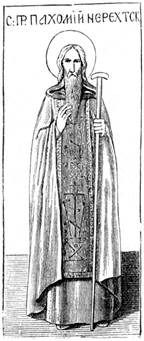
Нерехта известна была в гражданском быту ещё до появления Монголов220, но только в XIV веке прославилась она благочестием одного подвижника, преподобного Пахомия.
Nerekhta was known in civil life even before the appearance of the Mongols,220 but only in the 14th century was it glorified by the piety of one ascetic, the Venerable Pachomius.
Преподобный Пахомий, в крещении Иаков221, сын Владимирского священника Игнатия, семи лет «вдан бысть учитися священным книгам». Воспитание, совершавшееся под наставлением слова Божия, образовало в Иакове доброго отрока; когда «извык он Божественному писанию», то утешением для него было ходить в храм Божий и славословить Господа; самым же любимым местом его молитв был Рождественский монастырь. Здесь при мощах благоверного князя Александра Невского зажглось в душе его усердие посвятить жизнь свою на служение Господу. – По смерти родителя мать не препятствовала ему исполнить желание души своей; он поступил в любимый Рождественский монастырь и здесь был пострижен с именем Пахомия. Тогда было ему 21 год от роду. Молодой инок поручен опытному старцу; духовный отец строг был к духовному сыну, но ученик безмолвно выполнял приказания наставника. Воля настоятеля назначила молодому монаху послушание в пекарне; инок неутомимо трудился в пекарне и трудами усмирял плоть. Несколько годов Пахомий трудился в пекарне. По просьбе настоятеля святитель Алексий, тогда Владимирский епископ (1352 г.), посвятил его в иеродиакона. Пахомий зрел в жизни духовной. Когда св. Алексий возобновлял во Владимире монастырь Константиновский (а это было в 1365 г.)222, он поставил Пахомия игуменом сей обители. Преподобный усердно выполнял желания святителя о обители. Он пробыл в ней столько, сколько нужно было для устроения наружного и внутреннего порядка её. Сердце его давно горело желанием составить обитель молитвы не в стенах города, а в пустыне, где могли иметь в ней нужду многие. И он решился исполнить это желание.
The Venerable Pachomius, in baptism James,221 son of the Vladimir priest Ignatius, at seven years of age “was given to learn the sacred books.” The upbringing, accomplished under the instruction of the word of God, formed in James a good youth; when he “became skilled in Divine Scripture,” his consolation was to go to the church of God and glorify the Lord; his most beloved place of prayer was the Monastery of the Nativity. Here, at the relics of the Right-believing Prince Alexander Nevsky, there was kindled in his soul a zeal to dedicate his life to the service of the Lord. – After the death of his parent, his mother did not hinder him from fulfilling the desire of his soul; he entered the beloved Monastery of the Nativity and was there tonsured with the name Pachomius. He was then 21 years of age. The young monk was entrusted to an experienced elder; the spiritual father was strict with his spiritual son, but the disciple silently fulfilled the commands of his instructor. The will of the superior assigned the young monk the obedience of the bakery; the monk labored tirelessly in the bakery and by labors subdued the flesh. For several years Pachomius labored in the bakery. At the request of the superior, Hierarch Alexis, then Bishop of Vladimir (1352), ordained him a hierodeacon. Pachomius matured in the spiritual life. When St. Alexis was renewing the Monastery of St. Constantine in Vladimir (and this was in 1365),222 he appointed Pachomius abbot of that monastery. The Venerable One zealously fulfilled the wishes of the Hierarch concerning the monastery. He remained in it as long as was necessary for the establishment of its external and internal order. His heart had long burned with the desire to establish a monastery of prayer not within the walls of a city, but in the wilderness, where many might have need of it. And he resolved to fulfill this desire.
Ночью, тайно от всех, Пахомий вышел из Константиновской обители, ничего не имея при себе, кроме псалтири и книжки канонов. Он пришёл в Нерехтскую сторону. Место на речке Гриденке, впадающей в Салоницу и потом в Волгу, показалось ему красивым и удобным для пребывания иноческого; Сыпаново, так называлось то место, находилось в глухом лесу и представляло возвышенный полуостров. Преподобный пошёл в посад Нерехту и просил жителей отдать ему Сыпаново для устроения обители молитв. Нерехтцы с радостью согласились на просьбу человека Божия. – Одни из них пошли вместе с ним и помогли ему очистить место для кельи; другие обещали помощь свою при устроении обители. Блаженный Пахомий написал образ Святой Троицы. Отшельник остался подвизаться в молитве. Нерехтцы выполнили своё обещание: одни помогали ему в нуждах его, а другие приходили и оставались при нём жить. Строгая жизнь его одушевляла благочестием посещавших его. Являлись к Пахомию и иноки с желанием подвизаться под его руководством; мирян, изъявлявших то же желание, охотно принимал он и постригал в иночество. Святитель Алексий, к которому ходил он в Москву, с любовью благословил его строить храм и обитель Святой Троицы в глухом краю. Храм Святой Троицы, украшенный иконами и утварью, освящён с живым усердием преподобного.
By night, secretly from all, Pachomius went out from the Monastery of St. Constantine, having nothing with him except a Psalter and a book of canons. He came to the Nerekhta region. The place on the little river Gridenka, which flows into the Salonitsa and then into the Volga, seemed to him beautiful and suitable for monastic habitation; Sypanovo, as that place was called, lay in a dense forest and formed a raised peninsula. The Venerable One went to the settlement of Nerekhta and asked the inhabitants to give him Sypanovo for the establishment of a monastery of prayer. The people of Nerekhta gladly agreed to the request of the man of God. – Some of them went with him and helped him clear a place for a cell; others promised their assistance in the establishment of the monastery. Blessed Pachomius painted an icon of the Holy Trinity. The hermit remained to struggle in prayer. The people of Nerekhta fulfilled their promise: some helped him in his needs, while others came and remained to live with him. His strict life inspired piety in those who visited him. Monks also came to Pachomius, desiring to struggle under his guidance; laymen who expressed the same desire he willingly received and tonsured into monasticism. Hierarch Alexis, to whom he went in Moscow, lovingly blessed him to build a church and monastery of the Holy Trinity in that remote region. The church of the Holy Trinity, adorned with icons and vessels, was consecrated with the living zeal of the Venerable One.
Окончив построение храма, Пахомий занимался с ревностью устроением духовного порядка в новой обители. Он положил за правило, чтобы в его пустынной обители иноки сами обрабатывали землю и питались трудами рук своих. Он сам пахал, подавая пример другим. По его правилу, никто не должен иметь никакой своей собственности в обители. Построив кельи и трапезу для иночествующих, он построил и гостиницу, где по временам сам служил странникам и Богомольцам. Среди пустынного уединения подвижник преуспевал в жизни духовной. – Знавшие его видели в нём образец добродетелей и с особенной верой просили молитв его. Достигнув глубокой старости и чувствуя близость кончины, Пахомий назначил преемником себе Феодора, который пришёл к нему из Рождественского монастыря. – Марта 21-го 1384 г. собрал он братию и простился со всеми; через день потом ещё раз приобщился святых Таин и мирно скончался. – Подвижническое тело его положено по правую сторону алтаря Троицкого храма.
Having completed the building of the church, Pachomius zealously occupied himself with establishing the spiritual order in the new monastery. He laid down as a rule that in his wilderness monastery the monks themselves should till the land and be nourished by the labor of their own hands. He himself plowed, setting an example for others. According to his rule, no one was to possess any property of his own in the monastery. Having built cells and a refectory for the monastics, he also built a guesthouse, where at times he himself served pilgrims and those who came to pray. In the midst of wilderness solitude, the ascetic advanced in the spiritual life. – Those who knew him saw in him a model of virtues and with especial faith asked for his prayers. Having reached a deep old age and feeling the nearness of his end, Pachomius appointed as his successor Theodore, who had come to him from the Monastery of the Nativity. – On March 21, 1384, he gathered the brethren and took leave of all; a day later he partook once more of the Holy Mysteries and peacefully reposed. – His ascetic body was laid on the right side of the altar of the Trinity church.
Инок Иринарх, искренний ученик блаженного старца, много помогавший ему по устроению обители искусством иконописания, на другом году по кончине старца подвергся искушениям нечистого духа. Целомудренный измучен был восстанием плоти до того, что исповедал о том всей братии. Ночью то молился он со слезами перед иконой Спасителя и Богоматери, то выходил из кельи на могилу старца, прося его, чтобы помог избавиться от нечистого беса. Утомлённый молитвою, заснул он и видит перед собой старца, с долгою и белою бородою, с жезлом в руке. Старец говорит ему: «брат Иринарх! так всегда молись Господу и Пречистой Матери Его; я молился о тебе, и Господь помиловал тебя, более не греши, – ты исцелён». С этими словами ударил инока жезлом по левому бедру. Инок вскочил и увидел Пахомия, который прибавил: «не бойся, чадо: ты видишь меня, напиши образ мой, Господь причислил меня к лику преподобных; скажи о том и братии». Иринарх рассказал о всём игумену и братии, показывая знак удара на бедре. Освободившийся от нечистой страсти написал образ Пахомия; над могилой устроили гробницу и тут поставили икону.
The monk Irinarch, a sincere disciple of the blessed elder, who had greatly helped him in the establishment of the monastery by his skill in iconography, in the second year after the elder’s repose was subjected to temptations from an unclean spirit. The chaste one was tormented by the uprising of the flesh to such an extent that he confessed it to the whole brotherhood. At night he would pray with tears before the icon of the Savior and the Mother of God, or he would go out of his cell to the elder’s grave, asking him to help him be delivered from the unclean demon. Wearied by prayer, he fell asleep and saw before him an elder with a long white beard, holding a staff in his hand. The elder said to him: “Brother Irinarch! Thus always pray to the Lord and His Most Pure Mother; I prayed for you, and the Lord has had mercy on you; sin no more – you are healed.” With these words he struck the monk on the left thigh with his staff. The monk started up and saw Pachomius, who added: “Fear not, child: you see me; paint my icon; the Lord has numbered me among the ranks of the Venerable; tell this also to the brethren.” Irinarch told everything to the abbot and the brethren, showing the mark of the blow on his thigh. Delivered from the unclean passion, he painted an icon of Pachomius; over the grave they built a tomb and placed the icon there.
При построении каменного храма мощи преподобного видели нетленными и над ними построен был храм в его имя223. Ныне местное празднование преподобному совершается 15 мая, в день иноческого ангела преподобного. – В приходском храме закрытого Сыпанова монастыря в день памяти преподобного бывает многочисленное стечение народа, и верующие получают исцеления при раке преподобного.
During the building of a stone church, the relics of the Venerable One were seen to be incorrupt, and a church was built over them in his name223. At present, the local commemoration of the Venerable One is celebrated on May 15, the day of the monastic angel of the Venerable One. – In the parish church of the closed Sypanovo Monastery, on the day of the Venerable One’s memory, there is a great gathering of people, and the faithful receive healings at the shrine of the Venerable One.
Слаженный Василий, по ркп. житию его224, был Ярославский уроженец, сын Ярославского мелкого торговца Феодора. Поступив в приказчики к богатому купцу, отправился он с его товарами в Мангазею, тогда новое поселение Русских между инородцами на реке Тазе. Блаженный Василий с юных лет жил в страхе Божием: он усердно молился Богу и хранил себя в чистоте. – Купец-хозяин был человек сладострастный и жестокий; он хотел пользоваться Василием как орудием для удовлетворения скотским страстям. К сожалению, это тогда бывало нередко между поселенцами Сибири, – так показывает строгая грамота патриарха225. Но и чём общее был гнусный порок, тем строже был к себе Богобоязненный Василий. Он был честен и верен хозяину по торговле, но твёрдо помнил, что не призвал нас Бог на нечистоту, а на святость. Купец за несогласие на его дикую волю грозил мщением; 19-летний Василий предал себя в волю Божию. В ркп. святцах читаем: «святой мученик Василий отрок, иже в Мангазеи граде, новый чудотворец, пострадавший от господина своего за целомудрие». По ркп. житию, это было так. В праздничную утреню обокрадена была лавка у купца. Купец донёс о том воеводе Пушкину и объявил, что это воровство – дело Василия, – не могло оно совершиться без его участия. Пушкин, по настоянию озлившегося купца, тотчас же велел привести Василия в съезжую избу и подверг его пытке. – Василий говорил одно, что он – невинен. Пытки были так жестоки, что Василий несколько раз падал мёртвым, но, приходя в себя, повторял, что он невинен. Рассвирепевший хозяин ударил связкой ключей в висок Василия; страдалец тяжело вздохнул и закрыл глаза. Когда снова подняли его на дыбу, увидели, что он уже скончался. – Пушкин приказал немедленно положить тело в гроб и бросить в болотистое место, подле съезжей избы, в которой замучен был Василий; гроб погружен был в болото, и через него положили доски для прохода просителей, стрельцов и других, в съезжую избу. Так думали скрыть преступление несчастные грешники226.
Blessed Basil, according to his manuscript Life224, was a native of Yaroslavl, the son of a petty Yaroslavl merchant, Theodore. Having entered the service of a rich merchant as a clerk, he set out with his goods for Mangazea, then a new Russian settlement among the natives on the Taz River. Blessed Basil from his youth lived in the fear of God: he prayed fervently to God and kept himself in purity. – The merchant-master was a lustful and cruel man; he wanted to use Basil as an instrument for satisfying his brutish passions. Unfortunately, this was not uncommon at that time among the settlers of Siberia, as a strict decree of the patriarch shows225. But the more widespread the vile vice, the stricter with himself was the God-fearing Basil. He was honest and faithful to his master in trade, but firmly remembered that God has not called us to uncleanness, but to holiness. The merchant, for his refusal to submit to his wild will, threatened vengeance; the 19-year-old Basil committed himself to the will of God. In the manuscript calendar we read: “The holy martyr Basil, the youth, who was in the city of Mangazea, a new wonderworker, who suffered from his master for chastity.” According to the manuscript Life, this is how it happened. During a festal Matins, the merchant’s shop was robbed. The merchant reported this to the voivode Pushkin and declared that the theft was Basil’s doing – that it could not have happened without his involvement. Pushkin, at the insistence of the enraged merchant, immediately ordered Basil to be brought to the administrative office and subjected him to torture. – Basil said only one thing: that he was innocent. The tortures were so cruel that Basil several times fell down as if dead, but, coming to himself, he repeated that he was innocent. The infuriated master struck Basil on the temple with a bunch of keys; the sufferer sighed heavily and closed his eyes. When they raised him again on the rack, they saw that he had already died. – Pushkin ordered the body to be placed immediately in a coffin and thrown into a marshy place, near the administrative office in which Basil had been tortured; the coffin was sunk into the swamp, and planks were laid over it for the passage of petitioners, streltsy, and others into the administrative office. Thus the wretched sinners thought to conceal the crime226.
В 1652 г. при воеводе Игнатии Степановиче Корсакове гроб Василия с нетленным телом показался поверх тины. Мангазейцу Степану Ширяеву, который ещё раньше того заметил этот гроб, но оставил без внимания, явился в видении молодой человек, без бороды, с светлыми волосами и в белой рубашке; другие промышленники получали разные исцеления у гроба. Предание сказало, какой страдальческой смертью и за что умер сокрытый во гробе. Гроб вынули и поставили в сухое место, а над ним выстроили часовню. Здесь многие получали помощь в нуждах и болезнях, совершая панихиды о покое убиенного Василия.
In 1652, under Voivode Ignatius Stepanovich Korsakov, the coffin of Basil with his incorrupt body appeared above the slime. To Stepan Shiryaev, a man of Mangazea, who had earlier noticed this coffin but paid it no attention, a young man appeared in a vision, beardless, with fair hair and in a white shirt; other workmen received various healings at the coffin. Tradition told what a martyr’s death and for what cause the one hidden in the coffin had died. The coffin was taken out and placed in a dry place, and a chapel was built over it. Here many received help in their needs and illnesses, performing panikhidas for the repose of the slain Basil.
В марте 1670 г. старцу Тихону, основавшему за 10 лет перед тем монастырь на Енисее, является молодой человек с белокурыми волосами, без бороды, в белой одежде и приказывает идти в Мангазею за его телом; «я – тот самый Василий, говорил явившийся, о котором много говорят в народе и который замучен воеводой Пушкиным». Тихон за 500 вёрст отправился в Мангазею, которая теперь уже приходила в запустение и уступала своё значение новой Мангазее227. Он обрёл в указанном месте нетленное тело и 10 мая принёс его на себе в обитель.
In March 1670, to the elder Tikhon, who had founded a monastery on the Yenisei ten years earlier, a young man with fair hair, beardless, in white clothing appeared and commanded him to go to Mangazea for his body; “I am that same Basil,” said the one who appeared, “about whom much is spoken among the people and who was tortured to death by Voivode Pushkin.” Tikhon traveled 500 versts to Mangazea, which was now falling into desolation and yielding its importance to New Mangazea227. He found the incorrupt body in the indicated place and on May 10 carried it on his own back to the monastery.
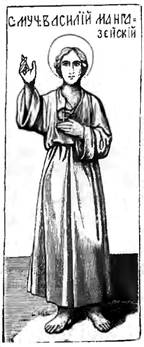
Житие рассказывает об исцелении многих больных, призывавших имя Василия в обители или на месте кончины. В часовне, на месте древней Мангазеи, и теперь видят звериные шкуры, – приношения Юраков и других инородцев, и каждый считает святотатством взять что-нибудь из часовни в собственность. У поселенцев Туруханского края с 1672 г. сохраняются иконы св. Василия Мангазейского. На одних он представляется свежим, белокурым юношей, в белой рубашке, а сбоку представлено истязание ему при купце и воеводе; на других изображён Троицкий Туруханский монастырь, а над ним молящийся Василий, в рубашке и без обуви; в 25 день марта в обители Троицкой совершается всенощное служение, в честь св. Василия228.
The Life tells of the healing of many sick people who called upon the name of Basil in the monastery or at the place of his death. In the chapel, on the site of ancient Mangazea, even now animal skins are seen – offerings of the Yuraks and other natives – and everyone considers it sacrilege to take anything from the chapel for oneself. Among the settlers of the Turukhansk region, icons of St. Basil of Mangazea have been preserved since 1672. In some he is depicted as a fresh, fair-haired youth, in a white shirt, and to the side his torture before the merchant and the voivode is shown; in others, the Trinity Turukhansk Monastery is depicted, and above it Basil praying, in a shirt and without shoes; on March 25, an All-night Vigil is celebrated in the Trinity Monastery in honor of St. Basil228.
Почитая память св. Василия, повторим учение Апостола о добродетели, за которую пострадал Василий. «Храни себя в чистоте, поучает Апостол (1Тим.5:22). Заботься о том, чтобы быть святым по телу и душе (1Кор.7:34). Не обманывайтесь: ни блудники, ни прелюбодеи, ни малакии, ни мужеложники, ни пьяницы, ни хищники не наследуют Царствия Божия (1Тим.6:9–10). Тело не для блуда, а для Господа, и Господь для тела (1Тим.6:13). Блуд и всякая нечистота и любостяжание даже и именоваться не должны у вас, как прилично святым (Еф.5:3). Умертвите земные члены ваши – блуд, нечистоту, сладострастие, злую похоть и любостяжание, которое есть идолослужение» (Кол.3:5).
Honoring the memory of St. Basil, let us repeat the teaching of the Apostle concerning the virtue for which Basil suffered. “Keep yourself pure,” teaches the Apostle (1 Tim. 5:22). “Be anxious about being holy in body and spirit” (1 Cor. 7:34). “Do not be deceived: neither fornicators, nor adulterers, nor the effeminate, nor homosexuals, nor drunkards, nor extortioners shall inherit the Kingdom of God” (1 Cor. 6:9–10). “The body is not for fornication, but for the Lord, and the Lord for the body” (1 Cor. 6:13). “But fornication and all uncleanness and covetousness, let it not even be named among you, as is fitting for saints” (Eph. 5:3). “Put to death your members which are on the earth: fornication, uncleanness, passion, evil desire, and covetousness, which is idolatry” (Col. 3:5).
Надпись на камне: „в л. 6576 инд. 6. Глеб князь мерил море по леду, от Тмутороканя до Кърчева, 14 т. сажень“. Исследования Буткова в извест. Р. археол. общ. 2, 273–292.
Inscription on a stone: “In the year 6576, indiction 6. Prince Gleb measured the sea over the ice, from Tmutorokan to Korchev, 14,000 sazhens.” Butkov’s studies in the Proceedings of the Russian Archaeological Society 2, 273–292.
Собр. л. III, 277. VII, 4. Никон, постригая в 1032 г. Феодосия, был не менее 30 лет: так по правилу о священстве.
Collection of Chronicles III, 277; VII, 4. Nikon, when tonsuring Theodosius in 1032, was no less than 30 years old: thus according to the rule on the priesthood.
Переслав. лет., стр. III, м. 1851 г. В ж. м. внутр. д., ч. 22, 13 сказано, что Нерехта в первый раз упоминается в житии пр. Пахомия, но это – ошибка.
Pereyaslavl Chronicle, p. III, Moscow, 1851. In Journal of the Ministry of Internal Affairs, part 22, p. 13, it is said that Nerekhta is mentioned for the first time in the Life of the Venerable Pachomius, but this is an error.
Ркп. святцы: „преп. Пахомий, игумен Троицкого монастыря, иже нарицается Сыпанов в Нерехотском стану, Костромский чудотворец, преставился в л. 6892 (1384) мар. в 21 д.“. Ист. иер. 6, 238 сведен. о мон., стр. 162. м. 1842 г. В святцах днём кончины поставлено 21 ч., но по житию в 21 д. приобщался, а скончался через день после того.
Manuscript Menology: "The Venerable Pachomius, abbot of the Trinity Monastery called Sypanov in the Nerekhta district, Kostroma Wonderworker, reposed in the year 6892 (1384) on March 21." History of the Hierarchy 6, p. 238; Information on Monasteries, p. 162, Moscow, 1842. In the Menology, the day of his repose is given as the 21st, but according to his Life, he received Communion on the 21st and reposed the day after.
Извлечение из жития, написанного около 1727 г. напеч. в Москвитянине 1852 г. № 8. Само описание жития и чудес бл. Василия, неискусно составленное, напеч. в Иркут. Епарх. Вед. 1863 и 1864 г.
An extract from the Life, written around 1727, was printed in The Muscovite, 1852, No. 8. The actual description of the life and miracles of the blessed Basil, unskillfully composed, was printed in the Irkutsk Diocesan Gazette, 1863 and 1864.
По Сибирскому летописцу (северн. арх., ч. 19, стр. 112) Мангазею строили в 1601 воеводы кн. Василий Михайлович Масальский и Влук (Вукол) Пушкин; тогда из Тобольска прислано к ним 100 служилых людей. По краткому исчислению Сибирских воевод, нап. в Тобольске 1792 г., Масальский и Пушкин были воеводами в 1601 и 1602 г. В 1600 г. Пасха была мар. 23; в 1601 и 1602 г. она была в апреле; в 1592 г. мар. 26. По ркп. святцам день кончины св. Василия полагается то 22 мар. 1592 г., то 25 мар. 1622 г. По времени пребывания Пушкина в Мангазее страдальческую кончину Василия надобно отнести к 1601 или 1602 г., а по указанию на пасхальное время, она должна падать на 1600 г. Но если положим, что воровство совершилось в утреню одного из дней страстной недели, когда благочестивый Василий конечно был в храме; то страдальческая кончина его может быть отнесена к 1602 г., когда воеводствовал Пушкин. С этим годом страдания согласно и то показание, что мощи открыты спустя 50 лет после кончины, в 1652 г.
According to the Siberian Chronicle (Northern Archive, part 19, p. 112), Mangazeya was built in 1601 by the voivodes Prince Vasily Mikhailovich Masalsky and Vukol (Vluk) Pushkin; at that time, 100 service men were sent to them from Tobolsk. According to the Brief Enumeration of Siberian Voivodes, printed in Tobolsk in 1792, Masalsky and Pushkin were voivodes in 1601 and 1602. In 1600, Pascha fell on March 23; in 1601 and 1602, it fell in April; in 1592, on March 26. According to manuscript Menologies, the day of the repose of St. Basil is given either as March 22, 1592, or as March 25, 1622. By the time of Pushkin's stay in Mangazeya, the martyr's end of Basil must be assigned to 1601 or 1602, and by the indication of the Paschal time, it must fall in 1600. But if we suppose that the theft occurred during the Matins of one of the days of Holy Week, when the pious Basil was certainly in church, then his martyr's end may be assigned to 1602, when Pushkin was voivode. The statement that his relics were uncovered 50 years after his repose, in 1652, also agrees with this year of his suffering.
Новая Мангазея, в 30 в. от Тихоновой обители, построена в 1672 г. Спасский о Сибири во врем. общ. ист., кн. 3, стр. 28. 29.
New Mangazeya, 30 versts from the Tikhona Hermitage, was built in 1672. Spassky, "On Siberia," in Proceedings of the Imperial Society of Russian History and Antiquities, Book 3, pp. 28–29.
Туруханский монастырь в Москвитянине 1852 г. № 8, во времен. общ. ист., кн. 3, стр. 30. Ратшина свед. о мон., стр. 98.
The Turukhansk Monastery, in The Muscovite, 1852, No. 8; in Proceedings of the Imperial Society of Russian History and Antiquities, Book 3, p. 30. Ratshin, Information on Monasteries, p. 98.