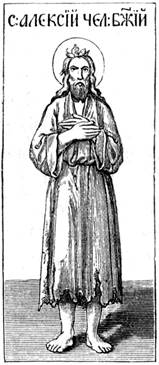
Св. преподобный Алексий, человек Божий, был сын благочестивых, знатных и богатых родителей, Евфимиана и Аглаиды, живших в Риме, в IV веке по Рождестве Христовом; получил хорошее воспитание; был обручён и обвенчан родителями с отроковицей из царского рода. После брачного веселия, ночью Алексий вошёл к своей юной супруге, и, взяв свой перстень золотой и пояс драгоценный и обвив порфирной завесой, отдал ей, сказавши: «сохрани сие, и Бог да будет между мной и тобой, доколе благодать Его в нас нечто новое устроит». Вышед от неё в свою отдельную ложницу, снял с себя златотканные одежды свои, облёкся в худшие и, взявши нечто из своего богатства, золота и камней драгоценных, скрылся из палат своих и из города. Пришед к морю, Алексий сел на корабль и отплыл в Лаодикию. Плывя, он молился Богу: «Боже! спаси меня ныне от суетного мирского жития, и сподоби десного на суде Твоем стояния со всеми Тебе угодившими». Из Лаодикии Алексий отправился в Месопотамию – в город Эдес. Продав все взятые им в доме родительском драгоценности свои и деньги раздав нищим, он облёкся в рубище нищего и пребывал почти непрестанно на паперти храма Божия, питался милостыней во имя Христово и остатками её питал иных нищих; был в непрестанном посте и молитве, вкушал немного хлеба и воды и еженедельно причащался святых Таин. Ум его, занятый Богомыслием, витал горе, плоть его от многого воздерживания увяла и иссохла. В сих подвижнических трудах преподобный Алексий провёл в Эдесе 17 лет, и был возлюблен Богу. Пономарю церкви, на паперти которой привитал преподобный, было в видении повеление от Богоматери: введи в церковь Мою человека Божия, да пребывает в ней, и под именем человека Божия указан был преподобный Алексий. Многим сделалось известно его Богоугодное житие, и он удалился из Эдеса в Тарс, но сильная буря загнала корабль, на коем он плыл, в Рим.
St. Venerable Alexis, the Man of God, was the son of pious, noble, and wealthy parents, Euphemian and Aglaida, who lived in Rome in the fourth century after the Nativity of Christ; he received a good upbringing; he was betrothed and married by his parents to a maiden of royal lineage. After the wedding feast, at night Alexis went in to his young wife, and taking his golden ring and precious belt and wrapping them in a purple veil, he gave them to her, saying: "Keep these, and may God be between me and you, until His grace shall establish something new in us." Going out from her into his own private chamber, he took off his gold-woven garments, clothed himself in the meanest, and taking some of his wealth, gold and precious stones, he disappeared from his palace and from the city. Coming to the sea, Alexis boarded a ship and sailed to Laodicea. As he sailed, he prayed to God: "O God! save me now from the vain life of the world, and vouchsafe me to stand at Thy right hand at Thy judgment with all who have pleased Thee." From Laodicea Alexis went to Mesopotamia—to the city of Edessa. Having sold all the precious things he had taken from his parental home and distributed the money to the poor, he clothed himself in the rags of a beggar and remained almost continually on the porch of the church of God, living on alms given for Christ's name and feeding other beggars with what was left; he was in unceasing fasting and prayer, partaking of a little bread and water, and weekly receiving the Holy Mysteries. His mind, occupied with the thought of God, soared on high; his flesh, from great abstinence, withered and dried up. In these ascetic labors the Venerable Alexis spent seventeen years in Edessa, and was beloved of God. The sexton of the church on whose porch the Venerable one dwelt was commanded in a vision by the Mother of God: "Bring into My church the Man of God, that he may remain in it," and the Venerable Alexis was pointed out under the name of the Man of God. His God-pleasing life became known to many, and he withdrew from Edessa to Tarsus, but a violent storm drove the ship on which he was sailing to Rome.
Действием Промысла Божия возвращённый на родину, человек Божий испросил себе при родительском доме малую хлевину и жил в ней, как бесприютный нищий, незнаемый родителями, питаясь ради Христа подаянием от стола их. Ежедневно получая пищу от трапезы своих родителей, преподобный разделял иным нищим, а сам питался только хлебом и водой. Ночи проводил без сна в молитве и еженедельно причащался Божественных Таин. Дивно было терпение человека Божия от слуг. Иные ударяли его, иные за волосы терзали, иные толкали, иные же помои на голову его изливали, и иным образом ругались над ним. Непобедимый страдалец всё это переносил молча. Ещё более скорбное терпение человека Божия было от того, что против хлевины его было окно палаты, в которой жила невеста его, оставшаяся в доме жениха своего и с своей свекровью часто плакавшие – одна о вдовстве своём, другая о лишении сына своего, и эти слёзы видел и рыдания слышал человек Божий. Так при доме родительском он прожил 17 лет, никем неузнанный, но как нищий и бесприютный странник.
By the action of God's Providence, having been returned to his homeland, the Man of God begged for himself a small shed near his parents' house and lived in it as a homeless beggar, unknown to his parents, feeding for Christ's sake on alms from their table. Receiving food daily from his parents' table, the Venerable one shared it with other beggars, while he himself lived only on bread and water. He spent the nights sleepless in prayer and weekly partook of the Divine Mysteries. Wondrous was the patience of the Man of God with the servants. Some struck him, others tore him by the hair, others pushed him, others poured slops on his head, and in other ways mocked him. The invincible sufferer bore all this in silence. Even more grievous was the patience of the Man of God from the fact that opposite his shed was the window of the chamber in which his wife lived, who remained in the house of her bridegroom and often wept with her mother-in-law—one over her widowhood, the other over the loss of her son—and the Man of God saw these tears and heard these sobs. Thus he lived at his parents' house for seventeen years, recognized by no one, but as a beggar and homeless stranger.
Господь открыл преподобному день и час исхода его в жизнь вечную. Испросив у слуги хартию, чернило и трость, святой написал всё житие своё. В один день папа Иннокентий совершал литургию, предстоял царь Онорий, и при конце литургии все услышали голос: «поищите человека Божия, от тела изыти хотящего, да помолится о граде». На следующий день опять был услышан из алтаря глас: «в дому Евфимиановом ищите человека Божия». Хартия, которую держал в руках своих преподобный Алексий, уже умерший, показала, кто был этот необыкновенный подвижник благочестия. Он преставился в 411 году, и чудотворные его мощи при погребении сопровождали. император Римский Онорий, папа Иннокентий и многочисленное стечение народа.
The Lord revealed to the Venerable one the day and hour of his departure into eternal life. Having asked a servant for paper, ink, and a reed, the saint wrote down his entire life. One day Pope Innocent was celebrating the Divine Liturgy, the Emperor Honorius was present, and at the end of the Divine Liturgy all heard a voice: "Seek the Man of God, who is about to depart from the body, that he may pray for the city." The next day a voice was again heard from the altar: "In the house of Euphemian seek the Man of God." The paper which the Venerable Alexis, already dead, held in his hands showed who this extraordinary ascetic of piety was. He reposed in the year 411, and his wonderworking relics were accompanied at his burial by the Roman Emperor Honorius, Pope Innocent, and a vast multitude of people.
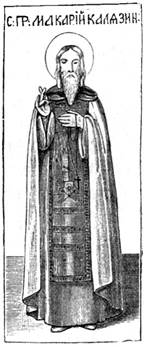
В Тверской области, в 8 верстах от Кашина, в имении своём, в с. Грибкове, что ныне Кожино, жил прославившийся в боях боярин Василий Кожа, родоначальник дворян Кожиных185. Он получил и прозвание и похвальную грамоту от князя Василия Тёмного за победу над Галицким князем, в знак которой доставлена им часть кожи убитого княжеского коня186. Сын его Матвей на седьмом году обучаем был грамоте, и отец готовил в нём верного слугу князю, каким был сам. Матвей Кожин желал более быть слугой Царя Небесного, чем слугой князя земного. Отец и мать долго уговаривали его вступить в супружество; уступая угрозам отца, сын со слезами сказал: «воля Господня да будет; делайте со мной, что хотите». Обрадованные родители нашли невесту в благородном доме Яхонтовых, и сын вступил в брак. Через год после того умерли родители, а через три – и супруга Елена, которых поминал он потом во всю жизнь и завещал поминать и в обители, которую основал187. «О горнем помышляйте, а не о земном» (Кол.3:1). Этот голос Апостола особенно сильно звучит в ушах наших в виду гробов; здесь говорит он – душе: если не расстанетесь по воле с земной суетой, расстанетесь по неволе; не достойнее ли свободы расстаться по воле с пустотой, столько опасною для вас? Молодой Кожин, похоронив супругу и родителей, расстался навсегда с миром; раздав имущество бедным, он поступил в Кашинский Клобуков монастырь и здесь принял монашество с именем Макария. Считая себя ниже всех, послушник Макарий с любовью повиновался не только игумену, но и каждому брату, старшему и младшему; ночь проводил он в пении псалмов и молитве; а днём после послушаний читал жития святых; в Клобукове указывают и келью, в которой подвизался Макарий188.
In the Tver region, eight versts from Kashin, on his estate in the village of Gribkovo, now Kozhino, lived the boyar Basil Kozha, renowned in battle, the progenitor of the Kozhin nobles185. He received both his surname and a commendatory charter from Prince Basil the Dark for a victory over the Prince of Galich, in token of which he brought a piece of the skin of the slain princely horse186. His son Matthew was taught to read and write in his seventh year, and his father prepared in him a faithful servant to the prince, as he himself was. Matthew Kozhin desired more to be a servant of the Heavenly King than a servant of an earthly prince. His father and mother long urged him to enter into marriage; yielding to his father's threats, the son said with tears: "May the will of the Lord be done; do with me as you will." The overjoyed parents found a bride in the noble house of the Yakhontovs, and the son entered into marriage. A year later his parents died, and after three years his wife Elena also died, whom he commemorated all his life afterward and bequeathed to commemorate in the monastery he founded187. "Set your affection on things above, not on things on the earth" (Col. 3:2). This voice of the Apostle sounds especially strongly in our ears in the sight of graves; here it speaks to the soul: if you do not part willingly with earthly vanity, you will part unwillingly; is it not more worthy of freedom to part willingly with the emptiness so dangerous to you? The young Kozhin, having buried his wife and parents, parted forever with the world; having distributed his property to the poor, he entered the Kashin Klobukov Monastery and there received monastic tonsure with the name Macarius. Considering himself lower than all, the novice Macarius obeyed with love not only the abbot but also every brother, elder and younger; he spent the night in singing psalms and prayer; and by day, after his obediences, he read the lives of the saints; in Klobukov they also point out the cell in which Macarius struggled188.
Не довольствуясь подвигами послушания и стремясь душой из городской обители в пустынное уединение, Макарий удалился с семью иноками из Кашина, чтобы отыскать безмолвное место для подвигов. В 18 верстах от Кашина, между двумя озёрами, вблизи Волги, нашёл он место красивое и тихое, какого искал душой. Водрузив крест, поставил он хижину и стал подвизаться в безмолвии. За местом великих подвигов его оставил название Колязиной пустыни боярин Иван Коляга, которому принадлежали ближние земли. Этому Коляге никак не хотелось, чтобы была здесь иноческая обитель: он опасался, что пустоши его отданы будут новому монастырю. В душе его зародилась сильная ненависть к Макарию; он дошёл до того, что решился убить Макария. Но неожиданно посетила его тяжкая болезнь. Страх близкой смерти пробудил в нём раскаяние. Больной Коляга велел нести себя к Макарию, у ног его рассказал о злом умысле своём на жизнь его и просил прощения. «Бог простит тебя», сказал пустынник. Коляга так искренен был теперь в своём раскаянии, что отдал Макарию свои земли в пользу обители молитвенников. Блаженный подвижник построил храм Св. Троице. Молва о чудесном обращении Коляги призвала к блаженному многих жаждавших благочестия. Надобно было избрать игумена. Макарию было не менее 53 лет; но он, считая себя неспособным, просил каждого из пришедших с ним старцев принять на себя сан священства и игуменства. Каждый из них отказался, и все братия объявили, что хотят видеть игуменом Макария. И Макарий, уступив общему желанию, посвящён был в игумена Тверским епископом Моисеем189.
Not content with the labors of obedience and striving in soul from the urban monastery to the solitude of the wilderness, Macarius withdrew with seven monks from Kashin to seek a silent place for ascetic labors. Eighteen versts from Kashin, between two lakes, near the Volga, he found a place beautiful and quiet, such as he sought in soul. Having set up a cross, he built a hut and began to struggle in silence. The place of his great labors received the name Kolyazin Hermitage from the boyar Ivan Kolyaga, to whom the nearby lands belonged. This Kolyaga by no means wanted a monastic community to be here: he feared that his waste lands would be given to the new monastery. A strong hatred for Macarius was born in his soul; he went so far as to resolve to kill Macarius. But unexpectedly a grievous illness visited him. The fear of imminent death awakened repentance in him. The sick Kolyaga ordered himself to be carried to Macarius, at his feet he told of his evil intent against his life and asked forgiveness. "God will forgive you," said the hermit. Kolyaga was now so sincere in his repentance that he gave his lands to Macarius for the benefit of the monastery of prayerful ones. The blessed ascetic built a church in honor of the Holy Trinity. The report of the miraculous conversion of Kolyaga summoned to the blessed one many who thirsted for piety. It was necessary to choose an abbot. Macarius was no less than fifty-three years old; but, considering himself incapable, he asked each of the elders who had come with him to accept upon himself the rank of priesthood and abbacy. Each of them refused, and all the brethren declared that they wished to see Macarius as abbot. And Macarius, yielding to the general desire, was consecrated abbot by Moses, Bishop of Tver189.
Первое служение своё алтарю Божию новый игумен готовился совершить долгой, уединённой молитвою, и потом приобщил всю братию святых Таин. В сане игумена Макарий трудился на ряду со всею братией, как и в то время, когда был иноком братом. Для умножившейся братии купил он у Тверского князя с. Сергеевское190. Игумен к подвигам инока присоединил заботу и труд – наставлять братию и посетителей обители. – Те, которые искренно искали спасения, в строгой жизни Макария видели сильное назидание, а в простых беседах его слышали голос опытного благочестия. Макария приходили видеть и слушать и простые люди, и многие вельможи. Они уважали его как отца, хотя носил он одежду худую, покрытую заплатами. По такому одеянию и по простоте обращения иные принимали его за человека простого и даже смеялись над ним191. Макарий более доволен бывал, когда слышал насмешки над ним, чем тогда, как хвалили его. Утешением для него было ходить по местам безмолвным и беседовать с природой. Тогда жителями пустынного края были дикие звери; но они были кротки с кротким рабом Божиим и иногда принимали от него пищу.
The new abbot prepared to perform his first service at the altar of God with long, solitary prayer, and then he communed all the brethren with the Holy Mysteries. In the rank of abbot, Macarius labored equally with all the brethren, just as when he was a monk and a brother. For the increased number of brethren he bought the village of Sergeyevskoye from the Prince of Tver190. The abbot added to the labors of a monk the care and toil of instructing the brethren and visitors to the monastery. — Those who sincerely sought salvation saw in the strict life of Macarius a powerful edification, and in his simple conversations heard the voice of experienced piety. Both common people and many nobles came to see and hear Macarius. They respected him as a father, although he wore poor clothing covered with patches. Because of such clothing and the simplicity of his manner, some took him for a simple man and even laughed at him191. Macarius was more pleased when he heard mockery of himself than when he was praised. It was a consolation for him to walk through silent places and converse with nature. At that time the inhabitants of the wilderness region were wild beasts; but they were meek with the meek servant of God and sometimes received food from him.
Духовная жизнь цвела в обители Макария. Вот что говорил сам Макарий посещавшему его Иосифу Волоколамскому: «когда пришёл я на это место, то со мной пришли из Клобукова монастыря семь старцев. Они были так совершенны в добродетелях и духовной жизни, что все братия приходили к ним принимать наставления; они же учили всех полезному, одних утверждали в добродетелях, а уклонявшихся к бесчинию удерживали запрещением и не дозволяли следовать своей воле». Сам Иосиф, очевидец жизни Макария и его сподвижник, прибавляет от себя: «такое-то благочиние и благочестие были в том монастыре». – Всё творилось согласно с отеческими и общежительными преданиями. – Даже великий старец Митрофан Бывальцев дивился тому. – Возвратясь с Афонской горы, где прожил 9 лет, он говорил братиям: «напрасно и не умно трудился я, совершая путь в святую гору, помимо Колязинского монастыря; в нём можно спастись; здесь всё совершается точно так же, как в киновиях св. горы»192.
Spiritual life flourished in the monastery of Macarius. This is what Macarius himself said to Joseph of Volokolamsk, who visited him: “When I came to this place, seven elders came with me from the Klobukov Monastery. They were so perfect in virtues and spiritual life that all the brethren came to them to receive instruction; they taught all that was profitable, confirming some in virtues, while restraining those who inclined to disorder by prohibition and not allowing them to follow their own will.” Joseph himself, an eyewitness of the life of Macarius and his fellow ascetic, adds on his own: “Such good order and piety were in that monastery.” – Everything was done according to the patristic and cenobitic traditions. – Even the great elder Mitrophan Byvaltsev marveled at this. – Having returned from Mount Athos, where he had lived for nine years, he said to the brethren: “In vain and unwisely did I labor, making the journey to the Holy Mountain, bypassing the Kolyazin Monastery; in it one can be saved; here everything is done exactly as in the cenobitic monasteries of the Holy Mountain”192.
Благодать Божия проявлялась в подвижнике Божием чудными знамениями ещё в земной жизни его. – Раз привезли в обитель его расслабленного Захарию, и больной со слезами просил Макария помолиться за него. – «Зачем привезли тебя ко мне, брат мой? Зачем просишь ты помощи у грешного, который едва кое-что приобрёл только для своего спасения?» говорил смиренный игумен. Расслабленный не переставал просить помощи. «Знаю, говорил он, что молитва твоя за меня несчастного не останется тщетной пред Богом». Макарий сказал ему: «сын мой! Бог не хочет смерти грешника и ведёт его к покаянию. – Вот и на тебя пришло посещение Божие. Если покаешься и отстанешь от прежних привычек худых, получишь исцеление; если же нет, хуже будет с тобой». Захарий со слезами исповедал все грехи свои. Блаженный благословил его, и больной стал здоровым. – Впоследствии этот исцелившийся был священником в Киясовых горах и до конца жизни твёрдо помнил наставления Макария. – Другой опыт был с бесновавшимся боярским молодым человеком Василием Рясиным. Макарий отслужил молебен о его здравии, осенил его крестом, и выздоровевший больной уже не возвратился в свой дом, а принял в обители иночество. – Раз недобрые люди украли рабочих волов обители, но внезапно ослепли. Блуждая в окрестности, они невольно воротились в обитель и покаялись в грехе своём Макарию; преподобный разрешил их от греха и слепоты, прибавив: «вперёд не грешите».
The grace of God was manifested in the ascetic of God by wondrous signs even during his earthly life. – Once a paralytic named Zacharias was brought to his monastery, and the sick man with tears asked Macarius to pray for him. – “Why have you been brought to me, my brother? Why do you ask help from a sinner, who has acquired barely something only for his own salvation?” said the humble abbot. The paralytic did not cease to ask for help. “I know,” he said, “that your prayer for me, the unfortunate one, will not be in vain before God.” Macarius said to him: “My son! God does not desire the death of a sinner and leads him to repentance. – Behold, a visitation of God has come upon you. If you repent and forsake your former evil habits, you will receive healing; if not, it will be worse for you.” Zacharias confessed all his sins with tears. The blessed one blessed him, and the sick man became well. – Afterwards this healed man became a priest in the Kiyasovy Hills and firmly remembered the instructions of Macarius until the end of his life. – Another experience was with a demon-possessed young man of boyar rank, Basil Ryasin. Macarius served a moleben for his health, made the sign of the cross over him, and the healed sick man no longer returned to his home, but received monastic tonsure in the monastery. – Once evil people stole the monastery’s work oxen, but suddenly became blind. Wandering in the vicinity, they involuntarily returned to the monastery and repented of their sin to Macarius; the Venerable One absolved them from sin and blindness, adding: “Sin no more.”
С тех пор, как поселился в пустыни, Макарий не изменял своего иноческого правила до глубокой старости: твёрдо стоял он на молитве днём и ночью. Раз вступив на жёстокий путь, не оставлял его до гроба и часто лил слёзы193. – По смерти нашли на нём тяжёлые вериги, о которых дотоле не знали194. – Блаженная кончина его последовала в 17 день марта 1483 г., на 83 году жизни его.
From the time he settled in the wilderness, Macarius did not change his monastic rule until extreme old age: he stood steadfast in prayer day and night. Having once entered upon the harsh path, he did not abandon it until the grave and often shed tears193. – After his death, heavy chains were found on him, of which no one had known before194. – His blessed end occurred on the 17th day of March, A.D. 1483, in the 83rd year of his life.
Мощи блаженного обретены нетленными (1521 г.) при копании рвов для нового храма195. С того времени начали истекать исцеления от его гроба. Живший в монастырской гостинице Иоанн двенадцать лет был со скорченными ногами. Он приполз ко гробу Макария и просил священников помолиться за него угоднику Божию. Его хотели приподнять, чтобы приложился он к святым мощам, но в ту же минуту иссохшие ноги его стали хрустеть вслух всех; он сам стал прямо на ногах и, приложась к мощам, стал здоровым. – Иеродиакон обители Андрей, страдавший от сильной ломоты ног, получил исцеление при мощах. Одна женщина страдала водяной болезнью и выздоровела у раки преподобного. Другая, 30 лет бывшая глухой, получила здесь же слух. Тоже испытала на себе Кашинская инокиня Мария, долго страдавшая ногами и имевшая скорченную руку. Юноша Григорий десять лет лежал на одре без движения; принесённый к гробу преподобного, молился он здесь и почувствовал, что может подняться; встал, чтобы поклониться гробу преподобного и – принесшие его, на время выходившие от гроба, увидав его на ногах, прославили вместе с ним Бога и Его угодника. Беснующийся Онуфрий привезён был из Новгорода, и ему возвратился смысл при гробе преподобного. Так писал очевидец чудес инок Макарий.
The relics of the blessed one were found incorrupt (A.D. 1521) while digging trenches for a new church195. From that time healings began to flow from his tomb. John, who lived in the monastery guesthouse, had had his legs contracted for twelve years. He crawled to the tomb of Macarius and asked the priests to pray for him to the saint of God. They wanted to lift him up so that he could venerate the holy relics, but at that very moment his withered legs began to crack audibly before all; he stood straight on his feet and, having venerated the relics, became well. – The hierodeacon of the monastery, Andrew, who suffered from severe pain in his legs, received healing at the relics. A certain woman suffered from dropsy and was healed at the shrine of the Venerable One. Another, who had been deaf for thirty years, received her hearing there. The same was experienced by the nun Maria of Kashin, who had long suffered in her legs and had a contracted hand. The youth Gregory lay on a bed without movement for ten years; brought to the tomb of the Venerable One, he prayed there and felt that he could rise; he stood up to bow before the tomb of the Venerable One, and – those who had brought him, having gone out from the tomb for a time, seeing him on his feet, glorified together with him God and His saint. The demon-possessed Onuphrius was brought from Novgorod, and his reason was restored to him at the tomb of the Venerable One. Thus wrote the monk Macarius, an eyewitness of the miracles.
В службе преподобному читаем: «как жемчуг драгоценный в виду всех лежат мощи твои, преподобный, и неоскудеваемо подают различные исцеления».
In the service to the Venerable One we read: “Like a precious pearl, your relics lie in the sight of all, O Venerable One, and unceasingly bestow various healings.”
Житие пр. Макария (в Ч. Μ. Макария) описано в 1540 г. иноком Макарием, который в предисловии говорит: „я не видел своими глазами преподобного, но слышал о подвигах его от многих достоверных людей, которые сами видели его; не за много лет пред нами жил он. Исцеления, бывшие при раке Богоносного отца, видел я и своими глазами». В Синод. б. житие с ркп. XVI в. № 555.
The Life of the Venerable Macarius (in the Chet’i-Minei of Macarius) was written in 1540 by the monk Macarius, who says in the preface: “I did not see the Venerable One with my own eyes, but I heard of his exploits from many trustworthy people who themselves saw him; he lived not many years before us. The healings that occurred at the shrine of the God-bearing father I saw with my own eyes.” In the Synodal Library, a Life from a 16th-century manuscript, No. 555.
Моисей рукоположен был в Тверского епископа в 1453 году св. Ионой; а преемник его был 1460–1477 г. Геннадий Кожин, родной брат преп. Макария (Ист. Иер. 1, 276. Ист. акт. 1, 502. 503. Прим., стр. 17, 109). Таким образом Макарий, скончавшийся 83 лет в 1483 г., был в 1453 г. не моложе 53 лет.
Moses was ordained Bishop of Tver in 1453 by St. Jonah; and his successor was Gennady Kozhin, the own brother of the Venerable Macarius, from 1460–1477 (History of the Hierarchy, vol. 1, p. 276; Historical Acts, vol. 1, pp. 502, 503; Notes, pp. 17, 109). Thus Macarius, who died at 83 years of age in 1483, was in 1453 no younger than 53 years.
Эта непоказная наружность вводила если не в обман, то в сомнение, и такого человека, каков был Вассиян, бывший князь, инок не беззаботный. – По временам увлекаясь рационализмом реформации, он на соборе 1531 г. говорил: „я знал его (Макария): – он был простой человек; но чудотворец ли он, или не чудотворец, вам остаётся судить“. Μ. Даниил отвечал Вассияну: „в святых ищи не телесного, а духовного благородства, высокого в очах Божиих; сказано: не от похоти плотские, не от похоти мужеские, но от Бога родишася“. Прение Μ. Даниила с старцем Вассияном в чтен. общ. ист. IX, 11. В своём оправдании Вассиян писал: „сие лжеши на мя и на моего старца Нила (Сорского), что мы хулим чудотворцев, и древних и новых“. – Рукоп. Синод. б. № 738.
This unpretentious appearance led, if not into deception, then into doubt, even a man such as Vassian, a former prince and a monk not without care. – At times, carried away by the rationalism of the Reformation, he said at the Council of 1531: “I knew him (Macarius): he was a simple man; but whether he is a wonderworker or not a wonderworker, it remains for you to judge.” Metropolitan Daniel answered Vassian: “In the saints seek not bodily, but spiritual nobility, which is high in the eyes of God; it is said: ‘born not of the will of the flesh, nor of the will of man, but of God.’” The Disputation of Metropolitan Daniel with the Elder Vassian in Readings of the Society of Russian History, IX, 11. In his defense, Vassian wrote: “You lie about me and about my elder Nilus (of Sora), that we blaspheme the wonderworkers, both ancient and new.” – Manuscript of the Synodal Library, No. 738.
Служба на обретение мощей преподобного (26 мая) в минее на май м. 1646 г. „Стянув тело своё веригами железными и чистотою, в вышния селения достигл еси, отче“.
Service for the Uncovering of the Relics of the Venerable One (May 26) in the Menaion for May of 1646. “Having girded your body with iron chains and with purity, you have attained the heavenly dwellings, O Father.”
Пролог 17 марта; Карамз. 7, пр. 383. Русск. времен. 2, 268, 269. В конце Евангелия Колязинской обители припись: „в л. 7041 (1533) в обители живоначальные Троицы и Пречистые Матери честнаго Рождества и св. страстотерпец Бориса и Глеба и преподобнаго и Богоноснаго отца нашего Макария в Колязине монастыре, по благословению игумена Евфимия, написано бысть Евангелие сие на престол“.
Prologue, March 17; Karamzin, vol. 7, note 383; Russian Timepiece, vol. 2, pp. 268, 269. At the end of the Gospel of the Kolyazin Monastery there is an inscription: "In the year 7041 (1533), in the monastery of the Life-giving Trinity and of the Most Pure Mother of Her Honorable Nativity and of the Holy Passion-bearers Boris and Gleb and of our Venerable and God-bearing Father Macarius in the Kolyazin Monastery, by the blessing of Abbot Euthymius, this Gospel was written for the altar."