Савин был один из начальных граждан Ермополя, что в Египте. Во время гонения Диоклитианова, скрываясь от сыщиков, удалился из Ермополя в некую пустынную деревню. Нищий же некто, питаемый им,
Savinus was one of the foremost citizens of Hermopolis in Egypt. During the persecution of Diocletian, hiding from the informers, he withdrew from Hermopolis to a certain deserted village. But a certain beggar, whom he had supported,
услышав, что Савина ищут, пришёл к идолослужителям и за две золотые монеты уговорился довести их до убежища Савинова. Так был схвачен блаженный и, после пыток сперва в Ермополе, потом в Антинополе, утоплен в реке Ниле с другими шестью христианами. – Папа же святой пострадал около 305 г. в Селевкии Исаврийской.
hearing that Savinus was being sought, went to the idolaters and for two gold coins agreed to lead them to Savinus’s hiding place. Thus the blessed one was seized and, after tortures first in Hermopolis and then in Antinoöpolis, was drowned in the river Nile together with six other Christians. – The holy Papas suffered around the year 305 in Seleucia of Isauria.
Жил в I веке. Апостол Аристовул, родом из Кипра, брат св. Апостола Варнавы, был поставлен в епископы св. Апостолом Павлом. Он проповедовал в Британии, нынешней Англии, почему и называется Вританийским или Британским. Много потрудился он, проповедуя язычникам, много и пострадал от них, и мирно скончался в Британии. – О нём упоминает св. Апостол Павел в послании к Римлянам: «приветствуйте верных из дома Аристовула» (Рим.16:10).
He lived in the first century. The Apostle Aristobulus, a native of Cyprus and brother of the holy Apostle Barnabas, was appointed bishop by the holy Apostle Paul. He preached in Britain, now England, for which reason he is called the Bishop of Britain or the British Bishop. He labored much, preaching to the pagans, and suffered much from them, and reposed peacefully in Britain. – The holy Apostle Paul makes mention of him in the Epistle to the Romans: “Salute the faithful of the household of Aristobulus” (Rom. 16:10).
Память его ещё – 31-го октября с другими пятью из 70-ти Апостолов: Стахием, Амплием, Урбаном, Наркиссом Апеллием, и – 4-го января, в соборе 70-ти Апостолов.
His memory is also kept on October 31 with five others of the Seventy Apostles: Stachys, Amplias, Urban, Narcissus, and Apelles, and on January 4, in the Synaxis of the Seventy Apostles.
Уроженец Никеи, сперва был монахом на горе Латре в Вифинии, потом игуменом обители на острове Косе. 1089 году он упросил императора Алексея Комнина отдать его обители пустынный тогда (от Сарацынских набегов) остров Патмос в замен имений на острове Косе и на берегу Карий, и устроил тут монастырь на горе близ пещеры, в которой, по преданию, св. Апостол Иоанн Богослов написал «Апокалипсис». В 1110 г. бежал с учениками своими на остров Евбею, по причине набегов морских разбойников, и скончался там в следующем году. Ученики перенесли обратно мощи преподобного, которые и доныне покоятся в его обители.
A native of Nicaea, he was first a monk on Mount Latros in Bithynia, then abbot of a monastery on the island of Cos. In the year 1089 he prevailed upon the Emperor Alexius Comnenus to grant to his monastery the then-deserted island of Patmos (due to Saracen raids) in exchange for properties on the island of Cos and on the Carian coast, and he established there a monastery on a mountain near the cave in which, according to tradition, the holy Apostle John the Theologian wrote the Apocalypse. In the year 1110 he fled with his disciples to the island of Euboea on account of raids by sea pirates, and reposed there in the following year. The disciples brought back the relics of the Venerable One, which to this day rest in his monastery.
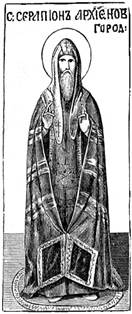
Блаженный Серапион родился в селе Пехорке (Пехре) невдали от Москвы171. Обученный грамоте на 7 году, он рано хотел расстаться с миром; но родители заставили его вступить в брак, и он принял сан священства; но через год после брака супруга его скончалась. Приняв иноческий образ, он для покоя родителей оставался священником при Покровской церкви; по смерти же родителей, отпустив работников и раздав имущество бедным, вступил в Дубенский Успенский монастырь, что на острове. По смерти настоятеля братия упросили Серапиона принять на себя должность строителя обители Дубенской, состоявшей тогда в ведении Сергиевой лавры. Преподобный столько известен был здесь духовными подвигами и так много соделал для Островской пустыни, что пустынь называлась потом пустынью Серапиона172. – Тяготясь заботливой должностью, он отказался от неё и перешёл в Сергиеву лавру. Но и здесь не долго был в покое. Волей митрополита и великого князя определён он (1493 г.) в игумена лавры. – Великий князь Иоанн уважал подвижника игумена. Три боярыни обвинены были перед великим князем в волшебстве; строгий Иоанн велел сжечь их. Блаженный Серапион, уверенный в невинности несчастных, после усердной молитвы к Св. Троице, явился к великому князю и убеждал его отменить суровый приговор; великий князь послушался благочестивого игумена, и жизнь трёх невинных была спасена. Заботливый о благоустройстве великой обители и особенно о жизни достойной иночества, блаж. Серапион был и на соборе о церковных имениях; здесь старался он согласить пользы Церкви и государства и подавал голос одинаковый с голосом игумена Волоколамского Иосифа173.
The blessed Serapion was born in the village of Pekhorka (Pekhra), not far from Moscow171. Having learned to read and write at the age of seven, he early desired to part from the world; but his parents compelled him to enter into marriage, and he received the rank of the priesthood; yet a year after the marriage, his wife reposed. Having received the monastic form, he remained, for the peace of his parents, a priest at the Church of the Protection; after the death of his parents, however, having dismissed his workers and distributed his possessions to the poor, he entered the Duben Monastery of the Dormition, which is on an island. After the death of the superior, the brethren entreated Serapion to take upon himself the office of builder of the Duben Monastery, which was then under the authority of the Sergius Lavra. The Venerable One became so renowned here for his spiritual struggles and did so much for the Island Hermitage that the hermitage was afterwards called the Hermitage of Serapion172. – Burdened by the cares of office, he declined it and transferred to the Sergius Lavra. But even here he was not long at peace. By the will of the Metropolitan and the Grand Prince, he was appointed (in 1493) abbot of the Lavra. – Grand Prince John respected the ascetic abbot. Three noblewomen were accused before the Grand Prince of sorcery; the stern John ordered them to be burned. The blessed Serapion, convinced of the innocence of the unfortunate women, after fervent prayer to the Holy Trinity, appeared before the Grand Prince and urged him to revoke the harsh sentence; the Grand Prince heeded the pious abbot, and the lives of three innocent women were saved. Careful for the good order of the great monastery and especially for a life worthy of monasticism, the blessed Serapion also took part in the council on church properties; here he strove to reconcile the interests of the Church and the state and gave his vote in agreement with that of Abbot Joseph of Volokolamsk173.
Великий князь Иоанн, передавая управление сыну своему Василию, указал ему на Серапиона, как на достойного занять святительскую кафедру в Новгороде, и 15 января 1506 г. собором архипастырей Серапион посвящён в архиепископа Новгородского. – Это возведение на высокую степень власти было для Серапиона призывом к самым сильным скорбям. В феврале прибыл он в Новгород; а осенью открылся мор. То же бедствие возобновлялось и в следующие два года, также осенью. В последнюю осень померло в Новгороде от язвы 15,398 человек. Между тем в августе того же 1508 года был такой страшный пожар и в Новгороде, что трудно указать в летописи другой подобный: страшная буря усилила свирепость огня до крайней степени. Святитель во время пожара выходил с крестным ходом на Волховской мост к чудному кресту». Молясь об утолении гнева Божия, он не только лил слёзы, но рыдал и от рыданий не мог читать молитв; он продолжал дотоле молиться, пока пожар стал ослабевать. Когда всё кончилось, оказалось, что одних людей сгорело до 3,315 человек174.
Grand Prince John, when transferring the rule to his son Basil, pointed to Serapion as one worthy to occupy the hierarchal see in Novgorod, and on January 15, 1506, Serapion was consecrated Archbishop of Novgorod by a council of chief pastors. – This elevation to a high degree of authority was for Serapion a summons to the most grievous sorrows. In February he arrived in Novgorod; and in autumn a plague broke out. The same calamity recurred in the following two years, also in autumn. In the last autumn, 15,398 persons died in Novgorod from the pestilence. Meanwhile, in August of that same year 1508, there was such a terrible fire in Novgorod that it is difficult to point to another like it in the chronicle: a terrible storm intensified the fury of the fire to the utmost degree. During the fire, the Hierarch went out with a cross procession to the Volkhov Bridge, to the wondrous cross. Praying for the appeasement of God’s wrath, he not only shed tears but sobbed, and from sobbing could not read the prayers; he continued praying until the fire began to abate. When all was over, it turned out that up to 3,315 persons alone had perished in the flames174.
Во время, столько тяжёлое для Новгорода и его архипастыря ревностного, началась горькая история по Волоколамскому монастырю. – Теснимый Волоколамским князем, блаженный игумен Иосиф обратился с просьбой о защите к великому князю и был принят с обителью в ведение митрополита и великого князя. Серапион подверг Иосифа запрещению за то, что он без ведения и воли своего архиепископа уклонился из его епархии. Великий князь Василий принял за личное оскорбление себе запретительную грамоту архиепископа. Архипастырь, обличая в Иосифе недостаток терпения, если не земную суетность, писал Иосифу: «почему ты отдал монастырь свой в ведение великого государства? Ты отступил от небесного и пришёл к земному». Василий в тревогах самолюбия объяснил себе это так: «ты назвал князя Феодора небесным, а меня земным. Что я земной, это я знаю; но скажи мне, почему ты князя Феодора назвал небесным?»175 На третьей неделе после Пасхи, в конце апреля 1509 г., не только без суда, но даже не выслушав объяснения со стороны Серапиона, Василий объявил Серапиона лишённым кафедры, вытребовал его в Москву и заключил в Андрониковом монастыре176. В заключении своём страдалец терпел много оскорблений от Андроньевского настоятеля Симеона, постриженца игумена Волоколамского. На соборе (в июле 1509 г.) обвинили Серапиона за отлучение Иосифа, желавшего, но не могшего, получить благословение архиепископа, и признали его лишённым кафедры177. – Но если Иосиф не был виновным за то, что без благословения своего архипастыря перешёл в другую епархию, так как на деле желал, но не мог получить его, – то и Серапион не был виновен перед церковным законом, произнося суд свой над Иосифом по сведениям, какие были тогда у него. Потому суд собора был только уступкой насилию власти. В сильном и пространном послании к митрополиту Симону, написанном в тяжёлом заточении, Серапион жаловался первосвятителю на то, что увлёкся он пристрастными внушениями Ростовского архиепископа Вассиана и других нерассудительных друзей Иосифа. Называя митрополита святейшим архиепископом, своим отцом и господином, себя же смиренным сыном и заточённым, он вместе с тем говорил, что и он сам по милости Божией архиепископ, которого не следует оскорблять несправедливо. Показывал вину Иосифа в том, что он вопреки церковным правилам удалился из его епархии без его благословения и возбудил смущение в целой Церкви. Напоминал митрополиту, что просил он дозволения явиться в Москву и объясниться перед государем на соборе и однако не был допущен до того; вместо же того вопреки правилам Церкви без суда лишили его кафедры и заточили. – «Вспомни, святейший, говорил далее страдалец, с какими обетами поставили вы меня, и что ты заповедовал мне? Не обещался ли я тебе, господину моему и отцу, и всем епископам, в святой церкви у Пречистой Богородицы, у цельбоносного гроба Петра чудотворца, сохранить заповеди, никого не боясь, и стоять в правде, по наставлению псалмопевца: «глаголах перед цари и не стыдяхся» (Пс.118:46). Тогда дал я слово Богу и вам поступать по преданиям Апостолов и святых отцов. А ты преподал мне хиротонию и власть вязать и решать, которую и употребил я над моим чернцом, когда он нарушил уставы прежних архиепископов Новгорода». В заключении писал: «мне, еже жити Христос и еже умрети приобретение (Флп.1:21). Кто ны разлучит от любве Божия? (Рим.8:35.) Ожидаю воздаяния праведным от Христа Господа моего».
During a time so grievous for Novgorod and its zealous archpastor, a bitter affair concerning the Volokolamsk Monastery began. – Harassed by the Prince of Volokolamsk, the blessed Abbot Joseph turned with a request for protection to the Grand Prince and was received, together with his monastery, under the authority of the Metropolitan and the Grand Prince. Serapion placed Joseph under suspension for having withdrawn from his diocese without the knowledge and will of his own archbishop. Grand Prince Basil took the archbishop’s letter of suspension as a personal insult to himself. The archpastor, reproaching in Joseph a lack of patience, if not earthly vanity, wrote to Joseph: “Why have you given your monastery over to the authority of the great state? You have departed from the heavenly and come to the earthly.” Basil, in the agitation of wounded pride, interpreted this as follows: “You called Prince Theodore heavenly, and me earthly. That I am earthly, I know; but tell me, why did you call Prince Theodore heavenly?”175 In the third week after Pascha, at the end of April 1509, not only without a trial but even without hearing Serapion’s explanation, Basil declared Serapion deprived of his see, summoned him to Moscow, and confined him in the Andronikov Monastery176. In his confinement, the sufferer endured many insults from the Andronikov superior, Simeon, a monk tonsured by Abbot Joseph of Volokolamsk. At a council (in July 1509), they accused Serapion for the excommunication of Joseph, who had desired but had been unable to obtain the archbishop’s blessing, and they declared him deprived of his see177. – But if Joseph was not guilty for having transferred to another diocese without the blessing of his archpastor, since in fact he had desired but could not obtain it, then Serapion also was not guilty before church law in pronouncing his judgment upon Joseph based on the information he then had. Therefore, the council’s judgment was merely a concession to the violence of authority. In a strong and lengthy epistle to Metropolitan Simon, written in his grievous confinement, Serapion complained to the chief hierarch that he had been swayed by the partial instigations of Archbishop Vassian of Rostov and other injudicious friends of Joseph. Calling the Metropolitan “most holy archbishop, my father and lord,” and himself “a humble son and a prisoner,” he nevertheless said that he himself, by the mercy of God, was an archbishop, who ought not to be unjustly insulted. He showed Joseph’s guilt in that, contrary to the church canons, he had withdrawn from his diocese without his blessing and had stirred up confusion in the whole Church. He reminded the Metropolitan that he had asked permission to come to Moscow and explain himself before the sovereign at the council, yet had not been allowed to do so; instead, contrary to the canons of the Church, without a trial they had deprived him of his see and imprisoned him. – “Remember, most holy one,” the sufferer continued, “with what vows you placed me, and what did you command me? Did I not promise you, my lord and father, and all the bishops, in the holy church at the Most Pure Theotokos, at the life-bearing tomb of Peter the Wonderworker, to keep the commandments, fearing no one, and to stand in the truth, according to the instruction of the Psalmist: ‘I spake before kings, and was not ashamed’ (Ps. 118:46)? Then I gave my word to God and to you to act according to the traditions of the Apostles and the holy fathers. And you conferred upon me the consecration and the power to bind and to loose, which I have used upon my monk when he violated the statutes of the former archbishops of Novgorod.” In conclusion he wrote: “For me, to live is Christ, and to die is gain (Phil. 1:21). Who shall separate us from the love of God? (Rom. 8:35.) I await the reward of the righteous from Christ my Lord.”
Митрополит Симон перед своей смертью († 1511 г.) с согласия великого князя пригласил к себе Серапиона, и – спросил у него прощения и сам, простив его, дозволил ему жить в любезной его лавре Сергия178. Тогда же примирился с высоким по жизни архипастырем преподобный Иосиф Волоколамский; а по его убеждению согласился на увольнение Серапиона в лавру великий князь179. Слишком строго судившие и осуждавшие Серапиона по видам человеческим испытали на себе суд Божий, как видели это современники180. В тот самый час, когда Иосиф переходил в жизнь вечную, блаженный Серапион встал и сказал вслух бывших с ним: «брат наш Иосиф преставился; да простит его Бог»; потом, смотря на икону Богоматери, прибавил: «бывает подобное и с праведными». Блаженный страдалец и строгий подвижник, приняв схиму, мирно почил 16 марта 1516 г.181. Святые мощи его обретены нетленными в следующем году, апреля 7 дня, и остаются под спудом в так называемой Серапионовой палатке лавры182.
Metropolitan Simon, before his death († 1511), with the consent of the Grand Prince, summoned Serapion to himself, asked his forgiveness, and himself, having forgiven him, permitted him to live in his beloved Lavra of St. Sergius178. At the same time, the Venerable Joseph of Volokolamsk was reconciled with the archpastor of lofty life; and at his persuasion, the Grand Prince agreed to Serapion’s release to the Lavra179. Those who had judged and condemned Serapion too harshly according to human considerations experienced the judgment of God upon themselves, as contemporaries saw180. At the very hour when Joseph was passing into eternal life, the blessed Serapion rose and said aloud to those with him: “Our brother Joseph has reposed; may God forgive him”; then, looking at the icon of the Mother of God, he added: “Such things happen even to the righteous.” The blessed sufferer and strict ascetic, having received the schema, peacefully reposed on March 16, 1516181. His holy relics were found incorrupt the following year, on April 7, and remain under the veil in the so-called Serapion Chamber of the Lavra182.
В 1608 г., во время осады лавры ляхами, св. Сергий, как видели лучшие старцы, будил иноков и звал в храм молитвы; сюда вошёл «святой архиепископ Серапион в одежде святительской и стал в алтаре, перед образом Пресвятыя Богородицы. Чудотворец Сергий, обратясь к нему, сказал: «отче Серапионе! не медли вознесть моление к милостивому Спасителю и Пресвятой Богородице». Святой архиепископ с поднятыми к небу руками воззвал: «о! всепетая Мати! от всякия избави напасти всех»183. Вместе с другими прославленными Новгородскими святителями святой Серапион призывается на помощь в церковных грамотах 1628 и 1654 г.184.
In 1608, during the siege of the Lavra by the Poles, St. Sergius, as the best of the elders saw, awakened the monks and called them to the church for prayer; there entered “the holy Archbishop Serapion in hierarchal vestments and stood in the altar, before the icon of the Most Holy Theotokos. The Wonderworker Sergius, turning to him, said: ‘Father Serapion! delay not to raise up supplication to the merciful Savior and the Most Holy Theotokos.’ The holy archbishop, with hands raised to heaven, cried out: ‘O all-hymned Mother! deliver all from every calamity.’”183 Together with other glorified hierarchs of Novgorod, St. Serapion is invoked for aid in church charters of 1628 and 1654.184
Ркп. житие св. Серапиона, описанное учеником его игум. Иаковом, в сборнике Сергиевой Лавры № 105 и 7. У Румянцева № 371.
Manuscript Life of St. Serapion, written by his disciple Abbot James, in the collection of the St. Sergius Lavra, Nos. 105 and 7. At Rumyantsev, No. 371.
Пролог 16 марта: „приходит в монастырь Пресв. Богородицы, честнаго Ея Успения, на остров, иже есть на Дубенке“. Дубенская общежительная пустынь находилась на острове, омываемом Дубенкой, Дубной и Быстрицей, на границах Тверской и Владимирской губерний, на северо-востоке от Сергиевой Лавры. – В с. Заболотье, находящемся в 6 верст. от Дубенского острова, сохраняется икона Спасителя, с надписью: „сия святая икона поступила из бывшего Успенского,Саввина и Серапионова монастыря, что в Шавпикине, от строителя старца Леонтия, в 1765 г.“. Чтен. Общ. Ист. 1860 г., кн. 1.
Prologue, March 16: “He came to the monastery of the Most Holy Theotokos, of Her honorable Dormition, on the island which is on the Dubenka.” The Dubenka cenobitic hermitage was situated on an island washed by the Dubenka, the Dubna, and the Bystritsa, on the borders of Tver and Vladimir provinces, to the northeast of the St. Sergius Lavra. – In the village of Zabolotye, located six versts from the Dubenka island, an icon of the Savior is preserved, with the inscription: “This holy icon came from the former Dormition, Sabbas, and Serapion monastery, which was in Shavpikino, from the builder Elder Leontius, in 1765.” Readings of the Society of History, 1860, Book 1.
Ркп. житие преп. Иосифа, соч. неизвестного: „в сих совопрошениях Троицкий Сергиева монаст. игумен Серапион да Иосиф разумне и добре расчиняху лучшая к лучшим, смотря обоюду пользующая“.
Manuscript Life of Venerable Joseph, composed by an unknown author: “In these discussions, the abbot of the Trinity St. Sergius Monastery, Serapion, and Joseph wisely and well arranged the better for the better, looking to what was profitable for both.”
Разрешительная грамота Иосифу от 8 июля 1509 г. в Ист. Акт. 1, 529. О соборе собр. л. VI, 249. 250. Львов. л. 3, 306–309. В последней – ошибка о времени собора.
Absolution charter to Joseph of July 8, 1509, in Historical Acts 1, 529. On the council: Collected Chronicles VI, 249, 250; Lviv Chronicle 3, 306–309. The latter contains an error regarding the time of the council.
Досифеево житие Иосифа: „и паки мало прейде, архиепископ Серапион со игуменом Иосифом межи себя общее прощение получиша“. Неизвестный в житии Иосифа: „Иосиф извествовася к Серапиону и дознавшеся на истине смирение умножиста себе преподобника и любовь множае первые утвердиста“. – Из послания к вел. кн. Василию видно, что князь спрашивал, как он думает поступить для примирения с Серапионом, и преподобный, поняв из письма неудовольствие Василия на этот мир, предоставил дело воле князя (Волоколам. ркп. № 122). По письму Иосифа к Челядину несомненно, что примирение Иосифа с Серапионом последовало уже при м. Варлааме. Летопись под 1516 г. говорит: „смирися вел. князь с Серапионом“ (Собр. л. 3. 184). Но примирение или точнее испрошение прощения – не то, что дозволение Серапиону перейти в лавру. О последнем в продолжении Нестора и в Русск. Времен. 2, 238 сказано, что в мае 1511 г. „вел. князь отпустил бывшего архиепископа Серапиона в Сергиев монастырь“.
Dositheus’ Life of Joseph: “And again, after a little time, Archbishop Serapion and Abbot Joseph received mutual forgiveness between themselves.” The unknown author in the Life of Joseph: “Joseph made himself known to Serapion, and having come to the truth, increased humility in himself, the venerable one, and established love more than before.” – From the epistle to Grand Prince Basil, it is evident that the prince asked how he thought to act for reconciliation with Serapion, and the venerable one, understanding from the letter Basil’s displeasure at this peace, left the matter to the prince’s will (Volokolamsk manuscript No. 122). According to Joseph’s letter to Chelyadin, it is beyond doubt that the reconciliation of Joseph with Serapion occurred already under Metropolitan Barlaam. The chronicle under 1516 says: “The Grand Prince was reconciled with Serapion” (Collection of Chronicles 3, 184). But reconciliation, or more precisely the asking of forgiveness, is not the same as permission for Serapion to move to the Lavra. Concerning the latter, in the Continuation of Nestor and in the Russian Timepiece 2, 238, it is said that in May 1511, “the Grand Prince released the former Archbishop Serapion to the St. Sergius Monastery.”
Собр. л. 4, 136. 258. 3, 148. 184. „Кто на него (Серапиона) ни постоял, Василий Андреевич Челядин, владыка Ростовский Вассиан (умер 28 авг. 1515 г.), владыка Суздальский Симеон, бывший Андроньевский настоятель († 15 сент. 1515 г.), того лета все умерли; а Иван Андреевич Челядин в Литве главу свою положил (взятый в плен августа 1 1514 г.); а Рязанский Тарасий владычество оставил его же ради; да того же лета и Пермский Пдотасий умре“.
Collection of Chronicles 4, 136, 258; 3, 148, 184. “Whoever stood by him (Serapion)—Vasily Andreevich Chelyadin, Bishop Vassian of Rostov (died August 28, 1515), Bishop Simeon of Suzdal, former superior of the Androniev Monastery (died September 15, 1515)—all died that year; and Ivan Andreevich Chelyadin laid down his head in Lithuania (taken captive on August 1, 1514); and Tarasius, Bishop of Ryazan, left his see on his account; and that same year also Ptodasius, Bishop of Perm, died.”
Пролог марта 16. В Музее Румянцева № 371: „апреля в 7 день обретение мощей иже во святых отца нашего Серапиона архиепископа Новгородского“. Здесь служба с каноном и потом житие Серапиона. В святцах устава XVI в. (Толстого 1 № 100) марта 16 „преставление св. Серапиона архиепископа Новгородского“.
Prologue, March 16. In the Rumyantsev Museum, No. 371: “April 7, the uncovering of the relics of our father among the saints Serapion, Archbishop of Novgorod.” Here there is a service with a canon and then the Life of Serapion. In the calendar of a 16th-century Typikon (Tolstoy 1, No. 100), March 16: “The repose of St. Serapion, Archbishop of Novgorod.”