Уроженец Дамаска, весьма образованный во внешних и священных науках, Софроний подвизался сначала в Палестинской обители преподобного Феодосия под руководством Иоанна Мосха, потом с ним же посещал Фиваидских пустынников. В Александрии заболел глазами и, когда через несколько месяцев врачи объявили болезнь неизлечимой, обратился с молитвой к св. врачам Киру и Иоанну (31 янв.) и был исцелён ими. Благодарный к св. мученикам, он изобразил жизнь и подвиги их и описал 70 чудес их. В Александрии Иоанн и Софроний жили при патриархе Иоанне Милостивом (12 ноября) и были ему помощниками в управлении делами Церкви и в борьбе с еретиками монофизитами; тут же Софроний и монахом сделался. Когда Персы приближались к Александрии (618 г.), Иоанн и Софроний отправились странствовать и посетили Кипр, Константинополь и Рим. В Риме Иоанн скончался (622 г.), и Софроний возвратился в лавру преп. Феодосия для предания земле останков учителя своего. Затем был в Александрии и со слезами умолял патриарха Кира не оглашать «изложения Веры», которым он думал соединить монофизитов с Церковью; но тщетны были его просьбы как здесь, так и в Константинополе, у патриарха Сергия. В начале 634 г. собор епископов Иерусалимского округа избрал его в патриарха. Софроний немедленно соборне обличил ересь и известил о том прочих патриархов. В 636 году, в августе магометане подступили к Иерусалиму и держали его в осаде пять месяцев; наконец Софроний явился в стан неприятельский и сдал город на возможно приличных условиях. Скончался около 638 года. От него имеются многие песни церковные, слова и объяснение на литургию.
A native of Damascus, highly educated in both secular and sacred sciences, Sophronius first asceticised in the Palestinian monastery of the Venerable Theodosius under the guidance of John Moschus, and afterwards visited the hermits of the Thebaid together with him. In Alexandria he fell ill with an eye disease, and when after several months the physicians declared the illness incurable, he turned in prayer to the holy physicians Cyrus and John (January 31) and was healed by them. Grateful to the holy martyrs, he wrote an account of their life and struggles and described seventy of their miracles. In Alexandria, John and Sophronius lived under Patriarch John the Merciful (November 12) and were his helpers in administering the affairs of the Church and in the struggle against the Monophysite heretics; it was there that Sophronius also became a monk. When the Persians drew near to Alexandria (A.D. 618), John and Sophronius set out on a journey and visited Cyprus, Constantinople and Rome. In Rome John reposed (A.D. 622), and Sophronius returned to the Lavra of the Venerable Theodosius to commit his teacher's remains to the earth. Afterwards he was in Alexandria and with tears besought Patriarch Cyrus not to promulgate the "Exposition of the Faith" by which he thought to unite the Monophysites with the Church; but his entreaties were in vain, both there and in Constantinople, before Patriarch Sergius. At the beginning of A.D. 634, a council of the bishops of the Jerusalem district elected him patriarch. Sophronius immediately denounced the heresy in council and informed the other patriarchs of it. In A.D. 636, in August, the Mohammedans approached Jerusalem and kept it under siege for five months; finally Sophronius appeared in the enemy camp and surrendered the city on the most honorable terms possible. He reposed around A.D. 638. Many church hymns, homilies and an explanation of the Divine Liturgy have come down from him.
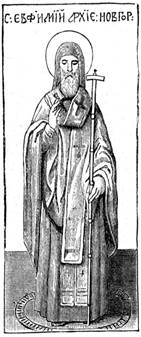
Св. Евфимий, в крещении Иоанн, сын молитвы бесплодных благочестивых родителей, Новгородцев, священника Михея и Анны118, на 15 году вступил в Вяжицкую обитель, – это была тогда обитель новая. Благочестивые пустынники Евфросин, Игнатий и Галактион избрали себе место для подвигов в лесу и на болоте. Они поставили сперва часовню в честь святителя Николая. Когда же пришёл к ним священник Пимен, в иночестве Пахомий, – устроен был храм св. Николая в 1411 г., и Пахомий был первым игуменом119. Один Новгородский боярин много прибавлял скорбей к суровой жизни пустынников, пока не получил исцеление в обители св. Николая. В это-то дикое и суровое место пришёл Иоанн и, приняв иночество, стал вести жизнь подвижническую. Узнав о строгой жизни инока Евфимия, архиепископ Симеон взял Евфимия в свой дом и поручил ему заведовать церковным имуществом; это был первый казначей из иноков, а до того времени казначеи дома избирались из мирян. Евфимий был и примерным казначеем, и строгим иноком. По смерти блаж. Симеона и после краткого правления и избранного, но не посвящённого, Феодосия избрали в архиепископа Евфимия бородатого. Казначей Евфимий удалился в Хутынь на безмолвие; но скоро иноки Лисичьей горы упросили его быть их игуменом.
St. Euthymius, in baptism John, the child of prayer of barren and pious parents, Novgorodians, the priest Micah and Anna118, entered the Viazhi Monastery in his fifteenth year—this was then a new monastery. The pious hermits Euphrosynus, Ignatius and Galaktion chose for themselves a place for ascetic labours in a forest and swamp. They first set up a chapel in honor of St. Nicholas. When the priest Pimen, in monasticism Pachomius, came to them, a church of St. Nicholas was built in 1411, and Pachomius was the first abbot119. A certain Novgorod boyar added many sorrows to the harsh life of the hermits, until he received healing in the monastery of St. Nicholas. It was to this wild and harsh place that John came, and having received the monastic tonsure, began to lead an ascetic life. Learning of the strict life of the monk Euthymius, Archbishop Simeon took Euthymius into his own house and entrusted him with the management of church property; this was the first treasurer chosen from among the monks, whereas until that time the treasurers of the house were chosen from the laity. Euthymius was both an exemplary treasurer and a strict monk. After the death of the blessed Simeon and after the brief rule of the elected but unconsecrated Theodosius, Euthymius the Bearded was chosen as archbishop. Treasurer Euthymius withdrew to Khutyn for silence; but soon the monks of Lisichya Gora begged him to be their abbot.
Ноября 29-го 1429 г. «священноинок Евфимий с Лисичьей горы по жребию возведён был на сени», т. е. в дом и должность Новгородского архипастыря120. Так как в Москве после изгнанного Исидора, от кровавых споров за престол великого князя долго не было митрополита, то Евфимий до 1434 г. оставался наречённым архиепископом, а в этом году (мая 24) посвящён был в Смоленске митрополитом Герасимом121. Такое положение не было лёгким для блаж. Евфимия; но это не мешало ему с ревностью заниматься делами порученного ему звания. Пожар, опустошивший Софийскую сторону в 1431 г., заставил его много трудиться для возобновления строений владычнего дома. В Новгородском кремле построено им несколько храмов и богато украшен Софийский собор. «Если хочешь, пишет Пахомий, видеть немногое из числа великих дел его, – иди к храму св. Софии. Там увидишь созданные им храмы святых, стоящие подобно горам. Не голосом, а делом открывают они разнообразную красоту свою». – «Это даровал мне архиепископ Евфимий», говорит одна церковь; другая говорит: «таким благолепием он украсил меня»; третья поведает: «меня воздвиг он с основания». Храм великого Иоанна Златоустого, высокий и красивый, рукой Златоустого благословляет его и от его лица говорит: «поелику ты воздвиг мне храм на земле, и я умолю Творца приготовить тебе храмину на небе». Соборный храм премудрости Божией, обветшавший от времени и возобновлённый им, вещает: «он возвратил мне прежнее благолепие моё, у красил меня св. иконами, – он – хвала и красота моя». Похваляясь перед Церковью ангела его Евфимия, им построенной, и прочими храмами, старец прибавляет: «се аз и дети, которых дал мне он». По летописям видим ещё, что в начальные годы правления паствой блаж. Евфимий многое устроил и в любимой своей обители Вяжицкой, дотоле бедной. В 1438 г. построен им здесь каменный храм св. Николая, который потом украшен был стенным письмом; а в следующем году построил он здесь же каменный тёплый храм Богослова с трапезой и службами122.
On November 29, 1429, "the hieromonk Euthymius from Lisichya Gora was raised by lot to the canopy," i.e., to the house and office of the Novgorod archpastor120. Since in Moscow, after the expulsion of Isidore, there was no metropolitan for a long time because of the bloody disputes over the grand princely throne, Euthymius remained the designated archbishop until 1434, and in that year (May 24) he was consecrated in Smolensk by Metropolitan Gerasim121. Such a situation was not easy for the blessed Euthymius; but this did not hinder him from zealously attending to the affairs of the office entrusted to him. The fire that devastated the St. Sophia side in 1431 compelled him to labor much for the restoration of the buildings of the vladyka's house. In the Novgorod Kremlin he built several churches and richly adorned the Cathedral of St. Sophia. "If you wish," writes Pachomius, "to see a small part of his great works, go to the church of St. Sophia. There you will see the churches of the saints built by him, standing like mountains. Not with voice, but with deed, they reveal their manifold beauty." — "This the Archbishop Euthymius granted me," says one church; another says: "with such splendor he adorned me"; a third declares: "he raised me from the foundations." The church of the great John Chrysostom, lofty and beautiful, blesses him with the hand of Chrysostom and speaks from his lips: "since you have raised up a church for me on earth, I will entreat the Creator to prepare a dwelling for you in heaven." The cathedral church of the Wisdom of God, which had decayed with time and was restored by him, proclaims: "he returned to me my former splendor, he adorned me with holy icons—he is my praise and beauty." Boasting before the Church of his angel Euthymius, built by him, and before the other churches, the elder adds: "Behold, I and the children whom he gave me." From the chronicles we also see that in the early years of his rule over the flock, the blessed Euthymius arranged much in his beloved Viazhi Monastery, which until then had been poor. In 1438 he built there a stone church of St. Nicholas, which was afterwards adorned with wall paintings; and in the following year he built there a stone warm church of the Theologian with a refectory and service buildings122.
Ревностный к славе Божией архипастырь благоговел к делам предшественников своих. Это благоговение его одобрено было свыше. Ночью в 1439 году пономарь Аарон, не во сне, а наяву, видел прежних святителей Новгорода, вошедших в храм из притвора. Объятый ужасом, не смел он разбудить товарищей своих. Немного спустя святители вышли из алтаря в полном облачении и, став перед Корсунской иконой Богородицы, начали совершать молебное пение; голос их слышал Аарон, но слов не мог понять. Они молились с час и возвратились в алтарь. – Тем кончилось видение. На рассвете Аарон донёс о том архиепископу Евфимию, а утром рассказал всем. – Блажен. архипастырь соборно отслужил литургию и панихиду по всем архипастырям св. Софии и потом роздал щедрую милостыню бедным123. В том же году при возобновлении Софийского собора, в притворе его найдены были нетленные мощи, но чьи, никто не знал. Ночью св. Евфимию явился святитель и сказал: «я тот Иоанн архиепископ, которого открыт гроб». Дав обещание молиться за город, повелел он творить поминовение по усопшим князьям и архипастырям Новгорода 124. Эти напоминания о долге чтить прежних наставников и князей были весьма благовременны: Новгороду, который часто засматривался на запад, нужно было напомнить, что у него есть достойное уважения его, а новости запада потому уже подозрительны, что они новы. Осенью 1437 г. митрополит Исидор был в Новгороде, потом, пробыв несколько недель в Пскове, отнял у Новгородского архипастыря «суд и печать и воды и землю и все доходы» по Псковской стороне, назначив своего наместника во Псков. Блаженный Евфимий с смирением и кротостью перенёс это, не зная ещё, верный ли пастырь церкви Исидор? В конце 1441 г. открылось для всей России, что Исидор был покорный слуга папы, властолюбивого и гордого, и хотел, чтобы вся Русская Церковь покорилась своеволиям папы125. Теперь-то блаж. Евфимий особенно ясно увидел и давал видеть другим, как нужно было для паствы его, имевшей столько сношений с западом, вразумление неба – помнить своих наставников веры.
Zealous for the glory of God, the archpastor revered the works of his predecessors. This reverence of his was approved from on high. One night in 1439, the sexton Aaron, not in sleep but while awake, saw the former hierarchs of Novgorod entering the church from the narthex. Seized with terror, he dared not awaken his companions. A little later the hierarchs came out of the altar in full vestments and, standing before the Korsun Icon of the Theotokos, began to sing a moleben; Aaron heard their voices, but could not understand the words. They prayed for about an hour and returned to the altar. — Thus the vision ended. At dawn Aaron reported it to Archbishop Euthymius, and in the morning told everyone. — The blessed archpastor celebrated a conciliar Divine Liturgy and a panikhida for all the archpastors of St. Sophia, and then distributed generous alms to the poor123. In the same year, during the restoration of the Cathedral of St. Sophia, incorrupt relics were found in its narthex, but no one knew whose they were. At night, a hierarch appeared to St. Euthymius and said: "I am that Archbishop John whose tomb has been opened." Having promised to pray for the city, he commanded that commemoration be made for the departed princes and archpastors of Novgorod124. These reminders of the duty to honor former teachers and princes were very timely: Novgorod, which often looked westward, needed to be reminded that it had its own worthy objects of reverence, and that the novelties of the West were suspect precisely because they were new. In the autumn of 1437, Metropolitan Isidore was in Novgorod; afterwards, having spent several weeks in Pskov, he took away from the Novgorod archpastor "the court and seal and waters and lands and all revenues" on the Pskov side, appointing his own vicar in Pskov. The blessed Euthymius bore this with humility and meekness, not yet knowing whether Isidore was a faithful shepherd of the Church. At the end of 1441 it became clear to all Russia that Isidore was a submissive servant of the Pope, ambitious and proud, and that he wished the entire Russian Church to submit to the Pope's arbitrary will125. Now the blessed Euthymius saw especially clearly, and made others see, how necessary for his flock—which had so many dealings with the West—was the heavenly admonition to remember their own teachers of the faith.
Дорожа св. Верой предков, блаженный архипастырь заботился о умножении книг полезных для души. Ещё и ныне целы книги, списанные по его воле и на его счёт126. – Но при уважении к древнему благочестию, не опасался он пользоваться изобретениями запада, относящимися к удобствам земной жизни. – С помощью заморских мастеров, но под надзором казначея своего Феодора, искусного зодчего, построил он множество каменных зданий на святительском дворе. Ещё поныне целы «палаты Евфимиевы», но уже изменённые во многом. Они изумляли собой современников Евфимия. По описанию Пахомия, они устроены были со внутренними переходами и множеством дверей, так что только домашний человек мог находить тайные сообщения между всеми покоями. – Евфимий построил ещё «часозвоню», каменное строение с часами и звоном. – Эта башня с часами составляет одно из самых высоких зданий, откуда виден Новгород с его отдалёнными монастырями. Пожар 1442 г., от которого повреждено до 12 каменных церквей, вызвал деятельность святителя на возобновление и устроение нескольких приходских церквей127.
Treasuring the holy Faith of his forefathers, the blessed archpastor cared for the multiplication of books profitable for the soul. Even now books copied by his will and at his expense remain intact126. — But while respecting ancient piety, he did not fear to make use of Western inventions pertaining to the comforts of earthly life. — With the help of overseas craftsmen, but under the supervision of his treasurer Theodore, a skilled architect, he built many stone buildings in the hierarchal court. Even now the "Euthymius Chambers" remain intact, though altered in many respects. They amazed Euthymius's contemporaries. According to Pachomius's description, they were arranged with internal passages and many doors, so that only a member of the household could find the secret connections between all the rooms. — Euthymius also built a "chime tower," a stone structure with a clock and bells. — This clock tower is one of the tallest buildings, from which Novgorod with its distant monasteries is visible. The fire of 1442, which damaged up to twelve stone churches, called forth the activity of the hierarch in restoring and building several parish churches127.
Нравы Новгородцев того времени доставляли много трудов и скорбей святителю, ревностному к долгу своему. Вот что говорит Новгородский летописец под 1446 г.: «в то время не было в Новгороде правды и правого суда, – явились ябедники, давали клятву и целовали крест на неправду, восстали грабежи по сёлам, волостям и городу, и были мы в поругание соседям нашим; были объезды по волостям тяжёлые и поборы частые; раздавались крик, рыдание, вопли и проклятия на старших наших и на город, потому что не было ни милости, ни суда правого». А древний повествователь о святителе пишет, что он сколько был заботлив о облегчении участи несчастных, столько строг был для наглого греха. Он не молчал, когда сильный властью или богатством делал противное закону Божию. Не смягчали и не останавливали его в обличениях греху ни просьбой, ни дарами, ни угрозами. Церковь восхваляет (в службе) «ревность его против незаконных браков и блуда». В 1446 г. блаженный архипастырь отправлялся «за Волок благословити Новгородскую отчину и свою архиепископыо и своих детей». – В этом путешествии провёл он целые полгода: оставив Новгород 7 августа, он возвратился из Заволочья 23 января 1447 г.; тогда посещал он между прочим и Копевец128.
The morals of the Novgorodians of that time brought much labor and sorrow to the Hierarch, who was zealous for his duty. This is what the Novgorod chronicler says under the year 1446: "At that time there was no truth or righteous judgment in Novgorod—slanderers appeared, they gave oaths and kissed the cross for falsehood, robberies arose in the villages, districts, and the city, and we were a reproach to our neighbors; there were grievous circuits through the districts and frequent exactions; cries, sobbing, wailing, and curses were raised against our elders and against the city, because there was neither mercy nor righteous judgment." And an ancient narrator of the Hierarch writes that he was as solicitous for the relief of the unfortunate as he was strict toward insolent sin. He was not silent when one powerful by authority or wealth acted contrary to the law of God. Neither entreaty, nor gifts, nor threats softened or stopped him in his denunciations of sin. The Church extols (in the service) "his zeal against unlawful marriages and fornication." In 1446, the blessed chief pastor set out "beyond the Volok to bless the Novgorod patrimony and his archiepiscopate and his children." — In this journey he spent a full half-year: having left Novgorod on August 7, he returned from Zavolochye on January 23, 1447; at that time he visited, among other places, Kopievets128.
В 1446 г. Шемяка захватил великокняжеский престол и вступил в сношения с Новгородом. – Для Новгородского архипастыря наступило затруднительное положение129. В 1451 г. святитель Иона писал к архиепископу Евфимию грамоту о том, чтобы старался он потушить волнения, поднятые в Новгороде Шемякой. «Я знаю, сын и брат мой, писал первосвятитель, что сам ты хорошо знаешь священное писание; но наше смирение, по долгу святительства своего, пишет тебе кратко... Благословляю тебя, сына, и брата, на то, чтобы ты сам наставлял и священникам приказывал учить духовных детей уклоняться от всякого худого дела». Тогда же первосвятитель особым посланием убеждал Новгородцев остановить беспорядки слепого своеволия, причём писал: «будьте во всём послушны нашему сыну и брату, а вашему отцу и учителю, Боголюбивому архиепископу Евфимию»130. По этому видно, что первосвятитель весьма уважал блаженного Евфимия. Но Новгородцы были не таковы, чтобы могли во всём слушаться великого святителя своего. Они никак не хотели прекратить связей с Шемякой. В 1452 г. первосвятитель писал архиепископу Евфимию, чтобы Новгородцы и кн. Димитрий прислали послов для испрошения прощения у великого князя Василия; иначе, прибавлял святой Иона, кровь падёт на того, кто хочет проливать её131. Шемяка, бессовестный клятвопреступник и жестокосердный враг, отлучён был от Церкви. Но Новгородцы и тогда не отставали от связи с ним. Шемяка до того умел обманывать других на счёт себя и льстить слабостям людским, что Новгородцы кричали: святая София – защита притеснённым. – Оружие великого князя восторжествовало над непокорными. Блаженному Евфимию пришлось быть ходатаем перед великим князем за преступных детей его. И великий князь простил виновных. Это было в 1456 г.132.
In 1446, Shemyaka seized the grand princely throne and entered into relations with Novgorod. — A difficult situation arose for the Novgorod chief pastor129. In 1451, Hierarch St. Jonah wrote to Archbishop Euthymius a letter urging him to try to quell the disturbances raised in Novgorod by Shemyaka. "I know, my son and brother," wrote the First Hierarch, "that you yourself know the Holy Scriptures well; but our humility, by the duty of our hierarchate, writes to you briefly... I bless you, my son and brother, that you yourself instruct and command the priests to teach their spiritual children to shun every evil deed." At the same time, the First Hierarch, by a special epistle, urged the Novgorodians to stop the disorders of blind self-will, writing: "Be in all things obedient to our son and brother, and your father and teacher, the God-loving Archbishop Euthymius"130. From this it is evident that the First Hierarch greatly respected the blessed Euthymius. But the Novgorodians were not such as to obey their great Hierarch in all things. They by no means wished to break off relations with Shemyaka. In 1452, the First Hierarch wrote to Archbishop Euthymius that the Novgorodians and Prince Demetrius should send envoys to ask forgiveness from Grand Prince Basil; otherwise, added St. Jonah, the blood would fall upon him who wished to shed it131. Shemyaka, a shameless oath-breaker and cruel-hearted enemy, was excommunicated from the Church. But even then the Novgorodians did not cease their connection with him. Shemyaka so well knew how to deceive others concerning himself and to flatter human weaknesses, that the Novgorodians cried out: "Holy Sophia is the defense of the oppressed." — The arms of the Grand Prince triumphed over the disobedient. The blessed Euthymius had to become an intercessor before the Grand Prince for his guilty children. And the Grand Prince forgave the guilty. This was in 1456132.
Блаженный архипастырь ни в чём не щадил самого себя, был строг к себе. Заботы по управлению не удерживали его от выполнения правила иноческого; чего днём не успевал он сделать, довершал ночью: за час до утрени вставал он на келейную молитву и потом слушал церковную. службу. Часто всю ночь проводил он без сна; укрощая плоть, носил оп вериги, но о них никто не знал до самой кончины его133. Первую неделю Великого поста проводил он в Вяжицкой своей обители, в безмолвной молитве и ничего не вкушая.
The blessed chief pastor spared himself in nothing; he was strict with himself. The cares of administration did not keep him from fulfilling the monastic rule; what he did not manage to do by day, he completed by night: an hour before Matins he rose for his cell prayer and then attended the church service. Often he spent the whole night without sleep; to subdue the flesh, he wore chains, but no one knew of them until his very end133. The first week of Great Lent he spent in his Viazhi monastery, in silent prayer, tasting nothing.
Достигнув глубокой старости и чувствуя близость смерти, Евфимий беспокоился в душе, что дела Шемяки поставляли его в неблаговидное отношение к первосвятителю, которого высоко чтил он. Он послал нарочного с письмом, испрашивая молитв и прощения себе у святого Ионы. Святитель в ответе писал, что скорбит о болезни Евфимия, и потом говорил: «напоминаем тебе, сын мой, что ты стал было поступать слишком просто: того, кто отлучён был нашим смирением за преступления, вы принимали у себя, с тем приятельское имели общение в пище и питье, того удостаивали своего благословения. – И ты, сын мой, принеси покаяние в том пред Богом». Далее сказано, что если Евфимий выздоровеет, то прибыл бы в Москву; если же умрёт до прибытия посланных, прощальная грамота должна быть прочтена над гробом его134. Блаженный Евфимий преставился 10 марта 1458 г.135. Посланный первосвятителя, духовник Евмений, прибыл в Новгород уже спустя 16 дней после кончины Евфимия; гроб его, по его завещанию, стоял в храме любимой Вяжицкой обители. Когда открыли гроб, чтобы прочесть прощальную грамоту Евфимию, к общему изумлению, тление не коснулось человека Божия; он лежал как спящий; персты его были сложены для благословения. «Ещё хранит Бог Новгород; за него молится святитель Евфимий», сказал вслух Евмений и, прочтя грамоту Ионы, вложил её в руку Евфимия.
Having reached a deep old age and feeling the nearness of death, Euthymius was troubled in soul because the affairs of Shemyaka had placed him in an unfavorable relation to the First Hierarch, whom he held in high honor. He sent a special messenger with a letter, asking for prayers and forgiveness for himself from St. Jonah. The Hierarch wrote in reply that he grieved over Euthymius's illness, and then said: "We remind you, my son, that you began to act too simply: him who was excommunicated by our humility for his crimes, you received among yourselves, with him you had friendly communion in food and drink, him you deemed worthy of your blessing. — And you, my son, offer repentance for this before God." It is further said that if Euthymius recovers, he should come to Moscow; if he dies before the arrival of the envoys, the letter of absolution should be read over his grave134. The blessed Euthymius reposed on March 10, 1458135. The envoy of the First Hierarch, the confessor Eumenius, arrived in Novgorod only sixteen days after the death of Euthymius; his coffin, according to his testament, stood in the church of his beloved Viazhi monastery. When they opened the coffin to read the letter of absolution to Euthymius, to the general astonishment, corruption had not touched the man of God; he lay as if sleeping; his fingers were folded for blessing. "God still preserves Novgorod; Hierarch Euthymius prays for it," said Eumenius aloud, and having read the letter of Jonah, he placed it in the hand of Euthymius.
Вскоре после кончины Евфимия стали истекать чудеса от святителя. Первый испытал на себе милость его игумен Вяжицкий Варлаам. Он сильно страдал от лихорадки и, когда возложил на себя схиму и вериги Евфимия, выздоровел. Сын Новгородского боярина Матфей, три года страдавший от головной боли, едва только возложил на себя схиму Евфимия при его гробе, получил исцеление. Подобно сему исцелились келарь обители, разбитый параличом, и многие другие. Особенно замечательно событие с протодиаконом святителя Феодором. В предсмертной болезни принял он иночество с именем Феодосия и сказал своим, чтобы похоронили его в Антониевой обители. Потом уже умирающий хотел он встать, но не мог, и велел всем оградиться крестным знамением. Что это значит? спросили его. «Блаженный архиепископ Евфимий пришёл ко мне и зовёт меня в свой монастырь; отнесите же меня в обитель на Вяжицы», сказал Феодосий и испустил дух136.
Soon after the repose of Euthymius, miracles began to flow from the Hierarch. The first to experience his mercy was the abbot of Viazhi, Barlaam. He was suffering severely from a fever, and when he put on the schema and chains of Euthymius, he was healed. The son of a Novgorod boyar, Matthew, who had suffered for three years from headaches, no sooner put on the schema of Euthymius at his grave than he received healing. Similarly, the cellarer of the monastery, stricken with paralysis, and many others were healed. Especially remarkable is the event with the Hierarch's protodeacon Theodore. In a mortal illness he received monasticism with the name Theodosius and told his people to bury him in the Antony monastery. Later, being already at the point of death, he wished to rise but could not, and he commanded all to make the sign of the cross. "What does this mean?" they asked him. "The blessed Archbishop Euthymius has come to me and calls me to his monastery; carry me then to the monastery at Viazhi," said Theodosius, and gave up his spirit136.
«Явилась благодать Божия, спасительная для всех человеков, научающая нас, чтобы мы, отвергнув нечестие и мирские похоти, трезвенно, праведно и благочестиво жили в настоящем веке, ожидая блаженного упования и явления славы великого Бога и Спасителя нашего Иисуса Христа» (Тит.2:11–13.)
"For the grace of God that brings salvation has appeared to all men, teaching us that, denying ungodliness and worldly lusts, we should live soberly, righteously, and godly in this present world, looking for the blessed hope and the glorious appearing of the great God and our Savior Jesus Christ" (Titus 2:11–13).
В тот же день преп. Софрония, затворника Печерского, спасавшегося в пещере, ежедневно прочитывавшего всю псалтирь и до кончины не снимавшего с себя власяницы и железного пояса. Мощи его в Феодосиевых пещерах в Киевской Лавре.
On the same day, the Venerable Sophronius, recluse of the Kiev Caves, who lived in a cave, daily reading the entire Psalter, and until his end never removing his hair shirt and iron belt. His relics are in the Theodosius Caves of the Kiev Lavra.
Ркп. житие св. Евфимия, описанное Пахомием. Сочинитель говорит, что пишет он о св. Евфимии „не по своему произволу, а по воле преемника престола его, владыки Ионы, который после него судом Божиим и избранием людей восприял кафедру святой Софии, а при жизни был искренним другом ему: движимый любовью велел он написать житие его. И я при помощи молитв святителя предлагаю слово моё для живущих по Богу, на пользу общую, чтобы не предана была забвению истина и не скрылась бы под тяжестью многих набегающих лет“. Синод. б-ки ркп. № 6309 Костомарова напеч. 4 ч. (памяти, стар. лит. СПб. 1862) со списка Софийской б-ки.
Manuscript life of St. Euthymius, written by Pachomius. The author says that he writes about St. Euthymius "not of his own will, but by the will of the successor to his throne, Vladyka Jonah, who after him, by the judgment of God and the election of the people, received the cathedra of Holy Sophia, and during his life was a sincere friend to him: moved by love, he commanded his life to be written. And I, with the help of the Hierarch's prayers, offer my word for those who live according to God, for the common benefit, that the truth might not be consigned to oblivion and hidden under the weight of many passing years." Synodal Library manuscript No. 6309; Kostomarov printed part 4 (Memorials of Ancient Literature, St. Petersburg, 1862) from a copy of the Sophia Library.
Ист. акт. 1, № 258. Тучков в житии св. Михаила Клопского: „сему чудному Евфимию возведену бывшу на престол, случися тогда нестроение во граде: овии от граждан прилежаху, по древним преданиям, Русским царем, вельможи же града вси и старейшины хотяху латыни приложитися и сих кралю повиноватися. И тако нестроению велику сушу и того ради блаж. Евфимию не совершившуся архиерейства три лета“. Московский боярин грозного царя по страху говорит неправду: нестроения 1431–1433 г. происходили в Москве между кн. Василием и Юрием, почему и опоздали отправить в Царьград св. Иону.
Historical Acts 1, No. 258. Tuchkov in the life of St. Michael of Klopsk: "When this wondrous Euthymius was raised to the throne, there happened at that time a disturbance in the city: some of the citizens adhered, according to ancient traditions, to the Russian Tsars, but all the nobles and elders of the city wished to join the Latins and submit to their king. And thus there was great disturbance, and for this reason the blessed Euthymius did not complete his hierarchate for three years." The Moscow boyar of the terrible Tsar, out of fear, speaks untruth: the disturbances of 1431–1433 occurred in Moscow between Prince Basil and Yuri, which is why they were late in sending St. Jonah to Constantinople.
Собр. л. III, 113. 239. 141. IV, 112. Ист. иер. III, 635. 636. В Новгородском Софийском соборе сохраняется серебр. артосный панагияр, устроенный, по надписи, в 1435 г. „повелением преосвященного архиепископа великого Новгорода, владыки Евфимия, при князе Юрье Лугвеньевце“.
Collection of Chronicles III, 113, 239, 141; IV, 112. History of the Hierarchy III, 635, 636. In the Novgorod Sophia Cathedral is preserved a silver artos panagiarium, made, according to the inscription, in 1435 "by the command of the most reverend Archbishop of Great Novgorod, Vladyka Euthymius, under Prince Yuri Lugvenievich."
Собр. л. III, 183. 112. 113. В Тихвинском уставе 1590 г. сказано: „на память священномуч. Иерофея уставися поминка от Евфимия архиепископа Вяжицкого, по повелению Ивана архиепископа темниц, по великих князьях и вел. княгинях и их сродник и архиепископех и епископех, иже лежат в вел. Новгороде в соборной церкви и по монастырех и по всех православных христианех“. В Воскресенском монастыре находился уставь 1440 г., где рукой самого святителя написана была заповедь совершать поминовение о почивающих в Софийском соборе.
Collection of Chronicles III, 183, 112, 113. In the Tikhvin Typikon of 1590 it is said: "On the memory of the Hieromartyr Hierotheus, a commemoration was established by Euthymius, Archbishop of Viazhi, by the command of John, Archbishop of Temnitsy, for the Grand Princes and Grand Princesses and their kinsmen, and for the Archbishops and Bishops who lie in Great Novgorod in the cathedral church and in the monasteries, and for all Orthodox Christians." In the Resurrection Monastery there was a Typikon of 1440, in which, in the hand of the Hierarch himself, a commandment was written to perform commemoration for those reposing in the Sophia Cathedral.
В Синод. б. целы служебник и устав святителя (Саввы указатель, стр. 252. 262); целы минеи служебные: за ноябрь 1438 г., за июнь 1439 г., за февраль 1441 г., за апрель 1442 г. минея праздничная. Замечательно послесловие писца первой минеи. Он говорит: „повелением господина моего архиепископа владыки Евфимия“ писал в обители Богородицы на Перыне игумен Дионисий, далее: „отцы, господа и братия, клир св. Софии! пойте или читайте, но исправляя; а меня грешного не клените; если где описался я, говоря ли с другом или обучая детей или по затмению мыслей: не ропщите на меня бедного“. Цель октоих, писанный в 1437 г. по приказанию св. Евфимия для Соф. собора. Извест. акад. VI, 294–296. 299. VII, 275.
In the Synodal Library, the service book and rule of the Hierarch (Sabbas’s Index, pp. 252, 262) are preserved; the service menaia are preserved: for November 1438, for June 1439, for February 1441, for April 1442, and a festal menaion. The afterword of the scribe of the first menaion is remarkable. He says: “by the command of my lord, Archbishop Vladyka Euthymius,” Abbot Dionysius wrote in the monastery of the Theotokos on Perino; further: “Fathers, lords, and brethren, the clergy of St. Sophia! Sing or read, but correct; and do not curse me, a sinner; if I have made a mistake anywhere, whether speaking with a friend or teaching children or through obscurity of thoughts: do not murmur against me, a poor wretch.” The Oktoechos, written in 1437 by order of St. Euthymius for the Cathedral of St. Sophia, is also preserved. Izvestia of the Academy VI, 294–296, 299; VII, 275.
Собр. л. IV, 122. Опис. Новгор. архиер. дома, стр. 12–14. 33. 34. 40–45. 59. По Новгор. л. (собр. л. III, 111. 112) палаты построены в 1435 г., башня – в 1436 г., новая колокольня в 1439 г., а часы – в 1449 г. (собр. л. III, 112. 239. IV, 123).
Collection of Chronicles IV, 122. Description of the Novgorod Archbishop’s House, pp. 12–14, 33, 34, 40–45, 59. According to the Novgorod Chronicle (Collection of Chronicles III, 111, 112), the chambers were built in 1435, the tower in 1436, the new bell tower in 1439, and the clock in 1449 (Collection of Chronicles III, 112, 239; IV, 123).
Летопись: 1458 г. „преставися владыка Евфимий мес. марта в 10 день. Покой, Господи, со святыми душу его“ (Собр. л. 4. 127). „Положен бысть на владычестве 24 года“ (Собр. л.3:241).
Chronicle: 1458. “Vladyka Euthymius reposed on the 10th day of the month of March. Give rest, O Lord, with the saints, to his soul” (Collection of Chronicles 4, 127). “He had occupied the archiepiscopal throne for 24 years” (Collection of Chronicles 3, 241).
Неволина о пятинах. В прол., стр. 16. В святцах устава XVI в. март. 11 „успение св. Евфимия архиеп. Новгор.“ у Толстого 1, № 100. Св. Евфимий изображён на столпе в алтаре Софийск. собора. Опис. собр. 94. СПб. 1853. Между святыми по грамотам XVII в. см. января 25, пр. 120.
Nevolin on the pyatinas. In the Prologue, p. 16. In the calendar of a 16th-century Typikon, March 11: “Repose of St. Euthymius, Archbishop of Novgorod,” at Tolstoy 1, No. 100. St. Euthymius is depicted on a pillar in the altar of the Cathedral of St. Sophia. Description of the Cathedral, p. 94. St. Petersburg, 1853. Among the saints according to charters of the 17th century, see January 25, note 120.