† Преп. Пиамы (или Пиамуки) и Александры
† The Venerable Piama (or Piamuka) and Alexandra
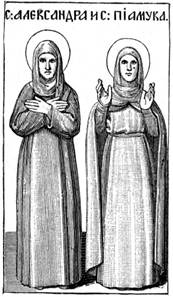
В окрестностях Александрии, при святителе Златоусте, было много спасавшихся девственниц. Иные жили в отдельных кельях, другие в киновиях. «В стране Египетской, – говорит великий проповедник, – в Антиохии, можно видеть Христово воинство, чудное общество, образ жизни, свойственный небесным силам. И это не только между мужчинами, но и между женщинами... И жены часто превосходят подвигами своих мужей и воздвигают знамения блистательной победы»43.
In the environs of Alexandria, in the time of St. John Chrysostom, there were many virgins who were being saved. Some lived in separate cells, others in cenobitic communities. "In the land of Egypt," says the great preacher, "and in Antioch, one may see the army of Christ, a wondrous company, a way of life befitting the heavenly powers. And this is found not only among men, but also among women... And women often surpass their husbands in struggles and raise up the banners of a brilliant victory."43
Близ Александрии спасалась и спаслась в могильной пещере великая девственница Александра. «Не могла я, – говорит усердная посетительница восточных отшельников, Мелания старшая, – видеть сию блаженную в лицо, но, став у отверстия, просила её открыть причину, по которой оставила она город и заключила себя в могильной пещере».
Near Alexandria, the great virgin Alexandra was being saved and was saved in a tomb cave. "I could not," says the zealous visitor of the Eastern hermits, Melania the Elder, "see this blessed one face to face, but, standing at the opening, I asked her to reveal the reason why she had left the city and shut herself up in a tomb cave."
Она отвечала мне через отверстие: «Один человек сходил с ума по мне: чтобы не огорчать и не бесчестить его, я решилась лучше заключить себя живой в этой гробнице, чем портить душу, созданную по образу Божиему». Когда сказала я ей: «Как же ты, раба Христова, выносишь это, что совсем никого не видишь, а одна борешься со скорбью и помыслами»; она отвечала: «С самого утра часа до девятого я молюсь; с час пряду лён; в остальные часы дня припоминаю себе сказания о вере святых отцов и патриархов, о подвигах блаженных апостолов, пророков и мучеников; когда наступает вечер, я, принесши славословие Господу моему, ем свою долю хлеба, а ночь всю провожу в молитве, ожидая конца своего, когда разрешусь отселе с благой надеждой и явлюсь лицу Христову». Пищу приносила ей одна добрая женщина и передавала через отверстие пещеры. Иначе затворница не показывалась на глаза ни мужчине, ни женщине. Так подвизалась она до двенадцати лет! Чувствуя близость кончины, приготовила она сама себя к погребению. Раз женщина, принесши пищу, не получает никакого ответа затворницы. Поняв, что она почила, дала знать о том в городе. Целые толпы поспешили из города к пещере великой подвижницы, открыли вход в пещеру и увидели, что Господь, по ожиданию подвижницы, принял её к Себе в селение праведных44.
She answered me through the opening: "A certain man was madly in love with me; in order not to grieve him nor dishonor him, I resolved to shut myself up alive in this tomb rather than ruin my soul, which was created in the image of God." When I said to her: "But how, O handmaid of Christ, do you endure this, that you see no one at all, but struggle alone with sorrow and thoughts?" she answered: "From early morning until the ninth hour I pray; for one hour I spin flax; in the remaining hours of the day I recall to myself the accounts of the faith of the holy fathers and patriarchs, of the struggles of the blessed apostles, prophets, and martyrs; when evening comes, having offered a doxology to my Lord, I eat my portion of bread, and I spend the whole night in prayer, awaiting my end, when I shall depart from here with good hope and appear before the face of Christ." A certain good woman brought her food and passed it through the opening of the cave. Otherwise the recluse did not show herself to the eyes of any man or woman. Thus she struggled for twelve years! Sensing the nearness of her end, she prepared herself for burial. Once, the woman who brought the food received no answer from the recluse. Understanding that she had reposed, she gave word of it in the city. Whole crowds hastened from the city to the cave of the great ascetic; they opened the entrance to the cave and saw that the Lord, according to the ascetic's expectation, had received her to Himself in the dwelling of the righteous.44
Так как Мелания беседовала с затворницей не прежде 373 г., а Палладий, путешествовавший по пустыням Египта с 388 г., уже не застал её в живых, то кончину святой надобно отнести к 376 году45.
Since Melania conversed with the recluse no earlier than 373 A.D., and Palladius, who traveled through the deserts of Egypt from 388 A.D., no longer found her alive, the end of the saint must be assigned to the year 376 A.D.45
Святая девственница Пиамука (Пиама) взошла на дивную степень духовного совершенства в доме матери. Она жила и здесь как в затворе, уединённо, не видалась с людьми пустыми, принимала пищу через день, после молитвы пряла лён. Так говорит о жизни её Палладий. При такой простоте жизни, но и при зорком наблюдении за своей душой, она так преобразовала свою душу, что Господь удостоил её дара прозрения. Последнее открылось по особенному случаю. Так как Нил разливом вод своих оплодотворяет поля, то поселениё, дорожа благодетельной влагой, задерживают её на полях искусственными загородями; при этом немощи людские поднимают спор и ссоры, нередко сопровождаемые драками. Община, более многолюдная, чем та, где жила Пиамука, поклялась истребить за воду слабое поселение. По молитвам Аммы Пиамы Бог спас от преступления и смертей. Ангел открыл Пиамуке о злодейском замысле соседей. Она, созвав старшин села своего, объявила им о замысле. Ступайте, говорила она, встречайте тех, которые идут на вас, упрашивайте их, чтобы удержались от боя. Старшины в страхе пали ей в ноги и говорили: «мы не смеем идти на встречу им; мы знаем пьяную жизнь их и их буйство; сотвори новую милость с нами, иди сама к ним и уговори их оставить нас в покое». Она не поступила по их просьбе, не пошла иметь дело с людьми, от сношения с которыми давно отказалась, а обратилась к Господу; удалясь в свой домик, провела всю ночь в молитве. «Господи! так молилась она. Ты Судия земли и не любишь неправды, прими молитву мою, пошли силу Твою, чтобы устремившиеся на погибель нашу стояли как столпы на месте, где встретит их сила Твоя!» И молитва её была услышана. Неприятели на третьем камне от села остановились и не могли сдвинуться с места. Им также было дано знать, что задерживает их молитва праведницы. Они прислали послов своих в село и просили мира. Благодарите, говорили, Бога, Который, по молитвам девы Пиамуки избавил вашу собственность от истребления46.
The holy virgin Piamuka (Piama) ascended to a wondrous degree of spiritual perfection in her mother's house. She lived there as in a cell, in solitude, not seeing idle people, taking food every other day, and after prayer spinning flax. So says Palladius concerning her life. With such simplicity of life, but also with vigilant watch over her soul, she so transformed her soul that the Lord deemed her worthy of the gift of foresight. This was revealed on a particular occasion. Since the Nile fertilizes the fields by its floodwaters, the inhabitants, valuing the beneficial moisture, hold it back on the fields with artificial barriers; at this, human weaknesses give rise to disputes and quarrels, often accompanied by fights. A community more populous than that where Piamuka lived swore to destroy the weaker settlement over water. Through the prayers of Amma Piama, God saved them from crime and death. An angel revealed to Piamuka the murderous plan of the neighbors. She, having summoned the elders of her village, declared the plan to them. "Go," she said, "meet those who are coming against you, entreat them to refrain from battle." The elders fell at her feet in fear and said: "We dare not go to meet them; we know their drunken life and their violence; work a new mercy with us: go yourself to them and persuade them to leave us in peace." She did not act according to their request; she did not go to have dealings with people, from intercourse with whom she had long since withdrawn, but turned to the Lord; withdrawing into her little house, she spent the whole night in prayer. "O Lord!" she prayed thus. "Thou art the Judge of the earth and lovest not unrighteousness; receive my prayer, send forth Thy power, so that those who have rushed to our destruction may stand like pillars on the spot where Thy power meets them!" And her prayer was heard. The enemies stopped at the third stone from the village and could not move from the spot. They were also informed that the prayer of the righteous woman was holding them back. They sent their envoys to the village and asked for peace. "Give thanks," they said, "to God, Who, through the prayers of the virgin Piamuka, has delivered your property from destruction."46
Память о св. Пиамуке (Пиаме) чтится марта 3-го дня и в субботу сыропустную.
The memory of St. Piamuka (Piama) is honored on March 3 and on Cheesefare Saturday.
Тот род подвижнической жизни, какой проходили блаженные девы Александра и Пиамука, много имеет своих преимуществ, но он соединён и со многими опасностями. По наблюдениям духовного опыта, жизнь наедине сближает с гордостью или отчаянием, а иногда с страстью к корысти, тогда как общежитие отнимает пищу у этой последней страсти и обламывает угловатую гордость. Вот и пример, выставленный Палладием из жизни современной свв. Александре и Пиамуке.
That kind of ascetic life which the blessed virgins Alexandra and Piamuka pursued has many advantages, but it is also joined with many dangers. According to the observations of spiritual experience, life in solitude draws one near to pride or despair, and sometimes to a passion for gain, whereas the cenobitic life takes away food from this latter passion and breaks off angular pride. Here is an example set forth by Palladius from the life of a contemporary of Sts. Alexandra and Piamuka.
В Александрии была девственница. По виду она была смиренна, но в душе горда, и любила более деньги, чем Христа, Она была богата, но не подавала пособия ни страннику, ни деве, ни монаху, ни обиженному, ни бедняку, ни в церковь. Она взяла себе на воспитание дочь сестры своей. Ей-то день и ночь обещала она своё имущество, расставшись с любовью к Небу. Бедная обманывала сама себя. Сперва заразилась она страстью к деньгам; потом и любовь свою к племяннице довела до страсти, под влиянием тщеславия. Кто поработил душу свою заботе о родных, тот подлежит суду закона за то, что мало ценил свою душу. Больную девственницу решился излечить пресвитер Макарий, надзиратель богадельни увечных. В молодости своей он был ювелиром, о чём знала и дева. Придя к ней, говорит он: попались мне дорогие камни-изумруды и яхонты; краденые они или не краденые не умею сказать, только камни высокой цены; владелец продаёт их за 500 червонцев; это – чудный наряд для твоей племянницы! Дева, привязанная к племяннице невесте, говорит: «сделай милость, не уступай их никому; вот тебе деньги», и выдала 500 червонцев. Святой Макарий употребил деньги на нужды богадельни. Прошло много времени, а девственница стыдилась напомнить ему о камнях. «Он пользовался высоким уважением, как старец весьма благочестивый и милостивый; он жил около ста лет, и я ещё застал его в живых», замечает Палладий. Наконец, встретившись с ним в церкви, дева говорит: «что ж камни, за которые дано 500 червонцев?» Он отвечал: «в тот же день, как ты дала мне деньги, я и заплатил их за камни; пойдём в странноприимный дом, они там у меня; если не понравятся тебе эти камни, возьмёшь свои деньги назад». Когда пришли они к дому, старец говорит: «что угодно тебе видеть сперва – яхонты или изумрудины?» «Что хочешь», отвечала она. Макарий повёл её наверх и, указывая на женщин увечных, слепых, сказал: «это вот яхонты!» Потом, сойдя вниз, указал ей на таких же мужчин, с словами: «а это – изумруды! По-моему, драгоценнее этих камней нигде не найти! Впрочем, прибавил он, если они не нравятся тебе: возьми свои деньги назад». Пристыженная девственница вышла и, придя к себе, занемогла от скорби. Но после она благодарила старца, когда племянница её, по выходе замуж, умерла бездетной. Она и сама стала употреблять своё имущество как должно47.
In Alexandria there was a virgin. In appearance she was humble, but in soul proud, and she loved money more than Christ. She was rich, but gave no assistance to a stranger, nor to a virgin, nor to a monk, nor to the wronged, nor to the poor, nor to the church. She took her sister's daughter to raise. To this niece she promised her property day and night, having parted with love for Heaven. The poor woman deceived herself. First she was infected with a passion for money; then she brought her love for her niece to the point of passion, under the influence of vainglory. He who has enslaved his soul to care for relatives is subject to the judgment of the law for having valued his soul little. The presbyter Macarius, the overseer of the almshouse for the crippled, resolved to heal the sick virgin. In his youth he had been a jeweler, which the virgin also knew. Coming to her, he says: "I have come across precious stones—emeralds and rubies; whether they are stolen or not I cannot say, only the stones are of high price; the owner sells them for 500 gold pieces; this is a wonderful adornment for your niece!" The virgin, attached to her niece the bride, says: "Do me a kindness, do not yield them to anyone; here is the money for you," and she gave out 500 gold pieces. St. Macarius used the money for the needs of the almshouse. Much time passed, and the virgin was ashamed to remind him about the stones. "He enjoyed high respect as a very pious and merciful elder; he lived about a hundred years, and I still found him alive," notes Palladius. Finally, meeting him in church, the virgin says: "What about the stones for which 500 gold pieces were given?" He answered: "On the same day that you gave me the money, I paid it for the stones; let us go to the hospice; they are there with me; if these stones do not please you, you shall take your money back." When they came to the house, the elder says: "What do you wish to see first—the rubies or the emeralds?" "Whatever you wish," she answered. Macarius led her upstairs and, pointing to the crippled and blind women, said: "These are the rubies!" Then, going downstairs, he pointed out to her the same sort of men, with the words: "And these are the emeralds! In my opinion, more precious stones than these are nowhere to be found! However," he added, "if they do not please you, take your money back." The shamed virgin went out and, coming home, fell ill from grief. But afterward she thanked the elder, when her niece, after marrying, died childless. And she herself began to use her property as was fitting.47
В наших штатных обителях, где деньги делятся по рукам, как нередко попадаются подобные больные!
In our established monasteries, where money is divided among hands, how often do such sick ones appear!