Св. Василия, спостника и сподвижника преп. Прокопия Декаполита, вместе с ним жившего и пострадавшего в темнице за иконопочитание при Льве Исаврянине. Скончался в 747 году.
St. Basil, fellow faster and fellow ascetic of the Venerable Procopius the Decapolite, who lived together with him and suffered with him in prison for the veneration of icons under Leo the Isaurian. He reposed in the year 747.
В то время, когда Диоскор, последователь лжеучения Евтихия, был патриархом в Александрии, там находился один пресвитер, Протерий, ученик св. Кирилла, который неустрашимо восставал и обличал уклонение от православия патриарха.
At the time when Dioscorus, a follower of the false teaching of Eutyches, was patriarch in Alexandria, there was there a certain presbyter, Proterius, a disciple of St. Cyril, who fearlessly rose up and denounced the patriarch's deviation from Orthodoxy.
Наконец, когда на Четвертом Вселенском Халкидонском соборе Диоскор подвергся обличению, низложению и изгнанию, то сделавшийся известным по рвению, с которым он защищал истину Христова учения, отличавшийся вообще своею строгою и добродетельною жизнью Протерий был избран патриархом Александрийским.
Finally, when at the Fourth Ecumenical Council of Chalcedon Dioscorus was subjected to rebuke, deposition and exile, Proterius, who had become known for the zeal with which he defended the truth of Christ's teaching and who was distinguished generally by his strict and virtuous life, was chosen Patriarch of Alexandria.
Между тем, в Александрии осталось много приверженцев Диоскора, которые восстали против избрания Протерия, произвели мятеж с целию восстановления Диоскора и сожгли отряд воинов, присланных для их усмирения.
Meanwhile, many adherents of Dioscorus remained in Alexandria, who rose up against the election of Proterius, raised a rebellion with the aim of restoring Dioscorus, and burned a detachment of soldiers sent to pacify them.
Царствовавший тогда благочестивый Маркиан послал снова усиленный отряд воинов, чтобы усмирить взбунтовавшихся. Лишенные при этом волею разгневанного императора различных льгот, которыми они пользовались до тех пор, Александрийцы смирились и обратились к Протерию же, прося его ходатайствовать перед императором о возвращении им прежних льгот.
The pious Marcian, who was then reigning, again sent a reinforced detachment of soldiers to subdue the rebels. Deprived thereby, by the will of the angered emperor, of various privileges which they had enjoyed until then, the Alexandrians humbled themselves and turned to Proterius himself, asking him to intercede with the emperor for the restoration of their former privileges.
Незлобивый святитель не отказал в своем ходатайстве за народ и достиг возвращения им льгот (как, например, ввоза хлеба в город из Египта).
The meek hierarch did not refuse his intercession for the people and obtained the restoration of their privileges (such as, for example, the importation of grain into the city from Egypt).
По смерти Маркиана еретики опять задумали восстание. Пресвитер Тимофей, домогавшийся патриаршего сана, воспользовавшись временным отсутствием начальника города, выступил во главе мятежников.
After the death of Marcian, the heretics again plotted rebellion. The presbyter Timothy, who was aspiring to the patriarchal dignity, taking advantage of the temporary absence of the city prefect, placed himself at the head of the rebels.
Святитель Протерий, не обладая средствами для укрощения мятежа, решился оставить Александрию, но в ту же ночь во сне он увидел пророка Исаию, который позвал его возвратиться в город, сказав ему, что он ждет его. – Святитель понял это предупреждение о своей мученической кончине и возвратился в Александрию.
Hierarch Proterius, having no means to quell the rebellion, resolved to leave Alexandria, but that same night in his sleep he saw the Prophet Isaiah, who called him to return to the city, saying to him that he was waiting for him. – The hierarch understood this warning of his martyric end and returned to Alexandria.
Здесь вошел он в крестильницу. – Узнав об этом, мятежники еретики ворвались в его убежище, напали на Протерия и убили его и бывших с ним еще шесть человек. Они не отступили перед злодеянием не смотря на то, что это было в день Великой субботы, и в ярости своей дошли до того, что, привязав веревку к телу убитого святителя, они вытащили его на улицу, били, терзали члены его и, наконец, сожгли его, и прах развеяли по воздуху – в 457 г.
There he entered the baptistery. – Learning of this, the heretical rebels broke into his refuge, fell upon Proterius and killed him and six other men who were with him. They did not shrink from this evil deed even though it was on the day of Great Saturday, and in their fury they went so far as to tie a rope to the body of the slain hierarch, drag him out into the street, beat him, tear his limbs apart, and finally burn him, and scatter his ashes to the wind – in the year 457.
Православные известили о случившемся императора Льва, преемника Маркиана, и патриарха Константинопольского Анатолия и умоляли их о защите против евтихиан. – Огорченный вестию о мученической кончине Протерия, император выслал войско, чтобы наказать жителей Александрии. Тимофей пресвитер был предан суду, лишен священного сана и сослан в заключение.
The Orthodox informed the Emperor Leo, the successor of Marcian, and the Patriarch of Constantinople, Anatolius, of what had happened, and implored them for protection against the Eutychians. – Grieved by the news of the martyric end of Proterius, the emperor sent out troops to punish the inhabitants of Alexandria. The presbyter Timothy was brought to trial, deprived of his sacred rank, and sent into exile.
Такими-то ужасами сопровождались здесь и в других местах, особенно же в Сирии и Египте – волнения, возбуждаемые вечно враждующими последователями различных ересей, разделявших и раздиравших Церковь Христову. Но из этого испытания вышла она невредимою, и оно, как и другие – в предыдущие и последующие века – послужило только к ее освящению и утверждению.
Such were the horrors that accompanied, here and in other places, especially in Syria and Egypt, the disturbances stirred up by the ever-contentious followers of the various heresies that divided and rent asunder the Church of Christ. But from this trial she came forth unharmed, and it, like others – in preceding and subsequent centuries – served only for her sanctification and confirmation.
По кончине Протерия современные ему четыре епископа Фракийские писали: святейшего Протерия полагаем в чине и лике святых и просим Бога быть милосердым и милостивым к нам его молитвами.
After the death of Proterius, four contemporary bishops of Thrace wrote: "We place the most holy Proterius in the rank and choir of the saints, and we beseech God to be merciful and gracious to us through his prayers."
Прошу не питать недоверия к тому, что рассказываю, хотя бы и привилось (слушателям) услышать нечто и превышающее их силы», – так предупреждает повествования свои о подвижниках блаженный Феодорит, епископ Кирский, – «и пусть не измеряют добродетелей святых по своей мерке, – продолжает он, – а твердо помнят, что Господь обыкновенно соразмеряет дары Святого Духа с душевным расположением людей благочестивых, и совершеннейшим из них посылает больше даров».
"I beg you not to distrust what I relate, even if it should happen that you hear something exceeding your strength," – thus does the blessed Theodoret, Bishop of Cyrrhus, preface his accounts of the ascetics – "and let them not measure the virtues of the saints by their own measure," – he continues – "but let them firmly remember that the Lord is wont to proportion the gifts of the Holy Spirit to the spiritual disposition of pious people, and to the most perfect among them He sends greater gifts."
Говоря о святых подвижницах, рассказывает Феодорит, что «их было и есть много, из которых одни проводили и проводят жизнь уединенную, а другие, любя общежитие, живут вместе по двести пятидесяти и более или менее, принимают одну пищу, спят только на рогожах и, во время занятия рук волною, посвящают язык на псалмопения. Таковых училищ любомудрия не только в нашей стране, но и по всему Востоку очень много, так что и перечислить их невозможно. Ими наполнены – и Палестина, и Египет, и Азия, и Понт, и Европа. С того времени, как Христос Господь почтил девство, родившись от Девы, природа произрастила эти, так сказать, луга девства и приносит Творцу благоуханные и никогда не увядающие цветы добродетелей в мужах и женах, без различия любомудрия у тех и других; потому что они различаются только телами, а не духом.
Speaking of the holy ascetic women, Theodoret relates that "there were and are many of them, of whom some led and lead a solitary life, while others, loving the cenobitic life, live together in groups of two hundred and fifty or more or less, take one kind of food, sleep only on mats, and, while their hands are occupied with wool, dedicate their tongues to psalmody. Of such schools of philosophy there are very many not only in our country but throughout all the East, so that it is impossible even to enumerate them. With them are filled both Palestine and Egypt, and Asia, and Pontus, and Europe. From the time when Christ the Lord honored virginity by being born of a Virgin, nature has produced these, so to speak, meadows of virginity and brings forth to the Creator fragrant and never-fading flowers of virtues in men and women, without distinction of philosophy in both; for they differ only in body, not in spirit.
«Во Христе Иисусе, по слову св. Апостола, несть мужеский пол, ни женский» (Гал.3:28); одна и та же вера дана мужам и женам: «один Господь, одна вера, одно крещение. Один Бог и Отец всех, Который над всеми, и чрез всех, и во всех нас. Каждому же из нас дана благодать по мере дара Христова» (Ефес.4:5, 6, 7). Одно и царство небесное обещал Подвигоположник победоносцам. Жены же достойны тем большей похвалы, что, имея слабейшую природу, показывают одинаковое с мужами усердие и освобождают свой пол от наследственного нарекания».
'In Christ Jesus, according to the word of the holy Apostle, there is no male nor female' (Gal. 3:28); the same faith is given to men and women: 'One Lord, one faith, one baptism. One God and Father of all, who is above all, and through all, and in us all. But unto every one of us is given grace according to the measure of the gift of Christ' (Eph. 4:5, 6, 7). One and the same kingdom of heaven did the Author of the contest promise to the victors. Women, however, are worthy of the greater praise, in that, having a weaker nature, they show the same zeal as men and free their sex from the hereditary reproach."
Родом они были из Берии; жили в IV веке и как бы восприняли ιι сами были блистательным отражением славы этой чудной эпохи христианской веры, просиявшей столькими подвижниками обоих полов. Живя среди одних светил и среди близких воспоминаний о других, отшедших, они рано постигли суету земных благ и красоту вечных, я к ним устремились, отстранившись от житейского блистательного поприща, которое представляло им их знатное происхождение и «воспитание, сообразное с этим происхождением».
They were by birth from Beroea; they lived in the fourth century and, as it were, received and themselves were a brilliant reflection of the glory of that wondrous epoch of the Christian faith, which shone forth with so many ascetics of both sexes. Living in the midst of some luminaries and amid the close memories of others who had departed, they early comprehended the vanity of earthly goods and the beauty of eternal ones, and they hastened toward them, having withdrawn from the brilliant worldly path which their noble birth and "an upbringing conformable to that birth" presented to them.
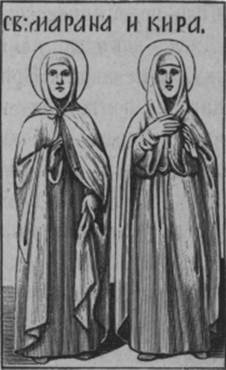
Марана и Кира утаились от света за городом, сами обгородили для себя один небольшой уголок земли и, завалив вход в свое убежище землею и камнями, посвятили себя всецело подвижнической жизни.
Marana and Cyra hid themselves from the world outside the city; they themselves fenced off for themselves a small plot of ground and, having blocked the entrance to their refuge with earth and stones, devoted themselves entirely to the ascetic life.
Так как за ними последовали сюда их бывшие служанки, пожелавшие приобщиться избранной ими жизни, то Кира и Марана поместили их в небольшом домике близ их ограды и через небольшое отверстие в своей ограде наблюдали за ними, возбуждали их к молитве и руководили на трудном пути всецелого посвящения себя Богу.
Since their former servant-maids followed them there, desiring to partake of the life they had chosen, Cyra and Marana placed them in a small house near their enclosure and through a small opening in their enclosure watched over them, stirred them up to prayer, and guided them on the difficult path of total dedication to God.
Сами же жили под открытым небом, большую часть времени проводили в молчании, но изредка, а именно в день Пятидесятницы, одна из них, Марана, принимала и беседовала с приходившими женщинами; голоса же Киры никогда никто не слыхал.
They themselves lived in the open air, spending most of their time in silence, but occasionally, namely on the day of Pentecost, one of them, Marana, would receive and converse with the women who came; but the voice of Cyra was never heard by anyone.
Не довольствуясь отречением от сладостей жизни, они ревностно подвергались и великим тяготам, обременили себя веригами, и вериги эти были так тяжелы, что нежная сложением Кира не могла выпрямить своего тела, но преклонялась под этим произвольным бременем до самой земли.
Not content with renouncing the sweets of life, they zealously subjected themselves also to great hardships, burdened themselves with chains, and these chains were so heavy that Cyra, who was delicate of build, could not straighten her body, but was bowed down under this self-imposed burden to the very ground.
Из уважения к сану священства блаженного Феодорита, подвижницы допускали его иногда внутрь их ограды. Пораженный видом их тяжелых вериг, он убеждал их не изнурять себя свыше сил; во время его присутствия они; соглашались уступить его убеждениям, но по уходе его снова возлагали их на себя.
Out of respect for the sacred rank of the blessed Theodoret, the ascetics sometimes allowed him inside their enclosure. Struck by the sight of their heavy chains, he urged them not to exhaust themselves beyond their strength; during his presence they agreed to yield to his persuasion, but after his departure they again placed them upon themselves.
И так жили Марана и Кира в продолжение слишком сорока лет, среди ненарушимых поста и молитвы и из силы в силу... Между тем все им казалось, что они только начинают свои подвижнические труды...
And thus Marana and Cyra lived for more than forty years, in unbroken fasting and prayer, going from strength to strength... Meanwhile, it seemed to them that they were only beginning their ascetic labors...
Два раза только выходили они из своего уединения, однажды – для совершения странствия в Иерусалим, которое совершили, не подкрепляя себя пищею во время пути, но только уже после того, как поклонились святыне, – а в другой раз ходили поклониться гробу победоносной первомученицы Феклы в Исаврии, соблюдая строжайший пост и во время этого второго путешествия.
Only twice did they go out from their solitude: once to make a pilgrimage to Jerusalem, which they accomplished without taking food during the journey, but only after they had venerated the holy places; and another time they went to venerate the tomb of the victorious Protomartyr Thecla in Isauria, observing the strictest fast also during this second journey.
Какими словами можно выразить благоговейное изумление при созерцании такой силы духовной, такой высоты земных существ, как бы бесплотных во плоти...
With what words can one express reverent astonishment at the contemplation of such spiritual strength, such height in earthly beings, as it were incorporeal in the flesh...
Родившаяся в Ависсоке, Фессалоникской епархии, от благочестивых родителей, молодая Кир-Анна, прекрасная душою, прекрасная и по наружности, имела несчастие обратить на себя внимание одного янычара, сборщика податей.
Born in Avissok, in the diocese of Thessalonica, of pious parents, the young Kyr-Anna, beautiful in soul, beautiful also in appearance, had the misfortune to attract the attention of a certain janissary, a tax collector.
Не успев достигнуть сближения с нею, озлобленный варвар, с помощию подговоренных им сообщников, похитил молодую девушку из родительского дома и представил ее судье с жалобою, что она противится исполнить – как будто – данное ею слово выйти за него замуж и принять магометанскую веру...
Having failed to achieve intimacy with her, the embittered barbarian, with the help of confederates he had suborned, abducted the young girl from her parental home and presented her to the judge with the complaint that she was refusing to fulfill – as it were – her given word to marry him and embrace the Mohammedan faith...
Но никакие угрозы, ни подарки, ни льстивые обещания янычара не оказывали действия на молодую девушку и не могли склонить ее исполнить его требования.
But neither threats, nor gifts, nor the flattering promises of the janissary had any effect on the young girl and could not induce her to fulfill his demands.
– Я – христианка, – сказала она ему, – люблю одного Христа, Господа Бога моего. Ему одному принадлежу с младенчества и готова умереть ради Него, чтобы жить с Ним в вечности... Вот, вы слышали мой ответ; теперь не ждите от меня более ни одного слова.
"I am a Christian," she said to him, "I love Christ alone, the Lord my God. To Him alone I have belonged from infancy, and I am ready to die for His sake, that I may live with Him in eternity... Behold, you have heard my answer; now expect not one more word from me."
И действительно, после того она не произнесла ни одного слова. Казалось, душа ее уже отошла и пребывала в созерцании Спасителя, и занята была только одною мыслию: скорее умереть за Него.
And indeed, after that she uttered not a single word. It seemed that her soul had already departed and abided in contemplation of the Savior, and was occupied only with one thought: to die for Him as soon as possible.
Янычар, все еще не теряя надежды уговорить девушку, чтобы она ему предалась, достал себе разрешение главного начальника тюрьмы – посещать ее. В продолжение дня он несколько раз пользовался этим разрешением, приходил к ней то один, то с другими янычарами. Сначала он старался подействовать на нее ласкою, но она, закрыв лице покрывалом, скрестив на груди руки, оставалась безмолвною и неподвижною. Тогда изверги начинали бить и истязать ее так, что она падала замертво.
The Janissary, still not losing hope of persuading the girl to surrender herself to him, obtained permission from the chief warden of the prison to visit her. During the day he made use of this permission several times, coming to her sometimes alone, sometimes with other Janissaries. At first he tried to act upon her with caresses, but she, covering her face with a veil and crossing her arms on her breast, remained silent and motionless. Then the fiends began to beat and torment her so that she fell down as if dead.
Ночью они оставляли ее. Но когда уходили они, и едва приходила она в себя, то начинал ее мучить тюремный пристав. Он вешал ее с закованными в цепи руками, бил ее чем попало и оставлял повешенною на холоде, – это было зимою.
At night they left her. But when they departed, and scarcely had she come to herself, the prison warden began to torment her. He hung her up with her hands bound in chains, beat her with whatever came to hand, and left her hanging in the cold—for it was winter.
Кроме Кир-Анны в темнице находились еще заключенные из евреев, турчанок и христиан. Все они, содержавшиеся здесь за разные проступки, возмущались жестокостями относительно ни в чем неповинной девушки, осыпали упреками пристава, и иногда, усовестив его, один из бывших тут христиан освобождал Кир-Анну на несколько времени от веревки.
Besides Kyr-Anna, there were also prisoners in the dungeon—Jews, Turkish women, and Christians. All of them, confined there for various offenses, were outraged at the cruelties inflicted upon the innocent girl, heaped reproaches upon the warden, and sometimes, when they had shamed him, one of the Christians present would free Kyr-Anna from the rope for a short time.
Сверхъестественно было терпение страдалицы; спокойно и безмолвно переносила она все истязания. Наконец узники-свидетели всего этого восстали и приступили к тюремному приставу с угрозами – пожаловаться на него паше за то, что он допускает в тюрьму посторонних лиц. Это несколько подействовало, и когда через час пришли янычары, то он не впустил их. Те пожаловались Али-бею. Вечером пристав тюремный получил выговор за недопущение в тюрьму янычаров, получивших на это разрешение от высшего начальства. Это озлобило до последней крайности бесчеловечного тюремщика. Придя в тюрьму, он бросился на Кир-Анну, повесил ее по прежнему и ударил ее попавшимся ему под руку огромным концом переломанного шеста. Через несколько времени Кир-Анна скончалась.
Supernatural was the patience of the sufferer; calmly and silently she endured all the torments. At last the prisoners, witnesses of all this, rose up and approached the prison warden with threats—to complain against him to the Pasha for allowing outsiders into the prison. This had some effect, and when an hour later the Janissaries came, he did not let them in. They complained to Ali-Bey. In the evening the prison warden received a reprimand for not admitting the Janissaries, who had obtained permission from the higher authorities to do so. This enraged the inhuman jailer to the utmost. Coming into the prison, he rushed at Kyr-Anna, hung her up as before, and struck her with a huge end of a broken pole that came to hand. After a short time, Kyr-Anna died.
Узник-христианин освободил ее руки из оков и благоговейно опустил ее тело на землю. На другое утро христиане собрались в темнице и, подняв тело мученицы, предали его погребению за городом, где обыкновенно погребают всех умерших христиан. – Это было в 1751 году.
A Christian prisoner freed her hands from the fetters and reverently lowered her body to the ground. The next morning Christians gathered in the prison and, lifting up the body of the martyr, committed it to burial outside the city, where all deceased Christians were usually buried. This was in the year 1751.
И сколько было подобных случаев и в последующее столетие! И не обеспечено еще безусловно и будущее от истязаний христиан – под игом турецким, хотя и много уже пролито крови единоверных в защиту их...
And how many similar cases there were in the following century as well! And even the future is not yet unconditionally secured from the torments of Christians under the Turkish yoke, although much blood of the faithful has already been shed in their defense...
Победа, которою побежден мир, есть вера наша», говорит: Апостол (1Ин.5:4). Это может повторить и о себе блаженный Николай Псковский.
"This is the victory that overcometh the world, even our faith," says the Apostle (1 Jn. 5:4). The blessed Nicholas of Pskov could say the same of himself.
В Троицком Псковском соборе, на гробнице блаженного, древний тропарь говорит, что блаженный Николай был родом из Псковской стороны, но подвигами юродства стал гражданином небесного Иерусалима. В древнем же кондаке написано: «чудотворец явися, Николае, царску державу и смысла свирепство на милость обратив»344. В летописи читаем следующее: в феврале 1570 года, на первой неделе Великого поста, грозный царь Иоанн прибыл ко Пскову и остановился в Любятовом монастыре, близ города345. Он готовил ту же страшную участь Пскову, какая досталась Новгороду. «Прииде с великою яростию, яко лев рыкая, хотя растерзати неповинные люди и кровь многую пролияти». Но Господь вложил в сердце блаженному Своему угоднику Николаю Салосу и христолюбивому князю Юрию Токмакову смягчить сердце царя. По их приказанию, по улицам города, пред каждым домом, поставлены были столы с хлебом и солью, и когда царь шел по городу, граждане с женами и детьми стояли на коленях: это тронуло жестокого Иоанна. Из собора зашел он в келью к блаженному Николаю юродивому; тот по своему уговаривал его перестать лить кровь человеческую и не грабить церквей Божиих346. «Не трогай нас, проходящий (минухне)», говорил блаженный, «ступай от нас, – не на чем тебе будет бежать»347. Царь не уважил этих слов; он приказал снять колокол у Святой Троицы, и в тот же час пал лучший конь его (аргамак) по пророчеству святого. Когда сказали о том царю, он пришел в ужас и поспешил выехать из города348. По другим известиям, блаженный Николай предложил Иоанну кусок сырого мяса, и когда тот сказал – я христианин, не ем мяса в Великий пост, блаженный отвечал: ты делаешь хуже, питаешься плотию и кровию человеческою, забывая не только пост, но и Бога349. Из предместия городского, где остановился царь по выезде из города, дозволил он опричникам грабить в городе дома богатых людей, но не велел трогать иноков и священников. Тем не менее сам отобрал у монастырей деньги, лучшие вещи, сосуды и книги350. На гробнице блаженного Николая написано: «преставися святый праведный Николай, Псковский чудотворец, в лето 7984 (1576) февраля 28-го числа»351. По особенному уважению жителей Пскова к блаженному Николаю, он погребен был под соборным храмом – почесть, какой удостаивались тогда только князья и архипастыри.
In the Trinity Cathedral of Pskov, on the tomb of the blessed one, an ancient troparion says that the blessed Nicholas was born in the land of Pskov, but through the exploits of folly-for-Christ he became a citizen of the heavenly Jerusalem. In an ancient kontakion it is written: "Thou didst appear as a wonderworker, O Nicholas, turning the royal power and the fierceness of his mind to mercy."344 In the chronicle we read the following: in February of the year 1570, during the first week of Great Lent, the terrible Tsar John arrived at Pskov and stopped at the Liubyatov Monastery, near the city.345 He was preparing the same terrible fate for Pskov as had befallen Novgorod. "He came with great fury, like a roaring lion, wishing to tear apart innocent people and to shed much blood." But the Lord put it into the heart of His blessed servant Nicholas Salos and the Christ-loving Prince George Tokmakov to soften the Tsar's heart. By their order, tables with bread and salt were set up in the streets of the city before every house, and when the Tsar walked through the city, the citizens with their wives and children knelt down: this touched the cruel John. From the cathedral he went to the cell of the blessed Nicholas the Fool-for-Christ; he, in his own way, urged him to stop shedding human blood and not to plunder the churches of God.346 "Touch us not, O passer-by (minukhne)," said the blessed one, "depart from us—you will have nothing to flee upon."347 The Tsar did not heed these words; he ordered the bell to be taken down from the Holy Trinity, and at that very hour his best horse (argamak) fell, according to the prophecy of the saint. When they told the Tsar of this, he was seized with terror and hastened to leave the city.348 According to other accounts, the blessed Nicholas offered John a piece of raw meat, and when the Tsar said, "I am a Christian, I do not eat meat during Great Lent," the blessed one replied: "You do worse—you feed on human flesh and blood, forgetting not only the fast but also God."349 From the suburb of the city where the Tsar stopped after leaving the city, he allowed the oprichniki to plunder the houses of rich people in the city, but ordered them not to touch monks and priests. Nevertheless, he himself took from the monasteries money, the best objects, vessels, and books.350 On the tomb of the blessed Nicholas it is written: "The holy righteous Nicholas, Pskov Wonderworker, reposed in the year 7984 (1576), on the 28th day of February."351 By the special reverence of the inhabitants of Pskov for the blessed Nicholas, he was buried beneath the cathedral church—an honor which at that time was granted only to princes and archpastors.
По видению, бывшему в 1581 г. во время нападения Батория на Псков, преп. Корнилий и блаженный Николай умоляли Пречистую умолить Сына Своего за людей согрешивших, и Богоматерь исполнила молитву их. Благодарный Псков тогда же написал икону Богоматери с предстоящими преп. Антонием и Корнилием, с князьями Владимиром Киевским, Гавриилом и Тимофеем Псковскими и с блаженным Николаем. Эта икона поставлена была в Покровской церкви и прославилась чудесами; ей празднуют 1-го октября352. С того времени стали праздновать во Пскове и день преставления блаженного Николая353.
According to a vision that occurred in 1581 during the attack of Bathory on Pskov, the Venerable Cornelius and the blessed Nicholas besought the Most Pure One to entreat Her Son for the sinful people, and the Mother of God fulfilled their prayer. Grateful Pskov at that time had an icon painted of the Mother of God with the Venerable Anthony and Cornelius standing before Her, with the princes Vladimir of Kiev, Gabriel and Timothy of Pskov, and with the blessed Nicholas. This icon was placed in the Church of the Protection and was glorified by miracles; its feast is celebrated on the 1st of October.352 From that time they began to celebrate in Pskov also the day of the repose of the blessed Nicholas.353
«Не трогай нас, проходящий!» Какие это кроткие и вместе сильные слова блаженного! Не должны ли отнесть их к себе разные преобразователи нового времени, готовые поставить все вверх дном, в том числе втоптать в грязь жизнь юродивых? Пусть бы подумали хотя о том, что их брань против святых прежде всего не делает чести их уму, неспособному понять идеала жизни самоотверженной, торжествующей над самолюбием своим, над природою физическою, над величиями мира преходящего. Не каждому идти одною дорогою к небу, но поклонение тельцу золотому наверно никого не доведет до неба. Не каждому идти одною дорогою к небу, но каждому надобно строго судить себя самого, и суда над совестию другого ни в каком случае не отнимать у Господа.
"Touch us not, O passer-by!" What meek and yet powerful words of the blessed one! Should not various reformers of modern times, ready to turn everything upside down, including trampling into the mud the life of the Fools-for-Christ, apply these words to themselves? Let them consider at least this: that their abuse of the saints does no honor to their mind, which is incapable of understanding the ideal of a self-denying life, triumphing over one's own self-love, over physical nature, over the grandeurs of this passing world. Not everyone must walk the same path to heaven, but worship of the golden calf will surely lead no one to heaven. Not everyone must walk the same path to heaven, but each one must strictly judge himself, and in no case take away from the Lord the judgment of another's conscience.
Любятов погост – в 5 верстах от Пскова, на восточной его стороне; здесь в храме, бывшем монастырском, над царскими вратами висит небольшой образ, оставленный Грозным царем. Гр. Толстого древн. Пскова, стр. 76. 77.
Liubyatov churchyard—5 versts from Pskov, on its eastern side; here in the church, formerly a monastery church, above the Royal Doors hangs a small icon left by the Terrible Tsar. Count Tolstoy's Antiquities of Pskov, pp. 76, 77.
Повесть о Печерском монаст. л. 44. Ркп. святцы: «св. блаженный Николай, Христа ради юродивый, Псковский чудотворец, бысть в л. 7070 м. дек. в 6 д.». Это год борьбы его с Грозным царем. По другому списку святцев: «преставися в л. 7084».
Tale of the Caves Monastery, fol. 44. Manuscript Saints' Calendar: "St. blessed Nicholas, Fool-for-Christ, Pskov Wonderworker, was in the year 7070, December 6." This is the year of his struggle with the Terrible Tsar. According to another copy of the Saints' Calendar: "He reposed in the year 7084."