Orthodox Translations

February 2424 февраля

Old Calendar: civil March 8 · New Calendar: civil February 24

History

Первое и второе обретение честной главы св. Иоанна Предтечи

The First and Second Uncovering of the Venerable Head of St. John the Forerunner
E1.TAI draft
Engraving

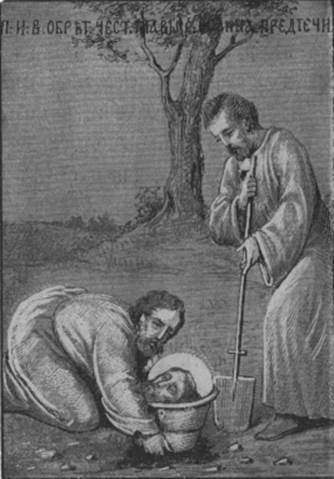
Убийцы Предтечи не допустили положить главу его вместе с телом, боясь, чтобы страшный обличитель их, если глава его приложится к телу, не воскрес и не стал снова обличать их (Мк.6:14–16). Тело Предтечи погребено было учениками его в Севастии – городе Самарийском, а отсеченная глава его особо сокрыта была Иродиадою во дворце Ирода, в месте бесчестием. Зная об этом уничижении, благочестивая Иоанна, жена Хузы – домоправителя Иродова (Лк.8:3), тайно ночью взяла оттуда главу Предтечи и, положив в сосуд, погребла на горе Елеонской – в поместье Ирода. Спустя много времени после того, некто Иннокентий, благочестивый подвижник, купил поместье Иродово и начал созидать церковь. Копая ров для основания, он обрел в земле глиняный сосуд и в нем главу Предтечи, которую узнал он по благодатным знамениям, бывшим от нее, и хранил ее у себя с великим благоговением. Это обретение было первое.

The murderers of the Forerunner did not permit his head to be laid with his body, fearing lest their terrible reprover, if his head were joined to his body, should rise again and begin once more to reprove them (Mk. 6:14–16). The body of the Forerunner was buried by his disciples in Sebaste, a city of Samaria, while his severed head was hidden separately by Herodias in the palace of Herod, in a place of dishonor. Knowing of this humiliation, the pious Joanna, the wife of Chuza, Herod's steward (Lk. 8:3), secretly took the head of the Forerunner from there by night and, placing it in a vessel, buried it on the Mount of Olives, on Herod's estate. Long after this, a certain Innocent, a pious ascetic, bought Herod's estate and began to build a church. While digging a trench for the foundation, he uncovered in the earth a clay vessel and in it the head of the Forerunner, which he recognized by the grace-filled signs that came from it, and he kept it with great reverence. This was the first uncovering.

E1.0AI draft

Пред смертию своею, желая сохранить главу Крестителя от поругания, которому она могла подвергнуться от неверующих во Иисуса Христа, Иинокентий укрыл ее в землю, в том месте, где обрел. Впоследствии, по смерти Иниокентия, и церковь им устроенная запустела и развалилась, и таким образом честная глава опять никому неизвестна стала.

Before his death, desiring to preserve the head of the Baptist from the desecration to which it might be subjected by those who did not believe in Jesus Christ, Innocent hid it in the earth, in the same place where he had found it. Afterwards, after the death of Innocent, the church he had built fell into desolation and ruin, and thus the venerable head again became unknown to all.

E1.1AI draft

Во дни Константина Великого, когда вера христианская воцарилась в мире, и благочестивые христиане отвсюду стали ходить ко святым местам на поклонеиие, двое иноков, пришедшие в Иерусалим на поклонение Животворящему Кресту и Гробу Господню, по откровению и повелению самого Предтечи, явившегося им во сне, обрели на горе Елеонской и взяли честную главу его с собою. Возвращаясь с нею в жилище свое, они встретились на пути с одним бедным скудельником, жителем Сирийского города Емессы, шедшим из своего отечества в иную страну, и пошли с ним вместе. Спутнику своему иноки дали понести вретище, в котором хранилась глава Крестителя. Скудельник не знал, что сокрыто во вретище, которое он нес. Ему явился св. Предтеча и повелел удалиться от спутников своих со вретищем, бывшим в руках его. Так Бог за неверие и леность отнял святыню у недостойных иноков, сначала не веривших явлению им во сне Предтечи, а потом не хотевших нести главу его! Удалясь от иноков, скудельник, по повелению Крестителя, пришел с главою его в свой дом; Бог благословил дом его обилием благ. Веруя, что виновник сих благ есть св. Иоанн Предтеча, скудельник с великим благоговением хранил честную главу его. Пред смертию своею он открыл о бывшей у него святыне и завещал сестре своей блюсти ее с особенным уважением, и потом передать достойнейшему из христиан. Долгое время честная глава Крестителя хранима была преемственно среди благочестивых христиан. Впоследствии приобрел сие сокровище некто Евстафий, муж, зараженный Ариевой ересью, не имевший страха Божия. Тогда Промыслу угодно было отнять святыню у недостойного и его же рукою сокрыть ее надолго в неведомой для православных пещере. Евстафий, избегая правосудия закона за зловерие свое и принужденный оставить свое жилище и скрываться, притаил главу Предтечи в пещере, чтобы после тайно взять ее оттуда. Но, выгнанный из жилища своего, он не мог уже после возвратиться и снова владеть неоцененною святынею. На месте пещеры, в коей скрывалось духовное сокровище, поселились благочестивые иноки и жили, не ведая: какое сокровище таится в их мирном пристанище благочестия.

In the days of Constantine the Great, when the Christian faith reigned in the world and pious Christians began to go from everywhere to the holy places for worship, two monks, who had come to Jerusalem to worship the Life-giving Cross and the Lord's Tomb, by revelation and command of the Forerunner himself, who appeared to them in a dream, uncovered on the Mount of Olives and took his venerable head with them. Returning with it to their dwelling, they met on the way a certain poor potter, an inhabitant of the Syrian city of Emesa, who was going from his homeland to another country, and they went with him. The monks gave their companion to carry the sack in which the head of the Baptist was kept. The potter did not know what was hidden in the sack he carried. St. John the Forerunner appeared to him and commanded him to depart from his companions with the sack that was in his hands. Thus God, for unbelief and laziness, took away the holy thing from the unworthy monks, who at first did not believe the appearance of the Forerunner to them in a dream, and then did not wish to carry his head! Departing from the monks, the potter, by command of the Baptist, came with his head to his own house; God blessed his house with an abundance of good things. Believing that the author of these blessings was St. John the Forerunner, the potter kept his venerable head with great reverence. Before his death, he revealed the holy thing that had been with him and bequeathed to his sister to guard it with special respect, and then to pass it on to the most worthy of Christians. For a long time the venerable head of the Baptist was kept successively among pious Christians. Afterwards, a certain Eustathius, a man infected with the Arian heresy, who had no fear of God, acquired this treasure. Then Providence was pleased to take away the holy thing from the unworthy one and, by his very hand, to hide it for a long time in a cave unknown to the Orthodox. Eustathius, fleeing the justice of the law for his false belief and forced to leave his dwelling and hide, concealed the head of the Forerunner in a cave, intending afterwards to take it secretly from there. But, driven from his dwelling, he could no longer return and again possess the priceless holy thing. On the site of the cave in which the spiritual treasure was hidden, pious monks settled and lived, not knowing what treasure was concealed in their peaceful haven of piety.

E1.2AI draft

Прошло много лет; глава Крестителя опять забыта была. Из пристанища иноков в пещере образовался впоследствии монастырь. Благочестивый архимандрит этой обители – Маркелл, который сам повествует о втором обретении главы Предтечевой, сподобился явления Крестителя и извещения от него о честной главе его, сокрытой в пещере монастыря, и она вторично обретена была в 452 лето по Р. X. и, по повелению Греческого царя Маркиана, перенесена была из Емессы в Халкидон, а потом в Константинополь.

Many years passed; the head of the Baptist was again forgotten. From the monks' refuge in the cave, a monastery later formed. The pious archimandrite of this monastery, Marcellus, who himself relates the second uncovering of the Forerunner's head, was vouchsafed an appearance of the Baptist and a revelation from him concerning his venerable head, hidden in the cave of the monastery, and it was secondly uncovered in the year 452 A.D. and, by command of the Greek Emperor Marcian, was translated from Emesa to Chalcedon, and afterwards to Constantinople.
E1.3AI draft

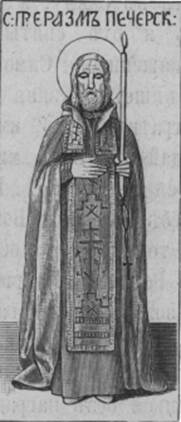
† Память преподобного Еразма Печерского

† The Memory of the Venerable Erasmus of the Kiev Caves

E2.TAI draft
Engraving

Блаженный Симон, епископ Владимирский, в наставление другу своему Поликарпу, между прочим, писал:

The blessed Simon, Bishop of Vladimir, in instruction to his friend Polycarp, wrote among other things:

E2.0AI draft

«Был в Печерском монастыре черноризец Эразм. Он стяжал наследие славы в небесном царствии за то, что все, что имел, употребил на украшение Печерской церкви, оковал множество икон, которые и поныне у нас над алтарем. С ним случилось такое искушение: когда обнищал он, то им стали пренебрегать. Дух злобы начал тогда внушать ему: «нет тебе пользы от того, что истратил ты имение на церковь; лучше было бы, если бы употребил ты на нищих». Не рассудив о таких помыслах, он пришел в уныние и стал жить нерадиво. Щедрый и милостивый Бог за его добродетель спас его. Он навел на него тяжкую болезнь. В этой болезни Эразм лежал без языка, с закрытыми глазами, семь дней, едва дыша. В осьмой день пришли к нему братия и, видя его тяжкое дыхание, говорили: «горе, горе душе сего брата, в лености прожившего! Она видит что-то и мятется, не выходя из тела». И вот Эразм внезапно встал, как здоровый, и сказал: «отцы и братия! точно я грешник, и грешник не каявшийся, как говорили вы; но вот ныне явились мне преподобные отцы наши Антоний и Феодосий и сказали: мы молились за тебя и Господь дал тебе время для покаяния. Потом видел я и Пречистую Богородицу с Сыном Христом Богом на руках, и Она сказала мне: Эразм! поскольку ты украсил церковь Мою иконами, и Я украшу тебя в царстве Сына Моего; встань, покайся, облекись в ангельский образ, а на третий день возьму Я тебя к Себе, как возлюбившего благолепие дома Моего». Сказав это, Эразм начал исповедовать грехи свои пред всеми без стыда. Потом пошел в церковь и был пострижен в схиму; а на третий день умер».

"There was in the Kiev Caves Monastery a monk named Erasmus. He acquired an inheritance of glory in the heavenly kingdom because he spent all that he had on the adornment of the Kiev Caves church, plating many icons, which are still with us above the altar. This temptation befell him: when he became poor, he began to be despised. The spirit of evil then began to suggest to him: 'There is no profit for you from having spent your wealth on the church; it would have been better if you had spent it on the poor.' Not having discerned such thoughts, he fell into despondency and began to live carelessly. The bountiful and merciful God saved him for his virtue. He brought upon him a grievous illness. In this illness Erasmus lay speechless, with closed eyes, for seven days, barely breathing. On the eighth day the brethren came to him and, seeing his heavy breathing, said: 'Woe, woe to the soul of this brother, who has lived in laziness! It sees something and is troubled, not departing from the body.' And then Erasmus suddenly sat up, as if healthy, and said: 'Fathers and brethren! Truly I am a sinner, and a sinner who has not repented, as you said; but behold, now our venerable fathers Anthony and Theodosius appeared to me and said: We have prayed for you, and the Lord has given you time for repentance. Afterwards I saw also the Most Pure Theotokos with the Son, Christ God, in her arms, and She said to me: Erasmus! Since you have adorned My church with icons, I also will adorn you in the kingdom of My Son; arise, repent, clothe yourself in the angelic habit, and on the third day I will take you to Myself, as one who has loved the beauty of My house.' Having said this, Erasmus began to confess his sins before all without shame. Then he went to the church and was tonsured into the schema; and on the third day he died."

E2.1AI draft

«Все это слышал я от святых свидетелей и очевидцев», говорит блаженный Симон, и затем, обращаясь к Поликарпу, пишет: «зная это, не думай, брат, что ты напрасно истратил, что имел. Все изочтено у Бога до медницы. Ожидай от Бога милости за труд твой. Ты устроил двое дверей в великой Печерской церкви Пресвятой Богородицы, и тебе отверзет Бог двери милости Своей. Ибо иереи взывают в той церкви: «освяти, Господи, любящые благолепие дому Твоего!» Вспомни о Патрикии, который велел сковать крест из чистого золота; поревновавший ему юноша прибавивший немного своего золота, стал наследником всего. И ты, если истратишь то, что есть у тебя, во славу Божию и Пречистой Матери Его, не останешься без награды. Скажи с Давидом: «приложу на всяку похвалу Твою» (Пс.70:14), дабы и тебе сказал Господь: «прославляющые Мя прославлю». Ты сам говорил мне: «лучше мне истратить, что имею, на церковные нужды, чтобы не было отнято у меня войною, или татями, или огнем». Я похвалил твое доброе намерение. Обещался, – так исполни. Обещайтеся, сказано, и воздадите. Лучше не обещаться, чем, обещавшись, не отдать. А если и случится быть окрадену, или лишиться всего от войны: не ропщи, не смущайся, но прославь за то Бога и скажи с Иовом: Господь даде, Господь отъя»335.

"All this I heard from holy witnesses and eyewitnesses," says the blessed Simon, and then, turning to Polycarp, he writes: "Knowing this, do not think, brother, that you have spent what you had in vain. Everything is counted with God, down to a mite. Expect mercy from God for your labor. You have made two doors in the great Kiev Caves church of the Most Holy Theotokos, and God will open to you the doors of His mercy. For the priests cry out in that church: 'Sanctify, O Lord, those who love the beauty of Thy house!' Remember Patricius, who ordered a cross to be made of pure gold; the youth who emulated him, adding a little of his own gold, became heir of all. And you, if you spend what you have for the glory of God and His Most Pure Mother, will not remain without reward. Say with David: 'I will add to all Thy praise' (Ps. 70:14), that the Lord may also say to you: 'Them that glorify Me I will glorify.' You yourself said to me: 'It is better for me to spend what I have on the needs of the church, so that it may not be taken from me by war, or by thieves, or by fire.' I praised your good intention. You have promised, so fulfill it. 'Vow, and pay,' it is said. It is better not to vow than to vow and not pay. And if it should happen that you are robbed, or lose everything from war: do not murmur, do not be troubled, but glorify God for it and say with Job: 'The Lord gave, the Lord hath taken away.'"335

E2.2AI draft

Такова повесть блаженного Симона об Эразме! поскольку же блаж. Симон, по словам его, видел очевидцев умиравшего Эразма: то кончина преподобного Эразма последовала, вероятно, около 1160 года. Он почивает в пещере Антония с именем святого и чудотворца336. Мелетий Сириг молился: «Эразм мудрый, истощивший богатство свое на благолепие храма Божия! Твоими молитвами да окажусь я духовным Эразмом»337.

Such is the account of the blessed Simon concerning Erasmus! Since the blessed Simon, according to his words, saw eyewitnesses of the dying Erasmus, the repose of the Venerable Erasmus probably occurred around the year 1160. He reposes in the cave of Anthony with the name of a saint and wonderworker336. Meletius Syrigus prayed: "Erasmus the wise, who exhausted his wealth on the beauty of the temple of God! By your prayers may I prove to be a spiritual Erasmus."337

E2.3AI draft

Примечания Notes

Послание по ркп.

Epistle according to the manuscript.

N335AI draft

Опис. К. лавры стр. 110. Ркп. святцы: «препод. отцы Пергий и Эразм, красота церковная». У Кальнофойского: «св. Эразм инок, чудотворец». В печатном патерике простая и прекрасная повесть Симона об Эраэме не только на половину сокращена, но и изменена прибавками странными. Преосв. Макарий (Ист. Рус. ц. III, 33) напрасно исключил пр. Эразма, как и нескольких других, из числа подвижников 1147–1240 г.

Description of the Kiev Lavra, p. 110. Manuscript menology: "The venerable fathers Pergius and Erasmus, the beauty of the church." In Kalnofoysky: "St. Erasmus, monk, wonderworker." In the printed Paterikon, the simple and beautiful account of Simon about Erasmus is not only shortened by half, but also altered with strange additions. The Most Reverend Macarius (History of the Russian Church, III, 33) wrongly excluded the Venerable Erasmus, as well as several others, from the number of ascetics of 1147–1240.

N336AI draft

Акафисты, К. 1674 г.

Akathists, Kiev, 1674.

N337AI draft