Скончался около 725 года. Славен был учительностию и чудотворениями; уничтожил продолжавшееся еще в той стране служение идолу богини Артемиды и посрамил волхва Илиодора, прельщавшего народ.
He reposed around the year 725. He was renowned for his teaching and miracles; he abolished the service to the idol of the goddess Artemis, which still continued in that region, and put to shame the sorcerer Heliodorus, who was deceiving the people.
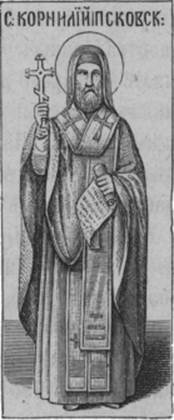
Преподобный Корнилий еще в молодых годах оставил мир и начал подвизаться в Печерском монастыре Псковской области; здесь пострижен он в иночество и проводил жизнь строгую, в трудах и молитве. При нем (с 1519 года) распространили в горе храм Успения Богоматери и устроили его с приделом, в честь преподобных Антония и Феодосия Печерских, а с 1524 года новая храмовая икона Успения Богоматери начала источать исцеления и другие чудеса307. В 1529 году блаженный Корнилий облечен был саном игумена новой Печерской обители. В продолжение 40летнего управления своего он возвысил обитель по всем отношениям. Жизнь его была образцом строгой иноческой жизни и он старался одушевить ревностию к подвижничеству подчиненных ему иноков308. В тогдашнее время случалось, что иные, внося в обитель богатые вклады, дозволяли себе жить в обители не по иночески, и вклад свой считали за право на жизнь по желаниям испорченного сердца. Блаженный Корнилий жил упованием на Господа и не думал поставлять благосостояние обители в зависимость от вкладов; он дорожил высоким значением обители, как училища благочестия, а потому всякого инока, когда не хотел он жить по иночески, подвергал исправительным мерам, а если тот не приходил в себя, то удалял его из обители, кто бы он ни был. Один из таких изгнанных вкладчиков явился с жалобою к митрополиту Макарию. Митрополит велел отправить его в обитель под строгую епитимию. Новгородский архиепископ Феодосий писал к блаженному игумену: «писал к нам святейший господин и отец наш Макарий, митрополит всей России, о вашем Печерском вкладчике старце Савватии, что был он в монастырских службах с мирскими людьми и пал в великие грехи, и что он приходил каяться и плакаться пред тобою о том падении, но ты не привял его на покаяние... Отдайте его доброму старцу под надзор, чтобы жил с правилом и ходил к началу каждой службы, а стоял бы пред церковию каждый день до конца правила, в церковь же не допускайте его. А ты наставляй и учи его по правилам. Ты сам хорошо знаешь писание. Оно говорит: если епископ, или игумен, или пресвитер не принимает на покаяние обращающегося от греха, то должен быть извержен»309. Блаженный Корнилий любил спасение братии и заботился о нем; при нем число иноков обители умножилось до 100 человек, тогда как прежде него было их мало. Он хорошо понимал и долг признательности к благотворителям обители. Памятником тому служит заведенный им синодик обители для поминовения усопшей братии и усопших благотворителей310. Неутомимый в трудах, с неусыпною ревностию ко благу обители, он построил в Пскове, на Печерском подворье, каменный храм в честь Богоматери-Одигитрии; в обители своей деревянный храм 40 мучеников он перенес за монастырь, для монастырских рабочих; а на месте его построил (1548 года) каменный храм Благовещения311. В назидание другим описал он чудеса Печерской иконы Богоматери. «Свидетель этих чудес, говорит он, не я один, а весь Псков и Новгород. Богоматерь подает исцеления не только православным, но и иноверным, приходящим из Немецкой земли (из Лифляндии) с верою к чудотворному образу»312. Блаженный Корнилий любил просвещение для себя и для других; образованные из современников, каков был князь Курбский, проживали по временам в его обители для бесед с ним; ученик его старец Вассиан Муромцев был одним из самых просвещенных людей своего времени313. Блаженный Корнилий насаждал благочестие не только в своей обители, но во всей окрестности; он построил храмы Божии в Агиреве и Топине314.
The Venerable Cornelius, while still in his youth, forsook the world and began to struggle in the Pechersk Monastery of the Pskov region; there he was tonsured into monasticism and led a strict life, in labors and prayer. During his time (from the year 1519) they enlarged the church of the Dormition of the Mother of God on the hill and built it with a side-chapel in honor of the Venerable Anthony and Theodosius of the Kiev Caves; and from the year 1524, a new church icon of the Dormition of the Mother of God began to pour forth healings and other miracles307. In the year 1529, blessed Cornelius was invested with the rank of abbot of the new Pechersk monastery. During the forty years of his administration, he raised the monastery in every respect. His life was a model of strict monastic life, and he strove to inspire zeal for asceticism in the monks under his authority308. In that time, it happened that some, bringing rich donations into the monastery, allowed themselves to live in the monastery in an unmonastic manner, and considered their donation as a right to live according to the desires of a corrupted heart. Blessed Cornelius lived in hope in the Lord and did not think to place the well-being of the monastery in dependence on donations; he valued the high significance of the monastery as a school of piety, and therefore every monk who did not wish to live in a monastic manner he subjected to corrective measures, and if that one did not come to his senses, he removed him from the monastery, whoever he might be. One of these expelled donors appeared with a complaint to Metropolitan Macarius. The Metropolitan ordered him to be sent to the monastery under strict penance. The Archbishop of Novgorod, Theodosius, wrote to the blessed abbot: "The most holy lord and our father Macarius, Metropolitan of all Russia, wrote to us concerning your Pechersk donor, the elder Savvatius, that he was in the monastery's services with worldly people and fell into great sins, and that he came to repent and weep before you concerning that fall, but you did not receive him for repentance... Hand him over to a good elder for supervision, that he may live with a rule and go to the beginning of each service, and stand before the church every day until the end of the rule, but do not admit him into the church. And you instruct and teach him according to the rules. You yourself know the Scriptures well. It says: if a bishop, or abbot, or presbyter does not receive for repentance one who turns from sin, he should be deposed"309. Blessed Cornelius loved the salvation of the brethren and cared for it; during his time the number of monks in the monastery increased to one hundred men, whereas before him there were few of them. He also well understood the duty of gratitude toward the benefactors of the monastery. A memorial of this is the synodikon of the monastery which he instituted for the commemoration of the departed brethren and departed benefactors310. Indefatigable in labors, with unceasing zeal for the good of the monastery, he built in Pskov, at the Pechersk metochion, a stone church in honor of the Mother of God Hodegetria; in his own monastery, he moved the wooden church of the Forty Martyrs beyond the monastery, for the monastery workers; and in its place he built (in the year 1548) a stone church of the Annunciation311. For the edification of others, he described the miracles of the Pechersk Icon of the Mother of God. "A witness of these miracles," he says, "am I not alone, but all Pskov and Novgorod. The Mother of God grants healings not only to the Orthodox, but also to the heterodox, coming from the German land (from Livonia) with faith to the wonderworking image"312. Blessed Cornelius loved enlightenment for himself and for others; educated men among his contemporaries, such as Prince Kurbsky, would sometimes stay in his monastery for conversations with him; his disciple, the elder Vassian Muromtsev, was one of the most enlightened men of his time313. Blessed Cornelius planted piety not only in his own monastery, but throughout the entire vicinity; he built churches of God in Agirevo and Topino314.
С 1558 года открылось новое поле деятельности для блажен. Корнилия. Царь решился возвратить православию принадлежащее ему в Ливонии и достойно наказать Немцев, испепеливших православные храмы и ругавшихся над святынею315. В апреле воеводы подступили под Нарву. В страстный пяток «вельможные и гордые Немцы, изобретшие себе новое имя евангеликов, еще с утра были пьяны» и, не смотря на перемирие, начали стрелять в Русских. Им задан урок. Не вразумились. «Найдя икону Богоматери с предвечным Младенцем на руках в доме, где стояли Русские купцы, они стали ругаться над иконою; потом, взяв ее со стены, бросили в огонь, где варилось пиво... Пламень внезапно, быстрее стрелы, бросился вверх, и верх здания запылал». Начался страшный пожар в Нарве. Русские, воспользовавшись пожаром, завладели городом. «Такова награда хулителям Божественного, тем, которые образ Христа, изображенного по плоти, и образ Матери Его равняют болванам богов языческих! Такова награда иконоборцам». Так пишет современник событий, князь Курбский. Нельзя было не содрогнуться при такой каре Божией. Надобно было подумать о себе ученикам новых учителей, тем более, что икона Богоматери и другая святителя Николая, которую также бросили в огонь лютеране, найдены на пожарище целыми. Блаженный Корнилий и Юрьевский архимандрит, по распоряжению митрополита и царя, освятили Нарву и Иван-город торжественным крестным ходом с чудодейственными иконами и затем доставили эти иконы в Москву316. Вслед за Нарвою взяты были замки Нейгауз, Киремпе и потом Дерпт317. Для бедных Эстов, пострадавших и теперь и прежде от войны, блаженный Корнилий щедрою рукою раздавал пособия всякого рода. Он принял на себя построить православный храм в Нейгаузе, тогда как в Нарве и других местах строило храмы правительство. Благотворительность блажен. Корнилия, его кроткие наставления, его бескорыстие и чистая жизнь произвели то, что в приходе Нейгауза все Эсты, а в приходах Рауге, Пельве и Гериеля многие обратились к св. православию, как к благочестию бескорыстному и искреннему318. Да, не трудно понять учение Апостола: «надобно быть исполнителями слова, а не слушателями только, обманывающими самих себя» (Иак.1:22). Что пользы, если и кто говорит, что он имеет веру, а дел не имеет (Иак.1:14)? Там, где хотят питать и развивать один разум, где с презрением отвергают способы образования воли, – там невозможно живое, вседушевное благочестие, там только обманывают самих себя. Там, где говорят: каждый думай о вере по своему усмотрению, ожидайте всего нечестивого, но уже отнюдь не христианского благочестия. События сами по себе сильно говорили в пользу православия. В 1560 году блаж. Корнилий был орудием дивного дела Божия, на радость православию и в казнь врагам его. В праздник Успения Богоматери он послал просфору и св. воду воеводам, стоявшим под Феллином, и лишь только прибыл туда посланный им, как в Феллине вспыхнул от ядер пожар, истребивший и снаряды и весь хлеб неприятеля. – Немцы вынуждены были сдаться; признательные воеводы прислали в обитель Богоматери Феллинский колокол319. В 1565 году блаженный Корнилий окружил монастырь каменною оградою, и над вратами обители построил храм в честь святителя Николая, поручив сему дивному защитнику чистой веры оберегать обитель православия. При положении обители на границе Ливонских Немцев, заклятых врагов православия, такое укрепление необходимо было не для одной обители, но и для целой России. Это неопровержимо доказали события 1581 года, когда монастырь счастливо выдержал осаду Баториевых войск и грозные силы неприятеля, без пользы для него, истратились под стенами обители320. В 1570 году преп. Корнилий со всем Псковским духовенством торжественно встречал грозного царя во Пскове321.
From the year 1558, a new field of activity opened for blessed Cornelius. The Tsar resolved to return to Orthodoxy what belonged to it in Livonia and to punish worthily the Germans, who had burned Orthodox churches and mocked the holy things315. In April, the voivodes approached Narva. On Good Friday, "the noble and proud Germans, who had invented for themselves the new name of Evangelicals, were drunk from early morning" and, despite the truce, began to shoot at the Russians. They were given a lesson. They did not come to their senses. "Finding an icon of the Mother of God with the Eternal Child in her arms in a house where Russian merchants were staying, they began to mock the icon; then, taking it from the wall, they threw it into the fire where beer was boiling... The flame suddenly, swifter than an arrow, shot upward, and the top of the building burst into flames." A terrible fire began in Narva. The Russians, taking advantage of the fire, seized the city. "Such is the reward of the blasphemers of the Divine, of those who equate the image of Christ, depicted in the flesh, and the image of His Mother with the idols of the pagan gods! Such is the reward of the iconoclasts." Thus writes a contemporary of the events, Prince Kurbsky. One could not but shudder at such a punishment of God. It was necessary to think about themselves, the disciples of the new teachers, all the more because the icon of the Mother of God and another of St. Nicholas, which the Lutherans had also thrown into the fire, were found intact on the burnt site. Blessed Cornelius and the Archimandrite of Yuriev, by order of the Metropolitan and the Tsar, consecrated Narva and Ivangorod with a solemn procession of the cross with the wonderworking icons, and then delivered these icons to Moscow316. After Narva, the castles of Neuhausen, Kierepe, and then Dorpat were taken317. To the poor Estonians, who had suffered both now and previously from the war, blessed Cornelius distributed aid of every kind with a generous hand. He undertook to build an Orthodox church in Neuhausen, while in Narva and other places the government built churches. The charity of blessed Cornelius, his gentle instructions, his disinterestedness and pure life produced the result that in the parish of Neuhausen all the Estonians, and in the parishes of Rauge, Pölve, and Härjamaa many, converted to holy Orthodoxy, as to a disinterested and sincere piety318. Yes, it is not difficult to understand the Apostle's teaching: "Be ye doers of the word, and not hearers only, deceiving your own selves" (Jas. 1:22). What profit is it, if a man says he has faith, but has not works? (Jas. 2:14). Where they wish to nourish and develop only the intellect, where they reject with contempt the means of forming the will—there a living, whole-souled piety is impossible; there they only deceive themselves. Where they say: let each think about faith according to his own discretion, expect everything impious, but by no means Christian piety. The events themselves spoke powerfully in favor of Orthodoxy. In the year 1560, blessed Cornelius was an instrument of a wondrous work of God, to the joy of Orthodoxy and to the punishment of its enemies. On the feast of the Dormition of the Mother of God, he sent a prosphora and holy water to the voivodes besieging Fellin, and no sooner had his messenger arrived there than a fire broke out in Fellin from the cannonballs, destroying both the supplies and all the enemy's grain. The Germans were forced to surrender; the grateful voivodes sent the Fellin bell to the monastery of the Mother of God319. In the year 1565, blessed Cornelius surrounded the monastery with a stone wall, and over the gates of the monastery he built a church in honor of St. Nicholas, entrusting this wondrous defender of the pure faith with guarding the monastery of Orthodoxy. Given the location of the monastery on the border of the Livonian Germans, sworn enemies of Orthodoxy, such a fortification was necessary not only for the monastery, but for all Russia. This was irrefutably proven by the events of 1581, when the monastery successfully withstood the siege of Batory's troops, and the formidable forces of the enemy were spent uselessly beneath the walls of the monastery320. In the year 1570, the Venerable Cornelius, together with all the Pskov clergy, solemnly greeted the fearsome Tsar in Pskov321.
Царь назначил православного епископа для завоеванной Ливонии, с титулом «епископа Юрьевского и Вельянского» (Феллинского), и первым епископом был посвящен блаженный Корнилий. По летописям, новый владыка Юрьевский 14 октября 1570 г. прибыл из Москвы в Новгород; а в 1572 г. являлся он к царю в Новгороде с иконами322. В синодике Печерского монастыря записана память преставления «священноепископа Корнилия Юрьевского и Вельянского». – Князь Курбский пишет: сумерщвлен им (Иоанном) Корнилий, игумен Печерского монастыря, человек святый, славный по иноческой жизни. Он с молодости своей жил в трудах иноческих и воздвигнул монастырь трудами долгими и молитвами пред Богом»323. В Печерской рукописи сказано о преп. Корнилии: «от тленного сего жития земным царем предпослан к Небесному Царю». – Как это было? за что или по какому поводу? Неизвестно. Только сам больной душою царь записал Корнилия в числе убиенных, показывая тем свою прикосновенность к страдальческой смерти Корнилия324. Подвижник благочестия скончался на 69 году жизни своей, 20 февраля. Святое тело его положено было в стене природной пещеры монастыря Печерского, а в 1690 г. перенесено в Успенскую церковь325. В 1581 году одному благочестивому старцу открыто было, как преподобный Корнилий сопутствовал Небесной Царице вместе с преподобным Антонием на защиту Пскова, как умолял он Ее простить грехи людей и спасти виновный Псков. «Стоявшие по правую руку, говорит современная повесть, игумен Корнилий, Савва и блаженный Николай пали пред Нею со слезами и молились: преступники они; умоли Сына твоего и Бога нашего за людей согрешивших». Потом и благоверные князья молили Ее пощадить город. И Псков спасен от Батория, не смотря на все усилия Батория326.
The Tsar appointed an Orthodox bishop for the conquered Livonia, with the title "Bishop of Yuriev and Velyan" (Fellin), and the blessed Cornelius was consecrated as the first bishop. According to the chronicles, the new Yurievskij vladyka arrived from Moscow in Novgorod on 14 October 1570; and in 1572 he appeared before the Tsar in Novgorod with icons322. In the synodicon of the Pechersk Monastery, the memory of the repose of "the Hierarch Cornelius, Bishop of Yuriev and Velyan" is recorded. – Prince Kurbsky writes: "Cornelius, the abbot of the Pechersk Monastery, a holy man, renowned for his monastic life, was put to death by him (John). He from his youth lived in monastic labors and by long toils and prayers before God built up the monastery"323. In a Pechersk manuscript it is said of the Venerable Cornelius: "from this corruptible life he was sent by the earthly king to the Heavenly King." – How did this happen? For what or on what account? It is unknown. Only the Tsar himself, sick in soul, recorded Cornelius among the slain, thereby showing his own complicity in the suffering death of Cornelius324. The ascetic of piety reposed in the 69th year of his life, on 20 February. His holy body was laid in the wall of the natural cave of the Pechersk Monastery, and in 1690 it was translated to the Dormition Church325. In 1581, it was revealed to a certain pious elder how the Venerable Cornelius accompanied the Heavenly Queen together with the Venerable Anthony in the defense of Pskov, and how he besought Her to forgive the sins of the people and to save the guilty Pskov. "Those standing on the right hand," says a contemporary account, "the abbot Cornelius, Sabbas, and the blessed Nicholas fell down before Her with tears and prayed: 'They are transgressors; entreat Thy Son and our God for the sinning people.'" Then also the Right-believing Princes besought Her to spare the city. And Pskov was saved from Batory, despite all the efforts of Batory326.
В Персии, в IV в., при Сапоре II, против христианской веры возникло жестокое и продолжительное гонение. В это время пострадал с дружиною своею и епископ Селевкийский и Ктезифонский327. Садок, преемник св. архиепископа Симеона (пам. 17 апр.), был доставлен в оковах в г. Бет-Лапат (Вифлапат), в Гузитской области, и после многих мук умерщвлен мечем (в 342 г.). О страдальческой кончине своей св. Садок предупрежден был в сонном видении: «В эту ночь видел я во сне лестницу, доходившую до небес, – рассказал еп. Садок клиру своему за год до исполнения этого сна, – наверху лестницы стоял в великой славе св. епископ Симеон и сказал мне: – иди ко мне, Садок, иди и не бойся! Я вошел сюда вчера, а ты войди ныне!.. – После этого видения верую я, что буду взят на мучение за Христа... А что сказал св. Симеон: – я взошел вчера, а ты взойди ныне, – то это означает, что он пострадал в прошедший год, а я пострадаю в этот год... Не убоимся же, братия мои, когда придет смерть, но каждый из нас да станет добрым Христовым воином!»
In Persia, in the 4th century, under Shapur II, a cruel and protracted persecution arose against the Christian faith. At that time, the Bishop of Seleucia and Ctesiphon327 also suffered with his company. Sadoc, the successor of St. Archbishop Simeon (commemorated 17 April), was brought in chains to the city of Bet-Lapat (Bethlapat), in the province of Khuzistan, and after many torments was put to death by the sword (in 342 A.D.). St. Sadoc was forewarned of his own martyr's death in a dream vision: "This night I saw in a dream a ladder reaching to heaven," Bishop Sadoc told his clergy a year before the fulfillment of this dream, "at the top of the ladder stood St. Bishop Simeon in great glory and said to me: 'Come to me, Sadoc, come and fear not! I entered here yesterday, and do you enter today!' ... After this vision I believe that I shall be taken to martyrdom for Christ... And what St. Simeon said: 'I ascended yesterday, and do you ascend today' – this signifies that he suffered in the past year, and I shall suffer in this year... Let us not fear, therefore, my brethren, when death comes, but let each of us stand as a good soldier of Christ!"
Так и сбылось. В одно время с св. Садоком и вскоре после него в Селевкии пострадали за веру Христову 128 человек, в числе которых были и 9 дев, посвятивших себя Богу. Приняв всевозможные истязания и идя на смерть, они молились и славили Бога. О них писал св. Маруфа328 в своей «Истории мучеников Персидских», страданий которых (именно позднейших из них) он был очевидцем, а о первых из них говорит Маруфа, что списал по повествованию престарелых епископов и правдолюбивых, стоящих доверия пресвитеров, которые сами были очевидцами деяний мучеников, совершившихся в их время». «Песни св. Маруфы в честь мучеников» до сих пор поются у Маронитов, Иаковитов и Несториан.
And so it came to pass. At the same time as St. Sadoc and shortly after him, 128 persons suffered for the faith of Christ in Seleucia, among whom were also nine virgins who had consecrated themselves to God. Having endured every kind of torment and going to their death, they prayed and glorified God. St. Maruthas328 wrote of them in his "History of the Persian Martyrs," of whose sufferings (namely the later ones) he was an eyewitness, and concerning the earlier ones Maruthas says that he transcribed them from the accounts of aged bishops and truth-loving, trustworthy presbyters, who were themselves eyewitnesses of the deeds of the martyrs that took place in their time." "The hymns of St. Maruthas in honor of the martyrs" are still sung by the Maronites, Jacobites, and Nestorians.
Собр. лет. 4, 293, 295. Повесть о Псков. Печер. мон. 4, 5. М. 1831. Дерпт, 1821 г., ркп. минея июн. 10 Сергиевой лаврской биб. № 5.
Collection of Chronicles 4, 293, 295. The Tale of the Pskov Caves Monastery 4, 5. M. 1831. Dorpat, 1821, manuscript menaion for June 10, Sergius Lavra Library, No. 5.
Храм 40 мучеников, похожий на молитвенный дом, с крышею в один екат, доселе цел и служит приходским храмом заштатного городка Печерска. Позже, и именно в 1565 г., при входе в монастырь построен пр. Корнилием храм св. Николая. Гр. Толстого святыни Пскова, стр. 103, 115 и прим. 5.
The Church of the Forty Martyrs, resembling a prayer house, with a roof of a single slope, is still intact and serves as the parish church of the unincorporated town of Pechersk. Later, namely in 1565, at the entrance to the monastery, the Venerable Cornelius built the Church of St. Nicholas. Count Tolstoy's Shrines of Pskov, pp. 103, 115 and note 5.
См. письмо Курбского и письмо Полубевского в Москвитянине 1853 г. ч. 5 стр. 147, 148. Там же сочинение Корнилия описание обители стр. 139. Письмо к Вассиану у Устрялова в изд. соч. Курбского, стр. 290, 292. Сочинение пр. Корнилия с такою надписью: «Сказание, откуда бысть прозвание Печерскому монастырю во Пскове». Эго сочинение пополняли Григорий инок в 1585 году, игумены Мелетий в 1587 г., Иоаким в 1601 г.
See Kurbsky's letter and Polubensky's letter in The Muscovite, 1853, part 5, pp. 147, 148. Ibid., Cornelius's composition, Description of the Monastery, p. 139. Letter to Vassian in Ustryalov's edition of Kurbsky's Works, pp. 290, 292. The composition of the Venerable Cornelius with this inscription: "An Account of Whence the Caves Monastery near Pskov Received Its Name." This composition was supplemented by the monk Gregory in 1585, by Abbots Meletius in 1587, and Joachim in 1601.
Межевая запись на села и деревни монастырские, данная писцами Юрьева-Ливонскаго, ноябр. 29 1556 г., в Музее Румянцева, стр. 87. Здесь в обводной грамоте 1491 г. видно значение одерена как оброчного. Другая грамота с переписью монастырских земель по писцовой книге дана сент. 8 1563 г., там же стр. 89.
Boundary record for the monastery's villages and hamlets, given by the scribes of Yuriev-Livonian, 29 November 1556, in the Rumyantsev Museum, p. 87. Here in the boundary charter of 1491 the significance of "oderen" as a quitrent is evident. Another charter with a census of monastery lands according to the cadastral book was given on 8 September 1563, ibid., p. 89.
Немец: «У Московскаго вел. князя были тогда храмы в Риге,Ревеле и Дерпте, где Русские купцы молились по воскресным дням.– Лютеранство не оставило в покое этих храмов; напротив, в фанатизме неистово нападают на них и разрушают до основания». Brendenb. f. Griefenthal chronie in Monum. livon. Y, 114. 509–515. Фабриций, папистический священник Феллинский ок. 1610 г., говорит о фанатиках лютеранизма: «сожжены ими и Московские храмы в Дерпте, Ревеле, Риге и во многих других местах; они ограблены и истреблены». Livon. liist. in rev. livon. script. t. 2. p. 467. Rigae. 1847.
A German: "The Grand Prince of Moscow then had churches in Riga, Reval and Dorpat, where Russian merchants prayed on Sundays. – Lutheranism did not leave these churches in peace; on the contrary, in fanaticism they furiously attacked them and razed them to the ground." Brendenbach's Griefenthal Chronicle in Monumenta Livoniae V, 114. 509–515. Fabricius, a papist priest of Fellin around 1610, says of the fanatics of Lutheranism: "The Moscow churches in Dorpat, Reval, Riga and in many other places were burned by them; they were plundered and destroyed." Livonica historia in Scriptores rerum Livonicarum, vol. 2, p. 467. Riga, 1847.
Курбского ист. Иоанна стр. 54–57. Собр. л. 4, 310. Ник. лет. 7, 307. Степ. кн. 2, 278. 279. Повесть о Печер. мон. 5. 6.
Kurbsky's History of John, pp. 54–57. Collection of Chronicles 4, 310. Nikon Chronicle 7, 307. Book of Degrees 2, 278, 279. The Tale of the Caves Monastery 5, 6.
Повесть о Печер. мон. Приинц Бухау: «оставлены (в крепостях) Московские гарнизоны, построены храмы, как и во всех завоеванных местах обыкновенно поступает царь, ИИ принесены благодарные молитвы за победы». Script. rer. livon. 2, 704. Летопись (собр. л.4:316): «1565 г. июня 7 приходили Литовские люди, воевали новаго городка (Нейгаузена) уезда Преч. Богородицы деревню Вирста да Рожину мызу (Рауге) с деревнею Кючи (Коссе), – Растинских деревней (Раппину)». Ляхи, взявшиеся защищать Немцев, нападали прежде всего на места, где Русские водворились с своею верою.
The Tale of the Caves Monastery. Prince Buchau: "Moscow garrisons were left (in the fortresses), churches were built, as the Tsar usually does in all conquered places, and thanksgivings were offered for the victories." Scriptores rerum Livonicarum 2, 704. Chronicle (Collection of Chronicles 4:316): "In 1565, on 7 June, Lithuanian people came, ravaged the district of the new town (Neuhausen), the village of Virsta of the Most Pure Theotokos, and the Rojina manor (Rauge) with the village of Küchi (Kosse), – the Rastino villages (Rappin)." The Poles, who undertook to defend the Germans, attacked first of all the places where the Russians had settled with their faith.
Собр. л. III, 164. 174. С 1570 г. игуменом Печерским был Савва, а с 1572 г. – Сильвестр (Толстого святыни Пскова стр. 109. Собр. л. III, 164). Езуит Поссевин: Vladicam, i. е. episcopum Dorpati imposuit. Comm. p. 17. Riga 1852.
Collection of Chronicles III, 164, 174. From 1570 the abbot of the Caves Monastery was Sabbas, and from 1572 – Sylvester (Count Tolstoy's Shrines of Pskov, p. 109. Collection of Chronicles III, 164). The Jesuit Possevino: "Vladicam, i.e., episcopum Dorpati imposuit." Commentarii, p. 17. Riga, 1852.
Повесть о Печерском мон. стр. 4. Год страдальческой кончины неизвестен. Но 20 ч. февр. показано днем кончины Корнилия как в ркп. святцах, так в записях Печерского монастыря.
The Tale of the Pechersk Monastery, p. 4. The year of his martyr's death is unknown. But the 20th of February is indicated as the day of Cornelius's death both in the manuscript menologia and in the records of the Pechersk Monastery.