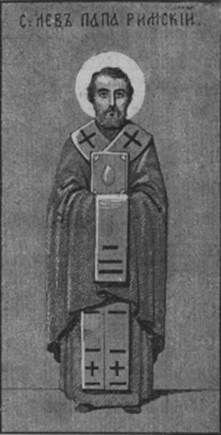
Родом из Италии, Лев I или Великий был избран папою в 440 году и святительствовал до 461 года. Он заслужил известность своею добродетельною и благочестивою жизнью. Защищал страну и от внешних врагов302 и от внутренних врагов Церкви – еретиков: манихеев и евтихиан. – При нем Евтихий, архимандрит одного из Константинопольских монастырей, противник учения Нестория, впавший в противоположную крайность, стал утверждать, что в Иисусе Христе следует признавать только одно Божественное естество. На местном соборе, происходившем в то время в Константинополе, были рассмотрены положения Евтихия; он был обличен в ереси и лишен церковной степени. Евтихий восстал против этого решения, обратился ко многим епископам, в том числе и к папе Льву, с просьбою пересмотреть его дело и при этом обвинил в ереси самого патриарха Цареградского Флавиана.
A native of Italy, Leo I, or Leo the Great, was elected Pope in the year 440 and served as Hierarch until 461. He earned renown for his virtuous and pious life. He defended the country both from external enemies302 and from the internal enemies of the Church—heretics: the Manichaeans and the Eutychians. — During his time, Eutyches, the archimandrite of one of the monasteries of Constantinople, an opponent of the teaching of Nestorius, fell into the opposite extreme and began to assert that in Jesus Christ only one divine nature should be acknowledged. At a local council then taking place in Constantinople, the positions of Eutyches were examined; he was convicted of heresy and deprived of his clerical rank. Eutyches rose up against this decision, appealing to many bishops, including Pope Leo, with a request to review his case, and at the same time accused the Patriarch of Constantinople, Flavian, himself of heresy.
Лев, узнав от Флавиана правду об этом деле, письменно изложил учение Церкви о соединении во Христе двух естеств: Божеского и человеческого.
Leo, having learned the truth of the matter from Flavian, set forth in writing the teaching of the Church concerning the union in Christ of two natures: the divine and the human.
«Не понимая того, как должно разуметь воплощение Бога Слова, – писал папа Лев Флавиану, – Евтихий должен был следовать тому всеобщему, единогласному учению, которое исповедует вся христианская Церковь, веруя – во Иисуса Христа Единородного Сына Божия, Господа нашего, родившегося от Духа Святого и от Девы Марии... Это рождение, само по себе единственное и изумительное, должно быть постигаемо не так, как будто необычайностию рождения уничтожились обыкновенные свойства родившегося человечества... Божество восприяло нашу немощь, не нарушив свойств ни того, ни другого естества. Истинный Бог явился в истинном и совершенном естестве истинного человека, весь с тем, что свойственно Ему, и весь в том, что свойственно нам (totus in suis, totus in nostris)... Как Бог не терпит перемен через снисхождение к нам, так и человек не уничтожается величием Божества. Та и другая природа действует при взаимном общении, свойственным себе образом, т. е. Слово действует, как свойственно Слову, а плоть совершает то, что приличествует плоти».
"Not understanding how the incarnation of God the Word ought to be understood," wrote Pope Leo to Flavian, "Eutyches ought to have followed that universal, unanimous teaching which the whole Christian Church confesses, believing in Jesus Christ, the Only-begotten Son of God, our Lord, born of the Holy Spirit and of the Virgin Mary... This birth, in itself unique and wondrous, must be understood not as if the extraordinary nature of the birth destroyed the ordinary properties of the humanity that was born... The Godhead assumed our weakness without violating the properties of either nature. The true God appeared in the true and perfect nature of a true man, wholly in that which is His own, and wholly in that which is ours (totus in suis, totus in nostris)... As God suffers no change through His condescension to us, so man is not annihilated by the majesty of the Godhead. Each nature acts, in communion with the other, in the manner proper to itself: that is, the Word does what is proper to the Word, and the flesh accomplishes what befits the flesh."
Письмо это было читано и одобрено на 4-м Вселенском – Халкидонском соборе, созванном императором Маркианом в Вифинии, в 451 г. Ересь Евтихия была окончательно осуждена.
This letter was read and approved at the Fourth Ecumenical Council—the Council of Chalcedon—convened by the Emperor Marcian in Bithynia, in 451. The heresy of Eutyches was finally condemned.
По прочтении письма папы Льва – был изложен догмат, что «Иисус Христос есть истинный Бог и истинный Человек; по Божеству Он вечно рождается от Отца и во всем Ему подобен; по человечеству же Он во времени родился от Пресвятой Девы Богородицы и во всем подобен нам, кроме греха; но в воплощении Он имеет одно лицо и два естества, соединенные в Нем неслиянно, неизменно, нераздельно, неразлучно».
Upon the reading of the letter of Pope Leo, the dogma was set forth that "Jesus Christ is true God and true Man; according to His Divinity He is eternally begotten of the Father and is in all things like unto Him; according to His humanity He was born in time of the Most Holy Virgin Theotokos and is in all things like unto us, except sin; but in the Incarnation He has one person and two natures, united in Him unconfusedly, unchangeably, indivisibly, inseparably."
«Долг милосердия, – говорит он в одном из последних, – определяется не по мере благ, а расположением сердца. Он – общ для всех, как все должны любить ближнего и по любви помогать ему. Бог для того и дает богатство, чтобы оно текло к бедному. Те злоупотребляют им, на беду себе, которые расточают его на пустые предметы, или берегут его взаперти. Потому-то Господь говорит нам, что милосердие для нас – ключ к Царствию Небесному».
"The duty of mercy," he says in one of the latter, "is measured not by the amount of goods, but by the disposition of the heart. It is common to all, for all must love their neighbor and, out of love, help him. God gives wealth for this very purpose, that it might flow to the poor. Those abuse it, to their own ruin, who squander it on empty objects, or hoard it under lock and key. For this reason the Lord tells us that mercy is for us the key to the Kingdom of Heaven."
Флавиан пострадал в борьбе против ереси Евтихия и умер вследствие ударов, нанесенных ему защитниками Евтихия во время собора, известного в истории под названием «разбойничьего» или «Ефесского разбоя», в 449 году. Мощи его были перенесены в Константинополь в 451 году. Преемник св. папы Льва Иларий, бывший легатом на разбойничьем соборе, изобразил в Риме в оратории св. Креста стенною живописью подвиг Флавиана на этом соборе.
Flavian suffered in the struggle against the heresy of Eutyches and died as a result of the blows inflicted upon him by the defenders of Eutyches during the council known in history as the "Robber Council" or the "Robbery of Ephesus," in the year 449. His relics were translated to Constantinople in 451. The successor of St. Pope Leo, Hilary, who had been a legate at the Robber Council, depicted in Rome, in the oratory of the Holy Cross, the deed of Flavian at that council in wall paintings.
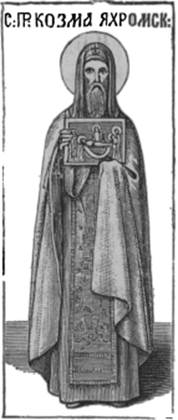
Преподобный Козма303 воспитывался у одного боярина, в селе; боярин, полюбив его за кротость, научил его грамоте. Благодетель боярин впал в тяжкую болезнь и переезжал из города в город, ища пособия в болезни; Козма был с ним неотлучно, утешая его чтением книг и ухаживая, как добрый сын за отцом. Во время переездов своих остановились они на реке Яхроме и благоговейному Козме является на дереве икона Успения Богоматери; он слышал от нее глас, повелевавший ему быть иноком и устроить монастырь. Больной господин его тогда же получил исцеление от сей иконы. Это еще более заставило господина любить Козму. Но уже и потому, что господину не нужны были услуги, Козма тайно удаляется в Киев и поступает в Печерскую обитель; облеченный здесь в иноческие одежды, проводит некоторое время в подвигах строгого поста и молитвы. Потом, следуя воле Богоматери, идет с явившеюся ему иконою на реку Яхрому, и здесь, в 40 верстах от Владимира и в 15 от Юрьева-польного, с пособиями добрых людей, сооружает храм в честь Успения Богоматери. Мало-помалу собрались к нему ревнители уединенной жизни, и он ревностно обучал их благочестию, в звании игумена. Постоянно верный правилам иночества, он не оставлял подвигов поста и молитвы, а вместе с любовию принимал странных и целил грешные души врачевством покаяния; слава о дивных подвигах его доходила и до великого князя. Достигнув глубокой старости и приобщившись св. Таин, он мирно предал дух свой Богу 18-го февраля 1492 года. В памяти Юрьевцев остались его строгая жизнь и наружный вид: лицо его было бледно и сухо, волоса седые, брада долгая и к концу узкая, несколько свившаяся; светлый взор сиял из-под высокого чела. – Различные исцеления ознаменовали святость жизни его. Мощи его почивают под спудом в Успенском монастырском храме304. Митрофан, впоследствии святитель Воронежский, быв игуменом Козмина монастыря, так говорил в надписи на Евангелии: «выменено сие Евангелие – преподобного отца нашего Козмы Яхринского чудотворца при игумене Митрофане»305. Явившаяся преподобному икона, ознаменовавшаяся чудесами, находится в том же храме, где и мощи преподобного, и ей празднуют 14-го октября306.
The Venerable Cosmas303 was raised in the household of a certain boyar, in a village; the boyar, having come to love him for his meekness, taught him letters. The benefactor boyar fell into a grievous illness and traveled from city to city, seeking relief from his sickness; Cosmas was with him unceasingly, comforting him by reading books and caring for him as a good son for a father. During their travels they stopped at the River Yakhroma, and to the reverent Cosmas there appeared on a tree an icon of the Dormition of the Mother of God; he heard a voice from it, commanding him to become a monk and to establish a monastery. His ailing master at that same time received healing from this icon. This made the master love Cosmas all the more. But since the master no longer needed his services, Cosmas secretly withdrew to Kiev and entered the Monastery of the Caves; having been clothed there in the monastic habit, he spent some time in the labors of strict fasting and prayer. Then, following the will of the Mother of God, he went with the icon that had appeared to him to the River Yakhroma, and there, 40 versts from Vladimir and 15 from Yuryev-Polsky, with the assistance of good people, he built a church in honor of the Dormition of the Mother of God. Little by little, zealots of the solitary life gathered to him, and he zealously taught them piety, in the rank of abbot. Ever faithful to the rules of monasticism, he did not abandon the labors of fasting and prayer, while at the same time he received strangers with love and healed sinful souls with the medicine of repentance; the fame of his wondrous labors reached even the Grand Prince. Having attained a deep old age and having partaken of the Holy Mysteries, he peacefully surrendered his spirit to God on the 18th of February, 1492. In the memory of the people of Yuryev there remained his strict life and his outward appearance: his face was pale and gaunt, his hair gray, his beard long and narrow at the end, somewhat curled; a bright gaze shone from beneath a high brow. — Various healings marked the holiness of his life. His relics lie hidden beneath a cover in the monastery church of the Dormition304. Mitrophan, afterwards Hierarch of Voronezh, having been abbot of the Cosmas Monastery, spoke thus in an inscription on a Gospel book: "This Gospel book was acquired — of our Venerable Father Cosmas of Yakhroma the Wonderworker, under Abbot Mitrophan"305. The icon that appeared to the Venerable One, which was marked by miracles, is located in the same church where the relics of the Venerable One are, and it is celebrated on the 14th of October306.
В 452 г. силою слова своего папа Лев убедил и удержал жестокого царя Гуннов Атиллу, готового вторгнуться в Рим с огнем и мечем, а в 455 г. успешно подействовал на такого же лютого предводителя Вандалов – Гензериха и отвратил пролитие крови и предание огню зданий в Риме.
In 452, by the power of his word, Pope Leo persuaded and restrained the cruel king of the Huns, Attila, who was ready to invade Rome with fire and sword; and in 455, he successfully influenced the equally fierce leader of the Vandals, Genseric, and averted the shedding of blood and the consigning of buildings to fire in Rome.
Житие преп. Козмы описано было иноком Григорием, но описание было потом распространено игум. Варлаамом. Из того составилась витиеватая повесть, богатая словами и скудная мыслями. Повесть у Румянцева № 371. В сборнике Петерб. дух. акад. № 277.
The life of the Venerable Cosmas was written by the monk Gregory, but the account was later expanded by Abbot Barlaam. From this was composed a florid narrative, rich in words and poor in thoughts. The narrative is in Rumyantsev, No. 371. In the collection of the St. Petersburg Theological Academy, No. 277.
Святцы: «преп. отец Козма, игумен Успенскаго монастыря Яхренский, иже в Шахматицех, Юрьевский чудотворец, преставися в л. 7000 мес. февр. в 18 день». Ист. иер. 4, 567. Служба преп. Козме на 18 д. февр. и житие его в сборнике Нижегор. Благовещ. монастыря.
The Saints' Calendar: "The Venerable Father Cosmas, Abbot of the Dormition Monastery of Yakhrenga, which is in Shakhmatitsy, Wonderworker of Yuryev, reposed in the year 7000, month of February, on the 18th day." Hist. Hier. 4, 567. The service to the Venerable Cosmas on the 18th day of February and his life in the collection of the Annunciation Monastery of Nizhny Novgorod.
Буслаева: словесн. и искусст. 2, 952. Владимирский сборник стр. 110. ст. М. 1858 г. По описи 1662 года «за Кузминым монастырем 94 двора».
Buslaev: Literature and Art 2, 952. Vladimir Collection, p. 110, M. 1858. According to the inventory of 1662, "behind the Cosmas Monastery there are 94 households."
Сведения о монастыр. стр. 31. М. 1852 г. В соч. «слава Пресв. Богородицы», о сей иконе ошибочно говорится в двух местах, как о двух различных (ч. 3, отд. 3, стр. 104, 106, 107, М. 1853 г.). В первом сказано, что св. икона явилась в 1482 г. Но это было раньше. – Ркп. повесть о Яхромской иконе в б. общ. ист. № 213. Румянцева № 371.
Information on Monasteries, p. 31, M. 1852. In the work "The Glory of the Most Holy Theotokos," this icon is erroneously spoken of in two places as two different ones (Part 3, Sect. 3, pp. 104, 106, 107, M. 1853). In the first it is said that the holy icon appeared in 1482. But this was earlier. — Manuscript account of the Yakhroma Icon in the library of the Society of History, No. 213. Rumyantsev, No. 371.