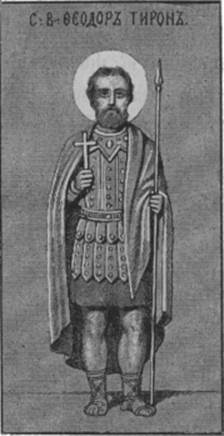
Тирон – слово Римское, значит новобранец, воин новый. Исповедав Христа пред вождями и товарищами по оружию, Феодор сжег капище богини Цибелы, и после бичеваний и других мук, как противник богов и христианин, сожжен на костре в Амасии, в 306 году. Верные похоронили его останки в г. Евхаите, недалеко от Амасии.
Tyro is a Roman word, meaning a new recruit, a new soldier. Having confessed Christ before his leaders and fellow soldiers, Theodore burned the temple of the goddess Cybele, and after scourging and other torments, as an enemy of the gods and a Christian, he was burned at the stake in Amasea, in the year 306. The faithful buried his remains in the city of Euchaita, not far from Amasea.
Церковь в субботу первой седмицы Великого поста, по древнему названию, Феодоровскую, совершает благодарственное празднование св. великомученику Феодору Тирону. Синаксарь в субботу первой седмицы Четыредесятницы начинается стихами:
The Church, on the Saturday of the first week of Great Lent, by the ancient name Theodore's Saturday, celebrates a thanksgiving feast in honor of St. Great Martyr Theodore the Tyro. The Synaxarion for the Saturday of the first week of the Forty Days begins with these verses:
Юлиан, отступник и лукавый гонитель христианства, желая осквернить св. пост наш в первую седмицу Четыредесятницы, издревле особенно чтимую, и подвергнуть христиан осмеянию, повелел в 362 году епарху Антиохийскому тайно – ежедневно в продолжение первой седмицы – осквернять припасы, продаваемые по обычаю в Антиохии на торжище, кровию идольских жертв, от которых христиане всегда обязаны удерживаться (Деян.15:29). Епарх исполнил повеление Юлиана. Но злоумышление врагов сделалось известно христианам. Св. великомученик Феодор Тирон (воин), стяжавший мученический венец при императоре Максимиане, в Амасии, около 306 года 17 февраля, является Константинопольскому архиепископу Евдоксию и повелевает ему призвать рано утром в чистый понедельник верующих и запретить им покупать на торжище оскверненную пищу. Епископ недоумевал, чем заменить это лишение, особливо имеющим недостаток в домашних запасах. Великомученик советовал употребить для пищи коливо (χολλυβα) или вареную пшеницу с медом, называемую иногда кутиею, и таким образом обличил и посрамил нечестивое намерение хитрого кощунника.
Julian the Apostate, a cunning persecutor of Christianity, wishing to defile our holy fast during the first week of the Forty Days, which from ancient times was especially honored, and to subject Christians to mockery, commanded the eparch of Antioch in the year 362 to secretly—daily throughout the first week—defile the provisions sold, according to custom, in the marketplace of Antioch, with the blood of pagan sacrifices, from which Christians are always obliged to abstain (Acts 15:29). The eparch carried out Julian's command. But the evil design of the enemies became known to the Christians. St. Great Martyr Theodore the Tyro (a soldier), who had won the martyr's crown under the Emperor Maximian, in Amasea, around the year 306, on February 17, appeared to Eudoxius, the Archbishop of Constantinople, and commanded him to summon the faithful early in the morning on Clean Monday and forbid them to buy the defiled food in the marketplace. The bishop was perplexed as to what to substitute for this deprivation, especially for those lacking in household stores. The Great Martyr advised using for food kolyva (κολλυβα), or boiled wheat with honey, sometimes called kutia, and thus exposed and put to shame the impious intention of the cunning blasphemer.
В память этого события и в благодарность великомученику Феодору, как потребителю идолов, предстателю и хранителю стада Христова, Православная Церковь с тех пор, т. е. с IV века, доселе ежегодно творит празднование великомученику, совершая в навечерие субботы, в пятницу на литургии по заамвонной молитве, молебный канон – сочинение св. Иоанна Дамаскина, и благословляя в честь великомученика коливо, коим внушил он заменить на первой седмице поста оскверненную постную пищу. В субботу Церковь постановила читать похвальное слово Феодору – сочинение Григория Нисского, и петь канон Иоанна, митрополита Евхаитского.
In memory of this event and in gratitude to the Great Martyr Theodore, as a destroyer of idols, an intercessor and guardian of Christ's flock, the Orthodox Church from that time, i.e., from the 4th century, until the present day annually celebrates the feast of the Great Martyr, performing on the eve of Saturday, on Friday, at the Divine Liturgy after the prayer behind the ambo, a moleben canon—the composition of St. John of Damascus—and blessing in honor of the Great Martyr the kolyva, with which he inspired the replacement of the defiled Lenten food during the first week of the fast. On Saturday, the Church appointed the reading of a panegyric to Theodore—the composition of Gregory of Nyssa—and the singing of the canon by John, Metropolitan of Euchaita.
Начальные подвиги иноческой жизни преподобный Феодосий289, Болгарин родом, совершал в Виддинском монастыре св. Николая, под управлением игумена Иова, мужа добродетельного и разумного. «Постриженный Иовом в иночество, Феодосий оказывался готовым на всякое послушание»: и настоятель поручил ему заведывание экономиею обители. Он мужественно подвизался и, как видели, служил не людям, а Богу. Послушание и смирение его были таковы, каких не видели в других. По кончине настоятеля Иова, перешел он в Тернов, тогда стольный город Болгарский, и стал жить в монастыре Богоматери, называвшемся Святою горою. Увлекаемый ревностию к высшей духовной жизни, он желал найти себе духовного наставника и с этим желанием переходил из монастыря в монастырь, из Терновского в монастырь Червеный, из Червеного в Славенскую гору. «Бедны были тогда жившие в Болгарских монастырях подвижники добродетели». В монастыре Эпикерна игумен принял его с любовию и братия оказывали ему любовь. Здесь он прожил не малое время, как слух о великом духовном подвижнике Григории Синаите вызвал его в пустыню Скрытную, где жил Синаит, удалившийся с Афона от тревог времени.
The initial ascetic labors of monastic life the Venerable Theodosius289, a Bulgarian by birth, performed in the Vidinsky Monastery of St. Nicholas, under the guidance of Abbot Job, a virtuous and wise man. "Tonsured by Job into monasticism, Theodosius proved himself ready for every obedience": and the superior entrusted him with the management of the monastery's economy. He struggled courageously and, as was seen, served not men, but God. His obedience and humility were such as were not seen in others. After the repose of Abbot Job, he moved to Tarnovo, then the capital city of Bulgaria, and began to live in the monastery of the Mother of God, called the Holy Mountain. Carried away by zeal for a higher spiritual life, he desired to find himself a spiritual guide, and with this desire he passed from monastery to monastery, from the Tarnovo monastery to the Cherveny Monastery, from Cherveny to the Slavenska Mountain. "Poor were the ascetics of virtue then living in the Bulgarian monasteries." In the Monastery of Epikerna, the abbot received him with love, and the brethren showed him affection. Here he lived for a considerable time, until word of the great spiritual ascetic Gregory of Sinai summoned him to the Skrytnaya (Hidden) Wilderness, where the Sinaite dwelt, having withdrawn from Mount Athos due to the disturbances of the time.
У преподобного Григория Феодосий нашел все, чего давно искала душа его. «Здесь днем и ночью научаем он был вере чистой и священным заповедям, возводящим душу в меру возраста духовного. Последуя священному учителю, насыщался он духовным питием. Великий подвижник, видя его ревность к жизни но Боге, передавал ему не только обыкновенные правила подвижничества, но и наставления в умозрительной жизни». Преподобный Григорий известен преимущественно как наставник созерцательной жизни; – таков он и в письменных наставлениях290. Вот как говорит он в одном своем наставлении: «я ниже всех людей по незнанию души моей, земля пепел ног их. Как не считать мне себя нечестивейшим всей твари, которая остается в своем естестве по прежнему, тогда как выступил я из естества моего безмерными беззакониями моими? Истинно, звери и скоты чистее меня грешного; я ниже всего и прежде смерти лежу в ад низверженный. Кто не сознается искренно, что грешник хуже бесов, как послушливый раб их, и потому вместе с ними затворен в бездне? Истинно, хуже бесов тот, кем владеют они. Ты с ними наследовала бездну, несчастная душа моя. Живя же прежде смерти в земле и аде, как сметь могу считать себя праведником? Нет, я сотворил себя нечистым грешником, подобным бесу»291.
With the Venerable Gregory, Theodosius found all that his soul had long sought. "Here, day and night, he was taught pure faith and the sacred commandments, which raise the soul to the measure of spiritual growth. Following the sacred teacher, he was nourished with spiritual drink. The great ascetic, seeing his zeal for life in God, imparted to him not only the ordinary rules of asceticism, but also instruction in the contemplative life." The Venerable Gregory is known chiefly as a teacher of the contemplative life;—such he is also in his written instructions290. Thus he speaks in one of his instructions: "I am lower than all men by the ignorance of my soul, the earth is the dust of their feet. How can I not consider myself more impious than all creation, which remains in its nature as before, whereas I have stepped out of my nature by my boundless transgressions? Truly, beasts and cattle are purer than I, a sinner; I am lower than everything, and before death I lie cast down into hell. Who does not sincerely confess that a sinner is worse than demons, as an obedient slave of theirs, and therefore together with them is shut up in the abyss? Truly, worse than demons is he whom they rule. You have inherited the abyss with them, my wretched soul. Living, then, before death on earth and in hell, how dare I consider myself righteous? No, I have made myself an unclean sinner, like a demon."291
И пустыня препод. Синаита часто страдала от нападения разбойников. Потому авва послал Феодосия к Болгарскому царю Александру с просьбою о защите от людей испорченных. Благочестивый царь, по просьбе Феодосия, доставил средства оградить монастырь крепкою оградою и башнею, и еще обезопасил обитель угодьями и скотом292.
And the wilderness of the Venerable Sinaite often suffered from attacks by robbers. Therefore, the abba sent Theodosius to the Bulgarian Tsar Alexander with a request for protection from depraved men. The pious tsar, at Theodosius's request, provided the means to enclose the monastery with a strong wall and a tower, and further secured the monastery with lands and cattle292.
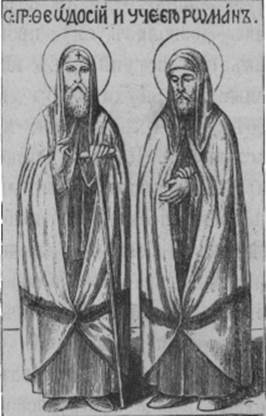
Возвратясь в обитель, Феодосий продолжал подвижническую жизнь, отделяя и ночь на молитву. Преподобный наставник дозволил ему проводить безмолвную жизнь в келье. Так он вступил в высший подвиг борения с духами и помыслами. Духи злобы наносили ему много тревог: но он побеждал их твердою молитвою. Случилась и еще нужда монастырская. По поручению наставника Феодосий снова был у царя Александра и выполнил поручение к утешению старца. Во время последнего пребывания в Тернове один из благородных и богатых людей явился к нему с неотступною просьбою взять его с собою в пустыню. Иначе, говорил он, лишусь жизни. – Это был Роман, впоследствии самый искренний и самый любимый ученик Феодосия. Феодосий взял его теперь с собою и привел к Синаиту. Принятый Григорием, Роман волею аввы послан был на послушания. В его отсутствие скончался преподобный Григорий. – Братия усильно просили Феодосия принять на себя звание настоятеля, но он отказался и удалился из обители293.
Returning to the monastery, Theodosius continued his ascetic life, also setting aside the night for prayer. The venerable guide allowed him to lead a life of silence in his cell. Thus he entered into the higher struggle against spirits and thoughts. The spirits of malice brought him much disturbance: but he conquered them with steadfast prayer. There arose yet another need of the monastery. By order of his guide, Theodosius again went to Tsar Alexander and fulfilled the commission to the consolation of the elder. During this last stay in Tarnovo, one of the noble and wealthy men came to him with an insistent request to take him with him into the wilderness. Otherwise, he said, I will lose my life. — This was Romanus, who later became the most sincere and most beloved disciple of Theodosius. Theodosius now took him with him and brought him to the Sinaite. Received by Gregory, Romanus was sent by the abba's will to obediences. During his absence, the Venerable Gregory reposed. — The brethren earnestly begged Theodosius to accept the office of abbot, but he refused and withdrew from the monastery293.
Он предпринял теперь долгое странствование по обителям с желанием слушать наставления опытных людей. Так он был в Солуне и в Месемврии. В последнем месте посещал он скит Антония, где тогда «много было постников, один другого предварявших в жизни добродетельной и проводивших жизнь ангельскую». Затем был он в Константинополе и возвратился в Скрытную обитель. Посетив братию Синаита и поклонившись раке его, вместе с Романом пришел на Эмонскую гору, что близ Месемврии, и тут подвизался в посте и молитвах. Но разбойники выгнали его из этого уединения.
He now undertook a long journey through monasteries, desiring to hear the instruction of experienced men. Thus he was in Thessalonica and in Mesembria. In the latter place, he visited the Skete of Anthony, where "there were many ascetics, each outdoing the other in virtuous life and leading an angelic life." Then he was in Constantinople and returned to the Skrytnaya monastery. Having visited the brethren of the Sinaite and venerated his reliquary, together with Romanus he came to the Emon Mountain, near Mesembria, and there struggled in fasting and prayers. But robbers drove him out of this solitude.
Гора, не далекая от Тернова, показалась сколько безопасною от разбойничьих нападений, столько и удобною для уединенной жизни. Феодосий поселился на ней с Романом. Три года прожили они здесь уединенно. Феодосий видит видение: гора его покрыта прекрасными птицами певчими. И вслед за тем стали приходить к нему ревнители пустынной жизни; число их дошло до 50. Это были искренние рабы Божии. Феодосий иеромонах вел такую постническую жизнь, что на нем оставались кожа да кости. Вместе с тем он ревностно занимался переводом Греческих сочинений на Славянский язык294.
A mountain not far from Tarnovo seemed both safe from robber attacks and suitable for a solitary life. Theodosius settled there with Romanus. They lived there in solitude for three years. Theodosius saw a vision: his mountain was covered with beautiful singing birds. And after that, zealots of the desert life began to come to him; their number reached 50. These were sincere servants of God. Theodosius the hieromonk led such an ascetic life that only skin and bones remained on him. At the same time, he zealously occupied himself with translating Greek works into the Slavonic language294.
Начинаются особые подвиги преп. Феодосия. Монах Феодосий приходит из Константинополя и начинает возмущать народ странным учением. Употребляя волхвования, он одобрял поклонение одному дубу, как цельбоносному; дело доходило до того, что пред дубом закалали в жертву овец и ягнят. Этот восстановитель народного суеверия обличен был преподоб. Феодосием и раскаялся в заблуждении.
The special struggles of the Venerable Theodosius begin. A monk named Theodosius came from Constantinople and began to disturb the people with a strange teaching. Using sorcery, he encouraged the worship of a certain oak tree as curative; matters went so far that sheep and lambs were sacrificed before the oak. This restorer of popular superstition was rebuked by the Venerable Theodosius and repented of his error.
Опаснее были богомилы, еще скрывавшиеся там и здесь и тайною проповедию распространявшие разврат в народе. В Солуне одна монахиня, увлеченная богомильством, обратила келью свою в блудилище. Посещавшие ее иноки перенесли ее учение на Афон, и там тайно развращали иноков. Так длилось три года, – пока Афонские старцы, составив собор, предали анафеме упорных. Двое из осужденных, Лазарь и Кирилл, пришли в Болгарию. Первый из них надел на себя личину юродивого и под этим прикрытием учил скоплению. Оба же хулили крест и иконы, отвергали брак, одобряли разврат, унижали крестную смерть Христову, хулили иерархию и на место единого Бога проповедали два начала, начало добра и начало зла, сонные мечтания свои выдавали за видения Божественные, и тогда, как вводили самую грязную жизнь, говорили о себе, что они – Божии рабы, нищие духом.
More dangerous were the Bogomils, who were still hiding here and there and spreading depravity among the people through secret preaching. In Thessalonica, a nun, carried away by Bogomilism, turned her cell into a brothel. Monks who visited her carried her teaching to Mount Athos, and there secretly corrupted the monks. This continued for three years—until the Athonite elders, having convened a council, anathematized the obstinate. Two of the condemned, Lazarus and Cyril, came to Bulgaria. The first of them put on the guise of a Fool-for-Christ and under this cover taught self-castration. Both blasphemed the Cross and icons, rejected marriage, approved of debauchery, disparaged the death of Christ on the Cross, blasphemed the hierarchy, and in place of the one God preached two principles, the principle of good and the principle of evil, passed off their sleepy fantasies as Divine visions, and while introducing the filthiest life, spoke of themselves as being God's servants, poor in spirit.
Преподобный Феодосий, собрав точные сведения о них, доложил о них царю и патриарху. «Иже тогда Церкви предстательствующий патриарх, прост сый, недоумевашеся отвсюду». Феодосий вызвался доказать нечестие новых учителей пред собором. Царь Александр любил просвещение столько же, сколько и истинное христианское благочестие295. – По воле его составился собор, где был и царь с своим советом. Приведены были сеятели лжи. «Что это у вас за новое учение?» спросил Феодосий. «Учение наше не новое», отвечали те, – «оно – то самое, которое выражено в словах: блаженны нищие духом; не делайте брашно гибнущее». – «Апостол Христов», отвечал в обличение Феодосий, «говорил о себе: руце мои послужисте мне и сущим со мною. Он трудился, а не бродил праздно, как вы, сеятели разврата. Напрасно выставляете вы из себя чтителей смирения: в вас вовсе нет смирения. Кто дал вам право быть учителями? Брак честен и ложе не скверно, учит Апостол, и Спаситель был на брачном пире. Только дух злобы может учить, как вы учите: выполняйте, говорите вы, стремления природы. На что же нам дана свобода, если не для того, чтобы дух побеждал нечистые движения плоти? Вы допускаете начало добра, и начало зла, одно небесное, другое земное. Но Господь велел признавать Бога Отцом неба и земли, Творцом и Промыслителем вседействующим». Учители нечестия стояли безмолвные. Лазарь пришел в сознание и принес раскаяние. Но Кирилл и ученик его Стефан остались упорными в своем нечестии. Царь велел заклеймить их раскаленным железом и выгнать из Болгарии.
The Venerable Theodosius, having gathered precise information about them, reported them to the Tsar and the Patriarch. "The Patriarch who then presided over the Church, being a simple man, was at a loss from all sides." Theodosius offered to prove the impiety of the new teachers before a council. Tsar Alexander loved enlightenment as much as he did true Christian piety295. – At his will a council was assembled, at which the Tsar and his council were present. The sowers of falsehood were brought in. "What is this new teaching of yours?" asked Theodosius. "Our teaching is not new," they replied, "it is the very one expressed in the words: blessed are the poor in spirit; do not make perishable food." – "The Apostle of Christ," replied Theodosius in refutation, "said of himself: my hands have served me and those with me. He labored, and did not wander idly like you, sowers of debauchery. In vain do you set yourselves up as venerators of humility: there is no humility in you at all. Who gave you the right to be teachers? Marriage is honorable and the marriage bed is not defiled, teaches the Apostle, and the Savior was at a wedding feast. Only the spirit of evil can teach as you teach: fulfill, you say, the urges of nature. For what purpose was freedom given to us, if not so that the spirit might overcome the impure movements of the flesh? You admit a principle of good and a principle of evil, one heavenly, the other earthly. But the Lord commanded us to acknowledge God as the Father of heaven and earth, the Creator and all-acting Provider." The teachers of impiety stood silent. Lazarus came to his senses and repented. But Cyril and his disciple Stephen remained stubborn in their impiety. The Tsar ordered them to be branded with red-hot iron and driven out of Bulgaria.
Открылись и еще лжеучители жидовствующие. Эти отвергали воплощение Сына Божия. Не смотря на явное антихристианство свое, они надеялись найти защиту себе в царице, которая была из Евреев296. Но благочестивый царь своею ревностию к благочестию побудил и царицу стать на стороне благочестия297.
Still other false teachers, the Judaizers, also appeared. These denied the incarnation of the Son of God. Despite their manifest anti-Christianity, they hoped to find protection for themselves in the Tsarina, who was of Jewish origin296. But the pious Tsar, by his zeal for piety, impelled even the Tsarina to take the side of piety297.
Так как с одной стороны еще оставались и проповедники разврата мессалианского, а дерзости жидовствующих, оскорбляя одних, смущали нетвердых в вере, то преп. Феодосий снова явился к царю и настоял на том, чтобы собран был новый собор. Так явились на соборе царь с сыновьями своими Шишманом и Ясенем, патр. Феодосий, митрополиты: Преславский и он же прототроп Дорофей, Дристерский (Силистрийский) Захария, Овча-поля (Праводский) Лазарь, Ловчанский Парфений, Филиппопольский Мануил, Средечский (Софийский) Леонттий, епископ Мадитский Иаков, архимандрит лавры 40 мучеников Иоанникий, несколько иеромонахов из обители Феодосиевой с своим настоятелем. Прочтен был символ веры вселенской, и произнесена анафема как жидовствующим, так и богомилам. Распространителей учений ложных царь сперва осудил па смертную казнь, но потом ограничился телесным наказанием. Один покаялся и принят в общение с Церковию. Два другие остались непреклонными. Соборное деяние записано было на память для потомства. Это было в 1360 г.298.
Since, on the one hand, preachers of Messalian debauchery still remained, and the insolence of the Judaizers, while offending some, troubled those who were unsteady in the faith, the Venerable Theodosius again appeared before the Tsar and insisted that a new council be convened. Thus, at the council appeared the Tsar with his sons Shishman and Yasen, Patriarch Theodosius, Metropolitans: of Preslav and also Protothronos Dorotheus, of Dristra (Silistria) Zacharias, of Ovcha Polya (Pravodsk) Lazarus, of Lovech Parthenius, of Philippopolis Manuel, of Sredets (Sofia) Leontius, Bishop of Madytus James, Archimandrite of the Lavra of the Forty Martyrs Joannicius, and several hieromonks from the monastery of Theodosius with their abbot. The Symbol of Faith of the Ecumenical Church was read, and an anathema was pronounced against both the Judaizers and the Bogomils. The Tsar first condemned the disseminators of false teachings to death, but later limited the punishment to corporal punishment. One repented and was received into communion with the Church. The other two remained unyielding. The conciliar act was recorded for the memory of posterity. This was in the year 1360298.
Когда Турки подняли войну, царь, не желая отпустить от себя Феодосия, устроил для него в безопасном месте пещеру – с кельями, где и поселился он с братьями.
When the Turks began a war, the Tsar, not wishing to let Theodosius go from him, arranged a cave with cells for him in a safe place, where he settled with the brethren.
Вскоре затем преподобный сделался больным и болел 20 месяцев. В этой болезни желал он видеться с преп. Каллистом, как с духовным другом. Каллист писал в Болгарию о том, чтобы отпустили Феодосия к нему. – Но на это не изъявили желания в Тырнове. Преподобный, передав управление братиею Роману, тайно удалился в Царьград и здесь скоро скончался в Мамантовой обители.
Soon after this the Venerable One fell ill and was sick for 20 months. In this illness he desired to see the Venerable Callistus, as a spiritual friend. Callistus wrote to Bulgaria that they should let Theodosius go to him. – But in Tarnovo they did not express a wish for this. The Venerable One, having entrusted the governance of the brethren to Romanus, secretly withdrew to Constantinople and there soon reposed in the Monastery of St. Mamas.
«Следует, прибавляет патриарх, сказать и о помянутом ученике Романе. Он был муж добродетельный, и по примеру наставника ревностный исполнитель заповедей Господних. Приняв обитель в свое попечение, усердно поучал братию. Потому часто приходили к нему и окрестные за наставлениями о постническом житии. Он раз в день вкушал пищу и то очень мало. Его томила болезнь тяжкая – кашель. – Но он никогда не опускал бдения и проводил ночи без сна, засыпая только утром». Скончался он февраля 17 дня.
"It is fitting," adds the Patriarch, "to speak also of the aforementioned disciple Romanus. He was a virtuous man, and, following the example of his teacher, a zealous fulfiller of the Lord's commandments. Having taken the monastery into his care, he diligently taught the brethren. Therefore, those from the surrounding area often came to him for instruction on the ascetic life. He partook of food once a day, and that very little. He was tormented by a grievous illness – a cough. – But he never missed the vigil and spent the nights without sleep, falling asleep only in the morning." He reposed on the 17th day of February.
Патриарх в описании жизни Феодосиевой не объясняет, почему в Тернове не согласились отпустить Феодосия в Царьград. Но дело объясняется грамотою преп. Каллиста, писанною «к почтенным инокам, пребывающим в Тернове», или, как сказано в Славянском переводе, «честнейшим в священноиноцех Феодосию и Роману и прочим священникам Тернова». В этой грамоте преп. Каллист осуждает Терновскую Церковь за то, что не поминает она в молитвах Константинопольского патриарха и что будто не по праву Терновский архипастырь называется патриархом299. Так как Терновское патриаршество учреждено было по согласию Константинопольского собора300, то, естественно, в Тернове были недовольны грамотою Каллиста и потому не были довольны желанием Феодосия посетить Царьград. Так прел. Феодосий приблизился к смерти скорбию, в 1362 г.
The Patriarch, in his description of the life of Theodosius, does not explain why they did not agree in Tarnovo to let Theodosius go to Constantinople. But the matter is explained by a letter of the Venerable Callistus, written "to the venerable monks dwelling in Tarnovo," or, as it is said in the Slavonic translation, "to the most honorable among the hieromonks, Theodosius and Romanus, and the other priests of Tarnovo." In this letter, the Venerable Callistus condemns the Church of Tarnovo for not commemorating the Patriarch of Constantinople in its prayers and for the fact that the archpastor of Tarnovo is called Patriarch, as if not by right299. Since the Patriarchate of Tarnovo was established by the agreement of the Council of Constantinople300, it was natural that in Tarnovo they were displeased with the letter of Callistus and therefore were not pleased with Theodosius's desire to visit Constantinople. Thus the Venerable Theodosius approached his death in sorrow, in the year 1362.
Служба преп. Феодосию написана была иеромонахом Серапионом, скорбевшим о том, что тогда, как Константинополь отдал честь подвигам преподобного, Болгарская страна не чтила своего подвижника301.
The service to the Venerable Theodosius was written by the hieromonk Serapion, who grieved that, while Constantinople had honored the struggles of the Venerable One, the Bulgarian land did not honor its own ascetic301.
Святой Апостол Филипп, проповедуя Евангелие в областях Малой Азии, пришел в Лидию и Мизию. Здесь присоединился к нему святой Апостол Варфоломей, и с этих пор, сопровождаемые сестрою Филиппа, девицею Мариамою, давшею обет девства и последовавшею за братом, они вместе продолжали свой Апостольский труд во славу Божию и во спасение людей, и вместе переносили все тяготы и скорби, «быв биеми, и в темняцах затворяеми, и камением побиваеми». Таким образом прошли они все Лидийские и Мизийские города, охраняемые Господом во время проповедования слова Его; на пути имели утешение встретиться с Иоанном Богословом, с ним вместе отправились во Фригию и прибыли для проповедования Евангелия в г. Иераполь. Здесь, «едва прибыли они, – рассказывает о них, на основании древних преданий, церковный историк Никифор Каллист Ксанфопул, – тотчас прекратилось служение идолам»; «боготворимая жителями Иераполя ехидна изгнана была из своего обыкновенного жилища»; «чтившие ее покрылись стыдом и досадою».
The holy Apostle Philip, preaching the Gospel in the regions of Asia Minor, came to Lydia and Mysia. Here the holy Apostle Bartholomew joined him, and from that time, accompanied by Philip's sister, the virgin Mariamne, who had taken a vow of virginity and followed her brother, they together continued their Apostolic labor for the glory of God and the salvation of men, and together endured all hardships and sorrows, "being beaten, and cast into prisons, and stoned." Thus they passed through all the Lydian and Mysian cities, protected by the Lord during the preaching of His word; on the way they had the consolation of meeting John the Theologian, and together with him they set out for Phrygia and arrived to preach the Gospel in the city of Hierapolis. Here, "as soon as they arrived," relates the church historian Nicephorus Callistus Xanthopoulos, concerning them on the basis of ancient traditions, "the service to idols immediately ceased"; "the viper worshipped by the inhabitants of Hierapolis was driven out of its usual dwelling"; "those who venerated it were covered with shame and vexation."
Здесь святой Апостол Иоанн расстался с ними, отойдя для благовествования в другие города. Оставшиеся же в Иераполе Фригийском святой Апостол Филипп с святым Апостолом Варфоломеем и Мариамою день и ночь неустанно проповедовали слово Божие здешним жителям.
Here the holy Apostle John parted from them, departing to proclaim the good news in other cities. Those remaining in Phrygian Hierapolis – the holy Apostle Philip with the holy Apostle Bartholomew and Mariamne – preached the word of God to the local inhabitants day and night without ceasing.
Когда же святой Апостол Филипп был распят головою вниз на кресте и среди молитв скончался, то сестра его Мариама с любовию обняла снятое со креста тело его, радуясь неземною радостию о святом брате своем, чудным подвигом завершившем преданную Христу жизнь свою...
When the holy Apostle Philip was crucified head-downwards on a cross and reposed amidst prayers, his sister Mariamne lovingly embraced his body taken down from the cross, rejoicing with unearthly joy for her holy brother, who had completed his life devoted to Christ by a wondrous feat...
По смерти святого Филиппа святая Мариама отправилась в Ликаонию ιι там, среди успешного благовествования, мирно упокоилась от трудов своих.
After the death of the holy Philip, the holy Mariamne set out for Lycaonia and there, amidst successful evangelization, peacefully rested from her labors.
Феодора Молчаливого Печерского, удостоившегося дара чудотворений, действующего и поныне в помощь с верою поклоняющимся св. мощам его, почивающим в Феодосиевых пещерах в Киеве.
Theodore the Silent of the Kiev Caves, who was vouchsafed the gift of wonderworking, acting even now to help those who venerate his holy relics with faith, which repose in the Theodosian Caves in Kiev.
«Житие пр. Феодосия, описанное тт. Каллистом», нап. в чт. общ. ист. 1860 г. кн. I. Описание богатое цветами красноречия, но не бедное и известиями о былом. Это описание по местам передаем в буквальном переводе, а чаще в извлечении.
"The Life of the Venerable Theodosius, described by Callistus," printed in the Readings of the Society of History, 1860, Book I. A description rich in flowers of eloquence, but not poor in accounts of the past. This description is given here in places in literal translation, and more often in extract.
Сочинения пр. Григория Синаита показаны у Медведева в оглавлении книг, § 52. Синодальной библиот. № 172. Жизнь пр. Григория, описанная тем же п. Каллистом, нап. в Афонском патерике 1, 348–376. Сл. заметки поклонника св. горы стр. 142, 143.
The works of the Venerable Gregory of Sinai are shown in Medvedev's table of contents of books, § 52. Synodal Library, No. 172. The life of the Venerable Gregory, described by the same Callistus, is printed in the Patericon of Mount Athos 1, 348–376. Cf. Notes of a Pilgrim of the Holy Mountain, pp. 142, 143.
Об этом конечно дана была грамота монастырю. Но ныне неизвестна она. Известен только хризовул ц. Александра Зографскому монастырю 1342 г. о даровании монастырю с. Хонтака близ Струмницы. Изв. ак. 11, 313.
Concerning this, a charter was of course given to the monastery. But it is now unknown. Only the chrysobull of Tsar Alexander to the Zographou Monastery of 1342 is known, concerning the granting to the monastery of the village of Chontak near Strumitsa. Izv. Ak. 11, 313.
Красноречивый жизнеописатель как в житии Феодосия, так и в житии пр. Григория, не показал, в каком году скончался пр. Григорий. Это – жаль. Серапион в записке своей о пр. Феодосии (чт. общ. ист. 1860 г.) говорит, что Каллист, соученик Феодосия, по смерти Григория «взят бысть в Сербии на архиерейство». В Афонском патерике (1403) сказано, что Каллист подвизался в Афонском скиту Могула, под руководством пр. Григория Синаита, и в 1350 г. поставлен в патриарха, а в 1368 г., быв послом к Сербской кралеве Елисавете, скончался в Ферах.
The eloquent hagiographer, both in the life of Theodosius and in the life of the Venerable Gregory, did not show in what year the Venerable Gregory reposed. This is a pity. Serapion, in his note on the Venerable Theodosius (Readings of the Society of History, 1860), says that Callistus, a fellow disciple of Theodosius, after the death of Gregory "was taken in Serbia for the episcopate." In the Patericon of Mount Athos (1403) it is said that Callistus struggled in the Athonite Skete of Mogula, under the guidance of the Venerable Gregory of Sinai, and in 1350 was appointed Patriarch, and in 1368, having been an envoy to the Serbian Queen Elizabeth, reposed in Pherae.
Более, чем вероятно, что сочинения Григория Синаита переведены были на Славянский язык этим трудолюбивым переводчиком. Пр. Нил Сорский уже читал в Славянском переводе Синаита.
It is more than probable that the works of Gregory of Sinai were translated into the Slavonic language by this industrious translator. The Venerable Nilus of Sora already read the Sinaite in Slavonic translation.
«Повелением господина моего благородного и христолюбивого – царе прекрасного Иоанна Александра в лето теченно 6853 (1347)», писал летописец Манассии. – См. Черткова о летописи Манассии стр. 4–7. М. 1842.
"By the command of my lord, the noble and Christ-loving – the beautiful Tsar John Alexander, in the year 6853 (1347)," wrote the chronicler Manasses. – See Chertkov on the Chronicle of Manasses, pp. 4–7. M. 1842.
Ц. Александр был дважды женат. От первой жены Феодоры, в иночестве Феофании, имел он сыновей Страшимира и Михаила. Потом, увлеченный красотою жидовки, окрестил ее и сочетался с нею браком. От этого супружества были сыновья Шишман и Ясень. Бывшую жидовку обвиняли (Раича ист. 1, 488–490), будто его отравлен пасынок Михаил и будто из опасения за жизнь Страшимира Страшимир послан был в Виддин с правами полномочного правителя. Но так ли все это было? В Болгарском синодике читаем: «Феодоре, благочестивой царице велик. ц. Иоанна Александра, сющеи от рода Еврейска, восприемши св. крещение и благочестивую верю делю сохранши и церквы мнозы объновлыши и монастыря различна воздвигшеи, матери сющи вел. ц. Иоанна Шишмана, вечная память». Временник м. общ, ист. Кн. 23, стр. 13.
Tsar Alexander was twice married. By his first wife, Theodora, who in monasticism was Theophania, he had sons Strashimir and Michael. Afterwards, captivated by the beauty of a Jewess, he baptized her and entered into marriage with her. From this union were born sons Shishman and Yasen. The former Jewess was accused (Raić, History 1, 488–490) of having poisoned her stepson Michael, and of having sent Strashimir to Vidin with the rights of a plenipotentiary ruler out of fear for his life. But was all this truly so? In the Bulgarian Synodikon we read: "To Theodora, the pious Tsaritsa of the Great Tsar John Alexander, who was of the Jewish race, who received holy Baptism and preserved the pious faith, and renewed many churches and raised up various monasteries, being the mother of the Great Tsar John Shishman, eternal memory." Vremennik of the Imperial Society of Russian History and Antiquities, Book 23, p. 13.
Лука новокрещенный «благороднейшаго – Авраама Асана Ходжаиса», писавший Ватопедский октатевх с сведениями о Греческих переводах библии и разорениях Иудеи (у поклонника горы стр. 99. 100) едва лит не из Тернова, как и Авраам Асаи, и едва ли оба не из Евреев, родственников Еврейки Феодоры.
Luke the newly-baptized, "of the most noble Abraham Asan Khojais," who wrote the Vatopedi Octateuch with information about the Greek translations of the Bible and the destructions of Judea (in The Pilgrim of Mount Athos, pp. 99, 100), was hardly from Tarnovo, as was Abraham Asan, and hardly were both not from among the Jews, relatives of the Jewess Theodora.
Когда Болгарские павликиане-богомилы обратились в папистов? Вероятно, Иоанн Ясень тем только и отблагодарил п. Иннокентия за присланный царский венец, что предоставил ксензам обращать богомилов в поклонников папы. По крайней мере несомненно то, что нынешние паписты в Болгарии не иначе и называются как павликианами и живут именно там, где поселил Цимисхий павликиан, около Филиппополя, Григоровича путеш. 166, 167, 177. Русск. бес. 1860 г. 11, 16.
When did the Bulgarian Paulicians-Bogomils turn to the Papists? Probably, John Yasen only thereby thanked Pope Innocent for the royal crown sent to him, by granting the Latin priests the right to convert the Bogomils into worshippers of the Pope. At least it is certain that the present-day Papists in Bulgaria are called nothing other than Paulicians, and live precisely where Tzimiskes settled the Paulicians, near Philippopolis (Grigorovich, Travels, pp. 166, 167, 177; Russkaya Beseda, 1860, Book 11, p. 16).