Преподобный Мартиниан с 18-ти-летнего возраста подвизался в окрестностях Кесарии Палестинской. Блудница, хотевшая соблазнить праведника, уцеломудрилась его терпением и незлобием и, под именем Зои, скончалась монахиней в Вифлееме. Мартиниан же, задумав искать более уединенного места, пошел к морю и нашел корабельщика, который свез его на скалу среди моря и обещал доставлять ему пищу (хлеб и воду – раза два или три в год) и финиковые ветви; «а я, сказал Мартиниан, буду тебе за это плесть разные изделия и молиться за тебя Богу». Шесть лет прожил он на каменной скале, но вот однажды из разбитого в море корабля спаслась на обломке девушка и, приплыв к скале, умоляла принять ее. Преподобный сказал: «нельзя нам жить вместе; оставайся тут; вот хлеб и вода, а чрез два месяца приедет сюда корабельщик». Потом перекрестил море, бросился со скалы и, благополучно достигши берега, возблагодарил Господа. И, вспомнивши слова Евангельские: когда будут гнать вас в одном городе, бегите в другой (Мф.10:23), он странствовал два года по разным местам и дошел до Афин, где и скончался в 422 году. Девица же, оставленная им на скале, водворилась там и спасалась шесть лет, знаемая только корабельщиком и его женою. Когда же они при одном посещении нашли ее уже мертвою, то положили тело ее в лодку и привезли в Кесарию, где епископ торжественно похоронил его. Память св. Фотинии, так называлась девица, совершается в один день с преп. Мартинианом.
The Venerable Martinian from the age of eighteen struggled in asceticism in the environs of Caesarea in Palestine. A harlot who wished to tempt the righteous man was made chaste by his patience and meekness and, under the name Zoe, reposed as a nun in Bethlehem. Martinian, however, thinking to seek a more solitary place, went to the sea and found a boatman who conveyed him to a rock in the midst of the sea and promised to bring him food (bread and water – two or three times a year) and date branches; “and I,” said Martinian, “will weave various articles for you in return and pray to God for you.” He lived for six years on the rocky crag, but then one day a maiden, saved from a shipwreck at sea on a plank, swam to the rock and implored him to receive her. The Venerable One said: “We cannot live together; remain here; here is bread and water, and in two months the boatman will come.” Then he made the sign of the cross over the sea, cast himself from the rock, and having safely reached the shore, gave thanks to the Lord. And, remembering the words of the Gospel: when they persecute you in one city, flee to another (Mt. 10:23), he journeyed for two years through various places and came to Athens, where he reposed in the year 422. The maiden whom he left on the rock settled there and was saved for six years, known only to the boatman and his wife. When, upon one visit, they found her already dead, they placed her body in the boat and brought it to Caesarea, where the bishop solemnly buried it. The memory of St. Photina – for so the maiden was called – is celebrated on the same day as the Venerable Martinian.
Младший между братьями своими, успел он сперва (с 1149 г.) стать жупаном Рашским; потом (с 1165 г.) присоединил к своему владению наследственную собственность предков своих – Зету – и стал великим жупаном Сербии. Наконец мало-помалу соединились под власть его все те земли, где только жили Сербы: «возстановил он, говорит сын его св. Савва, погибшую дедину, приобрел от поморской земли Зету с городами, от Албании оба Пилота, от Греческой земли Патково, Хвостно, все Подримье, Костричь, Дружковину, Ситницу, Лабь, Липляны, Глубочицу, Реку, Ушну, Помравие, Загралатну, Левче, Белицу. Все это из погибшей от насилия дедины приобрел он своим умом и деятельностию»247. Сперва был он, как и отец его, в некоторой зависимости от Греческого императора248, но потом оставался полновластным владетелем всей Сербии и назывался «господином всех Срьбских земель»249, тогда как Paca (нынешний Новый Базар) считалась «стольным местом посреди Сербской земли»250.
The youngest among his brothers, he succeeded first (from 1149) in becoming Župan of Raška; then (from 1165) he annexed to his domain the hereditary property of his ancestors – Zeta – and became the Grand Župan of Serbia. Finally, little by little, all those lands where Serbs dwelt were united under his authority: “he restored,” says his son St. Sava, “the lost patrimony, acquired from the maritime land Zeta with its cities, from Albania both Pilots, from the Greek land Patkovo, Hvostno, all Podrimlje, Kostrič, Družkovina, Sitnica, Lab, Lipljan, Glubočica, Reka, Ušna, Pomoravlje, Zagrlatna, Levče, Belica. All this from the patrimony lost through violence he acquired by his wisdom and activity”247. At first he was, like his father, in a certain dependence on the Greek emperor248, but later he remained the sovereign ruler of all Serbia and was called “lord of all Serbian lands”249, while Raša (present-day Novi Pazar) was considered “the capital city in the midst of the Serbian land”250.
В судьбе Немани и Сербии особенно ясно видно то, как много значит чистая вера для политического быта народов. – Сам Сербский народ доселе помнит свою историю только со времени Немани251, хотя жупания Славянская и южные горцы сражались с Римлянами за свою политическую свободу еще прежде времени христианского252. – Отчего это так? С 1062 г. большая часть Сербии по церковному быту состояла в зависимости от Римского папы253. – Неманя увидел, что романизм чем далее, тем более становится враждебным и чистой вере и свободному развитию народа. И он уже в 5 летах зрелых (30 лет) решился прервать всякую связь с папизмом. В младенчестве своем, рожденный в Зете, он был крещен Латинским священником254. В 1143 г. он торжественно снова принял крещение от рук православного Расского епископа Леонтия255. – Это решило судьбу его и Сербии. Без этого шага Немани достигнуть бы могущества жупана всей Сербии, но и не уцелеть бы и в своей маленькой области Расции. Ему пришлось воевать со всеми удельными жупанами Сербии. Дело доходило до того, что Неманя заключен был в подземную пещеру своими братьями256. Но Сербский народ стал на сторону православного Немани. Он любил свободу мыслей и не мог не тяготиться гнетом романизма; вера чистая, вера восточная, была по душе его; приняв ее на своем языке во время Кирилла и Мефодия257, он свято хранил ее, не взирая на противодействие романизма. Потому охотно переходил он на сторону Немани, когда тог начинал борьбу с тем или другим врагом своим. Блаж. Стефан в подвигах за чистую веру не оставляем был без помощи небесной. Когда братья привели против него (в 1175 г.) Немцев, Греков, Венгерцев: он, находясь вблизи Звечанского храма св. Георгия, послал добрых священников молиться св. Георгию. Совершены были нощное бдение и литургия. – Ночью один из священников видит пред собою воина. Кто ты? спросил он в испуге. – «Я раб Христов Георгий, отвечал явившийся, и послан на помощь к государю твоему». – И Стефан одержал неожиданную победу258. – Неманя довел дела до того, что и братья его, долго действовавшие в видах романизма, отказались от папы и прервали всякое сношение с ним. Папа и гневался и льстил: но это не помогло делам его259. Так блажен. Неманя, вытесняя романизм из Сербии, возвышал себя и народ свой260.
In the fate of Nemanja and Serbia it is especially clearly seen how much pure faith means for the political life of peoples. – The Serbian people themselves remember their history only from the time of Nemanja251, although the Slavic županate and the southern highlanders fought with the Romans for their political freedom even before Christian times252. – Why is this so? From 1062, the greater part of Serbia, in its ecclesiastical order, was dependent on the Roman pope253. – Nemanja saw that Romanism was becoming ever more hostile both to pure faith and to the free development of the people. And he, already in his mature years (at age 30), resolved to break every tie with papism. In his infancy, born in Zeta, he had been baptized by a Latin priest254. In 1143 he solemnly received baptism anew from the hands of the Orthodox Bishop of Raška, Leontius255. – This decided his fate and that of Serbia. Without this step, Nemanja might have attained the power of a župan of all Serbia, but he would not have survived even in his small region of Raška. He had to war with all the appanage župans of Serbia. Matters reached such a point that Nemanja was imprisoned in an underground cave by his own brothers256. But the Serbian people took the side of the Orthodox Nemanja. They loved freedom of thought and could not but be burdened by the yoke of Romanism; the pure faith, the Eastern faith, was after their heart; having received it in their own language in the time of Cyril and Methodius257, they kept it sacredly, despite the opposition of Romanism. Therefore they willingly went over to Nemanja’s side when he began a struggle with one or another of his enemies. The blessed Stephen was not left without heavenly help in his labors for the pure faith. When his brothers brought against him (in 1175) Germans, Greeks, and Hungarians: he, being near the Zvečan church of St. George, sent good priests to pray to St. George. An All-night Vigil and Divine Liturgy were celebrated. – At night one of the priests saw a warrior before him. “Who are you?” he asked in fright. – “I am the servant of Christ, George,” answered the one who appeared, “and I am sent to help your sovereign.” – And Stephen gained an unexpected victory258. – Nemanja brought matters to such a point that even his brothers, who had long acted in the interests of Romanism, renounced the pope and broke off all relations with him. The pope both raged and flattered: but this did not help his cause259. Thus the blessed Nemanja, driving out Romanism from Serbia, exalted himself and his people260.
Еще с большею настойчивостию он действовал против арианства, которое крылось в Сербии со времен Средечского и Сремского соборов. Неманя собрал собор. Явились и жаркие защитники арианства. Но Неманя с твердостию объявил, что он не намерен терпеть хулителей Сына Божия. «После собеседования с святителем Евфимием, с почтенными иноками и своими вельможами он, ни маю не медля, отправил войско с доверенными начальниками и одних подверг разным наказаниям, других выгнал вон из земли своей, а дома и имущества их отобрал для бедных и больных; главному учителю и начальнику их был отрезан язык, не исповедающий Христа Сыном Божиим, и потом тои с его нечестивыми книгами прогнан был»261.
With even greater persistence he acted against Arianism, which had lurked in Serbia since the time of the Councils of Sredets and Srem. Nemanja convened a council. Ardent defenders of Arianism also appeared. But Nemanja firmly declared that he did not intend to tolerate blasphemers of the Son of God. “After conferring with Hierarch Euthymius, with the venerable monks and his nobles, he, without any delay, sent an army with trusted commanders and subjected some to various punishments, drove others out of his land, and took their houses and property for the poor and sick; the chief teacher and leader of them had his tongue cut out, which did not confess Christ as the Son of God, and then he, together with his impious books, was driven out”261.
Бан Боснийский Кулин, по нерасположению к романизму, покровительствовал богомилам262. Но это не избавило Боснии от романизма и усилило расстройство Боснии пагубными началами манихейства263. – Блаженный Неманя, признавая богомилов за антихристиан, не терпел их, гнал их из Сербии, и они в конце XII столетия скрывались только в ущельях Боснии и на границах Кроатии264.
The Ban of Bosnia, Kulin, out of disinclination toward Romanism, patronized the Bogomils262. But this did not deliver Bosnia from Romanism and increased Bosnia’s disorder through the pernicious principles of Manichaeism263. – The blessed Nemanja, recognizing the Bogomils as anti-Christians, did not tolerate them, drove them out of Serbia, and they, at the end of the 12th century, hid only in the gorges of Bosnia and on the borders of Croatia264.
В горных ущельях, в местах глухих, в начале правления Немани в народе еще сохранялись остатки языческих суеверий. Неманя истреблял «глухи кумири» или, как выражается Дометиан, «бесовские храмы»265.
In mountain gorges, in remote places, at the beginning of Nemanja’s rule, remnants of pagan superstitions still survived among the people. Nemanja destroyed “the deaf idols” or, as Domentijan expresses it, “demonic temples”265.
Следствием таких распоряжений было то, что единством св. веры скреплялось единство державы Неманевой, и живительная сила чистого христианства вливала жизнь, порядок и крепость в политическое тело Сербии.
The consequence of such measures was that the unity of the holy faith strengthened the unity of Nemanja’s dominion, and the life-giving power of pure Christianity poured life, order, and strength into the political body of Serbia.
При такой политике успел он возвратить Сербии коренные Славянские поселения, занятые Греками, и возвысить народность Сербскую266. Это стоило ему долгой борьбы: Греки под видом покровительства чистой вере не только долго не хотели отказаться от чужой собственности, но противодействовали Немане и тогда, как домогался он соседние племена Славян соединить под одну Славянскую власть267.
With such a policy he succeeded in restoring to Serbia the original Slavic settlements occupied by the Greeks and in elevating the Serbian nationality266. This cost him a long struggle: the Greeks, under the guise of protecting the pure faith, not only long refused to give up another’s property, but also opposed Nemanja even when he sought to unite neighboring Slavic tribes under a single Slavic authority267.
Всею душою любя св. веру, блаженный Неманя усердно строил рассадники христианской жизни – монастыри. Так основаны и щедро одарены им монастыри Студеница268, Сопочаны269. Монастырь Юрьевых столбов был и памятником благодарности его за спасение из пещерной темницы270. Блаженный властитель Сербии простирал заботы свои и на приходское духовенство. По известию св. Саввы, он строго подтверждал стране своей о духовенстве сельском: «начетки даита ему от своих плод праведных»271.
Loving the holy faith with all his soul, the blessed Nemanja zealously built nurseries of Christian life – monasteries. Thus the monasteries of Studenica268 and Sopoćani269 were founded and richly endowed by him. The Monastery of George’s Pillars was also a monument of his gratitude for his deliverance from the cave prison270. The blessed ruler of Serbia extended his care also to the parish clergy. According to the account of St. Sava, he strictly enjoined upon his country concerning the rural clergy: “give them a portion from your righteous fruits”271.
Когда великий жупан был уже 80 лет, сын его св. Савва писал к отцу: «движимый Апостольским духом, ты просветил людей своих православием, истребил ереси, ниспроверг бесовские храмы и воздвиг церкви Богу. Теперь остается тебе исполнить слова Сына Божия, глаголющего в Евангелии: иже хощет по Мне ити, да отвержется себе и возмет крест свой и по Мне грядет». – Собрав вельмож и выбранных народа, он объявил желание свое оставить мир и назначил преемником своей власти сына Стефана. – Напрасно упрашивали его не разлучаться с ними. – Марта 25-го 1195 г. совершена была литургия епископом Каллиником; великий Неманя сложил с себя и передал сыну права властителя Сербии272. Затем тот же епископ в обители Студеницкой облек его и благочестивую супругу его Анну в иноческие одежды, назвав одного Симеоном, а другую Анастасиею273. – В то же время роздана была щедрая милостыня бедным, больным, иночествующим. Анастасия удалилась в женскую обитель; Симеон остался в Студенице. Здесь подвизался он иночески два года. Потом отправился к сыну на Афон274. Посетив вместе с Саввою все святогорские монастыри, насладившись беседою с отшельниками и оделив всех милостынею, Симеон поселился в кельях, построенных сыном в Ватопеде. Они вместе проходили подвиги, помогая один другому: сын удвоял пост и поклоны за себя и за старца; отец проливал слезы и вздохи за себя и сына. Симеон и на Афоне изливал щедрость свою для обителей молитвы. При входе на Афон, на месте называемом просфора, был монастырь с храмом Симеона Богоприимца; морские разбойники разорили его и он оставался в запустении. Щедростию Симеона построены были келии, ограда и башня, насаждены виноградники и возобновлен храм. Ватопед также украсился многими келиями для отшельников275. Благочестивый старец Славянин подал мысль князьям инокам – построить новый или возобновить какой-нибудь запустевший монастырь, с тем, чтобы приходящие на Афон Сербы находили себе готовый приют иночества. Старец Симеон с восторгом принял эту мысль и поручил сыну исполнить ее. Ни одно место столько не понравилось им, как запустевший Хиландарский монастырь. Ватопедским Грекам не хотелось выпустить из рук своих ни власти, ни земли. Савва обратился к проту всей горы и тот предоставил им Хиландарь. По просьбе отца сын, жупан Стефан, прислал деньги на возобновление обители и покупку участков земли; с любовию назначил и в Сербии имения в пользу Сербского Хиландаря276. Быстро возобновился Хиландарь и наполнился иноками – Славянами277. Император Алексей, родственник дома Неманей, даровал Хиландарю права независимой обители278. В хризовуле своем Симеон писал: «вышел я из отчизны в святую гору и застал Хиландарь таким, что не оставалось камня на камне; Владыка мой удостоил меня быть ктитором его; выпросил я грамоту у царя; даю ему в Призрене монастырь, в Милиях села Милушу, Сламодравы, Ретивлу» и пр.279.
When the Great Župan was already 80 years old, his son St. Sava wrote to his father: “Moved by the Apostolic spirit, you have enlightened your people with Orthodoxy, destroyed heresies, overthrown demonic temples, and raised up churches to God. Now it remains for you to fulfill the words of the Son of God, who says in the Gospel: If any man will come after Me, let him deny himself, and take up his cross, and follow Me.” – Having gathered the nobles and chosen men of the people, he declared his desire to leave the world and appointed his son Stephen as successor to his authority. – In vain they begged him not to part from them. – On March 25th, 1195 A.D., the Divine Liturgy was celebrated by Bishop Callinicus; the Great Nemanja laid down and transferred to his son the rights of the ruler of Serbia272. Then the same bishop, in the monastery of Studenica, clothed him and his pious wife Anna in monastic garments, naming him Simeon and her Anastasia273. – At the same time, generous alms were distributed to the poor, the sick, and monastics. Anastasia withdrew to a women’s monastery; Simeon remained in Studenica. Here he asceticised as a monk for two years. Then he set out to his son on Mount Athos274. Having visited together with Sava all the monasteries of the Holy Mountain, having enjoyed conversation with the hermits, and having bestowed alms upon all, Simeon settled in the cells built by his son at Vatopedi. Together they pursued ascetic labors, helping one another: the son doubled his fasting and prostrations for himself and for the elder; the father poured forth tears and sighs for himself and his son. Simeon also on Athos poured out his generosity for the monasteries of prayer. At the entrance to Athos, at a place called Prosphora, there was a monastery with a church of Simeon the God-Receiver; sea pirates had destroyed it, and it lay in desolation. Through Simeon’s generosity, cells, a wall, and a tower were built, vineyards were planted, and the church was restored. Vatopedi was also adorned with many cells for hermits275. The pious Slavic elder gave the thought to the prince-monks – to build a new monastery or restore some desolate one, so that Serbs coming to Athos might find a ready monastic refuge. Elder Simeon received this thought with delight and entrusted his son to carry it out. No place pleased them so much as the desolate Hilandar Monastery. The Greek monks of Vatopedi did not wish to let go of either authority or land. Sava turned to the Protos of the whole Mountain, and he granted them Hilandar. At the father’s request, the son, Župan Stephen, sent money for the restoration of the monastery and the purchase of land parcels; with love he also assigned estates in Serbia for the benefit of the Serbian Hilandar276. Hilandar was quickly restored and filled with Slavic monks277. The Emperor Alexios, a relative of the Nemanjić house, granted Hilandar the rights of an independent monastery278. In his chrysobull, Simeon wrote: “I went out from my fatherland to the Holy Mountain and found Hilandar such that not one stone was left upon another; my Lord deemed me worthy to be its ktetor; I obtained a charter from the emperor; I give to it in Prizren a monastery, in Milija the villages of Miluša, Slamodrava, Retivla,” etc.279.
Недолго глубокий старец прожил в Хиландаре, только 8 месяцев280. Чувствуя близость кончины, сделал он последние распоряжения, просил сына молиться за него, перенесть тело его в Сербию и не забывать Сербской Церкви. Накануне дня смерти простился со всею братиею и отпустил всех кроме сына. – В полночь, при всей слабости, встал, радостно облекся в полное иноческое одеяние, как бы ожидая великих гостей, и, причастившись святых Таин, сказал: «слава Богу о всем», затем впал в забытье. Поутру сын вынес отца в церковный притвор и положил на простой рогожке. Братия окружили благодетеля и рыдали. Преподобный, с трудом поднявши руку, дал знать, чтобы успокоились, и, веселым лицом взирая на образ Спасителя и Богоматери, шептал, как бы беседуя с кем: «всякое дыхание да хвалит Господа». Хвала Господу была последним словом его. Вдруг воздух наполнился благоуханием, – это была минута смерти. Так мирно почил старец 86 лет, февраля 13-го 1200 г.281.
The venerable elder did not live long in Hilandar, only 8 months280. Feeling the nearness of his end, he made his final arrangements, asked his son to pray for him, to transfer his body to Serbia, and not to forget the Serbian Church. On the eve of the day of his death, he took leave of all the brethren and dismissed all except his son. – At midnight, despite all his weakness, he arose, joyfully clothed himself in the full monastic habit, as if expecting great guests, and, having partaken of the Holy Mysteries, said: “Glory to God for all things,” then fell into oblivion. In the morning, his son carried his father out into the church narthex and laid him on a simple mat. The brethren surrounded their benefactor and wept. The Venerable One, with difficulty raising his hand, gave a sign that they should be calm, and, gazing with a cheerful face at the image of the Savior and the Mother of God, whispered, as if conversing with someone: “Let every breath praise the Lord.” Praise to the Lord was his last word. Suddenly the air was filled with fragrance – this was the moment of death. Thus peacefully the elder reposed at 86 years of age, on February 13th, 1200 A.D.281.
Спустя год, в день поминовения о нем, мраморный гроб его наполнился благоуханным миром. В изумлении и страхе все воскликнули: Господи, помилуй! потом все помазались миром. Страдавшие болезнями, одержимые духами, получили исцеление, быв помазаны миром. Перенесенное в Студеницкий монастырь, св. тело Симеона также источало токи живительного мира. Потому Симеон не иначе называется в памятниках древности, как «св. Симеон Неманя нови мироточьц Српьски»282. Даже оставленный в Хиландаре мраморный гроб святого известен поныне целениями своими283.
A year later, on the day of his commemoration, his marble coffin was filled with fragrant myrrh. In amazement and fear, all cried out: Lord, have mercy! Then all anointed themselves with the myrrh. Those suffering from illnesses, those possessed by spirits, received healing, having been anointed with the myrrh. Transferred to the Studenica Monastery, the holy body of Simeon also poured forth streams of life-giving myrrh. Therefore Simeon is called in the monuments of antiquity nothing other than “St. Simeon Nemanja, the new myrrh-streamer of Serbia”282. Even the marble coffin of the saint left in Hilandar is known to this day for its healings283.
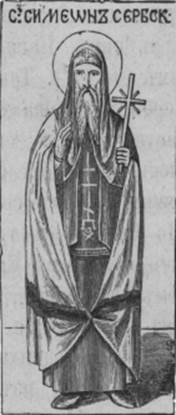
На древних иконах Сербских святой изображен с большою седою бородою, в монашеской одежде, с черною остроконечною скуфьею, украшенною тремя золотыми крестами284.
On ancient Serbian icons, the saint is depicted with a large gray beard, in monastic garb, with a black pointed skufia adorned with three golden crosses284.
Св. Евлогия, архиепископа Александрийского, жившего в конце VI и в начале VII в. – Письма к нему св. Григория Двоеслова свидетельствуют об успешной деятельности этого просвещенного пастыря в борьбе с различными ересями и сектами Антиохийскими.
St. Eulogius, Archbishop of Alexandria, who lived at the end of the 6th and the beginning of the 7th century. – The letters to him from St. Gregory the Dialogist testify to the successful activity of this enlightened pastor in the struggle with various heresies and sects of Antioch.
Житие св. Симеона Немани, описанное сыном Стефаном Первовенчанным, и другое описание св. Саввы: «о житии господина Симеона, како бысть пред Богом и человеки», изданы у Шафарика: Pamatky drevniho pisemnistwi, Прага 1851. В Дометиановом описании жития св. Саввы также довольно говорится о св. Симеоне.
The Life of St. Simeon Nemanja, written by his son Stephen the First-Crowned, and another account by St. Sava: “On the Life of the Lord Simeon, How He Was Before God and Men,” were published by Šafárik: Památky dřevního písemnictví, Prague 1851. In Domentijan’s account of the Life of St. Sava, much is also said about St. Simeon.
Шафарика памятники. Сам Симеон в хризовуле Хиландарю: «воздвиг я погибшую дедину свою и приобрел от Поморья Зету с городами, от Албанцев Пилоть, от Греков земли Лабь с Лепланом, Глубочицу, Реку, Загралату, Левчье, Белицу, Лепеницу». Григоровича путеш. 40. Сербляк (л. 124) показывает, что от Греков отобрано было 30 городов при императоре Андронике Комнене, след. в 1183–1185 г. Андроник хотел сокрушить молодое Сербское государство: но жестоко ошибся.
Šafárik’s Památky. Simeon himself in the chrysobull to Hilandar: “I raised up my ruined patrimony and acquired from the Coastland Zeta with its towns, from the Albanians Pilot, from the Greeks the lands of Lab with Leplan, Glubočica, Reka, Zagralata, Levčje, Belica, Lepenica.” Grigorovich’s Travels, p. 40. The Serbljak (fol. 124) shows that 30 towns were taken from the Greeks under the Emperor Andronikos Komnenos, consequently in 1183–1185 A.D. Andronikos wished to crush the young Serbian state, but he was cruelly mistaken.
Эта зависимость, по условиям начальным, была почти только номинальною. Theoph. contin. р. 291 ed. Bon. Мануил Комнен, предоставивший Немане звание великого жупана, велел написать на картине возведение Немани в жупана: он надеялся увидеть в Немане безответного вассала; но – ошибся. Евстафий Солунский в похвальном слове Мануилу не опускает этого деяния Мануилова, по как Грек прибавляет: «одно не одобряется в живописце, что везде украшает он раба трофеями, но не называет Неманю рабом».–Tafel de Thessalonica р. 419. 515.
This dependence, according to the initial conditions, was almost only nominal. Theoph. Contin. p. 291 ed. Bonn. Manuel Komnenos, who granted Nemanja the title of Great Župan, ordered to be painted on a picture the elevation of Nemanja to the županate: he hoped to see in Nemanja a submissive vassal; but – he was mistaken. Eustathius of Thessalonica, in his eulogy to Manuel, does not omit this deed of Manuel’s, but as a Greek adds: “One thing is not approved in the painter, that everywhere he adorns the slave with trophies, but does not call Nemanja a slave.” – Tafel de Thessalonica pp. 419, 515.
Сербская летопись, найденная Гильфердингом в ркп. XV века, начинает историю Сербии с Немани именно потому, что «когда угасла первая проповедь в Сербской земле и различные ереси умножились в ней на много лет, начальствующие ни мало не заботились об истреблении еретических плевелов до того времени, когда явился великий жупан Неманя». Русск. бес. 1860 г. 11, 19.
The Serbian Chronicle, found by Hilferding in a 15th-century manuscript, begins the history of Serbia with Nemanja precisely because “when the first preaching in the Serbian land was extinguished and various heresies multiplied in it for many years, the rulers took no care at all for the eradication of the heretical tares until the time when the Great Župan Nemanja appeared.” Russkaya Beseda 1860, II, 19.
Главный пастырь Сербской Церкви был архиепископ Антиварийский, получавший паллиум из Рима, и ему подчинены были епископии Сербии и Албании: Которское, Свачское, Скодринское, Дивотское, Пиглотское (Пулати сев. Албании), Сербское, Боснийское, Требинское. Булла п. Александра 1062 г. Антиварийскому архиепископу – у Фарлати (t. VII ed. Coletti) и Яффе (Regesta pontificum rornan.). Такие отношения Сербии начались с Сербского князя Михаила Воиславича, подчинившего Сербию папе около 1050 г. Со времени императора Василия Сербская церковь находилась в ведении Константинопольского патриарха. – О Греческих кафедрах см. «Рус. Св.» января 12-го пр. 20. О Ядринской Славянской метрополии, Босанском епископе Феодоре и Белоградском епископе Феодосии 1055 г. см. Гласник X, 195. 204.
The chief pastor of the Serbian Church was the Archbishop of Antivari, who received the pallium from Rome, and to him were subject the bishoprics of Serbia and Albania: Kotor, Svač, Skadar, Divot, Pilot (Pulati in northern Albania), Serbia, Bosnia, Trebinje. The bull of Pope Alexander in 1062 A.D. to the Archbishop of Antivari – in Farlati (t. VII ed. Coletti) and Jaffé (Regesta pontificum Romanorum). Such relations of Serbia began with the Serbian Prince Michael Vojislavljević, who subjected Serbia to the pope around 1050 A.D. From the time of Emperor Basil, the Serbian Church was under the jurisdiction of the Patriarch of Constantinople. – On the Greek sees, see “Russian Saints” January 12, note 20. On the Jadrin Slavic metropolis, the Bosnian Bishop Theodore and the Belograd Bishop Theodosius in 1055 A.D., see Glasnik X, 195, 204.
A Latinis haereticis baptizatus est, говорит летопись. Arkiv za povestn. Jugosi. III, 7. 8. 1854. Стефан в житии отца: «у храму сущим в земли тои и Латинским иереомо – сподобисе и Латинское приети крещение».
A Latinis haereticis baptizatus est, says the chronicle. Arkiv za povjesničku jugoslavensku III, 7, 8. 1854. Stephen in the Life of his father: “In the churches that were in that land and with Latin priests – he was deemed worthy to receive even Latinbaptism.”
Гильфердинг в Русс. бес. 1860 г. стр. 17.1858 г. III, 67. Цароставник у Раича 2, 329. Летоп. в Гласнике I, 164. Летоп. у Шафарика в памятн. стр. 54. Arkiv za povestn. III, 7. Св. Савва: «собою прьвее благоверие показа, потом же и ннех настави... друго крещение приемшу ему» Стефан.
Hilferding in Russkaya Beseda 1860, p. 17. 1858, III, 67. Tsarostavnik in Raič 2, 329. Chronicle in Glasnik I, 164. Chronicle in Šafárik’s Památky, p. 54. Arkiv za povestnicu III, 7. St. Sava: “He first showed orthodoxy in himself, then instructed others... having received a second baptism.” Stephen.
Еще и ныне указывают в мон. Юрьевых столбов пещеру, где заключен был Неманя. Русс. бес. 1858 г. III, 68. Летоп. в Гласнике У, 26, 27.
Even now they point out in the monastery of George’s Pillars the cave where Nemanja was imprisoned. Russkaya Beseda 1858, III, 68. Chronicle in Glasnik V, 26, 27.
В 1181 г. п. Александр присылал к Мирославу, князю Захолмскому, брату Немани, грамоту, где грозил Мирославу отказом в благословении за то, что тот не принял легата его, и всячески убеждал слушаться папы (Theiner monum. Slavorum meridion. Romae 1863 p. 1).
In 1181 A.D., Pope Alexander sent to Miroslav, Prince of Zahumlje, brother of Nemanja, a letter in which he threatened Miroslav with denial of blessing because he had not received his legate, and urged him in every way to obey the pope (Theiner, Monumenta Slavorum meridionalium, Romae 1863, p. 1).
Романизм властолюбивый был вытеснен. Но терпели Латинскую службу. Только подвергали наказанию «Латинского попа», который православного перевернул бы «у веру Латинску». Если «полуверец»– папист возьмет за себя православную: то должен принять православие. Иначе отбирается у него жена с детьми и ее имением. Еретик же в подобном случае, если не принимает православия, выгоняется из Сербии. Закон. Душана, зак. 7–10.
Ambitious Romanism was driven out. But Latin services were tolerated. Only they subjected to punishment “a Latin priest” who would convert an Orthodox “into the Latin faith.” If a “half-believer” – a papist – takes an Orthodox woman for himself, he must accept Orthodoxy. Otherwise, his wife with children and her property are taken from him. A heretic in a similar case, if he does not accept Orthodoxy, is expelled from Serbia. Dušan’s Code, laws 7–10.
Вулк, сын Немани, в 1199 г. писал к п. Иннокентию: haeresis immodica in terra Rungariae, videlicet in Boisina, pullulare videtur, in tantum, quod ipse Ban Culinus cum uxore sua, quae soror fuit defuncti Miroslavi Chelmensis, et cum pluribus consanguineis suis seductus, plus quam decem miilia Christianorum in eandem haeresim introduxit (Feier 2, 372). Отзыв Вулка не заслуживает полного доверия, потому что он увлекался тогда романизмом и для видов тщеславия поносил честь даже тетки своей, жены ненавистного папе Мирослава (пр. 258). Вероятнее всего, что Кулин, по примеру Мирослава, не допускал подданных своих быть подданными папе. Но несомненно и то, что Кулин терпел богомилов. – Assemani Calend. Υ, 30. 50. Monumenta Slavorum p. 12.
Vulk, son of Nemanja, wrote in 1199 to Pope Innocent: haeresis immodica in terra Rungariae, videlicet in Boisina, pullulare videtur, in tantum, quod ipse Ban Culinus cum uxore sua, quae soror fuit defuncti Miroslavi Chelmensis, et cum pluribus consanguineis suis seductus, plus quam decem miilia Christianorum in eandem haeresim introduxit (Feier 2, 372). Vulk’s account does not deserve full trust, because he was then carried away by Romanism and, for motives of vainglory, reviled even the honor of his own aunt, the wife of the hated-by-the-pope Miroslav (see §258). It is most probable that Kulin, following the example of Miroslav, did not permit his subjects to be subjects of the pope. But it is also undoubted that Kulin tolerated the Bogomils. – Assemani Calend. V, 30. 50. Monumenta Slavorum p. 12.
Ныне магометанство сильно в Боснии, как и папизм. Первыми магометанами были то остававшиеся богомилы, то обращенные из богомилов паписты. Русск. бес. 1860 г. 11, 16. Харьк. Вест. 1863 г. стр. 327–330.
Today Mohammedanism is strong in Bosnia, as is Papism. The first Mohammedans were either those who remained Bogomils, or Papists converted from the Bogomils. Russk. Bes. 1860, 11, 16. Khark. Vest. 1863, pp. 327–330.
В письме Конрада епископа Портуенского 1223 г. говорится, что «начальник Албигенсов, которого называют они папою, живет в оконечностях Болгарии, Хорватии и Кроации, около Венгерского народа». Gieseler Kircheng. 2. 615. По письму кор. Премысла (1260 г.) к папе в войске Венгерского короля Белы были «Болгары и Босняцкие еретики» – богомилы.
In a letter of Conrad, Bishop of Porto, from 1223, it is said that “the chief of the Albigenses, whom they call their pope, lives in the extremities of Bulgaria, Croatia and Croatia, near the Hungarian people.” Gieseler Kircheng. 2. 615. According to a letter of King Přemysl (1260) to the pope, in the army of the Hungarian King Béla there were “Bulgarians and Bosnian heretics” – Bogomils.
«Живот св. Симеона од кор. Стефана». Завонник Душана еще преследует волшебство, выкапывавшее и сожигавшее мертвые тела, и участвовавших в том священников. Зак. 43.
“The Life of St. Simeon by King Stephen.” Dušan’s Code of Laws still persecutes sorcery, which dug up and burned dead bodies, and the priests who participated in it. Law 43.
Стефан: «истовую дедину свою, населену бывшу от рода Грьчьскаго и созидави гради унеи (отнял) от рукь ихь, яко (не) проглаголет се Грьчьская область... Прочее же грады испроверже –Грьчьское име истребивь, да не именуеть се име ихь отнюдь в области тои, а люди свое, еже в вих, невредимо сьхрани». – Выше: «приложи к земли отьчьствия своего область Нишьвьскую до конца, Липлянь же и Мораву и глаголемы Врани, Призреяску область и Полога оба до коньца». – Последние места некоторое время принадлежали Болгарским князьям, и коренные обыватели их – Славяне. Неманя разрушил Греческие крепости и потом построил новые, чтобы Греки не имели более предлога говорить: это – ваши города.
Stephen: “He took his true patrimony, which had been inhabited by the Greek race, and built cities, (taking them) from their hands, so that (no longer) shall the Greek dominion speak there... The remaining cities he overthrew – destroying the Greek name, so that their name should never be mentioned in that region, and he preserved his own people, who were in them, unharmed.” – Above: “He added to the land of his fatherland the region of Niš completely, also Lipljan and Morava and the so-called Vranje, the region of Prizren and both Pologs to the end.” – The latter places belonged for some time to the Bulgarian princes, and their native inhabitants were Slavs. Nemanja destroyed the Greek fortresses and afterwards built new ones, so that the Greeks would no longer have the pretext to say: these are your cities.
Вильгельм Тирский о 1167 г. говорит: «император находился тогда в Сербии. Страна та гористая и покрытая лесами, расположена между Далматиею, Венгриею и Иллириком. Восставшие Сербы полагались на ущелья недоступные и. местности неудобопроходимые... За обиды нетерпимые для соседей государь вступил в их землю. Мы встретились с возвращавшимся императором, когда он покорил их». – По этому описанию, Неманя хотел покорить себе Кроатию: но интриги Римского духовенства, уже тогда сильного в Кроатии, вызвали оружие императора против Сербии и завистливые Греки не допускали Неманю достигнуть дели полезной и для чистой веры и для народности Славянской. Киннам хвастливо описывает эту победу Греков над Сербами (стр. 318–320. Спб. 1860 г.).
William of Tyre, speaking of the year 1167, says: “The emperor was then in Serbia. That country is mountainous and covered with forests, situated between Dalmatia, Hungary and Illyricum. The rebellious Serbs relied on inaccessible gorges and impassable terrain... For intolerable offenses against their neighbors, the sovereign entered their land. We met the emperor returning when he had subdued them.” – According to this description, Nemanja wished to subdue Croatia; but the intrigues of the Roman clergy, already strong in Croatia, drew the emperor’s arms against Serbia, and the envious Greeks did not allow Nemanja to attain a goal beneficial both for the pure faith and for the Slavic nationality. Cinnamus boastfully describes this victory of the Greeks over the Serbs (pp. 318–320. St. Petersburg, 1860).
Саввино житие св. Симеона: «Последи же техь ти (Студеницкий) пашь светы монастырь сьзда, его же и нарече в име Владычиде... създавь от мала и до велика, и села предав и с инеми правдами монастырю иконы и съсуды чьстными и книгы и ризы и завесы и яже суть писаеа в злопечатнеи повелеи его, паче же и в церкви написано на стене и с клетвою и с заузою, яко да никто не повторить егова предания»,– Поздний список грамоты Студенице – у Шафарика: Serbische Lesekömer. S. 121.
From the Life of St. Simeon by St. Sava: “Afterwards he built that bright monastery of yours (Studenica), which he named in the name of the Lady... building it from small to great, and he gave villages and with other rights to the monastery, icons and precious vessels and books and vestments and veils, and what is written in his sealed charter, and moreover also written in the church on the wall, with an oath and a curse, that no one should annul his donation.” – A later copy of the charter of Studenica is in Šafárik: Serbische Lesekömer. S. 121.
Помянник Сопочанского монастыря: «помени, Господи, ктитора нашего Симеова мироточца Срьбскаго и Анастасию монахию». Зап. Геогр. Общ. XIII, 150.
The Diptych of the Sopoćani Monastery: “Remember, O Lord, our ktetor Simeon the Myrrh-streamer of Serbia, and Anastasia the nun.” Zap. Geogr. Obshch. XIII, 150.
Св. Савва в житии: «сам же сьзда монастыре. И прьво у Топлицы св. отьца Николы. И другы таможде свету Богородицу у Топлицы. Потомжде сьзда монастирь св. Георгия в Расе. И вьсем тем монастыремь створи управу, яко же подобаеть». Стефан говорит то же, но пространнее. О мон. св. Николая пишет: «близь св. Богородице на усти реке Баньке, ходещу же оному босу... и чрьньчское правило устави у немь». О Георгиевском: «всякое детелию украсивь и изещне сь всякими делы црьковвыми и устави чрьяьчске вравило». В храме Юрьевых столбов дело древнее иизображение святаго, с надписью: «свет Симеон Неманя и хтиторь места сего святаго». Зап. геогр. общ. XIII, 140. По синаксарю Сербляка (л. 124) Неманею построены еще храмы: Богоматери в Топлице, св. Николая на Баньской реке, архистр. Михаила в Скопии, св. Пантелеимова в Нише. Сл. Раича 2, 332. 533.
St. Sava in the Life: “He himself built monasteries. And first at Toplica, of the holy father Nicholas. And another there, of the holy Theotokos at Toplica. Afterwards he built the monastery of St. George at Ras. And to all these monasteries he gave order, as is fitting.” Stephen says the same, but more fully. Of the monastery of St. Nicholas he writes: “Near the holy Theotokos at the mouth of the Banjska River, while he walked barefoot... and he established the monastic rule in it.” Of the St. George monastery: “He adorned it with every virtue and elegantly with every kind of church work, and established the monastic rule.” In the church of the St. George Pillars there is an ancient depiction of the saint, with the inscription: “St. Simeon Nemanja and ktetor of this holy place.” Zap. Geogr. Obshch. XIII, 140. According to the Synaxarion of the Serbljak (fol. 124), Nemanja also built churches: of the Theotokos in Toplica, of St. Nicholas on the Banjska River, of the Archistrategos Michael in Skopje, of St. Panteleimon in Niš. Cf. Raič 2, 332. 533.
По законнику Душана видно, что в Сербии были священники «башинницы» и «небашинницы»– своеземельные и безземельные; последние обрабатывали для себя «три ниве законите» – церковные. Властелин-помещик обязывался содержать священника: иначе тот имел право переходить на другое место. – Священники собирали в приходе произведения земли, что называлось «поповска земльна бирь». Часть этого сбора шла епископу. Душана зак. 6. 28. 31. 32. 38.
According to Dušan’s Code, it is evident that in Serbia there were priests “baštinnitsi” and “nebaštinnitsi” – those with land and those without land; the latter cultivated for themselves “three lawful fields” – church lands. A lord-landowner was obliged to support the priest; otherwise the priest had the right to move to another place. – The priests collected the produce of the land in the parish, which was called “the priest’s land-tax.” Part of this collection went to the bishop. Dušan’s Code 6. 28. 31. 32. 38.
Сам Симеон в хризовуле Хиландарской обители: «вънезапну оставих владычьство мое,–оставих на престоле моего лубвиваго ми сына Стефана, велнего жупава и севастократора, зетя кир Алексея царя». Григоровича пут. 40. Грамота изд. Миклошичем: Monumenta Serbica № IX. Сомнения поклонника Св. горы (стр. 352) – вовсе напрасны. Никон. л. 2, 280: «господствова лет 42».
Simeon himself in the chrysobull of the Hilandar Monastery: “Suddenly I left my lordship – I left on the throne my beloved son Stephen, the Grand Župan and Sebastocrator, son-in-law of the Lord Alexis the Emperor.” Grigorovich’s Travels, p. 40. The charter published by Miklosich: Monumenta Serbica No. IX. The doubts of the Pilgrim of the Holy Mountain (p. 352) are entirely groundless. Nikon. Chron. 2, 280: “He ruled for 42 years.”
Так называется супруга его в помянниках Сербских. Изв. акад. VIII, 156. Раичь 2, 327. В Никон. лет. 2, 280: «сему супружница бе Авва, подобна ему во велких добродетелех, священники и иноки и странные повсегда милуяше».
Thus is his spouse named in the Serbian diptychs. Izv. Akad. VIII, 156. Raič 2, 327. In the Nikon. Chron. 2, 280: “His wife was Avva, like him in great virtues, ever showing mercy to priests, monks and strangers.”
Барский пишет: «св. Савва Сербский купно с отцем свом Симеоном создаша в мон. Ватопеде параклисов шесть: 1 во имя Спасителя, 2 св. бессребренников, 3 св. Георгия, 4 св. Феодора, 5 св. Предтечи, 6 св. Николая; и быша новые ктиторы и празднуются тамо от иноков 12 генваря». Путешествие стр. 660.
Barsky writes: “St. Sava of Serbia together with his father St. Simeon built in the Vatopedi monastery six chapels: 1 in the name of the Savior, 2 of the holy Unmercenaries, 3 of St. George, 4 of St. Theodore, 5 of the holy Forerunner, 6 of St. Nicholas; and they became new ktetors and are commemorated there by the monks on 12 January.” Travels, p. 660.
Хризовул Симеона: «нзидох из отечества своего в Св. гору и обретох монастырь, бывший Хиландарь, иде же не бе камень на камени остал, и сподоби мене Владыка мои быти ему ктитору, – дадох монастырю у Милиях села». Летопись: «купивше многою ценою место Ватопедское, зовомое Хилавдар, – населиша Сербских своих иноков». Гласник V, 33.
The chrysobull of Simeon: “I went out from my fatherland to the Holy Mountain and found the monastery that had been Hilandar, where not one stone was left upon another, and my Lord deemed me worthy to be its ktetor – I gave to the monastery villages at Milije.” The Chronicle: “Having bought for a great price the Vatopedi place called Hilandar, they settled there their Serbian monks.” Glasnik V, 33.
Драгоценное Хиландарское Евангелие, писанное дьяком Григорием «князю великославному Мирославу, сыну Завидину» (у поклонника Св. горы стр. 309), без сомнения писано для племянника св. Немани. Завида, брат Немани, известен как строитель храма Апостолов на р. Лиме (Раича 2, 33). Мирослав сын Завиды не упоминается у Раича: но Раичь часто повторяет, что у него недостает многих сведений. – Очень естественно, что племянник подарил Евангелие туда, где подвизался дядя. Месяцеслов Мирославова Евангелия (у поклонника стр. 311–315) отличается тем, что имена святых переведены с Латинского языка, а не с Греческого. Так это и в месяцеслове Ассеманова Евангелия XI в. Хиландарский монастырь любили и цари Московские. Калайдовича экзарх стр. 114.
The precious Hilandar Gospel, written by the deacon Gregory “for the most glorious Prince Miroslav, son of Zavida” (in the Pilgrim of the Holy Mountain, p. 309), was without doubt written for the nephew of St. Nemanja. Zavida, brother of Nemanja, is known as the builder of the church of the Apostles on the River Lim (Raič 2, 33). Miroslav, son of Zavida, is not mentioned by Raič; but Raič often repeats that he lacks many details. – It is very natural that the nephew presented the Gospel to the place where his uncle labored. The Menologion of the Miroslav Gospel (in the Pilgrim, pp. 311–315) is distinguished by the fact that the names of the saints are translated from the Latin language, not from the Greek. So it is also in the Menologion of the Assemanian Gospel of the 11th century. The Hilandar Monastery was also beloved by the Tsars of Moscow. Kalaydovich’s Exarch, p. 114.
Император, давший Хиландарю право избирать себе настоятеля независимо от прота, прислал игуменский жезл с надписью своего имени.– Этот жезл цел и поныне в Хиландаре. Письма с востока 1, 230.
The emperor who granted Hilandar the right to elect its own abbot independently of the Protos sent an abbot’s staff with an inscription of his name. – This staff remains intact to this day in Hilandar. Letters from the East 1, 230.
Хиландарский типик св. Саввы: «в место сие (Хиландарь) вьселше – 8 месяц пробывь, к вечному преложисе блаженству», – По известию п. Досифея, Симеон пробыл год в Ватопеде и 8 месяцев в Хиландаре. О патр. Иерус. 2, 814. Но если Неманя принял монашество 80 лет и умер 86 лет (пр. 280): то в Ватопеде прожил он более двух лет. Всего в монашестве прожил пять лет без одного месяца.
The Typikon of Hilandar by St. Sava: “Having dwelt in this place (Hilandar) for 8 months, he passed over to eternal blessedness.” – According to the account of Patriarch Dositheus, Simeon spent a year in Vatopedi and 8 months in Hilandar. On the Patriarch of Jerusalem 2, 814. But if Nemanja received monasticism at 80 years and died at 86 years (see §280): then he lived in Vatopedi for more than two years. In all, he lived in monasticism for five years less one month.
Так по записи в типике св. Саввы. Изв. акад. VII, 206. Св. Савва в житии: «от рождьства же ему 46 лет и ту – приеть владычество и пребысть в владычестве 37 лет. Я ту прие свети ангелскы образ и пожи в том образе 3 лета. И вьсего живота его бысть 87 лет». – Счет не совсем точный. Неманя родился в 1114 г. и скончался 13 февраля 1200 года. Так и по своду летописей.
Thus according to the entry in the Typikon of St. Sava. Izv. Akad. VII, 206. St. Sava in the Life: “From his birth he was 46 years old and then – he received the lordship and remained in lordship for 37 years. And then he received the angelic habit and lived in that habit for 3 years. And his whole life was 87 years.” – The reckoning is not entirely exact. Nemanja was born in 1114 and reposed on 13 February 1200. So also according to the Chronicle Compilation.
Такова надпись на древнем изображении св. Симеона в Юрьевых столпах. Зап. геогр. общ. XIII, 147. В месяцеслове Евангелия 1329 г. февр. 13: «св. Симеона, господина и мироточца Сербские земли». У Григоровича стр. 18. В Норовском синаксаре XIII в. «февр. 13 память пр. о. н. Симеона Сербскаго, новаго мироточца, лежащаго в лавре великое». Зап. акад. VI, 108.
Such is the inscription on the ancient depiction of St. Simeon in the St. George Pillars. Zap. Geogr. Obshch. XIII, 147. In the Menologion of the Gospel of 1329, February 13: “St. Simeon, lord and myrrh-streamer of the Serbian land.” In Grigorovich, p. 18. In the Norov Synaxarion of the 13th century: “February 13, commemoration of our Venerable Father Simeon of Serbia, the new myrrh-streamer, lying in the great Lavra.” Zap. Akad. VI, 108.
Зап. геогр. общ. XIII, 147. В Сербляке 1861 г. картинка представляет пр. Симеона далеко не в том виде. О мощах пр. Симеона летоп. в Гласнике 1, 164. V, 33. 34. XI. 145, и Сербляк 125.
Zap. Geogr. Obshch. XIII, 147. In the Serbljak of 1861, the illustration depicts the Venerable Simeon in a far different form. On the relics of the Venerable Simeon, see the Chronicle in Glasnik 1, 164; V, 33. 34; XI, 145; and the Serbljak, 125.