Святой Парфений, родом из Мелитополя, провинции Геллеспонтской, был сын диакона тамошней церкви, с юного возраста воспитанный в страхе Божием. Ростя ребенком, он ходил на ближнее озеро, ловил рыбу, продавал ее и из этих денег подавал милостыню нищим. Восемнадцати лет он, по воле епископа Мелитопольского, стал изучать книги св. Писания и, как достойный, посвящен во пресвитера. Господь сподобил его и благодати чудотворений. – Кизический митрополит Ахиллий, слышав о добродетельной жизни мужа, поставил его епископом города Лампсака. Это было в царствование Константина Великого, около 325 года. Парфений нашел в городе мало христиан; большинство составляли язычники. Учительною жизнию своею, молитвами и чудесами благодати Божией он привел граждан к познанию истинного Бога и на месте храмов идольских, с соизволения царского и с царским пособием, создал храмы Божии.
St. Parthenius, a native of Melitopolis in the province of the Hellespont, was the son of a deacon of the local church, and from his youth was raised in the fear of God. As a child, he would go to a nearby lake, catch fish, sell them, and from the money thus obtained give alms to the poor. At eighteen years of age, by the will of the Bishop of Melitopolis, he began to study the books of Holy Scripture and, being found worthy, was ordained a presbyter. The Lord also granted him the grace of working miracles. — Achillius, the Metropolitan of Cyzicus, hearing of the virtuous life of this man, appointed him bishop of the city of Lampsacus. This occurred during the reign of Constantine the Great, around the year 325. Parthenius found few Christians in the city; the majority were pagans. By his instructive life, his prayers, and the miracles of God's grace, he led the citizens to the knowledge of the true God, and on the sites of idol temples, with the emperor's permission and assistance, he built churches to God.
Однажды к св. Парфению приведен был бесноватый юноша родителями, которые просили помолиться о исцелении его. Парфений сказал: «ваш сын недостоин исцеления; лукавый дух мучит его, как отцеубийцу, потому что часто он досаждал вам, и вы в горести души молились, чтоб Бог наказал его. Пусть же так страдает; ему полезно наказание». Но они со слезами просили молитв и прощения несчастному юноше. Святитель, преклоненный слезами и неотступными просьбами родителей и милосердовав о них, помолился к Богу о болящем и исцелил его.
Once, a demon-possessed youth was brought to St. Parthenius by his parents, who asked him to pray for his healing. Parthenius said: "Your son is not worthy of healing; the evil spirit torments him as a parricide, because he has often vexed you, and you in the grief of your soul prayed that God would punish him. Let him suffer then; punishment is beneficial to him." But they tearfully begged for prayers and forgiveness for the unfortunate youth. The Hierarch, moved by the tears and persistent entreaties of the parents and having compassion on them, prayed to God for the sick man and healed him.
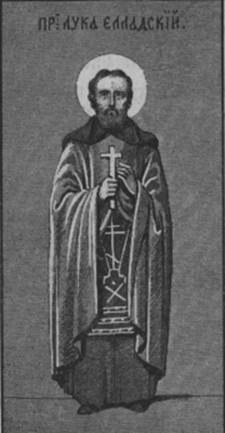
Преподобный Лука, родом из Аттики, села Кастории, сын богатого земледельца, с двадцати лет подвизался сперва в пустынной келлии на приморской горе, где и пострижен двумя иноками, шедшими в Рим на богомолье, а чрез семь лет, по случаю нашествия Болгар (около 908 года), когда вес народ бежал в крепости и на острова, он отплыл в Коринф и, услышав тут об одном столпнике в Патрах, пошел к нему и десять лет служил ему, как сын отцу. После сего возвратился в Елладу и снова поселился на своей горе. Случилось мимо того места проходить митрополиту Коринфокому на пути в Царьград, и расположиться для отдыха недалеко от келлии преподобного. Узнав об этом, Лука пришел поклониться архиерею и принес ему дары от трудов своих – овощей и кореньев. Митрополит пожелал взглянуть на его келью и, увидев ее и садик, дивился пустынному и безмолвному пребыванию. Достойно при сем внимания наставление архипастыря, как самому Луке приобщаться св. Таин без священника, потому что Лука не имел пресвитерского сана. Должно сосуд с преждеосвященными дарами поставить на престол, если приобщение имеет быть в церкви, или на чистый стол, если вне оной; развернувши чистое полотенце, положить на него св. частицы и, возжегши свечу и фимиам, пропеть псалмы изобразительные (то есть 102 и 145), Трисвятое и Верую, сделать три земных поклона и, сложивши руки, устами взять честное Тело Христа и Бога нашего, говоря: аминь; вместо св. Крови пить из сосуда с вином. Значит, еще и в X веке предоставлялось подвижникам хранить св. дары в келлиях и приобщаться их самим, как то было и в первые века.
The Venerable Luke, a native of Attica, from the village of Kastoria, was the son of a wealthy farmer. From the age of twenty he struggled first in a solitary cell on a mountain by the sea, where he was tonsured by two monks who were journeying to Rome on pilgrimage. After seven years, on the occasion of an invasion of the Bulgarians (around the year 908), when all the people fled to fortresses and islands, he sailed to Corinth. Hearing there of a certain Stylite in Patras, he went to him and served him for ten years as a son to his father. After this he returned to Hellas and again settled on his mountain. It happened that the Metropolitan of Corinth was passing by that place on his way to Constantinople and stopped to rest not far from the cell of the Venerable One. Learning of this, Luke came to bow before the hierarch and brought him gifts from his labors—vegetables and roots. The Metropolitan wished to see his cell, and seeing it and the little garden, he marveled at his solitary and silent dwelling. Worthy of note here is the archpastor's instruction on how Luke himself was to commune of the Holy Mysteries without a priest, for Luke did not hold the rank of presbyter. One should place a vessel with the Presanctified Gifts on the altar, if Communion is to take place in a church, or on a clean table, if outside; having spread a clean cloth, place the holy particles upon it, and, having lit a candle and incense, sing the "Typical" psalms (that is, Psalms 102 and 145), the Thrice-Holy Hymn, and the Creed, make three prostrations, and, folding one's hands, take with the lips the precious Body of Christ our God, saying: Amen; in place of the precious Blood, drink from a vessel of wine. This shows that even in the tenth century it was permitted for ascetics to keep the holy Gifts in their cells and to commune themselves, as was the practice in the first centuries.
Последним местом подвигов преподобного была гора Стирий в Елладе, куда собрались к нему братия и устроили монастырь, а воевода Аттики построил церковь во имя св. великомученицы Варвары. Скончался он 7-го февраля 946 года и похоронен в келлии, в которой подвизался. Чрез шесть месяцев некоему монаху Косьме, шедшему из Пафлагонии в Италию, было дано в видении повеление Божие идти на место, где почил, проп. Лика, и пребывать у гроба его. Косьма пришел ко гробу угодника Божия, взял из земли ковчег с нетленными мощами и, поставив верху земли, огородил его решетками, а келлию сделал церковию. Впоследствии, из опасения владевших Аттикою Латинян и Турок, мощи препод. Луки скрыты и теперь находятся под спудом в обители его имени.
The final place of the Venerable One's struggles was Mount Styrion in Hellas, where brethren gathered to him and established a monastery, and the voivode of Attica built a church in the name of the holy Great Martyr Barbara. He reposed on the 7th of February in the year 946 and was buried in the cell in which he had struggled. After six months, a certain monk named Cosmas, journeying from Paphlagonia to Italy, received a command from God in a vision to go to the place where the Venerable Luke had reposed and to remain at his tomb. Cosmas came to the tomb of the man of God, took from the earth the coffin containing his incorrupt relics, placed it above ground, enclosed it with a grating, and made the cell into a church. Later, for fear of the Latins and Turks who held Attica, the relics of the Venerable Luke were hidden and now lie concealed in the monastery that bears his name.
Когда стала известною история дивной Марии Египетской, высокие подвиги равноангельной, дивная надежда ее на Господа, оказавшаяся столь верною и сильною, одушевила не одну деву на подвиги более или менее трудные.
When the story of the wondrous Mary of Egypt became known, the lofty struggles of that angel-like woman, her marvelous hope in the Lord, which proved so true and strong, inspired more than one virgin to undertake struggles of greater or lesser difficulty.
Об одной подвижнице, скончавшейся при жизни св. Кириака, и следовательно прежде 557 года, когда почил св. Кириак, – рассказывает Кирилл в жизни св. Кириака62.
Concerning one ascetic, who reposed during the lifetime of St. Cyriacus, and therefore before the year 557, when St. Cyriacus reposed, Cyril relates in the Life of St. Cyriacus62.
За несколько лет пред сим шли мы с другом, братом Парамоном, к отцу Кириаку. И вот вдали видим стоящего человека. Мы, подумав, что это пустынник, поспешили подойти к нему, чтобы поклониться ему. Когда приблизились к тому месту, тот исчез из глаз наших. Мы испугались при мысли, не злой ли это дух. Стали на молитву и, помолясь, осмотрелись кругом, там и здесь, и нашли пещеру. Конечно, здесь раб Божий, сказали мы, он скрылся от нас сюда. Подойдя к пещере, просили мы, чтобы показался он нам и не лишил нас своих наставлений и благословения. Из пещеры услышали мы ответ: «Какой хотите пользы от женщины, грешной и простой? Куда идете вы?» – «Мы идем к отшельнику Кириаку», сказали мы, «но открой нам Бога ради твое имя, твою жизнь и почему пришла ты сюда?» Она отвечала: «идите куда идете, и когда возвратитесь, скажу вам». Мы с клятвою уверяли ее, что не отойдем, пока не выслушаем о ее жизни. Поняв, что не отойдем от нее, она, не показываясь нам, рассказала о себе так: «Я называюсь Мария, была чтицею псалмов при церкви Воскресения Христова; злой дух уязвлял мною многих. Я пришла в страх, как бы не быть мне виновною в соблазне и как бы не приложить грехов ко грехам моим. Молилась я усердно Богу – избавить меня от напасти. Раз, умилившись душою от страха Божия, пошла я к Силоаму, валила сосуд водою, взяла корзину с мочеными бобами, ночью вышла из святого города и, поручив себя Богу, отошла в пустыню. Бог привел сюда, и здесь живу я уже восемнадцать лет; благодатию Божиею ни вода не истратилась у меня, ни бобы в корзине не убавились. Затем прошу вас, – идите теперь к отцу Кириаку и выполните свою службу; когда же будете возвращаться, посетите меня бедную». Выслушав это, пошли мы к отцу Кириаку, рассказали ему все, что слышали от блаженной Марии. Отец Кириак, подивившись, сказал: «Слава Тебе, Боже наш, у Тебя есть сокровенные святые мужи и жены, тайно служащие Тебе. Идите, дети мои, – прибавил он, – к угоднице Божией, и что скажет вам, сохраняйте». Возвращаясь от отца Кириака, пришли мы к пещере блаженной Марии. «Раба Божия!» говорили мы, «по и твоему приказанию пришли мы к тебе». Но ответа не было. Войдя во вход к пещере, сотворили мы молитву, но ответа опять не было. Тогда вошли мы в самую пещеру и нашли рабу Божию скончавшеюся о Господе. От святого тела ее выходило сильное благоухание. С нами не было ничего, чем одеть ее. Поспешив в обитель, принесли мы все нужное; одев ее, похоронили ее в пещере и завалили устье пещеры камнем.
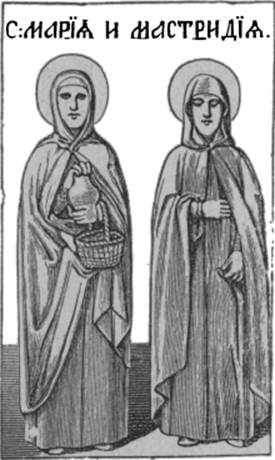
Several years ago, we were walking with a friend, Brother Paramon, to Father Cyriacus. And behold, in the distance we saw a person standing. Thinking it was a hermit, we hastened to approach him in order to bow before him. When we drew near to that place, he vanished from our sight. We were frightened, thinking it might be an evil spirit. We stood for prayer, and having prayed, looked around, here and there, and found a cave. "Surely," we said, "a servant of God is here; he has hidden from us in this place." Approaching the cave, we asked that he would show himself to us and not deprive us of his instructions and blessing. From the cave we heard a reply: "What benefit do you wish to receive from a woman, sinful and simple? Where are you going?" "We are going to the hermit Cyriacus," we said, "but for God's sake, reveal to us your name, your life, and why you came here?" She answered: "Go on your way, and when you return, I will tell you." We assured her with an oath that we would not depart until we had heard about her life. Perceiving that we would not leave her, she, without showing herself to us, told us about herself as follows: "My name is Mary; I was a reader of the Psalms at the Church of the Resurrection of Christ. An evil spirit used me to wound many. I became afraid, lest I be guilty of causing scandal and lest I add sins to my sins. I prayed earnestly to God to deliver me from this calamity. Once, being moved in soul by the fear of God, I went to Siloam, filled a vessel with water, took a basket of soaked beans, and at night went out from the holy city, and, entrusting myself to God, departed into the wilderness. God led me here, and here I have lived for eighteen years; by the grace of God, neither has the water failed me, nor have the beans in the basket diminished. Now I beg you—go now to Father Cyriacus and fulfill your service; when you return, visit me, a poor woman." Having heard this, we went to Father Cyriacus and told him all that we had heard from the blessed Mary. Father Cyriacus, marveling, said: "Glory to Thee, our God, Thou hast hidden holy men and women, who secretly serve Thee. Go, my children," he added, "to the handmaiden of God, and what she tells you, keep." Returning from Father Cyriacus, we came to the cave of the blessed Mary. "Handmaiden of God!" we said, "we have come to you as you commanded." But there was no answer. Entering the entrance of the cave, we said a prayer, but again there was no answer. Then we entered the cave itself and found the handmaiden of God reposed in the Lord. A strong fragrance came forth from her holy body. We had nothing with which to clothe her. Hastening to the monastery, we brought everything necessary; having clothed her, we buried her in the cave and sealed the mouth of the cave with a stone.
О другой Палестинской пустыннице рассказывал великий подвижник Сила, подвизавшийся в Аравийской пещере, в ските Фара. За несколько лет пред сим, говорил он братиям, жил вблизи меня отшельник, которого я очень любил. Было у нас обыкновение – посещать его в великие праздники, приносить ему нужное и получать благословение его. В праздник Пасхи взял я милоть, несколько бобов и несколько хлеба и пошел к старцу по обычаю. По смотрению Божию пришлось мне запутаться в холмах и пустырях; настал дневной зной, я стал изнемогать от жара и труда. И обратился я ко Господу с крепкою молитвою. Изнемогши от жажды и зноя, лежал я без сил и вошел в тонкий сон. Вот подходит ко мне кто-то и говорит: «будь бодр, авва, – ты не заблудился, и труд твой не напрасный». Проснувшись, не видал я никого, но с радостию благодарил Бога; помолился – и вот вижу между холмами следы человека. Я пошел по следам, вижу много хвороста и пещеру; я стал звать: благослови меня, отец; ответа не было. Подошел еще, вижу юного инока, сидящего в молчании. Поклонились мы один другому, и он сказал, чтобы начал я молитву. «Твое это дело, ты пресвитер», говорил он. Я отказывался, желая скрыть себя. «К чему лгать, авва-пресвитер?» сказал он. Мы сели, и я терялся в догадках, жена ли это или евнух? «Ты, авва, смущаешься о мне, жена ли или евнух я», сказал он. Я растерялся от этих слов. «Дай мне слово не говорить о мне никому до смерти, и я скажу тебе о себе», сказал пустынный человек. «Бог знает», отвечал я, «как я желаю знать о подвигах», и дал слово молчать. «Я дочь эпарха Константинопольского», так говорила она; «сенатор обручил меня за своего сына, быв другом отцу моему. Мне никак не хотелось выходить замуж, но не говорила я о том родителям. Утешением для меня было заниматься молитвою, и я молила Господа исполнить тайное желание мое. Раз говорит мне отец: «будь готова к браку, дочь моя, пришло время». «Нельзя мне решиться на то, отвечала я, прежде чем исполню обет». «Какой?» сказал отец. «Обещалась я поклониться святым местам», сказала я. Он шутливо говорит: «когда выйдешь замуж, тогда исполнишь обещание свое – вместе с мужем». «Нет», сказала я решительно, «я обещалась поклониться девою – и это должно быть выполнено; лгать пред Богом не могу, страшно». Родитель уступил. Со мною отпущено множество слуг, служанок, 3000 золотых. На корабле прибыли мы в святой город. Поклонившись святым местам, отправилась я посетить Египетских отцов. Близ великой лавры Египетской видела я трех великих старцев; один из них особенно показался мне Ангелом. По возвращении в святой город надлежало возвращаться в Константинополь. Я приготовила два письма, одно к родителям, другое к младшему брату, который был со мною. В последнем написала я, что не могу я быть в супружестве и посвящаю жизнь свою Господу. Когда выезжали мы уже из города, я сказала брату, что нужно мне побывать в Гефсимании. Оставив письма в одежде моей, с одною служанкою отправилась я в Гефсиманию. Потом, оставив ее здесь, одна поспешила к великому старцу своему. Со слезами просила я его облечь меня в монашество и дать мне книги, какие у него видела. Он исполнил просьбу мою. Пробыв у него день, сказала я ему: теперь благослови меня идти, куда Господь повелит. Со слезами помолившись о мне, дал он мне свои книги и отпустил с миром. Возложив надежды мои на Господа, пришла я в эту пустыню и вот живу в ней уже 28 лет; ты первый, кого я вижу здесь». Когда окончила она рассказ свой, я просил ее покушать со мною пищи, какая была со мною. «Тебе нужно подкрепиться пищею, – ты устал, а у меня есть другая пища», сказала она. Изумительно для меня было то, что, столько лет прожив в пустыне, она не потеряла своей красоты. В пещере ее я не чувствовал жажды, но думал: что-то будет после? Она, отвечая на мысль мою, сказала: «будь покоен, авва, жажда не будет томить тебя, пока не дойдешь до кельи твоей». Прощаясь с ней, просил я ее: «дозволь мне приходить к тебе для советов». Отправившись в путь, я точно не чувствовал жажды. Спустя некоторое время, пошел я к ней, но уже не нашел ее в пещере. За все слава Господу63.
Of another Palestinian female hermit the great ascetic Silas, who struggled in an Arabian cave in the skete of Pharan, used to tell. "A few years before this," he said to the brethren, "a hermit lived near me, whom I loved very much. It was our custom to visit him on the great feasts, to bring him what was needed and to receive his blessing. On the feast of Pascha I took a cloak, some beans and some bread and went to the elder according to custom. By God's providence, I happened to lose my way among the hills and wastes; the daytime heat came on, and I began to grow faint from the heat and the exertion. And I turned to the Lord with fervent prayer. Exhausted by thirst and heat, I lay without strength and fell into a light sleep. Then someone approached me and said: 'Be of good cheer, abba—you are not lost, and your labor is not in vain.' Waking up, I saw no one, but joyfully thanked God; I prayed—and then I saw traces of a man among the hills. I followed the tracks, saw much brushwood and a cave; I began to call out: 'Bless me, father'; there was no answer. I drew nearer and saw a young monk sitting in silence. We bowed to one another, and he said that I should begin the prayer. 'That is your office, you are a presbyter,' he said. I refused, wishing to conceal myself. 'Why lie, abba-presbyter?' he said. We sat down, and I was lost in conjecture: is this a woman or a eunuch? 'You, abba, are troubled about me, whether I am a woman or a eunuch,' he said. I was confounded by these words. 'Give me your word not to speak of me to anyone until my death, and I will tell you about myself,' said the desert dweller. 'God knows,' I replied, 'how much I desire to know about your struggles,' and I gave my word to be silent. 'I am the daughter of the eparch of Constantinople,' she spoke thus; 'a senator betrothed me to his son, being a friend of my father. I had no wish at all to marry, but I did not speak of it to my parents. My consolation was to occupy myself with prayer, and I besought the Lord to fulfill my secret desire. Once my father said to me: "Be ready for marriage, my daughter; the time has come." "I cannot decide upon that," I answered, "before I fulfill a vow." "What vow?" said my father. "I promised to venerate the holy places," I said. He said jestingly: "When you are married, then you will fulfill your promise—together with your husband." "No," I said resolutely, "I promised to venerate them as a virgin—and this must be fulfilled; I cannot lie before God, it is terrible." My parent yielded. Many servants, maidservants, and 3000 gold pieces were sent with me. We arrived by ship at the holy city. Having venerated the holy places, I set out to visit the Egyptian fathers. Near the great Lavra of Egypt I saw three great elders; one of them seemed to me especially like an Angel. Upon returning to the holy city, it was time to go back to Constantinople. I prepared two letters, one to my parents, the other to my younger brother, who was with me. In the latter I wrote that I could not be in marriage and was dedicating my life to the Lord. When we were already leaving the city, I told my brother that I needed to go to Gethsemane. Leaving the letters in my clothing, with only one maidservant I set out for Gethsemane. Then, leaving her there, I hastened alone to my great elder. With tears I begged him to clothe me in monasticism and to give me the books I had seen with him. He fulfilled my request. Having stayed with him a day, I said to him: 'Now bless me to go where the Lord commands.' Having prayed for me with tears, he gave me his books and dismissed me in peace. Placing my hopes on the Lord, I came to this desert and have now lived in it for 28 years; you are the first person I have seen here.' When she finished her account, I asked her to eat some of the food I had with me. 'You need to strengthen yourself with food—you are tired, but I have other food,' she said. It was astonishing to me that, having lived so many years in the desert, she had not lost her beauty. In her cave I did not feel thirst, but I thought: what will happen afterwards? She, answering my thought, said: 'Be at peace, abba; thirst will not torment you until you reach your cell.' Bidding her farewell, I asked her: 'Allow me to come to you for counsel.' Setting out on the way, I indeed felt no thirst. Some time later, I went to her, but no longer found her in the cave. For all things, glory to the Lord63."
Пришли мы, говорит Мосх, к авве Иоанну отшельнику, по прозванию Огненному. Он рассказывал нам, что́ сам слышал от аввы Иоанна Моавитского. «В святом городе (Иерусалиме) была дева, посвятившая себя Богу, весьма благочестивая и усердная (по Прологу, именем Мастридия)65. Диавол, позавидовав деве, зажег в одном молодом человеке сатанинскую любовь к ней. Великая дева, поняв хитрости диавола и видя опасное положение молодого человека, положила в корзину немного размоченных бобов и удалилась в пустыню, дабы чрез то самое как молодого человека избавить от искушения, так и себе самой найти в пустыне безопасность. Прошло не мало времени после того. Дабы высокий подвиг ее не остался в неизвестности, по смотрению Божию, увидал ее один отшельник Иорданской пустыни. «Мать! как ты зашла сюда?» спросили. он ее. Она, желая закрыть свое отшельничество, отвечает отшельнику: «прости меня, я сбилась с пути, сделай милость, ради Бога, отец, укажи мне дорогу». Отшельник, быв извещен о ней свыше, говорит ей: «мать! будь надежна, ты не сбилась с пути; другая дорога не нужна тебе; скажи же откровенно, как ты зашла сюда?» Тогда дева отвечала: «прости меня, авва! Один молодой человек соблазнялся мною. Признав за лучшее быть здесь, нежели служить соблазном, удалилась я в пустыню». Старец продолжал: «давно ли ты здесь?» Она отвечала: «по благодати Христовой семнадцать лет». «Чем же ты питаешься?» спросил старец. Она, вынув корзинку с лежавшими в ней бобами, сказала отшельнику: «вот эта корзинка, которую ты видишь, отправилась со мною из города с этою пищею; но Бог явил надо мною такую милость, что с тех пор доселе питаюсь тем же и пища не убывает. Не забудь, отец, и того, что так прикрыл меня Бог Своею милостию, что 17 лет никто не видал меня, кроме тебя одного, хотя видала я других». Услышав это, отшельник прославил Бога».
"We came," says Moschus, "to Abba John the hermit, surnamed the Fiery. He told us what he himself had heard from Abba John the Moabite. 'In the holy city (Jerusalem) there was a virgin who had dedicated herself to God, very pious and zealous (according to the Prologue, named Mastridia)65. The devil, envying the virgin, kindled in a certain young man a satanic love for her. The great virgin, understanding the devil's wiles and seeing the dangerous state of the young man, put some soaked beans into a basket and withdrew into the desert, so that by this very act she might both deliver the young man from temptation and find safety for herself in the desert. A considerable time passed after that. Lest her lofty struggle remain unknown, by God's providence a certain hermit of the Jordanian desert saw her. 'Mother! How did you come here?' he asked her. She, wishing to conceal her hermitage, answered the hermit: 'Forgive me, I have lost my way; do me the kindness, for God's sake, father, to show me the road.' The hermit, having been divinely informed about her, said to her: 'Mother! Be assured, you have not lost your way; you need no other road; tell me frankly, how did you come here?' Then the virgin answered: 'Forgive me, abba! A certain young man was tempted by me. Deeming it better to be here than to be a cause of temptation, I withdrew into the desert.' The elder continued: 'How long have you been here?' She answered: 'By the grace of Christ, seventeen years.' 'What do you eat?' asked the elder. She, taking out the basket with the beans lying in it, said to the hermit: 'This basket which you see set out with me from the city with this food; but God showed such mercy upon me that from that time until now I have been nourished by the same, and the food does not diminish. Do not forget, father, that God has so covered me with His mercy that for 17 years no one has seen me except you alone, though I have seen others.' Hearing this, the hermit glorified God.'"
В расстоянии около 20 тысяч шагов (40 верст) от Иерусалима, говорит блаженный Иоанн Мосх, есть монастырь так называемый Сапсас. Из этого монастыря двое отцов ходили поклониться на гору Синай. Возвратясь в монастырь, они рассказывали нам следующее: «Поклонившись на святой горе и возвращаясь обратно (так случилось с нами), мы заплутались в пустыне и долго носились по ней, как по морю.
"At a distance of about 20,000 paces (40 versts) from Jerusalem," says the blessed John Moschus, "there is a monastery called Sapsas. Two fathers from this monastery went to venerate Mount Sinai. Returning to the monastery, they told us the following: 'Having venerated the holy mountain and being on our way back (as it happened to us), we lost our way in the desert and wandered about for a long time as if on a sea.
В один день, увидя вдали маленькую пещерку, пошли мы к ней. Приближаясь к пещере, увидали небольшой источник, около него несколько травы и след человеческий; верно, сказали мы себе здесь живет раб Божий. Входя в пещеру, мы никого не видали, только слышали, что кто-то плачет. Осмотрев тщательно, мы нашли что-то в роде яслей и в них кто-то лежит. Подошедши к рабу Божию, мы просили его сказать нам что-нибудь. Но как он ничего не отвечал, мы взяли его. Тело его еще было тепло, но душа отошла ко Господу. Тут узнали мы, что в то самое время, как входили мы в пещеру, раб Божий скончался. Взяв тело его из того места, в котором лежал, вырыли могилу в той же пещере; один из нас скинул мантию, в которой был, и мы стали завертывать в нее тело; тогда нашли, что это была жена; прославили Бога и, совершив над нею правило, похоронили»66.
One day, seeing a small cave in the distance, we went towards it. Approaching the cave, we saw a small spring, near it some grass and a human footprint; surely, we said to ourselves, a servant of God lives here. Entering the cave, we saw no one, but only heard someone weeping. Having searched carefully, we found something like a manger and in it someone lying. Approaching the servant of God, we asked him to say something to us. But as he answered nothing, we took hold of him. His body was still warm, but his soul had departed to the Lord. Then we realized that at the very moment we entered the cave, the servant of God had reposed. Taking his body from the place where he lay, we dug a grave in the same cave; one of us took off the mantle he was wearing, and we began to wrap the body in it; then we found that it was a woman; we glorified God and, having performed the funeral service over her, buried her'"66.
Дабы примеры ревностных подвижниц были более сильны для нас, повторим для себя следующие наставления св. Писания: Те, которые Христовы, распяли плоть со страстями и похотями (Гал.6:24). Носите бремена друг друга и таким образом исполняйте закон Христов (Гал.6:2). Да приступаем с дерзновением к престолу благодати, чтобы получит милость и обрести благодать для благовременной помощи (Евр.4:16).
That the examples of zealous female ascetics may be more powerful for us, let us repeat for ourselves the following instructions of Holy Scripture: Those who are Christ's have crucified the flesh with its passions and desires (Gal. 5:24). Bear one another's burdens and thus fulfill the law of Christ (Gal. 6:2). Let us draw near with boldness to the throne of grace, that we may receive mercy and find grace for timely help (Heb. 4:16).
Кириллово описание жития св. Кириака in act, Sanet. VIII, 147 5 Analecta sacra. Paris. 1692 p. 100–127. В Четь-Минее сент. 29. Рассказ о Марии – в Сборном Патерике под знам. S.
Cyril's description of the life of St. Cyriacus in act. Sanet. VIII, 147 5 Analecta sacra. Paris. 1692 p. 100–127. In the Chetya-Menaea for September 29. The account of Mary is in the Composite Patericon under the sign S.