Двукратное. Одно в 107 году из Рима в Антиохию, тотчас после мученической кончины святителя, и другое в VII в. в Рим после того, как Антиохией овладели магометане. Ныне мощи в Риме, в церкви св. Климента.
Twofold: one in the year 107 from Rome to Antioch, immediately after the martyric death of the Hierarch, and the other in the 7th century to Rome after the Mohammedans had taken possession of Antioch. At present the relics are in Rome, in the church of St. Clement.
Святые черноризцы никак не дозволили ему того, так как видели примеры опасных искушений в Исааке и Никите. «Лаврентий пошёл к игумену св. Димитрия в монастырь Изяславов», который был близ Печерского монастыря321, и там затворился. За крепкое житие его Господь даровал ему благодать исцеления. Однажды привели к нему беснующегося, прося об исцелении. Долго пробыл бесноватый при Лаврентии, но не исцелялся.
The holy monks would by no means permit him to do so, for they had seen examples of dangerous temptations in Isaac and Niketas. "Laurence went to the abbot of St. Demetrius in the Izyaslav monastery," which was near the Monastery of the Caves321, and there shut himself up. For his strict life the Lord granted him the grace of healing. Once they brought to him a possessed man, begging for healing. The possessed man remained long with Laurence, but was not healed.
Лаврентий велел вести его в Печерский монастырь. «К кому ты посылаешь меня?» – говорил бесноватый. «Я не смею приблизиться к пещере для положенных в ней отцов Антония и Феодосия и прочих святых черноризцев, которых имена написаны в книге жизни».
Laurence ordered him to be taken to the Monastery of the Caves. "To whom are you sending me?" said the possessed man. "I dare not approach the cave for the fathers laid therein, Anthony and Theodosius and the other holy monks whose names are written in the book of life."
«А кто таковы в монастыре, которых ты боишься?» – спросили те, которые вели его и знали, что он никогда не бывал в монастыре. В Печерском монастыре было тогда 118 братий.
"And who are those in the monastery whom you fear?" asked those who were leading him and knew that he had never been in the monastery. In the Monastery of the Caves there were at that time 118 brethren.
«Что мне за польза бороться с мертвецами? они же так смело молятся Богу за своих черноризцев. Если хотите испытать мою силу, ведите в монастырь; там я могу бороться со всеми за исключением 30».
"What good is it to me to fight with dead men? They pray so boldly to God for their monks. If you wish to test my strength, lead me to the monastery; there I can fight with all except 30."
И начал он говорить по-Еврейски, по-Латыни, по-Гречески и на других языках. Потом, прежде чем вошли в монастырь, бес оставил больного. Когда спросили: кто исцелил тебя? Он, смотря на икону Богоматери, сказал: «с этой иконой 30 иноков встретили меня, и я исцелел»322
And he began to speak in Hebrew, in Latin, in Greek, and in other languages. Then, before they entered the monastery, the demon left the sick man. When asked: who healed you? He, looking at the icon of the Mother of God, said: "with this icon 30 monks met me, and I was healed."322
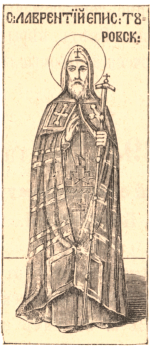
Блаженный Лаврентий подвизался после того в Печерском монастыре. Отсюда возведён он на кафедру Туровскую323, и с 1182 г. был преемником св. Кирилла Туровского; в этом году, он, в сане епископа Туровского, был на посвящении Василия в игумена Печерского324 Местное Туровское предание говорит, что из бывшего Туровского Борисоглебского кафедрального монастыря взяты нетленные мощи в Киев; по ркп. святцам XVII в., тело св. Лаврентия, епископа Туровского, покоится в Киевской пещере325. В каноне Печерским отцам молятся святителю Лаврентию326. По известию Кальнофойского, в пещере преп. Антония почивают мощи преп. Лаврентия затворника; так называется в пещере Туровской епископ и ныне, как Печерский затворник, по перенесению из Турова, положенный в прежней своей пещере327.
The blessed Laurence afterwards struggled in the Monastery of the Caves. From there he was elevated to the Turov cathedra323, and from 1182 was the successor of St. Cyril of Turov; in that year, in the dignity of Bishop of Turov, he was present at the consecration of Basil as abbot of the Caves.324 Local Turov tradition says that from the former Turov Cathedral Monastery of Sts. Boris and Gleb, incorrupt relics were taken to Kiev; according to 17th-century manuscript menologia, the body of St. Laurence, Bishop of Turov, rests in the Kiev Caves.325 In the canon to the Fathers of the Caves, the Hierarch Laurence is invoked.326 According to the account of Kalnofoyski, in the cave of the Venerable Anthony repose the relics of the Venerable Laurence the Recluse; so the Bishop of Turov is called in the cave even now, as a Recluse of the Caves, having been translated from Turov and laid in his former cave.327
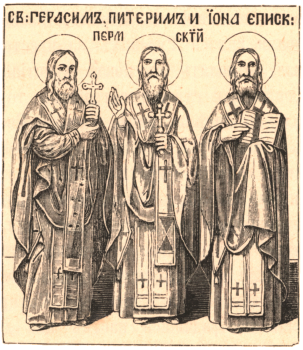
Мощи сих трёх святителей Пермских покоятся в Усть-вымском Благовещенском храме, там, где была их кафедра. Над гробницами их стоит икона, изображающая их во весь рост, со следующей надписью: «л. 7115 (1607) м. июния в 8 день, при великом государе царе и великом князе Василие Ивановиче, всея Руси самодержеце, и при святейшем Ермогене, патриархе Московском, написан бысть сей св. образ трех святителей Герасима, Питирима и Ионы, в славу Св. Троицы, Отца и Сына и Св. Духа, повелением их, смиренным епископом Иоасафом Вологодским и Великопермским, и положен бысть сей образ на гробницех их, великих чудотворцев, Герасима, Питирима и Ионы»!328 Память сих трёх святителей благоговейно чтится 29 января и без сомнения с того времени, как по соборному определению патриарха написана икона их.
The relics of these three Hierarchs of Perm rest in the Ust-Vym Church of the Annunciation, where their cathedra was. Above their tombs stands an icon depicting them at full length, with the following inscription: "In the year 7115 (1607), on the 8th day of June, under the great sovereign Tsar and Grand Prince Basil Ivanovich, Autocrat of All Russia, and under His Holiness Hermogenes, Patriarch of Moscow, this holy image of the three Hierarchs Gerasimus, Pitirim and Jonah was painted, to the glory of the Holy Trinity, Father and Son and Holy Spirit, by the command of them, the humble Bishop Joasaph of Vologda and Great Perm, and this image was placed upon their tombs, the great wonderworkers Gerasimus, Pitirim and Jonah!"328 The memory of these three Hierarchs has been reverently honoured on 29 January, and undoubtedly from the time when, by the conciliar decree of the Patriarch, their icon was painted.
В 1649 г. построен был в их имя храм в Вологодском архиерейском доме и в следующем году архиепископ Маркелл «по своему обещанию отправлялся на Усть-вым Пермским чудотворцем помолитися»330.
In 1649 a church was built in their name in the Vologda Archbishop's house, and in the following year Archbishop Markell "according to his vow set out for Ust-Vym to pray to the Permian wonderworkers."330
После св. Стефана, первого просветителя Перми, 20 января 1398 г. посвящён был в епископа Пермского Исаакий331. В марте 1416 г. он был на соборе в Москве, при посвящении Новгородского архиепископа и при совещаниях о Литовском митрополите332. После того он уже не возвращался в Усть-вым333. Новая паства, оставшаяся без пастыря, и сама по себе скоро дозволила себе беспорядки, а фанатики язычества – волхвы рады были, не видя себе сильной помехи, рассевать плевелы на ниве Божией; дикие Вогуличи даже насилием стали принуждать новых христиан к язычеству. «Овцы шалят, – говорит современник – блаженный Епифаний, – волки нападают; без пастыря свистеть некому, чтобы пугать и прогонять волков... Вогуличи делают нападения»334. При таком положении дел, преемнику Исаакию, пастырю, ревностному к своему долгу, много надлежало трудиться, много перенести неприятностей. Блаженный Герасим, преемник Исаакия, был жизни святой, как говорит о нём древность; с ревностью очищал он плевелы, появившиеся на новой ниве Христовой. И труды его не были напрасны.
After St. Stephen, the first enlightener of Perm, on 20 January 1398, Isaac was consecrated Bishop of Perm.331 In March 1416 he was at a council in Moscow, at the consecration of the Archbishop of Novgorod and at consultations concerning the Lithuanian metropolitan.332 After that he did not return to Ust-Vym.333 The new flock, left without a shepherd, soon allowed itself disorders, and the fanatics of paganism—the sorcerers—were glad, seeing no strong hindrance, to sow tares in God's field; the wild Voguls even began by force to compel the new Christians to return to paganism. "The sheep are unruly," says a contemporary, the blessed Epiphanius, "the wolves attack; without a shepherd there is no one to whistle to frighten and drive away the wolves... The Voguls make incursions."334 In such a state of affairs, the successor of Isaac, a pastor zealous for his duty, had much to labour and much unpleasantness to endure. The blessed Gerasimus, the successor of Isaac, was of holy life, as antiquity says of him; with zeal he cleansed the tares that had appeared in the new field of Christ. And his labours were not in vain.
В 1429 г. святитель Фотий уже писал о Перми: «ныне страна чисто и православно совершает службу Божию, по закону христианскому»335.
In 1429, the Hierarch Photius already wrote of Perm: "now the country purely and orthodoxly performs the service of God, according to the Christian law."335
В 1438 г. видим блаженного Герасима на Московском соборе, на котором осуждён был предатель православия Исидор336; потом был он и на соборе 1441 года, определявшем поставлять митрополита России собором Русских пастырей337. Ревностный пастырь пользовался пребыванием в Москве и для того, чтобы испросить помощь для нужд своей паствы. В последние годы правления его Вогуличи, под начальством свирепого князя Асыки, стали врываться в поселения крещёных Зырян. Святитель до того простирал свою отеческую заботу о покое паствы, что с опасностью жизни являлся в стан Вогуличей. Просьбы и убеждения святителя подействовали на дикарей, и они удалились в свои места. Ревностный пастырь занялся потом водворением покоя и порядка в поселениях, пострадавших от дикого неприятеля; он проникал в самые глухие места, если слышал, что там страдает беспомощная бедность; входил во все нужды жителей и спешил оказывать помощь. Такими подвигами заслужил он имя благодетеля народа.
In 1438 we see the blessed Gerasimus at the Moscow Council, at which the betrayer of Orthodoxy, Isidore, was condemned;336 afterwards he was also at the council of 1441, which decreed that the metropolitan of Russia should be appointed by a council of Russian pastors.337 The zealous pastor also used his stay in Moscow to obtain help for the needs of his flock. In the last years of his rule, the Voguls, under the command of the fierce prince Asyka, began to break into the settlements of the baptized Zyryans. The Hierarch extended his fatherly care for the peace of his flock so far that he appeared with danger to his life in the camp of the Voguls. The requests and persuasions of the Hierarch had an effect on the savages, and they withdrew to their own places. The zealous pastor then busied himself with establishing peace and order in the settlements that had suffered from the wild enemy; he penetrated into the most remote places if he heard that helpless poverty was suffering there; he entered into all the needs of the inhabitants and hastened to render aid. By such deeds he earned the name of benefactor of the people.
Душевные огорчения и недуги старости расстроили здоровье его; но он и больной отправился осмотреть места, ближайшие к Усть-выми, а на возвратном пути умер смертью мученика338. По одному древнему известию, «на Усть-вымском лугу, близ Усть-вымской крепости, за несколько стадий от соборной церкви, святой отец удушен домочадцами невинно и скончался 24 января». По другому известию, он удавлен был омофором, рукою Вогулича, принятого им на воспитание. Вероятно, дикарь поступил так с благодетелем своим по внушению тех, которым дорого было унижаемое язычество339.
Sorrows of soul and the infirmities of old age undermined his health; but even ill he set out to inspect the places nearest to Ust-Vym, and on the return journey he died a martyr's death.338 According to one ancient account, "on the Ust-Vym meadow, near the Ust-Vym fortress, a few stadia from the cathedral church, the holy father was strangled innocently by his household and reposed on 24 January." According to another account, he was strangled with his omophorion by the hand of a Vogul whom he had taken in for upbringing. It is probable that the savage acted thus against his benefactor at the instigation of those to whom the humiliated paganism was dear.339
Преемником блаженного Герасима на Пермской кафедре был блаженный Питирим340. До архипастырства своего он был архимандритом едва ли не Чудова монастыря, и был известен сколько по благочестию своему, столько и по просвещению. Пахомий в предисловии к житию св. Алексия пишет: «иное извлёк я из са́мого достоверного писания, архимандрита Питирима, бывшего потом епископом Перми. Он кратко написал о святителе и составил канон в похвалу ему, слышав верное о его жизни и чудесах. Сей епископ и вместе мученик не только пострадал от неверных за веру, но много потерпел бед и от князя, считавшего себя верным, которого потому до́лжно считать худшим неверного, как того, который осквернил свои руки кровью братней»341. Это, как видно, Шемяка.
The successor of the blessed Gerasimus on the Perm cathedra was the blessed Pitirim.340 Before his archpastoral service he was archimandrite, most likely of the Chudov Monastery, and was known as much for his piety as for his learning. Pachomius, in the preface to the Life of St. Alexis, writes: "Another part I have extracted from the most trustworthy writing of Archimandrite Pitirim, who afterwards became Bishop of Perm. He wrote briefly about the Hierarch and composed a canon in his praise, having heard reliable accounts of his life and miracles. This bishop and likewise martyr not only suffered from the infidels for the faith, but also endured many calamities from a prince who considered himself faithful, whom therefore one must consider worse than an infidel, as one who defiled his hands with brotherly blood."341 This, as is evident, was Shemyaka.
Блаженный Питирим посвящён был в епископа вслед за кончиной св. Герасима. В самом начале управления своего Усть-вымской паствой разослал он грамоты к Вятчанам и Вогуличам, убеждая их не тревожить мирных Зырян. Поелику же Асыка, пользуясь раздорами князей Русских за престол великого князя, не думал оставлять в покое христианские поселения, и Вогуличи производили страшные грабежи, то Новгородские владельцы земель по Ваге и Двине, Василий Своеземцев и Михаил Яковль, с 3.000 дружин своих (в 1445 году), прошли до Уральских гор и захватили множество Югры (Остяко-Вогулов). Хитрые дикари, усыпив воевод обещанием полной покорности, нечаянным нападением поразили дружину Своеземцева342. Но потом Асыка, попавшись в плен, вынужден был клясться всеми духами горными, что не станет более тревожить христиан.
The blessed Pitirim was consecrated bishop immediately after the death of St. Gerasimus. At the very beginning of his rule over the Ust-Vym flock, he sent letters to the Viatkans and Voguls, urging them not to disturb the peaceful Zyryans. But since Asyka, taking advantage of the discords of the Russian princes over the throne of the Grand Prince, did not think of leaving the Christian settlements in peace, and the Voguls committed terrible robberies, the Novgorod landowners of the lands along the Vaga and Dvina, Basil Svoezemtsev and Michael Yakovl, with 3,000 of their retinues (in 1445), marched as far as the Ural Mountains and captured many Yugra (Ostyak-Voguls). The cunning savages, having lulled the voivodes to sleep with promises of full submission, by a sudden attack defeated the retinue of Svoezemtsev.342 But afterwards Asyka, having been taken prisoner, was forced to swear by all the spirits of the mountains that he would no longer disturb the Christians.
Блаженный Питирим поспешил подать помощь пострадавшей пастве из доходов своей кафедры343. В следующем году (1447) он был в Москве344, лично ходатайствовал у великого князя Василия о помощи Зырянам. Великий князь сложил часть подати с пострадавших, а семья его вручила блаженному Питириму разные подарки для Зырян. Но пока успел возвратиться к своей пастве усердный пастырь, Вогуличи (1448 г.) снова учинили набег на бедных Зырян. Впрочем, с того времени они 5 лет не тревожили христианских поселений345. Ревностный пастырь имел теперь полную свободу заниматься долгом учительства. Ныне известен памятник желаний его распространять в пастве полезные книги. Это книга Дионисия Ареопагита, на которой впоследствии сделана была такая надпись: «сия книга святого Благовещения на Усть-выми; а положил сию книгу священномученик епископ Питирим, убиенный от нахождения сыроядцев Вогулич, за православную веру, идеже лежит многострадальное и трепетивое тело его»346.
Blessed Pitirim hastened to aid his suffering flock from the revenues of his see343. In the following year (1447) he was in Moscow344, personally interceding with Grand Prince Basil for assistance to the Zyrians. The Grand Prince remitted part of the tribute from the afflicted, and his family gave Blessed Pitirim various gifts for the Zyrians. But before the zealous shepherd could return to his flock, the Voguls (1448) again raided the poor Zyrians. However, from that time they did not disturb the Christian settlements for five years345. The zealous pastor now had full freedom to attend to the duty of teaching. Known to this day is a monument of his desire to spread useful books among his flock. It is the book of Dionysius the Areopagite, on which was later made this inscription: “This book belongs to the holy Church of the Annunciation at Ust-Vym; and this book was placed here by the Hieromartyr Bishop Pitirim, slain by the incursion of the raw-eating Voguls, for the Orthodox faith, where his much-suffering and awe-inspiring body lies.”346
Он беседовал с народом в храмах, а чаще на открытых местах, объясняя ему правила веры и благочестия. Апостольская ревность его успела обратить к св. вере и некоторых Вогуличей, живших в соседстве с крещёнными Зырянами. Этот последний подвиг его возбудил против него злобу в Асыке, который и без того злился за то, что мерами пастыря удержаны были Вогуличи так долго от злодейств над Зырянами. Асыка решился отмстить св. пастырю и его пастве347. В 1455 году свирепый вождь, вооружив Вогуличей стрелами и луками, пустился на плотах вниз по Вычегде, нигде не останавливаясь и задерживая прибрежных жителей, чтобы не предупредили в Усть-выме о его приближении; он пригласил с собой и Вятичей. В 10 вёрстах от впадения р. Выми в Вычегду остановился он в высоком бору, который поныне называют «Юр» – становище и «Вогул-як» – Вогульский бор. Рано утром один из Усть-вымцев плыл на ладье вверх по Вычегде и неожиданно напал на стан Вогуличей. Его поймали, и Асыка дознал от него пытками, какова стража в Усть-выме? Дома ли Питирим? Зырянин объявил, что Питирим в этот самый день (день был воскресный) пойдёт для молебствия на мыс, что близ устья р. Выми, и что о Вогуличах ничего не знают. Асыка поспешил к Усть-выми, а чтобы обмануть бдительность жителей, велел набросать на плоты множество срубленных елей и ветвями их прикрыть своё войско; в таком виде плоты казались издали плавучими деревьями, подрытыми быстриной воды. В Усть-выме, в воскресный день, старый и малый были в храме. После литургии святитель, клир и народ с крестами и иконами отправились на мыс. Скоро заметили груды деревьев, странно тянувшиеся на большом протяжении реки. Святитель понял хитрость Вогуличей и сказал народу об опасности. Обратившись к Усть-выми, он преклонил колена, трижды благословил народ и храмы крестным знамением и сказал: «дети мои! скорее удалитесь от меня; мне не убежать от смерти; Богу угодно предать меня в руки Вогуличей». Толпы Вогуличей выскочили на берег. И все бывшие с Питиримом в ужасе бросились, кто куда мог.
He conversed with the people in churches, and more often in open places, explaining to them the rules of faith and piety. His apostolic zeal succeeded in converting to the holy faith also some of the Voguls who lived in the vicinity of the baptized Zyrians. This last labor of his aroused against him the malice of Asyka, who was already angered that by the pastor’s measures the Voguls had been restrained so long from committing atrocities against the Zyrians. Asyka resolved to take vengeance on the holy pastor and his flock347. In 1455, the savage chieftain, having armed the Voguls with arrows and bows, set out on rafts down the Vychegda, stopping nowhere and detaining the coastal inhabitants so that they might not warn Ust-Vym of his approach; he also invited the Viatichs to join him. Ten versts from the mouth of the Vym River into the Vychegda, he halted in a tall pine forest, which to this day is called “Yur”—the encampment—and “Vogul-yak”—the Vogul forest. Early in the morning, one of the Ust-Vym men was sailing in a boat up the Vychegda and unexpectedly came upon the Vogul camp. He was captured, and Asyka learned from him through torture what the guard was like in Ust-Vym, and whether Pitirim was at home. The Zyrian declared that Pitirim on that very day (it was a Sunday) would go for a moleben to the promontory near the mouth of the Vym River, and that they knew nothing of the Voguls. Asyka hastened to Ust-Vym, and to deceive the vigilance of the inhabitants, he ordered many felled fir trees to be thrown onto the rafts and with their branches to cover his troops; in this form the rafts appeared from afar as floating trees, undercut by the swiftness of the water. In Ust-Vym, on Sunday, young and old were in the church. After the Divine Liturgy, the Hierarch, the clergy, and the people with crosses and icons proceeded to the promontory. Soon they noticed piles of trees strangely stretching over a great expanse of the river. The Hierarch understood the Voguls’ cunning and told the people of the danger. Turning toward Ust-Vym, he knelt, thrice blessed the people and the churches with the sign of the cross, and said: “My children! Quickly withdraw from me; I cannot escape death; God is pleased to deliver me into the hands of the Voguls.” Crowds of Voguls leaped ashore. And all who were with Pitirim fled in terror, each wherever he could.
Пастырь продолжал молиться. Кровожадные дикари бросились на беззащитного старца, избили, изранили, лишили его жизни и бросили св. тело на мысу. Так пострадал, говорит летопись, 19 августа 1455 года, св. епископ Питирим от безбожных Вогуличей и Вятчан и принял венец от подвигоположника Христа Господа348. Асыка удалился затем от Усть-выми, по боязни ли встретить сильный отпор, или потому, что очень доволен был смертью Питирима; он захватил только прибрежных жителей, на возвратном пути своём. Духовные и гражданские власти поспешили послать в Москву известие о своём несчастье. В продолжение 40 дней, пока не получили ответа из Москвы, тело святителя, в знойное время, оставалось на том месте, где было замучено, и тление не коснулось его. Из ближних и дальних мест стекались жители поклониться нетленному святителю. Благоговение к нему умножилось, когда узнали о чудесах, истекавших из гроба его349.
The pastor continued to pray. The bloodthirsty savages rushed upon the defenseless elder, beat him, wounded him, took his life, and cast his holy body upon the promontory. Thus suffered, says the chronicle, on August 19, 1455, St. Bishop Pitirim at the hands of the godless Voguls and Viatichs, and received the crown from the Author of contests, Christ the Lord348. Asyka then withdrew from Ust-Vym, either from fear of meeting strong resistance, or because he was well satisfied with Pitirim’s death; he captured only the coastal inhabitants on his return journey. The spiritual and civil authorities hastened to send news of their misfortune to Moscow. For forty days, until a reply came from Moscow, the body of the Hierarch, in the hot season, remained on the spot where it had been martyred, and corruption did not touch it. From near and far, inhabitants flocked to venerate the incorrupt Hierarch. Veneration for him increased when they learned of the miracles that flowed from his tomb349.
После св. Питирима, поступил на Пермскую кафедру св. Иона и, без сомнения, в конце того же 1455 года, как убиен был св. Питирим. Как потому, что в убиении св. Питирима участвовали Вятчане, так особенно потому, что они много наделали бед в северном краю, в 1458 и 1459 гг., сильная Московская рать, вместе с ратью Устюжан, строго наказала Вятчан и заставила их обязаться платить дань Москве351.
After St. Pitirim, St. Jonah entered upon the Perm see, undoubtedly at the end of the same year 1455, when St. Pitirim was slain. Both because the Viatichs had taken part in the slaying of St. Pitirim, and especially because they had caused much trouble in the northern region in 1458 and 1459, a strong Moscow army, together with the army of the Ustyugians, severely punished the Viatichs and compelled them to pledge payment of tribute to Moscow351.
Святитель Иона Пермский вместе с прочими епископами, декабря 12 дня 1459 г., писал увещание Литовским епископам сохранять верность св. православию и не принимать Григория, ученика Исидорова352. Он был на соборе 1461 года, на котором Ростовский архиепископ Феодосий, согласно с волей почившего святителя Ионы, избран был в митрополита; тогда он объявлял собору волю умиравшего святителя о преемнике, что показывает особенное доверие к нему великого святителя353. Деятельность его в Перми была блистательная, Апостольская. Он, как говорит летопись, «крестил великую Пермь», или, как выражается другая летопись, «добавне крести», окончательно крестил354. Великая Пермь, Пермь обширная и дикая, была по р. Каме и Чусовой и в верховьях Вычегды и Печоры, откуда врывались в поселения новых христиан Остяки и Вогуличи355; иначе, по Пермским названиям рек и речек, это нынешние уезды Пермский, Соликамский, Чердынский, западная половина Верхотурского и северная Оханского, где вместе с народом Коми-пермяками жили на юго-западе Вотяки, на востоке Остяки и Вогулы356.
Hierarch Jonah of Perm, together with the other bishops, on December 12, 1459, wrote an admonition to the Lithuanian bishops to preserve fidelity to holy Orthodoxy and not to accept Gregory, the disciple of Isidore352. He was at the council of 1461, at which Theodosius, Archbishop of Rostov, was elected Metropolitan according to the will of the reposed Hierarch Jonah; then he declared to the council the will of the dying Hierarch concerning his successor, which shows the special trust placed in him by the great Hierarch353. His activity in Perm was brilliant and apostolic. He, as the chronicle says, “baptized Great Perm,” or, as another chronicle expresses it, “completed the baptism,” finally baptized354. Great Perm, the vast and wild Perm, was along the Kama and Chusovaya Rivers and in the upper reaches of the Vychegda and Pechora, whence the Ostyaks and Voguls burst into the settlements of the new Christians355; otherwise, according to the Permian names of rivers and streams, these are the present-day districts of Perm, Solikamsk, Cherdyn, the western half of Verkhoturye, and the northern part of Okhansk, where together with the Komi-Permyak people lived the Votiaks in the southwest, and the Ostyaks and Voguls in the east356.
Блаженный Иона, после нелёгкой борьбы с волхвами, успел склонить к св. вере Пермского князя в городе его Уросе (ныне селе) и, окрестив, назвал его Михаилом. Этот первенец трудов его помог ему в дальнейших успехах его. Предметы суеверного и нечестивого обожания были истреблены, сами волхвы должны были отказаться от корыстных занятий своих; на месте идолов построены были храмы; на новой ниве поставлены были трудолюбивые сеятели, опытные из священников Усть-выми. Всё это происходило в 1462 и 1463 годах357. После того надлежало ещё утверждать благочестие в людях простодушных и тушить обычаи языческих сердец. В Чердыни основался Богословский монастырь, по актам, тогда, «как великая Пермь приведена в крещение»358. На р. Печоре, в 600 вёрстах от Усть-Сысольска, основалась Печерская обитель Св. Троицы; её иноки долго и после блаженного Ионы отправляли обязанности приходских священников для живших по р. Печоре359. Блаженный святитель был для паствы своей образцом искреннего благочестия и неутомимо трудился для блага Церкви своей. Он мирно почил в Усть-выме в 1470 году, и святое тело его положено было по левую сторону святителей Герасима и Питирима360.
Blessed Jonah, after a difficult struggle with sorcerers, succeeded in inclining the Permian prince in his city of Uros (now a village) to the holy faith, and having baptized him, named him Michael. This firstfruit of his labors helped him in his further successes. The objects of superstitious and impious worship were destroyed; the sorcerers themselves were forced to abandon their gainful occupations; on the sites of idols churches were built; upon the new field were placed diligent sowers, experienced priests from Ust-Vym. All this took place in the years 1462 and 1463357. After that, it was still necessary to confirm piety in simple-hearted people and to extinguish the customs of pagan hearts. In Cherdyn, the Theological Monastery was founded, according to the acts, at the time “when Great Perm was brought to baptism.”358 On the Pechora River, 600 versts from Ust-Sysolsk, the Pechora Monastery of the Holy Trinity was founded; its monks long after Blessed Jonah fulfilled the duties of parish priests for those living along the Pechora River359. The blessed Hierarch was for his flock an example of sincere piety and labored tirelessly for the good of his Church. He peacefully reposed in Ust-Vym in the year 1470, and his holy body was laid on the left side of the Hierarchs Gerasimus and Pitirim360.
Коссов свидетельствует (патерик на польск. яз., стр. 180. К. 1635 г.), что в его время ещё видно было место бывшего Дмитриева монастыря близ лавры. В 1128 г. монастырь был приписан к Печерской обители и по храму, построенному блаж. князем Ярополком во имя св. Петра, называли его Петровой церковью (собр. л. 1, 88. 131). Но после того Поликарп был игуменом Дмитриева монастыря, как говорит Симон.
Kossov testifies (Patericon in Polish, p. 180. K. 1635) that in his time the site of the former Demetrius Monastery near the Lavra was still visible. In 1128 the monastery was attached to the Caves Monastery and, after the church built by Blessed Prince Yaropolk in the name of St. Peter, it was called St. Peter’s Church (Coll. of Chr. 1, 88. 131). But after that Polycarp was abbot of the Demetrius Monastery, as Simon says.
Калайдович в предисл. к памятн. XII века, стр. 21, 22. По ркп. святцам, между святыми, почивающими в Киевской пещере, первым показан: «св. Лаврентий, епископ Туровский».
Kalaydovich in the preface to Monuments of the 12th Century, pp. 21, 22. According to manuscript saints’ calendars, among the saints reposing in the Kiev Caves, the first shown is: “St. Laurence, Bishop of Turov.”
Сказание о жизни и трудах св. Стефана Пермского, стр. 64, 65. СПб. 1856 г. Ист. иер. 6, 576. Другая такая же икона и также древняя стоит на Вознесенском Усть-вымском храме. Ист. иер. 6, 579.
Narrative of the Life and Labors of St. Stephen of Perm, pp. 64, 65. St. Petersburg, 1856. Hist. of Hier. 6, 576. Another such icon, also ancient, stands on the Ascension Church at Ust-Vym. Hist. of Hier. 6, 579.
Извлечение из современной записки в Волог. Епарх. Вед. 1865 г. № 22. Усть-вымский священник Евтихий (в 1717 г.) писал к секретарю Вологодского архиерейского дома: «пишем тебе, господину, о том, что в архиерейском доме или в соборной церкви или у твоей милости есть о начале и о бытности на Усть-выми, епископии Стефана, епископа Пермского, и по нём иных епископов по ряду и чудотворцев Герасима, Питирима и Ионы, в которые годы они епископствовали и откуда родом и который епископ и чудотворец сколько годов в епископии пребывал, и каковы чудотворцев кончины были и что из чудес и который епископ где почивает и в которые годы с Усть-выми на Вологду переведён? – мы не ведаем, а приходящее к чудотворцам богомольцы осуждают о том деле, что мы не ведаем; да и надлежит у их раки о вышеписанном деле на письме быть сполна. Ради их, чудотворцев, прикажи взыскать и архиерею Божию доложить и выписать и к нам на Усть-вым прислать». Что сделал по сему предмету дьяк Вологодского епископа, остаётся неизвестным.
Extract from a contemporary note in the Vologda Diocesan Gazette, 1865, No. 22. The Ust-Vym priest Eutychius (in 1717) wrote to the secretary of the Vologda bishop’s house: “We write to you, sir, about this: whether in the bishop’s house or in the cathedral church or with your grace there is anything about the beginning and the existence at Ust-Vym of the episcopacy of Stephen, Bishop of Perm, and after him of the other bishops in order, and of the wonderworkers Gerasimus, Pitirim, and Jonah, in what years they were bishops and whence they were born, and which bishop and wonderworker how many years he remained in the episcopacy, and what were the ends of the wonderworkers, and what miracles occurred, and which bishop reposes where, and in what years the see was transferred from Ust-Vym to Vologda—we do not know, and the pilgrims coming to the wonderworkers reproach us for this matter, that we do not know; and at their shrine there ought to be a full written account of the above-mentioned matter. For their sake, the wonderworkers, order an inquiry and report to the bishop of God and write it out and send it to us at Ust-Vym.” What the clerk of the Vologda bishop did on this matter remains unknown.
Плач о смерти св. Стефана. Слова эти не могут быть отнесены ко времени после кончины св. Стефана, потому что тогда немедленно посвящён был пастырь Исаакий.
Lament on the Death of St. Stephen. These words cannot be referred to the time after the repose of St. Stephen, because then the pastor Isaac was immediately consecrated.
Сказание о жизни св. Стефана, стр. 64. СПб. 1856. Ркп. святцы: «св. Герасим епископ, Пермский чудотворец, задушен бысть», в другом списке приб.: «омофором своим от своих домочадец», в третьем списке сказано: «от безбожных Вогулич в л. 6900 месяца января в 24 день». Ист. иер. 1, 395.
Narrative of the Life of St. Stephen, p. 64. St. Petersburg, 1856. Manuscript calendar: "St. Gerasimus, bishop, Wonderworker of Perm, was strangled"; in another copy it adds: "with his own omophorion by his own household"; in a third copy it says: "by the godless Voguls in the year 6900, month of January, on the 24th day." History of the Hierarchy 1, 395.
Ист. акт. 1, 73. У Щекатова в его словаре 2. 675; после св. Герасима: Иона и Киприан, св. Питирим, св. Иона, Филофей и Никон. Но Иона и Киприан прежде св. Питирима – ошибка. Киприан был епископом с января 1545 г. Сл. ист. иер. 1, 395, 396.
Historical Acts 1, 73. In Shchekatov's Dictionary 2, 675; after St. Gerasimus: Jonah and Cyprian, St. Pitirim, St. Jonah, Philotheus, and Nikon. But Jonah and Cyprian before St. Pitirim is an error. Cyprian was bishop from January 1545. Cf. History of the Hierarchy 1, 395, 396.
Собр. л. 4, 124. Сл. опыт исследования о древней Югри – в вест. геогр. общ. т. 14. СПб. 1855 г.
Collection of Chronicles 4, 124. Cf. An Essay on the Investigation of Ancient Yugra – in the Bulletin of the Geographical Society, vol. 14. St. Petersburg, 1855.
Архангельский летописец под 6963 г. Татищев в истории 1465 г. По ркп. святцам: «св. Питирим, епископ Пермский, чудотворец, преставися в л. 6900 месяца августа в 19 день». Год здесь не определён, Собр. л. 4, 147. 5, 271. 6, 180.
Archangel Chronicler under the year 6963. Tatishchev in his History, 1465. According to manuscript calendars: "St. Pitirim, bishop of Perm, Wonderworker, reposed in the year 6900, month of August, on the 19th day." The year here is not determined. Collection of Chronicles 4, 147; 5, 271; 6, 180.
Уже в уставе 1522 г. под 19 августа сказано: «в той же день убиен бысть владыка Питирим Пермский от безбожных Вогулич». Муз. Румянц., стр. 713. Сл. прим. 195.
Already in the Typicon of 1522, under August 19, it says: "on the same day was slain Vladyka Pitirim of Perm by the godless Voguls." Rumyantsev Museum, p. 713. Cf. note 195.
Епифаний в житии Стефана: «Пермь великая, глаголемая Чусовая... четвёртая река (её) Кама; сия убо преходящи всю землю Пермскую сквозь ню, по ней же мнози язы́цы». Собр. л. 5, 250. «Река же третия Вятка потече в другую сторону Перми и вниде в Каму; Сия же река Кама обходяще всю землю Пермскую; по сей бо мнози язы́цы сидят».
Epiphanius in the Life of Stephen: "Great Perm, called Chusovaya... the fourth river (of it) is the Kama; this river passes through the whole land of Perm, and along it dwell many peoples." Collection of Chronicles 5, 250. "The third river, the Vyatka, flows into another part of Perm and enters the Kama; this river Kama encircles the whole land of Perm; for along it dwell many peoples."
Акт. Э. 3, 434, 435. Грамота в Пермь Великую, в Чердынь: «Обвинского и Иньвенского стану крестьяне были союзным письмом и Сибирскими отпуски с ними Пермичи исстари, как и Пермь во крещение приведена». По другой грамоте в Пермь Великую, Чердынь: «в Перми Богословский монастырь общий один, как Пермичи крещение приняли». Ист. акт. I, 397. Отселе видно, что сочинитель статьи о быте Пермяков (ж. м. внутр. дел, XXIX, отд. III, стр. 64) ошибается, думая, что в Иньвенской даче главной группе Пермяков, христианство возникло или в конце XVI века, или в «начале XVII века».
Acts of the Archeographic Expedition 3, 434, 435. A charter to Great Perm, to Cherdyn: "The peasants of the Obva and Inva districts were in allied correspondence and Siberian dispatches with the Permians from ancient times, as when Perm was brought to baptism." According to another charter to Great Perm, Cherdyn: "In Perm there is one common Theological Monastery, as when the Permians received baptism." Historical Acts I, 397. From this it is evident that the author of the article on the life of the Permyaks (Journal of the Ministry of Internal Affairs, XXIX, section III, p. 64) errs in thinking that in the Inva district, the main group of Permyaks, Christianity arose either at the end of the 16th century or at the beginning of the 17th century.
Архангельск. лет., стр. 115. Здесь днём кончины его показан 6 день июня; в Софийск. лет. (собр. л.6:190) – 8 ноября 1470 г. По ркп. святцам: «св. Иона еписк. Пермский чудотворец, иже бысть на устье Целмы реки, у Соли, преставися в л. 6979 мес. октября 29 дня».
Archangel Chronicle, p. 115. Here the day of his repose is given as June 6; in the Sophia Chronicle (Collection of Chronicles 6:190) – November 8, 1470. According to manuscript calendars: "St. Jonah, bishop of Perm, Wonderworker, who was at the mouth of the Tsylma River, near Soli, reposed in the year 6979, month of October, on the 29th day."