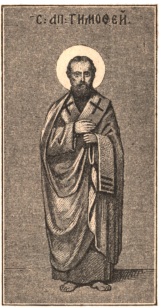
Родом из Ликаонии, города Листры, сын язычника и Евреянки; когда Ап. Павел проповедовал в Листре, то обратившаяся к вере вдовствовавшая мать его поручила его Павлу, который и отдал его достойным учителям для научения Писанию, а через несколько лет сделал его участником в Апостольских трудах своих и, наконец, оставил епископом в Ефесе. Скончался мученически: потому что когда, однажды, во время бесчинств и распутных действий языческой толпы в честь богов, он выступил с обличением, то избит был до смерти исступлёнными. Христиане положили честные его мощи за городом, где впоследствии и церковь была сооружена.
He was a native of Lycaonia, from the city of Lystra, the son of a pagan and a Jewess. When the Apostle Paul preached in Lystra, his widowed mother, who had been converted to the faith, entrusted him to Paul, who gave him to worthy teachers for instruction in the Scriptures. After several years, he made him a participant in his own apostolic labors and, finally, left him as bishop in Ephesus. He died a martyr's death: for once, during the disorderly and licentious actions of a pagan crowd in honor of their gods, he came forward with a rebuke and was beaten to death by the frenzied mob. Christians laid his venerable relics outside the city, where a church was later built.
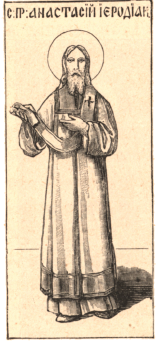
Перс знатного рода, сын мага; в 614 году, когда честное древо Креста Господня пленено было Персами, он много наслышался о христианской вере, отправился в Иерусалим и, приняв крещение, семь лет провёл в одном из тамошних монастырей. Однажды, накануне светлого праздника Воскресения, ему в видении некий светозарный муж подал чашу с вином и сказал: «прими и пей. Анастасий выпил из чаши, и душа его исполнилась радости; это счёл он предзнаменованием мученической смерти. Оставив обитель Иерусалимскую и посетив разные места, он прибыл в Кесарию Палестинскую, занятую ещё Персами, стал обличать нечестие их, схвачен, как отступник от веры предков, и, как не согласился отречься Христа, выслан в Персию на суд, где и осуждён на удавление верёвкой (622 г.). Мощи же его взяты верными и перенесены в Иерусалимскую обитель.
A Persian of noble birth, the son of a magus. In the year 614, when the venerable Wood of the Cross of the Lord was taken captive by the Persians, he heard much about the Christian faith, set out for Jerusalem, and, having received Baptism, spent seven years in one of the monasteries there. Once, on the eve of the bright feast of the Resurrection, a certain radiant man appeared to him in a vision, handed him a cup of wine, and said: "Take and drink." Anastasius drank from the cup, and his soul was filled with joy; he took this as a portent of a martyr's death. Leaving the Jerusalem monastery and visiting various places, he arrived at Caesarea in Palestine, which was still held by the Persians. He began to denounce their impiety, was seized as an apostate from the faith of his fathers, and, since he would not consent to deny Christ, was sent to Persia for judgment, where he was condemned to be strangled with a rope (A.D. 622). His relics were taken by the faithful and translated to the Jerusalem monastery.
Кальнофойский, показывая в Антониевой пещере мощи преподобных, говорит: «святой Тит пресвитер, чудотворец, с братом своим во Христе Анастасием»234. Эти слова дают видеть, что преп. Анастасий был современником преп. Тита и, соединённый c ним христианской любовью, почил в конце XII в.235. В рукописных святцах называется он диаконом. Мощи его в Антониевой пещере236.
Kalnofoisky, showing the relics of the venerable fathers in the Anthony Cave, says: "St. Titus the presbyter, wonderworker, with his brother in Christ Anastasius."234 These words indicate that the Venerable Anastasius was a contemporary of the Venerable Titus and, united with him in Christian love, reposed at the end of the 12th century.235 In the handwritten saints' calendars he is called a deacon. His relics are in the Anthony Cave.236
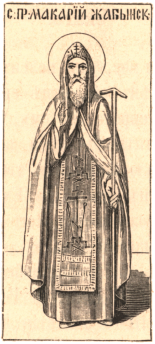
По рукописным святцам «преподобный священноинок Макарий, начальник Жабынского монастыря Введения Пресв. Богородицы, Белевский новый чудотворец, преставися в л. 7130 (1622) мес. янв. в 22 д.». По синодику Белевской обители, «преподобный отец Макарий, Белевский чудотворец, – в терпении иночески плотию страда: мраз, зной, в алчбе и жажде потерпе, монастырь возгради, братью собра, поживе в терпении своем лета довольна, – преставися в л. 7131 (1623), погребен ученики своими в своем, от него созданнем монастыре, месяца ианнуария 22 дня»237.
According to the handwritten saints' calendars: "The venerable hieromonk Macarius, head of the Zhabyn Monastery of the Entry of the Most Holy Theotokos, the new wonderworker of Belev, reposed in the year 7130 (A.D. 1622), on the 22nd day of the month of January." According to the synodicon of the Belev monastery: "The venerable father Macarius, wonderworker of Belev, suffered in the flesh with monastic patience: he endured frost, heat, hunger and thirst, built up the monastery, gathered the brethren, lived in his patience for a sufficient number of years, and reposed in the year 7131 (A.D. 1623), and was buried by his disciples in his monastery, which he had founded, on the 22nd day of the month of January."237
Жабынский монастырь на устье речки Жабыни, впадающей в Оку, в 5 верстах от Белева, основан был в 1583 г. старцем Онуфрием, но в 1614 г. был разорён и сожжён без остатка, как и Оптина пустынь. Преп. Макарію пришлось устроять всё вновь на пустом месте: строить храм и кельи, собирать братию. Это нелегко и в другое время, а когда разорен был весь край, старцу пришлось долго переносить на пепелище и голод и холод, он всё терпел для Господа, и пустынь Жабынская после того называлась Макариевой. Полагают, что его же терпению и трудам принадлежало и восстановление разорённой Литовцами Оптиной пустыни, которая также называлась Макариевой. Изображение преп. Макария видно было даже на столпе храма девичьего Козельского монастыря. В синодике Жабынском сказано и то, что преп. Макарий «доныне сияет в чудесех»238.
The Zhabyn Monastery, at the mouth of the Zhabynya River, which flows into the Oka, five versts from Belev, was founded in 1583 by the elder Onuphrius, but in 1614 it was utterly destroyed and burned down, as was Optina Hermitage. The Venerable Macarius had to build everything anew on the empty site: to construct a church and cells, and to gather the brethren. This was no easy task even in other times, but when the entire region had been laid waste, the elder had long to endure hunger and cold on the ashes; he endured all for the Lord's sake, and the Zhabyn Hermitage was thereafter called Macarius's. It is believed that the restoration of the Optina Hermitage, also destroyed by the Lithuanians, which was likewise called Macarius's, was also due to his patience and labors. An image of the Venerable Macarius was visible even on a pillar of the church of the Kozelsk Convent. The Zhabyn synodicon also says that the Venerable Macarius "shines even now in miracles."238
О пр. Тите февраля 27. Почему в словаре святых, стр. 22 Анастасий называется преподобномучеником, – не видно; в опис. лавры он диакон, но не назван мучеником.
Concerning the Venerable Titus, see February 27. Why Anastasius is called a Venerable Martyr in the Dictionary of Saints, p. 22, is not evident; in the description of the Lavra he is a deacon, but is not called a martyr.
Исследов. о древней области Вятичей, стр. 8, 86–87. По другому списку святцев, «пр. Макарий Белевский Жабынский преставися в л. 7130 сентября в 22 день». Год и день кончины несомненнее те, которые указаны в синодике пустыни; а 22 сентября, вероятно, было днём свидетельствования мощей.
Research on the Ancient Region of the Vyatichi, pp. 8, 86–87. According to another list of saints' calendars, "the Venerable Macarius of Belev and Zhabyn reposed in the year 7130, on the 22nd day of September." The year and day of his death are more certainly those indicated in the synodicon of the hermitage; September 22 was probably the day of the examination of his relics.