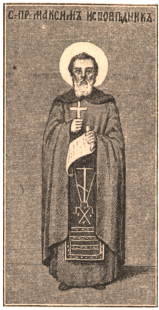
Цареградский уроженец, секретарь императора Ираклия, Максим, уклоняясь от общения с еретиками монофелитами, в 634 году удалился в Хризополь (ныне Скутари), принял монашество и игуменствовал в тамошней обители. В 639 году прибыл он в Африку, в Карфаген, и убедил здешних епископов произнести соборное осуждение ереси. Затем перешёл в Рим (645 г.) и участвовал в деяниях Латеранского собора (646 г.), созванного папой Мартином для осуждения еретических «образцов веры». Император Констанс велел, наконец, военной рукой схватить его (655 г.) в Риме и представить в Константинополь. Тут, как непреклонного в православии, его томили в тюрьме, били воловьими жилами и, наконец, отрезали ему язык и руку. В 657 году, сосланный на Кавказ, в Мингрелию, он там скончался через пять лет (13 августа 662 г.). От него осталось много сочинений, полезных для Церкви.
A native of Constantinople and secretary to the Emperor Heraclius, Maximus, shunning communion with the Monothelite heretics, withdrew in 634 to Chrysopolis (now Scutari), received the monastic tonsure, and became abbot of the monastery there. In 639 he arrived in Africa, in Carthage, and persuaded the bishops there to pronounce a conciliar condemnation of the heresy. He then went to Rome (645) and took part in the acts of the Lateran Council (646), convened by Pope Martin for the condemnation of the heretical "specimens of faith." The Emperor Constans finally ordered that he be seized by military force in Rome (655) and brought to Constantinople. There, as one unyielding in Orthodoxy, they tormented him in prison, beat him with ox sinews, and finally cut out his tongue and cut off his hand. In 657, exiled to the Caucasus, to Mingrelia, he reposed there five years later (13 August 662). Many writings useful to the Church remain from him.
Во времена языческих царей жизнь христиан часто подвергалась опасности из-за личных счетов, как видим из примера св. Агнии. Тринадцатилетняя Агния, Римлянка, возвращаясь домой из девичьего училища, обратила на себя взоры сына градоначальника Римского; он познакомился с её родителями, стал посылать подарки и, наконец, просил её согласия на брак. Но девица отвечала, что посвятила своё девство Богу. Отец юноши счёл для себя бесчестием отказа сыну и решился судить её за бесчестие богов; для того потребовал от неё посвятить себя богине Весте (быть весталкой, поддерживать в храме неугасимый огонь в честь Весты). Так как святая объявила себя христианкой и обличила суетность идолов, то градоначальник подверг её бичеванию и, наконец, по настоянью жрецов, она пронзена в горло мечом. Родители взяли тело её и похоронили в своём имении близ города, куда в устроенную церковь и собирались верующие для молитвы. Блаженная кончина её последовала в 304 году.
In the times of the pagan emperors, the life of Christians was often endangered because of personal accounts, as we see from the example of St. Agnes. The thirteen-year-old Agnes, a Roman, returning home from a girls' school, drew the gaze of the son of the Roman prefect; he became acquainted with her parents, began to send gifts, and finally asked for her consent to marriage. But the maiden replied that she had consecrated her virginity to God. The young man's father considered the refusal of his son a dishonor to himself and resolved to judge her for dishonoring the gods; for this purpose he demanded that she consecrate herself to the goddess Vesta (to become a Vestal, to keep the unquenchable fire in the temple in honor of Vesta). Since the saint declared herself a Christian and denounced the vanity of idols, the prefect subjected her to scourging and, finally, at the insistence of the priests, she was pierced in the throat with a sword. Her parents took her body and buried it on their estate near the city, where in a church built there the faithful gathered for prayer. Her blessed end followed in the year 304.
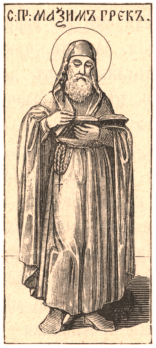
Преподобный Максим, родом Грек, по своим великим подвигам вполне принадлежит св. Русской Церкви, для которой он остаётся светильником по своим сочинениям224.
The Venerable Maximus, a Greek by birth, by his great ascetic labors belongs wholly to the holy Russian Church, for which he remains a luminary through his writings224.
Получив начальное образование в отчизне в г. Арте, где отец был знатным сановником, Максим, по любви к наукам, путешествовал по Европе: в Париже у знаменитого Грека Иоанна Ласкаря, потом во Флоренции и Венеции изучал словесные науки, историю, философию, богословие; основательно узнал языки Латинский и древний Греческий, познакомился с языками Французским и Итальянским. По возвращении в отечество, поступил на Афон и здесь в Ватопедской обители принял иночество.
Having received his elementary education in his homeland in the city of Arta, where his father was a noble dignitary, Maximus, out of love for learning, traveled through Europe: in Paris with the famous Greek John Lascaris, then in Florence and Venice he studied the literary sciences, history, philosophy, and theology; he thoroughly learned the Latin and ancient Greek languages, and became acquainted with the French and Italian languages. Upon returning to his homeland, he entered Mount Athos and there, in the Vatopedi monastery, received the monastic tonsure.
Когда великий князь Василий Иванович, желая разобрать в своей библиотеке собрание Греческих рукописей и иные видеть в переводе, просил султана и Афонское начальство прислать к нему учёного Грека, то на Максима указали, как на человека, самого способного исполнить желания великого князя225. Максиму не хотелось расстаться со св. горой и её безмолвием, но, повинуясь воле Афонских старцев, он в 1516 г. отправился в Россию; на пути время случайного пребывания в Перекопе употребил он на знакомство с Русским языком и в начале 1518 г. прибыл в Москву. Здесь принят он был ласково и ему указано жить в Чудове монастыре, на счёт великого князя. Сокровища Греческой учёности, которые увидал Максим в библиотеке Московской, привели его в восторг: сочинений, не переведённых на Славянский язык, нашлось много. На первый раз ему поручили перевести толкование на Псалтирь. В помощь ему, мало знакомому со Славянским языком, даны переводчики с Латинского Димитрий Герасимов и Власий и для письмоводства инок Сергиевой лавры Силуан и Михаил Медоварцов. Через год и 5 месяцев перевод толковой Псалтири совсем был окончен. Максима осыпали милостями, и оставили для новых трудов. По воле митрополита Варлаама и на его иждивение переведено им (в 1519 г.) толкование на книгу Деяний Апостольских. Ему поручили ещё пересмотреть Славянские Богослужебные книги. По воле великого князя, Максим принялся за исправление перевода триоди, по-прежнему при пособии переводчиков; затем пересматривал он и другие церковно-служебные книги. Грубы были ошибки, какие нашёл многосведущий Максим в церковных наших книгах, и разжигаемый, как говорил он, Божественной ревностью, очищал он плевелы обеими руками. По этой ревности резкие высказывал он отзывы о том, что видел в книгах. Но то, что видел он, видели немногие, и слепая страсть к старине принимала отзывы его за оскорбление святыни. Сначала ропот был тайный. Митрополит Варлаам, у которого испрашиваемо было разрешение на важные перемены в древних книгах, понимал преп. Максима; великий князь отличал его своей любовью. И клевета не смела открыто восставать на Максима. Советами его пользовались в делах Церкви и государства, отличая в нём человека умного и образованного, инока пламенного в любви к истине и вере. Он был усердным ходатаем за вельмож, впадавших в немилость князя, и князь внимателен был к его просьбам.
When the Grand Prince Basil Ivanovich, desiring to examine the collection of Greek manuscripts in his library and to see others in translation, asked the Sultan and the Athonite authorities to send him a learned Greek, they pointed to Maximus as the man most capable of fulfilling the Grand Prince's desire225. Maximus did not wish to part from the Holy Mountain and its silence, but, obeying the will of the Athonite elders, he set out for Russia in 1516; on the way, he used the time of his accidental stay in Perekop to become acquainted with the Russian language, and at the beginning of 1518 he arrived in Moscow. Here he was received kindly and was assigned to live in the Chudov Monastery at the Grand Prince's expense. The treasures of Greek learning that Maximus saw in the Moscow library filled him with delight: there were many works not translated into the Slavonic language. At first he was entrusted with translating a commentary on the Psalter. To assist him, who was little acquainted with the Slavonic language, translators from Latin were given—Demetrius Gerasimov and Vlasius—and for secretarial work, the monks Silouan of the Trinity-Sergius Lavra and Michael Medovartsev. After a year and five months, the translation of the commentary on the Psalter was completely finished. Maximus was showered with favors and was retained for new labors. By the will of Metropolitan Barlaam and at his expense, he translated (in 1519) a commentary on the book of the Acts of the Apostles. He was also entrusted with reviewing the Slavonic liturgical books. By the will of the Grand Prince, Maximus set about correcting the translation of the Triodion, again with the assistance of translators; afterwards he reviewed other church service books as well. Gross were the errors that the learned Maximus found in our church books, and, inflamed, as he said, with divine zeal, he cleared away the tares with both hands. Because of this zeal, he made sharp remarks about what he saw in the books. But what he saw, few saw, and a blind passion for antiquity took his remarks as an insult to sacred things. At first the murmuring was secret. Metropolitan Barlaam, from whom permission was sought for important changes in the ancient books, understood the Venerable Maximus; the Grand Prince distinguished him with his love. And slander dared not openly rise against Maximus. His advice was sought in matters of Church and state, recognizing in him an intelligent and educated man, a monk ardent in love for truth and faith. He was an earnest intercessor for nobles who had fallen into the Prince's disfavor, and the Prince was attentive to his requests.
Полный ревности к св. вере, он подал собору отцов совет принять строгие меры против жида Исаака. Митрополиту Варлааму советовал он пересмотреть Славянское собрание церковных правил, и сам начал переводить «Властареву синтагму» законов, – с древней Московской рукописи.
Full of zeal for the holy faith, he gave the council of fathers the advice to adopt strict measures against the Jew Isaac. He advised Metropolitan Barlaam to review the Slavonic collection of Church canons, and he himself began to translate the "Syntagma of Blastares" of laws—from an ancient Moscow manuscript.
В конце 1521 года правдивый и рассудительный Варлаам оставил кафедру, и его место (в февр. 1522 года) занял Даниил. Новый митрополит любил книги, но одни Славянские; любил заниматься делами веры, но не столько, сколько видами страстей. Блаженный Максим скоро понял, что не может он с прежней свободой и покоем трудиться для истины: с любовью к истине он обратился к новым предметам деятельности.
At the end of 1521, the truthful and judicious Barlaam left the see, and his place (in February 1522) was taken by Daniel. The new metropolitan loved books, but only Slavonic ones; he loved to occupy himself with matters of faith, but not so much as with the considerations of passions. The blessed Maximus soon understood that he could not labor for the truth with his former freedom and peace: with love for truth he turned to new subjects of activity.
Папа, обессиленный на западе Лютером, сильно заботился о том, чтобы распространить свою власть на северо-востоке. Легат его Николай Шонберг хитрил в Москве. Немец «к прочим лукавствам» присоединил и то, что тайно пустил в ход (в 1520 г.) слово: «о соединении руссов и латинян». Максиму достали сочинение Шонберга «о начале турков», написанное с видами папизма в защиту астрологической судьбы. Шонберг успел обольстить боярина Феодора Карпова, колебал и других; особенно мысли о фортуне, распространённые Шонбергом, производили впечатление на суеверный народ и нашли защитника себе даже в каком-то бывшем игумене. Максим восстал против лукавого немца и написал против него до 15 сочинений, преследуя козни его на всех путях. В то же время писал он против магометан и язычников. Эти труды ревности святой на время оберегали Максима от злобы раздражавшегося против него невежества, так как были не противны и духу времени. Но между трудами его не видно ни одного, который предпринял бы он лично для митрополита Даниила.
The Pope, weakened in the West by Luther, was greatly concerned to extend his authority in the northeast. His legate, Nicholas Schomberg, was intriguing in Moscow. The German "to his other wiles" added this also: that he secretly put into circulation (in 1520) a word "concerning the union of Russians and Latins." Maximus obtained Schomberg's work "On the Origin of the Turks," written with the aims of papism in defense of astrological fate. Schomberg succeeded in seducing the boyar Theodore Karpov, and was shaking others; especially the thoughts about fortune spread by Schomberg made an impression on the superstitious people and found a defender even in some former abbot. Maximus rose up against the cunning German and wrote up to 15 works against him, pursuing his machinations on all paths. At the same time, he wrote against the Mohammedans and pagans. These labors of holy zeal for a time protected Maximus from the malice of the ignorance that was being aroused against him, since they were not contrary to the spirit of the times either. But among his labors, not one is seen that he undertook personally for Metropolitan Daniel.
К 1523 г. окончены им переводы толкования св. Златоуста на Евангелия Матвея и Иоанна, но это было окончанием трудов, начатых при митрополите Варлааме. Даниилу хотелось, чтобы Максим перевёл церковную историю Феодорита. Рассудительный Максим представлял, что это сочинение, по содержащимся в нём письмам Ария и Нестория, может быть вредно «для простоты». Даниил принял такой ответ Максима за непослушание непростительное и остался в сильной досаде. Он не только не приближал к себе Максима, но, как видно по последствиям, был очень недоволен им за исправление книг, совершавшееся при Варлааме. Великий князь продолжал быть благосклонным к Максиму. Пользуясь этой любовью, Максим свободно обличал пороки в вельможах, в духовенстве, в народе. Он писал, что неприлично, не полезно, весьма опасно инокам владеть недвижимыми имуществами. Последнее сильно оскорбляло Даниила и ему подобных.
By 1523 he had completed translations of the commentary of St. Chrysostom on the Gospels of Matthew and John, but this was the completion of labors begun under Metropolitan Barlaam. Daniel wanted Maximus to translate the Church History of Theodoret. The judicious Maximus pointed out that this work, because of the letters of Arius and Nestorius contained in it, could be harmful "for the simple." Daniel took such an answer from Maximus as unpardonable disobedience and remained greatly vexed. He not only did not draw Maximus close to himself, but, as is evident from the consequences, was very displeased with him for the correction of books that had taken place under Barlaam. The Grand Prince continued to be favorable to Maximus. Taking advantage of this love, Maximus freely denounced vices in the nobles, in the clergy, and in the people. He wrote that it was unbecoming, unprofitable, and very dangerous for monks to possess immovable property. The latter greatly offended Daniel and those like him.
В 1524 г. великий князь Василий задумал развестись с добродетельной, но неплодной супругой своей Соломонией и вступить в новый брак с Еленой, – для того, чтобы иметь наследника. М. Даниил одобрял средство для цели. Но те, которые не хотели угождать людям более, чем Богу, свободно указывали великому князю на решение Спасителя. Таков был старец Вассиан, потомок князей Литовских и родственник Василия. Прямодушный Максим был тех же мыслей. Он предложил великому князю на бумаге сочинение, начинавшееся осуждением плотоугодия. «Того признавай царём истинным и самодержцем, – писал Максим Василию, кто управляет подданными по правде и закону, а бессловесные похоти и страсти старается преодолевать в себе... Кто побеждается ими в оскорбление смыслу, тот не образ одушевлённый Владыки Небесного, а бессловесное животное в виде человека». Великий князь Василий и в других случаях не любил противоречий воле его. Теперь положил он показать, что виновны несогласные с его желанием. И вот теперь-то отомстят Максиму за то, что осмелился он судить и осуждать Русское!
In 1524, the Grand Prince Basil conceived the idea of divorcing his virtuous but barren wife, Solomonia, and entering into a new marriage with Helena—in order to have an heir. Metropolitan Daniel approved of the means for the end. But those who did not wish to please men more than God freely pointed out to the Grand Prince the decision of the Savior. Such was the elder Vassian, a descendant of the Lithuanian princes and a relative of Basil. The straightforward Maximus was of the same mind. He presented to the Grand Prince in writing a composition beginning with a condemnation of fleshly indulgence. "Him do you acknowledge as a true king and autocrat," wrote Maximus to Basil, "who governs his subjects according to truth and law, and strives to overcome in himself irrational lusts and passions... He who is overcome by them to the insult of reason is not a living image of the Heavenly Master, but a speechless animal in the form of a man." The Grand Prince Basil, even on other occasions, did not like contradictions to his will. Now he resolved to show that those who disagreed with his desire were guilty. And now they would take revenge on Maximus for having dared to judge and condemn what is Russian!
В начале февраля 1525 года Максим брошен был в кандалах в темницу Симоновской обители. Прежде всего старались запутать его в дело двух бояр виновных, открыв, что они имели сношение с Максимом. Максим не скрывал, что они бывали у него для бесед; не скрывал ни того, что говорили они, ни того, что он им говорил; жалуясь на нововведения, они говорили: «страна, которая изменяет свои обычаи, долго не стоит». Максим отвечал на то: «страна, которая преступает заповеди Божии, должна ждать себе казни от Бога; а обычаи земные и царские государи изменяют по усмотрению нужды в том для государства».
At the beginning of February 1525, Maximus was thrown in chains into the dungeon of the Simonov Monastery. First of all, they tried to implicate him in the affair of two guilty boyars, revealing that they had had dealings with Maximus. Maximus did not conceal that they had visited him for conversations; he concealed neither what they said nor what he said to them; complaining about innovations, they said: "a land that changes its customs does not stand for long." Maximus replied to that: "a land that transgresses the commandments of God must expect punishment from God; but earthly and royal customs, sovereigns change as they see the need for it for the state."
То во дворце князя, то в покоях митрополита, осыпали Максима обвинениями в порче книг, оскорбительной для веры226. В судной список сочли достаточным внести одну вину Максима; в своей триоди написал он о седении Сына с Отцем: «седел еси, сидев». Максим искренно признал это за ошибку и в извинение указывал на своё тогдашнее незнание русского языка. В судном списке не записали ни сознания в ошибке, ни извинения, а записали, что, по словам Максима, разницы нет между «седе и седел» – то и другое время прошедшее227. Спешили произнести приговор: Максим еретик, портит книги. Великий князь, со своей стороны, объявил Максима виновным в том, что будто он и другой Святогорский инок Савва вели переписку с нашими и возбудили султана к войне против великого князя228. Понятно, что это такая же правда, как и то, что Максим еретик. Но Максима схватили и вывезли из Москвы так тайно, что в Москве долго не знали, жив ли он? Исповедник правды в оковах отправлен был в Волоколамскую темницу; здесь, от дыма и смрада, от оков и побоев, по временам приходил он в омертвение, но здесь же явившийся ему ангел сказал: «терпи, старец! этими муками избавишься вечных мук». Вассиан, Савва, Силуан, Медоварцов разосланы были по монастырям, под стражу. В стенах Волоколамской темницы Максим углём написал канон Духу Утешителю, поныне воспеваемый церковью.
Now in the prince's palace, now in the metropolitan's chambers, they showered Maximus with accusations of corrupting books, which was offensive to the faith226. They deemed it sufficient to enter into the indictment only one fault of Maximus: in his Triodion he wrote concerning the sitting of the Son with the Father: "Thou hast sat, having sat." Maximus sincerely acknowledged this as a mistake and, in excuse, pointed to his then ignorance of the Russian language. In the indictment they recorded neither the admission of the mistake nor the excuse, but recorded that, according to Maximus, there is no difference between "sat" and "hast sat"—both are past tense227. They hastened to pronounce sentence: Maximus is a heretic, he corrupts books. The Grand Prince, for his part, declared Maximus guilty of allegedly having, together with another monk of the Holy Mountain, Sabbas, carried on correspondence with ours and incited the Sultan to war against the Grand Prince228. It is clear that this is as much the truth as that Maximus is a heretic. But Maximus was seized and taken out of Moscow so secretly that for a long time in Moscow they did not know whether he was alive. The confessor of truth, in chains, was sent to the Volokolamsk dungeon; here, from smoke and stench, from chains and beatings, he would at times fall into a state of numbness, but here an angel appeared to him and said: "endure, elder! by these torments you will be delivered from eternal torments." Vassian, Sabbas, Silouan, and Medovartsev were sent to various monasteries under guard. Within the walls of the Volokolamsk dungeon, Maximus wrote with charcoal a canon to the Spirit the Comforter, which is still sung by the Church.
Спустя шесть лет (в 1531 г.), снова потребовали Максима к духовному суду в Москву. Это потому, что в Москве лучшие люди стали говорить за Максима и против Даниила, а сам Максим не признавал себя ни в чём виновным, когда в монастыре увещевали его каяться. Надобно было оправдать себя в жестокостях с Максимом. Имея в виду такую цель, прибрали из книг Максима всё, что можно было выставить против него; теперь успели и в том, что даже Медоварцев говорил против Максима. Но и по судному списку ошибки в поправках оказываются то ошибками писцов, то ошибками незнания русского языка. Теперь допрашивали о переводе Метафрастова жития Богоматери и старались уличить Максима в том, что будто ошибки, допущенные здесь, были прежде защищаемы Максимом. Но Максим отвечал, что Медоварцов говорит не по совести. Указывали в триоди на поправки славословий; «так было угодно митрополиту Варлааму», отвечал Максим. Выставили ошибку в книге правил, пересмотренной Максимом. Максим признал её за ошибку писца. Снова говорили: зачем вместо «седе» поправил «седел еси»? И в прежнем виде записали ответ его. В Русских книгах написано: «и в Духа Святого истинного», а ты для чего загладил истинного? Максим отвечал, что сам он не зачёркивал, а Медоварцов сказал, что, по словам Максима, нет этого слова в Греческом. Протодиакон Чушка, протопоп Афанасий и священник Василий в своём доносе писали, что Максим хулил все Русские книги, что, по его словам, в России нет ни Евангелия, ни Апостола, ни Псалтири, ни уставов. Но, очевидно, эти люди говорят против себя самих, выставляя своё невежество и злость. Максим, по его признанию, говорил, что в России книги испорчены то писцами, то переводчиками, и потому нужно поправлять и переводить их229. В заключение, блаженный Максим три раза повергался пред собором, умоляя о помиловании ради милости Божией, ради немощей человеческих, – со слезами просил простить ему ошибки, если какие и допущены им в книгах. Максима оставили и после сего суда под запрещением церковным; но не малым облегчением для него было то, что послали его в Тверь, под надзор добродушного епископа Акакия. Акакий принял его милостиво и обходился с ним приветливо, – он даже приглашал его к своей трапезе. Особенно приятно было для Максима, что он теперь мог читать книги и писать.
Six years later (in 1531), Maximus was again summoned to Moscow for an ecclesiastical trial. This was because in Moscow the best people had begun to speak for Maximus and against Daniel, and Maximus himself did not acknowledge himself guilty of anything when they exhorted him in the monastery to repent. It was necessary to justify themselves for their cruelties toward Maximus. With such a goal in mind, they gathered from Maximus's books everything that could be brought against him; now they even succeeded in having Medovartsev speak against Maximus. But even according to the indictment, the errors in the corrections turn out to be either errors of the scribes or errors due to ignorance of the Russian language. Now they interrogated him about the translation of Metaphrastes' Life of the Mother of God and tried to convict Maximus of having previously defended the errors made there. But Maximus replied that Medovartsev was not speaking according to his conscience. They pointed out in the Triodion corrections to the doxologies; "so it pleased Metropolitan Barlaam," answered Maximus. They brought forward an error in the Book of Canons, which Maximus had reviewed. Maximus acknowledged it as a scribal error. Again they said: why instead of "sat" did you correct it to "Thou hast sat"? And they recorded his answer in the same way as before. In the Russian books it is written: "and in the Holy Spirit, the true," and why did you erase "the true"? Maximus answered that he himself had not crossed it out, but Medovartsev said that, according to Maximus, this word is not in the Greek. Protodeacon Chushka, Protopope Athanasius, and Priest Basil wrote in their denunciation that Maximus blasphemed all Russian books, that, according to his words, in Russia there is neither Gospel, nor Apostle, nor Psalter, nor Typika. But obviously these people speak against themselves, displaying their own ignorance and malice. Maximus, by his own admission, said that in Russia the books are corrupted, sometimes by scribes, sometimes by translators, and therefore they need to be corrected and translated229. In conclusion, the blessed Maximus three times prostrated himself before the council, begging for mercy for the sake of God's mercy, for the sake of human infirmities—with tears he asked forgiveness for any errors, if any, that he had made in the books. Even after this trial, Maximus was left under ecclesiastical ban; but it was no small relief for him that they sent him to Tver, under the supervision of the kind-hearted Bishop Acacius. Acacius received him mercifully and treated him kindly—he even invited him to his table. It was especially pleasant for Maximus that he could now read books and write.
По смерти великого князя Василия (1534 г.), преподобный решился дать публичное оправдание в возведённых на него винах. В «Исповедании веры» он предложил своё верование, вполне православное; потом показал, что еретическими и неумными словами наполнены не те книги, которые им исправлены, а те, которые противники его считали за святыню. «Свидетель мне, – писал он, – Господь наш Иисус Христос, Бог истинный; – много у меня беззаконий, но не знаю я за собою никакой хулы против святой, христианской веры». О называвших его врагом России сказал он: «да не вменит им Господь того в согрешение тяжкое»! В заключение же умолял отпустить его в Афон, представляя и то, что суд о нём принадлежит патриарху. Но участь его не переменилась. Крамольные бояре, управлявшее Россией в малолетство Иоанна, заняты были тем, что душили друг друга. Максим лишился даже и снисходительности Акакия. По случаю пожара, истребившего (в 1537 г.) построенный Акакием великолепный храм в Твери, Максим высказал правду об Акакии и жителях Твери, и Аканий сильно прогневался на Максима.
After the death of Grand Prince Basil (1534), the Venerable One resolved to give a public justification concerning the charges brought against him. In the "Confession of Faith" he set forth his belief, which was fully Orthodox; then he showed that it was not the books which he had corrected that were filled with heretical and foolish words, but those which his opponents considered sacred. "Witness for me," he wrote, "is our Lord Jesus Christ, the true God; I have many transgressions, but I know of no blasphemy against the holy Christian faith in myself." Concerning those who called him an enemy of Russia, he said: "May the Lord not impute that to them as a grievous sin"! In conclusion he begged to be released to Athos, also pointing out that judgment over him belonged to the Patriarch. But his lot did not change. The seditious boyars who ruled Russia during the minority of John were occupied with strangling one another. Maximus even lost the indulgence of Acacius. On the occasion of a fire that destroyed (in 1537) the magnificent church built by Acacius in Tver, Maximus spoke the truth about Acacius and the inhabitants of Tver, and Acacius became greatly angered at Maximus.
В 1538 году умерла Елена; а в начале 1539 года Даниил послан в заточение. Максим за долг совести счёл примирить с собой совесть изгнанника. Узнав, что Даниил питает прежнее нерасположение к нему, он именем Отца Небесного просил оставить вражду и с глубоким смирением говорил о своей невинности. После того писал он к новому митрополиту ответ «об исправлении книг», и на имя бояр другой ответ «об исправлении Русских книг». Свобода духа и теперь была в нём прежняя. «Бог свидетель за меня недостойного пред вами благоверными; пишу вам не по лицемерию, как будто хотел льстить вам или желал получить от вас облегчение в скорби временной, которая лежит на мне уже 19 лет».
In 1538 Helen died; and at the beginning of 1539 Daniel was sent into exile. Maximus considered it a duty of conscience to reconcile the conscience of the exile with himself. Learning that Daniel still harbored his former ill-will toward him, he begged him in the name of the Heavenly Father to abandon enmity and with deep humility spoke of his own innocence. After that he wrote to the new Metropolitan a reply "concerning the correction of books," and to the boyars another reply "concerning the correction of Russian books." The freedom of his spirit was still the same as before. "God is witness for me, the unworthy one, before you who are faithful; I write to you not out of hypocrisy, as if I wished to flatter you or desired to receive from you relief in the temporal sorrow that has lain upon me for 19 years."
Блаженный митрополит Иоасаф утешил страдальца; по его благословению он мог теперь приобщаться св. таин и ходить в церковь. Это было в конце 1541 года.
The blessed Metropolitan Joasaph comforted the sufferer; by his blessing he could now partake of the Holy Mysteries and go to church. This was at the end of 1541.
В 1545 году восточные патриархи просили царя Иоанна отпустить Максима в Афон. Максим сам в письме умолял о том же. Но подозрительная политика того времени не имела обыкновения выполнять подобные просьбы. В 1551 году Троицкий игумен Артемий и добродетельные бояре упросили царя освободить Максима из Тверского заточения, и Максим, мирно принятый в Москве, с честью вступил в Сергиеву лавру. Страдалец был уже измождён тяжестью темничной жизни; но ум его был ясен. По просьбе ученика своего Нила, бывшего князя Курлятева, перевёл он с Греческого Псалтирь.
In 1545 the Eastern Patriarchs asked Tsar John to release Maximus to Athos. Maximus himself in a letter begged for the same. But the suspicious politics of that time had no custom of fulfilling such requests. In 1551 the Trinity Abbot Artemius and virtuous boyars persuaded the Tsar to free Maximus from his Tver imprisonment, and Maximus, peacefully received in Moscow, entered the Sergius Lavra with honor. The sufferer was already exhausted by the weight of his prison life; but his mind was clear. At the request of his disciple Nilus, a former Prince Kurlyatev, he translated the Psalter from the Greek.
Преподобный достиг семидесятилетней старости. Дух его, очищенный огнём скорбей и страданий, стал видеть теперь далеко. В 1553 году царь Иоанн посетил келью святого старца, слушал наставления его и объявил ему о намерении своём совершить путешествие в Кириллову обитель, в благодарность за исцеление от болезни. Старец сказал: «обет твой, царь, не согласен со здравым рассуждением. Вдовы и сироты убитых под Казанью льют слёзы, ожидая твоей помощи; собери их под царственный кров твой, и тогда все святые будут радоваться о тебе и помолятся за тебя. Бог и святые слышат нас не по месту, а по доброму изволению нашему». Царь не хотел отменять своего намерения. И св. старец просил вельможей сказать от него царю: «если не послушаешь меня, который советует тебе по воле Божьей – пренебрежёшь кровью убитых погаными, то знай – сын твой умрёт». Царь не послушался, и пророчество святого исполнилось.
The Venerable One reached seventy years of age. His spirit, purified by the fire of sorrows and sufferings, now saw far. In 1553 Tsar John visited the cell of the holy elder, listened to his instructions, and announced to him his intention to make a pilgrimage to the Cyril Monastery, in gratitude for healing from an illness. The elder said: "Your vow, O Tsar, is not in accord with sound reason. Widows and orphans of those slain near Kazan shed tears, awaiting your help; gather them under your royal roof, and then all the saints will rejoice over you and will pray for you. God and the saints hear us not according to place, but according to our good will." The Tsar did not wish to change his intention. And the holy elder asked the nobles to say to the Tsar from him: "If you do not hearken to me, who counsel you according to the will of God—if you neglect the blood of those slain by the pagans, then know—your son will die." The Tsar did not hearken, and the prophecy of the saint was fulfilled.
В следующем году царь приглашал Богомудрого старца на собор против Матвея Башкина. Св. старец отвечал, что дряхлость его не дозволяет ему быть в Москве. Царь в письме к Максиму, объяснив причину, по которой приглашает он в Москву епископов и лучших иноков, писал: «так захотелось мне послать и за тобою, дабы ты был поборником православия, по примеру первых богоносных отцов, да приимут и тебя небесные обители, как древних ревнителей благочестия, имена которых известны тебе. Итак, будь сотрудником их, умножь данный тебе Богом талант, пришли отзыв на нынешнее нечестие. Слышно, что ты оскорбляешься и думаешь, что мы посылали для того, что будто причисляем тебя к общинникам Матвея. Нет, верного не считаем мы с неверным. Оставь всякое сомнение и по данному тебе таланту пришли нам ответ на сие послание». Преподобный послал сочинение своё о почитании святых икон.
The following year the Tsar invited the God-wise elder to the council against Matthew Bashkin. The holy elder replied that his infirmity did not permit him to be in Moscow. The Tsar, in a letter to Maximus, having explained the reason for which he was summoning bishops and the best monks to Moscow, wrote: "so it pleased me to send also for you, that you might be a champion of Orthodoxy, after the example of the first God-bearing fathers, that the heavenly mansions may receive you also, like the ancient zealots of piety, whose names are known to you. Therefore, be their fellow worker, multiply the talent given you by God, send a response to the present impiety. I hear that you are offended and think that we sent for you because we supposedly number you among the partisans of Matthew. No, we do not count the faithful with the faithless. Leave aside all doubt and, according to the talent given you, send us an answer to this epistle." The Venerable One sent his composition on the veneration of holy icons.
В 1651 г. совершились одно за другим два чуда над могилой преп. Максима. Поселянин небрежно сел на могильном камне преподобного и внезапно был сброшен с него, так что расслаб всем телом. Придя в себя, приполз он к могиле в раскаянии и, когда отслужили панихиду, исцелел.
In 1651, two miracles occurred one after another at the grave of the Venerable Maximus. A peasant carelessly sat down on the gravestone of the Venerable One and was suddenly thrown from it, so that his whole body became paralyzed. Coming to himself, he crawled to the grave in repentance, and when a panikhida was served, he was healed.
В конце XVII века имя преподобного Максима писали в святцах. Святитель Платон устроил раку и часовню над гробом страдальца истины и правды230.
At the end of the 17th century, the name of the Venerable Maximus was written in the calendar of saints. St. Platon built a shrine and a chapel over the grave of the sufferer for truth and righteousness230.
Из многочисленных сочинений великого страдальца истины Особенно драгоценен для православной церкви «ответ об исправлении книг»231.
Of the numerous writings of the great sufferer for truth, the "Reply concerning the Correction of Books" is especially precious to the Orthodox Church231.
Доказав примерами, что в Славянские книги вошли многочисленные ошибки, и иные из них до того изменили точный вид подлинников, что выставляют словами своими мысли еретические, противные св. вере, св. Максим говорит: «что скажут на это те, которые так неосновательно клевещут на меня, называя меня растлителем св. писания и осуждая меня за оправдание своё? Порчу ли я книги, когда правильно поправляю не священный писания, а то, что в них составляет неодобрительную ошибку, допущенную по недоразумению, по недосмотру, по забывчивости древних переводчиков, или по невежеству и небрежности переводчиков? Пусть перестанут злословить ближнего, который трудится для славы Божьей и для пользы всякому рассудительному и правоверующему брату своему». Противники скажут: «ты делом своим наносишь оскорбление великим чудотворцам, давно прославившимся в Русской земле? Они с этими священными книгами угодили Богу и по смерти прославлены чудесами». Не я буду отвечать им, но пусть блаженный Павел вразумит их. Он говорит: «одному даётся Духом слово мудрости, другому слово знания тем же Духом; иному – вера тем же Духом, одному дар исцелений тем же Духом, другому чудесные действия; иному пророчества, другому различение духов; одному дар языков, другому истолкование языков: всё же сие совершает один и тот же Дух, разделяя властью каждому, как Ему угодно» (1Кор.12:7–11). Ясно, что не даются одному все дарования духовные. И я исповедую, что по дарованию свыше прославлены в земле Русской св. чудотворцы, и что Богоносные отцы, как были прежде, так и ныне есть; и я поклоняюсь им, как истинным угодникам Божьим. Но они не приняли свыше ни дара языков различных, ни истолкования их. Потому не до́лжно удивляться, если при их величии прошло мимо их разумения исправление описок, исправленных мною. Им, по их Апостольскому смирению, кротости и святости жизни, даны дары исцелений и чудес; другому же, хотя и грешен он больше всех, даны знание и толкование языков. И нечему тут дивиться.
Having proven with examples that numerous errors had entered the Slavonic books, and that some of them had so altered the precise form of the originals that they set forth heretical thoughts by their words, contrary to the holy faith, St. Maximus says: "What will those say to this who so baselessly slander me, calling me a corrupter of Holy Scripture and condemning me for my justification? Do I corrupt books when I rightly correct, not the sacred writings, but that which in them constitutes a reprehensible error, admitted through misunderstanding, through oversight, through forgetfulness of the ancient translators, or through the ignorance and negligence of translators? Let them cease to slander a neighbor who labors for the glory of God and for the benefit of every prudent and right-believing brother of his." The opponents will say: "Do you, by your deed, offer insult to the great wonderworkers who have long been glorified in the Russian land? They, with these sacred books, pleased God and after death were glorified by miracles." I will not answer them, but let the blessed Paul instruct them. He says: "For to one is given by the Spirit the word of wisdom; to another the word of knowledge by the same Spirit; to another faith by the same Spirit; to another gifts of healings by the same Spirit; to another the working of miracles; to another prophecy; to another the discerning of spirits; to another various kinds of tongues; to another the interpretation of tongues. But all these things are accomplished by one and the same Spirit, who apportions to each one individually as He wills" (1 Cor. 12:7–11). It is clear that not all spiritual gifts are given to one. And I confess that, by the gift from on high, the holy wonderworkers have been glorified in the Russian land, and that the God-bearing Fathers, as they were before, so also now they are; and I venerate them as true saints of God. But they did not receive from on high either the gift of various kinds of tongues or the interpretation of them. Therefore, one ought not to wonder if, in their greatness, the correction of copyists' errors, which I have corrected, passed beyond their understanding. To them, according to their Apostolic humility, meekness, and holiness of life, gifts of healings and miracles were given; to another, though he be more sinful than all, knowledge and interpretation of tongues were given. And there is nothing here to wonder at.
Иноплеменник Иофор вразумил Моисея об избрании старейшин. Чудный Макарий, после молитвы, не был ли вразумлён отроком пастухом о том, как надобно принимать пищу? Он ещё выслушал и укоризну: или ты осёл, авво? Таковы все искренние угодники Божьи. Они со смирением ищут и с признательностью выслушивают всякого, кто говорит полезное... Честный пресвитер, за незлобие и чистую жизнь, удостоен был благодатью зреть стоящим и служащим ему Ангела; но не был ли он исправлен диаконом, пришедшим из Константинограда? Несколько лет по неведенью погрешал он, повторяя слова Севировой ереси при св. тайнах. Он спрашивал Ангела, почему столько лет, стоя близь него, молчал он о таком согрешении его? И услышал ответ: так Бог положил, что человека исправляет человек. Так бывшим во времена гонений святейшим архиереям и мученикам ни малого не наносили оскорбления или поношения бывшие после них разные исправления св. писания ветхого завета, совершавшиеся Симмахом, Феодотионом, Акилой и Лукианом, пресвитером Антиохийским, из которых каждый исправлял недосмотренное прежними переводчиками232.
The foreigner Jethro instructed Moses concerning the choosing of elders. Was not the wondrous Macarius, after prayer, instructed by a shepherd boy about how he ought to take food? He even heard the reproach: "Are you an ass, Abba?" Such are all sincere saints of God. They seek with humility and listen with gratitude to anyone who speaks what is profitable... A worthy presbyter, for his guilelessness and pure life, was vouchsafed by grace to see an Angel standing and serving him; but was he not corrected by a deacon who came from Constantinople? For several years, through ignorance, he erred, repeating the words of the Severian heresy at the Holy Mysteries. He asked the Angel why, standing near him for so many years, he had remained silent about such a sin of his. And he heard the answer: Thus God has ordained, that man corrects man. Thus, the most holy hierarchs and martyrs who lived in times of persecution suffered no small insult or reproach from the various corrections of the Holy Scripture of the Old Testament made after them by Symmachus, Theodotion, Aquila, and Lucian, the presbyter of Antioch, each of whom corrected what had been overlooked by previous translators232.
В другом сочинении, показав в одном Славянском сочинении суеверные мысли, блаженный учитель говорит: «не сказал ли я правду в самом начале, что великое зло не знать Богодухновенных писаний и неосмотрительно принимать всякое писание? Если бы странные мудрецы нашего последнего времени умели правильно и рассудительно испытывать писания Апостолов и Евангелистов, то не принимали бы так скоро всякое невежественное и не свидетельствованное писание»233.
In another work, having shown superstitious thoughts in one Slavonic composition, the blessed teacher says: "Did I not speak the truth at the very beginning, that it is a great evil not to know the God-inspired writings and to accept every writing without discernment? If the strange wise men of our latter time knew how to examine the writings of the Apostles and Evangelists correctly and with discernment, they would not so quickly accept every ignorant and unattested writing"233.
«Сказание о том, что надобно в точном виде сохранять исповедание православной веры», обличает изменявших нечто в Символе Веры. Преподобный пишет: «не говори, что не велика разница в мудровании, на которое осмеливаетесь. Вы подвергаете себя анафеме, изменяя Богодухновенные слова – „из Марии“, а не „Марии“, и „чаем“, а не „чаю“, и жизнь „будущая веки“, а не „будущего века“».
The "Discourse on the Necessity of Preserving the Confession of the Orthodox Faith in its Exact Form" denounces those who altered something in the Symbol of Faith. The Venerable One writes: "Do not say that there is no great difference in the opinion which you dare to hold. You subject yourselves to anathema by changing the God-inspired words – 'of Mary' and not 'Mary,' and 'we await' and not 'I await,' and life 'of the ages to come' and not 'of the age to come.'"
Письмо в. к. в Афон и ответ Афонцев, напеч. в 5 кн. Врем. общ. ист. М. 1830 года.
The letter of the Grand Prince to Athos and the response of the Athonites, printed in Book 5 of the Proceedings of the Society of Russian History and Antiquities, Moscow, 1830.
Продол. Нестора (М. 1784): «того же месяца (в котором прощён Воротынский; а он прощён в феврале 1525 г. Соб. грам. 1. № 154) бысть у вел. князя собор». Список с судного дела: «митрополит (Даниил) велел (1531 г.) Досифею, владыке Крутицкому, спрашивати Максима, что было взыскание и соборы на Максима и на Савву у вел. князя на дворе, в палате; тоже потом соборы многие были у митрополита в палате его, лета 7033 (1525) на Максима о тех хулах, которые прибыли и взыскавшася месяца апреля и месяца маия». Чтен. общ. ист. № 9. М. 1847. Обвинители Максима, по воле Даниила, Чудовский архимандрит Иона и Вассиан Топорко, монах Волоколамский, который вслед за тем, апр. 2 дня 1525 г., посвящён был в Коломенского епископа. Синод. ркп. № 347. Карамз. 7. пр. 331. 383.
Continuation of Nestor (Moscow, 1784): "In the same month (in which Vorotynsky was pardoned; and he was pardoned in February 1525. Collection of State Charters, 1. No. 154) there was a council with the Grand Prince." A copy of the trial record: "The Metropolitan (Daniel) ordered (in 1531) Dosifei, Bishop of Krutitsy, to question Maximus about what inquiries and councils concerning Maximus and Sabbas had taken place at the Grand Prince's court, in the chamber; likewise, many councils were afterwards held at the Metropolitan's in his chamber, in the year 7033 (1525) concerning Maximus, about those blasphemies which had come to light and been investigated in the month of April and the month of May." Readings of the Society of Russian History and Antiquities, No. 9, Moscow, 1847. The accusers of Maximus, by the will of Daniel, were the Archimandrite of the Chudov Monastery, Jonah, and Vassian Toporko, a monk of Volokolamsk, who immediately thereafter, on April 2, 1525, was consecrated Bishop of Kolomna. Synodal manuscript No. 347. Karamzin, History of the Russian State, Vol. 7, notes 331, 383.
Месяцеслов Сергиевой лавры, стр. 3, 48. М. 1850 г. Здесь: «21 янв. память пр. Максима Грека». Ркп. святцы: «Преп. Максим Грек Афонския горы преставися в л. 7064».
Menologion of the Holy Trinity–St. Sergius Lavra, pp. 3, 48. Moscow, 1850. Here: "January 21, commemoration of the Venerable Maximus the Greek." Manuscript calendar of saints: "The Venerable Maximus the Greek of Mount Athos reposed in the year 7064."
Подробное рассмотрение сочинений преп. Максима в Москвитянине 1842 г. № 11, стр. 65–96, где два и напечатаны; в обзоре дух. литер. § 130 полный перечень.
A detailed examination of the writings of the Venerable Maximus in The Muscovite for 1842, No. 11, pp. 65–96, where two of them are also printed; in Survey of Russian Spiritual Literature, §130, a complete list.