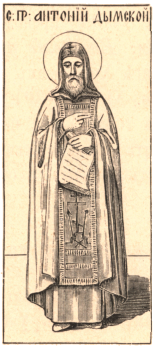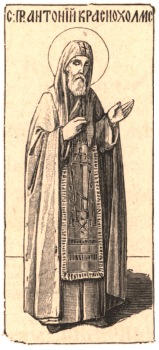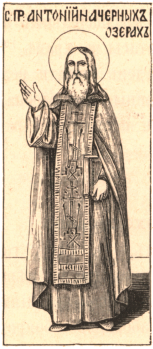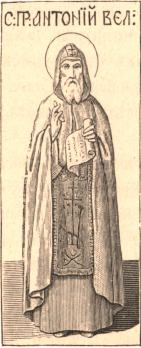
Сей великий подвижник Церкви Христовой родился в 252 году в Египте, от благочестивых христианских и знатных родителей, которые и его воспитали в правилах веры и благочестия, необходимых для истинного христианина. Ещё в летах юности храм Божий, где мог Антоний слышать учение Иисуса Христа, Апостолов и других святых, был единственным для Антония прибежищем, доставлявшим наслаждение его душе. По смерти родителей своих, 18 лет, сделавшись наследником богатого имения и питателем юной сестры своей, Антоний, призываемый Промыслом на высшую степень благочестия, обеспечил положение сестры своей и, согласно внушениям Евангелия (Мф.6:36, 19:21), раздав книги и бо́льшую часть имения соседям и бедным, оставил кров родительский для благочестивого уединения, имея около 20 лет от роду. «Я прежде слышал, – говорит блаженный Августин, – что св. Антоний призван был гласом Евангелия, во время чтения которого он как бы нечаянно узнал и обратил к себе следующие, тогда читаемые слова: иди, продаждь имение твое и даждь нищим и имети имаши сокровище на небеси (Мф.19:21). Так Твоё откровение, Боже мой, обратило его к Тебе». «Глас Христов услышав, – говорит о св. Антонии прав. Церковь, – шествовал вослед Его заповедей и отверг все заботы, стяжание имений и любление рабов и сестры. Един в пустынях, чистейше беседуя Богу, приял благодать разума».
This great ascetic of the Church of Christ was born in the year 252 in Egypt, of pious Christian and noble parents, who raised him in the rules of faith and piety necessary for a true Christian. Even in the years of his youth, the temple of God, where Anthony could hear the teaching of Jesus Christ, the Apostles, and other saints, was for Anthony the sole refuge, affording delight to his soul. Upon the death of his parents, at eighteen years of age, having become heir to a rich estate and the guardian of his young sister, Anthony, called by Providence to a higher degree of piety, secured his sister's position and, according to the injunctions of the Gospel (Mt. 6:36, 19:21), having distributed his books and the greater part of his estate to his neighbors and the poor, left his parental home for pious solitude, being about twenty years old. "I have heard before," says blessed Augustine, "that St. Anthony was called by the voice of the Gospel, during the reading of which he, as if by chance, learned and applied to himself the following words then being read: Go, sell thy possessions and give to the poor, and thou shalt have treasure in heaven (Mt. 19:21). Thus Thy revelation, O my God, turned him to Thee." "Hearing the voice of Christ," says the Orthodox Church of St. Anthony, "he followed after His commandments and cast off all cares, the acquisition of possessions, and love for slaves and sister. Alone in the deserts, conversing most purely with God, he received the grace of understanding."
Удаляясь от мира, Антоний поселился сначала близ места рождения своего и подвизался под руководством одного старца, с молодых лет проводившего уединённую жизнь. Горя желанием высшего духовного совершенства, Антоний, постепенно преуспевая в благочестии, укрывался от общества далее и строже, вглубь пустыни Фиваидской; всё тщание прилагал к трудам подвижническим. Слыша, что праздный ниже да яст (2Фес.3:10), преподобный работал собственными своими руками, и иное издерживал на хлеб себе, иное же на нуждающихся. Молился он часто, зная, что до́лжно наедине молиться непрестанно (1Фес.5:17); был внимателен к читаемому, так что ни одно слово Писания не падало у него на землю, но всё удерживал он в себе, почему наконец память заменила ему книги. Столько неутомим был в бдении, что часто целую ночь проводил без сна. Пищу вкушал однажды в день по захождению солнца, иногда принимал её через два дня, а нередко и через четыре. Пищей его служили хлеб и соль и питием – одна вода. О мясе и вине не нужно и говорить, потому что и у других подвижников едва ли встретишь что-либо подобное. Во время сна Антоний возлегал на рогоже, а большей частью – на голой земле. Никогда не умащал себя елеем.
Withdrawing from the world, Anthony first settled near his birthplace and struggled under the guidance of an elder who from his youth had led a solitary life. Burning with desire for higher spiritual perfection, Anthony, gradually advancing in piety, withdrew from society ever farther and more strictly, into the depths of the Thebaid desert; he applied all diligence to ascetic labors. Hearing that he who is idle should not eat (2 Thess. 3:10), the Venerable One worked with his own hands, spending some on bread for himself and some on the needy. He prayed often, knowing that one ought to pray in secret without ceasing (1 Thess. 5:17); he was attentive to what was read, so that not a single word of Scripture fell to the ground, but he retained all within himself, wherefore in the end memory served him in place of books. He was so indefatigable in vigil that he often spent the whole night without sleep. He partook of food once a day after sunset, sometimes receiving it after two days, and not infrequently after four. His food was bread and salt, and his drink only water. Of meat and wine there is no need to speak, because even among other ascetics one would scarcely find anything of the sort. During sleep, Anthony lay on a mat, and for the most part on the bare ground. He never anointed himself with oil.
Общество благочестивых, привлекаемое славой пустынных подвигов Антония, текло вслед его и населяло безмолвную пустыню. Антоний сделался основателем пустынножития. До Павла Фивейского и Антония преподобные подвизались в мире, – в местах своего рождения или близ оных, ведя жизнь более затворническую. Но преп. Антоний, подражая древним пророкам и пустынножителям Илии и Крестителю, подобно Павлу Фивейскому, сделался в своё время подвижником и, как говорит Церковь, «первым украсителем пустыни, началообразным начертанием добродетельного жития». Антоний убедил многих избрать иноческую жизнь, и таким образом при горах Египетских явились монастыри; пустыня населена иноками. Антоний, как отец, сделался руководителем многих иноков.
The company of the pious, attracted by the fame of Anthony's desert struggles, flowed after him and populated the silent desert. Anthony became the founder of desert-dwelling. Before Paul of Thebes and Anthony, the Venerable Ones struggled in the world—in their places of birth or near them, leading a more reclusive life. But the Venerable Anthony, imitating the ancient prophets and desert-dwellers Elijah and the Baptist, like Paul of Thebes, became in his time an ascetic and, as the Church says, "the first adorner of the desert, the primordial outline of the virtuous life." Anthony persuaded many to choose the monastic life, and thus monasteries appeared near the mountains of Egypt; the desert was populated by monks. Anthony, as a father, became the guide of many monks.
Для иноков Антоний был истолкователем монашеской жизни не только своим поведением, но и писанием. В руководство иноков Антоний написал правила для монахов (LXXX); поучения или слова к монахам (XX); разные постановления монахам; изложение некоторых мыслей и ответы на разные вопросы; стезю мудрости и многие письма.
For the monks, Anthony was an interpreter of the monastic life not only by his conduct, but also by his writings. For the guidance of monks, Anthony wrote Rules for Monks (LXXX); teachings or Discourses to Monks (XX); Various Ordinances for Monks; An Exposition of Certain Thoughts and Answers to Various Questions; The Path of Wisdom; and Many Letters.
«Паче всего, – заповедует Антоний инокам, – да будет у всех общее попечение о том, чтобы, начав, не ослабевать в деле, не говорить: давно мы подвизаемся. Взирая на мир, не будем думать, что отреклись мы от чего-либо великого. Вся земля эта очень мала пред целым небом. Если бы мы были обладателями всей земли и отреклись от всей земли, то и это не было бы равноценно Небесному Царству. Никто из нас да не питает в себе пожелания приобретать. Какая выгода приобретать то, чего не возьмём с собой. Монаху до́лжно непрестанно молиться, не смотря ни на время, ни на место, ни на занятия. Слова: Господи мой, Иисусе Христе, пошли мне помощь! и проч. до́лжно ему непрестанно иметь в уме. Кроме того надобно ему неопустительно ходить к Богослужению и притом с первым зовом. Как кающийся грешник, монах обязан денно-нощно сокрушаться и печалиться о грехах своих, как бы всегда в келье его был умерший. Время проводить ему надобно в молчании; ходить с лицом всегда печальным, с поникшей головой, не обращая лица своего по сторонам; ослаблять тело, не есть до сытости, спать мало. Как рыбы, оставаясь долго на суше, умирают, – так и монахи, находясь долго вне кельи или пребывая с мирскими людьми, теряют любовь к безмолвию. Посему как рыба рвётся в воду, так и мы должны спешить в келью, дабы, оставаясь вне её, не забыть о внутреннем бдении. Кто живёт в пустыне и в безмолвии, тот свободен от трёх искушений: от искушения слуха, языка и взора; у него одно только искушение, – искушение в сердце».
"Above all," Anthony enjoins the monks, "let there be a common concern among all, that having begun, they not grow slack in the work, nor say: we have been struggling for a long time. Looking upon the world, let us not think that we have renounced anything great. All this earth is very small before the whole heaven. If we were possessors of the whole earth and renounced the whole earth, even this would not be equal in value to the Heavenly Kingdom. Let none of us nourish within himself the desire to acquire. What profit is there in acquiring what we shall not take with us? A monk ought to pray unceasingly, regardless of time, place, or occupation. The words: 'My Lord, Jesus Christ, send me help!' and so forth, he ought to have continually in his mind. Besides this, he must unfailingly go to the Divine Service, and moreover at the first call. As a penitent sinner, the monk is obliged day and night to be contrite and sorrowful over his sins, as though a dead man were always in his cell. He ought to spend his time in silence; to walk with a face always sorrowful, with downcast head, not turning his face to the sides; to mortify the body, not to eat to fullness, to sleep little. As fish, remaining long on dry land, die, so monks, remaining long outside the cell or dwelling with worldly people, lose their love for silence. Therefore, as the fish yearns for the water, so we must hasten to the cell, lest, remaining outside it, we forget the inner vigil. He who lives in the desert and in silence is free from three temptations: from the temptation of hearing, of the tongue, and of sight; he has only one temptation—the temptation in the heart."
«Не приходите в страх, слыша о добродетели. Она не далеко от нас, не вне нас образуется. Еллины, чтобы обучаться словесным наукам, предпринимают дальние путешествия, переплывают моря, а нам нет нужды ходить далеко ради Царствия Небесного, или переплывать море ради добродетели. Господь ещё прежде сказал: Царствие Небесное внутрь вас есть (Лк.17:21). Поэтому добродетель имеет потребность в нашей только воле. Добродетель образуется в душе, у которой разумные силы действуют согласно с её естеством».
"Do not be afraid when you hear of virtue. It is not far from us, nor is it formed outside us. The pagans, to learn the verbal sciences, undertake distant journeys and cross seas, but we have no need to go far for the sake of the Heavenly Kingdom, or to cross the sea for the sake of virtue. The Lord said beforehand: The Kingdom of Heaven is within you (Lk. 17:21). Therefore virtue has need only of our will. Virtue is formed in the soul whose rational faculties act in accordance with its nature."
Некто из мудрецов спросил Антония: как ты живёшь, отец, лишённый утешения от книг? Преподобный отвечал: «моя книга есть природа вещей; она всегда готова, как скоро мне захочется читать слово Божие». Благочестивому и мудрому слепцу Дидиму Антоний сказал: «не смущайся, Дидим, что лишился чувственного зрения. У тебя не стало глаз, которыми смотрят комары и мошки: лучше радуйся, что имеешь глаза, которыми смотрят Ангелы, созерцается Бог и воспринимается свет Его».
A certain wise man asked Anthony: How do you live, Father, deprived of the consolation of books? The Venerable One answered: "My book is the nature of things; it is always ready, whenever I wish to read the word of God." To the pious and wise blind man Didymus, Anthony said: "Do not be troubled, Didymus, that you have lost bodily sight. You have lost the eyes with which gnats and flies see; rather rejoice that you have the eyes with which Angels see, by which God is contemplated and His light is perceived."
«Нам потребны, – говорит Антоний, – усильная молитва и подвиги, чтобы, прияв от Духа дарование рассуждения духовом (1Кор.12:10), можно было узнать о демонах. Они всякому христианину, наипаче же монаху трудолюбивому, покушаются положить соблазны через лукавые помыслы, стараются устрашить мечтательными привидениями и коварным велеречием, обмануть подобием образа благоговейного. Но не до́лжно нам бояться их, потому что они бессильны и не могут ничего более сделать, как только угрожать. Нетрудно распознать присутствие Ангелов от демонов. Видение святых бывает невозмутительно и сопровождается радостно. Много раз ублажали меня демоны, а я заклинал их именем Господним».
"We need," says Anthony, "intense prayer and struggles, so that, having received from the Spirit the gift of discerning of spirits (1 Cor. 12:10), we may be able to know about demons. They attempt to place stumbling blocks before every Christian, and especially before the labor-loving monk, through evil thoughts; they try to frighten with imaginary apparitions and crafty eloquence, to deceive by the likeness of a reverent image. But we ought not to fear them, for they are powerless and can do nothing more than threaten. It is not difficult to discern the presence of Angels from that of demons. The vision of the saints is undisturbed and accompanied by joy. Many times the demons have flattered me, but I adjured them by the name of the Lord."
Антоний столько любил уединение, что в продолжение 85-летних подвигов своих два раза только оставлял пустыню и являлся в Александрию, призываемый обязанностью ревнителя веры и благочестия. В первый раз пришёл он в Александрию во время последнего гонения христиан, воздвигнутого Диоклитианом и Максимианом в 303 году, для помощи, утешения и участия в страданиях св. мучеников. Но Бог сохранил светильника веры и возвратил на путь пустынных великих его подвигов веры. В другой раз в 335 году приходил Антоний в Александрию, чтобы оправдать себя в клевете от ариан, которые говорили, будто бы и он следует их учению, и показать, что он не имеет общения с раскольниками и лжеучителями.
Anthony so loved solitude that during the course of his eighty-five-year struggles he only twice left the desert and appeared in Alexandria, called by the duty of a zealot for faith and piety. The first time he came to Alexandria was during the last persecution of Christians, raised by Diocletian and Maximian in the year 303, to help, comfort, and share in the sufferings of the holy martyrs. But God preserved the lamp of faith and returned him to the path of his great desert struggles of faith. The second time, in the year 335, Anthony came to Alexandria to clear himself of slander from the Arians, who said that he too followed their teaching, and to show that he had no communion with schismatics and false teachers.
При своей суровой и пустынной жизни преп. Антоний к другим всегда был ласков и человеколюбив, благоразумен и твёрд, в обращении кроток и приятен, в беседах терпелив, в защищении обижаемых неутомим, за которых, он ходатайствовал пред городскими начальниками; св. Афанасия Александрийского, гонимого арианами, часто посещал и неоднократно писал о нём к равноапостольному Константину.
Despite his harsh and desert life, the Venerable Anthony was always affectionate and philanthropic toward others, prudent and firm, gentle and pleasant in manner, patient in conversation, indefatigable in defending the wronged, for whom he interceded before the city authorities; he often visited St. Athanasius of Alexandria, persecuted by the Arians, and wrote about him repeatedly to the Equal-to-the-Apostles Constantine.
Скрываясь от людей, Антоний не скрыл, однако ж, своей славы от мира. Слава святой его жизни была столь велика, что когда приходил он в Александрию, особенно в последний раз, все жители города сбегались видеть Антония. Даже язычники и жрецы их приходили в храм Господень, говоря: желаем видеть человека Божия. Ибо так называли его все. Многие даже из язычников желали хоть прикоснуться только к старцу, в той уверенности, что получат от него пользу. И действительно, в сии немногие дни столько обратилось в христианство, сколько в иные времена обращалось в продолжение года. Император Константин Великий и дети его уважали великого пустынника, как отца, просили его прийти к себе, или прислать им благословение. Слава его при конце его подвигов пронеслась во всех странах, в Африке, Испании, Галлии и Италии.
Hiding from men, Anthony nevertheless did not conceal his glory from the world. The fame of his holy life was so great that when he came to Alexandria, especially the last time, all the inhabitants of the city ran together to see Anthony. Even the pagans and their priests came to the temple of the Lord, saying: We wish to see the man of God. For so all called him. Many even of the pagans desired only to touch the elder, in the confidence that they would receive benefit from him. And indeed, in those few days as many turned to Christianity as in other times turned in the course of a year. The Emperor Constantine the Great and his sons respected the great desert-dweller as a father, asking him to come to them, or to send them his blessing. His fame at the end of his struggles spread throughout all lands: in Africa, Spain, Gaul, and Italy.
Великий подвижник Египетский после 85-летних пустынных подвигов мирно преставился на 105 году от роду, в 358 году по Р.X. Честное тело Антония, по завещанию его, предано земле учениками его в прославленной им пустыне, – в сокровенном месте. Современник Антония св. Афанасий, епископ Александрийский, который был другом Антония и которому завещал Антоний свою милоть и ризу, написал о его примерном и назидательном житие. По словам, св. Афанасия, «жизнь Антония есть образец подвижничества; все знавшие Антония называли его Боголюбивым, человеком Божьим. Антоний был истинный Богоносец, имевший благодатные дары прозорливости, целения, совета и различения духов. Он дарован был Богом Египту как врач, отец и руководитель. Всюду говорили о нём, все удивлялись ему, даже не видавшие любили его, – и это служит доказательством его добродетели и Боголюбивой души. Лицо Антония было выражением его св. души – имело великую и необычайную приятность, так что не знавшие его прямо подходили к нему. Поелику душа его была безмятежна, то внешние чувства оставались невозмутимы. Весьма чуден был по вере и благочестив; никогда не имел общения с отщепенцами и еретиками; был готов умереть за Христа. По блаженном успении Антония каждый из получивших милоть и изношенную одежду его – хранит, как нечто великое. Ибо взирать на сие значит как бы видеть самого Антония».
The great ascetic of Egypt, after eighty-five years of desert struggles, peacefully reposed in the 105th year of his life, in the year 358 A.D. The honorable body of Anthony, according to his testament, was committed to the earth by his disciples in the desert he had glorified—in a hidden place. A contemporary of Anthony, St. Athanasius, Bishop of Alexandria, who was a friend of Anthony and to whom Anthony bequeathed his mantle and cloak, wrote about his exemplary and instructive life. According to the words of St. Athanasius, "The life of Anthony is a model of asceticism; all who knew Anthony called him God-loving, a man of God. Anthony was a true God-bearer, possessing the grace-given gifts of clairvoyance, healing, counsel, and discernment of spirits. He was given by God to Egypt as a physician, father, and guide. Everywhere they spoke of him, all marveled at him, even those who had not seen him loved him—and this serves as proof of his virtue and God-loving soul. The face of Anthony was an expression of his holy soul—it possessed great and extraordinary pleasantness, so that those who did not know him would approach him directly. Since his soul was serene, his outward senses remained undisturbed. He was most wondrous in faith and pious; he never had communion with schismatics and heretics; he was ready to die for Christ. After the blessed repose of Anthony, each one who received his mantle and worn-out garment keeps it as something great. For to look upon these is as if to see Anthony himself."
Св. Иоанн Златоуст говорит о нём: «Египет произвёл славнейшего после Апостолов мужа, блаженного и великого Антония, о котором все доныне говорят непрестанно, что он предсказал о недугующих Ариевым зловерием и о вреде, который имел от него произойти». С особенным уважением также упоминает о св. Антонии Иероним, называя его блаженным, о коем слава распространилась по всему Египту.
St. John Chrysostom says of him: "Egypt produced a man most glorious after the Apostles, the blessed and great Anthony, of whom all speak unceasingly even to this day, that he foretold concerning those afflicted with the evil belief of Arius and the harm that was to come from him." Jerome also mentions St. Anthony with particular respect, calling him blessed, whose fame spread throughout all Egypt.
Созомен пишет об Антонии: «все согласны, что монашеский образ жизни на высоту строгости и совершенства, своими правами и приличными упражнениями, возвёл монах Антоний Великий». Феодорит говорит: «много сияло вождей иноческого жития, но превосходнейшим руководителем в исполнении подвижнических уставов был многохвальный Антоний». Имя Великого усвоено было Антонию при жизни его.
Sozomen writes of Anthony: "All agree that the monastic way of life was raised to the height of strictness and perfection, with its rules and fitting exercises, by the monk Anthony the Great." Theodoret says: "Many leaders of the monastic life shone forth, but the most excellent guide in the fulfillment of ascetic statutes was the much-praised Anthony." The name "Great" was ascribed to Anthony during his lifetime.
Память преп. Антония тотчас по смерти его стали творить иноки его обители. В V веке Анатолий Константинопольский предал Церкви некоторые песнопения для прославления св. Антония Великого. Кирилл Скифопольский, писатель VI века, упоминает о празднике в честь св. Антония Великого, бывшем в монастыре св. Евфимия. В 544 году мощи Антония Великого перенесены из пустыни в Александрию. В IX веке. Феофан и Студит умножили священные песнопения Церкви на день св. Антония. В начальных буквах канона преподобному Феофан заключил речение: «Антония божественного восхвалити лепо».
The memory of Venerable Anthony began to be celebrated by the monks of his monastery immediately after his death. In the 5th century, Anatolius of Constantinople delivered to the Church certain hymns for the glorification of St. Anthony the Great. Cyril of Scythopolis, a writer of the 6th century, mentions a feast in honor of St. Anthony the Great that took place in the monastery of St. Euthymius. In 544, the relics of Anthony the Great were transferred from the desert to Alexandria. In the 9th century, Theophanes and the Studite increased the sacred hymns of the Church for the day of St. Anthony. In the initial letters of the canon to the Venerable One, Theophanes enclosed the saying: "It is fitting to praise the divine Anthony."
Церковь между прочим почитает Антония покровителем немощных, называя его «искуснейшим и честным врачом недугующих».
The Church, among other things, honors Anthony as the protector of the infirm, calling him "the most skillful and honorable physician of the ailing."
При Богослужении в день памяти св. Антония Великого Церковь произносит паримии (первую из Прем.5:15–16; вторую из Прем.3:1–9; третью из Прем.4:7, 16–20, 5:1–17) о блаженной участи преподобных как в этой, так и в вечной жизни. Евангелие утреннее благовествует о благом и лёгком иге Христовом, которое возложили на себя преподобные (Мф.11:27–30); на литургии чтение – Апостола и Евангелия то же, какое положено в день святителя Алексия, митрополита Всероссийского, 12 февраля. Ибо и преподобный Антоний есть пастырь и отец.
During the divine service on the day of the memory of St. Anthony the Great, the Church pronounces paroemia (the first from Wis. 5:15–16; the second from Wis. 3:1–9; the third from Wis. 4:7, 16–20, 5:1–17) concerning the blessed lot of the venerable ones both in this life and in eternal life. The Morning Gospel proclaims the good and easy yoke of Christ, which the venerable ones took upon themselves (Mt. 11:27–30); at the Divine Liturgy, the reading of the Apostle and Gospel is the same as that appointed for the day of St. Alexis, Metropolitan of All Russia, on February 12. For the Venerable Anthony is also a shepherd and father.