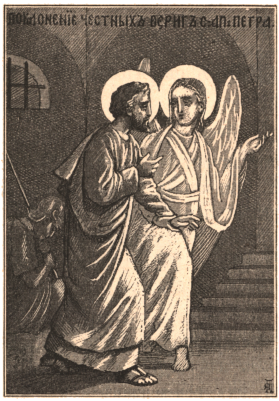
Во время гонения на юную Иерусалимскую Церковь, воздвигнутого Иродом Агриппой, царём Иудейским, около 42 года по Р.X., ревностный проповедник Евангелия – Апостол Пётр закован был в цепи и заключён в темницу. Ночью, накануне того дня, в который положено было вывести Апостола на суд к народу, Ангел чудесно освободил Петра от оков и темницы (Деян.12). Слух о чудесном освобождении Петра немедленно распространился в Иерусалиме; благочестивые ученики его стяжали себе, как драгоценность и святыню, цепи или вериги св. узника и с уважением хранили, передавая их, при кончине своей, преемственно один другому. Верующие получали от них исцеления, как от платков и полотенец, бывших на теле Ап. Павла (Деян.19:12).
During the persecution raised against the young Church of Jerusalem by Herod Agrippa, king of the Jews, around A.D. 42, the zealous preacher of the Gospel, the Apostle Peter, was bound in chains and cast into prison. On the night before the day appointed to bring the Apostle before the people for judgment, an angel miraculously freed Peter from his bonds and from the prison (Acts 12). The report of Peter's miraculous deliverance immediately spread throughout Jerusalem; his pious disciples obtained for themselves, as a treasure and a sacred object, the chains or fetters of the holy prisoner and preserved them with reverence, passing them on, at their death, successively one to another. Believers received healings from them, as from the handkerchiefs and aprons that had touched the body of the Apostle Paul (Acts 19:12).
Императрица Евдокия, супруга Феодосия II (408–450), по обету своему бывши в Иерусалиме для поклонения св. местам, получила от Иерусалимского патриарха Ювеналия между духовными сокровищами и чудотворные вериги Ап. Петра. Пришедши в Константинополь, она одну из них в 439 году послала в дар дочери своей Евдоксии, супруге Римского императора Валентиниана III (423–460), а другую в том же году положила в Царьграде, – в церкви св. Апостолов. Евдокия соорудила в Риме храм в честь вериг Ап. Петра.
The Empress Eudocia, wife of Theodosius II (408–450), having been in Jerusalem according to her vow to venerate the holy places, received from Patriarch Juvenal of Jerusalem, among spiritual treasures, also the wonderworking chains of the Apostle Peter. Upon arriving in Constantinople, she sent one of them in the year 439 as a gift to her daughter Eudoxia, wife of the Roman Emperor Valentinian III (423–460), and the other she placed in the same year in Constantinople, in the Church of the Holy Apostles. Eudocia built a church in Rome in honor of the chains of the Apostle Peter.
Между тем в Риме обретены и другие вериги Ап. Петра, которые там возложены были на него по повелению Нерона, осудившего его на смерть. В VΙ веке с благоговением писал о части вериг Ап. Петра св. Григорий Двоеслов к Динамию Патрицию. «Послал я к тебе в благословение от первоверховного Апостола небольшой крест с частицами вериг Апостола, – говорит святитель, – дабы вериги сии, недолго державшие его в узах, освободили тебя навсегда от грехов».
Meanwhile, in Rome, other chains of the Apostle Peter were discovered, which had been placed upon him there by order of Nero, who had condemned him to death. In the VI century, St. Gregory the Dialogist wrote with reverence to Dynamius the Patrician concerning a portion of the chains of the Apostle Peter. "I have sent to you as a blessing from the foremost Apostle a small cross with particles of the Apostle's chains," says the Hierarch, "so that these chains, which held him in bonds but a short time, may free you forever from sins."
В честь сих вериг, обретённых в Иерусалиме и Риме, установлено 16 января поклонение им. Оно началось на Востоке и Западе почти в одно время, и с IV века делается уже известным.
In honor of these chains, discovered in Jerusalem and in Rome, the veneration of them was established on January 16. It began in the East and the West almost at the same time, and from the IV century it became known.
О нём упоминает блаженный Иероним в письме своём к Евстохию. В древних Русских летописях 16 день января называется днём спадания вериг, ибо Писание свидетельствует, что они спадоша с Петра.
Blessed Jerome mentions it in his letter to Eustochium. In ancient Russian chronicles, the 16th day of January is called the day of the falling off of the chains, for Scripture testifies that they fell off from Peter.
В день поклонения веригам Ап. Петра православная Церковь прославляет Апостола, который «Рима не оставль к нам пришел (в Царьград) честными веригами, яже носил; того верою целуем вериги».
On the day of the veneration of the chains of the Apostle Peter, the Orthodox Church glorifies the Apostle, who "hath not left Rome but hath come to us (to Constantinople) through his venerable chains which he wore; with faith we kiss his chains."
На литургии чтением Апостола Церковь упоминает о веригах, кои возложены были на Ап. Петра в Иерусалиме (Деян.12:1–11); Евангелием благовествует о восстановлении Ап. Петра в звании Апостола и о его мученической смерти.
At the Divine Liturgy, by the reading of the Apostle, the Church makes mention of the chains that were placed upon the Apostle Peter in Jerusalem (Acts 12:1–11); by the Gospel it proclaims the restoration of the Apostle Peter to his Apostolic rank and his martyr's death.
Местом родины преп. Ромила192 был Бдин (Виддин); мать его была Болгарка. Достаточное состояние родителей доставило ему способы получить хорошее образование. В Терновском монастыре Устье, расположенном за городом на святой горе, полагал он начало монашеской жизни; тут было тогда много иноков; тут произнесены им обеты иноческие. Когда в Скрытной (парорийской) пустыне стал жить преп. Григорий Синаит, Ромил поступил под его руководство. Но нападения разбойников («ихже и хусаре места оного жители наричють») вынудили его удалиться опять в Загорье, и он жил с другом своим Иларионом в уединённом месте, называемом Мокрое, в расстоянии от Тернова на день пути. Когда же царь Александр усмирил разбойников, и в Скрытном стало покойно, Ромил опять жил в Скрытной пустыне.
The birthplace of the Venerable Romil192 was Bdin (Vidin); his mother was a Bulgarian woman. The sufficient means of his parents provided him with the opportunity to receive a good education. In the Ustye Monastery of Tarnovo, situated outside the city on the holy mountain, he made the beginning of his monastic life; there were many monks there at that time; there he pronounced his monastic vows. When the Venerable Gregory of Sinai began to dwell in the Skrytna (Paroria) hermitage, Romil placed himself under his guidance. But attacks by robbers ("whom even the inhabitants of that place call 'husars'") compelled him to withdraw again to Zagorie, and he lived with his friend Hilarion in a solitary place called Mokro, at a distance of one day's journey from Tarnovo. When Tsar Alexander pacified the robbers, and it became peaceful in Skrytna, Romil again lived in the Skrytna hermitage.
Сюда пришёл к нему из Константинополя Григорий Цамблак, описатель жития его. Спустя некоторое время Скопельский начальник известил, что магометане хотят напасть на их места, потому пусть удалятся в другое место. Ромил удалился в прежнюю келью свою, что была в Мокром; а отсель перешёл на Афон в лавру и жил уединённо в скиту Меланском; Цамблак жил с ним в этом уединении. Когда убит был (на войне) деспот (Романский) Углеш (в 1370 г.): «тогда на Афоне все иноки наполнились смятением и ужасом и многие убежали» с Афона. Так и Ромил «удалился в другое место, называемое Авлонь (это вблизи Драча), а отсюда уходит со своими учениками в Сербскую землю, в место, называемое Раваница, где обитель Вознесения Господа нашего Иисуса Христа. Здесь прожив немногое время, переходит с земли на небо». Так говорить Цамблак. Краткое житие замечает о последнем времени в особенности. «Вышед со св. горы, – говорится здесь, – достигает Иллирика; тут находит он раздоры страстей и жалкие разделения, но в короткое время успевает своими наставлениями ввести согласие. Отсюда переходит в Далматское место Раваницу». В каком году почил преп. Ромил, не показано ни в кратком, ни в пространном сказании о нём. Но по всему, что известно, вероятно, что почил он не ранее 1375 г. Мощи его почивают в Раваницкой обители, где подают зрение слепым, хождение хромым и исцеляют всякие недуги193.
Hither came to him from Constantinople Gregory Tsamblak, the writer of his Life. After some time, the ruler of Skopje gave notice that the Mohammedans intended to attack their region, and therefore they should withdraw to another place. Romil withdrew to his former cell, which was in Mokro; and from there he went to Mount Athos, to the Lavra, and lived in solitude in the Melana Skete; Tsamblak lived with him in this solitude. When the despot (of Romania) Uglješ was killed (in war) (in 1370): "then on Athos all the monks were filled with confusion and terror, and many fled" from Athos. So Romil also "withdrew to another place, called Avlon (this is near Drač), and from there he departed with his disciples into the Serbian land, to a place called Ravanica, where is the monastery of the Ascension of our Lord Jesus Christ. Here, having lived a short time, he passed from earth to heaven." Thus speaks Tsamblak. The brief Life notes especially concerning the final period. "Having come forth from the Holy Mountain," it says, "he reaches Illyricum; here he finds dissensions of passions and pitiable divisions, but in a short time he succeeds, by his instructions, in introducing harmony. From there he goes to the Dalmatian place Ravanica." In what year the Venerable Romil reposed is not shown either in the brief or in the lengthy account of him. But from all that is known, it is probable that he reposed no earlier than 1375. His relics rest in the Ravanica monastery, where they grant sight to the blind, walking to the lame, and heal every infirmity193.
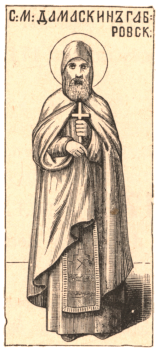
По любви к иночеству он удалился на Афон и принял монашество в Хиландарском монастыре. Здесь посвящён был в иеродиакона и потом в иеромонаха; здесь же избрали его и в игумена.
Out of love for monasticism, he withdrew to Mount Athos and received the monastic tonsure in the Hilandar Monastery. Here he was ordained a hierodeacon and later a hieromonk; here also he was chosen as abbot.
По нуждам обители отправился он в Болгарское поселение Свистово195. Исполнив нужные дела по обители, он должен был ещё получить старый долг с турок. Когда им было сказано о долге, должники, согласись между собою, не только не платить долга, но ещё напали на беззащитного христианина и отняли у него всю бывшую на подворье собственность. Злодеям и того было мало. Они подговорили турчанку худого поведения и тайно провели её в подворье. Потом, напав на подворье с шумом и криком, разбили двор, найдя тут турчанку, связали Дамаскина, как виновато в похищении магометанки, и представили в суд. Кадий, выслушав Дамаскина, видел, что тут только насилие злобы. Но взволнованная клеветой толпа изуверов неистово кричала, что монах осквернил закон их.
For the needs of the monastery, he set out for the Bulgarian settlement of Svishtov195. Having accomplished the necessary business for the monastery, he still had to collect an old debt from the Turks. When the debt was mentioned to them, the debtors, having agreed among themselves, not only refused to pay the debt, but also fell upon the defenseless Christian and took from him all the property that was in the guesthouse. Even this was not enough for the evildoers. They suborned a Turkish woman of bad character and secretly brought her into the guesthouse. Then, falling upon the guesthouse with noise and shouting, they broke into the courtyard, and finding the Turkish woman there, they bound Damascene as one guilty of abducting a Mohammedan woman, and brought him before the court. The qadi, having heard Damascene, saw that this was only the violence of malice. But the crowd of fanatics, agitated by the slander, cried out furiously that the monk had defiled their law.
Фанатики предложили Дамаскину на выбор одно из двух – или виселицу, или обращение в магометанство. Преподобный отвечал: «я родился христианином, таким и умру. Отречься от Христа – то же, что отказаться от вечной жизни: без Него нет спасения грешникам, каковы все мы, я и вы. Он примиритель правды Божией с грешным человечеством: Он – податель благодати Божией, необходимой для выполнения воли Божией. Жалею о вас, если вы не понимаете того. Но было бы безумием, если бы я согласился купить за временную жизнь погибель вечную».
The fanatics offered Damascene a choice of one of two things: either the gallows, or conversion to Mohammedanism. The Venerable One answered: "I was born a Christian, and as such I shall die. To deny Christ is the same as to renounce eternal life: without Him there is no salvation for sinners, such as we all are, I and you. He is the reconciler of God's righteousness with sinful mankind: He is the giver of the grace of God, necessary for the fulfillment of the will of God. I pity you, if you do not understand this. But it would be madness if I agreed to purchase eternal perdition for a temporal life."
Со связанными назад руками привели его на место казни. Он попросил дозволения помолиться. И, получив его, оградил себя крестным знамением, с лицом, обращённым на Восток, помолился, и потом сказал: «теперь я готов на смерть». Его повесили.
With his hands bound behind his back, they led him to the place of execution. He asked permission to pray. And having received it, he made the sign of the cross over himself, with his face turned to the East, prayed, and then said: "Now I am ready for death." They hanged him.
Гнев Божий скоро постиг злодеев: вслед за кончиной мученика, переправляясь через Дунай, они потонули. Священномученик пострадал в 1771 г. января 16 числа.
The wrath of God soon overtook the evildoers: immediately after the martyr's death, while crossing the Danube, they drowned. The Hieromartyr suffered on January 16, 1771.
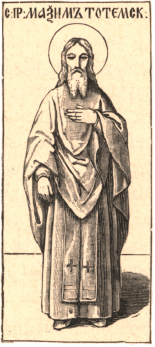
Блаженный Максим, тотемский священник, юродствовал 45 лет, преставился 1650 года января 16 числа. Мощи его под спудом в градской церкви, что у варниц. Почитание его (местное) началось с 1715 г.196.
Blessed Maximus, a priest of Totma, played the fool for Christ for 45 years, and reposed on January 16, 1650. His relics lie hidden in the town church at the salt-works. His veneration (local) began in 1715196.
В рукописи Белградской библиотеки два жития преп. Ромила, одно краткое, другое – пространное; последнее, писанное Григорием Цамблаком, находится и в синаксаре Гильфердинга. Изв. акад. VIII, 399. Выписки из Белградской рукописи в IX ч. Гласника, стр. 245, 252–254. 4 ч., стр. 161. 162.
In the manuscript of the Belgrade Library there are two Lives of the Venerable Romil, one brief, the other lengthy; the latter, written by Gregory Tsamblak, is also found in the Synaxarion of Hilferding. Izv. Acad. VIII, 399. Excerpts from the Belgrade manuscript in part IX of the Glasnik, pp. 245, 252–254. Part 4, pp. 161, 162.
Свистово – на берегу Дуная. Ныне здесь 4 церкви. Габрово – на юге от Тернова, на той же реке Янтре, на которой и Тернов. Жители там и здесь преимущественно Болгары. Григоровича путешеств. 171–176.
Svishtov is on the bank of the Danube. Today there are 4 churches there. Gabrovo is south of Tarnovo, on the same Yantra River on which Tarnovo lies. The inhabitants there and here are predominantly Bulgarians. Grigorovich's Travels, 171–176.