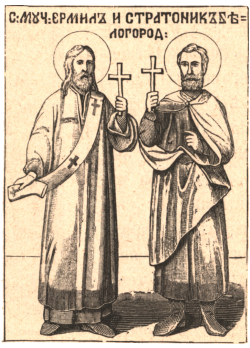
Св. Ермил был диакон церкви Христовой. Ликиний, находясь на р. Дунае, услышав о его славе, велел схватить его и, избитого железными прутьями, приказал беречь в тюрьме Стратонику. Стратоник же, когда в тюремное окно увидел Ангела, разговаривающего с Ермилом, уверовал во Христа и стал другом Ермила. Ермил, выведенный из тюрьмы, был принуждаем поклониться идолам и, не согласившись на то, был бит палками и потом терзаем был крючьями по чреву и груди.
St. Hermylus was a deacon of the Church of Christ. Licinius, being on the Danube River, having heard of his fame, ordered him to be seized and, after he was beaten with iron rods, commanded that he be kept in prison under Stratonicus. Stratonicus, however, when through the prison window he saw an Angel conversing with Hermylus, believed in Christ and became a friend of Hermylus. Hermylus, brought out of prison, was forced to worship idols, and not consenting to this, was beaten with clubs and then torn with hooks on his belly and chest.
«В третий же день обретена быша святая телеса их на брезе и погребоша я̀ вернии честно за осмьнадесять стадий от града Сингидона, во едином положивше гробе»174.
"On the third day their holy bodies were found on the bank, and the faithful buried them honorably eighteen stadia from the city of Singidunum, placing them in one tomb"174.
По Римскому мартирологу, они страдали в Сингидоне в верхней Мизии в 315 г. Сингидон, или Сингидом – жилище чеха-славянина, нынешний Белград. По такой местности и по званию странника-воина, эти мученики – славяне175.
According to the Roman Martyrology, they suffered in Singidunum in Upper Moesia in the year 315. Singidunum, or Singidom, was the dwelling of a Czech Slav, the present-day Belgrade. By such a locality and by the calling of a wandering warrior, these martyrs were Slavs175.
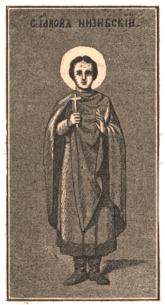
Св. Иаков по множеству чудес, совершённых им, назывался чудотворцем, а по обилию и высоте духовной мудрости – мудрым. Сын одного из удельных князей Армении, весьма образованный, он с юных лет отказался от удовольствий света и, в 314 году избранный в епископа Низибу, продолжал подвижническую жизнь, заботился о сиротах и вдовах и собственным примером, как и словом, назидал всех. Участвовал в деяниях первого Вселенского собора (325 г.) и в двукратную осаду Низиба Персами, 338 и 347 гг., явил себя мужественным пастырем и пламенным молитвенником пред Богом; уже готовые вторгнуться в город, они по молитвам святителя прогнаны были несметным множеством мух и комаров, произведших расстройство в рядах их.
St. James, because of the multitude of miracles performed by him, was called Wonderworker, and because of the abundance and height of his spiritual wisdom, the Wise. A son of one of the appanage princes of Armenia, highly educated, from his youth he renounced the pleasures of the world, and in the year 314, having been chosen bishop of Nisibis, he continued an ascetic life, cared for orphans and widows, and by his own example as well as by word edified all. He participated in the acts of the First Ecumenical Council (325) and, during the two sieges of Nisibis by the Persians, in 338 and 347, showed himself a courageous pastor and a fervent intercessor before God; already ready to burst into the city, they were driven away by the prayers of the Hierarch by an innumerable multitude of flies and mosquitoes, which produced disorder in their ranks.
Он умер в старости, около 450 года. Когда город Низиб в 336 году уступлен был Персам, выселившиеся жители взяли с собой и мощи святителя. Много сочинений догматического и нравственного содержания оставил он. В слове о покаянии, убеждая чистосердечно исповедоваться в грехах, говорит: иначе священник не может знать болезней твоих.
He died in old age, around the year 450. When the city of Nisibis was ceded to the Persians in 336, the emigrating inhabitants took with them the relics of the Hierarch. He left many writings of dogmatic and moral content. In a homily on repentance, urging sincere confession of sins, he says: otherwise the priest cannot know your infirmities.
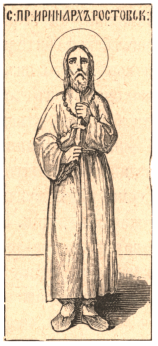
Преподобный Иринарх, в мире Илия, родился в земледельческом быту дер. Кондаковой, Ростовского округа176. Во время бывшего здесь голода два года жил он в Нижнем Новгороде, и, потеряв отца, перешёл с матерью и братом в Ростов, где занимался торговлей. На 30-м году жизни, оставив мир, постригся в Ростовском Борисоглебском монастыре, что на Устье. В духовной жизни его очевидна постепенность, с какой переходил он от нелёгкого подвига к тяжёлому и потом к весьма трудному; очевидно и то, как скорби, который наносили ему люди, не понимавшие его, благотворны были душе его. Он начал подвижничество своё тем, что стал ходить босой и в рубище. Монах босой и в рубище – какое неприличие. Так говорили дорожившие нарядом, а не своей душой! Чтобы заставить Иринарха носить обувь и рясу, его то запирали на несколько дней в холодную келью, то в морозы посылали звонить на колокольне. Блаженный переносил всё это. Когда же назначили ему исполнять послушание за монастырём, удаление от молитв храма показалось ему невыносимым, и он перешёл в Авраамиев монастырь. Здесь назначили ему должность келаря. Строгий к себе самому, он сильно скорбел, что другие без страха Божия расточают собственность обители.
The Venerable Irenarchus, in the world Elias, was born into a peasant household in the village of Kondakovo, in the Rostov district176. During a famine that occurred there, he lived for two years in Nizhny Novgorod, and, having lost his father, moved with his mother and brother to Rostov, where he engaged in trade. In the thirtieth year of his life, having left the world, he was tonsured in the Rostov Borisoglebsk Monastery, on the Ustye River. In his spiritual life, the gradualness with which he passed from a light feat to a heavy one and then to a very difficult one is evident; it is also evident how the sorrows inflicted upon him by people who did not understand him were beneficial to his soul. He began his asceticism by going barefoot and in rags. A monk barefoot and in rags—what impropriety! So said those who valued attire, not their own soul! To force Irenarchus to wear shoes and a cassock, they would either lock him for several days in a cold cell, or send him in frosts to ring the bells in the bell tower. The blessed one endured all this. When they assigned him to perform obedience outside the monastery, removal from the prayers of the church seemed unbearable to him, and he transferred to the Abraham Monastery. Here he was appointed to the office of cellarer. Strict with himself, he grieved greatly that others, without fear of God, squandered the property of the monastery.
По смерти матери уединился он в келье отшельника Лазаря. В это время в Авраамиевой обители подвизался в затворе старец Пимен, и беседа с ним облегчала Иринарха177. Спустя 3 года, возвращённый новым настоятелем в Борисоглебскую обитель, блаженный явился в ней с тяжёлыми веригами на плечах и с оковами на ногах. Страдания распятого Спасителя более и более становились предметом любви его, душа его глубже и глубже наполнялась ими. Он молился в храме пред распятым Спасителем об указании ему пути спасения и, получив тайное извещение, затворился безвыходно в келье, достал трёхсаженную цепь и ею приковал себя к стулу. Послушник Алексий вызвался служить строгому затворнику и с именем Александра стал жить при нём; он-то впоследствии и описал жизнь наставника своего. По совету блаженного Иоанна большого колпака, Иринарх устроил себе сто медных крестов и повесил их на вериги; к ним присоединил он и ещё 30 крестов. Так подвизался труженик Божий 6 лет! Ему прислали из Углича цепь в 3 сажени; он прицепил её к своей и так провёл другие 6 лет; присоединив, затем третью цепь, он просидел на девятисаженной цепи 13 лет. Люди, не понимавшие ни себя, ни подвижника снова выгоняли его из Борисоглебской обители: но спустя год, возвратился он в свой затвор. Здесь он увеличил ещё тяжесть для тела своего. Ночью спал он только два часа; бо́льшая часть времени его занята была молитвой, в другое время занимался он рукоделием – шил власяницы и клобуки, а выручаемые за то деньги раздавал нищим. Христу сораспялся, говорил апостол. Без сомнения, показывал он тем собственно распятие самолюбивых желаний души. Но если для сего распятия употребляется доброй волей какое-либо страдание телесное: такое дело воли не заключает ли в себе распятия внутреннего? Таково значение подвигов блаж. Иринарха!
After the death of his mother, he secluded himself in the cell of the hermit Lazarus. At that time, in the Abraham Monastery, the elder Pimen was struggling in seclusion, and conversation with him eased Irenarchus177. After three years, having been returned by a new abbot to the Borisoglebsk Monastery, the blessed one appeared there with heavy chains on his shoulders and fetters on his feet. The sufferings of the crucified Savior more and more became the object of his love; his soul was more and more deeply filled with them. He prayed in the church before the crucified Savior for an indication of the path of salvation, and having received a secret revelation, he shut himself up without exit in his cell, obtained a three-sazhen chain, and with it chained himself to a stool. The novice Alexis volunteered to serve the strict recluse and, taking the name Alexander, began to live with him; it was he who later described the life of his teacher. On the advice of the blessed John the Big Cap, Irenarchus made for himself one hundred copper crosses and hung them on his chains; to these he added another thirty crosses. Thus the laborer of God struggled for six years! A chain of three sazhens was sent to him from Uglich; he attached it to his own and thus spent another six years; having then added a third chain, he sat on a nine-sazhen chain for thirteen years. People who understood neither themselves nor the ascetic again drove him out of the Borisoglebsk Monastery; but after a year, he returned to his seclusion. Here he increased the burden on his body even more. At night he slept only two hours; the greater part of his time was occupied with prayer; at other times he occupied himself with handiwork—sewed hair shirts and klobuks, and distributed the money received for them to the poor. I have been crucified with Christ, said the Apostle. Without doubt, he thereby showed the very crucifixion of the soul's self-loving desires. But if for this crucifixion some bodily suffering is employed by good will: does not such an act of will contain within itself an inner crucifixion? Such is the significance of the feats of the blessed Irenarchus!
Тяжкими и долгими подвигами очистилось духовное зрение преподобного и дух его стал так силён, что начал он оказывать услуги не только ростовскому краю, но и целой России. В одно время в тонком сне видит он Москву в огне и во власти Ляхов и голос сказал ему: иди, скажи об этом царю. Он явился к царю Василию Иоанновичу и рассказал о видении; царь принимал его с честью, но он пробыл в Москве только сутки. Пророчество его скоро сбылось.
By heavy and long feats, the spiritual vision of the Venerable One was purified, and his spirit became so strong that he began to render services not only to the Rostov region, but to all Russia. At one time, in a light sleep, he saw Moscow in flames and under the power of the Poles, and a voice said to him: go, tell this to the Tsar. He appeared to Tsar Basil Ioannovich and told him of the vision; the Tsar received him with honor, but he stayed in Moscow only a day. His prophecy soon came true.
В 1609 году ляхи завладели Ростовом; свирепый пан Микульский явился в Борисоглебский монастырь и, войдя к старцу с другими панами, спросил: кого признаёт он за царя? «Я живу в России, – отвечал старец, – и признаю Русского; другого же не знаю».
In 1609, the Poles seized Rostov; the fierce Pan Mikulsky appeared at the Borisoglebsk Monastery and, entering the elder with other pans, asked: whom does he acknowledge as Tsar? "I live in Russia," answered the elder, "and I acknowledge the Russian; I know no other."
Когда подошёл Сапега с войсками к монастырю: все ожидали, что монастырь будет истреблён вместе с иноками. Преп. Иринарх слёзно молился Господу. Сапега пришёл к старцу в келью. «Благослови батько! как терпишь ты эту муку в такой темнице?», говорил подвижнику Сапега. «Для Бога», отвечал старец. Он не молится ни за короля, ни за Димитрия, сказали пришедшие с Сапегой. Старец повторил прежний свой ответ, и Сапега сказал: «правда в батьке велика: в какой земле жить, тому и служить». Старец сказал Сапеге: «возвратись, пан, в свою землю; полно тебе разорять Россию: если не выйдешь из России, или опять придёшь, – уверяю тебя Богом, – убьют тебя в России». Сапега призадумался и сказал: «что бы подарить тебе? Такого батьку не видал я нигде, столько бесстрашного пред нашим мечом. «Господь питает меня, отвечал старец: но как наставит тебя Бог, так и поступай». Сапега прислал 5 рублей денег и строго запретил тревожить обитель.
When Sapieha approached the monastery with his troops, everyone expected that the monastery would be destroyed together with the monks. The Venerable Irenarchus tearfully prayed to the Lord. Sapieha came to the elder in his cell. "Bless me, father! How do you endure this torment in such a dungeon?" said Sapieha to the ascetic. "For God," answered the elder. "He prays neither for the king nor for Demetrius," said those who came with Sapieha. The elder repeated his former answer, and Sapieha said: "Great is the truth in the father: in whatever land you live, that land you serve." The elder said to Sapieha: "Return, Pan, to your own land; enough of you ravaging Russia; if you do not leave Russia, or come again, I assure you by God—they will kill you in Russia." Sapieha became thoughtful and said: "What gift shall I give you? Such a father I have not seen anywhere, so fearless before our sword." "The Lord nourishes me," answered the elder; "but as God instructs you, so do." Sapieha sent five rubles in money and strictly forbade disturbing the monastery.
Князь Димитрий Пожарский, готовясь идти на помощь Москве, опасался Заруцкого, по проискам которого убит был Ляпунов. Преподобный послал князю благословение и просфору, со словами: «ступай в Москву, не боясь Заруцкого; увидите славу Божью». Князь пришёл сам к св. старцу и преподобный дал ему свой крест и благословение. Пожарский, совершив подвиг, возвратил крест затворнику и освободил своей грамотой монастырь от доставления припасов для войска.
Prince Demetrius Pozharsky, preparing to go to the aid of Moscow, feared Zarutsky, through whose intrigues Lyapunov had been killed. The Venerable One sent the prince a blessing and a prosphora, with the words: "Go to Moscow, fearing not Zarutsky; you shall see the glory of God." The prince himself came to the holy elder, and the Venerable One gave him his cross and blessing. Pozharsky, having accomplished the feat, returned the cross to the recluse and freed the monastery by his charter from supplying provisions for the army.
За два года до кончины, блаженному Иринарху пришлось вытерпеть ещё насилие от иноков, какого не терпел он от ляхов: его вытолкали из затвора и сломали при том руку ему. Снова явились затем Ляхи в Ростове; иноки разбежались; Иринарх остался в своём затворе. «Благослови батько! сказал вошедший к нему польский начальник; Сапега убит под Москвой, как сказал ты». «Если не уйдёте в свою землю, не быть и вам живыми», сказал старец. Поляки оставили Ростов, не тронув никого, по уважению к старцу.
Two years before his death, the blessed Irenarchus had to endure yet another violence from the monks, such as he had not endured from the Poles: they pushed him out of his seclusion and broke his arm in the process. Then the Poles again appeared in Rostov; the monks fled; Irenarchus remained in his seclusion. "Bless me, father!" said the Polish commander who entered to him; "Sapieha has been killed near Moscow, as you said." "If you do not depart to your own land, you too will not remain alive," said the elder. The Poles left Rostov, touching no one, out of respect for the elder.
Подвижник Божий 38 лет изнурял тело своё на особенном пути своём и скончался на 69 году жизни своей, января 13 д. 1616 года178. По смерти его совершилось несколько исцелений для призывавших молитвенную помощь его; особенно бесноватые боятся креста его и получают здравие при возложении его на них179.
The man of God for 38 years exhausted his body on his particular path and reposed in the 69th year of his life, on January 13, 1616178. After his death, several healings occurred for those who called upon his prayerful help; especially, the demon-possessed fear his cross and receive health when it is placed upon them179.
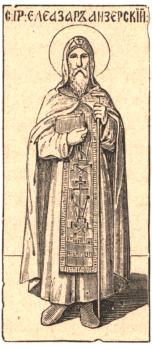
Уроженец г. Козельска, сын купца Севрюкова, Елеазар ещё в молодых летах пришёл в Соловецкую обитель180 и испытанный послушаниями пострижен был в монашество; строгим постом, крепостью в молитве, глубоким вниманием к себе самому он приобрёл себе уважение братии и любовь игум. Иринарха. Ревнуя служить Господу с самоотречением более тяжким, по благословению преподобного Иринарха, удалился он на Анзерский остров, за 20 вёрст от обители, и здесь стал подвизаться отшельником, не развлекаемый никем. Сперва жил он на горе у озера. Для пропитания своего на пустынном острове делал он своими руками деревянные чашки, ставил их у морской пристани, и временные гости – моряки оставляли отшельнику хлеб и другие съестные припасы. Спустя 4 года, в 1616 г., постриженный в схиму, перешёл он к ветхой церкви с. Николая, поставленной для временных тружеников на солеварнях. Здесь поставил он себе малую келийку и жил с Господом.
A native of the city of Kozelsk, the son of the merchant Sevryukov, Eleazar came to the Solovetsky monastery180 while still in his youth, and after being tested by obediences, he was tonsured into monasticism; by strict fasting, steadfastness in prayer, and deep attention to himself, he acquired the respect of the brethren and the love of Abbot Irenarchus. Zealous to serve the Lord with a more severe self-denial, with the blessing of the Venerable Irenarchus, he withdrew to Anzer Island, twenty versts from the monastery, and there began to struggle as a hermit, undistracted by anyone. At first he lived on a hill by a lake. For his sustenance on the desolate island, he made wooden bowls with his own hands, placed them at the seashore, and occasional visitors—sailors—would leave the hermit bread and other food supplies. After four years, in 1616, having been tonsured into the schema, he moved to the dilapidated church of St. Nicholas, which had been built for temporary laborers at the saltworks. There he set up a small cell for himself and lived with the Lord.
Мало-помалу собралось к нему несколько ревнителей скитского жития. Преподобный Елеазар ввёл для сподвижников древний чин скитского жития. Кельи безмолвных пустынников поставлены были в версте одна от другой. В субботу вечером собирались они для общей молитвы и в следующий день, совершив воскресное пение, расходились по кельям для Богомыслия. Молитва, псалмопение, рукоделие по силе, составляли обыкновенное занятие их. О душевных смущениях открывали они пр. старцу. Преподобный был не только великим подвижником, но и любителем духовного просвещения. «От многого божественного писания, сказано о нём во вкладной книге скита, различные повести собра и три книги цветника своей рукой написа уставом; такожде и чин монашеского келейного правила в писании – от искуса, добре истолкова». В другое время преподобный то коленопреклонно молился, то рубил дрова и носил их на спине своей. Немало пришлось ему претерпеть искушений то от духа злобы, то от людей немощных.
Little by little, several zealots of the skete life gathered to him. The Venerable Eleazar introduced for his fellow ascetics the ancient rule of skete life. The cells of the silent hermits were placed a verst apart from one another. On Saturday evening they gathered for common prayer, and on the following day, having completed the Sunday singing, they dispersed to their cells for the contemplation of God. Prayer, psalmody, and handiwork according to their strength constituted their usual occupation. They revealed their spiritual disturbances to the venerable elder. The Venerable One was not only a great ascetic but also a lover of spiritual enlightenment. "From much divine Scripture," it is said of him in the donation book of the skete, "he gathered various narratives and wrote three books of a flower-garden with his own hand in uncial script; likewise, the rule of the monastic cell rule in writing—from experience, he interpreted it well." At other times, the Venerable One would either pray on bended knees or chop wood and carry it on his back. He had to endure no small number of temptations, sometimes from the spirit of malice, sometimes from weak people.
Раз явился ему искуситель в виде брата обители, с приглашением в обитель. Подвижник не хотел идти в путь, прежде чем совершит правило келейной молитвы, и стал на молитву. Но когда приводилось ему читать молитву Господню – Отче наш, мнимый брат выходил из кельи; подвижник изумлялся и продолжал молиться. Наконец, после нескольких опытов повторения той же истории, мнимый брат исчез без следа: а подвижник увидел, что если бы отправился он в обитель, то бурное море поглотило бы его.
Once the tempter appeared to him in the form of a brother of the monastery, with an invitation to the monastery. The ascetic did not wish to set out on the journey before completing the rule of cell prayer, and he stood up to pray. But when he came to read the Lord's Prayer—"Our Father"—the supposed brother would leave the cell; the ascetic was amazed and continued to pray. Finally, after several instances of the same story repeating itself, the supposed brother vanished without a trace; and the ascetic saw that if he had set out for the monastery, the stormy sea would have swallowed him.
Царь Михаил, скорбевший о том, что не имеет наследника престола и узнавший о пр. Елеазаре от прежнего келаря лавры, а теперь подвижника Соловецкого Александра Булатникова, вызвал старца в Москву и просил молитв его. Старец сказал царю, что родится наследник, и после тёплой мольбы старца, в 1629 году родился царевич Алексей. Признательный царь Михаил до гроба своего благотворил Анзерскому скиту. Царь Алексий, по вступлении на престол, предписал строить каменный храм в скиту, начатый по воле отца его, но постройка которого была остановлена. Он желал видеть старца лично, и старец, уже дряхлый, опять был в Москве. Старец был обласкан царём. Но в Соловецкой обители негодовали на то, что Анзерскому скиту предоставлена была независимость от обители. Вследствие того не только не оканчивалось построение храма, невзирая на царский указ, но сам старец заключаем был в оковы и темницу181.
Tsar Michael, who grieved that he had no heir to the throne and who had learned of the Venerable Eleazar from the former cellarer of the Lavra, now an ascetic of Solovki, Alexander Bulatnikov, summoned the elder to Moscow and asked for his prayers. The elder told the Tsar that an heir would be born, and after the elder's fervent supplication, in the year 1629, Tsarevich Alexis was born. The grateful Tsar Michael was a benefactor to the Anzer Skete until his grave. Tsar Alexis, upon ascending the throne, ordered the construction of a stone church in the skete, begun by his father's will, but whose construction had been halted. He wished to see the elder in person, and the elder, already decrepit, was again in Moscow. The elder was caressed by the Tsar. But in the Solovetsky monastery, they were indignant that the Anzer Skete had been granted independence from the monastery. As a result, not only was the construction of the church not completed, despite the Tsar's decree, but the elder himself was put in fetters and prison181.
Преподобный образовал из учеников своих строгих подвижников. Таков был Никодим, бывший преемником наставника своего в скиту; великий Никон также был учеником Елеазара. Когда сей анзерский скитник стал восходить со степени на степень власти и силы, он делал всё, что мог для покоя преп. Елеазара. Будучи митрополитом, писал он к архимандриту: «поберегите анзерских старцев, строителя и братию», и предписывал исполнить просьбу старца Елеазара – отпустить в его скит больничного старца Кирика182; в 1655 г. патр. Никон выпросил у царя отпускать в анзерский скит более прежнего свеч, ладана, вина и муки для церковной службы; установил быть 17 братиям в скиту и послал от себя серебряные оклады на икону и дары скитникам деньгами и рыбой. Св. старец скончался, после 40 летних подвигов, янв. 13 д. 1656 г. Память его чтится местно183.
The Venerable One formed from his disciples strict ascetics. Such was Nicodemus, who became the successor of his teacher in the skete; the great Nikon was also a disciple of Eleazar. When this Anzer skete-dweller began to ascend from degree to degree of power and authority, he did everything he could for the repose of the Venerable Eleazar. Being a metropolitan, he wrote to the archimandrite: 'Take care of the Anzer elders, the builder and the brethren,' and ordered that the request of the elder Eleazar be fulfilled—to release to his skete the infirmary elder Kirik182; in 1655, Patriarch Nikon obtained from the Tsar permission to send to the Anzer Skete more candles, incense, wine, and flour for church services than before; he established that there be seventeen brethren in the skete and sent from himself silver rizas for an icon and gifts to the skete-dwellers in money and fish. The holy elder reposed, after forty years of struggles, on January 13, A.D. 1656. His memory is venerated locally183.
Вершинского месяцеслов, стр. 9. О древнем Сигиндоне, нынешнем Белграде, исследование в Гласнике V, 113–211. О Сигах, Сигинах Геродота, Савельева Славянский сборник, стр. 99–106. Чертков во Временнике XVI, 76. В 885 г. Сигиндон-Белград Славянский: так по житию св. Климента.
Vershinsky's Menologion, p. 9. On ancient Singidunum, present-day Belgrade, a study in Glasnik V, 113–211. On the Sigi and Sigynnae of Herodotus, Savelyev's Slavic Collection, pp. 99–106. Chertkov in Vremennik XVI, 76. In 885, Singidunum-Belgrade was Slavic: according to the life of St. Clement.
Ркп. житие преп. Иринарха, опис. учеником его Александром. Отрывки жития напеч. в чтен. м. общ. ист. 1847 г. № 2. Ундольского в библиогр. разысканиях стр. 62–68. Москва. 1846 г.
Manuscript life of the Venerable Irinarch, described by his disciple Alexander. Fragments of the life printed in Readings of the Moscow Society of History, 1847, No. 2. Undolsky's Bibliographical Investigations, pp. 62–68. Moscow, 1846.
В 1618 г. по прошению архимандрита Авраамиева монастыря Иосифа и затворника Пимена, ц. Михаил утвердил за обителью земли её. След., тогда ещё жив был старец Пимен. В Ркп. святцах «преп. Афанасий и Пимен в Аврамьеве монастыре». Здесь же ещё «преп. отец Пимен затворник Богоявленский», по другому списку, «затворник и вержиник, что в Богоявленском монастыре во Острове».
In 1618, at the request of Archimandrite Joseph of the Abraham Monastery and the recluse Pimen, Tsar Michael confirmed the monastery's lands. Consequently, the elder Pimen was still alive then. In the manuscript Menologia: "Venerable Athanasius and Pimen in the Abraham Monastery." Here also: "Venerable Father Pimen, recluse of the Theophany," according to another list, "recluse and chain-bearer, who was in the Theophany Monastery on Ostrov."
Ркп. святцы: «преп. отец Иринарх затворник Борисоглебского монастыря, преставился в л. 7123 (1615), января 13 д.». По житию, скончался в 1616 году.
Manuscript Menologia: "Venerable Father Irinarch, recluse of the Boris and Gleb Monastery, reposed in the year 7123 (1615), January 13." According to the life, he died in 1616.
Ркп. житие преп. Елеазара нап. в Православн. собеседн. 1860 г. 1. 108–120, 237–259. Писатель говорит: «бысть по нем царь Алексий Михаилович, ныне царствующого родитель» (стр. 241). Далее он выставляет себя жителем скитским, но который пишет то, что слышал от «сказателей» (стр. 249). Потому житие писано в 1706 г.
Manuscript life of the Venerable Eleazar, printed in The Orthodox Interlocutor, 1860, 1. 108–120, 237–259. The writer says: "After him was Tsar Alexis Mikhailovich, the parent of the now reigning one" (p. 241). Further, he presents himself as a skete dweller, but one who writes what he heard from "narrators" (p. 249). Therefore, the life was written in 1706.
Опис. Соловецкого монастыря, стр. 324–326. Ркп. святцы: «преп. Елеазар, строитель Анзерского скита, иже на Океане». Тропарь и молитва преподобному Елеазару – у Царского № 744.
Description of the Solovetsky Monastery, pp. 324–326. Manuscript Menologia: "Venerable Eleazar, builder of the Anzer Skete, which is on the Ocean." Troparion and prayer to the Venerable Eleazar—in Tsarsky's No. 744.