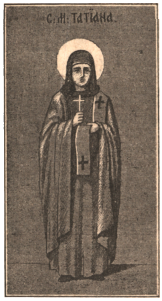
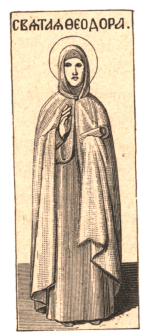
Римлянка Татиана была дочь знатных и богатых родителей. Отец её, состоявший на Римской службе (и три раза исправлявший должность префекта), исповедовал втайне христианскую веру и дочери своей дал христианское воспитание. Проникнувшись им всецело, она посвятила себя служению Богу, и в сане диакониссы предавалась делам милосердия и молитве постоянной. Подготовленная таким образом, она явилась достойной избранницей Божией для получения мученического венца. Она пострадала во время гонения на христиан при малолетнем императоре Александре Севере. Страдания, которым подвергали её, были жестоки и разнообразны. Её резали бритвами, били по лицу, выкололи ей глаза, строгали тело железными когтями, но твёрдость её веры и терпения были непоколебимы; среди мучений она только молилась, чтобы Бог просветил её мучителей, и Господь услышал молитву праведницы: восемь слуг эпарха, мучивших святую, уверовали во Христа, поражённые той сверхъестественной силой, при помощи которой мученица оставалась твёрдой и невредимой среди истязаний...
Tatiana, a Roman woman, was the daughter of noble and wealthy parents. Her father, who was in the Roman service (and had three times discharged the office of prefect), secretly confessed the Christian faith and gave his daughter a Christian upbringing. Having wholly imbibed it, she devoted herself to the service of God, and in the rank of deaconess gave herself to works of mercy and constant prayer. Prepared in this manner, she proved herself a worthy chosen one of God for receiving the martyr's crown. She suffered during the persecution of Christians under the youthful emperor Alexander Severus. The torments to which she was subjected were cruel and varied. She was cut with razors, beaten on the face, her eyes were gouged out, her body was scraped with iron claws, but the firmness of her faith and patience was unshakable; amid her torments she only prayed that God would enlighten her tormentors, and the Lord heard the prayer of the righteous woman: eight servants of the eparch who were tormenting the saint believed in Christ, struck by that supernatural power by which the martyr remained firm and unharmed amid tortures...
– Прости нас, служительница истинного Бога! – воззвали они к ней, упав к ногам её, и объявили себя верующими в Бога Татианы, – и тут же были преданы смерти, громко исповедуя и прославляя Христа, истинного Бога.
— Forgive us, servant of the true God! — they cried to her, falling at her feet, and declared themselves believers in Tatiana's God — and were immediately put to death, loudly confessing and glorifying Christ, the true God.
После истязаний, в продолжение целого дня, Татиану отвели на ночь в темницу, где всю ночь бодрствовала она, молясь и славя Господа. На другой день эпарх приказал вывести её на съедение выпущенному льву, но лев начал ласкаться к ней и лизал ей ноги... Тогда, опасаясь, чтобы это новое чудо не поразило народ и не привлекло бы многих к исповеданию Бога Татианы, эпарх осудил её на казнь мечом.
After tortures lasting a whole day, Tatiana was led away for the night to prison, where she kept vigil all night, praying and glorifying the Lord. On the next day the eparch ordered her to be brought out to be devoured by a released lion, but the lion began to caress her and lick her feet... Then, fearing that this new miracle might strike the people and draw many to the confession of Tatiana's God, the eparch condemned her to death by the sword.
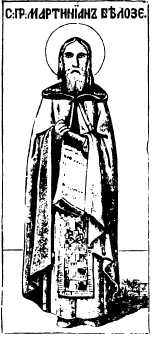
Мартиниан, в мире Михаил132, родился в деревне Березниках, вблизи которой ныне Сямский монастырь, прославленный иконой Богоматери. Ещё в юных летах оказывать он наклонность учиться грамоте; но родители не находили, у кого ему учиться; на 13 году оставил родителей и родину, и прямо с поля, где боронил вспаханную отцом полосу, тайно ушёл к преп. Кириллу Белозерскому, о котором слышал от многих.
Martinian, in the world Michael132, was born in the village of Berezniki, near which is now the Siama Monastery, glorified by the Icon of the Mother of God. Even in his early years he showed an inclination to learn to read and write; but his parents could not find anyone from whom he might learn; at the age of 13 he left his parents and his homeland, and straight from the field, where he was harrowing a strip plowed by his father, he secretly went away to the Venerable Cyril of Belozersk, of whom he had heard from many.
Березники в 30 вёрстах от Кириллова монастыря, но это было нипочём для Миши. «Возьми меня к себе, господине – говорил он преподобному, упав ему в ноги. Преподобный оставил добродушного отрока у себя: «прилучися, близ обители святого человек некий живяше, имя ему Олеш (Алексий) Павлов, дияк мирский, дело его бяше книги писати и ученики учити грамотный хитрости: и зело искусен бе таковому художеству. Сего Кирилл призвав, рече ему: друже, сотвори ми любовь Божию, научи ми отрока сего грамоте, егоже видиши». Алексий Павлович с любовью выполнил поручение преп. Кирилла. Полюбив чистую душу юного Михаила, святой старец облёк его в иноческое одеяние и велел ему жить у себя в келье. Когда блаженный Кирилл молился в своей келье, и Мартиниан клал поклоны; он первый являлся по благовесту в храм к утреннему славословию; смущавшие его помыслы открывал св. старцу.
Berezniki is 30 versts from the Cyril Monastery, but that was nothing for Misha. "Take me to yourself, master," he said to the venerable one, falling at his feet. The venerable one kept the good-natured youth with him: "It happened that near the monastery of the saint there lived a certain man, by name Olesh (Alexis) Pavlov, a secular scribe; his work was to write books and to teach students the skill of letters: and he was very skilled in such a craft. Cyril, summoning him, said to him: Friend, do me a kindness for the love of God: teach this youth, whom you see, to read and write." Alexis Pavlovich fulfilled the commission of the Venerable Cyril with love. Having come to love the pure soul of the young Michael, the holy elder clothed him in the monastic habit and bade him live in his own cell. When blessed Cyril prayed in his cell, Martinian also made prostrations; he was the first to appear at the summons to the church for the morning doxology; the thoughts that troubled him he revealed to the holy elder.
Испытав Мартиниана послушаниями, преп. Кирилл позволил ему жить в особой келье, но зорко смотрел за его духовной жизнью. Раз Мартиниан из церкви зашёл в келью одного брата. « Зачем нарушаешь устав обители?» – сказал ему Кирилл. «Войдя в свою келью, сомневаюсь, чтобы захотел я выйти из неё; а мне нужно было быть в келье брата», – отвечал Мартиниан. «Наперёд иди в свою келью, чтобы сотворить там должную молитву, и келья научит тебя всему», – сказал св. старец133. По просьбе св. игумена Мартиниан посвящён был в иеродиакона и потом в иеромонаха. Преп. Кирилл любил блаж. Мартиниана. Это возбуждало в иных зависть, язвившую Мартиниана оскорблением; Мартиниан терпел. По воле преп. Кирилла, Мартиниан списывал для него книги. А такое послушание пр. игумен назначил только двум ученикам: Христофору и Мартиниану.
Having tested Martinian with obediences, the Venerable Cyril allowed him to live in a separate cell, but kept a watchful eye on his spiritual life. Once Martinian went from the church into the cell of one of the brethren. "Why do you violate the rule of the monastery?" said Cyril to him. "Having entered my cell, I doubt that I would wish to leave it; but I needed to be in the brother's cell," answered Martinian. "Go first to your own cell, to make there the due prayer, and the cell will teach you everything," said the holy elder133. At the request of the holy abbot, Martinian was ordained hierodeacon and then hieromonk. The Venerable Cyril loved the blessed Martinian. This aroused envy in some, which wounded Martinian with insult; Martinian endured. By the will of the Venerable Cyril, Martinian copied books for him. And such an obedience the venerable abbot assigned to only two disciples: Christopher and Martinian.
Ещё цел в обители канонник, списанный Мартинианом. Послесловие его особенно драгоценно: оно показывает, какими чувствами дышала душа Мартиниана. Вот оно: «в 1423 г. сентября 1, написана эта книга душеполезная в обители пречистой Богородицы, по благословению господина старца Кирилла игумена, в славу Св. Троицы, аминь. О! Дева Богоизбранная! О! Отроковица Богоневестная! О! Владычица мира, Пречистая Богородица! во всемирных Твоих молениях к Сыну и Богу помяни, милостивая Госпожа, и меня грешного, недостойной рукой писавшего сие.
There is still preserved in the monastery a canon book copied by Martinian. Its afterword is especially precious: it shows with what feelings Martinian's soul breathed. Here it is: "In the year 1423, September 1, this soul-profitable book was written in the monastery of the Most Pure Theotokos, by the blessing of the lord elder Cyril, abbot, to the glory of the Holy Trinity, amen. O God-chosen Virgin! O God-betrothed Maiden! O Lady of the world, Most Pure Theotokos! In your all-worldly prayers to your Son and God, remember, merciful Sovereign Lady, me also, a sinner, who wrote this with an unworthy hand.
Всякому делу благому начало и конец Христос. Ему слава в бесконечные веки, аминь. Господи Иисусе Христе! Спаси писавшего и имеющего читать.
To every good work the beginning and the end is Christ. To Him be glory unto endless ages, amen. Lord Jesus Christ! Save the writer and those who shall read.
По смерти св. Кирилла, 1427 г., блаж. Мартиниан удалился для безмолвия на безлюдный остров озера Вожа. Когда сюда стали собираться к нему братия, он создал храм Преображения Господня и ввёл чин общежития. Братия Ферапонтовой пустыни, осиротевшие по вызову Ферапонта в Можайск, умоляли преп. Мартиниана принять игуменство над ними; преподобный покорился призыву любви. Уцелевшие памятники представляют заботливость игумена Мартиниана о Ферапонтовой обители: с 1435 г. и в продолжение 12 лет он привёл обитель Ферапонтову в такое цветущее состояние, что она долго называлась обителью Мартиниановой.
After the death of St. Cyril, in 1427, the blessed Martinian withdrew for silence to an uninhabited island of Lake Vozha. When brethren began to gather to him there, he built a church of the Transfiguration of the Lord and introduced the rule of cenobitic life. The brethren of the Ferapontov hermitage, orphaned by the summons of Ferapont to Mozhaisk, besought the Venerable Martinian to accept the abbacy over them; the venerable one submitted to the call of love. The surviving monuments show the solicitude of Abbot Martinian for the Ferapontov monastery: from 1435 and for 12 years he brought the Ferapontov monastery to such a flourishing state that it was long called the monastery of Martinian.
Сын князя Можайского, князь Михаил Андреевич, живший в Белозерье, много помогал Мартиниану в средствах к поддержанию и украшению обители135. Более же всего Мартиниан возвысил обитель строгим сохранением иноческих правил. Как пчёлы слетаются на медовые цветки, так стекались к Мартиниану миряне и иноки слушать его наставления и видеть жизнь, устроившуюся по его святым мыслям.
The son of the Prince of Mozhaisk, Prince Michael Andreevich, who lived in Belozerye, greatly helped Martinian with means for the support and adornment of the monastery135. But above all Martinian exalted the monastery by the strict preservation of monastic rules. As bees flock to honeyed flowers, so laymen and monks streamed to Martinian to hear his instructions and to see a life ordered according to his holy thoughts.
Когда великий князь Василий Васильевич Тёмный решился искать себе Московского престола, отнятого насилием Шемяки, он получил на то благословение преп. Мартиниана и полюбил св. старца. Вступив на Московский престол, признательный князь Василий вызвал Мартиниана к себе и поручил ему игуменство над обителью преп. Сергия. Имя Мартиниана, игумена Троицкого, было первым между игуменами в грамоте Московского собора 29 декабря 1447 г., которой Шемяку предавали отлучению от церкви за кровавые смуты, если не покается136. Преподобный искренно любил покой отчизны, но дорожил правдой и о правде говорил всякому, не думая о своём покое. Великий кн. Василий поручил Мартиниану уговорить вельможу, удалившегося к Тверскому князю, возвратиться в Москву, с тем, что тот не только будет прощён, но и награждён будет почестями. Боярин послушался преподобного, но вместо почести заключён был в темницу. Услышав о том, Мартиниан немедленно явился к великому князю и сказал духовному своему сыну: «таков ли праведный суд твой, великий князь?! Ты продал грешную мою душу, лишив свободы того, кому ручался я за свободу душой моей. Ты нарушил своё слово. Да не будет немощное благословение моё на тебе и на твоём княжении». И вслед за тем вышел от князя, сел на коня и возвратился в монастырь.
When the Grand Prince Basil Vasilievich the Dark resolved to seek the throne of Moscow, which had been taken from him by the violence of Shemyaka, he received for this the blessing of the Venerable Martinian and came to love the holy elder. Having ascended the throne of Moscow, the grateful Prince Basil summoned Martinian to himself and entrusted to him the abbacy over the monastery of the Venerable Sergius. The name of Martinian, abbot of the Trinity, was first among the abbots in the charter of the Moscow Council of December 29, 1447, by which Shemyaka was condemned to excommunication from the Church for bloody disturbances, if he did not repent136. The venerable one sincerely loved the peace of the fatherland, but treasured truth and spoke the truth to everyone, not thinking of his own repose. The Grand Prince Basil entrusted Martinian with persuading a nobleman, who had withdrawn to the Prince of Tver, to return to Moscow, on the condition that he would not only be forgiven but also rewarded with honors. The boyar heeded the venerable one, but instead of honor he was cast into prison. Hearing of this, Martinian immediately appeared before the Grand Prince and said to his spiritual son: "Is this your righteous judgment, O Grand Prince?! You have sold my sinful soul, depriving of freedom him for whose freedom I pledged my soul. You have broken your word. May my feeble blessing not be upon you and upon your principality." And immediately after that he went out from the prince, mounted his horse, and returned to the monastery.
Великий князь осознал свой грех. В слух бояр своих сказал он, как бы гневаясь: «судите, бояре, что со мною наделал болотный чернец? Пришёл ко мне во дворец и снял с меня благословение Божие». Бояре не понимали, что это значит. Великий князь прибавил: «виноват я пред Богом, други мои! Забыл своё слово и поступил несправедливо; пойдём к св. Троице, к преп. Сергию и блаж. Мартиниану, чтобы получить прощение».
The Grand Prince recognized his sin. In the hearing of his boyars he said, as if in anger: "Judge, boyars, what the swamp monk has done to me! He came to me in the palace and took from me the blessing of God." The boyars did not understand what this meant. The Grand Prince added: "I am guilty before God, my friends! I forgot my word and acted unjustly; let us go to the Holy Trinity, to the Venerable Sergius and the blessed Martinian, to receive forgiveness."
Вслед за тем освободил он боярина и осыпал его милостями, а потом отправился в обитель преподобного Сергия. Здесь со всей братией вышел к великому князю навстречу обрадованный Мартиниан. Но обитель, близкая к столице, тяготила пустынника; он припоминал себе слова наставника своего преп. Кирилла: «добро иноку хранить молчание и нестяжание и избегать всего, что может возмущать чувств». С другой стороны, желал он докончить устроение внутреннего порядка в любезной ему Ферапонтовой обители. И в 1455 г. Мартиниан простился с братией лавры.
Thereupon he freed the boyar and showered him with favors, and then set out for the monastery of the Venerable Sergius. Here, with all the brethren, the overjoyed Martinian came out to meet the Grand Prince. But the monastery, close to the capital, weighed upon the hermit; he recalled the words of his teacher, the Venerable Cyril: "It is good for a monk to keep silence and non-acquisition and to avoid everything that may disturb the senses." On the other hand, he desired to complete the establishment of internal order in the Ferapontov monastery, dear to him. And in 1455 Martinian took leave of the brethren of the Lavra.
В Ферапонтовом монастыре приняли Мартиниана с великой радостью, как ангела Божия, и упросили его (в числе упрашивавших был и игумен Филофей) принять опять управление обителью. Он устроил здесь чин монашеской жизни, заняв иное из устава Кирилловой обители, а другое из чина Сергиевой. К старцу высокой духовной опытности спешили приходить за советами, и он с любовью преподавал их. Любезный ученик великого Кирилла и собеседник Ферапонта много назидательного из жизни их сообщал слушателям своим. Так слушал его жизнеописатель святой Пахомий, который отзывается о нём с похвалами, как о муже высокой духовной жизни137. Преп. Мартиниан достиг старости глубокой. Но и в дряхлой старости не оставлял ни келейного правила, ни служения храма. Когда уже не мог он ходить от дряхлости, его носили в храм, – такова была верность его своим обетам! Причастившись св. таин, скончался он на 86 году жизни, января 12 дня 1483 года. Спустя 30 лет, когда хотели погребсти подле него друга его архиепископа у Иоасафа, тело преподобного найдено совершенно нетленным, даже с одеждой, хотя гроб наполнен был водой. Мощи его почивают ныне под спудом в храме его имени138. Над гробницей его хранится древняя икона с изображением подлинного вида преподобного Мартиниана; здесь же и ореховый костыль преподобного игумена; но обитель, к сожалению, закрыта с 1798 года139.
In the Ferapontov monastery they received Martinian with great joy, as an angel of God, and entreated him (among those entreating was also Abbot Philotheus) to take up again the governance of the monastery. He established here the order of monastic life, taking some things from the rule of the monastery of Cyril and others from the order of the monastery of Sergius. To the elder of high spiritual experience men hastened for counsel, and he lovingly imparted it. The beloved disciple of the great Cyril and companion of Ferapont related much that was edifying from their lives to his listeners. Thus the hagiographer St. Pachomius heard him, who speaks of him with praise as a man of high spiritual life137. The Venerable Martinian reached a deep old age. But even in decrepit old age he did not abandon either his cell rule or his service in the church. When he could no longer walk from decrepitude, they carried him to the church—such was his faithfulness to his vows! Having partaken of the Holy Mysteries, he reposed in the 86th year of his life, on January 12, 1483. Thirty years later, when they wished to bury his friend Archbishop Joasaph beside him, the body of the venerable one was found completely incorrupt, even with his clothing, although the coffin was filled with water. His relics now rest under cover in the church bearing his name138. Above his tomb is preserved an ancient icon with a depiction of the true likeness of the Venerable Martinian; here also is the walnut crutch of the venerable abbot; but the monastery, unfortunately, has been closed since 1798139.
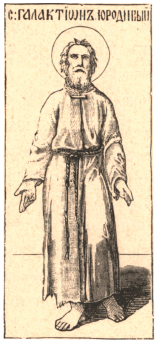
В рукописных святцах читаем: «преподобный Галактион юродивый бысть в Ферапонтове монастыри». Блаж. Галактион был учеником преп. Мартиниана; он жил у него в келье и, когда преподобный по дряхлости уже не мог сам ходить в храм, Галактион носил его в церковь. Преподобный Мартиниан, зная настроение души его и тайные подвиги, благословил ему, по его желанию, юродствовать. Галактион тайными подвигами достиг высокого совершенства.
In the manuscript Menologia we read: "The Venerable Galaktion the Fool-for-Christ was in the Ferapontov monastery." Blessed Galaktion was a disciple of the Venerable Martinian; he lived in his cell, and when the venerable one, from decrepitude, could no longer walk to the church, Galaktion carried him to church. The Venerable Martinian, knowing the disposition of his soul and his secret struggles, blessed him, according to his desire, to play the fool for Christ. Galaktion attained high perfection through secret struggles.
Однажды братия взошли во вновь построенную трапезу и стали хвалить её; «хороша, да недолговечна», – сказал Галактион. На другой день трапеза сгорела. У одного брата загорелась келья, и пламя распространилось по обители.
Once the brethren entered a newly built refectory and began to praise it; "It is good, but not long-lasting," said Galaktion. The next day the refectory burned down. A brother's cell caught fire, and the flame spread throughout the monastery.
Здесь пребывал тогда блаж. Иоасаф, Ростовский архиепископ, прежде того бывший князь Оболенский. Когда пламя пожара обняло келью Иоасафа, он скорбел, что погибнет в ней одна дорогая вещь, принадлежащая монастырю. Галактион, услышав, что это – собственность обители, осенил себя крестным знамением, бросился в пылавшую келью, вынес оттуда вещь и сказал святителю: «вот она, не тужи, зачем тужить о пустом?».
At that time the blessed Joasaph, Archbishop of Rostov, who had formerly been Prince Obolensky, was staying there. When the flame of the fire enveloped Joasaph's cell, he grieved that a certain precious object belonging to the monastery would perish in it. Galaktion, hearing that it was the property of the monastery, made the sign of the cross, threw himself into the blazing cell, brought out the object, and said to the hierarch: "Here it is, do not grieve; why grieve over a trifle?"
Опасность пожара грозила колокольне; сбежавшиеся сторонние люди хотели снимать колокола, но Галактион прогнал всех со словами: «этому не гореть». И точно, колокольня осталась цела140. Это было пред кончиной преподобного Мартиниана, в 1483 г.141. Блаженный Галактион, после наставника своего, ещё прожил более 20 лет в обители, служа примером строгой жизни и по временам подкрепляя ослабевавших. Один из братий тяготился унынием, хотел оставить обитель. Галактион пришёл к нему, сел на пороге кельи его и сказал: «Что это, брат, задумал ты? От волнения не убежишь, хотя бы ты и удалился от нас: нигде нельзя избежать искушений вражьих»142.
The danger of the fire threatened the bell tower; people from outside who had run up wanted to take down the bells, but Galaktion drove them all away with the words: "This will not burn." And indeed, the bell tower remained intact140. This was before the repose of the Venerable Martinian, in 1483141. Blessed Galaktion, after his teacher, lived more than twenty more years in the monastery, serving as an example of strict life and from time to time strengthening the faint-hearted. One of the brethren was burdened by despondency and wished to leave the monastery. Galaktion came to him, sat on the threshold of his cell, and said: "What is this, brother, that you have conceived? You will not flee from disturbance, even if you depart from us: nowhere can one escape the temptations of the enemy"142.
В 1505 году новый великий князь Василий отправил брата своего, князя Димитрия с войском против Казани; слух о том дошёл до Ферапонтовой обители; об этой новости сообщили Галактиону. «И ещё много раз князь Василий будет хлопотать о Казани, но всё будет безуспешно; родится сын Иван, – тот овладеет Казанским царством». Эти слова замечены были в обители; потому с года на год ждали рождения сына Ивана. Но так как долго и после смерти Галактионовой не видели покорения Казани, то положили, что слова Галактиона были слова юродивого, без всякого особенного значения. Спустя 24 года родился и князь Иван(1630 г.), а спустя другие 23 года взята и Казань. Тогда-то уверились, что слова Галактиона были точной историей будущего143. Блаженный Галактион предвидел свою кончину и сказал о ней братии; сотрудник его Савва скорбел о разлуке с ним. «Не скорби, через восемь дней увидимся», – сказал Галактион. И точно, спустя 8 дней после блаженного Галактиона умер и Савва. Кончина преподобного последовала в 1506 году144
In 1505 the new Grand Prince Vasily sent his brother, Prince Demetrius, with an army against Kazan; the rumor of this reached the Ferapontov monastery; they reported this news to Galaktion. "And many more times Prince Vasily will trouble himself about Kazan, but all will be unsuccessful; a son Ivan will be born—he will take possession of the Kazan kingdom." These words were noted in the monastery; therefore from year to year they awaited the birth of the son Ivan. But since long after Galaktion's death they did not see the subjugation of Kazan, they concluded that Galaktion's words were the words of a fool, without any special significance. Twenty-four years later Prince Ivan was born (1630), and another twenty-three years later Kazan was taken. Then they became convinced that Galaktion's words were an exact history of the future143. Blessed Galaktion foresaw his own repose and spoke of it to the brethren; his fellow worker Sabbas grieved over separation from him. "Do not grieve; in eight days we shall see each other," said Galaktion. And indeed, eight days after blessed Galaktion, Sabbas also died. The repose of the venerable one occurred in 1506144.
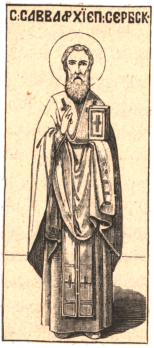
У великого жупана Сербии Стефана Немани были два сына – Стефан и Волкан, но родителям хотелось ещё иметь сына, и по молитве их родился им сын Ростислав145. Желанному сыну дано было прекрасное образование; на 15-м году Ростислав получил в управление особую область Герцеговину, которая впоследствии и называлась герцогством святителя Саввы146. Когда наступил 17-й год, родители готовились женить его. Но у сына не было желаний мирской жизни – душа его томилась скукой среди шума мирского. Случилось, что когда он прибыл к родителям, пришёл в дом их, всегда открытый для странников, инок с Афона, русский, из монастыря русского. Весёлые родители давали пиры по случаю свидания с любимыми сыном, а они, позвав в уединённую комнату инока, расспрашивал о жизни Афонской. Когда инок говорил о тихой жизни молитвенников, – об их подвигах и надеждах на вечность, слёзы текли у Ростислава, и он сказал иноку: «теперь я понял, чего желала душа моя, так недовольная всегда суетой мирской. Счастливы те, кого привёл Бог вести безмятежную жизнь пустыни.
The Great Župan of Serbia, Stephen Nemanja, had two sons—Stephen and Vukan—but his parents desired yet another son, and through their prayer a son Rostislav was born to them145. The longed-for son was given an excellent education; in his fifteenth year Rostislav received in governance a particular region, Herzegovina, which was later called the duchy of St. Sava146. When his seventeenth year came, his parents prepared to marry him. But the son had no desire for worldly life—his soul languished with weariness amid the noise of the world. It happened that when he came to his parents, a monk from Mount Athos, a Russian from a Russian monastery, entered their house, which was always open to strangers. The joyful parents gave feasts on the occasion of meeting with their beloved son, while he, calling the monk into a secluded room, questioned him about the life on Mount Athos. When the monk spoke of the quiet life of the men of prayer—of their struggles and hopes for eternity—tears flowed from Rostislav, and he said to the monk: "Now I have understood what my soul desired, which was always so discontented with the vanity of the world. Happy are those whom God has brought to lead the undisturbed life of the desert.
– Но, что делать, – прибавил он, – с родителями, которые так любят меня? Они готовы женить меня, а я боюсь, что супружеская жизнь, весёлости и толкотня мирская погасят во мне всё лучшее». Инок сказал, что нужна твёрдая решимость на добро. Ростислав выпросился на охоту; разослав слуг делать облаву, он с несколькими преданными и иноком поспешил в Афон.
– But what is to be done," he added, "with my parents, who love me so? They are ready to marry me, and I fear that married life, merriments, and worldly bustle will extinguish in me all that is best." The monk said that a firm resolve for good was needed. Rostislav asked permission to go hunting; having sent his servants to make a beat, he hastened with a few trusted men and the monk to Mount Athos.
Отец, выслушав весть о Ростиславе, понял, что тот с иноком удалился в Афон. Призвав надёжного из воевод, печальный отец сказал: «испытал ли ты болезнь любви к детям? Докажи мне твою верность, – возврати мне моего Ростислава». Поручив ему дружину молодых людей, он написал к воеводе Солунскому, что отмстит войной, если не возвратят ему сына из Афона. Воевода и дружина поспешили к эпарху с письмом и от него приняли письмо к проту горы.
The father, having heard the news about Rostislav, understood that he had departed with the monk to Mount Athos. Summoning a trusted voivode, the sorrowful father said: "Have you experienced the pain of love for children? Prove your faithfulness to me—return my Rostislav to me." Entrusting him with a company of young men, he wrote to the voivode of Thessalonica that he would avenge himself with war if they did not return his son from Mount Athos. The voivode and the company hastened to the eparch with the letter and received from him a letter to the Protos of the Mountain.
Прибыв на Афон, расспросами дознались, что Ростислав в русском монастыре, и явились прямо в тот монастырь. Князь наедине просил воеводу не препятствовать ему облечься в иночество, обещая написать потом письмо к отцу. «Нет, – отвечал старик, – и не проси меня о том, – я должен быть верен жупану отцу», – и велел не спускать глаз с князя. Ростислав переговорил с игуменом. Воевода и дружина были угощены с полным радушием, а вслед за тем все отправились на всенощное служение. Длинное служение после быстрой поездки и сытного стола расположило к тому, что старик и молодые товарищи задремали и даже заснули сном глубоким в покойных сиденьях. Ростислав и старец иеромонах тихо вышли из храма, и в башне монастырской княжич совершил иноческие обеты с именем Саввы147. Окончилось бдение. Стражи, проспавшие князя, подняли шум и страшную тревогу. Савва из окна башни дал знать, что дело кончено и стыдно тревожить невинных. «Вот, – говорил он старцу-воеводе, – одежда моя и волосы мои, – доставьте родителям эти памятники моего прошлого»; затем он вручил письмо к родителям. Это было в 1186 году.
Having arrived on Mount Athos, they learned through inquiries that Rostislav was in the Russian monastery, and they appeared directly at that monastery. The prince privately asked the voivode not to hinder him from being clothed in monasticism, promising to write a letter afterward to his father. "No," replied the old man, "and do not ask me for that—I must be faithful to the župan your father"—and he ordered that the prince not be let out of sight. Rostislav spoke with the abbot. The voivode and the company were entertained with full hospitality, and then all went to the All-night Vigil. The long service after the swift journey and the hearty meal disposed the old man and the young companions to doze off and even fall into a deep sleep in the comfortable seats. Rostislav and the elder hieromonk quietly went out of the church, and in the monastery tower the prince made his monastic vows with the name Sava147. The Vigil ended. The guards, who had slept through the prince, raised a clamor and a terrible alarm. Sava from the tower window let them know that the matter was finished and it was shameful to disturb the innocent. "Behold," he said to the old voivode, "my clothing and my hair—deliver these mementos of my past to my parents"; then he handed over a letter to his parents. This was in 1186.
Ватопедские иноки, пригласив Савву на храмовый праздник Благовещения, убедили его остаться в их обители148. Спустя несколько времени Савва испросил благословения у игумена посетить отшельников горы, дабы принять от них благословение и советы. Побыв в лавре святого Афанасия, Савва взошёл на вершину горы Афонской. Здесь провёл несколько дней и ночей в молитве. Посещая отшельников, Савва узнавал об их жизни и оживлялся высоким подвигом их. «Хотя, – говорит описатель жизни его, – и нельзя назвать сих отцов Ангелами, потому что они имели плоть, но истинно были человеки Божии. Они свободны были от всего: не занимались ни земледелием, ни торговлей; занятием их были молитвы, слёзы, постоянное устремление ума к Богу; открытое небо было их храмом; Христа зрели они в сердцах своих; их тесные кельи украшены были только травой; слух их оглашался шумом дерев и пением птиц. Иные скрывались в расселинах камней; другие, подобно птицам, гнездились на камнях морских, терпя дождь и ветры, летом опаляемые зноем, зимой перенося холод; пища их была самая скудная; иные немного принимали хлеба, другие довольствовались плодами и дикими растениями». Такая жизнь отшельников восхитила Савву.
The monks of Vatopedi, having invited Sava to their patronal feast of the Annunciation, persuaded him to remain in their monastery148. After some time Sava asked the abbot's blessing to visit the hermits of the Mountain, in order to receive their blessing and counsel. Having stayed at the Lavra of St. Athanasius, Sava ascended to the summit of Mount Athos. Here he spent several days and nights in prayer. Visiting the hermits, Sava learned about their life and was enlivened by their high struggle. "Although," says the writer of his life, "one cannot call these fathers angels, because they had flesh, yet truly they were men of God. They were free from everything: they occupied themselves neither with agriculture nor with trade; their occupation was prayers, tears, the constant direction of the mind toward God; the open sky was their church; they beheld Christ in their hearts; their narrow cells were adorned only with grass; their hearing was filled with the rustling of trees and the singing of birds. Some hid in the clefts of rocks; others, like birds, nested on the rocks of the sea, enduring rain and winds, in summer scorched by heat, in winter bearing cold; their food was most meager; some took a little bread, others were content with fruits and wild plants." Such a life of the hermits enraptured Sava.
Он хотел жить отшельнически, но игумен не дозволил ему, объяснив, что молодому иноку небезопасна жизнь отшельническая, полезнее для него – общежитие. Савва подчинился совету опытности. В Ватопеде он стал образцом послушания, готовый служить каждому; днём служил братии, ночь проводил в молитве; питался только хлебом; носил одну власяницу, перенося холод зимы; ходил босой. Старец-отец прислал на содержание сына много денег и запасов. Савва по благословению игумена пошёл босой раздать отшельникам кое-что из присланного. Близ Нилопотама напали на него разбойники и отняли всё. Блаженный изъявил скорбь, что задержанный не поспеет, куда надобно. Те спросили: «Кто и откуда он?» Савва назвал себя учеником старца Макария, пользовавшегося известностью на Афоне. Те возвратили Савве, что взяли. И он поспешил к Макарию. Затем был он с милостыней в лавре святого Афанасия. Признательный игумен велел доставить его в обитель на лодке. Тут опять напали недобрые люди, и Савва спасён был от них хитростью старца. На деньги родителей Савва устроил в Ватопеде кельи и три храма и покрыл собор оловом. Два раза писал отец к сыну, прося его побывать у родителей. Сын писал отцу: «Расстанься с земным богатством, столько призрачным, с благами мира, суетными и непрочными; вступи на крестный путь; переселись ко мне и, упразднясь от суеты, приготовь себя к вечности молитвой и постом. Ты удостоился милостью Божией земного царства, смирением иноческой жизни достигнешь венца небесного. Я буду жить с тобою, и любовью твоей избавишь ты душу мою от печалей. Добрая мать моя последует твоему примеру в своей стране. Молю вас, да не будут слова мои тяжки для вас, как для известного юноши». Отец и мать в одном храме, в Студеницкой обители, совершили обет иночества. О. Симеон переселился к сыну в келью, и сын окружал старца отца самыми нежными заботами до самой его смерти (1200 г.).
He wished to live as a hermit, but the abbot did not permit him, explaining that the hermitic life was unsafe for a young monk, and that the common life was more profitable for him. Sava submitted to the counsel of experience. At Vatopedi he became a model of obedience, ready to serve everyone; by day he served the brethren, by night he spent in prayer; he ate only bread; he wore but a single hair-shirt, enduring the cold of winter; he went barefoot. The elder-father sent much money and provisions for his son's support. Sava, with the abbot's blessing, went barefoot to distribute to the hermits something of what had been sent. Near Nilopotamus robbers fell upon him and took everything. The blessed one expressed sorrow that, being delayed, he would not arrive in time where he needed to be. They asked: "Who is he, and whence?" Sava named himself a disciple of the elder Macarius, who was well known on Athos. They returned to Sava what they had taken. And he hastened to Macarius. Then he was with alms at the Lavra of St. Athanasius. The grateful abbot ordered him to be conveyed to the monastery by boat. Here again evil men attacked, and Sava was saved from them by the elder's cunning. With his parents' money Sava built cells and three churches at Vatopedi, and covered the cathedral with tin. Twice his father wrote to his son, asking him to visit his parents. The son wrote to his father: "Part with earthly wealth, so illusory, with the goods of the world, vain and unstable; enter upon the way of the Cross; move to me and, freed from vanity, prepare yourself for eternity by prayer and fasting. You have been vouchsafed by the mercy of God an earthly kingdom; by the humility of the monastic life you shall attain the heavenly crown. I will live with you, and by your love you shall deliver my soul from sorrows. My good mother will follow your example in her own land. I pray you, let not my words be burdensome to you, as to that certain youth." Father and mother, in one church, in the Studenica monastery, made their vow of monasticism. Father Simeon moved to his son's cell, and the son surrounded the elder father with the most tender cares until his very death (1200 A.D.).
По настоянию благочестивого прота Дометия Савва принял на себя звание настоятеля Хиландарской обители, восстановленной из развалин щедростью родителя. Савва со страхом принял на себя Хиландар: братии было немного. Но к усердному рабу Божию пришли ревнители благочестия. Оградив обитель от нужд временных вкладами, преподобный в ограждение нравственной жизни дал обители устав. «Преподобные и богоносные отцы наши, – пишет Савва в начале устава, – оставили мир по словам Господа: иже хощет по Мне идти, да отвержется себе, и возмет крест свой, и по Мне грядет (Мк.8:34). Подвизаясь в исполнении заповедей, они день и ночь воздыхали о спасении души, с охотой терпели страдания и нужды, из любви к Нему распинали и умерщвляли себя каждый день послушанием и отсечением своей воли. И я, грешный Савва, последний из всех монахов, молю вас, возлюбленные о Христе, духовные братия мои и отцы, будем подражать тем купцам, которые променяли временное на вечное. Ревнуйте умным девам, которые наполнили елеем светильники». Словами Писания показав необходимость терпения (Иак.1:2–4), добрых дел (Иак.2:19–24) любви к ближним (Ин.1:4–7; 6, 16–21, 5:1–3), наставник продолжает: «друг друга любите, друг другу покоряйтесь, друг друга тяготы носите, все единомысленно повинуйтесь настоятелю».
At the insistence of the pious protos Dometius, Sava accepted upon himself the office of superior of the Hilandar monastery, restored from ruins by the generosity of his parent. Sava took upon himself Hilandar with fear: the brethren were few. But zealots of piety came to the diligent servant of God. Having shielded the monastery from temporal needs by endowments, the Venerable one gave the monastery a rule for the safeguarding of moral life. "Our Venerable and God-bearing fathers," writes Sava at the beginning of the rule, "forsook the world according to the words of the Lord: Whosoever will come after Me, let him deny himself, and take up his cross, and follow Me (Mk. 8:34). Striving in the fulfillment of the commandments, they sighed day and night for the salvation of the soul, willingly endured sufferings and needs, and out of love for Him crucified and mortified themselves each day by obedience and the cutting off of their own will. And I, sinful Sava, the last of all monks, pray you, beloved in Christ, my spiritual brethren and fathers, let us imitate those merchants who exchanged the temporal for the eternal. Be zealous for the wise virgins, who filled their lamps with oil." Having shown by the words of Scripture the necessity of patience (Jas. 1:2–4), of good works (Jas. 2:19–24), of love for one's neighbor (Jn. 1:4–7; 6, 16–21, 5:1–3), the instructor continues: "Love one another, submit to one another, bear one another's burdens, all with one mind obey the superior."
Устав святителя Саввы обнимал и порядок службы Божией, и порядок жизни и правления монастырского. Хиландар должен быть общежительным. Монахам не позволялось иметь никакой собственности, даже и одной медной монеты. Пищей должны пользоваться в общей трапезе и по кельям ничего не держать съестного. На первый раз поступающий в обитель получает монастырскую одежду, а потом выдаются ему деньги; каждый день братия должны исповедовать грехи свои игумену, если он есть и духовник. Игумен должен учить всех и каждого путям спасения. Те, которые чувствуют себя свободными от нечистых помыслов, от гнева, ропота, памятозлобия, могут приобщаться Святых таин три раза в неделю. Иначе пусть приступают раз в неделю. Впрочем, это решает духовник. Подле монастыря Савва устроил гостиницу для принятия странных, нищих и больных; им обитель должна доставлять пищу и одежду149. Приведя Хиландар в полное устройство, преподобный захотел исполнить давнее своё желание – жить в безмолвии. Ещё в 1193 году «всех правоверных крестьян молитвенник, Савва грешный», грамотой купил место для типикарницы Карейской150. Там построено было несколько келий для хиландарской братии на те случаи, когда они по нуждам приходили в Карею. Савва выстроил для себя келью с иконостасом во имя Саввы Освященного151. Здесь заключился он с тремя братиями, которые должны были совершать церковную службу. Тут он усилил свои подвиги поста и молитвы, сокрушения о грехах и смирения; душевные страсти утишал памятью о смерти. Впрочем, являлся ли кто с душевной нуждой или говорил о бедности и внезапной беде, у Саввы готова была для всех посильная помощь. Он написал и для Карейской отшельнической жизни устав152.
The rule of Hierarch Sava embraced both the order of the divine service and the order of monastic life and governance. Hilandar was to be a cenobium. The monks were not permitted to possess any property, not even a single copper coin. They were to take food at the common refectory and keep nothing edible in their cells. Upon first entering the monastery, one received the monastic clothing, and afterwards money was given to him; each day the brethren were to confess their sins to the abbot, if he is also the spiritual father. The abbot was to teach all and each the ways of salvation. Those who felt themselves free from impure thoughts, from anger, murmuring, and remembrance of wrongs, might commune of the Holy Mysteries three times a week. Otherwise let them approach once a week. However, this was decided by the spiritual father. Beside the monastery Sava built a guesthouse for the reception of strangers, the poor, and the sick; the monastery was to supply them with food and clothing149. Having brought Hilandar into full order, the Venerable one wished to fulfill his long-standing desire—to live in stillness. Already in 1193, "the prayer-book of all right-believing Christians, the sinful Sava," by charter purchased a place for the Karyes typikarnitsa150. There several cells were built for the Hilandar brethren for those occasions when they came to Karyes on business. Sava built for himself a cell with an iconostasis in the name of Sabbas the Sanctified151. Here he shut himself in with three brethren, who were to perform the church services. Here he intensified his labors of fasting and prayer, of compunction for sins and humility; he stilled the passions of the soul by remembrance of death. Yet, if anyone appeared with a spiritual need, or spoke of poverty or sudden misfortune, Sava had ready for all whatever help he could give. He also wrote a rule for the Karyes hermitic life152.
Преподобный Савва крепко молил Господа, дабы дано ему было извещение об отце его. И в одну ночь явился ему Симеон в лике святых, сияющих славой; явившийся обещает сыну подобную блаженную участь, но сказал, что ему ещё многое надобно совершить для Сербии. Сербия находилась тогда в печальном положении. Преемником престола оставил отец Стефана. Честолюбивый брат Вулкан при помощи венгров отнял у Стефана Далматию и Диоклею и объявил себя королём. Стефану оставалась одна Сербия с титулом великого жупана. Но враги хотели отнять у него и последние владения. Стефан писал к брату Савве, чтобы он для спасения земли Сербской перенёс мощи святого отца их в Сербию. Святитель Савва не мог остаться равнодушным к скорби брата и бедствиям отчизны. Вулкан, чтобы достигнуть тщеславных своих целей, подчинился папе; в его владениях был собор под распоряжением легатов папы и приняты некоторые правила западной церкви. Папа убеждал венгерского короля ввести в Сербии римскую веру153. Савва, посвящённый в архимандрита в Солуни, перенёс мощи святого отца своего в Студеницкую обитель. В день памяти его испросил у Господа обильное излияние мира от мощей Симеона и в сильном слове показал народу волю Божию о спасении вечном. Уступив просьбам брата, остался в Студеницкой обители. Для оживления в народе искреннего благочестия отправился он с проповедью слова Божия по всей стране. Проповедь его тем более имела силу над сердцами людей, что один расслабленный всеми членами по его молитве получил полное исцеление. Следствием того было то, что замыслы папы ввести в Сербии романизм остались неудавшимися154. Между братьями по убеждениям святителя Саввы прекратились ссоры и утвердился мир. Для Студеницкой обители преподобный написал устав155.
The Venerable Sava earnestly prayed to the Lord that he might be given assurance concerning his father. And one night Simeon appeared to him in the ranks of the saints, shining with glory; the one who appeared promised his son a like blessed lot, but said that he still had much to accomplish for Serbia. Serbia was then in a sorrowful condition. His father had left Stephen as successor to the throne. The ambitious brother Vukan, with the help of the Hungarians, took Dalmatia and Dioclea from Stephen and declared himself king. To Stephen remained only Serbia with the title of Grand Župan. But enemies wanted to take from him even his last possessions. Stephen wrote to his brother Sava, that for the salvation of the Serbian land he should translate the relics of their holy father to Serbia. Hierarch Sava could not remain indifferent to his brother's grief and the calamities of his homeland. Vukan, to attain his vainglorious aims, submitted to the pope; in his domains a council was held under the direction of papal legates, and certain rules of the Western Church were accepted. The pope urged the Hungarian king to introduce the Roman faith into Serbia153. Sava, having been ordained archimandrite in Thessalonica, translated the relics of his holy father to the Studenica monastery. On the day of his memory he asked of the Lord an abundant outpouring of myrrh from the relics of Simeon, and in a powerful discourse showed the people the will of God concerning eternal salvation. Yielding to his brother's entreaties, he remained at the Studenica monastery. To revive sincere piety among the people, he set out with a preaching of the word of God throughout the whole land. His preaching had all the more power over men's hearts because a certain paralytic, helpless in all his limbs, received complete healing through his prayer. The consequence was that the pope's designs to introduce Romanism into Serbia remained unfulfilled154. Between the brothers, through the persuasions of Hierarch Sava, quarrels ceased and peace was established. For the Studenica monastery the Venerable one wrote a rule155.
Соскучив шумом и почестями, преподобный, невзирая на просьбы брата, возвратился в Хиландарскую обитель. Хиландарские иноки с радостью встретили преподобного отца своего. Святой по временам удалялся в любимую Карейскую келью для глубокого безмолвия.
Growing weary of the noise and honors, the Venerable one, notwithstanding his brother's entreaties, returned to the Hilandar monastery. The Hilandar monks joyfully met their Venerable father. The saint from time to time withdrew to his beloved Karyes cell for deep stillness.
Нужды Афона заставили Савву отправиться к царю и патриарху. В Царьграде тогда уже властвовали или, точнее, неистовствовали папёжники. Царь и патриарх пребывали в Никее. Царь Феодор Ласкарь был в родстве с владетельным домом Сербским: дочь его была за Радославом, племянником святителя Саввы. Император принял преподобного со всей любовью; всё, о чём просил Савва, сделано было для Афона. Он уже хотел возвращаться в своё уединение, как пришло ему на мысль воспользоваться случаем – испросить милость для Сербии. Призвав Господа на помощь, он предложил царю прошение о том, чтобы патриарх посвятил одного из сербов, спутников его, в архиепископа, по той мысли, что серб-пастырь может быть более полезен для Сербии, чем иноплеменник. Благочестивый Феодор с радостью согласился, но прибавил: «Хочу видеть избранного тобою брата, благоволит ли к нему душа моя? То̀т должен быть особенным человеком, на кого падёт такой жребий». Савва представил всех спутников. «Все братия твои, – сказал царь, – хороши, но ни одному не могу доверить высокого сана, к тебе одному расположена душа моя». Смиренный Савва не хотел и слышать о том. Долго уговаривали его царь и патриарх, и едва согласился Савва на их желание по долгу послушания. В день Успения Богоматери Савва посвящён был в архиепископа патриархом. После того новый святитель решился ещё испросить милость для Сербии. «Доверши милости твои, государь, – говорил Савва. – Пусть на словах и на бумаге предоставится право рукополагать архиепископа Сербии собором епископов Сербских». Святой объяснил как то, что это согласно будет с правилами Апостольскими, так особенно то, что во время бурь военных, так частых в печальное время, трудно являться из Сербии для посвящения архиепископа. И царь, и патриарх отяготились такой просьбой: им хотелось, чтобы Сербская церковь оставалась в полном подчинении патриарху. Долго происходили совещания по этому делу. Наконец, выдана была и желанная патриаршая грамота156.
The needs of Athos compelled Sava to go to the emperor and the patriarch. In Constantinople the papists then already held sway, or rather, raged. The emperor and patriarch dwelt in Nicaea. Emperor Theodore Lascaris was related to the ruling house of Serbia: his daughter was married to Radoslav, the nephew of Hierarch Sava. The emperor received the Venerable one with all love; everything Sava asked for Athos was done. He already wished to return to his solitude, when it came into his mind to avail himself of the opportunity—to ask a favor for Serbia. Calling upon the Lord for help, he presented to the emperor a petition that the patriarch should consecrate one of the Serbs, his companions, as archbishop, on the thought that a Serbian pastor might be more useful for Serbia than a foreigner. The pious Theodore gladly agreed, but added: "I wish to see the brother chosen by you, whether my soul is well disposed toward him. He must be a special man, upon whom such a lot falls." Sava presented all his companions. "All your brethren," said the emperor, "are good, but to none of them can I entrust the high rank; to you alone is my soul disposed." The humble Sava would not even hear of it. For a long time the emperor and patriarch urged him, and scarcely did Sava consent to their desire out of the duty of obedience. On the day of the Dormition of the Theotokos, Sava was consecrated archbishop by the patriarch. After that, the new hierarch resolved to ask yet another favor for Serbia. "Complete your favors, sovereign," said Sava. "Let the right be granted, in word and in writing, to ordain the archbishop of Serbia by the council of the Serbian bishops." The saint explained both that this would be in accordance with the Apostolic canons, and especially that in times of military storms, so frequent in that sorrowful age, it would be difficult to come from Serbia for the consecration of an archbishop. Both the emperor and the patriarch were burdened by such a request: they wished the Serbian Church to remain in full submission to the patriarch. For a long time deliberations took place on this matter. At last, the desired patriarchal charter was also issued156.
По возвращении из Никеи святитель, простясь с Афоном, отправился в Сербию. Брат Стефан лежал больным и отправил сыновей своих встретить святителя на границе владений.
Upon his return from Nicaea, the hierarch, having bid farewell to Athos, set out for Serbia. His brother Stephen lay ill and sent his sons to meet the hierarch at the border of his domains.
Посетив больного, архиепископ освятил воду, напоил и окропил больного, и больной почувствовал лёгкость, а вскоре стал здоровым. Кафедра архиепископа поставлена была в Жичах, где ещё отцом начат великолепный собор. Хотя храм ещё не был докончен, но святитель, украсив внутренность его иконами, освятил престол и потом посвятил избранных учеников своих в епископы Сербии157. По его мысли созваны были все жупаны Сербии, и в их присутствии Стефан венчан был королевским венцом. На другой день во время Литургии после Евангелия сам читал он Символ веры, и вслед за ним повторяли все от короля до последнего подданного. В следующие за тем два дня предлагал народу различные наставления и заключил поучение такими словами: «ни добрая жизнь без правой веры не может принести нам пользы, ни правая вера без добрых дел не приведёт нас к Богу». Святитель принял потом меры против незаконных сожитий. В народе многие брачные жили без освящения священнического. Священникам предписано обвенчать в храме всех невенчанных. Сам святитель обозревал свою паству, убеждая народ проводить жизнь достойную христиан; иноков, живших на своей воле в виде скитников, но без правила скитского, собрал в общежития и подчинил уставу. Между благородными оставались ещё державшиеся ересей, и он убеждал их соединиться с Церковью, обещая милости короля158. Когда король венгерский, завидуя возвышению сербского короля, объявил Сербии войну, патриот-пастырь отправился в Венгрию и после увещаний силой чуда склонил короля к миру и правой вере159.
Having visited the sick man, the archbishop blessed water, gave it to the sick man to drink and sprinkled him, and the sick man felt relief, and soon became well. The archbishop’s see was established in Žica, where a magnificent cathedral had been begun by his father. Although the church was not yet finished, the hierarch, having adorned its interior with icons, consecrated the altar and then consecrated chosen disciples of his as bishops of Serbia157. At his suggestion, all the župans of Serbia were summoned, and in their presence Stephen was crowned with the royal crown. On the following day, during the Divine Liturgy after the Gospel, he himself read the Symbol of Faith, and all, from the king to the lowliest subject, repeated it after him. On the two days following, he offered various instructions to the people and concluded his teaching with these words: “Neither can a good life without right faith bring us benefit, nor can right faith without good works lead us to God.” The hierarch then took measures against unlawful unions. Many among the people were living in marriage without priestly blessing. The priests were instructed to perform the church wedding of all who were not married. The hierarch himself surveyed his flock, urging the people to lead a life worthy of Christians; he gathered monks who lived according to their own will in the manner of skete-dwellers, but without the rule of the skete, into cenobitic communities and subjected them to a rule. Among the nobles there remained some who held to heresies, and he urged them to unite with the Church, promising them the king’s mercy158. When the Hungarian king, envying the rise of the Serbian king, declared war on Serbia, the patriot-pastor set out for Hungary and, after admonitions, by the power of a miracle inclined the king to peace and right faith159.
По смерти брата святитель Савва отправился на Восток для поклонения святым местам, освящённым стопами Спасителя. Не оставлено им ни одно место Святой земли, где бы не побывал он; посетил и все пустыни иноческие. В обители Саввы Освященного получил он дорогой дар – жезл Освященного, хранимый поныне по его завещанию на Афоне160. На обратном пути был он в Никее. Император Иоанн Ватаци принял и отпустил его с почестями в Афон. Прибыв на кафедру, совершил годичное поминовение о брате-короле и утешен был нетлением тела его.
After the death of his brother, Hierarch Sava set out for the East to venerate the holy places sanctified by the footsteps of the Savior. Not one place in the Holy Land was left unvisited by him; he also visited all the monastic deserts. In the monastery of Sabbas the Sanctified, he received a precious gift—the staff of the Sanctified, preserved to this day on Athos according to his testament160. On the return journey he was in Nicaea. The Emperor John Vatatzes received him and dismissed him with honors to Athos. Having arrived at his see, he performed the annual commemoration for his brother the king and was consoled by the incorruption of his body.
Святитель старался умирить вражду, поднявшуюся между племянниками. Радослав, завлечённый дурной женщиной в дурные дела, вынужден был бежать из Сербии. Святитель венчал на королевство Владислава в 1230 году.
The hierarch strove to pacify the enmity that had arisen between his nephews. Radoslav, enticed by an evil woman into evil deeds, was forced to flee from Serbia. The hierarch crowned Vladislav king in the year 1230.
Под бдительным надзором святителя Саввы цвело благочестие в Сербии. Он каждый праздничный день предлагал поучение в храме: вельможным внушал не забывать о смерти, воинам – остерегаться своеволий, народу – не возобновлять языческих веселий. В монастырях вводил он всё лучшее, что видел на Востоке. Для устроения и украшения храмов вызывал с Востока лучших иконописцев и мастеров мраморной работы161.
Under the vigilant oversight of Hierarch Sava, piety flourished in Serbia. On every feast day he offered a homily in church: he admonished the nobles not to forget death, the soldiers to beware of lawlessness, and the people not to revive pagan revelries. In the monasteries he introduced all the best that he had seen in the East. For the building and adornment of churches, he summoned the best iconographers and marble workers from the East161.
В грамоте своей святитель писал: «Спаситель нам сказал: славящих Меня прославлю; кто исповедует Меня пред людьми, о том возвещу и Я пред Отцом Моим Небесным (см.: Мф.10:32). Христолюбивый Иларион, священный епископ Зетский, последуя словам Спасителя, поднял много трудов в своём святительстве. Поставленный мной в святителя Зетской области, он прежде всего старался учить людей Божественному закону. Потом построил в местечке Вранине дом Божий, храм в честь преподобного отца нашего Николая, поселил там черноризцев для славословий Богу и отдал святое место под мою защиту. Я, архиепископ Сербской земли, даю заповедь именем Господа Вседержителя и именем смирения моего: пусть при преемниках моих архиепископах святое то место не обращается в метохию (подворье) архиепископа или на другое работное назначение... Пусть братия сами избирают себе старейшину и только получают благословение архиепископа»162.
In his charter the hierarch wrote: “The Savior said to us: ‘Those who glorify Me I will glorify; whoever confesses Me before men, of him I will also confess before My Father in heaven’ (see Mt. 10:32). The Christ-loving Hilarion, sacred bishop of Zeta, following the words of the Savior, undertook many labors in his hierarchate. Appointed by me as hierarch of the Zetan region, he first of all strove to teach the people the Divine law. Then he built in the town of Vranina a house of God, a church in honor of our Venerable Father Nicholas, settled there monks for the glorification of God, and placed the holy place under my protection. I, the archbishop of the Serbian land, give a commandment in the name of the Lord Almighty and in the name of my humility: let that holy place not be turned into a metochion (dependency) of the archbishop or to any other servile purpose under my successors the archbishops… Let the brethren themselves choose their elder and only receive the blessing of the archbishop”162.
Народ сербский назвал святителя Савву просветителем Сербии. И не напрасно. Путешествуя по стране Сербской, святой насадил в ней благочестие, которое пережило в народе бури веков. И поныне в сербском народе остаётся ещё много благочестивых, истинно христианских обычаев, насаждённых просветителем Сербии. Биограф святого Стефана Лазаревича пишет о современных ему сербах: «с юного возраста все, от малого до старого, приучены посещать храм Божий дважды в день». Грешно было бы для серба обещать что-нибудь, не прибавив: «если Господу угодно». Путника не спрашивают: «Куда идёшь?» Опуская из вида его волю, говорят: «Если Богу угодно, что?» Прежде всего воля и слава Божия. Перед питием вина серб всегда скажет: «В славу Божию». До нового года с первого дня праздника Рождества Христова при встрече говорят друг другу: «Христос родился» и «воистину родился». В продолжение трёх дней праздника каждый может приходить в дом чужой и есть и пить, сколько угодно. Радость о Христе всё приготовила. Сколько других ещё прекрасных обычаев живёт ещё в народе, невзирая на давившую тьму магометанства163.
The Serbian people called Hierarch Sava the enlightener of Serbia. And not in vain. Traveling through the Serbian land, the saint planted in it piety, which survived in the people through the storms of the ages. Even to this day, many pious, truly Christian customs planted by the enlightener of Serbia remain among the Serbian people. The biographer of St. Stephen Lazarević writes of the Serbs of his time: “From a young age, all, from small to great, are accustomed to attend the house of God twice a day.” It would be sinful for a Serb to promise anything without adding: “If the Lord wills.” A traveler is not asked: “Where are you going?” Setting aside his will, they say: “If God wills, what?” Above all is the will and glory of God. Before drinking wine, a Serb will always say: “To the glory of God.” From the first day of the feast of the Nativity of Christ until the new year, when meeting they say to one another: “Christ is born” and “Truly He is born.” For the duration of the three days of the feast, anyone may come into another’s house and eat and drink as much as they wish. Joy in Christ has prepared everything. How many other beautiful customs still live among the people, despite the oppressive darkness of Mohammedanism163.
Святитель приближался к концу земного пути. Избрав в преемника себе испытанного инока Арсения, при собрании епископов посвятил он его в сан святительский и поручил ему вместо себя управлять делами архиепископии; он объявил, что отправляется на Восток. Племянник-король и все другие удерживали его, но он сказал, что желает посетить Синай и потом, если Господу угодно будет, жить в безмолвии. Король Владислав, впервые начавший обрабатывать сербские рудники в горах Сербии и тем обогативший Сербию164, доставил святому богатые дары для церквей Востока. Савва отправился морем. Поднялась буря; все спутники ожидали смерти. Святитель молился; потом, подняв руки, осенил море крестным знамением, и волны утихли. В Иерусалиме беседовал он с патриархом Афанасием и отправился в Александрию. Помолившись в храмах святого Марка и мученика Мины, с проводником патриаршим посетил отцов Мареота и Ливии и был в Фиваиде. На Синае покланялся месту Боговидения; здесь пробыл он весь Великий пост. Возвратясь в Иерусалим, отсюда путешествовал в Антиохию и в монастырь Симеона Дивногорца; через Армению прибыл в Болгарию к родственнику, князю Ясеню. Сделавшись болен, он сказал, что умрёт в Тернове, и приказал отправить собранные им святыни к архиепископу Арсению в Сербию. Потом, причастившись Святых Таин, сказал: «славу Богу за всё», и предал дух свой Господу. Патриарх Иоаким с епископами и игуменами совершил надгробное пение, и святое тело положено было (14 января) в новой княжеской церкви 40 мучеников165.
The hierarch was approaching the end of his earthly path. Having chosen as his successor the tested monk Arsenius, in the assembly of bishops he consecrated him to the hierarchal rank and entrusted him to govern the affairs of the archdiocese in his stead; he announced that he was setting out for the East. His nephew the king and all others tried to restrain him, but he said that he wished to visit Sinai and then, if the Lord willed, to live in silence. King Vladislav, who first began to work the Serbian mines in the mountains of Serbia and thereby enriched Serbia164, provided the saint with rich gifts for the churches of the East. Sava set out by sea. A storm arose; all his companions expected death. The hierarch prayed; then, raising his hands, he made the sign of the cross over the sea, and the waves grew calm. In Jerusalem he conversed with Patriarch Athanasius and set out for Alexandria. Having prayed in the churches of St. Mark and the Martyr Menas, with a guide from the patriarch he visited the fathers of Mareotis and Libya and was in Thebaid. On Sinai he venerated the place of the Theophany; he spent the entire Great Lent there. Returning to Jerusalem, from there he journeyed to Antioch and to the monastery of Symeon of the Wonderful Mountain; through Armenia he arrived in Bulgaria to his relative, Prince Asen. Having fallen ill, he said that he would die in Tarnovo, and ordered the holy things he had collected to be sent to Archbishop Arsenius in Serbia. Then, having partaken of the Holy Mysteries, he said: “Glory to God for all things,” and surrendered his spirit to the Lord. Patriarch Joachim, with bishops and abbots, performed the funeral chant, and the holy body was laid (on January 14) in the new princely church of the Forty Martyrs165.
Спустя полгода после погребения усильными просьбами король Владислав склонил Ясеня уступить мощи святителя Саввы отчизне его, и они торжественно перенесены были в монастырь Милешевский, построенный Владиславом166. В 1595 году изуверный визирь Сянан, взяв Милешево, предал святые мощи огню, но казнь Божия постигла гордого изувера. Доселе счастливый на войне, он разбит был слабыми сербами и, вторично разбитый Трансильванским баном, постыдно кончил жизнь. На месте же, где лежали мощи преподобного, больные и после того получали исцеление167.
Six months after the burial, King Vladislav, by earnest entreaties, prevailed upon Asen to yield the relics of Hierarch Sava to his homeland, and they were solemnly translated to the Mileševa Monastery, built by Vladislav166. In 1595, the fanatical vizier Sinan, having taken Mileševa, consigned the holy relics to the fire, but God’s punishment overtook the proud fanatic. Previously fortunate in war, he was defeated by weak Serbs and, defeated a second time by the Ban of Transylvania, ended his life shamefully. At the place where the relics of the Venerable one had lain, the sick continued to receive healing even afterward167.
Святая девственница Феодора подвизалась в Александрии; по памятникам называется она Александрийской. По наставлениям её более чем вероятно, что она была настоятельницей общины дев. По её же словам видно, что она жила в то время, как Александрийской Церковью управлял архиепископ Феофил169. Между письмами святого Исидора Пелусиотского, жившего во время Феофила и Кирилла Александрийских, есть послание к александрийским инокиням сандальницам (σανδαλαριαις). Это название значит, что инокини блаженной Феодоры носили на ногах сандалии, тогда как Фиваидские пустынницы ходили босыми. «Женский пол, – писал преподобный, – не имеет права на снисхождение: он может мужественно противостоять обольщению и отражать нападения пожеланий. Учат этому славная Сусанна, дочь Иефая, и достойная удивления Иудифь... А глава женских побед и трофеев, всехвальная Фекла, стоявшая неизменным столпом девства, как огонь, возгоревшись среди волн страстей, приплыла в безопасную пристань. Если желаете быть таковыми, сохраняйте неугасимыми лампады: скоро придёт Жених. Да не усыпит вас какой-либо сон сладострастия, который сонливых и нерадивых оставляет за дверями брачного чертога»170.
The holy virgin Theodora struggled in Alexandria; according to the records she is called Theodora of Alexandria. From her instructions it is more than probable that she was the superior of a community of virgins. From her own words it is evident that she lived at the time when the Church of Alexandria was governed by Archbishop Theophilus169. Among the letters of St. Isidore of Pelusium, who lived during the time of Theophilus and Cyril of Alexandria, there is an epistle to the Alexandrian nuns sandal-bearers (σανδαλαριαις). This name signifies that the nuns of blessed Theodora wore sandals on their feet, whereas the Thebaid desert-dwellers went barefoot. “The female sex,” wrote the Venerable one, “has no right to indulgence: it can manfully withstand seduction and repel the attacks of desires. This is taught by the glorious Susanna, the daughter of Jephthah, and the admirable Judith… And the head of women’s victories and trophies, the all-praiseworthy Thecla, who stood as an unshaken pillar of virginity, like fire kindled amid the waves of passions, swam into a safe harbor. If you wish to be such, keep your lamps unquenchable: the Bridegroom will come soon. Let no sleep of voluptuousness lull you to sleep, which leaves the drowsy and negligent outside the doors of the bridal chamber”170.
Блаженная Феодора бодро ожидала Небесного Жениха, зорко смотрела за состояниями души своей, не допуская власти греха над собою. По памятникам остаётся за нею название святой Феодоры щедролюбивой. Это значит, что она отличалась в жизни своей особенною любовью к подвигам милосердия. Подвигами многих лет достигла она высокой духовной опытности, так что наставления её записывались и перешли в книгу духовных советов.
Blessed Theodora vigilantly awaited the Heavenly Bridegroom, watchfully observing the states of her soul, not allowing sin to have power over her. In the records she retains the name of St. Theodora the Bountiful. This means that in her life she was distinguished by a particular love for works of mercy. Through the labors of many years she attained such high spiritual experience that her instructions were written down and passed into a book of spiritual counsels.
Она приглашала избирать тесный путь, указанный Спасителем, как путь, необходимый для духовного совершенствования. «Старайтесь, – говорила она, – входить тесными вратами. Если бы деревья не подвергались в холодное время напору ветров, дождю и стуже, то летом не приносили бы плодов. Жизнь земная с её невзгодами – наша зима. Если не станете переносить скорби и испытания, – не ожидайте себе покоя за гробом».
She exhorted them to choose the narrow path pointed out by the Savior, as the path necessary for spiritual perfection. “Strive,” she said, “to enter by the narrow gate. If trees were not subjected in the cold season to the pressure of winds, rain, and frost, they would not bear fruit in summer. Earthly life with its adversities is our winter. If you do not bear sorrows and trials, do not expect rest beyond the grave.”
«Неоценимы выгоды уединённой жизни, особенно для дев и отшельников молодого возраста. Но надобно строго наблюдать за собою, чтобы не утонуть в лени или унынии. Под предлогом желаемого душевного мира предаются покою телесному и доходят до бед душевных; появляется чувство усталости, расслабление колен, – появляется то та, то другая болезнь. „Болен я, – говорят, – не могу прочитывать положенных молитв“.
"The benefits of the solitary life are invaluable, especially for virgins and young recluses. But one must strictly watch over oneself, lest one sink into laziness or despondency. Under the pretext of a desired peace of soul, they give themselves over to bodily rest and fall into spiritual calamities; a feeling of weariness appears, a weakening of the knees—now one ailment appears, now another. 'I am sick,' they say, 'I cannot read the appointed prayers.'
Один монах, при наступлении часа молитвы, ощущал лихорадку и боль в голове. Раз он говорит себе: „да, я чувствую себя дурно; пожалуй и умру: пусть же встану и помолюсь Богу прилежнее обыкновенного“. Так он вынудил себя стать на молитву и читал положенные молитвы. Оказалось, что ещё не окончил он молитв, как чувствовал лёгкость, и когда прочёл, то пропала вся болезнь. После того он стал бороться с лукавой ленью точно так же, и каждый раз чувствовал себя после молитвы свежим и здоровым».
A certain monk, when the hour of prayer arrived, felt a fever and pain in his head. Once he said to himself: 'Yes, I feel unwell; perhaps I shall even die: let me then arise and pray to God more diligently than usual.' Thus he compelled himself to stand at prayer and read the appointed prayers. It turned out that he had not yet finished the prayers when he felt lightness, and when he had finished, the whole illness disappeared. After that he began to struggle against crafty laziness in the same way, and each time he felt fresh and healthy after prayer."
«Христианин, разговаривая с манихеем, настаивавшим, что тело – источник зла и дело демона, отвечал ему умно: подчините тело ваше христианскому умерщвлению, – и убедитесь, что тело создано Богом».
"A Christian, conversing with a Manichaean who insisted that the body is a source of evil and the work of a demon, answered him wisely: subject your body to Christian mortification—and you will be convinced that the body was created by God."
«Один уважаемый человек, – говорила она ещё, – был осыпаем жестокою бранью. Выслушав брань, отвечал он спокойно: „я мог бы отвечать вам такой же бранью, но Христов закон заграждает мне уста“».
"A certain respected man," she also said, "was showered with cruel abuse. Having heard the abuse, he answered calmly: 'I could answer you with the same abuse, but the law of Christ closes my lips.'"
Был святой пустынник и изгонял духов из бесноватых. Раз спросил он демона, что прогоняет его, не пост ли? «Нет, – отвечал тот, – и мы постимся». Не бдение ли? «Нет; ты знаешь, что и мы не спим и бываем очень деятельны». Не пустынная ли жизнь? «Нет; и мы ходим по пустыням». Какая же добродетель изгоняет вас? «Смирение побеждает нас, смирения не терпим мы», – отвечал тот. «Видите, – продолжала Феодора, – смирение есть та добродетель, которая дарует нам победу над злыми духами».
There was a holy hermit who cast out spirits from the possessed. Once he asked a demon what drove it out—was it not fasting? "No," it answered, "for we also fast." Was it not vigil? "No; you know that we too do not sleep and are very active." Was it not the solitary life? "No; we too walk through the deserts." What virtue then drives you out? "Humility conquers us; humility we cannot endure," it answered. "You see," continued Theodora, "humility is that virtue which grants us victory over evil spirits."
Она не дозволяла никому оставлять своей кельи по причине искушений. «Искушения, – говорила она, – пойдут за нами везде. Пустынник, мучимый искушением, собирался совсем в дорогу, чтобы оставить свою келью. Но неожиданно видит, что кто-то в человеческом образе надевает сандалии и говорит ему – ты, может быть, ради меня удаляешься отсюда; но уверяю тебя, что я хожу скорее тебя, и куда бы ты ни пошёл, везде найдёшь меня. Видите, он ещё насмеялся над неопытным пустынником».
She did not allow anyone to leave his cell on account of temptations. "Temptations," she said, "will follow us everywhere. A hermit, tormented by temptation, was preparing to set out on a journey to leave his cell. But unexpectedly he sees someone in human form putting on sandals and saying to him—'You are perhaps departing from here because of me; but I assure you that I walk faster than you, and wherever you go, you will find me everywhere.' You see, he even mocked the inexperienced hermit."
Вот прекрасный урок, данный святой для начальствующих! «Кто не умеет, – говорила она, – вести другие души к спасению, пусть откажется от мысли о начальствовании. Начальник не должен питать в себе ни гордости, ни желания власти. Он не должен быть игрушкой лести и не должен ослепляться подарками. Начальник должен быть кроток, исполнен смирения, терпелив; он должен быть строго честен и прямодушен; должен быть кстати снисходительным и в своё время строгим. Любовь его должна заботиться о других, как о самом себе»171.
Here is a beautiful lesson given by the saint for those in authority! "Whoever does not know how," she said, "to lead other souls to salvation, let him renounce the thought of holding authority. A superior must nourish in himself neither pride nor desire for power. He must not be a plaything of flattery and must not be blinded by gifts. A superior must be meek, filled with humility, patient; he must be strictly honest and straightforward; he must be lenient when appropriate and strict in due time. His love must care for others as for himself."171
Напр., в грам. март. 1 д. 1484 г. Григорий Перхутков отдаёт свои деревни и поля «Пречистой Матери Божией в Мартинианову пустыню». Юрид. акт. № 122. Князь Михаил Андреевич на имя игум. Мартиниана дал грамоты: одной 1435 г. отдал монастырю Ферапонтову Крохинскую деревню, другой утвердил за обителью её земли. Юрид. акт. № 5. Три другие грамоты Ферапонтову монастырю на имя игум. Мартиниана (1437, 1438 и 1440 г.) в акт. 9. 1. 24. 28. 31.
E.g., in the gramota of March 1, 1484, Gregory Perkhutkov gives his villages and fields "to the Most Pure Mother of God in the Martinian hermitage." Juridical Acts No. 122. Prince Michael Andreevich gave charters in the name of Abbot Martinian: by one of 1435 he gave the Krokhino village to the Ferapontov monastery, by another he confirmed its lands to the monastery. Juridical Acts No. 5. Three other charters to the Ferapontov monastery in the name of Abbot Martinian (1437, 1438 and 1440) in Acts 9. 1. 24. 28. 31.
Пахомий говорит, что о пр. Кирилле «слышал он от очевидцев жития его, самые же достоверные сведения получил от ученика его Мартиниана, бывшего игуменом славного Сергиева монастыря».
Pachomius says that about Venerable Cyril "he heard from eyewitnesses of his life, and the most reliable information he received from his disciple Martinian, who was abbot of the glorious Sergius monastery."
Ист. иер. 6, 851, 854. Новгород. летоп. (Софийск. б. № 560): «в л. 6991 (1483) преставися преп. Мартиниан чудотворец генваря 12 д. – ученик преп. Кирилла чудотворца, и лежит в Ферапонтове монастыре». Между рукописями преп. Филарета, по описи 1630 г., «канон и житие Мартиниана Белозерского». Иванова опись госуд. архива, стр. 293. М. 1849 г.
History of the Hierarchy 6, 851, 854. Novgorod Chronicle (Sophia collection No. 560): "in the year 6991 (1483) reposed Venerable Martinian the Wonderworker on January 12—disciple of Venerable Cyril the Wonderworker, and he lies in the Ferapontov monastery." Among the manuscripts of Venerable Philaret, according to the inventory of 1630, "a canon and life of Martinian of Beloozero." Ivanov's inventory of the state archive, p. 293. M. 1849.
«Не по одному слуху составлял я житие, но многое принял от учеников блаженного, постившихся и странствовавших вместе с ним, которые изложили известное им на бумаге... Не вымысел предлагаю в похвалу, но точную правду, чтоб не оскорбить его лишними похвалами», – так говорит хиландарский иеромонах Дометиан в описании жития свт. Саввы. На Афоне список Дометианова описания, писанный иноком Феодулом в 1336 г. (Григорович В. Очерк путешествия? стр. 291). В списке Сербской патриархии сказано, что житие свт. Саввы сложил и переписал иеромонах Дометиан, пребывающий в «молчальнице» в Карее, в л. 6762 (1254) и послал в дар королю Стефану Урошу. См.: Русская беседа. М., 1858; Казанский П. Жизнь Святого Саввы, первого Архиепископа Сербского // Прибавления к изданию творений свв. отцов. Ч. 8.; Дометиан. Житие свт. Саввы. Белград, 1860.
"Not from hearsay alone did I compose the life, but I received much from the disciples of the blessed one, who fasted and journeyed together with him, and who set down in writing what they knew... I offer not invention in praise, but exact truth, lest I offend him with excessive praises"—thus says the Hilandar hieromonk Dometian in his description of the life of St. Sava. On Athos there is a copy of Dometian's description, written by the monk Theodulus in 1336 (Grigorovich V. Sketch of a Journey? p. 291). In the copy of the Serbian Patriarchate it is said that the life of St. Sava was composed and copied by the hieromonk Dometian, dwelling in a "silent cell" in Karyes, in the year 6762 (1254), and sent as a gift to King Stephen Urosh. See: Russkaya Beseda. M., 1858; Kazansky P. Life of St. Sava, first Archbishop of Serbia // Supplements to the edition of the works of the holy fathers. Part 8.; Dometian. Life of St. Sava. Belgrade, 1860.
Ducatus. s. Sabbat. Зап. геогр. общ. XIIІ, 311. {Записки Императорского Русского географического общества. Т. XIII (далее – Записки географического общества. – Ред.).}
Ducatus. s. Sabbat. Notes of the Geographical Society XIII, 311. {Notes of the Imperial Russian Geographical Society. Vol. XIII (hereafter – Notes of the Geographical Society. – Ed.).}
Эта башня-пирг и поныне видна в развалинах старого монастыря, отстоящего от нынешнего на два часа ходу. О русском монастыре см.: Собрание сочинений и писем Святогорца к друзьям своим о Св. Горе Афонской, Палестине и русских святых местах, стр.46–53. СПб., 1865. Памятники самых древних монастырей Афона: Антонин (Капустин), архим. Заметки поклонника Святой Горы. К., стр. 38–40, 242–243. 1864 (далее – Антонин (Капустин), архим. Заметки поклонника Св. Горы. – Ред.).
This tower-pyrgos is still visible today in the ruins of the old monastery, which stands two hours' walk from the present one. On the Russian monastery see: Collection of Works and Letters of the Holy Mountaineer to his Friends about the Holy Mount Athos, Palestine and Russian Holy Places, pp. 46–53. St. Petersburg, 1865. Monuments of the most ancient monasteries of Athos: Antonin (Kapustin), archim. Notes of a Pilgrim of the Holy Mountain. K., pp. 38–40, 242–243. 1864 (hereafter – Antonin (Kapustin), archim. Notes of a Pilgrim of the Holy Mountain. – Ed.).
Это обстоятельство, печальное для Русика и не совсем достойное Ватопеда, метко выяснено у поклонника Св. Горы: Антонин (Капустин), архим. Заметки поклонника Св. Горы, стр. 353. К. 1864 г.
This circumstance, sad for Rusik and not entirely worthy of Vatopedi, is aptly clarified by the pilgrim of the Holy Mountain: Antonin (Kapustin), archim. Notes of a Pilgrim of the Holy Mountain, p. 353. K. 1864.
Устав Саввы, данный Хиландарю, надписывается так: «указание жития в монастыре Пресвятыя Богородицы, преданное грешным и смиренным мнихом Саввою» (Порфирий (Успенский). Указатель актов, хранящихся в обители св. горы Афонской, стр. 15. // Журнал Министерства народного просвещения. СПб., 1847. Ч. LV (далее – Порфирий (Успенский). Указатель актов. – Ред.)). Нельзя не жалеть, что ныне в Хиландаре, против воли святого, не общежитие, и преобладают Греки. У поклонника Горы (стр. 306) на акте Русика 1427 г. подписался «игумен свещение и царскые великые обители Хилантара иеромонах Григорие» (Антонин (Капустин), архим. Заметки поклонника Св. Горы). Даже при Барском ещё был игумен в Хиландаре.
The rule of Sava, given to Hilandar, is inscribed thus: "indication of the life in the monastery of the Most Holy Theotokos, handed down by the sinful and humble monk Sava" (Porphyry (Uspensky). Index of Acts preserved in the monastery of the Holy Mount Athos, p. 15. // Journal of the Ministry of Public Education. St. Petersburg, 1847. Part LV (hereafter – Porphyry (Uspensky). Index of Acts. – Ed.)). One cannot but regret that today in Hilandar, against the will of the saint, there is no cenobitic life, and Greeks predominate. In the pilgrim of the Mountain (p. 306), on an act of Rusik of 1427, there signed "abbot of the sacred and royal great monastery of Hilandar, hieromonk Gregory" (Antonin (Kapustin), archim. Notes of a Pilgrim of the Holy Mountain). Even in Barsky's time there was still an abbot in Hilandar.
Надпись над царскими вратами с означением 1195 г. (см.: Прохоров В.А. Русские Древности: В 2 т. СПб., 1871–1877) (1865 г. стр. 144).
The inscription above the royal doors with the indication of 1195 (see: Prokhorov V.A. Russian Antiquities: In 2 vols. St. Petersburg, 1871–1877) (1865, p. 144).
В Карее доселе целы келья и собственноручный устав Саввы. Подпись под уставом: «всех последний Саввы грешный» (см.: ИОРЯС. Т. VII; Порфирий (Успенский). Указатель актов). (Изв. акад. VII, 206. Порфирия указатель, стр. 15). Содержание устава типикарницы довольно подробно показано Святогорцем в письмах (см.: Собрание сочинений и писем Святогорца к друзьям своим о Св. Горе Афонской, Палестине и русских святых местах. В 4 т. СПб., 1865).
In Karyes the cell and the handwritten typikon of Sava are still intact to this day. The signature under the typikon: "of all the last, Sava the sinful" (see: Proceedings of the Department of Russian Language and Literature of the Imperial Academy of Sciences. Vol. VII; Porphyry (Uspensky). Index of Acts). (Proceedings of the Academy VII, 206. Porphyry's Index, p. 15). The content of the typikon of the typikaritsa is shown in considerable detail by the Holy Mountaineer in his letters (see: Collection of Works and Letters of the Holy Mountaineer to his Friends about the Holy Mount Athos, Palestine and Russian Holy Places. In 4 vols. St. Petersburg, 1865).
У Дометиана не назван по имени патриарх, хиротонисавший Савву, а только сказано, что грамота с правами прислана патр. Германом. Герман взошёл на кафедру только в 1226 г., а имп. Феодор умер в 1221 г. Потому посвящение Саввы не могло быть при патр. Германе. Пролог относит посвящение Саввы к 1214 г., а патр. Досифей – к 1218 г. По сербским летописям св. Савва посвящён в 1219 г. Гласник I, 164. XI, 145 (Гласник Српск. учен. друштва. Кн. 1; 11 (далее – Гласник. – Ред.)). О правах архиепископа см.: Acta Sanctorum. Ian. d. 14 p. 980; ДосифейII (Нотара), патр. История Иерусалимских Патриархов. Бухарест, 1715, 2, 817 (далее – ДосифейII*, патр. История Иерусалимских Патриархов. – *Ред.); Никон. л. 2, 282.
Dometian does not name the patriarch who consecrated Sava, but only says that the charter with rights was sent by Patriarch Germanus. Germanus ascended the see only in 1226, while Emperor Theodore died in 1221. Therefore the consecration of Sava could not have taken place under Patriarch Germanus. The Prologue dates the consecration of Sava to 1214, and Patriarch Dositheus to 1218. According to the Serbian chronicles, St. Sava was consecrated in 1219. Glasnik I, 164. XI, 145 (Glasnik of the Serbian Learned Society. Book 1; 11 (hereafter – Glasnik. – Ed.)). On the rights of the archbishop see: Acta Sanctorum. Ian. d. 14 p. 980; Dositheus II (Notaras), patr. History of the Patriarchs of Jerusalem. Bucharest, 1715, 2, 817 (hereafter – Dositheus II, patr. History of the Patriarchs of Jerusalem. – Ed.); Nikon Chronicle 2, 282.
По списку кафедр имп. Льва (886–897) в митрополии Дирахийской (Драчы) епископы: 1) стефаниакский, 2) хуновский, 3) кройский, 4) елиский, 5) диоклейский, 6) скордский... главеницкий или акрокеравийский,.. черникский... 15) градичский р. 49, 50. ed. Tafel. По летописям не одни и те же показываются места, куда поставлены св. Саввой епископы, хотя везде говорится, что посвящено было 12 епископов (Гласник, 1, 164. V, 37. XI, 46. (Кн. 1, 5, 11)). У Дометиана сказано: «свештив же и с благородными, где и в коих странах епископы поставити». Потом говорится: «от ученик своих, их же достойны и подобны знаше, епископы сих освещаются». При архиепископе Евстафии присутствовали на соборах (у Григоровича В. Очерк путешествия, 41, 46) епископы: 1) Зетский (имеющий кафедру при храме Архангела Михаила); 2) Рашский (в новом Пазаре при храме апостолов Петра и Павла); 3) Звечанский (в монастыре св. Георгия); 4) Хвостинский (в Студенецкой лавре); 5) Холмский (в Захолмии, в монастыре Богородичном); 6) Призренский (в монастыре Богоматери, на границе Македонии и Албании); 7) Топличский (при храме свт. Николая); 8) Будимльский (в Будимле на Мораче, повыше Спужа, при храме св. Георгия); 9) Липлянский (в монастыре Богоматери-Грачанице, о чём окт. 30 пр. 17); 10) Скопский (соседний с Призренским); 11) Бебрский (при храме св. Николая, о чём окт. 30 пр. 17); 12) Маравичский (в Рудницком округе при храме св. Ахила). При архиеп. Никодиме (с 1318 г.) видите ещё (см.: Григорович В. Очерк путешествия, 48) епископов: Браничевского (в Браничеве, при впадении Млавы в Дунай, при храме свт. Николая) иˆМачьского (на Саве и при впадении Дрины в Саву). Стефан Милютин устроил епископию «у Расии на тёплых водах в Баньске», при храме свт. Николая; здесь был епископом Даниил, впоследствии архиепископ. В Сопочанском помяннике поминаются ещё епископы: Белой церкве (Белгородской), Зворникский, Сремский, Вучетрский (заменивший Баньского), Новобродский, Смедеревский, Рудничский, Пожегский, Босанский, Херсоговский, Темишверский, Вершачский (Записки географического общества. Т. XIII, 152, 153).
According to the list of sees of Emperor Leo (886–897), in the metropolis of Dyrrhachium (Drač) the bishops were: 1) of Stephaniak, 2) of Chunovo, 3) of Krujë, 4) of Elis, 5) of Dioclea, 6) of Skord... of Glavenica or Acroceraunia,.. of Černik... 15) of Gradić, p. 49, 50. ed. Tafel. According to the chronicles, the places where St. Sava appointed bishops are not shown as the same, although it is everywhere said that twelve bishops were consecrated (Glasnik, 1, 164. V, 37. XI, 46. (Books 1, 5, 11)). Domentian says: “He consecrated also with the noble ones, where and in which regions to appoint bishops.” Then it is said: “of his disciples, whom he knew to be worthy and suitable, these he consecrated as bishops.” Under Archbishop Eustathius, the following bishops were present at councils (in V. Grigorovich, Outline of a Journey, 41, 46): 1) of Zeta (having his see at the church of the Archangel Michael); 2) of Raška (in Novi Pazar at the church of the Holy Apostles Peter and Paul); 3) of Zvečan (in the monastery of St. George); 4) of Hvostno (in the Studenica Lavra); 5) of Hum (in Zahumlje, in the monastery of the Theotokos); 6) of Prizren (in the monastery of the Theotokos, on the border of Macedonia and Albania); 7) of Toplica (at the church of St. Nicholas); 8) of Budimlje (in Budimlje on the Morača, above Spuž, at the church of St. George); 9) of Lipljan (in the monastery of the Theotokos of Gračanica, of which see Oct. 30, § 17); 10) of Skopje (neighbouring to that of Prizren); 11) of Bebro (at the church of St. Nicholas, of which see Oct. 30, § 17); 12) of Moravica (in the Rudnik district at the church of St. Achillius). Under Archbishop Nikodim (from 1318) you see further (see: V. Grigorovich, Outline of a Journey, 48) the bishops: of Braničevo (in Braničevo, at the confluence of the Mlava with the Danube, at the church of St. Nicholas) and of Mačva (on the Sava and at the confluence of the Drina with the Sava). Stephen Milutin established a bishopric “in Raška at the warm waters in Banjska,” at the church of St. Nicholas; here Daniel, later archbishop, was bishop. In the Sopoćani diptych, bishops are also commemorated: of Bela Crkva (Belgrade), of Zvornik, of Srem, of Vučitrn (which replaced that of Banjska), of Novo Brdo, of Smederevo, of Rudnik, of Požega, of Bosnia, of Herzegovina, of Timișoara, of Vršac (Notes of the Geographical Society. Vol. XIII, 152, 153).
Какие это ереси оставались после Немани, в сказании Дометиана не сказано. Поздний летописец так излагает известие Дометиана: «Елици крещени во латинскую ересь вопадоша, сам молитву миру изглаголав помазует их и верним причитает. Елицы же не покараху се, сих повелеваше цару Стефану брату со безчестием от отчьства изгнати и недаваше растити тернию во место винограда» (Гласник. Х, 36). Но Латиняне жили в Сербии и при Душане. Итак, не этих людей имел в виду Дометиан, когда говорил о подвиге Саввы в отношении к ересям. Вероятнее, это были остатки ариан и богомилов.
Which heresies these were that remained after Nemanja is not said in Domentian’s account. A later chronicler sets forth Domentian’s account thus: “As many as were baptized and fell into the Latin heresy, he himself, having spoken a prayer for peace, anointed them and numbered them among the faithful. As many as did not submit, these he commanded Tsar Stephen, his brother, to drive out of the fatherland with dishonour, and he did not allow the thorns to grow in the place of the vineyard” (Glasnik. X, 36). But Latins lived in Serbia even under Dušan. Therefore, Domentian did not have these people in mind when he spoke of Sava’s labour concerning heresies. More likely, these were remnants of the Arians and Bogomils.
Об этом говорится и в Русских летописях. См.: Карамзин Н.М. История государства Российского. Том IV, прим. 84, 388; Сербская летопись в Гласнике. V, 38. 39, Х, 360.
This is also spoken of in the Russian chronicles. See: N.M. Karamzin, History of the Russian State. Vol. IV, note 84, 388; Serbian Chronicle in Glasnik. V, 38, 39, X, 360.
Письма с востока 1, 114. (Муравьев А.Н. Письма с Востока в 1849–1850 гг.: В 2 ч. СПб., 1851. Ч. 1 (далее – Муравьев А.Н. Письма с Востока. – Ред.)).
Letters from the East 1, 114. (A.N. Muraviev, Letters from the East in 1849–1850: In 2 parts. St. Petersburg, 1851. Part 1 (hereafter – A.N. Muraviev, Letters from the East. – Ed.)).
Грамота 1233 г., не совсем сохранившаяся, напечатана в извест.{ИОРЯС} В акад. VII, 207. 208. Не бесплодна была заботливость св. Саввы о Зетской кафедре В 1252 г. старанием «епископа всея Зетскея области кир Неофита, восполняющего всё недостающее из святых писателей в святой церкви арх. Михаила на месте Иловице» переведён был вновь номоканон с полными правилами и толкованиями (у Григоровича, стр. 182, 183), перешедшей в 1270 г. в Россию.
A charter of 1233, not fully preserved, is printed in the known {IORYaS} in the Academy VII, 207, 208. The solicitude of St. Sava for the see of Zeta was not fruitless. In 1252, through the efforts of “the bishop of all the Zetan region, kyr Neophytus, who supplied all that was lacking from the holy writers in the holy church of the Archangel Michael at the place Ilovica,” a nomocanon with full rules and interpretations was newly translated (in Grigorovich, pp. 182, 183), which passed into Russia in 1270.
Раича ист. 2, 382. (Раич Йован. История разных славенских народов, наипаче болгар, хорватов и сербов: В 4 ч. Вена, 1794–1795. Ч. 2 (далее – Раич. История разных славенских народов. – Ред.)).
Raich, History 2, 382. (Jovan Raič, History of Various Slavic Peoples, Especially the Bulgarians, Croats and Serbs: In 4 parts. Vienna, 1794–1795. Part 2 (hereafter – Raič, History of Various Slavic Peoples. – Ed.)).
Относили смерть свт. Саввы к 1241 г. Но напрасно. Болгарский патр. Иоаким, отпевавший его, скончался в первой половине 1237 г., когда Ясень осуждал Цорулуму, нынешний Чорлу (Georgios Akropolites. Historia, стр. 36). Следовательно, кончина свт. Саввы последовала в январе 1237 г. Так и по летописям: Никон. л. 2, 287, 288; Гласник. V, 46. Х, 263. В псалтири Киприана память свт. Саввы 14 января, у Царского № 564 служба генваря 14 на память свт. Саввы. Так и в греческом синаксаре. Но на Афоне празднуют память его 12 января (Афонский патерик. Ч.2:180).
They ascribed the death of St. Sava to 1241. But wrongly. The Bulgarian Patriarch Joachim, who sang his funeral service, reposed in the first half of 1237, when Asen was besieging Corulum, present-day Çorlu (Georgios Akropolites, Historia, p. 36). Consequently, the end of St. Sava followed in January 1237. So also according to the chronicles: Nikon Chronicle 2, 287, 288; Glasnik. V, 46. X, 263. In the Psalter of Cyprian, the memory of St. Sava is on January 14; in Tsarsky No. 564, a service for January 14 for the memory of St. Sava. So also in the Greek Synaxarion. But on Mount Athos they celebrate his memory on January 12 (Athos Patericon. Part 2:180).
Милешев монастырь находился в Герцеговине, в жупе чёрной скалы, на расстоянии в часе пути от Прилепа (Записки географического общества. Т. XV, 309–314). В древнем Сербском прологе под 6 мая: «В си же день принесен бысть от Трьнова града в славную лавру Мылешеву кралем Владиславом прьвы архиепископ и господин српскые земли светы Савва, в свое отьчество, в л. 6742 (1234)». В годе – ошибка. Но ясно, что в Сербии праздновали и день перенесения мощей свт. Саввы.
The Mileševa monastery was located in Herzegovina, in the župa of Crna Stijena, at a distance of an hour’s journey from Prilep (Notes of the Geographical Society. Vol. XV, 309–314). In the ancient Serbian Prologue under May 6: “On this day was brought from the city of Trnovo to the glorious Lavra of Mileševa by King Vladislav the first archbishop and lord of the Serbian land, holy Sava, into his fatherland, in the year 6742 (1234).” There is an error in the year. But it is clear that in Serbia they also celebrated the day of the translation of the relics of St. Sava.
По Греческой минее 12 января память преп. Феодоры Александрийской. У Коптов св. Феодора щедролюбивая апр. 11 (6) дек. Ludolfi comment, ad hist. (Аd soam historiam aethiopicam commentaries).
According to the Greek Menaion, on January 12 the memory of Venerable Theodora of Alexandria. Among the Copts, St. Theodora the Bountiful, April 11 (6) Dec. Ludolfi comment, ad hist. (Ad soam historiam aethiopicam commentaries).