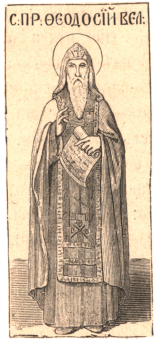
Феодосий Великий, основатель общежития монахов, родился около 423 года в Каппадокии от благочестивых родителей, которые получили его от Провидения, как дар Божий, и посему назвали его Феодосий. Воспитанный в благонравии, и часто читая слово Божие, он воспламенился ревностью оставить всё и последовать Христу, и молился Господу указать ему путь правый. Преп. Симеон Столпник благословил его на предлежащий подвиг иноческий и прорёк о нём, что он будет великий вождь словесных овец. Первоначально Феодосий уединился близ Иерусалима; потом, избегая человеческой славы, скрылся далее в Палестинской пустыне, в пещере, в которой, по преданию, на возвратном пути переночевали волхвы, приходившие с дарами на поклонение новорождённому Царю иудейскому. В уединении от мира Феодосий столько обнят был Божественной любовью, что все силы свои устремлял к Единому Создателю и Спасителю Богу, дабы любить Его от всей души, от всего сердца, и всем помышлением, и эту любовь являть в телесных, трудах и подвигах. Молитва его была непрестанна, стояние всенощно, слёзы всегдашни, и пост чрезвычайный: в 30 лет не вкусил он хлеба, питаясь финиками, или соком, или зеленью и корнями пустынными, и притом столь мало, чтобы только не умереть от голоду. Душу же свою непрестанно питал он словом Божьим, насыщал её внутренним Боговидением, и стяжал благодатный дар чудес и прозорливости.
Theodosius the Great, founder of the cenobitic life for monks, was born around the year 423 in Cappadocia to pious parents, who received him from Providence as a gift of God, and therefore named him Theodosius. Brought up in virtue, and often reading the word of God, he was inflamed with zeal to leave all and follow Christ, and prayed to the Lord to show him the right path. The Venerable Simeon the Stylite blessed him for the monastic struggle that lay before him and prophesied concerning him that he would be a great leader of the rational sheep. At first Theodosius secluded himself near Jerusalem; afterwards, fleeing human glory, he withdrew further into the wilderness of Palestine, into a cave in which, according to tradition, the Magi who came with gifts to worship the newborn King of the Jews spent the night on their return journey. In his withdrawal from the world, Theodosius was so embraced by Divine love that he directed all his powers toward the One Creator and Savior God, that he might love Him with all his soul, with all his heart, and with all his mind, and manifest this love in bodily labors and struggles. His prayer was unceasing, his standing at vigil all-night, his tears perpetual, and his fasting extraordinary: for thirty years he did not taste bread, feeding on dates, or juice, or wild herbs and roots, and even then so little as only not to die of hunger. His soul, however, he continually nourished with the word of God, filled it with inner vision of God, and acquired the grace-given gift of miracles and clairvoyance.
Зная, что начинающим жить по Богу весьма полезно памятование смерти, которое у отцов Церкви называется истинным любомудрием, преподобный повелел ископать гроб, чтобы иноки, имея пред очами своими смерть, помнили о своей кончине. При скудости и лишениях пропитания, преп. Феодосий поучал учеников своих твёрдо надеяться на Бога, да в терпении чают милости Божией, уповая на Того, Кто насыщает всякую душу алчущую. Если Господь даёт бессловесным пищу (Пс.144:15), кольми паче разумные творения не лишит потребной пищи.
Knowing that for those beginning to live according to God, the remembrance of death is very beneficial—which the Fathers of the Church call true philosophy—the Venerable One commanded that a grave be dug, so that the monks, having death before their eyes, might remember their own end. In the scarcity and deprivation of provisions, the Venerable Theodosius taught his disciples to firmly hope in God, that in patience they might await God's mercy, trusting in Him Who fills every hungry soul. If the Lord gives food to the speechless creatures (Ps. 144:15), how much more will He not deprive rational creatures of necessary food?
Когда число иноков, руководимых Феодосием, умножилось, Господь указал ему устроить пространнейшую обитель. Из этого уединённого, пустынного общества учеников преп. Феодосия образовалась знаменитая и славная лавра, в которой он, подражая иноческому житию Василия Великого, первый ввёл общежитие, и посему называется начальником общежитий. В лавре его находили упокоение не только иноки, но и миряне, странники и пришельцы, нищие и убогие, больные и немощные.
When the number of monks guided by Theodosius increased, the Lord showed him to establish a more spacious monastery. From this secluded, desert community of disciples of the Venerable Theodosius was formed the famous and glorious Lavra, in which he, imitating the monastic life of Basil the Great, first introduced the cenobitic life, and is therefore called the founder of cenobitic life. In his Lavra, not only monks found rest, but also laymen, strangers and sojourners, the poor and needy, the sick and infirm.
Всех братий, которых преп. Феодосий духовно породил и привёл на путь добродетели, было 693. Как ученики преподобного были из разных народов, поэтому он устроил для своих иноков разные церкви, в коих каждые из них на своём языке: в великой и главной церкви – Греки, в другой – Иверияне, в третьей – Армяне, пели правило церковное, седмижды в день, по уставу псалмопевца (Пс.118:164).
The total number of brethren whom the Venerable Theodosius spiritually begot and led onto the path of virtue was 693. As the disciples of the Venerable One were from different nations, he therefore arranged different churches for his monks, in which each of them in their own language: in the great and main church—the Greeks, in another—the Iberians, in a third—the Armenians, sang the church services, seven times a day, according to the ordinance of the Psalmist (Ps. 118:164).
К братии своей преп. Феодосий был человеколюбив и милостив, как отец сердобольный, друг нежный, служитель усердный; очищал язвы и струпья больных, омывал кровь и гноения, целовал прокажённых, утешал и из своих рук, питал их, и всячески служил, им. Все наслаждались его любовью, милостью и щедротами: у него не было никого презренного.
Toward his brethren, the Venerable Theodosius was loving and merciful, like a compassionate father, a tender friend, a zealous servant; he cleansed the wounds and sores of the sick, washed away blood and pus, kissed the lepers, comforted them and fed them from his own hands, and served them in every way. All enjoyed his love, mercy, and bounty: he had no one who was despised.
Преподобный учил словом и делом, сам являя в себе образ стаду. Поэтому, когда и ласково кого увещевал, был страшен. Словесные его наставления были несравненны, хотя он и не научен, был великому любомудрию. Во время распространения лжеучения монофизитов преподобный Феодосий был столпом православия.
The Venerable One taught by word and deed, himself showing an example to the flock. Therefore, even when he gently admonished someone, he was fearsome. His verbal instructions were incomparable, although he was not taught in great philosophy. During the spread of the false teaching of the Monophysites, the Venerable Theodosius was a pillar of Orthodoxy.
Преп. Феодосий Великий преставился в глубокой старости – с лишком 105 лет от роду, и погребён в Вифлеемской пустыне, в которой он первоначально иночествовал. Преставление его сопровождалось славой чудотворений. В IX веке Иосиф Студит и Феофан написали в честь св. преп. Феодосия многие песнопения, коими православная Церковь ныне прославляет его в день его памяти.
The Venerable Theodosius the Great reposed in extreme old age—over 105 years of age—and was buried in the Bethlehem wilderness, in which he had originally lived the monastic life. His repose was accompanied by the glory of miracles. In the ninth century, Joseph the Studite and Theophanes composed many hymns in honor of St. Venerable Theodosius, with which the Orthodox Church now glorifies him on the day of his memory.
Прославляя преподобного, Церковь произносит: «насажден во дворех Господа твоего преподобными твоими добродетельми: красно процвел еси, и умножил, чада твоя в пустыни, стадоначальниче Божий».
Glorifying the Venerable One, the Church proclaims: 'Planted in the courts of your Lord by your venerable virtues, you have blossomed beautifully, and multiplied your children in the wilderness, O divine shepherd.'
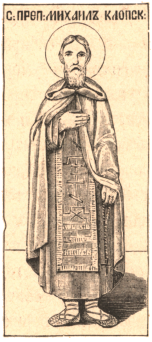
И познаете истину, и истина сделает вас свободными (Ин.8:31–32). Эти слова Спасителя исполнились на праведном Михаиле. Он твёрд был в слове Христовом, жил по Его воле и узнал истину, и истина поставила его выше всякой суеты, выше всякой призрачной действительности, вывела его на свободу, здесь и за гробом.
And ye shall know the truth, and the truth shall make you free (Jn. 8:31–32). These words of the Savior were fulfilled in the righteous Michael. He was firm in the word of Christ, lived according to His will, and came to know the truth, and the truth set him above all vanity, above all illusory reality, and led him out into freedom, both here and beyond the grave.
При великом князе Василии Дмитриевиче, при митрополите Фотии и при Клопском игумене Феодосии, говорит жизнеописатель боярин Тучков120, в летнее время шла утреня в Клопской обители, тогда бедной и малоизвестной. Когда пели девятую песнь канона, иеромонах Макарий, совершая каждение храма, подошёл покадить и келью свою, стоявшую близ храма. Но в келье, которая оставлена была запертой, сидел человек в чёрном одеянии и при свече писал книгу Деяний Апостольских. Испуганный Макарий сказал о том игумену, – игумен и братия, после утрени, найдя келью запертой изнутри, разломали дверь и увидели пишущего. На вопросы игумена: кто он такой? как его зовут? сидевший отвечал только повторением предлагавшихся вопросов и выставлял из себя юродивого. Во время литургии странный пришлец вместе с прочими пел, читал апостол, а за трапезой – житие. Игумен дал ему келью, но никак не могли узнать, откуда и кто он такой? Блаженный поселился в обители в 1408 году. Он раз в неделю вкушал хлеб и пил немного воды, в келье не было у него ничего, даже, и рогожки; спал он на полу. Такова была жизнь его и до гроба! В Клопскую обитель явился он уже иноком и здесь проводил он такую строгую жизнь, какую вели очень немногие121.
During the time of Grand Prince Basil Dmitrievich, under Metropolitan Photius and under the Klopsk Abbot Theodosius, says the biographer, the boyar Tuchkov120, in the summertime, Matins was being served in the Klopsk monastery, which was then poor and little-known. When they were singing the ninth ode of the canon, the hieromonk Macarius, while censing the church, approached to cense also his own cell, which stood near the church. But in the cell, which had been left locked, sat a man in a black garment, writing the book of the Acts of the Apostles by candlelight. The frightened Macarius told the abbot about this—and the abbot and the brethren, after Matins, finding the cell locked from within, broke down the door and saw the writer. To the abbot's questions: who he was? what his name was? the one sitting answered only by repeating the questions put to him and acted the fool. During the Divine Liturgy, the strange newcomer sang with the others, read the Epistle, and at the meal—the Lives of the Saints. The abbot gave him a cell, but they could in no way learn whence he came or who he was. The blessed one settled in the monastery in the year 1408. He partook of bread once a week and drank a little water; in his cell he had nothing, not even a mat; he slept on the floor. Such was his life even to the grave! He came to the Klopsk monastery already a monk, and here he led such a strict life as very few led121.
В праздник Преображения Господня посетил Клопскую обитель князь Константин Дмитриевич, лишённый своего удела великим князем Василием; он приобщился здесь св. таин вместе со своей княгиней; был за братской трапезой, во время которой игумен велел совершать чтение блаженному пришельцу. Блаженный читал историю Иова. Князь, услышав чтеца, подходит к нему и, всмотревшись, кланяется ему. «Это – Михаил Максимович, – сказал князь».
On the feast of the Transfiguration of the Lord, Prince Constantine Dmitrievich, deprived of his appanage by Grand Prince Basil, visited the Klopsk monastery; he partook of the Holy Mysteries here together with his princess; he was at the fraternal meal, during which the abbot ordered the blessed newcomer to do the reading. The blessed one read the story of Job. The prince, hearing the reader, approached him and, looking closely, bowed to him. 'This is Michael Maximovich,' said the prince.
«Зачем скрываешь ты от нас твоё имя?» – сказал игумен. Блаженный сперва сказал: «Бог знает»; потом подтвердил, что он – точно Михаил. «Это наш родственник!)», прибавил князь122.
Why do you hide your name from us? said the abbot. The blessed one first said: 'God knows'; then he confirmed that he was indeed Michael. 'He is our kinsman!' added the prince122.
С того времени, узнав в Михаиле родственника князей, стали чтить его более прежнего; но он всего менее желал известности у людей, и потому более прежнего стал юродствовать. Благодать Божия возрастала в душе его и по временам проявлялась видимо для всех.
From that time, having recognized in Michael a kinsman of the princes, they began to honor him more than before; but he least of all desired fame among men, and therefore began to play the fool more than before. The grace of God increased in his soul and from time to time manifested itself visibly to all.
Когда умер архиепископ Иоанн (1410 г.), блажен. Михаил сказал игумену Феодосию: «сидеть тебе во владычнем дому, но стола владычнего не удостоишься». После блажен. Симеона (1420 г.) Новгородцы избрали Клопского игумена Феодосия в архиепископа, ввели его в дом владычний для управления делами, и он пробыл там два года, а потом они же сказали на вече: не хотим пришельца, и выслали Феодосия из владычнего двора123.
When Archbishop John reposed (1410), the blessed Michael said to Abbot Theodosius: 'You shall sit in the vladyka's house, but you shall not be deemed worthy of the vladyka's table.' After the blessed Simeon (1420), the Novgorodians elected the Klopsk Abbot Theodosius as archbishop, brought him into the vladyka's house to administer affairs, and he remained there for two years; but then they said at the veche: we do not want a stranger, and they expelled Theodosius from the vladyka's court123.
В 1419 г. князь Константин опять прибыл в обитель. «Помолись за меня, – сказал он блаженному, – я очень огорчён потерей отеческого наследства». «Не скорби, князь, – отвечал Михаил, – верь Св. Троице, – построй каменный храм в Её славу и получишь не только отчину свою, но и небесные кровы, – братия примут тебя с честью».
In 1419, Prince Constantine again arrived at the monastery. 'Pray for me,' he said to the blessed one, 'I am greatly grieved by the loss of my father's inheritance.' 'Grieve not, O prince,' answered Michael, 'believe in the Holy Trinity—build a stone church in Her glory, and you shall receive not only your patrimony, but also heavenly dwellings—the brethren will receive you with honor.'
Князь тогда же велел призвать каменщиков, и храм, оконченный в два месяца, освящён был в сентябре 1419 года. В самый день освящения князь объявил блажен. Михаилу и игумену: «вашими молитвами братия зовут меня в мою отчину»124.
The prince then ordered masons to be summoned, and the church, completed in two months, was consecrated in September of 1419. On the very day of the consecration, the prince declared to the blessed Michael and the abbot: 'By your prayers, the brethren are calling me to my patrimony.'124
Случилась сильная засуха, так что пересохли речки, в том числе и Веряжа, из которой брали воду для обители. Пономарь, ходивший на Веряжу, увидал Михаила пишущим что-то на песке. Извещённый о том игумен прочёл следующее: «чашу спасения прииму, на этом месте явится источник».
A severe drought occurred, so that the rivers dried up, including the Veryazha, from which they took water for the monastery. The sexton, who had gone to the Veryazha, saw Michael writing something on the sand. Informed of this, the abbot read the following: 'I will take the cup of salvation; in this place a spring shall appear.'
«Что это значит?» – спросил игумен. Блаженный повторил, что писал. Игумен и блаженный стали копать землю, и вдруг выбросился поток воды. Этот колодезь и поныне с водой, всегда свежей и чистой125.
What does this mean? asked the abbot. The blessed one repeated what he had written. The abbot and the blessed one began to dig the earth, and suddenly a stream of water burst forth. This well is to this day full of water, always fresh and pure125.
За засухой следовал в Новгородской стороне голод126. Толпы бедных стали приходить в обитель за кусками хлеба. Игумен, опасаясь оскудения запасов, не знал, что и делать? «Господь напитал семью хлебами четыре тысячи народа», – сказал Михаил, и упросил игумена кормить всех голодных. Скоро зароптали братия на трату нужного хлеба. Михаил повёл игумена и братию в хлебный амбар, и те с изумлением увидели, что запасы хлеба не умалялись.
After the drought, a famine followed in the Novgorod region126. Crowds of poor people began to come to the monastery for pieces of bread. The abbot, fearing the depletion of supplies, did not know what to do. 'The Lord fed four thousand people with seven loaves,' said Michael, and persuaded the abbot to feed all the hungry. Soon the brethren began to murmur at the expenditure of necessary bread. Michael led the abbot and the brethren to the grain storehouse, and they saw with astonishment that the supplies of bread were not diminishing.
В одно время игумен стоял в храме во время литургии. «Гости хотят прийти к вам», – со смехом сказал Михаил, подойдя к игумену. По выходе из храма, игумен увидел трёх чужих людей. «Позови их в трапезу», – сказал Михаил. Игумен позвал. «За монастырём наши товарищи», – отвечали посетители. Игумен велел пригласить и тех. И вот явилось 30 молодцов с оружиями, люди известного ремесла. Блаженный велел посадить всех за трапезу. И они все сели обедать, – только двое ничего не ели. «Отчего не едите вы?» сказал Михаил; «дурной замысел ваш, будьте твёрдо уверены, не исполнится». Устрашённые этими словами, они упали на пол и не могли выговорить ни слова. Прочие, посмотрев, подумали, не досталось бы и им то же самое. Они дали игумену подаяние, прося помолиться за больных, и вышли из обители. Один из больных разбойников пожелал быть монахом; игумен боялся постригать его, но Михаил велел постричь, и он, постриженный, скоро умер. Другой же, выздоровев, вышел из обители.
On one occasion, the abbot was standing in the church during the Divine Liturgy. "Guests wish to come to you," said Michael with a laugh, approaching the abbot. Upon leaving the church, the abbot saw three strangers. "Call them to the refectory," said Michael. The abbot called them. "Our comrades are outside the monastery," the visitors replied. The abbot ordered those also to be invited. And so there appeared thirty fellows with weapons, men of a known trade. The blessed one ordered them all to be seated at the refectory. And they all sat down to dine—only two ate nothing. "Why do you not eat?" said Michael; "your evil design, be firmly assured, will not be fulfilled." Terrified by these words, they fell to the floor and could not utter a single word. The rest, looking on, thought that the same might befall them as well. They gave alms to the abbot, asking him to pray for the sick, and left the monastery. One of the sick robbers wished to become a monk; the abbot feared to tonsure him, but Michael ordered him tonsured, and he, having been tonsured, soon died. The other, having recovered, left the monastery.
Раз блаженный Михаил был в Вяжицком монастыре. В обитель прибыл и блажен. архиепископ Евфимий Вяжицкий. Блаженный Михаил неожиданно очутился на колокольне и звонил во все колокола. Что это значит? спрашивал народ. «Ныне в Москве радость», – говорил, юродствуя, Михаил. Что за радость такая? спросил архиепископ. «У великого князя, – отвечал Михаил, – родился сын Тимофей, он же и Иван. Да и какой сын! он будет грозой для соседей, завладеет Новгородом, изменит его обычаи, отберёт у вас золото и совсем покорит своей власти».
Once the blessed Michael was in the Vyazhitsky Monastery. The blessed Archbishop Euthymius of Vyazhitsy also arrived at the monastery. The blessed Michael unexpectedly found himself on the bell tower and rang all the bells. What does this mean? the people asked. "Today there is joy in Moscow," said Michael, playing the fool. What kind of joy is that? asked the archbishop. "The Grand Prince," replied Michael, "has had a son, Timothy, who is also Ivan. And what a son! He will be a terror to his neighbors, will take possession of Novgorod, change its customs, take away your gold, and completely subdue it to his authority."
Января 22 1440 года родился князь Иван Васильевич, человек с железной волей, покоривший Новгород в 1471 году127. Блаженный Михаил свободно обличал в слабостях и людей сильных. Архиепископу Евфимию брадатому (1424–1428 г.) сказал он в глаза: «дозволяют ли правила пастырю расхищать своё стадо? Для кого ты собираешь»128? Евфимий, поражённый обличением, заболел и умер.
On January 22, 1440, Prince Ivan Vasilievich was born, a man of iron will, who subdued Novgorod in 1471127. The blessed Michael freely reproved even powerful men for their weaknesses. To Archbishop Euthymius the Bearded (1424–1428) he said to his face: "Do the canons permit a shepherd to plunder his own flock? For whom are you gathering?"128 Euthymius, stricken by the reproof, fell ill and died.
Князь Димитрий Шемяка не раз со всем уважением просил блажен. Михаила молиться об успехе дел его. Блаженный в первый раз сказал ему: «довольно бед натворил ты; если ещё примешься за то же, со стыдом воротишься сюда, где гроб ждёт тебя». В другой раз на просьбу его отвечал: «слышу, князь, земля простонала три раза и зовёт тебя к себе». Участь Шемяки известна.
Prince Demetrius Shemyaka more than once with all respect asked the blessed Michael to pray for the success of his affairs. The blessed one said to him the first time: "You have caused enough trouble; if you take up the same again, you will return here in shame, where the grave awaits you." Another time, in response to his request, he replied: "I hear, Prince, the earth has groaned three times and calls you to itself." Shemyaka's fate is known.
Прожив в Клопской обители 44 года, блажен. Михаил скончался 11 января 1453 года. Святое тело его положено было в Троицком храме обители. Живый пред Господом праведник продолжал совершать чудеса по воле Божией, и его звали чудотворцем. По летописи, в 1562 г. «разобран был обветшавший храм, где положены были мощи преподобного отца нашего Михаила Клопского чудотворца, построили новый и в нём раку чудотворцу, последнюю на иждивение царя»129 Память чудотворца положено праздновать всюду собором с 1547 года130. «Честные мощи твои лежат в обители, где ты при жизни столько потрудился, и источают множество исцелений для приходящих с верою. Молим тебя, отче, исцели душевные страсти и недуги славящих тебя»131.
Having lived in the Klopsky Monastery for 44 years, the blessed Michael reposed on January 11, 1453. His holy body was placed in the Trinity Church of the monastery. The righteous man, living before the Lord, continued to work miracles by the will of God, and he was called a wonderworker. According to the chronicle, in 1562 "the dilapidated church where the relics of our Venerable Father Michael of Klopsk, the wonderworker, were laid was taken apart; they built a new one and in it a shrine for the wonderworker, the latter at the Tsar's expense."129 The commemoration of the wonderworker was appointed to be celebrated everywhere by the Council from 1547130. "Your precious relics lie in the monastery where you labored so much during your life, and pour forth a multitude of healings for those who come with faith. We pray to you, Father, heal the spiritual passions and infirmities of those who glorify you."131
Ркп. житие преп. Михаила, описанное Михаилом Тучковым, по воле архиеп. Макария, – в сборнике Сергиевой лавры № 8 у Ундольского и в минее м. Макария.
Manuscript life of Venerable Michael, written by Michael Tuchkov, at the behest of Archbishop Macarius—in the collection of the Holy Trinity–St. Sergius Lavra, No. 8, at Undolsky's, and in the menaion of Metropolitan Macarius.
Иноком называется блаж. Михаил в Степ. книге: «инок свят от вельможеска роду, живый в монастыре Клопском, внезапу нача звонити». 2, 99. Преподобным именуется он и в грамотах 1563 г. Ист. акт. 1, 302, 551 и в церк. службе.
The blessed Michael is called a monk in the Book of Degrees: "a monk, a saint of noble birth, living in the Klopsky Monastery, suddenly began to ring." 2, 99. He is called Venerable in charters of 1563. Historical Acts, 1, 302, 551, and in the church service.
По описанию Тучкова, князь Константин назвал Михаила сыном Максимовым. Так и в прологе. Степ. книга называет Михаила членом «вельможеского роду», а не княжеского. К тому же вовсе невероятно, чтобы Михаил, сын великого князя Симеона (1353 г.), известный по летописи в 1348 г., мог дожить до 1452 г.
According to Tuchkov's description, Prince Constantine called Michael the son of Maximus. So also in the Prologue. The Book of Degrees calls Michael a member of "noble birth," not princely. Moreover, it is entirely improbable that Michael, the son of Grand Prince Simeon (1353), known from the chronicle in 1348, could have lived until 1452.
По летописям (собр. л. 3, 109. 138. 4. и 119. Никон. л.5:75) в 1419 г. князь Константин в Новгороде, лишённый отчины и бояр своих и игум. Феодосий построили храм; а отчина возвращена князю в 1421 году.
According to the chronicles (Collection of Chronicles, 3, 109, 138; 4, 119; Nikon Chronicle, 5:75), in 1419 Prince Constantine, deprived of his patrimony and his boyars, and Abbot Theodosius built a church in Novgorod; and the patrimony was returned to the prince in 1421.
Тучков говорит при том: «бысть нужи некоей належащи монастырю от архиепископа Евфимия, о всегда насильствием среброимания; о всегда монастырских коней отнятием».
Tuchkov says moreover: "there was some need pressing upon the monastery from Archbishop Euthymius, concerning the constant violent extortion of silver; concerning the constant taking away of the monastery's horses."
А. э. 1. № 213. Ркп. служба св. Михаилу, написанная в 1547 году у Румянцева № 397. Она же в печ. минее. «Преподобный Михаил Клопский», в грам. 1563 г. ист. а. 1, 320, 451.
Acts of the Archeographic Expedition, 1, No. 213. Manuscript service to Venerable Michael, written in 1547, at Rumyantsev's, No. 397. It is also in the printed menaion. "Venerable Michael of Klopsk," in a charter of 1563, Historical Acts, 1, 320, 451.