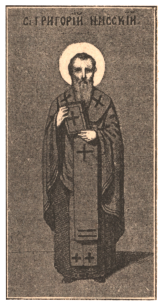
Св. Григорий был родной брат Василия Великого. Изучив науки красноречия и философии, он и сам был наставником в Неокесарии, но при императоре Юлиане, воспретившем (360 г.) христианам быть учителями, принял должность чтеца и обратился всей душой к изучению памятников веры; затем удалился в пустыню и проводил жизнь в богомыслии и учёных занятиях. Василий Великий, уже епископ Кесарийский, желая иметь помощника в борьбе с арианством, в начале 372 г. поставил его, против воли, в епископа Нисского (а Нисса вёрстах в 50 от Кесарии). В 375 г. ариане, покровительствуемые императором Валентом, оклеветали Григория и изгнали с кафедры, но поборник православия не оставался в бездействии: он переходил с места на место утверждать православие и утешать православных. По смерти Валента (в августе 378 г.) он возвратился на кафедру, поучал верных словом и делом, участвовал в деяниях второго вселенского собора и скончался в глубокой старости 394 года, оставив много сочинений как в назидание верным, так и в обличение еретиков.
St. Gregory was the own brother of Basil the Great. Having studied the sciences of rhetoric and philosophy, he himself was also a teacher in Neocaesarea, but under the Emperor Julian, who forbade (in 360 A.D.) Christians to be teachers, he accepted the office of reader and turned with his whole soul to the study of the monuments of the faith; then he withdrew into the desert and spent his life in the contemplation of God and in scholarly labors. Basil the Great, already bishop of Caesarea, desiring to have a helper in the struggle against Arianism, at the beginning of 372 A.D. appointed him, against his will, as bishop of Nyssa (Nyssa being about 50 versts from Caesarea). In 375 A.D. the Arians, protected by the Emperor Valens, slandered Gregory and drove him from his see, but the champion of Orthodoxy did not remain inactive: he went from place to place to confirm Orthodoxy and to comfort the Orthodox. After the death of Valens (in August 378 A.D.) he returned to his see, taught the faithful by word and deed, participated in the acts of the Second Ecumenical Council, and reposed in extreme old age in the year 394, leaving many writings both for the edification of the faithful and for the refutation of heretics.
пресвитера и эконома великой церкви в Константинополе, славного нестяжательностью и состраданием к бедным. Он спас много блудниц, то увещаниями, то денежной помощью склонив их избрать себе мужа и жить честно. Был современником патриарха Геннадия (458–471 г.).
presbyter and steward of the Great Church in Constantinople, renowned for his non-acquisitiveness and compassion for the poor. He saved many harlots, inclining them, whether by exhortations or by financial help, to choose a husband for themselves and to live honorably. He was a contemporary of Patriarch Gennadius (458–471 A.D.).
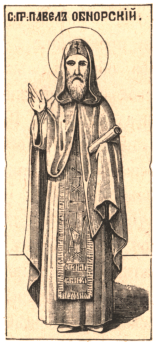
Преподобный Павел родился в Москве от благородных родителей109. С молодых лет возлюбил он Господа, усердно ходил в храм Божий и благоговейно внимал святому писанию; особенно же не пропускал он случая – благотворить бедным; случалось, что, не имея денег, делился он с бедняком и своей одеждой. Благочестивые родители утешались такой добротой сына, но желали, чтобы единственный сын их вступил в брак. Павел 22 лет тайно оставил родительский дом, не взяв с собой ничего, и скрылся в Приволожскую обитель. Здесь, приняв иночество, проводил он жизнь строгую, питался хлебом и водой, трудился днём и ночью, первый являлся в храм и был слугой каждого. Ища опытного наставника, пришёл он к преподобному Сергию Радонежскому; прозорливый подвижник велел новому иноку проходить послушания монастырские; Павел перебывал и в кухне и в трапезе, везде отличаясь безответным послушанием. По прошествии нескольких лет, испросил он у Сергия дозволение жить в уединении. Вдали от обители поселился он в отшельнической келье и провёл в ней 15 лет. О пище он мало думал, пищей служили ему молитва и поучение в св. писании. Когда стали посещать безмолвного отшельника братия: это показалось ему тяжко; он так полюбил безмолвие, – в нём видел он для себя надёжный путь к спасению. Потому просил он у Сергия благословение идти в пустыню. Великий старец дал ревностному труженику медный крест на благословение. Павел жил несколько времени отшельником в Кирилловой обители; такую же жизнь хотел проводить в Галичской великой пустыни, – но это не понравилось привыкшим к общежитию, и его выгнали из великой пустыни. Переходя из одного места в другое для безмолвия, наконец, остановился он в Комельском лесу110. Над речкой Грязовицей, дупло старой липы Павел избрал себе кельей. Здесь прожил он три года, славя Бога вместе с пернатыми; сюда не достигал уже голос человеческий; отшельник свободно душой молился со слезами Господу, нёс суровый пост и в безмолвии очищал ум созерцаниями духовными. Затем перешёл он на реку Нурму и, полюбив место, сказал: «здесь – покой мой, здесь вселюся Построил тут хижину, не многим просторнее оставленного дупла, и выкопал колодезь в полугоре. В бдении и молитве проходили дни его. Пять дней в неделю пребывал он совсем без пищи и только в субботу и воскресение вкушал немного хлеба и воды. Злые люди, напав, связали ему руки и ноги, избили его, ограбили, что было в келье, и ушли; Бог послал добрых людей развязать связанного пустынника. Звери были милостивее к нему, не вредили ему. Раз, преп. Сергий Нуромский, живший за 4 версты от Павла, пришёл к нему и увидел вот что: стаи птиц вились около Павла, иные из них сидели на голове и на плечах его, и он кормил их из рук; тут же стоял медведь, ожидая себе пищи от пустынника; лисицы и зайцы бегали вокруг, ожидая того же111. Вот жизнь невинного первого человека!
The Venerable Paul was born in Moscow of noble parents109. From his youth he loved the Lord, diligently went to the church of God and reverently attended to the Holy Scripture; especially he did not miss an opportunity to do good to the poor; it happened that, having no money, he shared even his own clothing with a poor man. His pious parents were comforted by such goodness of their son, but desired that their only son should enter into marriage. Paul, at 22 years of age, secretly left his parental home, taking nothing with him, and hid himself in the Privolozhskaya Monastery. There, having received the monastic tonsure, he led a strict life, fed on bread and water, labored day and night, was the first to appear in church, and was a servant to everyone. Seeking an experienced guide, he came to the Venerable Sergius of Radonezh; the clairvoyant ascetic commanded the new monk to undergo the obediences of the monastery; Paul served both in the kitchen and in the refectory, everywhere distinguishing himself by unquestioning obedience. After several years had passed, he asked Sergius for permission to live in solitude. Far from the monastery he settled in a hermit's cell and spent 15 years in it. He thought little about food; his food was prayer and instruction in the Holy Scripture. When the brethren began to visit the silent hermit, this seemed burdensome to him; he had so come to love silence—in it he saw for himself a sure path to salvation. Therefore he asked Sergius for a blessing to go into the wilderness. The great elder gave the zealous laborer a copper cross as a blessing. Paul lived for some time as a hermit in the monastery of St. Cyril; he wished to lead the same life in the Great Galich Wilderness—but this displeased those accustomed to the cenobitic life, and they drove him out of the Great Wilderness. Passing from one place to another for the sake of silence, he finally stopped in the Komel Forest110. By the river Gryazovitsa, the hollow of an old linden tree Paul chose as his cell. Here he lived for three years, glorifying God together with the birds; the human voice no longer reached here; the hermit freely prayed with tears in his soul to the Lord, bore a severe fast, and in silence purified his mind with spiritual contemplations. Then he moved to the river Nurma and, having come to love the place, said: "Here is my rest, here will I dwell." He built a hut there, not much more spacious than the abandoned hollow, and dug a well halfway up the hill. His days passed in vigil and prayer. Five days a week he remained completely without food, and only on Saturday and Sunday did he taste a little bread and water. Evil people, attacking him, bound his hands and feet, beat him, robbed whatever was in the cell, and left; God sent good people to untie the bound hermit. The beasts were more merciful to him, they did him no harm. Once, the Venerable Sergius of Nurma, who lived 4 versts from Paul, came to him and saw this: flocks of birds circled around Paul, some of them sat on his head and on his shoulders, and he fed them from his hands; there also stood a bear, waiting for food from the hermit; foxes and hares ran about, waiting for the same111. Such was the life of the innocent first man!
Когда мало-помалу разошлась молва о новом Нуромском отшельнике, явились к нему ревнители благочестия и просили дозволения жить под его руководством. Сперва Павел не соглашался на то, считая себя неспособным к учительству; потом, побеждённый любовью, начал принимать к себе приходящих, но всё ещё ожидал воли Божией. В светлую ночь Пасхи услышал он в пустыне своей звон колоколов и, открыв оконце кельи, увидел свет на одном месте, там, где впоследствии поставлен храм Св. Троицы. Как это событие, так советы духовного друга его преп. Сергия заставили его отправиться в Москву для испрошения благословения на основание обители. Μ. Фотий сперва не дал согласия на просьбу бедного пустынника. Но ночью услышал он голос: «зачем оскорбил ты человека Божия? Поспеши найти старца и выполни желание его, – иначе сильно пострадаешь». Фотий провёл ночь без сна, в страхе и утром велел отыскать пустынника. Его нашли в одной из обителей, и святитель принял его с любовью: испросив прощение у св. старца, выслушав подробное известие его о его жизни и намерениях, благословил строить храм, дал щедрое подаяние от себя на обитель, выпросил у него худую одежду его, а ему в знак любви дал свою; наконец посвятил ученика его в священника, после того, как сам Павел отказался принять на себя священство. Когда храм был построен по прошению преподобного, святитель прислал с антиминсом поучительную грамоту. По содержанию её видно, что преподобный сам просил святителя преподать письменное наставление для иноков новой обители его, и митрополит даже повторяет слова и мысли самого преподобного: «ты прислал ко мне грамоту, – так писал святитель, – прося святого антиминса на освящение церкви и благословения на желание устроить святую обитель и собрать братию; ты пишешь, сын мой, что уже и собрал ты желающих. Не только не препятствую я сему, но посылаю благословение и молю милостивого Бога, да просветит то место и прославится имя Его в вас. Я послал антиминс для освящения храма Божия. Когда был ты у меня: помнишь, сын мой, сам ты много говорил, каковым надобно быть духовному настоятелю. Ему до́лжно быть образцом для всех: в день великого суда он будет давать ответ за души, вверенные ему. О том же пишу и я: будь внимателен к тому, кого и откуда принимаешь к себе. Приходят они в безветренное пристанище, в святую обитель, принимают на себя ангельский образ, обещают переносить до последнего издыхания всякую нужду; такое исповедание записывается ангелами, хранится в руке Творца нашего Владыки Христа, Коему даём мы обещания, и предъявлено будет пред лицом нашим в день великого суда. Пишу любви вашей, собравшиеся там о Христе! помните, что, подчинив временное вечному, придя в безветренное пристанище, приняв на себя великое иго, вы решились работать Небесному Царю. Мы дали обещание не ангелу и не царю или князю времени, а обещались Царю царствующих. С сим исповеданием нашим Господь явится в день суда и воздаст каждому, чего кто сто́ит. Молю вас крепко внимать сему исповеданию и ограждать себя словом Христовым: „никто же, руки возложа на рало и зря вспять, управлен есть в Царствии Небесном“. Молю вас, потщитесь совершать подвиг свой по званию своему, старайтесь сохранить ризу спасения и шлем нелицеприятия чистыми и вас самих представить непорочными Владыке своему. Будьте непоколебимыми воинами Христовыми, мужественно и смело боритесь с крепкими борцами. Супостат наш диавол не хочет спасения нашего, раскидывает сети и козни против нас, ловит в свою волю и не терпит того, чтобы возвышались мы над тлением...»112
When little by little the rumor about the new hermit of Nurma spread, zealots of piety came to him and asked permission to live under his guidance. At first Paul did not agree to this, considering himself incapable of teaching; then, overcome by love, he began to receive those who came to him, but still awaited the will of God. On the bright night of Pascha he heard in his wilderness the ringing of bells and, opening the little window of his cell, saw a light at one place, where later the church of the Holy Trinity was built. Both this event and the advice of his spiritual friend, the Venerable Sergius, compelled him to go to Moscow to ask for a blessing to found a monastery. Metropolitan Photius at first did not give his consent to the request of the poor hermit. But at night he heard a voice: "Why have you offended the man of God? Hasten to find the elder and fulfill his desire—otherwise you will suffer greatly." Photius spent the night without sleep, in fear, and in the morning ordered the hermit to be found. He was found in one of the monasteries, and the Hierarch received him with love: having asked forgiveness from the holy elder, having heard a detailed account of his life and intentions, he blessed him to build a church, gave generous alms from himself for the monastery, begged from him his poor clothing, and gave him his own as a sign of love; finally, he ordained his disciple as a priest, after Paul himself had refused to accept the priesthood. When the church was built at the request of the Venerable One, the Hierarch sent an instructive letter with the antimension. From its content it is evident that the Venerable One himself asked the Hierarch to give a written instruction for the monks of his new monastery, and the Metropolitan even repeats the words and thoughts of the Venerable One himself: "You sent me a letter,"—thus wrote the Hierarch—"asking for a holy antimension for the consecration of the church and a blessing for the desire to establish a holy monastery and gather brethren; you write, my son, that you have already gathered those who desire. Not only do I not hinder this, but I send a blessing and pray to the merciful God that He may enlighten that place and that His name may be glorified in you. I have sent an antimension for the consecration of the church of God. When you were with me: remember, my son, you yourself said much about what a spiritual superior ought to be. He must be an example for all: on the day of the great judgment he will give an answer for the souls entrusted to him. Concerning this I also write: be attentive to whom and from where you receive into your community. They come into a windless haven, into a holy monastery, take upon themselves the angelic image, promise to bear every need until their last breath; such a confession is recorded by the angels, is kept in the hand of our Creator, the Lord Christ, to Whom we make our promises, and will be set before our face on the day of the great judgment. I write to your love, gathered there in Christ! Remember that, having subjected the temporal to the eternal, having come into a windless haven, having taken upon yourselves the great yoke, you have resolved to serve the Heavenly King. We have made a promise not to an angel or to a king or prince of this time, but we have promised the King of kings. With this our confession the Lord will appear on the day of judgment and will render to each what he is worth. I beseech you to heed this confession firmly and to guard yourselves with the word of Christ: 'No man, having put his hand to the plow and looking back, is fit for the Kingdom of Heaven.' I beseech you, strive to accomplish your feat according to your calling, endeavor to keep the robe of salvation and the helmet of impartiality pure, and to present yourselves blameless to your Master. Be unshakable soldiers of Christ, fight courageously and boldly with strong wrestlers. Our adversary the devil does not desire our salvation, he spreads nets and wiles against us, catches us into his will, and cannot bear that we should rise above corruption..."112
Собранной братии своей преп. Павел завещал сохранять общежительные уставы Пахомия великого и Феодосия киновиарха и строго наблюдал, чтобы всё исполнялось по преданно отцов, – никто и ничего не называл бы своим, а всё было бы общее. По его наставлению в келье ничего не должно быть кроме иконы и книг, даже не держать и кваса для утоления жажды, а пить в трапезе. В церкви, в трапезе, на работах должно быть наблюдаемо безмолвие: «лучше, – говорил он, – пасть с высоты, чем согрешать языком, – язык много делает вреда другим и самому говорливому». Он заповедовал отнюдь не держать в обители опьяняющего пития, – содержание приобретать трудами рук своих и рукоделием изгонять праздность. «Нищих не забывайте, – говорил он, – не забывайте уже и потому, что сами мы нищие и душой, и внешним состоянием».
To his gathered brethren the Venerable Paul commanded to preserve the cenobitic rules of Pachomius the Great and Theodosius the Cœnobiarch, and strictly observed that everything be fulfilled according to the tradition of the fathers—that no one should call anything his own, but that all should be common. According to his instruction, in the cell there should be nothing except an icon and books; they should not even keep kvass to quench thirst, but should drink in the refectory. In church, in the refectory, at work, silence should be observed: "It is better," he said, "to fall from a height than to sin with the tongue—the tongue does much harm to others and to the talkative person himself." He commanded that under no circumstances should intoxicating drink be kept in the monastery—that sustenance should be acquired by the labor of one's own hands, and that idleness should be banished by handiwork. "Do not forget the poor," he said, "do not forget them, if only because we ourselves are poor both in soul and in outward appearance."
Ученику своему Алексию поручив должность начальника обители, сам преподобный по-прежнему жил отшельнически на горе, в своей келье. Он приходил к братии на молитву только по субботам и дням воскресным. В эти дни разделял он с братиями трапезу, но вкушал только хлеб с водой и суровым растением, и то мало; ни масла, ни молока, ни рыбы никогда не вкушал. Днём и ночью поучался он в законе Господнем и снискал богатые сведения. Когда слух о нём распространился, то многие приходили к нему для духовного назидания, и он преподавал благоплодные наставления. Он был доступен для каждого, и для каждого готово было у него слово полезное; он наставлял и словом, и жизнью. Беседовал ли с ним одержимый страстью, – получал врачевство; приходил ли отягчённый скорбью, – находил у него утешение. Он узнавал и тайные помыслы и целил их благодатным словом. Преподобный авва достиг самой глубокой старости, но не отменял своего правила; ученики его просили дать отдых изнемогающему телу, но он не хотел, чтобы плоть одолевала дух. И чудное действие жизни духовной! Преподобный достиг 112 лет, но всё был свеж и бодр; глаза его были светлы, сияя кротостью и благостью, и стан – не согбенный; борода окладистая была бела как снег. Пятьдесят лет провёл в разных обителях, после пострижения своего на 22-м году, и сорок лет прожил в Обнорской пустыни113. За несколько времени до кончины, чувствуя близость её, он стал ещё более безмолвствовать. В день Богоявления, когда пришли к нему пред литургией, он вздохнул и прослезился. Ученики спросили о причине, и он сказал: «в сей день и час нечестивые татары, взяв город Кострому, предали его огню и мечу, – многих увели в плен, и всё это за наши грехи, за то, что ходим в волях сердец наших». Оказалось, что это действительность точная114. Последние слова св. Павла к ученикам своим были: «имейте искреннюю любовь между собой, храните правила общежития». В самый час исхода своего, приобщившись св. таин, св. Павел мирно предал дух свой Господу в 10-й день января 1429 года.
Having entrusted the office of superior of the monastery to his disciple Alexis, the Venerable One himself continued to live as a hermit on the mountain, in his cell, as before. He came to the brethren for prayer only on Saturdays and Sundays. On those days he shared the meal with the brethren, but partook only of bread with water and a bitter herb, and that in small quantity; he never tasted oil, milk, or fish. Day and night he studied the law of the Lord and acquired rich knowledge. When word of him spread, many came to him for spiritual edification, and he gave fruitful instruction. He was accessible to everyone, and for each he had a useful word ready; he taught both by word and by life. If one possessed by passion conversed with him, he received a remedy; if one weighed down by sorrow came, he found consolation in him. He also discerned secret thoughts and healed them with a grace-filled word. The Venerable Abba reached extreme old age, but did not alter his rule; his disciples begged him to give rest to his failing body, but he did not wish the flesh to overcome the spirit. And such was the wondrous effect of the spiritual life! The Venerable One reached 112 years, yet was still fresh and vigorous; his eyes were bright, shining with meekness and goodness, and his frame was not bent; his full beard was white as snow. He spent fifty years in various monasteries after his tonsure in his 22nd year, and forty years in the Obnora Hermitage113. Some time before his end, sensing its approach, he became even more silent. On the day of Theophany, when they came to him before the Divine Liturgy, he sighed and shed tears. The disciples asked the reason, and he said: "On this day and at this hour, the impious Tatars, having taken the city of Kostroma, gave it over to fire and sword—they led many into captivity, and all this for our sins, because we walk according to the wills of our hearts." It turned out that this was exact reality114. The last words of St. Paul to his disciples were: "Have sincere love among yourselves, keep the rules of the cenobitic life." At the very hour of his departure, having communed of the Holy Mysteries, St. Paul peacefully gave up his spirit to the Lord on the 10th day of January, 1429.
В посмертной жизни преп. Павел не раз являлся строгим охранителем устава общежительного в своей обители. Так, два брата Павловской обители, жив некоторое время в другом монастыре, возвратились в Павлову обитель с новыми привычками. Они стали варить себе пищу в своей келье; один из них пошёл взять тайно хлеба из трапезы. Оставшийся в келье слышит голос: «несчастные! зачем вы разоряете монастырский устав?» Он подумал было, что это мечта. Но голос повторился, и брат, поражённый ударом, упал в корчах. Возвратившийся товарищ пришёл в ужас. «Прости нас, отче Павле, что преступили заповедь твою», – сказал он в слезах раскаяния. Поспешно схватив горшок с варевом, выбросил его за дверь кельи. После усердной братней молитвы, в которой дан был обет вперёд не нарушать устава обители, больной пришёл в себя и встал здоровым. «Об этом поведал мне очевидец события», говорит древний повествователь.
In his posthumous life, the Venerable Paul more than once appeared as a strict guardian of the cenobitic rule in his monastery. Thus, two brethren of the Paul's monastery, having lived for some time in another monastery, returned to the Paul's monastery with new habits. They began to cook food for themselves in their cell; one of them went to take bread secretly from the refectory. The one remaining in the cell heard a voice: "Wretches! Why are you destroying the monastic rule?" He thought it was a delusion. But the voice was repeated, and the brother, struck by a blow, fell down in convulsions. The returning companion was horrified. "Forgive us, Father Paul, that we transgressed your commandment," he said in tears of repentance. Hastily seizing the pot with the cooked food, he threw it out the cell door. After fervent prayer by the brethren, in which a vow was made henceforth not to violate the monastery's rule, the sick man came to himself and rose up healthy. "An eyewitness of the event told me this," says the ancient narrator.
В 1538 году Казанские татары напали на Вологодскую страну. В Комельском лесу сожгли они Иннокентиеву обитель, умертвили трёх старцев, многих захватили в плен; спасшиеся её иноки возвестили о том Павловой обители. Многие иноки поспешили спастись бегством; другие, особенно дряхлые, не хотели оставить св. места и обратились к молитве.
In 1538, the Kazan Tatars attacked the Vologda region. In the Komel forest they burned the Innocentius monastery, killed three elders, and captured many; the monks who had escaped announced this to the Paul's monastery. Many monks hastened to save themselves by flight; others, especially the infirm, did not wish to leave the holy place and turned to prayer.
Ефрем, подвижник 80 лет, ночью сидел в келье своей и, утомлённый молитвой, вошёл в дремоту; и вот внезапно видит пред собой святого старца, который говорит ему: «брат мой Ефрем! вас ждёт такая скорбь от нечестивых варваров: тебя изрубят и также двух с тобой, один поболеет и исцелеет. Не скорби; монастырь ваш хотя и будет разграблен и сожжён, но ещё лучше выстроится и будет обилен». Всё это исполнилось. Варвары разграбили и сожгли монастырь; старец Ефрем и с ним двое были изрублены; старец и один изрубленный умерли, но келейник Мина, весь израненный, начиная с пробитой головы, выздоровел. Дионисия терзали и лишили головы; Иероним и Исаакий израненные умерли от ран. Монастырский служитель Иоанн в 3-х вёрстах от обители, пронизанный копиями и с рассечённой шеей, брошен был на снегу, полумёртвый.
Ephraim, an ascetic of 80 years, was sitting in his cell at night and, wearied by prayer, fell into a doze; and suddenly he saw before him a holy elder, who said to him: "My brother Ephraim! Such sorrow awaits you from the impious barbarians: you will be cut down, and likewise two with you; one will be ill and will recover. Do not grieve; your monastery, though it will be plundered and burned, will be built even better and will be abundant." All this was fulfilled. The barbarians plundered and burned the monastery; the elder Ephraim and two with him were cut down; the elder and one of the cut-down men died, but the cell-attendant Mina, all wounded, beginning with a pierced head, recovered. Dionysius was tortured and deprived of his head; Jerome and Isaac, wounded, died of their wounds. The monastery servant John, three versts from the monastery, pierced with spears and with a severed neck, was thrown onto the snow, half-dead.
Больной, почувствовавшей в себе несколько силы, к изумлению нашёл подле себя бумагу и приложил её. В лёгком забытьи увидел он старца, который сказал: «ещё ли не видишь на себе милости Божией? сколько ран на тебе! и ты на морозе. Верь, Бог воскрешает и мёртвых». В хижине своей Иван ещё раз видел старца; ему казалось, старец режет ножом в ранах, и на изумление старец сказал: «я отнимаю болезнь». Затем старец пошёл по воздуху к Обнорской обители, что видел уже вскочивший, как не больной, Иван115.
The sick man, feeling some strength within himself, to his astonishment found paper beside him and applied it. In a light faint he saw an elder, who said: "Do you not yet see the mercy of God upon you? How many wounds you have! and you are in the frost. Believe, God raises even the dead." In his hut, John saw the elder once more; it seemed to him that the elder was cutting at the wounds with a knife, and to his astonishment the elder said: "I am removing the sickness." Then the elder went through the air toward the Obnora monastery, which John, who had already jumped up as if not sick, saw115.
Симон лежал в расслаблении не один год, и по временам бывал и голоден, и холоден; христианское сострадание поместило его в хижине за оградой Павловой обители. Раз ночью молился он. Внезапно хижина его осветилась светом дня. Входит Пречистая – от лица Её исходили лучи солнечные, ризы Её блистали молнией. За нею в глубоком благоговении шёл старец, держа рукой клобук, старец святолепный, с белой густой бородой. Расслабленный трепетал. Пречистая, став у одра, сказала больному: «что ты лежишь? иди в церковь и молись; здесь не следует лежать, а надобно молиться и работать». Старец говорит: «подними его, Владычица, и пусть идёт в церковь». Она взяла за два пальца правой руки и дёрнула. Больной вскочил и побежал, не понимая, живой ли он. Прибежав в монастырь и придя в себя, понял, что он выздоровел. Со слезами принеся благодарение Богоматери и преп. Павлу, рассказал он братии, что с ним было.
Simon lay in paralysis for more than one year, and at times was both hungry and cold; Christian compassion placed him in a hut outside the enclosure of the Paul's monastery. One night he was praying. Suddenly his hut was illuminated with daylight. The Most Pure One entered—rays of the sun issued from Her face, Her garments shone like lightning. Behind Her, in deep reverence, walked an elder, holding his klobuk with his hand, a holy-looking elder with a thick white beard. The paralytic trembled. The Most Pure One, standing by the bed, said to the sick man: "Why are you lying down? Go to the church and pray; you should not lie here, but should pray and work." The elder says: "Raise him up, O Lady, and let him go to the church." She took two fingers of his right hand and pulled. The sick man jumped up and ran, not understanding whether he was alive. Having run to the monastery and come to himself, he understood that he was healed. With tears, offering thanks to the Mother of God and the Venerable Paul, he told the brethren what had happened to him.
В 1546 году, при копании рвов для нового храма, найден был гроб с мощами св. Павла; но явившийся пустынник сказал настоятелю: «зачем ты хочешь осмотреть мои мощи? Огонь сожжёт вас, вели скорее обделать гроб». Настоятель немедленно исполнил волю преподобного. Тогда же обретены были ещё 6 мощей неизвестных угодников, без сомнения, учеников преподобного116. В следующем году Павел Обнорский причтён был вместе с некоторыми другими к лику святых117. Мощи его и ныне почивают под спудом, – но в каменном храме, построенном в 1548 г. во имя его. В обители его хранятся: крест, которым благословил Павла преп. Сергий, остаток того липового дупла, где жил преподобный как птица, и колодезь, который он сам выкопал118.
In 1546, while digging ditches for a new church, a coffin with the relics of St. Paul was found; but a hermit who appeared said to the abbot: "Why do you wish to examine my relics? Fire will burn you; hasten to cover the coffin." The abbot immediately fulfilled the Venerable One's will. At the same time, six more relics of unknown saints were found, undoubtedly disciples of the Venerable One116. In the following year, Paul of Obnora was numbered together with some others among the ranks of the saints117. His relics still repose under a veil—but in a stone church built in 1548 in his name. In his monastery are preserved: the cross with which the Venerable Sergius blessed Paul, the remnant of the linden hollow where the Venerable One lived like a bird, and the well which he himself dug118.
«Возлюбив жизнь безмолвную, преподобный отче, ты удалился от людей, поселился в пустыне и жил со зверьми. Ныне пребываешь ты во свете святых. Поминай нас, почитающих память твою»119.
"Having loved the silent life, O Venerable Father, you withdrew from men, settled in the wilderness, and lived with beasts. Now you abide in the light of the saints. Remember us who honor your memory."119
Ркп. житие преп. Павла писано неизвестным, который рассказывает то, что слышал от достоверных людей и что нашёл в записках очевидцев; оно помещено в мин. Макария, в б. общ. ист. № 54. В прологе 20 янв. – сокращение, но с некоторыми дополнительными сведениями.
The manuscript Life of the Venerable Paul was written by an unknown author, who relates what he heard from trustworthy people and what he found in the notes of eyewitnesses; it is included in the Menaion of Macarius, in the Society of History, No. 54. In the Prologue for January 20—an abridgment, but with some additional information.
По прологу (ркп. и печ.) из великой пустыни «отъиде на Городец и на Низу у св. мученика Феодора в обители пребываше; а оттоле во иных местах пустых живяше лета довольна, от мира и от человек удалялся». Великая пустынь находилась в Галичском уезде; Чухломская Покровская обитель на Городце основана была пр. Аврамием, учеником пр. Сергия, скончавшимся в 1375 г. Основание Покровской обители относилось к последним годам жизни Аврамиевой. По соображению времени кончины Аврамиевой с жизнью пр. Павла, оказывается, что пр. Павел был на Городце ещё при жизни Аврамия.
According to the Prologue (manuscript and printed), from the Great Hermitage "he went to Gorodets and to the Niz, and dwelt in the monastery of the holy martyr Theodore; and from there he lived in other desolate places for a sufficient number of years, withdrawing from the world and from men." The Great Hermitage was located in the Galich district; the Chukhloma Protection monastery on Gorodets was founded by the Venerable Abraham, a disciple of the Venerable Sergius, who reposed in 1375. The founding of the Protection monastery is dated to the last years of Abraham's life. By reckoning the time of Abraham's repose with the life of the Venerable Paul, it appears that the Venerable Paul was at Gorodets still during Abraham's lifetime.
Обитель основана по благословению м. Фотия и след., не раньше 1410 г., затем до 1429 г. оставалось 19 лет. Другое дело, если сорок лет прошло со времени поселения в Обнорской пустыни. Ркп. житие: «двадцати двух лет от рождения его прииде в иноческий чин и по разным пустыням в безмолвии поживе лет 50; в том же святем месте пребысть лет четыредесять».
The monastery was founded with the blessing of Metropolitan Photius and, consequently, not earlier than 1410; then until 1429 there remained 19 years. It is another matter if forty years passed from the time of his settlement in the Obnora Hermitage. The manuscript Life: "At twenty-two years of age from his birth he entered the monastic rank and lived in various hermitages in silence for 50 years; in that same holy place he remained for forty years."
Татары опустошили Кострому 6 января 1429 г., потом то же сделали с Плесом и Лугой и ушли. Никон. лет. 5, 96. Собр. лет. 5, 263. 6. 143. Львов, лет. 2. 266, 267.
The Tatars devastated Kostroma on January 6, 1429, then did the same with Ples and Luga and withdrew. Nikon Chronicle, 5, 96. Collection of Chronicles, 5, 263; 6, 143. Lvov Chronicle, 2, 266, 267.
Намёки на это нападение Казанцев в Львов. лет. 4. 101, 102, Карамзин 8, пр. 84. Довольно подробно говорит об этом нападении современник в житии пр. Зосимы и Савватия: «иноплеменники нашли для себя удобное время. Когда умер умный государь всей России, великий князь Василий, потряслось царство его и отягчилось многими бедами. Государем православия остался сын Иоанн, ещё юный отрок. Вельможам пришло время для самоуправления, и они нанесли много зла ссорами: многие умерли от гонений. Видя это, Казанские татары выползли как змеи из тины и жестоко изранили многие области Русского царства, от Мурома даже до Вятки; кроме Галича сильно пострадали от них Кострома и Вологда, на Сухоне даже до Устюга промчалась неукротимая волна, неудержимое войско. И черемисы ходили с ними везде. Раз, воюя на Сухоне, пришли из леса в деревню, когда не ждали их. Не знали, где искать спасения; иные разбежались, другие были схвачены. Вбежав в дом, татары хватали топоры, ножи, всё железное и медное, из дверей цепи, пробои, обобрали всё в доме». Буслаева христом. 785.
Hints of this attack by the Kazanians are in the Lvov Chronicle, 4, 101, 102, Karamzin 8, note 84. A contemporary speaks in some detail of this attack in the Life of the Venerable Zosimas and Sabbatius: "The foreigners found a convenient time for themselves. When the wise sovereign of all Russia, the Grand Prince Basil, died, his kingdom was shaken and burdened with many misfortunes. The son John, still a young youth, remained the sovereign of Orthodoxy. The time had come for the nobles to rule themselves, and they brought much evil through their quarrels: many died from persecutions. Seeing this, the Kazan Tatars crept out like snakes from the mire and grievously wounded many regions of the Russian kingdom, from Murom even to Vyatka; besides Galich, Kostroma and Vologda suffered greatly from them; on the Sukhona even to Ustyug an unbridled wave, an unrestrainable army, swept through. And the Cheremis went with them everywhere. Once, while warring on the Sukhona, they came from the forest into a village when they were not expected. They did not know where to seek salvation; some scattered, others were seized. Running into a house, the Tatars seized axes, knives, everything made of iron and copper, the chains and hinges from the doors, they stripped everything in the house." Buslaev's Christomathy, 785.
Обретение мощей было при игумене Протасии; а ему предшествовал после Алексия Иларион, потом «не бе игумена во обители», затем «игумен», но неизвестный по имени. Так по описанию чудес. Обретению мощей предшествовало, по описанию, 22 чуда.
The uncovering of the relics was under Abbot Protasius; and before him, after Alexis, came Hilarion, then "there was no abbot in the monastery," then "an abbot," but unknown by name. So according to the account of the miracles. The uncovering of the relics was preceded, according to the account, by 22 miracles.
Акт. э. 1, 203. Ркп. служба пр. Павлу напис. в 1548 г. у Румянцева № 397. Павел Обнорский «святый» – в грам. 1563 г. Ист. акт. 320. Память его янв. 10 в святцах устава и псалтири XVI в. у Толстого 1 № 100. 113.
Acts of the Archeographic Expedition, 1, 203. Manuscript service to the Venerable Paul, written in 1548, in Rumyantsev, No. 397. Paul of Obnora "the saint" – in a charter of 1563. Historical Acts, 320. His commemoration on January 10 in the calendars of the Typikon and Psalter of the 16th century, in Tolstoy 1, No. 100, 113.