Андрей был родом Еврей, из Вифсаиды Галилейской, рыбарь и брат Ап. Петра и первоначально ученик Иоанна Крестителя. Как только Предтеча указал на грядущего Христа: се Агнец Божий, вземляй грехи мира, Андрей первый сделался учеником Иисуса Христа (Ин.1:35–42), первый исповедал Его Мессиею пред старшим братом своим Симоном Петром: мы обрели Мессию, глаголемого Христа, и назван Первозванным. От ловитвы рыб на море Галилейском, Андрей призван Самим Господом в звание Апостола и, по исчислению Евангелиста Матфея, занимает между Апостолами второе место (Мф.4:18–19; 10:2). В числе четырех учеников Господа Андрей удостоен был Им доверия услышать пророчество Его о будущих судьбах Церкви и мира (Мк.13:3–5) и особенной близости обращения с Иисусом Христом (Ин.12:21–22). В Сионской горнице, вместе с прочими учениками, Андрей утешен явлением Воскресшего и принял от Него вместе с прочими Апостолами власть вязать и решить грехи. В той же горнице сподобился сошествия Св. Духа, страдал за проповедь Евангелия в Иерусалиме от Иудеев и участвовал в соборе Апостольском, бывшем около 50 года по Р. X. (Деян.15:28).
Andrew was a Jew by birth, from Bethsaida in Galilee, a fisherman and the brother of the Apostle Peter, and was initially a disciple of John the Baptist. As soon as the Forerunner pointed to the coming Christ: Behold the Lamb of God, Who taketh away the sin of the world, Andrew first became a disciple of Jesus Christ (Jn. 1:35–42), he was the first to confess Him as the Messiah before his elder brother Simon Peter: We have found the Messiah, which is, being interpreted, the Christ, and was called First-Called. From fishing on the Sea of Galilee, Andrew was called by the Lord Himself to the office of Apostle and, according to the enumeration of the Evangelist Matthew, occupies the second place among the Apostles (Mt. 4:18–19; 10:2). Among the four disciples of the Lord, Andrew was deemed worthy by Him to hear His prophecy concerning the future destinies of the Church and the world (Mk. 13:3–5) and of a special closeness of intercourse with Jesus Christ (Jn. 12:21–22). In the Upper Room of Zion, together with the other disciples, Andrew was comforted by the appearance of the Risen One and received from Him, together with the other Apostles, the authority to bind and loose sins. In the same Upper Room he was vouchsafed the descent of the Holy Spirit, suffered for the preaching of the Gospel in Jerusalem at the hands of the Jews, and participated in the Apostolic Council, which took place around the year 50 A.D. (Acts 15:28).
Подъемля труды и болезни во благовестии Христове, Аи. Андрей обтек с проповедию своею многие страны Азии и Европы, Вифинии и Пропонтиды, Греции и Македонии, Фракии и Скифии. Для проповеди Евангелия он совершил три путешествия из Иерусалима и Иудеи, – первое в Антиохию Сирийскую, в Тиану, город Каппадокии, откуда доходил до Синопа в пределах Скифии, бывшего столицею Понта, где доселе жители указывают памятники его пребывания. Из Синопа Первозванный был в Амисии или Амасии на берегу Понта; посетил также Трапезонт, откуда отправился в Иверию, отселе в землю Парфян или в Самхетию и возвратился в Иерусалим на праздник Пасхи.
Undertaking labors and afflictions in the preaching of Christ, the Apostle Andrew traversed with his preaching many countries of Asia and Europe: Bithynia and the Propontis, Greece and Macedonia, Thrace and Scythia. For the preaching of the Gospel he made three journeys from Jerusalem and Judea: the first to Syrian Antioch, to Tyana, a city of Cappadocia, whence he went as far as Sinope in the regions of Scythia, which was the capital of Pontus, where to this day the inhabitants point out monuments of his sojourn. From Sinope the First-Called was in Amisus or Amasia on the shore of Pontus; he also visited Trebizond, whence he set out for Iberia, from there to the land of the Parthians or Samkhetia, and returned to Jerusalem for the feast of Pascha.
После праздника Пятьдесятницы св. Ап. Андрей предпринял второе свое странствование для проповеди Евангелия и устроения церквей. Из Иерусалима он опять прибыл в Антиохию Сирийскую, в Ефес, в Лаодикию, в Одисс, город Мисии, в Никею в Вифинии, где Апостол обратил многих ко Христу и крестил. Пробыв в Никее два года, Первозванный странствовал в соседнюю Никомидию. Оттуда отплыл морем в Вифинский город Халкидон, потом посетил морем Ираклию и Понтийский Амастр или Амастриду, в которой оставался долгое время, и просветил многих светом Евангелия. Из Амастриды прибыл в город Харикон. По насаждении спасительной веры в этом городе, Апостол отплыл в Синоп и был вторично в Амисии и Трапезонте. С большим успехом проповедал веру Христову в Неокесарии и достиг до города Самосата в Армении, откуда возвратился в Иерусалим на праздник Пасхи.
After the feast of Pentecost, the holy Apostle Andrew undertook his second journey for the preaching of the Gospel and the establishment of churches. From Jerusalem he again arrived in Syrian Antioch, in Ephesus, in Laodicea, in Odyssus, a city of Mysia, in Nicaea in Bithynia, where the Apostle converted many to Christ and baptized them. Having remained in Nicaea for two years, the First-Called journeyed to neighboring Nicomedia. From there he sailed by sea to the Bithynian city of Chalcedon, then visited by sea Heraclea and Pontic Amastris or Amastrida, where he remained for a long time and enlightened many with the light of the Gospel. From Amastris he arrived at the city of Charicon. After planting the saving faith in this city, the Apostle sailed to Sinope and was a second time in Amisus and Trebizond. With great success he preached the faith of Christ in Neocaesarea and reached the city of Samosata in Armenia, whence he returned to Jerusalem for the feast of Pascha.
Из Иерусалима Первозванный отправился в третие и последнее свое путешествие для обращения к Христу Иудеев и язычников и прибыл в Эдесс, посетил Сванетию, пределы Осетин. Из Осетии отправился в Абхазию и остановился в городе Севасте (Сухуме); отселе вдоль Помория в землю Джигетов. Потом посетил приморский город Понта Эвксинского – Керчь или древний Воспор, лежавший в земле Таврогуннов. Следуя вдоль южного помория Тавриды, посетил Феодосию, и путешествовал на западную оконечность полуострова, – в город Готфов – Херсонес. Отсюда, предполагают, Апостол отплыл вверх по Днепру в Скифию. По древнему преданию, основанному на сказании Ипполита и Оригена – писателей III века, и, что всего важнее, допускаемому и Церковию, Первозванный Апостол был даже и в ненаселенных тогда горах Киева, где он, водрузив крест, прорек будущее просвещение России христианскою верою. «Видите ли горы сии? прорек Апостол своим ученикам; на сих горах воссияет благодать Божия, имать град велик быти и церкви многи имать Бог воздвигнути». Место, где водружен был крест Первозванным, ознаменовано в Киеве храмом во имя его. От гор Киевских Ап. Андрей доходил до озера Ильменя. Возвратясь в Херсонес, св. Андрей опять посетил Воспор, оттуда переплыл Понт и в третий раз прибыл в Синоп, где усердными трудами его уже утвердилось христианство. Посетив многие города и селения, где были основаны церкви, Апостол Андрей с берегов Анатолии отплыл для проповеди Евангелия в Византию, и в нынешнем предместии Константинополя, Аргирополе (серебряном граде), рукоположил для Византии епископом Стахия (Рим.16:9), одного из 70 учеников Христовых. Из Византии Первозванный прибыл во Фракийский город Ираклию и там насадил христианство. Потом Апостол благовествовал Евангелие в Фессалонике и утверждал в вере обращенных в христианство Ап. Павлом в Пелопонесе и в Ахайском городе Патрах. Здесь начальник области Агеат, злой язычник, видя возрастающее число христиан и запустение языческих капищ, и особенно раздраженный на Апостола за обращение жены своей в христианство, заключил проповедника спасения в темницу. Но темница Апостола сделалась храмом, куда стекались христиане слушать спасительное учение св. узника. Эгей или Агеат, видя продолжение ненавистной ему проповеди, осудил Апостола на распятие, и он за проповедь Евангелия распят был на кресте, который имел вид буквы X, и потому называется крестом Ап. Андрея. Два дня продолжались крестные страдания Первозванного, и во все это время он не переставал поучать народ, толпившийся около креста. 30 ноября около 70 года по Р. X. Апостол преставился. Пресвитеры и диаконы Ахайские погребли св. тело Первозванного и предали историю его мученичества в небольшом послании, которое сохранилось до наших времен. В 355 году по Р. X., в царствование Констанция, обретены и перенесены по желанию его мощи Первозванного из Патраса в Константинополь и положены во храме св. Апостолов между гробницами св. Евангелиста Луки и св. Тимофея – ученика Ап. Павла.
From Jerusalem the First-Called set out on his third and final journey for the conversion of Jews and pagans to Christ and arrived in Edessa, visited Svanetia, the borders of Ossetia. From Ossetia he set out for Abkhazia and stopped in the city of Sebastopolis (Sukhumi); from there along the coast to the land of the Dzhigets. Then he visited the maritime city of the Euxine Pontus—Kerch or ancient Bosporus, which lay in the land of the Tauro-Huns. Following along the southern coast of Taurida, he visited Theodosia, and journeyed to the western extremity of the peninsula—to the city of the Goths, Chersonesus. From there, it is supposed, the Apostle sailed up the Dnieper into Scythia. According to an ancient tradition, based on the account of Hippolytus and Origen—writers of the third century, and, what is most important, admitted also by the Church, the First-Called Apostle was even in the then-uninhabited mountains of Kiev, where, having planted a cross, he foretold the future enlightenment of Russia with the Christian faith. "Do you see these mountains?" the Apostle foretold to his disciples; "on these mountains the grace of God shall shine forth; there shall be a great city, and God shall raise up many churches." The place where the cross was planted by the First-Called is marked in Kiev by a church in his name. From the hills of Kiev the Apostle Andrew went as far as Lake Ilmen. Returning to Chersonesus, St. Andrew again visited Bosporus, from there crossed the Pontus and arrived a third time in Sinope, where Christianity was already established through his zealous labors. Having visited many cities and villages where churches had been founded, the Apostle Andrew sailed from the shores of Anatolia for the preaching of the Gospel to Byzantium, and in the present-day suburb of Constantinople, Argyropolis (Silver City), he ordained for Byzantium as bishop Stachys (Rom. 16:9), one of the seventy disciples of Christ. From Byzantium the First-Called arrived at the Thracian city of Heraclea and there planted Christianity. Then the Apostle preached the Gospel in Thessalonica and confirmed in the faith those converted to Christianity by the Apostle Paul in the Peloponnese and in the Achaian city of Patras. Here the governor of the region, Aegeates, a wicked pagan, seeing the growing number of Christians and the desolation of pagan temples, and especially enraged at the Apostle for the conversion of his wife to Christianity, cast the preacher of salvation into prison. But the prison of the Apostle became a church, where Christians flocked to hear the saving teaching of the holy prisoner. Aegeas or Aegeates, seeing the continuation of the preaching he hated, condemned the Apostle to crucifixion, and he was crucified for the preaching of the Gospel on a cross which had the form of the letter X, and is therefore called the Cross of the Apostle Andrew. The crucifixion sufferings of the First-Called lasted two days, and all this time he did not cease to teach the people who thronged around the cross. On November 30, around the year 70 A.D., the Apostle reposed. The presbyters and deacons of Achaia buried the holy body of the First-Called and committed the account of his martyrdom to a brief epistle, which has been preserved to our times. In the year 355 A.D., during the reign of Constantius, the relics of the First-Called were discovered and translated, at his desire, from Patras to Constantinople and placed in the Church of the Holy Apostles, between the tombs of the holy Evangelist Luke and St. Timothy, the disciple of the Apostle Paul.
Сказание об этом обретении и перенесении мощей поучительно показывает высокое благоговение древних христиан к св. Апостолам. Констанций, узнав от одного епископа, что тела Христовых Апостолов, Андрея и Луки, погребены в Ахаии, что тело Андрея почивает в Патрасе, а Луки – в Фивах Беотийских, очень обрадован был известием, громко воскликнул и сказал присутствующим: «позовите ко мне Артемия». Артемий тотчас пришел. «Поздравляю тебя, Боголюбезнейший из всех людей, воззвал к нему Констанций. Находишь ли ты что-нибудь благоприятнее обретения тел Христовых Апостолов?» Артемий отвечал: «кто теперь и откуда, владыка, откроет нам это сокровище?» «Откроет епископ Ахаии, предстоятельствующий ныне в Патрасе, сказал Констанций. Так ступай и скорее перенеси их в Константинополь». Выслушав это от царя, Артемий отправился в путь, чтобы святые останки Апостолов перенести в Константинополь. Перенесенные из Ахаии мощи Ап. Андрея, Евангелиста Луки и св. Тимофея, почившего в Ефесе Ионийском, положены во храме св. Апостолов. Со времени перенесения мощей св. Ап. Андрея Первозванного память его, 30-го ноября, стали совершать торжественнее. В IV веке св. отцы – Григорий Богослов, Иоанн Златоуст, Прокл и другие прославляли Андрея Первозванного в своих поучениях. Св. Григорий Богослов в IV слове против Юлиана говорит: «ужели ты не устыдился жертв, закланных Христа ради, и не убоялся великих подвижников: Петра, Павла, Иоанна, Иакова, Стефана, Луки, Андрея, Феклы и всех тех, которым установлены великие почести и празднества, которых самые тела, также как и души, могущественны, когда их чтут или к ним прикасаются». В V веке Анатолий Константинопольский, в VII – Андрей Иерусалимский, в VIII – Иоанн Дамаскин, Герман Константинопольский, Малакс составили многие хвалебные песни, поемые ныне прав. Церковию в честь св. Ап. Андрея Первозванного.
The account of this discovery and translation of the relics is instructive, showing the high reverence of ancient Christians for the holy Apostles. Constantius, learning from a certain bishop that the bodies of Christ's Apostles, Andrew and Luke, were buried in Achaia, that the body of Andrew rested in Patras, and that of Luke in Thebes of Boeotia, was greatly rejoiced at the news, cried out loudly and said to those present: "Summon Artemius to me." Artemius came immediately. "I congratulate you, most God-beloved of all men," Constantius exclaimed to him. "Do you find anything more favorable than the discovery of the bodies of Christ's Apostles?" Artemius answered: "Who now and from where, O lord, will reveal this treasure to us?" "The bishop of Achaia, who now presides in Patras, will reveal it," said Constantius. "So go and quickly translate them to Constantinople." Having heard this from the emperor, Artemius set out on the journey, to translate the holy remains of the Apostles to Constantinople. The relics of the Apostle Andrew, the Evangelist Luke, and St. Timothy, who had reposed in Ephesus of Ionia, translated from Achaia, were placed in the Church of the Holy Apostles. From the time of the translation of the relics of the holy Apostle Andrew the First-Called, his commemoration, on November 30, began to be celebrated more solemnly. In the fourth century, the holy fathers—Gregory the Theologian, John Chrysostom, Proclus, and others—glorified Andrew the First-Called in their homilies. St. Gregory the Theologian, in his fourth Oration against Julian, says: "Did you not blush at the sacrifices slain for Christ's sake, and did you not fear the great athletes: Peter, Paul, John, James, Stephen, Luke, Andrew, Thecla, and all those to whom great honors and festivals are established, whose very bodies, as well as souls, are powerful when they are honored or touched?" In the fifth century, Anatolius of Constantinople; in the seventh, Andrew of Jerusalem; in the eighth, John of Damascus, Germanus of Constantinople, and Malax composed many hymns of praise, now sung by the Orthodox Church in honor of the holy Apostle Andrew the First-Called.
Во времена крестоносцев, мощи Первозванного перенесены были в 1208 году 8-го мая в Италию – в город Амальфи, где доселе торжественно празднуется 8-й день мая. Глава же Первозванного последним императором Царьграда, Константином перенесена в Рим, где она доселе чествуется в Ватиканской базилике св. Ап. Петра.
During the time of the Crusaders, the relics of the First-Called were translated in the year 1208, on May 8, to Italy—to the city of Amalfi, where to this day the 8th day of May is solemnly celebrated. The head of the First-Called, however, was translated by the last emperor of Constantinople, Constantine, to Rome, where it is still venerated in the Vatican Basilica of the holy Apostle Peter.
По долгому пребыванию мощей Ап. Аудрея в Царьграде по общению, родственному и духовному, императоров и патриархов Константинопольских с самодержавными и святителями России, неоднократно уделяемы были им частицы св. мощей Первозванного. Таким образом и в Московском Успенском соборе хранится кисть от десной руки его, которую принес в благословение царю Михаилу Феодоровичу от вселенского патриарха Парфения архимандрит Солунский Галактион. Также патриарх Иерусалимский Афанасий прислал, как священный дар Святейшему Синоду, часть от мощей Первозванного из Иерусалима, которая ныне хранится в серебряном ковчеге в Синодальной палате.
Due to the long sojourn of the relics of the Apostle Andrew in Constantinople, by reason of the kinship, both familial and spiritual, of the emperors and patriarchs of Constantinople with the autocrats and hierarchs of Russia, portions of the holy relics of the First-Called were repeatedly granted to them. Thus, in the Moscow Dormition Cathedral there is preserved the hand of his right arm, which was brought as a blessing to Tsar Michael Feodorovich from the Ecumenical Patriarch Parthenius by the Archimandrite of Thessalonica, Galaktion. Also, the Patriarch of Jerusalem, Athanasius, sent, as a sacred gift to the Most Holy Synod, a portion of the relics of the First-Called from Jerusalem, which is now preserved in a silver reliquary in the Synodal Chamber.
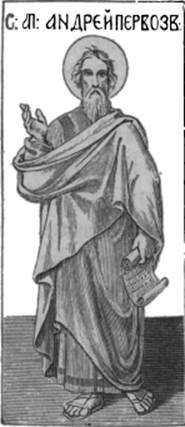
Благоговение древних христиан к Ап. Андрею сохранило для потомства и наружный образ его: он был роста немалого, несколько согбен, нос имел орлиный, глаза исполненные благодатного выражения, брови стройные, волосы и браду густые.
The reverence of ancient Christians for the Apostle Andrew has preserved for posterity also his outward appearance: he was of no small stature, somewhat stooped, had an aquiline nose, eyes full of grace-filled expression, well-formed eyebrows, and thick hair and beard.
Как западные христиане с особенною верою обращаются к Петру, коему они приписывают основание Церкви Римской, так восточные с особенною любовию притекают к Андрею, который обошел пределы Церкви православной.
Just as Western Christians turn with particular faith to Peter, to whom they ascribe the founding of the Roman Church, so Eastern Christians with particular love hasten to Andrew, who traversed the bounds of the Orthodox Church.
В 1698 году Россия установила орден во имя св. Ап. Андрея Первозванного и на этом ордене нарекла Апостола своим особенным покровителем. Посему день памяти св. Ап. Андрея Первозванного в нашем отечестве есть вместе и кавалерский праздник ордена, учрежденного в честь сего Апостола.
In the year 1698, Russia established the Order of St. Andrew the First-Called, and upon this order named the Apostle as her special patron. Therefore, the day of the commemoration of St. Andrew the First-Called in our fatherland is also the feast day of the knights of the order instituted in honor of this Apostle.
В день, посвященный памяти св. Апостола Андрея, Церковь прославляет его «яко Апостолов Первозванного, мужества тезоименитого Богоглагольника и Церкве возследователя верховного, Петрова сродника: зане якоже древле сему, и ныне нам воззва: приидите, обретохом желаемаго (Христа). Град Патрский пастыря показа тя, Апостоле Андрее».
On the day dedicated to the memory of St. Andrew the Apostle, the Church glorifies him "as the First-Called of the Apostles, the namesake of courage, the God-speaker, and the supreme follower of the Church, the kinsman of Peter: for as of old he called to him, so now he calls to us: Come, we have found the desired One (Christ). The city of Patras showed you to be a shepherd, O Apostle Andrew."