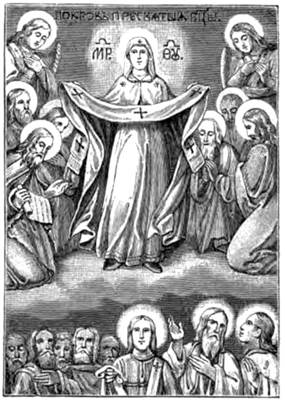
В начале X века, в 910 г., во время вторжения Сарацин в пределы Греческой империи, св. Андрей юродивый и ученик его – Епифаний, находясь в 1-й день октября во Влахернском Константинопольском храме, в коем хранилась риза Богородицы, при всенощном воскресном пении, видели на воздухе чудное явление Пресв. Девы Богородицы, окружённой как венцом – пророками, Апостолами и ангелами, солнечным светом сияющей, молящейся о грешном мире и покрывающей христиан честным Своим омофором. Сподобившийся этого видения Андрей спросил ученика своего Епифания: «видишь ли, брате, Царицу и Госпожу всех, молящуюся о всём мире?» «Вижу, св. отче, отвечал ему Епифаний, и ужасаюсь». Видение прославлено было сперва молящимися во храме, потом во всём Константинополе. Праздник же Покрову Богоматери установлен в Церкви Русской, которая и освятила день явления его торжественным празднованием. Видение последовало 1-го октября, и так в этот день Церковь установила праздник ежегодного воспоминания явления ей особенного над ней покрова Богородицы. Прославляя свою Небесную Заступницу, Церковь поёт: «Днесь благовернии людие светло празднуем, осеняеми Твоим, Богомати, пришествием, и к Твоему взирающе пречистому образу, умильно глаголем: покрый нас честным Твоим покровом и избави нас от всякаго зла, молящи Сына Твоего Христа Бога нашаго, спасти души наша». «Владычице, с честными и славными пророки, с верховными Апостолы, и со священномученики, и со архиереи, за ны грешныя Богу помолися, Твоего покрова праздник в Российстей земли прославльшия». Сими словами объясняется, что праздник Покрова действительно установлен в России. Праздник Покрова Богородицы особенно почитается в правосл. России. Он есть великий, и кроме Богослужения, приличного ему, Правосл. Церковь имеет акафист Покрову Богоматери.
At the beginning of the tenth century, in the year 910, during the invasion of the Saracens into the borders of the Greek Empire, St. Andrew the Fool-for-Christ and his disciple Epiphanius, being on the first day of October in the Blachernae church of Constantinople, in which the robe of the Theotokos was kept, during the Sunday All-night Vigil, saw in the air a wondrous appearance of the Most Holy Virgin Theotokos, surrounded as by a crown—by prophets, Apostles, and angels, shining with sunlight, praying for the sinful world and covering Christians with Her venerable omophorion. Andrew, who had been vouchsafed this vision, asked his disciple Epiphanius: "Do you see, brother, the Queen and Lady of all, praying for the whole world?" "I see, holy father," Epiphanius answered him, "and I am amazed." The vision was first glorified by those praying in the church, then throughout all Constantinople. The feast of the Protection of the Mother of God was established in the Russian Church, which consecrated the day of its appearance with a solemn celebration. The vision occurred on the first of October, and so on this day the Church established a feast for the annual commemoration of the appearance to Her of the special protection of the Theotokos. Glorifying Her heavenly Intercessor, the Church sings: "Today the faithful people brightly feast, overshadowed by Thy coming, O Mother of God, and gazing upon Thy most pure image, we tenderly cry: Cover us with Thy venerable protection and deliver us from every evil, entreating Thy Son, Christ our God, to save our souls." "O Lady, with the venerable and glorious prophets, with the chief Apostles, and with the hieromartyrs, and with the hierarchs, pray to God for us sinners, who hast glorified the feast of Thy protection in the Russian land." By these words it is explained that the feast of the Protection was indeed established in Russia. The feast of the Protection of the Theotokos is especially venerated in Orthodox Russia. It is a great feast, and besides the divine service befitting it, the Orthodox Church has an akathist to the Protection of the Mother of God.
Сия икона находится в Псковоградской Покровской церкви, а точный с неё список в Московском Успенском соборе, над южными дверьми придела во имя св. Ап. Петра и Павла, в деревянном киоте. Празднование Псково-Покровской иконе во Пскове установлено в память избавления Пскова в 1581 году от упорной осады Польским королём Стефаном Баторием.
This icon is located in the Protection Church of the city of Pskov, and an exact copy of it is in the Moscow Dormition Cathedral, above the southern doors of the side-chapel in the name of the Holy Apostles Peter and Paul, in a wooden icon-case. The celebration of the Pskov-Protection Icon in Pskov was established in memory of the deliverance of Pskov in 1581 from the stubborn siege by the Polish King Stephen Báthory.
В 1581 году августа с 26-го числа Стефан Баторий обступил с своими войсками Псков. Августа 27-го числа, за несколько дней до приступа, назначенного Баторием, на угол крепости при Покровском монастыре, ныне приходской церкви, один благочестивый старец, именем Дорофей, кузнец, сидел в сенях своей кельи и скорбел о бедствии города. Вдруг увидел он необыкновенный свет, который, подобно столпу, возвышался до небес над Печерской Псковской обителью, шёл от неё ко Пскову через реку Великую, по левую сторону Мирожского монастыря. В этом свете узрел он Пресвятую Богородицу, шедшую по воздуху и сопутствуемую по левую руку преподобным Антонием, начальником Киевских пещер, а по правую – Корнилием, игуменом Успенской Псково-Печерской обители. Богоматерь, пройдя по воздуху через городскую стену, вошла вместе с сими преподобными в церковь Покровскую. Вышедши из церкви и ставши вместе с теми преподобными на стене города, спросила: «где Мирожский строитель Нифонт, еп. Новгородский?» При сих словах её св. епископ предстал пред Ней и, поклонившись с видом глубокой скорби, сказал: «Владычица! в моём монастыре сего лета не бяше литургии». На сие Богоматерь рекла: «Сыну Моему и Богу тако изволившу». Потом воззвала: «где избранные Божии, пребывающие в церкви Св. Троицы?» И тотчас предстали перед Ней благоверные князья Василий Киевский, Гавриил и Тимофей Псковские, позади же их, на расстоянии как бы полусажени, стал блаженный Николай и св. Евфросин с Саввой, и все с благоговением поклонились Ей. Богоматерь, взирая на город с видом скорби, сказала: «о, люди беззаконные! Вы прогневали Сына Моего, Господа и Бога, и осодомили град сей скверными делами. И вот теперь пришла на вас беда, велия». В это время стоявшие с правой руки игумен-Корнилий и Евфросин с Саввой и блаженный Николай, падши перед Ней, со слезами молились: «Владычице! Есть грех на людех и беззаконие, не прогневайся на них до зела, но помолися Сыну Твоему и Богу нашему за град сей и за людей согрешивших». После сего и все благоверные князья, припадши к ногам её, со слезами молили Её о защищении города. Тогда Богоматерь воззвала к Себе старца, удостоившегося видения, и он в то же мгновение увидел себя стоящим у ног Богоматери, Которая сказала ему: «старец! иди немедленно к Боголюбивым воеводам и к Печерскому игумену, и в собор Пресв. Троицы, и возвести им, чтобы прилежно и непрестанно молили Господа Бога и принесли бы старый Печерский образ и хоругвь на стену города, где стою Я, и чтобы поставили здесь одну пушку, а другую внизу, для стреляния из них по королевским шатрам и влево за королевские шатры». Указывая рукой означенные места, Пречистая Богоматерь повелевала ему объявить людям, чтобы они плакали о грехах своих и молили милостивого Бога; «а Я, присовокупила Богоматерь, буду молиться Сыну Моему и Богу о прощении ваших грехов».
In 1581, from the 26th day of August, Stephen Báthory surrounded Pskov with his troops. On the 27th day of August, a few days before the assault appointed by Báthory, at the corner of the fortress near the Protection Monastery, now a parish church, a certain pious elder, named Dorotheus, a blacksmith, was sitting in the entryway of his cell and grieving over the city's calamity. Suddenly he saw an extraordinary light, which, like a pillar, rose up to the heavens above the Pskov-Caves Monastery, coming from it toward Pskov across the Velikaya River, to the left side of the Mirozh Monastery. In this light he beheld the Most Holy Theotokos, walking through the air and accompanied on the left hand by the Venerable Anthony, founder of the Kiev Caves, and on the right by Cornelius, abbot of the Dormition Pskov-Caves Monastery. The Mother of God, having passed through the air across the city wall, entered together with these venerable ones into the Protection Church. Coming out of the church and standing together with those venerable ones on the city wall, She asked: "Where is Niphon, the builder of Mirozh, bishop of Novgorod?" At these words of Hers, the holy bishop appeared before Her and, bowing with an expression of deep sorrow, said: "O Lady! In my monastery this summer there was no Divine Liturgy." To this the Theotokos replied: "Thus hath My Son and God been pleased." Then She called out: "Where are the chosen ones of God, abiding in the church of the Holy Trinity?" And immediately there appeared before Her the Right-believing Princes Basil of Kiev, Gabriel and Timothy of Pskov, and behind them, at a distance of about half a sazhen, stood the blessed Nicholas and St. Euphrosynus with Sabbas, and all bowed to Her with reverence. The Mother of God, looking upon the city with an expression of sorrow, said: "O lawless people! You have angered My Son, the Lord and God, and have Sodomized this city with foul deeds. And now a great calamity has come upon you." At this time, those standing on the right hand—Abbot Cornelius, and Euphrosynus with Sabbas, and the blessed Nicholas—falling down before Her, tearfully prayed: "O Lady! There is sin upon the people and lawlessness; be not exceedingly wroth with them, but pray to Thy Son and our God for this city and for the people who have sinned." After this, all the Right-believing Princes also, falling at Her feet, tearfully besought Her for the city's defense. Then the Mother of God called to Herself the elder who had been vouchsafed the vision, and in the same instant he saw himself standing at the feet of the Mother of God, Who said to him: "Elder! Go immediately to the God-loving voivodes and to the abbot of the Caves, and to the cathedral of the Most Holy Trinity, and announce to them that they should diligently and unceasingly pray to the Lord God and bring the old Caves icon and the banner onto the city wall, where I stand, and that they should place one cannon here, and another below, for firing from them at the king's tents and to the left beyond the king's tents." Pointing with Her hand to the indicated places, the Most Pure Theotokos commanded him to declare to the people that they should weep for their sins and pray to the merciful God; "and I," added the Mother of God, "will pray to My Son and God for the forgiveness of your sins."
Чудесное видение Богоматери, бывшее Дорофею, изображено на иконе, на которой написана Богоматерь с преп. Антонием и Корнилием, с благоверными князьями Киевским и Псковским Гавриилом и Тимофеем и Николаем юродивым Псковским. На этой иконе помещено описание чудесного явления Богоматери и составлена особая на память сего служба. Икона сия прославилась чудесами и стала известна под именем Псково-Покровской, по церкви, в которой находится, и празднество ей совершается октября 1 дня.
The miraculous vision of the Mother of God, which occurred to Dorotheus, is depicted on an icon, on which are painted the Mother of God with the Venerable Anthony and Cornelius, with the Right-believing Princes of Kiev and of Pskov, Gabriel and Timothy, and Nicholas the Fool-for-Christ of Pskov. On this icon is placed a description of the miraculous appearance of the Mother of God, and a special service for its commemoration was composed. This icon was glorified by miracles and became known under the name of the Pskov-Protection Icon, after the church in which it is located, and its feast is celebrated on the 1st day of October.
А в Московском Успенском соборе совершается празднование сей иконе в благодарность за победу над Турками и Татарами после войны с ними с 1736 по 1740 год.
And in the Moscow Dormition Cathedral, a celebration of this icon is performed in thanksgiving for the victory over the Turks and Tatars after the war with them from 1736 to 1740.
«И будет в те дни, излию от Духа Моего на всякую плоть». – И осуществление этих слов пророка (Иоил.2:28) составляет неотъемлемое и драгоценнейшее достояние мира. Проявившееся уже в избранниках Ветхого Завета излиянием даров Духа Святого на древних пророков, оно ещё изобильнее стало проявляться в лицах, озарённых Новозаветным Откровением. Нагляднее и, так сказать, существеннейшим образом оно проявилось на Апостолах, когда они, «при наступлении дня Пятидесятницы, пребывая единодушно вместе, исполнились все Духа Святого и начали говорить на других языках,какДух давал им провещевать» ... и одарены были таким образом, орудием распространения в мире словом той Истины, которую уже восприняли их сердца.
"And it shall come to pass in those days, I will pour out of My Spirit upon all flesh." And the fulfillment of these words of the prophet (Joel 2:28) constitutes an inalienable and most precious possession of the world. Having already manifested itself in the chosen ones of the Old Testament through the outpouring of the gifts of the Holy Spirit upon the ancient prophets, it began to manifest itself even more abundantly in persons illumined by the New Testament Revelation. Most clearly and, so to speak, in the most essential manner, it manifested itself upon the Apostles, when they, "when the day of Pentecost had come, being all with one accord in one place, were all filled with the Holy Spirit and began to speak with other tongues, as the Spirit gave them utterance" ... and were thus endowed with the instrument for spreading in the world the word of that Truth which their hearts had already received.
И с тех пор продолжались и не прерываются проявления силы Духа Святого в христианской Церкви в лице тех, кого Он избирает достойным сосудом для восприятия Его разнообразных даров: – «Дары различны, но Дух – один и тот же; и служения – различны, а Господь – один и тот же; и действия – различны, а Бог – один и тот же, производящий всё во всех. Но каждому даётся проявление Духа на пользу. Одному даётся Духом – слово мудрости, другому – слово знания – тем же Духом; иному – вера, тем же Духом; иному – дары исцелений, тем же Духом; иному – чудотворения, иному – пророчество, иному – различение духов, иному – разные языки, иному – истолкование языков. Всё же сие производит один и тот же Дух, разделяя каждому особо, как Ему угодно» (1Кор.12:4–12).
And from that time onward, the manifestations of the power of the Holy Spirit have continued and do not cease in the Christian Church in the person of those whom He chooses as a worthy vessel for the reception of His diverse gifts:—"Now there are diversities of gifts, but the same Spirit; and there are differences of administrations, but the same Lord; and there are diversities of operations, but it is the same God which worketh all in all. But the manifestation of the Spirit is given to every man to profit withal. For to one is given by the Spirit the word of wisdom; to another the word of knowledge by the same Spirit; to another faith, by the same Spirit; to another the gifts of healing, by the same Spirit; to another the working of miracles; to another prophecy; to another discerning of spirits; to another divers kinds of tongues; to another the interpretation of tongues. But all these worketh that one and the selfsame Spirit, dividing to every man severally as He will" (1 Cor. 12:4–12).
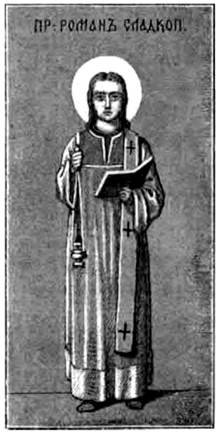
Так и душу воспоминаемого сегодня Церковью св. Романа посетил и осенил Святой Дух, «любящий взирать на смиренного сердцем», – и убогого в глазах людей, но полного любовью к Богу, одарил орудиями ведения и слова, прославившими в нём силу Божию и превратившими его – безгласного – в славного «Сладкопевца», величаемого Церковью.– «Пресветлый и светозарный светильник, – восхваляет она Романа, – цитра сладкогласная, струна преславных слов Духа, звучно поёт и научает концы славить неумолкаемыми песнями единый свет Божества».
Thus also the soul of St. Romanus, commemorated today by the Church, was visited and overshadowed by the Holy Spirit, "Who loveth to look upon the humble of heart,"—and upon one who was poor in the eyes of men, but full of love for God, and endowed him with the instruments of knowledge and speech, glorifying in him the power of God and transforming him—who was voiceless—into the glorious "Sweet-Singer," extolled by the Church.—"The most bright and radiant lamp," the Church praises Romanus, "the sweetly-sounding cithara, the string of the most glorious words of the Spirit, sings loudly and teaches the ends of the earth to glorify with unceasing hymns the one light of the Godhead."
Роман родился и воспитывался в Емесе Сирском; в Берите состоял при церкви пономарём. С детства проводил он жизнь благочестивую и целомудренную, которая довела его до истинного подвижничества. Так, переселясь в Константинополь, где он жил при храме Божией Матери, называвшемся Кировым, он, не ограничиваясь трудами по храму, ночи проводил в поле, в молитве, или ходил на нощное бдение в храм Влахернский – за городом.
Romanus was born and raised in Emesa of Syria; in Berytus he served as a sexton at the church. From childhood he led a pious and chaste life, which brought him to true asceticism. Thus, having moved to Constantinople, where he lived at the church of the Mother of God, called that of Cyrus, he, not limiting himself to labors for the church, spent nights in the field in prayer, or went to the night vigil at the Blachernae church—outside the city.
Получив назначение пономарём при Софийском храме, Роман, продолжая своё подвижническое служение Богу, не отличался однако же искусством в пении и чтении, какое требовалось от состоящих на служении при знаменитом столичном храме. Тем не менее патриарх Евфимий (490–504) любил и отличал его между прочими служителями и даже положил ему равный удел с клириками, составлявшими хор церковный, тогда как он занимал низшую должность при храме, занимался зажиганием свеч и лампад и соблюдением чистоты в церкви. Это возбудило зависть и злобу на Романа, клирики презрительно обращались с ним и преследовали его насмешками. Однажды в навечерие Рождества Христова, когда сам император Анастасий присутствовал в храме и Роман зажигал свечи, певцы стали принуждать его петь на амвоне и толкали его, говоря: – ты ведь получаешь равную часть с нами, так поди же на амвон и пой с нами... – Пристыженный своим неумением петь, осмеянный при всём народе, Роман, по окончании Богослужения оставшись в храме один, припал со слезами перед иконой Божией Матери и излил перед Нею скорбь о своём неведении и неумении воспевать Бога, как другие... Возвратясь к себе, он, «насытясь слезами и не вкусив хлеба», лёг и заснул.
Having received an appointment as sexton at the church of Hagia Sophia, Romanus, continuing his ascetic service to God, was not distinguished, however, by skill in singing and reading such as was required of those serving at the famous church of the capital. Nevertheless, Patriarch Euthymius (490–504) loved and distinguished him above the other servants and even allotted him an equal portion with the clerics who made up the church choir, whereas he held the lowest office at the church, being occupied with lighting the candles and lamps and keeping the church clean. This aroused envy and malice toward Romanus; the clerics treated him contemptuously and persecuted him with mockery. Once, on the eve of the Nativity of Christ, when the Emperor Anastasius himself was present in the church and Romanus was lighting the candles, the singers began to force him to sing on the ambo and pushed him, saying: "You receive an equal portion with us, so go up onto the ambo and sing with us..." Ashamed of his inability to sing, mocked before all the people, Romanus, after the service ended, remained alone in the church, fell down with tears before an icon of the Mother of God, and poured out before Her his grief over his ignorance and inability to hymn God as others did... Returning home, he, "having satiated himself with tears and not tasted bread," lay down and fell asleep.
Во сне же увидел Матерь Божию, Которая, подав ему свиток хартии, сказала ему: «открой уста и вкуси», и вместе с тем таинственно сообщила ему дар творения песней, так как, когда он проснулся, то почувствовал в сердце невыразимое утешение, а в уме – просвещение и необычное разумение...
In his sleep he saw the Mother of God, Who, giving him a scroll of paper, said to him: "Open your mouth and taste," and at the same time mysteriously bestowed upon him the gift of composing hymns, for when he awoke, he felt in his heart an inexpressible consolation, and in his mind an enlightenment and an unusual understanding...
Осенённый вдохновением свыше, Роман, по утрени праздника, в то время, когда певцу следовало петь кондак, взошёл на амвон и, к общему удивлению, прекрасным голосом запел в уме его составившуюся песнь:
Overshadowed by inspiration from above, Romanus, after the Matins of the feast, at the time when the singer was to chant the kontakion, went up onto the ambo and, to the general astonishment, began to sing in a beautiful voice the hymn that had been composed in his mind:
«Дева днесь Пресущественнаго раждает, и земля вертеп Неприступному приносит; ангелы с пастырями славословят, волхвы же со звездою путешествуют; нас бо ради родися Отроча младо, Превечный Бог!»
"Today the Virgin gives birth to the Transcendent One, and the earth offers a cave to the Unapproachable One; angels with shepherds sing praises, and Magi travel with the star; for a young Child is born for us, the Pre-eternal God!"
Выслушав эту новую песнь, патриарх спросил Романа: кто его научил так петь? Роман передал ему бывшее ему видение Божией Матери, и тогда все прославили дар Божий, проявившийся в простом, не книжном человеке... Патриарх возвёл Романа в сан диакона, и посещённый Божией милостью ревностный служитель Божий стал изливать душу свою в многочисленных вдохновенных песнопениях, которыми с тех пор и поныне славит Бога Православная Церковь при Богослужении.
Having heard this new hymn, the Patriarch asked Romanus: who had taught him to sing thus? Romanus related to him the vision of the Mother of God that had come to him, and then all glorified the gift of God that had manifested itself in a simple, unlettered man... The Patriarch elevated Romanus to the rank of deacon, and the zealous servant of God, visited by God's mercy, began to pour out his soul in numerous inspired hymns, with which from that time until now the Orthodox Church glorifies God in its divine services.
Число песнопений Романа (кондаков и икосов) простирается до 1000. Лучшими из них, кроме вышеизложенного, почитаются: 1) стихиры предпразднеству Рождества Христова: «Ангельские предшествуйте силы; вы, которые в Вифлееме, уготовьте ясли! Слово рождается, мудрость происходит; Церковь, приими лобзание, на радость Богородице. Народы воскликнем: благословен Грядущий Бог наш; слава Тебе!» – И 2) кондаки и икос на Вел. пяток. Первый кондак и икос известны по Триоди, 2-й кондак: «не надеялась Я, Чадо, видеть Тебя таковым, не доверяла Я тому, пока беззаконные не возложили на Тебя рук. Ибо вот дети взывают Тебе: благословен еси. – Желала бы узнать, для чего стала беда? Увы Мне! как погасает свет Мой! Как весь Он на кресте!» 3-й кондак: «отводят Тебя, Чадо, на беззаконное убиение – и никто не состраждет Тебе: не следует за Тобою Пётр, который сказал Тебе: не отрекусь от Тебя, хотя бы и умереть мне. Оставил Тебя Фома, воззвавший: умрём с Ним все. Прочие все, свои и знаемые, имеющие судить колена Израилевы, где они? Нет ни одного! Один умираешь за всех, Чадо единое, вместо того, что спасал всех и благотворил всем». 4-й кондак: «Мария сокрушалась от тяжкой скорби и тогда, как от великой горести взывала и вопияла, обратился к Ней Тот, Кто из Неё, и так вещал: что плачешь, Мати Моя? Что принесу всем прочим жёнам, если не постражду, если не умру? Как спасу Адама, если не вселюсь во гробе? Как привлеку к жизни сущих во аде, если не вселюсь во гроб? Ты зришь – распят Я неправедно. Что же плачешь, Мати? Паче взывай, что стражду по воле». 5-й кондак: «отгони убо, Мати, печаль Свою; Тебе неприлично плакать; Тебя называть будут благословенною; не закрывай сего явления рыданием, не уподобляйся немудрым, премудрая Дева; Ты среди брачного чертога Моего как бы стоящая душою вне его, не омрачай же сущих в чертоге, ибо каждый текущий слушает Тебя, когда Ты говоришь: где Он?» Кондак 6-й: «не принимай дня страдания за горький день: Тобою Я сладкий нисшел с неба, как манна; не на горьких водах прежде, но во чреве твоём явился; здесь усырен, как предвозвещал Давид об усыренной горе: помысли, Чистая: Я есмь. Будучи Словом, стал Я в Тебе плотию; в ней стражду, в ней спасаю. Не плачи убо, Мати, но взывай, радуясь: с любовью приемлет Он страдания».
The number of Romanus's hymns (kontakia and oikoi) reaches 1000. The best of them, besides the one set forth above, are considered: 1) the stichera for the Forefeast of the Nativity of Christ: "Angelic powers, go before; you who are in Bethlehem, prepare the manger! The Word is born, wisdom comes forth; Church, receive the kiss, to the joy of the Theotokos. Peoples, let us exclaim: blessed is our coming God; glory to Thee!" – And 2) the kontakia and oikoi for Great Friday. The first kontakion and oikos are known from the Triodion; the 2nd kontakion: "I did not hope, O Child, to see Thee thus; I did not believe it until the lawless laid hands on Thee. For behold, the children cry out to Thee: blessed art Thou. – I would like to know why this calamity has come? Woe is Me! How My light is extinguished! How He is all on the cross!" The 3rd kontakion: "They lead Thee away, O Child, to a lawless murder – and no one suffers with Thee: Peter, who said to Thee: I will not deny Thee, even if I must die, does not follow Thee. Thomas, who cried out: let us all die with Him, has left Thee. All the rest, kinsmen and acquaintances, who are to judge the tribes of Israel, where are they? Not one! Thou diest alone for all, O only Child, instead of having saved all and done good to all." The 4th kontakion: "Mary was crushed by heavy grief, and when, from great sorrow, she cried out and lamented, He Who was born of Her turned to Her and spoke thus: Why weepest Thou, My Mother? What shall I bring to all other women if I do not suffer, if I do not die? How shall I save Adam if I do not enter the tomb? How shall I draw those in Hades to life if I do not enter the tomb? Thou seest – I am crucified unjustly. Why then weepest Thou, Mother? Rather cry out that I suffer by will." The 5th kontakion: "Cast away, then, O Mother, Thy sorrow; it is not fitting for Thee to weep; Thou shalt be called blessed; do not conceal this manifestation with weeping, do not imitate the foolish, O all-wise Virgin; Thou standest as if with Thy soul outside the bridal chamber of My wedding, do not darken those who are in the chamber, for each one who passes listens to Thee when Thou sayest: where is He?" The 6th kontakion: "Do not take the day of suffering for a bitter day: through Thee I, the sweet one, descended from heaven like manna; not on bitter waters before, but in Thy womb I appeared; here I am bedewed, as David foretold concerning the bedewed mountain: think, O Pure One: I am. Being the Word, I became flesh in Thee; in it I suffer, in it I save. Weep not, then, O Mother, but cry out, rejoicing: with love He accepts the sufferings."
Обогатив церковную сокровищницу своими творениями, в которых излилась его Боголюбивая душа, стяжав общее почитание своей благочестивой жизнью, преп. Роман скончался около 510 г. Был погребён в Кировом храме, где потом и совершалась память его с особым торжеством.
Having enriched the church treasury with his works, in which his God-loving soul poured itself forth, having acquired universal veneration by his pious life, the Venerable Romanus reposed about the year 510. He was buried in the church of Cyrus, where afterwards his memory was celebrated with special solemnity.
«Божественными добродетельми духа измлада украсився, Романе премудре, – воспевает творца церковных песен сама Церковь, – Церкви Христовей пречестное украшение был еси: пением бо прекрасным украсив ю, блаженне».
"Having adorned thyself from childhood with the divine virtues of the spirit, O wise Romanus," sings the Church herself of the composer of church hymns, "thou wast an honorable adornment of the Church of Christ: for thou didst adorn her with beautiful singing, O blessed one."
«Вдохновенными песнями ты, блаженный, возвестил неизреченноедомостроение Христово и венчал всех святых хвалами; с ними, премудрейший отче, ты прославил чистую Деву и истинную Матерь Божию, с Коей предстоя Троице, помилуй нас!»
With inspired songs, O blessed one, thou didst proclaim the ineffable economy of Christ and didst crown all the saints with praises; with them, O most wise father, thou didst glorify the pure Virgin and true Mother of God, with Whom, standing before the Trinity, have mercy on us!
Избранный Иисусом Христом в число 70-ти Апостолов, ученик Спасителя – Анания жил в г. Дамаске, когда Господь явился ему в видении и повелел пойти к Тарсянину, по имени Савлу, который «теперь молится и видел в видении мужа, именем Ананию, пришедшего к нему и возложившего на него руку, чтобы он прозрел»1… И когда Анания выразил недоумение, как идти ему к человеку, сделавшему много зла святым Божиим в Иерусалиме, то «Господь сказал ему: иди, ибо он есть Мой избранный сосуд, чтобы возвещать имя Моё перед народами и царями и сынами Израилевыми, и Я покажу ему, сколько он должен пострадать за имя Моё»2.
Chosen by Jesus Christ into the number of the Seventy Apostles, the disciple of the Savior – Ananias lived in the city of Damascus, when the Lord appeared to him in a vision and commanded him to go to a Tarsian named Saul, who "is now praying and has seen in a vision a man named Ananias coming to him and laying his hand on him that he might receive his sight"1… And when Ananias expressed perplexity as to how he could go to a man who had done much evil to the saints of God in Jerusalem, then "the Lord said to him: Go, for he is My chosen vessel to proclaim My name before peoples and kings and the sons of Israel, and I will show him how much he must suffer for My name"2.
И тогда «Анания пошёл и вошёл в указанный Господом дом и, возложив руки на Савла, сказал: брат Савл! Господь Иисус, явившийся тебе на пути, послал меня, чтобы ты прозрел и исполнился Святого Духа!»3. И когда Савл прозрел, то Анания крестил его; впоследствии же, когда Иудеи искали случая убить Павла за то, что из гонителя Христа он сделался ревностным проповедником учения Его, то Анания с другими учениками ночью, взяв Павла, спустили его по стене дома в корзине, чтобы спасти его от стороживших его у ворот дома Евреев.
And then "Ananias went and entered the house indicated by the Lord and, laying his hands on Saul, said: Brother Saul! The Lord Jesus, who appeared to you on the road, has sent me that you might receive your sight and be filled with the Holy Spirit!"3. And when Saul received his sight, Ananias baptized him; afterwards, when the Jews sought an opportunity to kill Paul because from a persecutor of Christ he had become a zealous preacher of His teaching, Ananias, together with other disciples, taking Paul by night, let him down the wall of the house in a basket to save him from the Jews who were guarding him at the gates of the house.
Святой Апостол Анания принял мученическую смерть за проповедование Иудеям и язычникам об Иисусе Христе. Он после многих мук был побит камнями в г. Елевферополе, откуда мощи его были перенесены верующими в отечество его Дамаск, а впоследствии – в Царьград.
St. Apostle Ananias suffered a martyr's death for preaching to the Jews and pagans about Jesus Christ. After many torments he was stoned to death in the city of Eleutheropolis, whence his relics were transferred by the faithful to his homeland Damascus, and later to Constantinople.
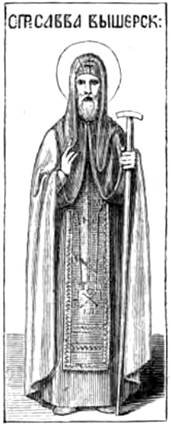
Преп. Савва4, уроженец гор. Кашина, был второй из восьми сыновей Ивана Васильевича Борозды, отрасль рода, отличавшегося в боях5. Воспитанный в благочестии, он и тогда, когда был ещё в первых летах молодости, не любил рассеянной жизни: нося мирскую одежду, постился и усердно ходил в храм Божий. Потом удалился он в Саввину Тверскую пустынь, где хранили тогда примерно-строгое житие. Здесь во всех монастырских службах был он рабом Божиим, послушливым и искренно-усердным. Братия столько уважали его высокую жизнь, что избрали его в игумена. Но ласки и уважение знакомых стали тяжелы для души его, и он, отказавшись от начальствования над другими, отправился на Афонскую гору6. Неизвестно, долго ли он пробыл на Афоне, но впечатления Афона надолго остались в душе, как это увидим по жизни: известно также, что он принёс с собой из Афона в Россию список Кормчей книги, которым пользовался потом Вассиан, архиепископ Ростовский7. – Вероятно, он же «недостойный и худый и ленивый мних Савва» говорит: «слышав и видев сицевый псалтырь (с уставом хотящим дрьжати псалтырь в молчании живущим иноком и белцем) написал Греческим языком, сжаливси, – понеже не разумел добре Гречески, – но – по силе изложих, елико мощь постигла, и предах вам торжником, да вы сотворите им прикуп». Сборник с этим уставом замечателен и потому, что здесь же помещены толкования на разные места св. Писания, с замечаниями против разных Русских слабостей8. По возвращении с Афона, преп. Савва странствовал в виде бедного инока по обителям Новгорода, отыскивая себе место для уединённого пребывания.
The Venerable Sabbas4, a native of the city of Kashin, was the second of eight sons of Ivan Vasilievich Borozda, a scion of a family distinguished in battle5. Brought up in piety, even when he was still in the first years of his youth, he did not love a dissipated life: while wearing worldly clothing, he fasted and diligently went to the church of God. Afterwards he withdrew to the Sabbas Hermitage of Tver, where at that time they kept a strictly exemplary life. Here in all the monastic obediences he was a servant of God, obedient and sincerely zealous. The brethren so respected his lofty life that they chose him as abbot. But the caresses and respect of acquaintances became burdensome to his soul, and he, having refused to be in authority over others, set out for Mount Athos6. It is unknown how long he remained on Athos, but the impressions of Athos long remained in his soul, as we shall see from his life; it is also known that he brought from Athos to Russia a copy of the Kormchaya Kniga, which was later used by Vassian, Archbishop of Rostov7. – Probably it is the same "unworthy and poor and lazy monk Sabbas" who says: "Having heard and seen such a Psalter (with a rule for those wishing to keep the Psalter in silence, for monks and laymen living in stillness) written in the Greek language, taking pity, – since I did not understand Greek well, – but – to the best of my ability I set it forth, as far as my strength reached, and gave it to you merchants, that you might make profit with it." The collection containing this rule is also remarkable because it includes commentaries on various passages of Holy Scripture, with observations against various Russian weaknesses8. Upon his return from Athos, the Venerable Sabbas wandered in the guise of a poor monk through the monasteries of Novgorod, seeking a place for solitary dwelling.
В семи верстах от Новгорода, на р. Вишере, понравилось ему тихое место. Он поставил здесь крест9, а вблизи хижину, и стал подвизаться отшельнически. Здесь видна живая память об Афонском отшельничестве. Но преп. Савва жил, как жили и живут многие. Случилось одному из Новгородцев проходить мимо того места, где подвизался Савва. День был знойный, а инок пустынный стоял на молитве, недвижимый; лицо его покрыто было комарами и истерзано до крови, а он как бы ничего не чувствовал, погружённый в молитву. Изумлённый тем, Новгородец рассказал другим, какого видел он раба Божия. Когда до архиепископа Иоанна дошла молва, что в его епархии явился неведомый отшельник, он послал спросить, как дозволил себе тот жить в его епархии без его благословения? «Одна девица, поручил отвечать Савва, сидела у окна близ площади и бесстыдно смотрела на всех проходивших, другая же, сидя у другого окна, бережно хранила чистоту души своей. Люди добрые осуждали первую и одобряли вторую: не будет, говорили, добра в той суетной и рассеянной. Поселясь в этой пустыне, я убегаю только мира, а не архипастыря, которого молитв и благословения жажду». – Архиепископ понял по такому ответу, что отвечающий – старец духовной жизни, и захотел посетить его. Он встретился с Саввой на пути и, не узнав его, покрытого рубищем, едва уговорил ехать с ним до кельи Саввы. Беседа во время пути показала архиепископу в спутнике смиренномудрого раба Божия, и архиепископ полюбил Савву, прежде чем узнал его. Перед кельей своей Савва назвал себя по имени, и архипастырь с живейшею радостью любви благословил Савву. – Разделив с ним пустынную трапезу и насладясь духовной беседой его, архиепископ Иоанн прислал потом свои дары для пустыни Саввы.
Seven versts from Novgorod, on the River Vishera, a quiet place pleased him. He set up a cross there9, and a hut nearby, and began to struggle as a hermit. Here is seen a living memory of the Athonite hermit life. But the Venerable Sabbas lived as many have lived and do live. It happened that one of the Novgorodians was passing by the place where Sabbas was struggling. The day was sultry, and the desert monk stood at prayer, motionless; his face was covered with mosquitoes and torn to blood, yet he seemed to feel nothing, immersed in prayer. Amazed by this, the Novgorodian told others what a servant of God he had seen. When word reached Archbishop John that an unknown hermit had appeared in his diocese, he sent to ask how he had dared to live in his diocese without his blessing? "A maiden," Sabbas bade reply, "sat by a window near the square and shamelessly looked at all who passed by, while another, sitting at another window, carefully preserved the purity of her soul. Good people condemned the first and approved the second: they said no good would come of that vain and distracted one. Settling in this wilderness, I flee only the world, not the chief shepherd, whose prayers and blessing I thirst for." – The Archbishop understood from such an answer that the respondent was an elder of spiritual life, and wished to visit him. He met Sabbas on the way and, not recognizing him, covered in rags, barely persuaded him to ride with him to Sabbas's cell. The conversation during the journey showed the Archbishop in his companion a humble-minded servant of God, and the Archbishop came to love Sabbas before he knew him. Before his cell, Sabbas named himself, and the chief shepherd, with the liveliest joy of love, blessed Sabbas. – Having shared the desert meal with him and delighted in his spiritual conversation, Archbishop John later sent his gifts for Sabbas's wilderness.
По случаю спора, поднятого иноками Лисичьего монастыря за землю, преп. Савва обратился к начальникам Славянского конца с просьбой отвести ему место на р. Вишере для пустынной обители, и они с любовью отвели10. В 1418 г. по благословению блаж. архиепископа Симеона преподобный построил деревянный храм в честь Вознесения Господня и поставил кельи для братий11. Когда строил он своими руками храм, явились к нему удалые молодцы, надеясь поживиться чужим добром. «Детки, сказал Савва, помогите мне поднять дерево на стену». Он указал им на тонкий конец бревна, а сам взял за толстый. Те никак не могли поднять своего конца, а Савва легко поднял и положил свой конец на место. Разбойники переглянулись между собой; «худо нам будет», думали они, «если такой черноризец вздумает разделываться с нами», и поспешили уйти от него12. К преп. подвижнику стали являться ревнители пустынной жизни. Он принимал их с любовью, встречая ещё далеко от своей обители, там, где водружён был крест. Преподобный трудился для новой обители более других. Инок другого дальнего монастыря, оставшись в обители Саввы для отдыха, слышал, как в соседней келье Савва всю ночь до утрени молол рожь жерновом и в то же время читал псалмы, а потом отправился на утреннее пение.
On the occasion of a dispute raised by the monks of the Lisich Monastery over land, the Venerable Sabbas turned to the heads of the Slavensk End with a request to allot him a place on the River Vishera for a desert monastery, and they lovingly allotted it10. In 1418, with the blessing of the blessed Archbishop Simeon, the Venerable One built a wooden church in honor of the Ascension of the Lord and set up cells for the brethren11. While he was building the church with his own hands, some bold fellows appeared to him, hoping to profit from another's goods. "Children," said Sabbas, "help me lift a log onto the wall." He pointed them to the thin end of the beam, while he himself took the thick end. They could not lift their end at all, but Sabbas easily lifted and placed his end in position. The robbers exchanged glances among themselves; "it will be bad for us," they thought, "if such a black-robed one decides to deal with us," and they hastened to flee from him12. Zealots of the desert life began to appear to the Venerable ascetic. He received them with love, meeting them still far from his monastery, where the cross had been set up. The Venerable One labored for the new monastery more than others. A monk from another distant monastery, remaining in Sabbas's monastery for rest, heard how in the neighboring cell Sabbas ground rye with a hand-mill all night until Matins, while at the same time reading the psalms, and then went to the morning singing.
По устроении обители, преподобный построил себе столп невдали от обители и стал подвизаться на нём в молитвах. Чудная свобода жизни духовной! Посетитель Афона полюбил Афонскую отшельническую жизнь, но, опытом дознав, что точный вид её не совсем совместим и с местностью, и с его расположениями, он избирает новый вид уединения – жизнь на столпе. Зато какая точная верность своему правилу жизни! Родной брат, долго не видевший Савву, пришёл повидаться с ним; Савва сошёл со столпа, молча благословил брата и возвратился на столп. Преп. столпник, так называется Савва и в ркп. святцах, сходил к братии со столпа в субботу, слушал службу воскресного дня, разделял с братией трапезу и потом удалялся на столп. «Поселясь в чужой стране и войдя в пустыню безмолвную, здесь ты, преподобный, создал столп и на нём приобрёл богатство небесное: сеяв в посте и слезах, весело пожинаешь плоды трудов твоих. – Не оставь же обитель с учениками, снисканную трудами твоими; молись Христу, отче, чтобы спаслись души наши»13. Так поёт обитель прославленному Савве. Он и в земной жизни, хотя жил на столпе, по-видимому удалённый от обители и забот о ней, хранил её своими молитвами. Раз недобрые люди подошли к монастырю, чтобы ограбить его. Преподобный, увидев их издали со столпа и поняв намерение их, стал стучать жезлом по стене, и воры в я страхе убежали14. В другое время преподобный привёл на вече медведя и, жалуясь, что он убил у него двух рабочих лошадей, просил суда посадничего. Медведь осуждён был работать вместо лошади и работал до смерти святого. Конечно это было уроком и для посадников, не очень щадивших бедность.
After the establishment of the monastery, the Venerable One built himself a pillar not far from the monastery and began to struggle on it in prayers. Marvelous freedom of spiritual life! The visitor of Athos loved the Athonite hermit life, but, having learned by experience that its exact form was not entirely compatible either with the locality or with his dispositions, he chooses a new form of solitude—life on a pillar. Yet what precise fidelity to his rule of life! His own brother, who had not seen Sabbas for a long time, came to see him; Sabbas came down from the pillar, silently blessed his brother, and returned to the pillar. The Venerable Stylite—so Sabbas is called also in manuscript saints' calendars—would come down to the brethren from the pillar on Saturday, attend the service of the Lord's Day, share the meal with the brethren, and then withdraw to the pillar. "Having settled in a foreign land and entered the silent wilderness, here you, O Venerable One, built a pillar and on it acquired heavenly riches: sowing in fasting and tears, you joyfully reap the fruits of your labors. – Do not abandon the monastery with the disciples, acquired by your labors; pray to Christ, O Father, that our souls may be saved"13. Thus the monastery sings to the glorified Sabbas. Even in his earthly life, although he lived on a pillar, seemingly removed from the monastery and its cares, he preserved it by his prayers. Once evil men approached the monastery to plunder it. The Venerable One, seeing them from afar from the pillar and understanding their intention, began to strike the wall with his staff, and the thieves fled in fear14. At another time, the Venerable One brought a bear to the veche and, complaining that it had killed two of his work horses, asked for judgment from the posadnik. The bear was condemned to work in place of a horse and worked until the saint's death. This was, of course, a lesson also for the posadniks, who were not very sparing of poverty.
Под руководством Саввы образовались люди высокой жизни. Ученик его Андрей, принимавший после него начальство над обителью, до того изнурил тело своё постом и бдением, что у него остались только кожа и кости; преп. Ефрем Перекопский также был учеником его. На 80 г. жизни, приблизясь к кончине, преп. Савва приобщился св. Таин и мирно предал дух свой Господу, 1 октября 1460 (6969) года.
Under Sabbas's guidance, men of high life were formed. His disciple Andrew, who received authority over the monastery after him, so exhausted his body by fasting and vigil that only skin and bones remained of him; the Venerable Ephraim of Perekom was also his disciple. In the 80th year of his life, approaching his end, the Venerable Sabbas partook of the Holy Mysteries and peacefully surrendered his spirit to the Lord, on October 1, 1460 (6969).
Вскоре после кончины преподобного монастырь и столп его сгорели; но часовня над гробом Саввы уцелела среди пламени. Это было первое чудо, которым Господь указал в почившем Савве угодного Ему раба. Потом некто Захария видел во сне старца, который говорил ему: если хочешь видеть Савву, иди за мной и увидишь. Захарии казалось, что он пошёл за старцем, дошёл до гробницы преподобного, увидел нескольких святителей и между ними преп. Савву, который сказал ему несколько слов в назидание. Настоятель Саввиной обители Геласий заболел от отравы; в крайности своей обратился он с молитвой к преп. Савве; задремав потом, увидел он старца в светлой одежде, молящегося о Церкви, и пробудясь нашёл себя совсем здоровым. Новгородский святитель Иона, узнав о чудесах преподобного, приказал написать икону преп. Саввы, составить в честь его службу и описать житие, что и было исполнено просвещённым иноком Пахомием15. В летописи читаем, что осенью 1522 г. освящён был в Саввиной пустыни каменный храм Покрова Богоматери над мощами преподобного: «ту и гроб преп. Саввы Вышерского», замечает она16. От гроба его продолжали истекать исцеления17, и преп. Савва известен был с именем Новгородского чудотворца18. Грехи людей продолжали творить своё, – разрушение и гибель; благодать Божия, обитая в святом, вносила жизнь и благоустройство в само общество людей грешных. «В 1571 г. июня 7 дня, говорит летопись, в Саввиной пустыни на Вишере освятили церковь Покрова, где лежат мощи преп. отца нашего Саввы Вишерского, Новгородского чудотворца, и устроили новую раку; это – на другом году после того, как ратные люди государевы разрушили гроб чудотворца»19.
Soon after the Venerable One's repose, his monastery and pillar burned down; but the chapel over Sabbas's grave survived amidst the flames. This was the first miracle by which the Lord pointed out in the reposed Sabbas a servant pleasing to Him. Then a certain Zacharias saw in a dream an elder who said to him: if you wish to see Sabbas, follow me and you will see. It seemed to Zacharias that he followed the elder, reached the tomb of the Venerable One, saw several hierarchs and among them the Venerable Sabbas, who said a few words of edification to him. The abbot of Sabbas's monastery, Gelasius, fell ill from poison; in his extremity he turned with a prayer to the Venerable Sabbas; then, dozing off, he saw an elder in bright garments praying for the Church, and upon waking found himself completely well. The Novgorod Hierarch Jonah, learning of the Venerable One's miracles, ordered an icon of the Venerable Sabbas to be painted, a service in his honor to be composed, and a life to be written, which was accomplished by the learned monk Pachomius15. In the chronicle we read that in the autumn of 1522 a stone church of the Protection of the Mother of God was consecrated in Sabbas's wilderness over the relics of the Venerable One: "there also is the tomb of the Venerable Sabbas of Vishera," it notes16. Healings continued to flow from his tomb17, and the Venerable Sabbas was known by the name of the Wonderworker of Novgorod18. The sins of men continued to do their work—destruction and ruin; the grace of God, dwelling in the saint, brought life and good order into the very society of sinful men. "In 1571, on June 7, the chronicle says, in Sabbas's wilderness on the Vishera they consecrated the church of the Protection, where lie the relics of our Venerable Father Sabbas of Vishera, the Wonderworker of Novgorod, and they built a new reliquary; this is in the second year after the sovereign's soldiers destroyed the wonderworker's tomb"19.
На шёлковом покрове с изображением преп. Саввы надпись говорит: «лета 1721 положил сий покров на святого чудотворца Савву посадник бурмистр Фома Иванов сын Ларин, по своему обещанию от потопа, по себе и по своих родителях»20. Ныне мощи преподобного почивают под спудом в Покровском храме; на новой гробнице стоит древняя икона преподобного; в его имя – два храма в обители21.
On a silk cover with the image of the Venerable Sabbas, an inscription says: "In the year 1721, this cover was placed on the holy wonderworker Sabbas by the posadnik burgomaster Thomas Ivanov, son of Larin, according to his vow from the flood, for himself and for his parents"20. Now the relics of the Venerable One rest under a covering in the Church of the Protection; on the new tomb stands an ancient icon of the Venerable One; there are two churches in the monastery in his name21.
«Не прельщайтесь, говорит нам жизнью своею св. Савва, Бога не обманешь: что посеет человек, то и пожнёт. Да не унываем, делая добро: ибо в своё время пожнём, если не ослабеем» (Гал.6:7, 9).
"Do not be deceived," the holy Sabbas says to us by his life, "you will not deceive God: what a man sows, that he will reap. Let us not despair in doing good: for in due time we shall reap, if we do not grow weak" (Gal. 6:7, 9).
Житие препод. Саввы, описанное Пахомием, в минее м. Макария. Пахомий говорит: «я не мог подробно описать все дела такого мужа». К удивлению, он ничего не говорит о пребывании Саввы в Саввиной пустыни; говорит только: «пострижеся в иноческий чин в некоем монастыре, идеже житие живяху жестокое». Он описывает только пребывание Саввы в Новгородской стороне. То жеКостомаров (севернорус. народопр. 2, 349–353).
The Life of the Venerable Sabbas, written by Pachomius, in the menaion of Metropolitan Macarius. Pachomius says: "I could not describe in detail all the deeds of such a man." Surprisingly, he says nothing about Sabbas's stay in the Sabbas Monastery; he only says: "he was tonsured into the monastic order in some monastery where they lived a harsh life." He describes only Sabbas's sojourn in the Novgorod region. The same Kostomarov (Severnoruss. Narodopr. 2, 349–353).
О Бороздиных родослов. кн. в времен. общ. ист. X, 115. 175. «У Ивана Борозды восемь сынов: большой Андрей Юшко да Сава Яря бездетен да Феодор Челей (и от того пошли Челеевы)» и проч. Далее прямо сказано, что сей Савва Вишерский чудотворец. – У пр. Иосифа «Савва Бороздин, нарицаемый Ера». Духовн. гл. X. Царств. кн. 345.Борозда древнее военное название окопа, траншеи. Сл. Лакьера Геральдика, стр. 409.
About the Borozdins, genealogical book in Vrem. Obshch. Ist. X, 115. 175. "Ivan Borozda had eight sons: the eldest Andrey Yushko and Sava Yarya childless, and Theodore Cheley (and from him came the Cheleyevs)" etc. Further it is directly said that this is Sabbas of Vishera the wonderworker. – In the work of Venerable Joseph, "Sabbas Borozdin, called Era." Dukhovn. gl. X. Tsarstv. kn. 345. Borozda is an ancient military term for a trench, a ditch. Sl. Lakier Heraldika, p. 409.
Крест и теперь стоит в часовне при монастыре, но обложенный досками и с лицевой стороны литыми из алебастра изображениями святых.Макария древности I, 628. Так как преп. Савва виделся потом с архиепископом Иоанном (1387–1415 г.), то поселение его на Вышере было не позже 1415 г. и водружение креста напрасно относят к 1417 г.
The cross still stands in a chapel at the monastery, but covered with boards and on the front side with images of saints cast in alabaster. Makariya Drevnosti I, 628. Since the Venerable Sabbas later met with Archbishop John (1387–1415), his settlement on the Vishera was no later than 1415, and the setting up of the cross is wrongly attributed to 1417.
Известна печать с крестом в средине и с надписью вокруг: «печать Славенского конца», а на обороте с изображением святого в венце и с надписью: «Павел исповедник» (Лакьера Геральдика, стр. 50). По этому видно, что в Славянском конце было своё управление. Грамоты, данные правлением конца Вишерскому монастырю и дошедшие в списках, изд. в ист. иер. III, 559.
A seal is known with a cross in the middle and an inscription around: "Seal of the Slavensk End," and on the reverse with an image of a saint in a crown and the inscription: "Paul the Confessor" (Lakiera Heraldika, p. 50). From this it is evident that the Slavensk End had its own administration. The charters given by the administration of the End to the Vishera Monastery and preserved in copies are published in Ist. Ier. III, 559.
Собр. л. III, 236. «В л. 6826 (1418) – поставиша вознесение Христово в Савине пустыни у Саввы Вышерского».
Collection of Chronicles III, 236. "In the year 6826 (1418) – they erected the Ascension of Christ in Savina Hermitage at [the monastery of] Sabbas of Vyshera."
Пахомиева служба препод. Савве у Румянцева № 397, у Царского № 563. Она же и в печ. минее. Преставление преп. Саввы октября 1. – В святцах устава и псалтири XVI в. У Толстого 1. № 100. 113.
Pachomius's service to Venerable Sabbas is in Rumyantsev No. 397, in Tsarsky No. 563. It is also in the printed Menaion. The repose of Venerable Sabbas is on October 1. – In the saints' calendar of the Typicon and Psalter of the 16th century. In Tolstoy 1. No. 100. 113.
По летописи, в 1552 г. «кн. Феодор Троекуров был в Саввиной пустыни, у гроба чудотворца... Игумен благословил князя образом чудотворца Саввы» (Собр. л. III. 156). То же – в 1558 г. (ibid. ПИ, 158). В 1572 г. архиеп. Леонид «ездил молиться чудотворцу Савве Вишерскому» (ibid. III, 171). В обители Евангелие с припиской: «л. 7080 (1572) – Евангелие тетр – положил Леонид архиепископ В. Новгор. в пречестную обительпреп. отца нашего Саввы чудотворца, иже над Вышерой рекой» ... В этом Евангелии имя Иисуса пишется Ис и Иис.
According to the chronicle, in the year 1552: "Prince Theodore Troekurov was in Savina Hermitage, at the tomb of the Wonderworker... The abbot blessed the prince with an icon of the Wonderworker Sabbas" (Collection of Chronicles III. 156). The same – in the year 1558 (ibid. III, 158). In the year 1572, Archbishop Leonid "went to pray to the Wonderworker Sabbas of Vyshera" (ibid. III, 171). In the monastery there is a Gospel with an inscription: "the year 7080 (1572) – a Tetraevangelion – placed by Leonid, Archbishop of Great Novgorod, in the most honorable monastery of our Venerable Father Sabbas the Wonderworker, which is on the Vyshera River" ... In this Gospel the name Jesus is written as Is and Iis.