Кроме ризы пресв. Богородицы сохранился между христианами в честный пояс ее, который во успении Божией Матери ею самою вверен был ап. Фоме, потом, как пишет Никифор Каллист, передаваем был между верующими, так же как и риза ее, преемственно от одного к другому. В V веке, в царствование Аркадия, сына Феодосия Великого, честный пояс Богородицы перенесен из Иерусалима, а по мнению иных из Зилы, в Царьград, и положен в драгоценном ковчеге, за царскою печатию, в константинопольском Влахернском храме, построенном во имя Богородицы благочестивою Пульхериею, сестрою Феодосия Младшего (408–450). В IV в. Иосиф Студит написал канон на день положения пояса, с акростихом или краегранесием: «крепостию мя твоею опояши чистая Дева». В Х веке честный пояс Богородицы прославлен был особенным знамением, бывшим от него. Греческая царица Зоя, супруга императора Льва философа I (886–912), долгое время страдая от болезни, получила однажды во сне откровение, что она немедленно выздоровеет, если возложен будет на нее пояс пресв. Богородицы. Царица объявила о сем видении императору в патриарху: тогда священный ковчег был открыт, и пояс, найденный совершенно невредимым, распростерт руками патриарха над больною, которая действительно получила исцеление от недуга. После сего всенародно принесены и были благодарственные молитвы Господу Богу и пречистой Его Матери за дарованную милость, и пояс с торжеством опять положен был в ковчег, в котором прежде хранился; в воспоминание же чуда, бывшего от него над больною царицей, установлен в начале X века праздник в честь преблагословенные девы Богородицы: положение честнаго пояса пресв. Богородицы, 31 августа. Российская Церковь, приняв от греческой сие благочестивое установление, совершает также празднество в похвалу преблагословенной Девы Марии, прославляя в честном ее поясе и залог благословения и утверждения православных царств.
Besides the Robe of the Most Holy Theotokos, there has been preserved among Christians her venerable Sash, which at the Dormition of the Mother of God was entrusted by Her to the Apostle Thomas, and afterwards, as Nikephoros Kallistos writes, was passed down among the faithful, like her Robe, successively from one to another. In the fifth century, during the reign of Arcadius, son of Theodosius the Great, the venerable Sash of the Theotokos was transferred from Jerusalem—or, according to some, from Zela—to Constantinople, and placed in a precious reliquary, sealed with the imperial seal, in the Constantinopolitan Church of Blachernae, built in the name of the Theotokos by the pious Pulcheria, sister of Theodosius the Younger (408–450). In the fourth century, Joseph the Studite composed a canon for the day of the Placing of the Sash, with an acrostic or marginal verse: "Gird me with Thy strength, O pure Virgin." In the tenth century, the venerable Sash of the Theotokos was glorified by a special sign that came from it. The Greek Empress Zoe, spouse of Emperor Leo the Philosopher I (886–912), having long suffered from an illness, once received a revelation in a dream that she would recover immediately if the Sash of the Most Holy Theotokos were placed upon her. The Empress declared this vision to the Emperor and the Patriarch; then the sacred reliquary was opened, and the Sash, found completely unharmed, was spread out by the hands of the Patriarch over the ailing woman, who indeed received healing from her malady. After this, prayers of thanksgiving were offered publicly to the Lord God and His most pure Mother for the mercy granted, and the Sash was again placed with triumph in the reliquary in which it had formerly been kept. In remembrance of the miracle that occurred from it over the ailing Empress, a feast was established at the beginning of the tenth century in honor of the most blessed Virgin Theotokos: the Placing of the Venerable Sash of the Most Holy Theotokos, on August 31. The Russian Church, having received this pious institution from the Greek Church, also celebrates the feast in praise of the most blessed Virgin Mary, glorifying in her venerable Sash both a pledge of blessing and the confirmation of Orthodox kingdoms.
В песнопениях богослужебных в этот день Церковь прославляет пояс Богоматери, как кивот освящения верующим, священное ограждение, источник исцелений. Апостол и евангелие на Литургии в день Положения пояса Богородицы те же, что и в день положения ризы ее. И вообще песнопения в честь пояса Богородицы во многом очень сходны с песнопениями в честь ризы.
In the liturgical hymns of this day, the Church glorifies the Sash of the Mother of God as an ark of sanctification for the faithful, a sacred protection, a source of healings. The Epistle and Gospel at the Divine Liturgy on the day of the Placing of the Sash of the Theotokos are the same as those on the day of the Placing of her Robe. And in general, the hymns in honor of the Sash of the Theotokos are in many respects very similar to the hymns in honor of the Robe.
О последующей судьбе пояса Богоматери сообщают предания следующее. Пояс, сопутствовавший в походах императоров греческих, взят был у греков победоносным царем болгарским Коломаном и принесен в дар обители Ватопеда на Афоне сербским князем Лазарем в ΧΙV веке. Пояс разделен на две части, из коих одна постоянно пребывает в обители, запечатанная двумя царскими печатями, вероятно – Аркадия и Льва Философа, а другая носится по селениям Румелии. Во время страшной холеры, опустошавшей Адрианополь, спасительно было таи появление части пояса.
Concerning the subsequent fate of the Sash of the Mother of God, traditions relate the following. The Sash, which accompanied the Greek emperors on their campaigns, was taken from the Greeks by the victorious Bulgarian Tsar Koloman and presented as a gift to the Monastery of Vatopedi on Mount Athos by the Serbian Prince Lazar in the fourteenth century. The Sash was divided into two parts, of which one constantly remains in the monastery, sealed with two imperial seals, probably those of Arcadius and Leo the Philosopher, while the other is carried through the villages of Rumelia. During the terrible cholera that devastated Adrianople, the appearance of that part of the Sash was salvific.
В 1387 году русский митрополит Пимен видел во Влахернском храме ковчег, в котором лежали риза и пояс Богородицы. Часть пояса Богородицы находится также в пределах наших, в домовой церкви владетелей мингрельских, куда пожертвовал император Роман, выдавший в исходе X века дочь свою Аргиру, получившую исцеление от этого пояса, за знаменитого царя Абхазии и Грузии, – Баграта Куропалата. Аргира умоляла отца отпустить с нею в дальнюю страну часть чудотворного пояса. Эта часть ныне находится в Мингрелии, в Зугдиде, где, по повелению Российского Императора Александра I выстроена церковь для охранения святыни.
In 1387, the Russian Metropolitan Pimen saw in the Church of Blachernae the reliquary in which the Robe and Sash of the Theotokos lay. A portion of the Sash of the Theotokos is also found within our borders, in the domestic church of the rulers of Mingrelia, to which it was donated by the Emperor Romanos, who at the end of the tenth century gave his daughter Argyra—who had received healing from this Sash—in marriage to the renowned King of Abkhazia and Georgia, Bagrat Kuropalates. Argyra begged her father to let a portion of the wonderworking Sash go with her to that distant land. This portion is now in Mingrelia, in Zugdidi, where, by order of the Russian Emperor Alexander I, a church was built for the preservation of the shrine.
Уроженец Карфагена, воспитанный в язычестве, Киприан в очень молодых летах сделался преподавателем философии и красноречия в своем городе, жил весело и роскошно. Ему случилось познакомиться с христианским священником Цецилианом, который убедил его, что только христианское учение ведет к истине и спасению. Киприан уверовал и крестился, пробывши немалое время в разряде оглашаемых, в 246 году, а скоро рукоположен и во пресвитера. «Узнал я», – писал он другу по обращении – «что прежняя жизнь для плоти и греха есть жизнь земная и гибнущая, а жизнь по заповедям Христовым есть жизнь божественная».
A native of Carthage, raised in paganism, Cyprian at a very young age became a teacher of philosophy and rhetoric in his city, living cheerfully and luxuriously. It happened that he became acquainted with the Christian presbyter Caecilian, who convinced him that only Christian teaching leads to truth and salvation. Cyprian believed and was baptized, having spent considerable time among the catechumens, in the year 246, and was soon ordained also to the presbyterate. "I have learned," he wrote to a friend after his conversion, "that the former life for the flesh and sin is an earthly and perishing life, but life according to the commandments of Christ is a divine life."
В 248 году, по смерти епископа Доната, карфагенские христиане избрали его во епископа. Киприан был ревностным пастырем Церкви, учил словом и писаниями, назидал примером собственной жизни. В гонение Декия укрылся от преследователей, но при Валериане сперва подвергся изгнанию (257 г.), а потом осужден на смерть. Он был обезглавлен 14 сент. 258 года.
In 248, after the death of Bishop Donatus, the Christians of Carthage elected him as bishop. Cyprian was a zealous shepherd of the Church, teaching by word and writings, edifying by the example of his own life. During the Decian persecution he hid from the persecutors, but under Valerian he was first subjected to exile (in 257), and then condemned to death. He was beheaded on September 14, 258.
Геннадий, из конст. священников, возведен на престол в июле 458 года, в царствование Льва Великого. Был ревнителем истины, учителем чистоты нравов, искоренял симонию между епископами и от принимающих свящ. сан требовал знания Псалтыря (то есть наизусть). Пас Церковь тринадцать лет; скончался 471 года на острове Кипре, на обратном пути из Иерусалима, куда ходил на богомолье.
Gennadius, from among the priests of Constantinople, was elevated to the throne in July 458, during the reign of Leo the Great. He was a zealot for truth, a teacher of purity of morals; he eradicated simony among bishops and required knowledge of the Psalter (that is, by heart) from those receiving holy orders. He shepherded the Church for thirteen years; he reposed in the year 471 on the island of Cyprus, on his return journey from Jerusalem, where he had gone on pilgrimage.
Во дни сего патриарха некий иконописец дерзнул неподобающим образом написать образ Спасителя, по подобию языческого бога Зевса, и тотчас постигла его казнь; ибо рука, дерзнувшая на то, усохла. Он пришел к патриарху с плачеи и раскаянием; и патриарх, помолившись Богу, исцелил руку его.
In the days of this Patriarch, a certain iconographer dared to paint an image of the Savior in an unseemly manner, after the likeness of the pagan god Zeus, and punishment immediately overtook him; for the hand that had dared to do this withered. He came to the Patriarch with weeping and repentance; and the Patriarch, having prayed to God, healed his hand.
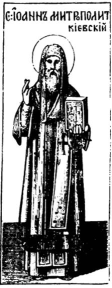
После м. Георгия, преемника блаж. м. Илариону, блаж. Иоанн, родом, вероятно, болгарин, при был в Киев в сане митрополита всей России в 1080 г. и скоро заслужил общее глубокое уважение352.
After Metropolitan George, the successor of the blessed Metropolitan Hilarion, the blessed John, by birth probably a Bulgarian, arrived in Kiev in the rank of Metropolitan of all Russia in 1080, and soon earned universal deep respect352.
Преп. Нестор, современник и очевидец дел его, восхищенный высокими качествами его, говорит: «подобного ему еще не было в Руси да и не будет; это – муж сведущий в книгах, искусный в учении, милостивый к убогим и вдовицам, ласковый ко всякому, богатому и бедному, смиренный и кроткий, любитель молчания, владевший даром слова и утешавший святыми беседами печальных353. Древность называла святителя Иоанна пророком Христовым. По высокому изображению блаженного Иоанна у преп. Нестора не сомневаемся, что, называя его пророком Христовым, соединяли с тем мысль о прозорливце354. Из дел его летопись упоминает о немногих. По ней, в 1086 году он основал храм ап. Андрея в Андреевском монастыре, – причем называется он «преподобным митрополитом»; в 1087 году торжественно погребал убиенного кн. Ярополка; в 1087 году освящал храм архангела Михаила в Выдубицком монастыре355; 1089 г. августа 14 освящал чудную, великую церковь печерскую и вслед затем скончался356. Летописи после Нестора называют его то добрым, то святым, то блаженным357. По ркп. святцам он «святый Иоанн митрополит»; а в одном списке прибавлено: «положен бысть в Печерском монастыре». Блаженный Иоанн оставил для Церкви русской несколько сочинений358.
The Venerable Nestor, a contemporary and eyewitness of his deeds, enraptured by his lofty qualities, says: "One like him has not yet been in Rus', nor will there be; he is a man learned in books, skilled in teaching, merciful to the poor and to widows, kindly to everyone, rich and poor, humble and meek, a lover of silence, possessing the gift of speech and comforting the sorrowful with holy conversations353. Antiquity called the Hierarch John a prophet of Christ. From the lofty depiction of the blessed John by the Venerable Nestor, we do not doubt that, in calling him a prophet of Christ, they connected with that the idea of a clairvoyant354. Of his deeds, the chronicle mentions but a few. According to it, in 1086 he founded the church of the Apostle Andrew in the St. Andrew's Monastery—on which occasion he is called "the Venerable Metropolitan"; in 1087 he solemnly buried the murdered Prince Yaropolk; in 1087 he consecrated the church of the Archangel Michael in the Vydubychi Monastery355; on August 14, 1089, he consecrated the wondrous, great Church of the Caves, and soon after reposed356. The chronicles after Nestor call him now good, now holy, now blessed357. According to manuscript menologia, he is "St. John the Metropolitan"; and in one list it is added: "he was buried in the Monastery of the Caves." The blessed John left for the Russian Church several writings358.
Послание м. Иоанна к Клименту папе старшего Рима359 – драгоценно и по содержанию своему, особенно же по духу кротости, которым дышит оно. «Приятна любовь твоя во Господе, человек Божий, достойный апостольского престола», так писал русский святитель. – «Ты из далекой страны призираешь на нашу худость и смирение, касаешься нас крылами любви твоей, приветствуешь нас искренно и с любовию, предлагаешь желания духовные, догматы православной и чистой веры нашей приемлешь и изумляешься им, как возвестил нам и ясно показал епископ твоего святейшества. Так как дела в таком положении и ты таким оказываешься архиереем Божиим, не каковы были недавно архиерействовавшие, возмутители и оскорбители истины: то и я, самый меньший, приветствую и мысленно лобызаю священную главу твою. Будь счастлив! Да покрывает тебя божественная, Всевышня рука! Да даст благий и милостивый Бог тебе и твоим дням увидеть улучшение дел между вами и нами!
The Epistle of Metropolitan John to Clement, Pope of Elder Rome359, is precious both for its content and especially for the spirit of meekness with which it breathes. "Pleasant is your love in the Lord, O man of God, worthy of the apostolic throne," thus wrote the Russian Hierarch. "From a distant land you look upon our lowliness and humility, touch us with the wings of your love, greet us sincerely and with love, offer spiritual desires, receive the dogmas of our Orthodox and pure faith and marvel at them, as the bishop of your holiness has announced to us and clearly shown. Since matters are in such a state and you prove to be such a bishop of God, not like those who have lately been bishops, disturbers and revilers of the truth: therefore I, the least of all, greet and mentally kiss your sacred head. Be happy! May the divine, Most High hand cover you! May the good and merciful God grant to you and to your days to see the improvement of affairs between you and us!
«Не знаю я, откуда и как явились соблазны и препятствия на пути Божием? отчего и как они доселе не исправились? Недоумеваю и не понимаю, какой жестокий демон, злобный враг истины и благоческие, наделал все это, разрушил братскую любовь вашу и союз, соединяющий христиан. Не скажу, что все погублено. Мы знаем, что вы из начала христиане по благодати Божией и во многом мы одобряем вас. Но вы не во всем согласны с нами и кое в чем отделяетесь. Вот смотрите:
"I know not whence or how temptations and obstacles have appeared on the path of God; why and how they have not been corrected to this day? I am perplexed and do not understand what cruel demon, malicious enemy of truth and piety, has done all this, destroyed your brotherly love and the bond that unites Christians. I will not say that all is lost. We know that you are from the beginning Christians by the grace of God, and in many things we approve of you. But you are not in all things in agreement with us, and in some things you separate yourselves. Behold, see:
«Все признают семь святых и вселенских соборов. На них благочестивая и православная вера христиан исследована, изучена, получила твердость со всею полнотою и убедительностию, они семь столпов богословствующей мудрости; на них построила она свой святой дом – вселенскую Церковь. Сим святым вселенским соборам единомысленно последовали все предстоятели и преемники кафедры верховного из славных апостолов Петра, одни – лично присутствуя и одобряя согласием деяния и слова, другие – чрез доверенных посланных своих подавая содействующий голос апостольской кафедры вашей. Таковы были: на первом вселенском соборе Сильверст, на втором Дамаз, на третьем Целестин; четвертому -вселенскому собору был подкреплением блаженнейший и славный папа Лев, написавший послание к Флавиану премудрое и святое, которое считали столпом православия все знаменитые того времени. На пятом соборе был Вигилий, на шестом Агафон, муж почтенный и духовно-просвещенный. На седьмом вселенском соборе святейший папа Адриан изъявлял согласие чрез посланников своих, святых и богоносных мужей, Петра протопресвитера и игумена римсвой обители св. Саввы.
«All acknowledge the seven holy and Ecumenical Councils. Upon them the pious and Orthodox faith of Christians was examined, studied, and received firmness with all fullness and persuasiveness; they are the seven pillars of theological wisdom; upon them she built her holy house—the universal Church. These holy Ecumenical Councils were unanimously followed by all the prelates and successors of the see of the chief of the glorious Apostles Peter, some—being present in person and approving the acts and words with their consent, others—through their trusted envoys giving the supporting voice of your apostolic see. Such were: at the First Ecumenical Council, Sylvester; at the Second, Damasus; at the Third, Celestine; the Fourth Ecumenical Council was strengthened by the most blessed and glorious Pope Leo, who wrote the most wise and holy epistle to Flavian, which all the renowned men of that time considered a pillar of Orthodoxy. At the Fifth Council was Vigilius; at the Sixth, Agatho, a man honorable and spiritually enlightened. At the Seventh Ecumenical Council, the most holy Pope Adrian expressed his consent through his envoys, the holy and God-bearing men, Peter the protopresbyter and abbot of the Roman monastery of St. Sabbas.
«Когда же все это так, откуда явились раздор и разделение? Кто посеял на римской ниве такие плевелы? Подлинно много у вас творится дерзостей. Из многого предложу я любви твоей немногое:
«When, then, all this is so, whence have discord and division appeared? Who has sown such tares in the Roman field? Truly, many audacities are committed among you. From many things I will set before your love a few:
«Во первых пост субботний соблюдаете незаконно. Потом первую неделю, отделяя от великого поста, заставляете народ есть молоко, сыр и другую вседневную пищу. Отвергаете иереев вступивших в законное супружество. Тех, которые миропомазаны пресвитерами, в другой раз помазываете, как будто это должны совершать не иереи, а епископы. Не говорю о опресноках: это явная принадлежность иудейского служения и веры. Всего хуже то, что вы осмеливаетесь изменять св. символ, утвержденный вселенскими определениями, и говорите, что Дух св. происходить не только от Отца, но и от Сына»...
«First, you unlawfully observe the Saturday fast. Then, you separate the first week from the Great Fast and compel the people to eat milk, cheese, and other everyday food. You reject priests who have entered into lawful marriage. Those who have been chrismated by presbyters you anoint a second time, as if this ought to be performed not by priests but by bishops. I say nothing of the unleavened bread: this is a manifest mark of Jewish service and faith. Worst of all is that you dare to alter the holy Symbol, confirmed by the definitions of the Ecumenical Councils, and say that the Holy Spirit proceeds not only from the Father but also from the Son»…
Представив потом опровержение каждого из выставленных своеволий запада, в обличение произвола о св. Духе говорит: «изумительно и страшно, как дерзаете вы изменять веру 318 св. отцов и св. вселенских соборов. От конца до конца вселенной, во всех христианских церквах, поется единогласно: «веруем и в св. Духа, Господа животворящаго, от Отца исходящаго, со Отцем и Сыном споклоняемаго и славимаго». Для чего вы не говорите так, как все христиане, а делаете прибавление? Вы вводите новое учение. Но апостол говорит: «иже благовестит вам паче, еже приясте, да будет проклят» (Гал.1:8). О! да не услышите вы над собою сего проклятия! Истнано страшно изменять и портить святое писание, хотя бы одною иотою или одною чертою! Уже ли не понимаете, как велик этот соблазн? Вы вводите две причины, два начала для св. Духа; вы унижаете достоинство Его в впадаете в ересь Македония».
Having then presented a refutation of each of the set forth self-willful acts of the West, in reproof of the arbitrariness concerning the Holy Spirit he says: «it is astonishing and terrible how you dare to alter the faith of the 318 holy fathers and the holy Ecumenical Councils. From one end of the universe to the other, in all Christian churches, it is sung with one voice: “We believe in the Holy Spirit, the Lord, the Giver of Life, Who proceeds from the Father, Who with the Father and the Son is worshipped and glorified.” Why do you not speak as all Christians do, but make an addition? You introduce a new teaching. But the Apostle says: “Whoever preaches to you anything other than what ye have received, let him be accursed” (Gal. 1:8). O! may you not hear this curse upon yourselves! Truly it is terrible to alter and corrupt the Holy Scripture, even by one iota or one tittle! Do you not understand how great this scandal is? You introduce two causes, two principles for the Holy Spirit; you diminish His dignity and fall into the heresy of Macedonius.»
В заключение всего пишет: «прошу и молю и припадаю в священным ногам твоим, – исправитесь во всем этом, особенно же относительно опресноков и указанного недостатка, так как то касается св. причащения, а это пагуба для чистой веры. Прости написавшего тебе это»...
In conclusion of all he writes: «I ask and beseech and fall at your sacred feet—correct yourselves in all this, especially concerning the unleavened bread and the indicated deficiency, since the one concerns the Holy Communion, and the other is a ruin for the pure faith. Forgive him who has written this to you»…
«Иоанна митрополита русского, нареченного пророком Христовым церковное правило», писанное для черноризца Иакова, долго оставалось в составе правил Церкви русской, как объяснение правил вселенской Церкви в применении их к нуждам русской Церкви360.
«The Church Rule of John, Metropolitan of Rus’, called the Prophet of Christ», written for the monk James, long remained among the rules of the Church of Rus’, as an explanation of the rules of the universal Church in their application to the needs of the Church of Rus’360.
В правиле 4 писал святитель: «с теми, которые служат на опресноках, едят мясо в сырную неделю, едят кровь и удавленину, не должно приобщаться св. Таин) и совершать богослужение. Но ни мало не возбраняется вкушать с ними пищу, по обстоятельствам, для любви Христовой. Если кто хочет под видом чистоты или по немощи избегать и сего: пусть уклоняется; но смотрите, чтобы не вышел из того соблазн или не возродилась сильная вражда и злопамятование. Надобно из большого зла избирать меньшее». Превосходное правило! апостольское правило!
In Rule 4 the Hierarch wrote: «With those who serve on unleavened bread, eat meat during Cheese Week, eat blood and strangled meat, one must not commune of the Holy Mysteries or perform divine services. But it is by no means forbidden to eat food with them, as circumstances require, for the sake of the love of Christ. If anyone wishes, under the pretext of purity or from weakness, to avoid even this: let him abstain; but take heed that no scandal arise from this, or that strong enmity and rancor be not born. One must choose the lesser from the greater evil.» An excellent rule! an apostolic rule!
В других правилах св. Иоанн осуждает волхвование, языческие обычаи, соблазнительные песни, показывает, как грешно торговать крещенными рабами в земле половцев; священникам предписывает быть примером трезвости; князьям запрещает отдавать дочерей за иноверцев; налагает епитимии на нарушающих чистоту и целомудрие; дает наставления о таинствах и разных священных предметах. «Ты спрашивал меня, так пишет он к Иакову, о тех, которые покупают слуг и после того, как с ними вместе молились и приобщались св. Таин, продают их язычникам, какой подвергать их епитимии? Закон говорит: христианина не должно продавать ни жиду, ни еретику; кто продаст жидам, тот беззаконник; он виновен не только пред законом, но и пред Богом. Представь себе Ананию и Сапфиру – и подумай. Они обещали ап. Петру цену поля принесть Богу, но потом удержали только малую часть и осуждены на смерть. Купившие же слуг положили знамение Божие на них (крещение) и освятили молитвою, как пишешь ты, потом продают их язычникам? – Они творят не тайное, а явное хищение у Бога, крадут часть, которую принесли Богу. Как думаю, они грешат столько же, сколько те, которые гонят нашу веру и многих от веры доводят до неверия. Их надобно отклонять от такого злого дела всеми убеждениями и увещаниями. Если же не послушают, то считать их за язычников и мытарей».
In other rules St. John condemns sorcery, pagan customs, seductive songs; shows how sinful it is to trade baptized slaves in the land of the Polovtsy; prescribes to priests to be an example of sobriety; forbids princes to give their daughters in marriage to those of other faiths; imposes penances on those who violate purity and chastity; gives instructions concerning the Mysteries and various sacred objects. «You have asked me,» thus he writes to James, «concerning those who buy servants and, after having prayed with them and communed of the Holy Mysteries, sell them to pagans, what penance to impose on them? The law says: a Christian must not be sold either to a Jew or to a heretic; whoever sells to Jews is a transgressor; he is guilty not only before the law but also before God. Imagine Ananias and Sapphira—and think. They promised to the Apostle Peter to bring the price of the field to God, but then kept back only a small part and were condemned to death. But those who bought servants placed the sign of God upon them (baptism) and sanctified them with prayer, as you write, and then sell them to pagans?—They commit not a secret but an open theft from God; they steal a part which they have offered to God. As I think, they sin as much as those who persecute our faith and lead many from faith to unbelief. They must be turned away from such an evil deed by all persuasions and admonitions. If they do not listen, then count them as pagans and publicans.»
«Если святая трапеза деревянная и честные кресты и иконы сделаются ветхи: то отнюдь не бросать их, а поправить. Если слишком обветшают и на иконах не видно ликов, то положить их в огражденное место, где бы не человек, ни животное не могли коснуться их нечистотою, дабы не быть нам сквернителями святыни. В случае перенесения деревянной церкви на другое место, место, где стоял алтарь и совершалась бескровная жертва, должно оградить и хранить неприкосновенным, как святыню».
«If the holy table is wooden and the venerable crosses and icons become old: by no means throw them away, but repair them. If they become too dilapidated and the faces on the icons are no longer visible, then place them in a fenced place, where neither man nor beast could touch them with uncleanness, lest we be defilers of the sanctuary. In case of moving a wooden church to another place, the place where the altar stood and the bloodless sacrifice was offered must be fenced and kept inviolate, as a sanctuary.»
«Те, которые приносят жертвы бесам, болотам, кладезям, или без благословения берут по нескольку жен, или отпускают свою жену и начинают жить с другою, или ни разу в год не приобщаются св. Таин, тогда как не удержаны от того духовным отцом, – ты знаешь сам, все таковые чужды чистой нашей веры, осуждены соборною Церковию. Старайся всею силою убеждения направлять их на правый путь, вразумляй их не раз и не два, а много раз, пока узнают истину и научатся добру. Если же не покорятся, не оставят своей худой привычки: то считать их чуждыми соборной Церкви, непринадлежащими к ведению ее заповедей».
«Those who offer sacrifices to demons, to marshes, to wells, or without blessing take several wives, or dismiss their own wife and begin to live with another, or do not commune of the Holy Mysteries even once a year, when they are not prevented from doing so by their spiritual father—you know yourself, all such are strangers to our pure faith, condemned by the Catholic Church. Strive with all the power of persuasion to direct them to the right path, admonish them not once nor twice, but many times, until they come to know the truth and learn what is good. If they do not submit, and do not abandon their evil habit: then count them as strangers to the Catholic Church, not belonging to the keeping of her commandments.»
«Тех, которые совершают волхвования и чары, мужчина ли то, или женщина, должно вразумлять словом наставления и обращать от зла; если не обращаются, подвергать строгому наказанию; но не лишать жизни и не уродовать; последнего не допускает церковное учение»361. Припомните при этом, что на западе в XI и XII в., по предписаниям бискупов, жгли волхвов и чародеев на кострах! Бак же не говорить нам от души: слава св. Троице, просвещающей пастырей св. православной Церкви!
«Those who practice sorcery and enchantments, whether man or woman, must be admonished with the word of instruction and turned from evil; if they do not turn, subject them to strict punishment; but do not deprive them of life nor mutilate them; the latter the Church’s teaching does not permit»361. Recall here that in the West in the 11th and 12th centuries, by the decrees of bishops, sorcerers and enchanters were burned at the stake! How can we not say from the heart: glory to the Holy Trinity, Who enlightens the shepherds of the holy Orthodox Church!
Собр. л. 2, 276. Погодин полагает, что Иоанн был не грек, а болгарин, знавший греческий язык. «Каким образом грек мог прославиться красноречием между русскими не зная русского языка? – Правило его имеем только на русском языке». Исследов. 7, 39.
Collection of Chronicles 2, 276. Pogodin supposes that John was not a Greek, but a Bulgarian who knew the Greek language. «How could a Greek become famous for eloquence among the Rus’ without knowing the Russian language?—His Rule we have only in the Russian language.» Researches 7, 39.
«Иоанна митрополита русского, нареченного пророком Христовым церковное правило», – так надписывается правило его по всем спискам. Латино-греческий словарь объясняет слово antistites словами Ιερείς, προφηπται, επισκοποι? Ho а) Иоанн в надписи уже назван митрополитом и следовательно не для чего было прибавлять еще название того же значения; б) обыкновенное народное значение пророка есть значение прозорливца и след. надпись, говоря о нар. назв. митроп., могла иметь в виду только значение прозорливца, а не придуманное искусством значение предстоятеля церкви.
«The Church Rule of John, Metropolitan of Rus’, called the Prophet of Christ»—so his Rule is titled in all copies. The Latin-Greek dictionary explains the word antistites by the words Ἱερεῖς, προφῆται, ἐπίσκοποι? But a) John is already called metropolitan in the title, and therefore there was no need to add another title of the same meaning; b) the ordinary popular meaning of prophet is that of a seer, and consequently the title, speaking of the popular name of the metropolitan, could have in view only the meaning of a seer, and not the artificially invented meaning of a prelate of the Church.
Это послание, известное по некоторым слав. ркп. без имени папы, к которому писано, сочинителем Палинодии и другими приписывалось м. Иоанну 4. Но в надписи греческого послания стоит имя папы Климента. Кто же этот п. Климент? Собственно в Риме не было п. Климента ни при Иоанне 2, ни при Иоанне 4. м. Но по воле имп. Генриха, врага Гильдебрандова, избран был в папы архиепископ Равенский, который с именем Климента оставался папою с 1080 до 1099 года. – Эта современность п. Климента ученому м. Иоанну 2 служит твердым основанием уверенности, что послание русского митрополита к п. Клименту писано м. Иоанном вторым (Неволин в извест. акад. 2, № 6). – Содержание послания говорит то же. Запад, по посланию, ищет союза с русскою церковию. Генрих, унижаемый и преследуемый гордым Гильдебрандом, находился в необходимости искать помощи своему делу в союзе с русскою церковию. Послание к папе на греческом и славян. языках напечатано в учен. записк. акад. наук кн. 1. Спб. 1854 г. 3, 1–20.
This epistle, known from certain Slavonic manuscripts without the name of the pope to whom it was written, was attributed by the author of the Palinodia and others to Metropolitan John IV. But in the title of the Greek epistle stands the name of Pope Clement. Who is this Pope Clement? Strictly speaking, there was no Pope Clement in Rome either under John II or under John IV. But by the will of Emperor Henry, the enemy of Hildebrand, the Archbishop of Ravenna was elected pope, who under the name of Clement remained pope from 1080 to 1099.—This contemporaneity of Pope Clement with the learned Metropolitan John II serves as a firm foundation for the certainty that the epistle of the Russian metropolitan to Pope Clement was written by Metropolitan John the Second (Nevolin in the Proceedings of the Academy 2, No. 6).—The content of the epistle says the same. The West, according to the epistle, seeks union with the Russian Church. Henry, humiliated and persecuted by the proud Hildebrand, found himself in need of seeking help for his cause in union with the Russian Church. The epistle to the pope in Greek and Slavonic was printed in the Scientific Notes of the Academy of Sciences, Book 1. St. Petersburg, 1854, 3, 1–20.