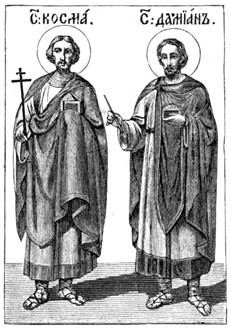
Св. Косма и Дамиан – родные братья. Отец их был язычник, мать – благочестивая христианка, Феодотия. Оставшись вдовой, Феодотия посвятила всю свою жизнь на то, чтобы дать детям благочестивое воспитание и образование, посредством которого они приносили бы пользу ближним.
Sts. Cosmas and Damian were brothers by birth. Their father was a pagan, their mother a pious Christian named Theodotia. Left a widow, Theodotia devoted her entire life to giving her children a pious upbringing and education, through which they might be of benefit to their neighbors.
Благочестивая мать поэтому дала своим детям средства получить медицинское образование, благодаря которому они оказывали пользу ближним вовремя их телесных недугов. А воспитав сыновей своих в благочестивой христианской жизни, Феодотия сделала их способными подавать ближним и нравственную помощь. При высоконравственном состоянии своего духа они в врачебном искусстве превзошли и своего учителя врача – язычника.
The pious mother therefore provided her children with the means to obtain a medical education, through which they could be of help to their neighbors in times of bodily infirmity. And by raising her sons in a pious Christian life, Theodotia made them capable of offering moral assistance to their neighbors as well. In the high moral state of their spirit, they surpassed even their own teacher of medicine, a pagan, in the art of healing.
Время, когда жили сии святые врачи, было временем первоначального распространения христианства между язычниками. Св. врачи, исцеляя тело ближних, желали блага и их душе. Всецело посвятивши себя благу ближних, они, при лечении больных, чужды были корыстолюбия. Мало того, будучи людьми богатыми, они не только ничего не брали за лечение, но и раздавали из своего имущества бедным. При лечении больных они заявляли, что жизнь наша зависит от Бога и что, при лечении, их немощная сила потому и имеет крепость, что с нею действует сила Божия. И, действительно, кто не испытывал на себе кроме действия лекарств и нравственного влияния врача? Тем более не могли не испытывать на себе влияния силы Духа больные от Космы и Дамиана, как людей святых, на которых видимо почивала сила Божия.
The time in which these holy physicians lived was the time of the initial spread of Christianity among the pagans. The holy physicians, while healing the bodies of their neighbors, also desired the good of their souls. Having wholly devoted themselves to the welfare of their neighbors, they were strangers to covetousness in their treatment of the sick. Moreover, being wealthy men, they not only took nothing for their treatment, but also distributed from their own possessions to the poor. In treating the sick, they declared that our life depends on God, and that their weak power in healing was effective only because the power of God acted together with it. And indeed, who has not experienced, besides the effect of medicines, the moral influence of a physician? How much more then must the sick have experienced the influence of the power of the Spirit from Cosmas and Damian, as holy men upon whom the power of God visibly rested.
Св. Косма и Дамиан, врачуя болезни телесные, проповедовали в тоже время веру во Христа, пришедшего на землю обновить всю природу человека, как душевную, так и телесную.
Sts. Cosmas and Damian, while healing bodily illnesses, at the same time preached faith in Christ, Who came to earth to renew the whole nature of man, both soul and body.
Святость жизни Космы и Дамиана, их всегдашняя готовность пособлять бедным и больным, усердие к ближним, простирающееся до того, что св. врачи лечили и скот болеющий, и нравственное влияние святых, проникнутое силою Божией, побуждали язычников вслушиваться в проповедь о Христе. И весьма многие из язычников – благодаря проповеди св. врачей словом и делом – приняли христианство.
The holiness of the life of Cosmas and Damian, their constant readiness to help the poor and the sick, their zeal for their neighbors extending even to the point that the holy physicians treated ailing livestock, and the moral influence of the saints, permeated with the power of God, moved the pagans to listen attentively to the preaching about Christ. And very many of the pagans—thanks to the preaching of the holy physicians by word and deed—accepted Christianity.
Св. Косма и Дамиан, посвятившие свою жизнь благу ближних, врачевали больных, как мы уже сказали, бесплатно и даже из своего имущества уделяли бедным. Вследствие этого никто не мог заподозрить их в лечении ради корысти.
Sts. Cosmas and Damian, having dedicated their lives to the welfare of their neighbors, treated the sick, as we have already said, free of charge, and even gave from their own possessions to the poor. Consequently, no one could suspect them of treating for the sake of gain.
Но получавшие врачебную помощь не могли не быть благодарными к своим благодетелям, несущим ради них самоотверженные труды. Они готовы были последним поделиться с своими благодетелями, хотя святые, имея в виду, что на них обращены взоры язычников, ищущих случая укорить их в корыстолюбии, избегали всяких благодарностей.
But those who received medical help could not but be grateful to their benefactors, who bore self-sacrificing labors for their sake. They were ready to share their last possession with their benefactors, although the saints, mindful that the eyes of the pagans, who sought occasion to accuse them of covetousness, were upon them, avoided all expressions of gratitude.
Одна женщина, истратившая на лечение себя огромное богатство и осуждённая другими врачами на смерть, услышала о врачах Косме и Дамиане и пригласила их к себе. Святые, употребивши своё врачевство и призвавши в своей молитве имя Божие, скоро восстановили больную от одра. Больная не находила слов, как благодарить Косму и Дамиана. Она предлагала им богатые дары, но они отказались. Наконец, она решилась убедить одного из них принять что-нибудь в знак благодарности. Она прислала Дамиану три яйца, сказавши, что присылает их во имя Св. Троицы. Дамиан, услышав о Св. Троице, принял эту благодарность. Но Косма, узнавши об этом, долго был недоволен за это на брата, не потому, конечно, чтобы считал грехом получить за свои труды средство для своего существования от лиц состоятельных или вообще от общества, а потому, что боялся подать повод язычникам укорять христианских врачей в корыстолюбивых целях.
A certain woman, who had spent a vast fortune on treating herself and had been condemned to death by other physicians, heard of the physicians Cosmas and Damian and invited them to her. The saints, applying their medicine and invoking the name of God in their prayer, soon restored the sick woman from her bed. The woman could find no words to thank Cosmas and Damian. She offered them rich gifts, but they refused. Finally, she resolved to persuade one of them to accept something as a token of gratitude. She sent Damian three eggs, saying that she sent them in the name of the Holy Trinity. Damian, hearing of the Holy Trinity, accepted this token of gratitude. But Cosmas, learning of this, was long displeased with his brother on this account—not, of course, because he considered it a sin to receive from wealthy individuals or from society at large the means for one's subsistence in return for one's labors, but because he feared giving the pagans occasion to reproach Christian physicians with covetous intentions.
Между тем, пользовавшиеся врачебною помощью от Космы и Дамиана, а также видевшие их самоотвержение, до такой степени были исполнены любви и благодарности к св. врачам, что не только готовы были жертвовать для них из своего имущества, но за них готовы были и жизнь свою положить.
Meanwhile, those who had received medical help from Cosmas and Damian, as well as those who had witnessed their self-denial, were so filled with love and gratitude for the holy physicians that they were ready not only to sacrifice their possessions for them, but also to lay down their lives for them.
В 284 году по рождестве Христовом было воздвигнуто гонение на христиан. Завистники славы Космы и Дамиана донесли гонителю христиан Аврелию Карину, что врачи Косма и Дамиан исповедуют христианскую веру и что они будто бы волшебством лечат людей и скот. Аврелий Карин послал воинов схватить Косму и Дамиана. Узнав об этом, верующие стали просить св. врачей укрыться от воинов. Долго не соглашались св. врачи на просьбу верующих и хотели сами отдаться в руки воинов, но слёзы облагодетельствованных ими и мольбы о том, чтобы они ради блага ближних не отдавали себя на смерть, побудили их укрыться в одной пещере. Воины, узнав, что христиане где-то укрыли своих врачей, схватили вместо них несколько других человек в той стране, где укрылись св. врачи. Схваченные, несмотря на то, что были обложены тяжёлыми веригами, и взяты были с тем, чтобы быть отправленными в Рим на смерть, решились лучше умереть, чем указать место, где были скрыты святые врачи. Узнали об этом Косма и Дамиан и не захотели, чтобы за них страдали другие. Они сами явились пред лицом гонителя христианства.
In the year 284 A.D., a persecution was raised against Christians. Envious of the glory of Cosmas and Damian, certain men informed the persecutor of Christians, Aurelius Carinus, that the physicians Cosmas and Damian professed the Christian faith and that they supposedly healed people and livestock by sorcery. Aurelius Carinus sent soldiers to seize Cosmas and Damian. Learning of this, the faithful begged the holy physicians to hide from the soldiers. For a long time the holy physicians did not agree to the request of the faithful, wishing to give themselves into the hands of the soldiers; but the tears of those they had benefited and their entreaties that they not deliver themselves to death for the sake of the good of their neighbors moved them to hide in a certain cave. The soldiers, learning that the Christians had hidden their physicians somewhere, seized several other men from that region where the holy physicians were concealed. Those seized, although they were loaded with heavy chains and taken to be sent to Rome to death, resolved to die rather than reveal the place where the holy physicians were hidden. Cosmas and Damian learned of this and did not wish others to suffer for their sake. They themselves appeared before the face of the persecutor of Christianity.
Торжественно, среди множества народа, гонитель стал укорять Косму и Дамиана за веру во Христа и за их мнимые при лечении волшебства (знахарства). Святые твёрдо исповедали свою веру во Христа и то, что они, как христиане, ненавидят волшебство, и что они исцеляют больных силой Господней, которая щедро своей мудростью рассыпала по земле всё полезное для здравия человека. Промысл Божий судил и самому гонителю испытать действия врачевства св. Космы и Дамиана. Когда он был ими исцелён от страшной болезни, они были отпущены. Слава св. врачей после этого ещё более возросла, и имя Христово между язычниками стало ещё более прославляться.
Solemnly, in the midst of a multitude of people, the persecutor began to reproach Cosmas and Damian for their faith in Christ and for their supposed sorcery (witchcraft) in healing. The saints firmly confessed their faith in Christ, and that as Christians they hated sorcery, and that they healed the sick by the power of the Lord, Who in His wisdom had generously scattered upon the earth everything useful for the health of man. The providence of God ordained that the persecutor himself should experience the effect of the healing of Sts. Cosmas and Damian. When he was healed by them of a terrible illness, they were released. The glory of the holy physicians increased even more after this, and the name of Christ was glorified still more among the pagans.
Врачи языческие особенно стали завидовать их славе и старались их убить. Врач, бывший прежде учителем врачевства Космы и Дамиана, теперь притворившись их другом, пригласил их, будто бы, с целью пойти вместе с ними на горы собирать врачебные травы. И там, собирая вместе с ними травы, он умертвил св. врачей Косму и Дамиана, доставивши мученический венец за усердие к благу ближних посредством врачевства. Память Космы и Дамиана св. церковь празднует 1-го июля и 1-го ноября.
The pagan physicians became especially envious of their glory and sought to kill them. The physician who had formerly been the teacher of medicine to Cosmas and Damian, now pretending to be their friend, invited them, supposedly, to go with him into the mountains to gather medicinal herbs. And there, while gathering herbs with them, he put to death the holy physicians Cosmas and Damian, bestowing upon them the martyr's crown for their zeal for the welfare of their neighbors through the art of healing. The holy Church celebrates the memory of Cosmas and Damian on July 1st and November 1st.
В Крыму у подошвы Чатыр-Дага существует источник, называемый источником св. Космы и Дамиана. К этому источнику, считаемому целебным, с давних времён к 1-му июля, дню памяти святых, ежегодно стекается множество Богомольцев; даже и Магометане нередко привозят своих больных. Священники из Бахчисарая и Симферополя приезжали сюда на это время для совершения чина освящения воды и молебнов. По мысли преосвященного Иннокентия, здесь устроен монастырь в 1856 году.
In the Crimea, at the foot of Chatyr-Dag, there is a spring called the spring of Sts. Cosmas and Damian. To this spring, considered healing, a multitude of pilgrims have gathered annually from ancient times on July 1st, the day of the saints' memory; even Mohammedans often bring their sick there. Priests from Bakhchysarai and Simferopol used to come here at this time to perform the rite of the blessing of water and molebens. By the design of His Grace Innocent, a monastery was established here in 1856.
Пётр, сын патриция и полководца Константина, придя в возраст, вступил в супружество и по смерти отца получил сан его и был патрицием (членом государственного совета) в царствование Ирины и Константина, сына её. В войну Греков с Болгарами при императоре Никифоре, назначенный главным военачальником, он пошёл против врагов и сначала поразил их, но в июле 811 года войско Греческое попало в засаду близ Шумлы и потерпело поражение; сам император был убит. Пётр же с пятьюдесятью другими высшими военными сановниками взят в плен и содержался в узах. Некогда молясь Богу о своём избавлении, он увидел явившегося ему Иоанна Богослова, который избавил его от уз и указал путь к западу, в Рим. Отсюда уже безопасно воротился в страны Греческие и, отрёкшись мира пошёл на Олимпийскую гору и там в монашестве подвизался вместе с преп. Иоанникием (4 ноября). Прожил он на Олимпе тридцать четыре года и по смерти жены возвратился в Царьград, где сначала жил при основанной им же церкви Евандровой, а потом восемь лет провёл в уединённой куще, в молитве и бдении. Скончался семидесяти семи лет, 865 года.
Peter, the son of the patrician and military commander Constantine, upon reaching maturity entered into marriage, and upon his father's death received his rank and became a patrician (a member of the state council) during the reign of Irene and her son Constantine. In the war of the Greeks with the Bulgarians under Emperor Nicephorus, being appointed chief military commander, he went against the enemies and at first defeated them, but in July of the year 811 the Greek army fell into an ambush near Shumla and suffered defeat; the emperor himself was killed. Peter, together with fifty other high military dignitaries, was taken captive and held in bonds. Once, while praying to God for his deliverance, he saw John the Theologian appear to him, who freed him from his bonds and showed him the way westward, to Rome. From there he returned safely to the Greek lands, and having renounced the world, went to Mount Olympus and there struggled in monasticism together with the Venerable Joannicius (November 4). He lived on Olympus for thirty-four years, and after the death of his wife returned to Constantinople, where he first lived at the church of Evander which he himself had founded, and then spent eight years in a solitary hut, in prayer and vigil. He reposed at the age of seventy-seven, in the year 865.
Родился в Сардинии1 от язычника Гиласа. Найдя случайно книги священного Писания, тринадцатилетний Потит стал читать их и так был проникнут их содержанием, что пошёл к христианам и принял святое крещение. Когда отец его узнал об этом, то, не успев уговорить своего сына отказаться от христианской веры, он запер его в одной из комнат своего дома и морил голодом несколько и времени, чтобы принудить его к послушанию. Мальчик молился всё это время, моля Бога дать ему терпение и вразумить его. И Бог исполнил молитву его даже превыше ожидания... Он внушил ему такие слова, которыми отрок-сын привёл к истине закоренелого язычника отца. Выслушав речи Потита о Божественности Христа, видя бестрепетную готовность отрока принять ради Него все муки, Гилас сказал: «я узнал теперь и верю, что истинен Бог, говорящий устами этого отрока, потому что не мог бы отрок говорить такие мудрые речи, если бы не был вразумлён Божественною силой» ... И, уверовав всей душой, Гилас принял святое крещение.
He was born in Sardinia1 to a pagan father named Hylas. Having chanced upon books of the Holy Scriptures, the thirteen-year-old Potitus began to read them and was so penetrated by their content that he went to Christians and received holy Baptism. When his father learned of this, and having failed to persuade his son to renounce the Christian faith, he locked him in one of the rooms of his house and starved him for some time in order to force him into obedience. The boy prayed all this while, begging God to grant him patience and to enlighten him. And God fulfilled his prayer even beyond expectation... He inspired in him such words by which the youth, a son, brought his hardened pagan father to the truth. Having heard Potitus's discourses on the Divinity of Christ, and seeing the fearless readiness of the youth to suffer all torments for His sake, Hylas said: "I now know and believe that the God who speaks through the mouth of this youth is true, for a youth could not speak such wise words unless he were instructed by Divine power"... And believing with all his soul, Hylas received holy Baptism.
После того Потит поучал и других вере Христовой и многих просветил истиной. Жил несколько времени на пустынной горе, среди диких зверей, и они повиновались ему. Известность о чудном отроке стала между тем распространяться, тем более, что он уже успел именем Божиим совершить некоторые исцеления. Поэтому, когда занемогла дочь императора Антонина – Агния, то послан был за Потитом сановник Геласий с 40 воинами. Богатое вознаграждение и почести были обещаны Потиту – если он исцелит больную.
After this, Potitus taught others the faith of Christ and enlightened many with the truth. He lived for some time on a desolate mountain, among wild beasts, and they obeyed him. Meanwhile, the fame of the wondrous youth began to spread, all the more because he had already accomplished certain healings in the name of God. Therefore, when the daughter of the Emperor Antoninus, Agnia, fell ill, the dignitary Gelasius was sent for Potitus with forty soldiers. Rich rewards and honors were promised to Potitus—if he would heal the sick girl.
Если я исцелю дочь твою, – обратился Потит к императору, – то уверуешь ли ты в Бога, именем Которого я исцелю её? – Антонин отвечал утвердительно, но, когда Агния была исцелена, он приписал её чудное исцеление, которое обратило многих ко Христу, просто – изумительному искусству христиан в волшебстве... и сверх того приказал совершить благодарственное жертвоприношение языческим богам, в котором принуждал принять участие и Потита. Когда же Потит отказался, то император, подвергнув его пыткам, стал угрожать ему смертью...
"If I heal your daughter," Potitus said to the emperor, "will you believe in the God in whose name I shall heal her?" Antoninus answered affirmatively; but when Agnia was healed, he attributed her miraculous recovery—which had turned many to Christ—simply to the astonishing skill of Christians in sorcery... and moreover he ordered a thank-offering to be made to the pagan gods, in which he compelled Potitus to take part. When Potitus refused, the emperor, subjecting him to tortures, began to threaten him with death...
– Да покроется стыдом лицо твоё! – сказал ему отрок, – потому что и в собаке больше смысла, чем в тебе: если она примет хлеб из рук человека, то ласкается к нему, ты и же, получив от Бога исцеление твоей дочери, оскорбляешь Его неверием и почитанием ложных богов...
"Let your face be covered with shame!" the youth said to him, "for there is more sense even in a dog than in you: if a dog receives bread from a man's hand, it fawns upon him; but you, having received from God the healing of your daughter, offend Him with unbelief and the worship of false gods..."
Разгневанный смелым порицанием отрока, царь велел бросить его на съедение зверям, но выпущенные на Потита хищные звери лобызали ноги его...
Enraged by the youth's bold reproach, the emperor ordered him to be thrown to the beasts for devouring; but the wild beasts released upon Potitus licked his feet...
Но и это чудо не обратило язычника, он только изумлялся силе волшебства и в яростном желании сокрушить эту непонятную силу, изобретал одно за другим страшные истязания для молодого мученика. В слабости же немощного продолжала действовать сила Божия и сохраняла Потита среди всех испытаний, и поражала простые сердца народа, во множестве уверовавшего во Христа при этих чудных явлениях... В это время и дочь царя, исцелённая Агния, припав к ногам мученика, просила крестить её во имя Бога его.
But even this miracle did not convert the pagan; he only marveled at the power of sorcery, and in his furious desire to crush this incomprehensible power, he devised one terrible torment after another for the young martyr. Yet in the weakness of the frail one, the power of God continued to act and preserved Potitus through all trials, and struck the simple hearts of the people, who believed in Christ in great numbers amid these wondrous manifestations... At this time the emperor's daughter, the healed Agnia, falling at the martyr's feet, asked that she be baptized in the name of his God.
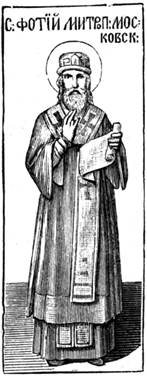
После кончины св. Киприана († 16 сент. 1406 г.) более двух лет прошло, пока прибыл в Россию новый митрополит2. В. кн. Василий Дмитриевич смиренно предоставил патриарху и собору дело о новом митрополите России3. Витовт, в. кн. Литовский, отправил в Константинополь Феодосия, епископа Полоцкого, с настойчивой просьбой как о посвящении его в митрополита, так и о том, чтобы он был отдельным Литовским митрополитом4. Давнее желание властителей юго-запада России иметь особого митрополита в этот раз обнаружилось в резком виде оттого, что Витовт и в. кн. Василий вели в это время войну между собой. П. Матфей не признал нужным на сей раз отступать от древнего обычая и отправил в звании митрополита всей России известного ему с лучшей стороны Фотия5.
After the death of St. Cyprian († 16 Sept. 1406 A.D.), more than two years passed before the new metropolitan arrived in Russia2. Grand Prince Basil Dimitrievich humbly left the matter of the new metropolitan of Russia to the patriarch and the council3. Vitovt, Grand Prince of Lithuania, sent Theodosius, Bishop of Polotsk, to Constantinople with an insistent request both for his consecration as metropolitan and that he should be a separate Metropolitan of Lithuania4. The long-standing desire of the rulers of southwestern Russia to have a separate metropolitan manifested itself this time in a sharp form because Vitovt and Grand Prince Basil were at that time waging war with each other. Patriarch Matthew did not deem it necessary on this occasion to depart from the ancient custom, and sent in the rank of Metropolitan of All Russia Photius, whom he knew from the better side5.
О жизни своей до отправления в Россию вот что пишет блаж. Фотий в предсмертном своём завещании: «с юного возраста желал я жить для добродетели; потому удержался я от приятностей брака, не прельстили меня почести мира и не желал я временной славы человеческой. Счастье земное представлял я в виде корабля, который, не видя того, что позади его, встречает впереди себя только препятствия и стеснение. Одного желал я, об одном заботился – представить бессмертную душу мою чистой Богу и Владыке моему. Как только расстался я с миром, под покровом благодати Божией устремлял я мысли и душу мою к светлым небесным селениям; меня просветили наставления святого старца Акакия, великого, равного древним великим отцам, которого уважали царь, патриарх и святители. Я ещё отроком был, когда поручил себя сему святому наставнику; душа моя ещё не знала тогда зла, и я с юных лет, под его руководством и наставлениями, напечатлевал в душе моей образ благочестия. Великий святитель любил меня и всегда беседовал со мной, как с любимым сыном, укреплял меня верой, хранил чистоту тела моего, наполнил ум мой полезными познаниями, наставил, как мне жить, как мне быть мёртвым для мира. И я желал жить не в связи с призрачными образами временной жизни, а стремился душой созерцать чистые, святые, светлые предметы той жизни. И вот встретился я бедный с неожиданным несчастием. По воле святого старца, великого между святителями, кир Акакия, прибыл я из Мореи в Константинополь, и державный император Мануил возложил на меня тяжесть, чтобы принял я великий степень святительский; Богу известно, что собор долго принуждал меня к тому, но не мог я избавиться; святейший патриарх кир Матфей с собором определил, и я отправился в святейшую митрополию Русскую»6. По этим словам видно, что не легко было бл. Фотию расставаться с Востоком. В утешение душе своей он взял близких к нему иером. Пахомия из Болгар, с которым жил он у блаж. Акакия7, и Патрикия. И в Морее, и в Константинополе он заставил любить себя. Из Константинополя поддерживал дружеские сношения с ним самый образованный муж своего времени, благочестивый учитель Константинопольской Церкви, иер. Иосиф Вриенний8. Патриарх в настольной грамоте одобрял Фотия, как весьма способного наставника в вере и благочестии9. Монемвасийская Церковь, где ревностно исполнял он благие распоряжения архипастыря её Акакия, поминала его в молитвах, как «возрастившего её своими трудами и украсившего своими приношениями»10. Так как в Морее много было и Славян во время блаж. Фотия11, то если не успел он коротко узнать язык их, в чём сознаётся сам12, по крайней мере дух и обычаи Славян были ему известны, что, конечно, не мало значило для служения его в Церкви Русской.
Concerning his life before his departure for Russia, the blessed Photius writes the following in his deathbed testament: "From my youthful age I desired to live for virtue; therefore I refrained from the pleasures of marriage, the honors of the world did not seduce me, and I did not desire the temporal glory of men. Earthly happiness I represented to myself as a ship which, not seeing what is behind it, encounters before it only obstacles and constraint. One thing I desired, for one thing I cared—to present my immortal soul pure to God and my Master. As soon as I parted from the world, under the shelter of the grace of God I directed my thoughts and my soul toward the luminous heavenly habitations; I was enlightened by the instructions of the holy elder Acacius, a great man, equal to the great fathers of old, whom the emperor, the patriarch, and the hierarchs respected. I was still a youth when I entrusted myself to this holy instructor; my soul did not yet know evil then, and from my youthful years, under his guidance and instructions, I impressed upon my soul the image of piety. The great hierarch loved me and always conversed with me as with a beloved son, strengthened me in faith, kept the purity of my body, filled my mind with useful knowledge, instructed me how to live, how to be dead to the world. And I desired to live not in connection with the illusory images of temporal life, but strove with my soul to contemplate the pure, holy, luminous objects of that life. And behold, I, the poor one, encountered an unexpected misfortune. By the will of the holy elder, great among hierarchs, kyr Acacius, I came from the Morea to Constantinople, and the sovereign emperor Manuel laid upon me the burden that I should receive the great hierarchal rank; God knows that the council long compelled me to this, but I could not escape; the most holy patriarch kyr Matthew with the council determined it, and I departed for the most holy metropolis of Russia"6. From these words it is evident that it was not easy for the blessed Photius to part from the East. For the consolation of his soul he took with him the hieromonk Pachomius of the Bulgarians, close to him, with whom he had lived at the home of the blessed Acacius7, and Patricius. Both in the Morea and in Constantinople he made himself beloved. From Constantinople, the most educated man of his time, the pious teacher of the Church of Constantinople, the priest Joseph Vriennius, maintained friendly relations with him8. The patriarch in his investiture charter approved Photius as a most capable instructor in faith and piety9. The Church of Monemvasia, where he zealously fulfilled the good ordinances of its archpastor Acacius, remembered him in prayers as the one "who had nurtured her with his labors and adorned her with his offerings"10. Since there were many Slavs in the Morea during the time of the blessed Photius11, even if he had not managed to become closely acquainted with their language, as he himself confesses12, at least the spirit and customs of the Slavs were known to him, which, of course, was no small matter for his service in the Russian Church.
Сент. 1-го 1409 г. бл. Фотий прибыл в Киев13. Так как на юго-западе жаловались на то, что не видят у себя митрополита14, то Фотий пробыл там более 7 месяцев, лично осматривая положение дел и решая жалобы на нарушения порядка. Особенно же пустынно-любивой душе его отрадно было видеть пещеры подвижников Божиих и здесь просить помощи новому служению своему у небожителей – пещерных. Наконец отправился он в Москву. Накануне Пасхи (22 апр. 1410 г.) и в. князь, и всё духовенство Московское далеко за городом встретили Фотия15. Много горького досталось видеть Фотию в Москве. После нашествия Едигея (в дек. 1408 г.) все города России от Рязани до Ростова и от Нижнего до Твери и Серпухова были опустошены; кремль Московский спасся, но все посады Москвы сгорели. В доме митрополии, где так долго не было хозяина, Фотий «не нашёл ничего»; даже недвижимые имения митрополии расхищены16. Фотий «начал восстановлять церковные имения и доходы митрополии и стал отыскивать, где что пропало, что взято с обидой князьями и боярами, что похищено другими корыстолюбивыми людьми, сёла, волости, доходы, пошлины, принадлежащие дому Пречистой Богородицы»17. Собрав возможно точные сведения о положении имуществ митрополии, он обратился с просьбой к в. князю о защите Церкви от своеволия людей. «Молю благочестие твоё, сын мой, писал он, утверди твоей грамотой принесённое в дар Церкви Божией, огради все её обычные права, укрепи её пошлины»18. Затем отправился он осмотреть другой кафедральный град у своей митрополии – Владимир. Соборный храм Владимирский незадолго перед тем был расписан лучшими иконописцами Даниилом и Андреем Рублёвыми19 и известен был богатством своим. Фотий поручил прибывшему с ним Патрикию охранять кафедральный собор и отправился в Святоозерскую пустынь, любимое местопребывание св. Киприана. Но едва выехал он из Владимира, как (3 июля 1410 г.), по наущению Нижегородского кн. Даниила Борисовича, царевич Талыча с толпами татар напал на Владимир. Грабители опустошали и жгли селения и храмы, – ворвались в соборный Владимирский храм, – оборвали св. иконы, требовали у Патрикия скрытых им сокровищ храма, – сосудов и казны. Патрикий, верный своему долгу, не выдавал. Его предали огню, содрали с него кожу, влачили по городу, привязав к лошадиному хвосту, и, замучив до смерти, не вынудили измены20. Талыча посылал татар – захватить самого святителя, но бл. Фотий удалился с Пахомием в глухие леса на озеро Синег, что ныне в Покровском уезде. Тихое, безмятежное место напоминало собой пустыню бл. Акакия. Увлечённый прелестью уединения, бл. Фотий устроил здесь храм Рождества Богоматери. Представляя себе волнения и труды служения пастырского, с сокрушением повторял: «думал ли я расстаться с любезным мне молчанием и плачем о грехах моих? И что стало со мной? После такого покоя сколько тревог, волнения, трудов!» Давно миновала опасность со стороны татар, прошло более месяца со времени удаления из Владимира, а пустынно-любивый пастырь не думал оставлять дорогого безмолвия. В. князь прислал к нему с просьбой возвратиться на кафедру. Надобно было ехать в Москву21. Государь встретил митрополита с радостью. После беседы о прошлых бедах в. князь передал пастырю приятное известие о желании императора сочетать дочь Московского князя и внуку Витовта с сыном своим. Святитель благословил этот союз, так как он обещал много полезного для св. Церкви22. Благожелательному святителю и молитвеннику, вслед затем, как совершился брак, прислан был из Константинополя саккос с шитыми изображениями молодой царственной четы, в. князя, его супруги и самого Фотия; по краям саккоса вышит золотом по-Гречески Символ веры, без прибавления слова: «истинного»23. Между тем Фотий продолжал преследовать дела об имуществах митрополии. Это возбудило против него сильные неудовольствия; даже в. князь не совсем доволен был этим делом, так как некоторые доходы с спорных земель шли в его казну; а люди услужливые старались клеветами усилить неудовольствие в. князя на митрополита. Злость и неправда осыпали бл. Фотия злоречием24. Пастырь, не дорожа ничем земным, заботливый только об исполнении долга своего, в письме к в. князю приводил примеры великих имп. Константина и Феодосия, и учреждение имп. Мануила об имуществах церковных. «Но ныне молчит всё древнее, говорил он далее, и много говорит новое. Меня порицают. Для меня не важно, хвалят ли меня, или бранят. Хула не печалит меня и для похвалы не сделаюсь я хуже. Бранят ли меня, хвалят ли, останусь тем же чем был: ибо я раб Божий, хотя и грешный. Тому, кто во всём предаёт себя воле Божией и всё творит для славы Божией, не на что более смотреть. Тебе же, сын мой, да будет ведомо, что ты человек и царствуешь с Богом над Его избранной паствой; потому должен подвизаться за Его паству и за Его правду против всякого восстания, даже до крови. Знай, сын мой, что ты оскорбляешь Церковь Божию, с насилием отнимая у неё не принадлежащее тебе. Говори же, сын мой, к Церкви Христовой и ко мне, отцу твоему: «согрешил я, отче, прости меня, отселе найдёшь во мне благопокорного сына во всём, чего требует закон; нарушенные права Церкви восстановлю, данное и утверждённое прародителями моими, но потом, в течении многих лет оставленное и обедневшее, возвращу». Вот в чём прошение моё к человеку Божию и великому князю всей России»25. При такой настойчивости пастырь, хотя и не скоро, хотя и с скорбями, успел возвратить кафедре всё принадлежащее ей, успел приобрести и кое-что вновь то покупкой, то от добровольных приношений26. Заботы о делах земных св. пастырь облегчал современными беседами с современными подвижниками благочестия, каковы были преп. Никон Радонежский, Сергий и Павел Обнорские, Дионисий Глушицкий, Ферапонт Можайский. По любви к иноческой жизни Фотий основал вблизи от себя Новинский монастырь на земле, принадлежащей митрополии27. По временам же удалялся он в подмосковное Голенищево, любимое св. Киприаном28. В 1413 г. Москва обрадована была явлением чудотворной иконы Богоматери на Колоче, и блаж. Фотий встречал св. икону торжественно в Москве29. Столь же утешительным событием было обращение к св. вере упорных язычников Мценской страны. Язычники отвергали все увещания, которые предлагались им проповедниками св. веры. «В. кн. Василий Дмитриевич послал войско, а митрополит Фотий священника». Упорные язычники внезапно ослепли. «Устрашённые силой оружия, а ещё более внезапной слепотой, послушались проповеди и жители как самого города, так и его окрестностей были крещены»30.
On September 1, 1409, the blessed Photius arrived in Kiev13. Since in the southwest they complained that they did not see a metropolitan among them14, Photius remained there for more than seven months, personally examining the state of affairs and resolving complaints about violations of order. But especially to his desert-loving soul it was a joy to see the caves of the ascetics of God and to ask help for his new service from the heavenly dwellers—those of the caves. At length he set out for Moscow. On the eve of Pascha (April 22, 1410), both the Grand Prince and all the clergy of Moscow met Photius far outside the city15. Much bitterness fell to Photius to see in Moscow. After the invasion of Edigei (in December 1408), all the cities of Russia, from Ryazan to Rostov and from Nizhny to Tver and Serpukhov, were laid waste; the Moscow Kremlin was saved, but all the posads of Moscow were burned. In the metropolitan’s house, where for so long there had been no master, Photius “found nothing”; even the immovable properties of the metropolis had been plundered16. Photius “began to restore the church lands and revenues of the metropolis and to search out where anything had been lost, what had been taken with injury by princes and boyars, what had been stolen by other covetous people—villages, volosts, revenues, dues belonging to the house of the Most Pure Theotokos”17. Having gathered as accurate information as possible about the state of the metropolis’s properties, he turned with a petition to the Grand Prince for the protection of the Church from the lawlessness of men. “I entreat your piety, my son,” he wrote, “confirm by your charter what has been offered as a gift to the Church of God, guard all her customary rights, strengthen her dues”18. Then he set out to inspect another cathedral city of his metropolis—Vladimir. The cathedral church of Vladimir had shortly before been painted by the finest iconographers, Daniel and Andrei Rublev19, and was known for its richness. Photius entrusted the cathedral to Patricius, who had come with him, and set out for the Svyatoozersk Hermitage, the beloved abode of St. Cyprian. But scarcely had he left Vladimir when (on July 3, 1410), at the instigation of Prince Daniel Borisovich of Nizhny Novgorod, Tsarevich Talycha with hordes of Tatars attacked Vladimir. The plunderers devastated and burned villages and churches—they burst into the cathedral church of Vladimir, stripped the holy icons, and demanded from Patricius the treasures of the church hidden by him—the vessels and treasury. Patricius, faithful to his duty, did not give them up. They consigned him to fire, flayed his skin, dragged him through the city tied to a horse’s tail, and, having tortured him to death, did not force betrayal from him20. Talycha sent Tatars to seize the hierarch himself, but the blessed Photius withdrew with Pachomius into the deep forests to Lake Sineg, which is now in Pokrovsky District. The quiet, serene place reminded him of the desert of the blessed Acacius. Carried away by the charm of solitude, the blessed Photius built there a church of the Nativity of the Theotokos. Imagining the disturbances and labors of pastoral service, he repeated with contrition: “Did I think to part with my beloved silence and weeping over my sins? And what has become of me? After such peace, how many alarms, disturbances, labors!” Long had the danger from the Tatars passed; more than a month had elapsed since his departure from Vladimir, but the desert-loving pastor did not think of leaving his precious silence. The Grand Prince sent to him with a request to return to his see. It was necessary to go to Moscow21. The sovereign met the metropolitan with joy. After a conversation about past calamities, the Grand Prince conveyed to the pastor the pleasant news of the emperor’s desire to unite the daughter of the Prince of Moscow and granddaughter of Vytautas with his son. The hierarch blessed this union, as it promised much that was beneficial for the holy Church22. To the benevolent hierarch and man of prayer, immediately after the marriage was accomplished, there was sent from Constantinople a sakkos with embroidered images of the young imperial couple, the Grand Prince, his spouse, and Photius himself; along the edges of the sakkos was embroidered in gold, in Greek, the Symbol of Faith, without the addition of the word “true”23. Meanwhile, Photius continued to pursue the matters of the metropolis’s properties. This aroused strong displeasure against him; even the Grand Prince was not entirely satisfied with this affair, since some revenues from the disputed lands went into his treasury; and obliging people tried by slanders to increase the Grand Prince’s displeasure with the metropolitan. Malice and falsehood showered the blessed Photius with evil speech24. The pastor, prizing nothing earthly, solicitous only for the fulfillment of his duty, in a letter to the Grand Prince cited the examples of the great emperors Constantine and Theodosius, and the ordinance of Emperor Manuel concerning church properties. “But now all that is ancient is silent,” he said further, “and much that is new speaks. I am blamed. It matters not to me whether I am praised or reviled. Blame does not grieve me, nor for praise shall I become worse. Whether I am reviled or praised, I shall remain what I was: for I am a servant of God, though a sinful one. He who wholly surrenders himself to the will of God and does all for the glory of God has nothing more to look to. But to you, my son, be it known that you are a man and reign with God over His chosen flock; therefore you must strive for His flock and for His truth against every uprising, even unto blood. Know, my son, that you offend the Church of God, with violence taking from her what does not belong to you. Say then, my son, to the Church of Christ and to me, your father: ‘I have sinned, father, forgive me; henceforth you shall find in me a well-obedient son in all that the law requires; the violated rights of the Church I will restore; what was given and confirmed by my forefathers, but afterward, in the course of many years, was neglected and impoverished, I will return.’ This is my petition to the man of God and Grand Prince of all Russia”25. With such persistence, the pastor, though not quickly, though with sorrows, succeeded in restoring to the see all that belonged to it, and succeeded in acquiring something new as well, partly by purchase, partly from voluntary offerings26. The holy pastor lightened his cares for earthly affairs by timely conversations with contemporary ascetics of piety, such as were the Venerable Nikon of Radonezh, Sergius and Paul of Obnora, Dionysius of Glushitsa, and Ferapont of Mozhaisk. Out of love for the monastic life, Photius founded near himself the Novinsky Monastery on land belonging to the metropolis27. At times he withdrew to Golenishchevo near Moscow, beloved by St. Cyprian28. In 1413, Moscow was rejoiced by the appearance of the wonderworking Icon of the Mother of God at Kolocha, and the blessed Photius solemnly met the holy icon in Moscow29. No less comforting an event was the conversion to the holy faith of the stubborn pagans of the Mtsensk region. The pagans rejected all the admonitions offered them by the preachers of the holy faith. “Grand Prince Vasily Dmitrievich sent an army, and Metropolitan Photius a priest.” The stubborn pagans suddenly became blind. “Frightened by the force of arms, and still more by sudden blindness, they heeded the preaching, and the inhabitants both of the city itself and of its environs were baptized”30.
Для блаж. святителя пришло время тяжкое. Витовт, созвав себе подвластных князей Русских, объявил, что надобно отказать Фотию в управлении Литовскими церквами и иметь особого митрополита. По общему решению послали просить у императора и патриарха особого митрополита. Император и п. Евфимий не нашли нужным исполнять желания Витовта, и Григорий Цамвлак, которого желали видеть митрополитом, возвратился ни с чем. Витовт созвал епископов и архимандритов своей области и предложил им своё желание и отказ Востока. Духовные, как говорит Витовт, согласились с тем, что «вследствие дальности митрополита от их епархий выходит много беспорядков и что они могут без патриарха посвятить митрополита». По летописям духовенство долго не соглашалось с желанием Витовта и указывало на правило церковное (4 Всел. Соб. пр. 12); но ему грозили бедствиями Церкви и силой вынудили согласие. Подтверждением верности летописного известия служит то, что после совещаний Витовт снова послал в Константинополь прежнюю просьбу свою. Отправляя послов в марте 1415 г., он требовал прислать ответ не позже 15 августа, прибавляя, что иначе будет избран и посвящён митрополит местными епископами. Когда из Константинополя не прислали ответа и в начале ноября, то 14 ноября возведён был на степень митрополита Литовской России Григорий31. Епископы Литовско-Русские обнародовали два послания, одно к Фотию, другое ко всей Русской Церкви. В первом они объявляют, что при первом посещении Киева Фотием, они заметили в нём действия, противные церковным правилам, а после услышали о поступке, подвергающем его извержению; но они не хотят наносить ему бесчестия и только отказываются от повиновения ему. Во втором они оправдывают поставление Григория в митрополита: указывают на невыгоды, какие терпела Киевская Церковь от пребывания митрополита в Москве, – на примеры поставления митр. Илариона и Климента, на правило Апостольское и наконец на незаконность произволов императора. – Витовт издал от себя грамоту, где высказывал резкие жалобы на императора, патриарха и Фотия, и говорил, что он действовал согласно с волей князей и только для чести Русской Церкви32. Блаж. Фотий желал отвратить собиравшееся несчастие личным объяснением с Витовтом, но обобранный на границе Литвы, принуждён был возвратиться в Москву. Пастырю России нельзя было не подать голоса своего о столь важном событии, каково разделение митрополии. Блаж. Фотий написал окружное послание. Но ни в этом, ни в других посланиях ни слова не говорит он о своей личности в защиту против обвинений, взведённых на него епископами и Витовтом. Черта замечательная и вполне приличная пастырю! Зато каждый сторонний в праве и должен сказать правду о блаж. Фотии. Витовт писал, будто взяты из Киева в Москву драгоценные утвари, «св. мощи, дски страдания Христова, скипетр Пресв. Богородицы, риза и сандалия Её». Если бы это была правда, то означенные священные предметы известны были бы Москве по летописям и описям Москвы, они конечно сохранились бы до позднего времени; а о них никто и никогда не знал в Москве. Епископы говорят о каких-то поступках Фотия в Киеве, о которых дошли до них сведения. Но по правилам Церкви надлежало потребовать объяснений от обвиняемого и потом уже составлять решение, при том по отношению к митрополиту то и другое надлежало совершать не иначе, как с разрешения патриарха. Без всякого сомнения оскорбительные отзывы Витовта и епископов о Фотии составились на основании слухов, распущенных дурными людьми, бежавшими из Москвы в Литву. «Дурные люди, говорит летопись, составили множество клевет на него; это те домашние его, которые бежали из Москвы к Черниговскому владыке, а оттуда в Литву к Витовту»33. В окружном послании своём Фотий защищает императора и патриарха, оправдывает единство митрополии древностью его, напоминает епископам Литвы их клятву не принимать иного митрополита, кроме присланного из Царьграда, и приводит одно за другим до 30 правил в подтверждение того, что приемлющий власть незаконно не истинный пастырь и посвящающие себе пастыря самовольно подвергаются отлучению34. Это послание, как и всё дело о Григории, рассмотрено было на соборе пастырей, собиравшихся в марте 1416 г. для посвящения Новгородского архипастыря35. В защиту блаж. Фотия и всей Московской Церкви в это время совершилось несколько чудес от мощей первого митрополита Москвы св. Петра – а Киев ограблен и предан был огню Татарами36. Блаж. Фотий писал в Псков: «не дивитесь случившемуся... Время поставляет слуг своих. Блюдите свою истинную православную веру и обычаи, удаляйте и от слуха вашего неправедные писания нарушающих св. правила. Если же кто из той мятежной страны, из Литвы, перейдёт к вам жить, принимайте их к себе, как православных христиан, удаляющихся неправды»37.
For the blessed Hierarch, a grievous time had come. Vytautas, having summoned the Russian princes subject to him, declared that it was necessary to deny Photius the governance of the Lithuanian churches and to have a separate metropolitan. By common decision, they sent to ask the emperor and the patriarch for a separate metropolitan. The emperor and Patriarch Euthymius did not find it necessary to fulfill Vytautas’s wishes, and Gregory Tsamblak, whom they wished to see as metropolitan, returned empty-handed. Vytautas summoned the bishops and archimandrites of his domain and proposed to them his desire and the refusal of the East. The clergy, as Vytautas says, agreed that “because of the distance of the metropolitan from their dioceses, many disorders arise, and that they could consecrate a metropolitan without the patriarch.” According to the chronicles, the clergy long did not agree with Vytautas’s desire and pointed to the church canon (4th Ecumenical Council, canon 12); but he threatened them with calamities for the Church and compelled their consent by force. A confirmation of the truth of the chronicle account is that after the consultations, Vytautas again sent his former request to Constantinople. Sending envoys in March 1415, he demanded a reply no later than August 15, adding that otherwise a metropolitan would be elected and consecrated by the local bishops. When no reply was sent from Constantinople even by the beginning of November, on November 14 Gregory was elevated to the rank of metropolitan of Lithuanian Rus’31. The bishops of Lithuanian Rus’ published two epistles, one to Photius and the other to the entire Russian Church. In the first, they declare that upon Photius’s first visit to Kiev, they observed in him actions contrary to church canons, and later they heard of an act subjecting him to deposition; but they do not wish to bring dishonor upon him and only refuse obedience to him. In the second, they justify the appointment of Gregory as metropolitan: they point to the disadvantages suffered by the Kievan Church from the metropolitan’s residence in Moscow, to the examples of the appointment of Metropolitans Hilarion and Clement, to the Apostolic canon, and finally to the illegality of the emperor’s arbitrary acts. Vytautas issued a charter of his own, in which he expressed sharp complaints against the emperor, the patriarch, and Photius, and said that he acted in accordance with the will of the princes and only for the honor of the Russian Church32. The blessed Photius wished to avert the impending misfortune by a personal explanation with Vytautas, but, robbed at the border of Lithuania, he was forced to return to Moscow. The Shepherd of Russia could not but raise his voice concerning so important an event as the division of the metropolis. The blessed Photius wrote an encyclical epistle. But neither in this nor in his other epistles does he say a single word about his own person in defense against the accusations brought against him by the bishops and Vytautas. A remarkable trait, and entirely fitting for a shepherd! For that reason, every outsider has the right and the duty to speak the truth about the blessed Photius. Vytautas wrote that precious vessels, “holy relics, the tablets of the Passion of Christ, the scepter of the Most Holy Theotokos, Her robe and sandal,” had supposedly been taken from Kiev to Moscow. If this were true, the said sacred objects would have been known in Moscow from chronicles and inventories of Moscow; they would certainly have been preserved until later times; but no one in Moscow ever knew of them. The bishops speak of certain acts of Photius in Kiev, of which reports had reached them. But according to the canons of the Church, explanations should have been demanded from the accused, and only then a decision rendered; moreover, with respect to a metropolitan, both were to be done only with the permission of the patriarch. Without any doubt, the offensive remarks of Vytautas and the bishops about Photius were based on rumors spread by evil men who had fled from Moscow to Lithuania. “Evil men,” says the chronicle, “composed many slanders against him; these were those of his household who fled from Moscow to the bishop of Chernigov, and from there to Lithuania, to Vytautas”33. In his encyclical epistle, Photius defends the emperor and the patriarch, justifies the unity of the metropolis by its antiquity, reminds the bishops of Lithuania of their oath not to accept any other metropolitan except one sent from Constantinople, and cites one after another up to thirty canons in confirmation that he who receives authority unlawfully is not a true shepherd, and that those who consecrate a shepherd for themselves arbitrarily are subject to excommunication34. This epistle, like the whole matter concerning Gregory, was examined at a council of pastors gathered in March 1416 for the consecration of the archpastor of Novgorod35. In defense of the blessed Photius and the entire Moscow Church, several miracles were at this time performed through the relics of the first metropolitan of Moscow, St. Peter—while Kiev was plundered and given over to fire by the Tatars36. The blessed Photius wrote to Pskov: “Marvel not at what has happened... Time sets its own servants in place. Guard your true Orthodox faith and customs; remove from your hearing even the unrighteous writings of those who violate the holy canons. If anyone from that rebellious land, from Lithuania, should come to live among you, receive them as Orthodox Christians who flee from unrighteousness”37.
Печальное время разделённой митрополии длилось не долго. Григорий умер в 1419 г.38. Свидригайло, выпущенный из темницы (в 1418 г.) друзьями православия и всегда готовый действовать в защиту православных, пугал собой Витовта и заставил его отложить в сторону планы Ягайлы о папизме39. Потому вслед за смертью Григория Витовт дал согласие на то, чтобы Фотий снова принял в своё заведование епархии юго-запада40. Блаж. Фотий отправился для обозрения юго-западной митрополии. В 1420 г. был он в Новгородке у Витовта и в Мстиславле у кн. Симеона Лугвеня, а в Слуцке крестил сына у кн. Александра. Затем из Киева в 1421 г. был во Львове; праздник Рождества Христова провёл во Владимире Волынском, в день Богоявления прибыл в Вильну41. Вероятно, в это время крестил он внука Мамаева кн. Олексу, родоначальника князей Глинских: Олекса крещён был митрополитом в Киеве42.
The sorrowful time of the divided metropolis did not last long. Gregory died in 141938. Švitrigaila, released from prison (in 1418) by friends of Orthodoxy and always ready to act in defense of the Orthodox, frightened Vytautas and compelled him to set aside Jogaila’s plans concerning papism39. Therefore, immediately after Gregory’s death, Vytautas gave his consent for Photius again to take the dioceses of the southwest under his care40. The blessed Photius set out to inspect the southwestern metropolis. In 1420, he was in Novgorodok with Vytautas and in Mstislavl with Prince Simeon Lugveny, and in Slutsk he baptized the son of Prince Alexander. Then, from Kiev, in 1421 he was in Lviv; he spent the feast of the Nativity of Christ in Vladimir-Volynsk, and on the day of Theophany arrived in Vilnius41. Probably at this time he baptized the grandson of Mamai, Prince Olexa, the founder of the Glinsky princes: Olexa was baptized by the metropolitan in Kiev42.
Скорби не преставали теснить попечительного пастыря. Три года сряду (1420–1422) не родился хлеб в России, и цена возвысилась на него до крайности43. С 1417 г. моровая язва переходила из одного места в другое, и с 1420 г. начала действовать с возрастающей силой в страшных видах44. Святитель рассылал послания и поучения, одно за другим, призывая к покаянию нераскаянных и утешая унывавших45. – В этих скорбях святитель утешен был помощью Богоматери: с принесением Чирской иконы Одигитрии во Псков во Пскове утихла (1420 г.) язва, и митрополит благословил праздновать во Пскове, июля в 16 д., Чирской иконе46. Спустя два года открыты были мощи пр. Сергия, – как торжество духа над смертью и тлением, и около того же времени прославился чудесами преп. Никита, Переяславский столпник.
Sorrows did not cease to oppress the solicitous shepherd. For three consecutive years (1420–1422), grain did not grow in Russia, and its price rose to an extreme43. From 1417, a plague passed from one place to another, and from 1420 it began to act with increasing force in terrible forms44. The Hierarch sent out epistles and homilies, one after another, calling the impenitent to repentance and comforting the despondent45. In these sorrows, the Hierarch was comforted by the help of the Mother of God: with the bringing of the Chira Icon of the Hodigitria to Pskov, the plague ceased in Pskov (1420), and the metropolitan blessed the celebration in Pskov on July 16 of the Chira Icon46. Two years later, the relics of the Venerable Sergius were uncovered—as a triumph of spirit over death and corruption—and about the same time, the Venerable Nikita, the Stylite of Pereslavl, was glorified by miracles.
Но вот и ещё заботы. В начале 1425 г. февраля 29 д. скончался в. кн. Василий Дмитриевич, оставив по себе сына Василия 10 лет и четырёх братьев. Три младшие брата ещё при жизни Василия Дмириевича признали племянника в. князем. Юрий Дмитриевич, князь Галичский и Звенигородский, не скрепил своим согласием духовного завещания, как сделали братья47. Лишь только скончался в. князь, в ту же ночь м. Фотий отправил своего боярина в Звенигород – звать Юрия в Москву для определения отношений его к престолу в. князя. Но Юрий не поехал и в Галиче начал собирать полки. Войска в. князя также двинулись. Принуждённый бежать, Юрий просил перемирия. В Москве видели необходимость – укрепить согласие в виде более прочном. И вот по общему голосу святитель Фотий отправился в Галич – убеждать Юрия к полной покорности. Он так спешил выполнить важное поручение, что, не смотря на все просьбы, не остался в Ярославе совершить литургию в день св. Предтечи (24 июня). Юрий принял блаж. Фотия с честью за городом, тогда как собранные из сёл толпы народа расположены были в виду по горе, чтоб испугать Фотия. Митрополит, поняв мысль Юрия, сказал: «сын князь Юрий! не видывал я никогда столько людей в овечьей шерсти». Святитель убеждал прекратить притязания на престол в. князя и заключить вечный мир. Юрий не согласился. Святитель оставил город, не преподав святительского благословения. И губительная болезнь, уже действовавшая в разных местах и в самой Москве, немедля начала свирепствовать в Галиче. Народ пришёл в ужас, и Юрий познал вразумление Божие. Он поспешил за удалившимся святителем и со слезами умолял возвратиться в город; он согласился на мир с тем, чтобы в договоре спор о престоле предоставлен был решению хана48. Так стараниями блаж. Фотия остановлены были кровавые междоусобия.
But behold, yet more cares. At the beginning of 1425, on February 29, Grand Prince Vasily Dmitrievich reposed, leaving behind him a son, Vasily, aged ten, and four brothers. The three younger brothers, during the lifetime of Vasily Dmitrievich, had recognized their nephew as Grand Prince. Yuri Dmitrievich, Prince of Galich and Zvenigorod, had not affixed his consent to the spiritual testament, as the brothers had done47. No sooner had the Grand Prince reposed than, that same night, Metropolitan Photius sent his boyar to Zvenigorod to summon Yuri to Moscow to determine his relations to the throne of the Grand Prince. But Yuri did not go, and began to gather troops in Galich. The troops of the Grand Prince also moved. Forced to flee, Yuri asked for a truce. In Moscow, they saw the necessity of strengthening concord in a more durable form. And so, by common voice, the Hierarch Photius set out for Galich to persuade Yuri to full submission. He hastened so much to fulfill this important commission that, despite all entreaties, he did not remain in Yaroslavl to celebrate the Divine Liturgy on the day of the holy Forerunner (June 24). Yuri received the blessed Photius with honor outside the city, while crowds of people gathered from the villages were stationed in view on the hill, to frighten Photius. The metropolitan, understanding Yuri’s intention, said: “My son, Prince Yuri! Never have I seen so many people in sheep’s wool.” The Hierarch urged him to cease his claims to the throne of the Grand Prince and to conclude a perpetual peace. Yuri did not agree. The Hierarch left the city without imparting his hierarchal blessing. And the deadly disease, already active in various places and in Moscow itself, immediately began to rage in Galich. The people were seized with terror, and Yuri recognized God’s admonition. He hastened after the departed Hierarch and with tears begged him to return to the city; he agreed to peace, on condition that the dispute over the throne be referred to the decision of the khan48. Thus, through the efforts of the blessed Photius, bloody internecine strife was halted.
Последние годы блаж. святителя особенно тяжелы были по скорбям от усилившейся страшной заразы в народе. Чадолюбивый архипастырь глубоко сочувствовал страданиям паствы своей. «Богу известно, писал он, как тяжелы были горести мои о разлучении с нами благочестивого вел. князя Василия Дмитриевича. Но затем наступило ещё большее бедствие и мне надобно было плакать и рыдать. А там и ещё впал я в более глубокую скорбь. Жалость ела меня и вместе с пророком исчезали очи мои от слёз о пастве Христовой, от необозримой смертности и опустошения жилищ христианских, постигшего за нашу нераскаянность перед Богом». Так исповедуется блаж. пастырь в предсмертном своём завещании. В посланиях и поучениях своих49 он выражал те же чувства сострадания и преподавал спасительные утешения. «Господь ищет спасения нашего, а не погибели, писал он во Псков, когда там стала утихать болезнь. Много раз поражая, бережёт Он корень, чтобы могли явиться плоды. Было и у нас такое же посещение Божие в Москве и окрестных городах, в Твери и пр. местах. Благодарим неисследимые пути человеколюбия Божия; не вдруг, не внезапно похищает смерть, но даёт больным христиански умереть, с чистым покаянием, елеосвящением и с причащением св. и животворящего тела Христова и животворящей крови Его. А многие отходят к Богу и в чине великого ангельского образа. Об отходящих с таким приготовлением уповаю я на человеколюбие Божие»50.
The final years of the blessed Hierarch were especially grievous due to the sorrows caused by the intensified terrible plague among the people. The loving archpastor deeply sympathized with the sufferings of his flock. “God knows,” he wrote, “how heavy were my griefs over the separation from us of the pious Grand Prince Vasilii Dmitrievich. But then an even greater calamity came, and I had to weep and lament. And then I fell into yet deeper sorrow. Compassion consumed me, and together with the prophet, my eyes grew dim from tears over the flock of Christ, over the boundless mortality and desolation of Christian dwellings that befell us because of our impenitence before God.” Thus the blessed pastor confesses in his dying testament. In his epistles and homilies49 he expressed the same feelings of compassion and offered saving consolations. “The Lord seeks our salvation, not our destruction,” he wrote to Pskov when the disease began to abate there. “Striking many times, He preserves the root, so that fruit may appear. There was also such a visitation of God among us in Moscow and the surrounding cities, in Tver and other places. We give thanks for the inscrutable ways of God’s love for mankind; death does not snatch away suddenly or unexpectedly, but grants the sick to die as Christians, with pure repentance, anointing with oil, and communion of the holy and life-giving body of Christ and His life-giving blood. And many depart to God even in the rank of the great angelic schema. Concerning those who depart with such preparation, I have hope in the love of God for mankind.”50
В 1430 году, когда исполнилось 20 лет служения архипастырского в Москве, пришёл вестник с приглашением блаж. Фотия в другой мир. – На Светлой неделе в четверток (20 апреля) после утрени Фотий лёг отдохнуть. Вдруг засиял необыкновенный свет. И святитель увидел перед собой светоносного мужа, с венцем на голове и с посохом в руке. В трепете Фотий спросил: «кто ты и как явился здесь, когда двери заперты?» «Я не из числа людей, отвечал посетитель, но ангел Божий и послан к тебе от Господа Вседержителя Саваофа. Господь повелел сказать тебе слово для утверждения твоего. Внимай себе и стаду твоему. Христос Бог даёт тебе седмицу на рассмотрение жизни твоей и на распоряжение о пастве». Услышав эти слова, святитель в трепете пал к ногам посланника Божия, но он стал невидим. Это видение и слава ангела так потрясли Фотия, что он долго лежал на полу, пока иноки, жившие с ним, не вошли и не положили его на постель. Он молчал и не раскрывал глаз. Потом пришёл в себя и рассказал видение51; святитель предоставил себя воле Божией и продолжал вверенное ему служение.
In the year 1430, when twenty years of his archpastoral service in Moscow had been fulfilled, a messenger came summoning the blessed Photius to the other world. – On Bright Week, on Thursday (April 20), after Matins, Photius lay down to rest. Suddenly an extraordinary light shone forth. And the Hierarch saw before him a radiant man, with a crown on his head and a staff in his hand. Trembling, Photius asked: “Who are you, and how have you appeared here when the doors are shut?” “I am not of the number of men,” answered the visitor, “but an angel of God, and I have been sent to you from the Lord Almighty, Sabaoth. The Lord has commanded me to speak a word to you for your confirmation. Attend to yourself and to your flock. Christ God gives you a week to examine your life and to make disposition concerning your flock.” Hearing these words, the Hierarch fell trembling at the feet of the messenger of God, but he became invisible. This vision and the glory of the angel so shook Photius that he lay long upon the floor, until the monks who lived with him entered and placed him on his bed. He was silent and did not open his eyes. Then he came to himself and related the vision51; the Hierarch submitted himself to the will of God and continued the ministry entrusted to him.
Спустя 5 месяцев после видения, первосвятитель вместе с великим князем был в Литве у Витовта, по особенным обстоятельствам. Ещё в 1429 году император Сигизмунд предложил на сейме Литовском возвести Витовта в сан короля. Тогда же он, побуждённый просьбами императора Иоанна Палеолога и явными беспорядками западной иерархии, объявил твёрдое намерение заняться делом соединения Церквей и его мысли клонились вовсе не в пользу Римской Церкви52. В августе 1430 г. надлежало быть съезду князей и государей в Литве и тогда же Витовту надлежало быть коронованным. Великий князь Московский отправился в Вильну и с ним отправился митр. Фотий, как связанный по званию своему с властителями Москвы и Литвы. Мечта престарелого Витовта не осуществилась. Поляки перехватили послов, посланных императором с короной. Витовт, сражённый скорбью, день ото дня близился к смерти, и она последовала 29 октября 1430 г. Фотий оставался в Вильне почти до самой смерти Витовта. Он виделся потом и с новым великим князем Литвы Свидригайлом, которого все Русские любили за благосклонные расположения его к православию53. Без сомнения, к этому-то времени, когда думали решить примирение, между Церквами восточной и западной, блаж. Фотий приготовил сочинения свои об исхождении Святого Духа и о различии Церкви восточной от западной54. – Ими он приготовлял как юного государя Московского, так и других своей паствы, к делу о соединении Церквей. И конечно наставлениям блаж. пастыря одолжена была Русская Церковь тем, что молодой великий князь с такой твёрдостью отверг унию Исидора.
Five months after the vision, the Primate, together with the Grand Prince, was in Lithuania with Vytautas, due to special circumstances. As early as 1429, the Emperor Sigismund had proposed at the Lithuanian Diet to raise Vytautas to the rank of king. At that same time, prompted by the requests of the Emperor John Palaiologos and the evident disorders of the Western hierarchy, he declared his firm intention to take up the matter of the union of the Churches, and his thoughts inclined in no way in favor of the Roman Church52. In August 1430, a congress of princes and sovereigns was to be held in Lithuania, and at that time Vytautas was to be crowned. The Grand Prince of Moscow set out for Vilna, and with him went Metropolitan Photius, as one bound by his office to the rulers of Moscow and Lithuania. The dream of the aged Vytautas was not realized. The Poles intercepted the envoys sent by the emperor with the crown. Vytautas, stricken with grief, drew nearer to death day by day, and it came on October 29, 1430. Photius remained in Vilna almost until Vytautas’s death. He later met also with the new Grand Prince of Lithuania, Švitrigaila, whom all Russians loved for his favorable disposition toward Orthodoxy53. Without doubt, it was to this time, when reconciliation between the Eastern and Western Churches was being considered, that the blessed Photius prepared his writings on the procession of the Holy Spirit and on the difference between the Eastern and Western Churches54. – With these he prepared both the young sovereign of Moscow and the others of his flock for the matter of the union of the Churches. And surely the Russian Church was indebted to the instructions of the blessed pastor for the fact that the young Grand Prince rejected the Union of Isidore with such firmness.
Наконец срок, назначенный блаж. Фотию для приготовления к вечности, скончался. Он мирно почил 1 июля 1431 г.55. Мощи его обретены в 1471 г.56.
At last the term appointed to the blessed Photius for preparation for eternity came to an end. He peacefully reposed on July 1, 143155. His relics were uncovered in 147156.
Святитель оставил после себя множество поучений и посланий57. Особенную важность для Церкви некоторые из них получили впоследствии. Таково – послание его в Псков от 12 августа 1419 г. Здесь говорил он Псковичам: «относительно того, что пишете мне об аллилуии на славах, – так говори: «слава Отцу и Сыну и Святому Духу и ныне и присно и во веки веков, аминь: аллилуия, аллилуия, аллилуия, слава Тебе, Боже» иещё 2 раза»58. На это послание указывал ещё в XV веке сочинитель послания «к Афанасию, ктитору великия лавры св. Николы о трегубой аллилуии». «Надлежало бы тебе, отче, послушать, как Самого Христа, кир митрополита Киевского, Московского и всей России, Фотия, что писал он нам в дом Святой Троицы во Псков, прислал грамоту, запечатанную печатью с воплощением Сына Божия в чистой Деве Марии, Богородице, каковая грамота и поныне лежит у Святой Троицы; в ней так написано: аллилуия, аллилуия, аллилуия, слава Тебе, Боже»59. Замечательно, что и в Греческой триоди святителя Фотия ἀλληλούϊα написано трижды60. В одном из трёх посланий против стригольников61 блаж. Фотий писал: «если правила св. Апостолов и Вселенские св. соборы запрещают, даже с угрозой проклятия, священническому чину составлять отдельные собрания: тем более возбраняют они мирянину осмеливаться на что-нибудь подобное. Мирянин не облечён священным саном; он – овца словесная – обязан повиноваться церковному порядку... Пусть говорят хульное на епископа или на священника: не следует отлучаться от общения с ним, пока не произведён будет суд и тот не будет лишён звания». Обращаясь к священникам, говорит: «вразумляйте их со всем вниманием; если не обратятся, отлучайте их от православной веры, чтобы не были они между вами, как плевелы между пшеницей». В другом послании писал: «слышу, что у вас некоторые, нерадя о своём христианском имени, ни во что ставят великое Божие священство и иночество... Христианская вера утвердилась учением и властью Апостолов; та же власть, по заповеди Христовой, даётся святительскому и священническому чину. Священству Божию вручено право прощать грехи. Если те не обратятся, не принимайте от них приношений и отсекайте их, как гнилые члены, от здравого тела – Церкви Христовой». Он же писал: «как небо отстоит от земли, так наш сан выше всякого мирского, так Христово священнодействуемое таинство выше всего в мире. Христос Сам священнодействовал, дав нам тело Своё и кровь Свою в пищу и питие, и завещал через Апостолов творить то же самое. Превыше всего рука священническая: она касается Божественного угля. Приняв человека смрадного и мёртвого, силой благодати Христос сотворил его яко Бога, поручил нам дело, которое принадлежит единому Богу – прощать грехи человеческие».
The Hierarch left behind many homilies and epistles57. Some of them later acquired particular importance for the Church. Such is his epistle to Pskov of August 12, 1419. Here he said to the Pskovites: “Concerning what you write to me about the Alleluia on the ‘Glories’ – say thus: ‘Glory to the Father and to the Son and to the Holy Spirit, both now and ever and unto the ages of ages, Amen: Alleluia, Alleluia, Alleluia, glory to Thee, O God’ and twice more”58. This epistle was still pointed to in the fifteenth century by the author of the epistle “To Athanasius, Ktetor of the Great Lavra of St. Nicholas, concerning the Thrice-Sung Alleluia.” “It would behoove you, father, to listen, as to Christ Himself, to Kyrios Metropolitan of Kiev, Moscow, and All Russia, Photius, who wrote to us at the house of the Holy Trinity in Pskov, sending a letter sealed with a seal bearing the incarnation of the Son of God in the pure Virgin Mary, the Theotokos, which letter lies to this day at the Holy Trinity; in it is written thus: Alleluia, Alleluia, Alleluia, glory to Thee, O God”59. It is noteworthy that in the Greek Triodion of Hierarch Photius, ἀλληλούϊα is written three times60. In one of the three epistles against the Strigolniki61, the blessed Photius wrote: “If the canons of the holy Apostles and the holy Ecumenical Councils forbid, even under threat of anathema, the priestly order to hold separate assemblies, then much more do they forbid a layman to dare anything of the sort. A layman is not invested with holy orders; he is a rational sheep – obliged to obey the church order... Let them speak blasphemy against a bishop or a priest: one should not separate from communion with him until a trial has been conducted and he has been deprived of his rank.” Addressing the priests, he says: “Admonish them with all attention; if they do not turn back, cut them off from the Orthodox faith, that they may not be among you as tares among the wheat.” In another epistle he wrote: “I hear that among you some, neglecting their Christian name, hold the great priesthood and monasticism of God as nothing... The Christian faith was established by the teaching and authority of the Apostles; the same authority, by the commandment of Christ, is given to the hierarchical and priestly order. To the priesthood of God is entrusted the right to forgive sins. If those do not turn back, accept no offerings from them and cut them off, as rotten members, from the healthy body – the Church of Christ.” He also wrote: “As heaven is distant from earth, so is our rank above every worldly rank; so is the mystery of Christ, celebrated by the priesthood, above everything in the world. Christ Himself celebrated the mystery, giving us His body and His blood for food and drink, and commanded through the Apostles to do the same. Above all is the hand of the priest: it touches the divine coal. Having taken a man, foul and dead, by the power of grace Christ made him as God, entrusting to us a work that belongs to God alone – to forgive the sins of men.”
«Соборне преосвящ. кир Матвеем патриархом рукоположен бых святитель в Киевскую митрополию на всю Русь», говорит Фотий в духовном завещании степенной книги. По настольной грамоте (ист. а. № 254), он посвящён марта 11-го 1393 г. Антонием. Надобно положить, что в завещании Фотия разумеется соборное определение об отправлении Фотия в Россию, в звании митрополита всей России. Это вполне согласно и с ходом дела. В России знали только время этого собора, важного по последствиям и потому писали (Ник. л. 5, 17. Русск. времен.1:222): «в лето 6917 сент. 1 (1408) поставлен бысть Фотий митрополит п. Матфеем». Степен. кн. 2, 28: «по соборному избранию посгавлену бывшу Фотию – на митрополию Киевскую и всея Русии – в л. 6917».
“By a council of the most reverend Kyrios Matthew, patriarch, I was consecrated Hierarch to the Kiev Metropolis for all Rus’,” says Photius in his spiritual testament in the Book of Degrees. According to the chart of installation (Historical Acts, No. 254), he was consecrated on March 11, 1393, by Anthony. It must be supposed that in the testament Photius refers to the conciliar decree concerning the sending of Photius to Russia in the rank of Metropolitan of All Russia. This is fully consistent with the course of events. In Russia they knew only the time of this council, important for its consequences, and therefore wrote (Nikon Chronicle 5, 17. Russian Chronographer 1:222): “In the year 6917, September 1 (1408), Photius was appointed Metropolitan by Patriarch Matthew.” Book of Degrees 2, 28: “By conciliar election Photius was appointed to the Metropolis of Kiev and All Russia – in the year 6917.”
Собр. л. 6.144, 145. В Никон. л. 5, 100–108 и в степен. кн. 2, 40–47. Завещание Фотия в другом переводе и с некоторыми сокращениями и прибавлениями.
Collection of Chronicles 6.144, 145. In the Nikon Chronicle 5, 100–108 and in the Book of Degrees 2, 40–47. Photius’s testament in another translation and with some abbreviations and additions.
Г. Шевырев со всей уверенностью пишет, что этот Пахомий есть известный жизнеописатель Серб Пахомий Логофег (Ист. Рус. слов. III, предисл., стр. 18). Но: а) писатель Серб и Логофет, а пришедший с Фотием – Болгарин; б) современная заметка говорит о Пахомии писателе: «иже прииде от Сербския земли к вел. кн. Василию Васильевичу» (Царского № 20, стр. 51); в) вовсе невероятно, чтобы Пахомий, прибывший в Россию в 1408 г. иеромонахом и след. не моложе 30 лет, мог странствовать по России в 1461 г. См. обзор лит. § 99.
Mr. Shevyrev writes with full confidence that this Pachomius is the well-known hagiographer, the Serb Pachomius Logothetes (History of Russian Literature III, preface, p. 18). But: a) the writer is a Serb and Logothetes, while the one who came with Photius is a Bulgarian; b) a contemporary note says of the writer Pachomius: “who came from the Serbian land to Grand Prince Vasilii Vasilievich” (Tsarskii No. 20, p. 51); c) it is entirely improbable that Pachomius, who arrived in Russia in 1408 as a hieromonk and therefore no younger than 30, could have traveled about Russia in 1461. See Survey of Literature § 99.
«Не зазрите смирению моему, яко не искусну ми сущу писанию вашему и языку». Дополн. к ист. ак. 1, 323. Степ. кн. 2, 29: «м. Фотия Русскому языку еще не навыкшу».
“Do not despise my humility, for I am unskilled in your writing and language.” Suppl. to Hist. Acts 1, 323. Book of Degrees 2, 29: “Metropolitan Photius had not yet learned the Russian language.”
Витовт: «и мы не хотели было того приняти Фотия митрополита и он клялся паки зде у нас быти и церковь строити». Ак. зап. Р. 1, 36.
Vytautas: “And we did not wish to accept that Metropolitan Photius, and he swore again to be here with us and to build the church.” Acts of Western Russia 1, 36.
Поучение в Волокол. ркп. № 411 и в прибавл. 1852 г., стр. 423–424. Что касается до грамоты (а. и. 1. № 255), с которою будто бы обращался Фотий к совести похитителей митрополичьей казны, то она относится совсем к другому делу – к похищению частного имущества, положенного в храм для сбережения.
Instruction in the Volokolamsk manuscript No. 411 and in the Supplement of 1852, pp. 423–424. As for the charter (Hist. Acts 1. No. 255), with which Photius supposedly appealed to the conscience of the plunderers of the metropolitan treasury, it pertains to an entirely different matter—to the theft of private property placed in the church for safekeeping.
Степ. кн. 2, 30–33. Собр. л. V, 256. VI, 139. Никон. л. V, 37–39. В последней показан 1411 год ошибочно: во всех прочих – 1410 г.
Book of Degrees 2, 30–33. Collection of Chronicles V, 256. VI, 139. Nikon Chronicle V, 37–39. In the latter, the year 1411 is given erroneously; in all others—1410.
Никон. л. V, 39. 40. Степ. кн. 2, 31. 1, 531. Ист. иер. 6, 70. 71. Где, впрочем, ошибочно озеро Синег принимается за одно с Святым озером и с пустыней, где живал м. Киприан.
Nikon Chronicle V, 39. 40. Book of Degrees 2, 31. 1, 531. History of the Hierarchy 6, 70. 71. Where, however, Lake Sineg is mistakenly taken to be the same as the Holy Lake and the hermitage where Metropolitan Cyprian once lived.
Никон. л. 5, 41, прод. Нест. 233. Собр. л. 6, 139. Степ. кн. 2, 33. 1, 531. 532. Русск. времен. 1, 222, о замужестве Анны Ducas, hist. Bysant. р. 53. 54. Par. 1649 г.
Nikon Chronicle 5, 41, Continuation of Nestor 233. Collection of Chronicles 6, 139. Book of Degrees 2, 33. 1, 531. 532. Russian Chronograph 1, 222, concerning the marriage of Anna Ducas, hist. Bysant. p. 53. 54. Paris 1649.
Никон. л. 5, 33. 107. Собр. л. 6, 145. Степей, кн. 2, 30. В. князь примирился с требованиями Фотия: это видно из того, что клеветники вынуждены были бежать в Литву. Никон. л. 5, 53. 54.
Nikon Chronicle 5, 33. 107. Collection of Chronicles 6, 145. Book of Degrees 2, 30. The Grand Prince reconciled himself to Photius’s demands: this is evident from the fact that the slanderers were forced to flee to Lithuania. Nikon Chronicle 5, 53. 54.
Никон. л. 5, 48–51. Русск. времени. 1, 235–237. Пролог 9 июля. Степ. кн. 1, 532. 566–568. Современная заметка на ркп.: «а сего лета (1413) от Можайского града за 10 верст, в селе Андрея князя Дмитриевича, от иконы Пресвятые Владычицы нашея Богородица явилося жалованья и прощения людем много, слепым, хромым, расслабленным, глухим и иным: не несть мощно сказати или исчести их; ум человеческий не может изрещи, колико человеколюбье Божие и какова милость на людех». Изв. акад. VI, 304.
Nikon Chronicle 5, 48–51. Russian Chronograph 1, 235–237. Prologue, July 9. Book of Degrees 1, 532. 566–568. A contemporary note in a manuscript: “And in this summer (1413), ten versts from the town of Mozhaisk, in the village of Prince Andrei Dmitrievich, from the icon of the Most Holy Lady our Theotokos, there appeared much grace and healing to the people: to the blind, the lame, the paralyzed, the deaf, and others; it is not possible to tell or count them; the human mind cannot express how great is the love for mankind of God and what mercy is upon the people.” Proceedings of the Academy VI, 304.
Никон. л. 6, 53, 54. Собр. л. VII, 87. Степей, кн. 2, 36. Здесь поименованы двое: Савва Аврамием и торговавший в Литве Фома Лазарев.
Nikon Chronicle 6, 53, 54. Collection of Chronicles VII, 87. Book of Degrees 2, 36. Here two are named: Sabbas, surnamed Abram, and Thomas Lazarev, who traded in Lithuania.
Собр. л. 4, 116. Где сокращённо предложено окружное послание Фотия и где говорится о соборе «по случаю» собравшемся, осудил Григория. Фотий упоминает о своём окружном послании в послании от 6 сентября 1416 г. (ак. ист. 1. № 20).
Collection of Chronicles 4, 116. Where Photius’s encyclical is presented in abbreviated form, and where it speaks of a council that gathered “on the occasion,” which condemned Gregory. Photius mentions his encyclical in an epistle of September 6, 1416 (Hist. Acts 1. No. 20).
Никон. л. 5, 73. Собр. л. VIII, 90. В конце одного Евангелия замечено: «лета 6928 (1420) инд. 13 преставися митрополит Российский Грегорие Цамблак». Заметка поклонника святой горы, стр. 251. Киев, 1864.
Nikon Chronicle 5, 73. Collection of Chronicles VIII, 90. At the end of one Gospel it is noted: “In the year 6928 (1420), indiction 13, the Metropolitan of Russia, Gregory Tsamblak, reposed.” Note of a Pilgrim of the Holy Mountain, p. 251. Kiev, 1864.
«Паки Христос миром Свою церковь украси и смиревие мое в Церковь Свою введе, советыванием благороднаго, славнаго вел. кн. Александра (Витовта)». Дополн. к ист. ак. 1, 338. Иеродиакон Зосима конечно воспользовался этим миром и полгода прожил в Киеве, прежде чем отправился в Иерусалим. «От Русския страны и от стольна града Москвы, пишет он, из великия лавры преп. игумена Сергия, потщахся постигнути славный град Киев, иже бе мати всем градом Русским. И достигнув благодатию Б. града Киева, пребыхом в лавре, еже зовется Киевская печера, у гроба преп. Антония и игумена Феодосия пол-лета. И тамо возмыслихом и восхотехом видети св. места, идеже Христос Своими стопами походи».
“Again Christ adorned His Church with peace and brought my humility into His Church, through the counsel of the noble, glorious Grand Prince Alexander (Vytautas).” Suppl. to Hist. Acts 1, 338. Hierodeacon Zosima, of course, took advantage of this peace and lived in Kiev for half a year before setting out for Jerusalem. “From the Russian land and from the capital city of Moscow,” he writes, “from the great Lavra of the Venerable Abbot Sergius, I hastened to reach the glorious city of Kiev, which is the mother of all Russian cities. And having reached, by the grace of God, the city of Kiev, I remained in the Lavra called the Kiev Caves, at the tomb of the Venerable Anthony and Abbot Theodosius, for half a year. And there I conceived and desired to see the holy places where Christ walked with His own feet.”
Родослов. кн. во Времени. X, 157. 158. 195. «По Божию изволению похоте Алекса креститися и прислал к Киеву, и митрополит Киевский крестил его в крестьянскую веру и дал ему во святом крещении имя князь Александр». Здесь же сказано, что отец Олексы кн. Мансур – Кията основал города Глинск, Глинецу и Полтеву (Полтаву), и сын после отца владел этими городами.
Genealogical Book in The Chronologist X, 157. 158. 195. “By God’s will, Aleksa desired to be baptized and sent to Kiev, and the Metropolitan of Kiev baptized him into the Christian faith and gave him in holy baptism the name Prince Alexander.” Here it is also said that Aleksa’s father, Prince Mansur-Kiyat, founded the towns of Glinsk, Glinets and Poltava, and his son ruled these towns after his father.
Никон. л. 5, 82–85. Собр. л. VIII, 92. 93. Степей, кн. 2, 4. 5. 37. 38. В грамотах (собр. грам. 1. № 43. 44). Кн. Юрий признавал племянника своего вел. князем.
Nikon Chronicle 5, 82–85. Collection of Chronicles VIII, 92. 93. Book of Degrees 2, 4. 5. 37. 38. In the charters (Collection of State Charters 1. No. 43. 44). Prince Yuri acknowledged his nephew as Grand Prince.
Собр. л. 4, 206. 5, 264. 6, 144. Никон. л. 5, 97. 98. Степен. кн. 2, 47. Только в степен. кн. полагается кончина бл. Фотия 2 июля; во всех прочих – 1 июля.
Collection of Chronicles 4, 206. 5, 264. 6, 144. Nikon Chronicle 5, 97. 98. Book of Degrees 2, 47. Only in the Book of Degrees is the repose of Blessed Photius placed on July 2; in all others—July 1.
Ркп. Синод. биб. XVI в. № 466. л. 260 и Макарьевской минее м. авг. л. 815. Сочинитель послания говорит, что Константинополь взят Турками «на сих летех». Царьград взят в 1453 г., след. послание писано около 1470 г.
Manuscript of the Synodal Library, 16th c., No. 466. l. 260 and Macarius’s Menaion for August, l. 815. The author of the epistle says that Constantinople was taken by the Turks “in these years.” Constantinople was taken in 1453; consequently, the epistle was written around 1470.