Состояние славы Воскресшего Христа окончилось на земле вознесением Его на небо. Христу Архиерею грядущих благ (Евр.9:11), принёсшему Себяединою в жертву за грехи (Евр. VII, 27; IX. 26), надлежало войти не в рукотворенная*святая,* но в самое небо, да явится лицу Божию о нас (Евр.9:24). О своём вознесении Господь предсказывал и в Ветхом Завете через Своих пророков (Псал. 46:6), и во время Своей земной жизни предрек: восхожу к Отцу Моему и Отцу вашему, и Богу Моему Богу вашему (Ин.20:17). По воскресении своём Спаситель в продолжении четыредесяти дней являлся Своим ученикам и Апостолам, уверял их в истине Своего воскресения и приготовлял к Своему отшествию на небо (1Кор.15:5–8). Апостол Пётр говорит: мы с Ним ядохом и пихом, по воскресении Его от мертвых (Деян.10:41).Пред ними же Он постави Себе жива по страдании Своем, во мнозех истинных знамениих денми четыредесятми являлся им, и глаголя яже о Царствии Божии (Деян.1:3). Говорил им о Своей Божественной власти на небеси и на земли, о Божественном избрании их проповедать Евангелие всем народам, крестить их во имя Отца и Сына и Святого Духа, и учить блюсти вся, елика Господь заповеда; обещался быть с Своей Церковью во вся дни до скончания века (Мф.28:18–20).
The state of glory of the risen Christ ended on earth with His ascension into heaven. Christ, the High Priest of good things to come (Heb. 9:11), Who offered Himself once as a sacrifice for sins (Heb. 7:27; 9:26), was to enter not into the holy places made with hands,but into heaven itself, now to appear in the presence of God for us (Heb. 9:24). The Lord foretold His ascension both in the Old Testament through His prophets (Ps. 46:6), and during His earthly life He predicted: I ascend unto My Father and your Father, and to My God and your God (Jn. 20:17). After His resurrection, the Savior appeared to His disciples and Apostles for forty days, assuring them of the truth of His resurrection and preparing them for His departure into heaven (1 Cor. 15:5–8). The Apostle Peter says: we did eat and drink with Him after He rose from the dead (Acts 10:41). To whom also He showed Himself alive after His passion by many infallible proofs, being seen of them forty days, and speaking of the things pertaining to the kingdom of God (Acts 1:3). He spoke to them of His divine authority in heaven and in earth, of their divine election to preach the Gospel to all nations, to baptize them in the name of the Father and of the Son and of the Holy Spirit, and to teach them to observe all things whatsoever the Lord had commanded; He promised to be with His Church always, even unto the end of the world (Mt. 28:18–20).
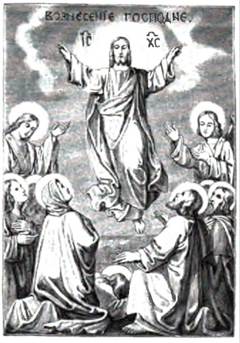
В последний день Своего видимого пребывания на земле Господь, явившись Своим ученикам и Апостолам, заповедал им не отлучаться из Иерусалима, но ждать обещанного сошествия Духа Святого. Ведя их на гору Елеонскую, покрытую маслинами, отстоящую от Иерусалима на субботний путь (Деян.1:12), Господь обещал им чудодейственную силу: прииметесилу, нашедшу Святому Духу на вы, и будете Ми свидетели даже до последних земли (Деян.1:8). По глаголании же к ученикам и Апостолам, Господь воздвиг руце Свои и благослови их. И бысть егда благословляиие их, отступи от них, и возношашеся на небо. И тии поклонишасяЕму (Лк.24:50–52), и смотрели на небо, во время восхождения Его, и облакподъят Его от очию их. И се мужа два стаста пред ними в одеждах белых и сказали: Сей Иисус, вознесыйся от вас на небо, такожде приидет, имже образом видесте Его идуща на небо (Деян.1:9–11). Апостолы возвратились в Иерусалим с радостью великой и до сошествия на них Снятого Духа пребывали всегда во храме, хваля и благословляя Бога. Так, совершив искупление мира, Сын Божий в 40 день после славного Своего воскресения паки восшел на небо к Богу Отцу Своим человечеством и седе одесную Бога (Мк.16:19).
On the last day of His visible sojourn on earth, the Lord, appearing to His disciples and Apostles, commanded them not to depart from Jerusalem, but to wait for the promised descent of the Holy Spirit. Leading them to the Mount of Olives, covered with olive trees, which is from Jerusalem a sabbath day’s journey (Acts 1:12), the Lord promised them miraculous power: ye shall receive power, after that the Holy Ghost is come upon you: and ye shall be witnesses unto Me both unto the uttermost part of the earth (Acts 1:8). And after He had spoken to the disciples and Apostles, He lifted up His hands, and blessed them. And it came to pass, while He blessed them, He was parted from them, and carried up into heaven. And they worshippedHim (Lk. 24:50–52), and looked steadfastly toward heaven as He went up, and a cloud received Him out of their sight. And, behold, two men stood by them in white apparel and said: This same Jesus, which is taken up from you into heaven, shall so come in like manner as ye have seen Him go into heaven (Acts 1:9–11). The Apostles returned to Jerusalem with great joy, and until the descent of the Holy Spirit upon them they were continually in the temple, praising and blessing God. Thus, having accomplished the redemption of the world, the Son of God, on the 40th day after His glorious resurrection, ascended again into heaven to God the Father in His humanity, and sat on the right hand of God (Mk. 16:19).
В воспоминание славного вознесения Господня издревле установлен Церковью праздник, ежегодно совершаемый в четверток шестой по Пасхе недели. Этот праздник есть Апостольский; об нём упоминается в постановлениях Апостольских и говорится: «по прошествии 40 дней от первого воскресного дня празднуйте Вознесение Господне». Об Апостольском происхождении праздника Вознесения Господня свидетельствует также блаженный Августин в письме своём к Януарию, где говорит оп: «что храним мы не по писанию, а преданию, и что сохраняется во всём мире, то предано или от самих Апостолов, или от соборов. По их спасительному установлению сохраняются в Церкви правила и постановления, напр. касательно ежегодного празднования страданий, воскресения и вознесения Господа на небо и сошествия Святого Духа.
In commemoration of the glorious Ascension of the Lord, the Church from ancient times established a feast, celebrated annually on the Thursday of the sixth week after Pascha. This feast is Apostolic; it is mentioned in the Apostolic Constitutions, where it is said: "After the passing of 40 days from the first Sunday, celebrate the Ascension of the Lord." The Apostolic origin of the feast of the Ascension of the Lord is also attested by Blessed Augustine in his letter to Januarius, where he says: "What we keep not by writing but by tradition, and what is preserved throughout the whole world, is handed down either by the Apostles themselves or by councils. By their salutary institution, rules and ordinances are preserved in the Church, for example, concerning the annual celebration of the sufferings, resurrection, and ascension of the Lord into heaven, and the descent of the Holy Spirit."
В день Новозаветной Пятидесятницы, в 50 день после исшествия Своего из гроба, и в 10 по вознесении своём Господь, восседший одесную Бога Отца, ниспослал Пресвятого Духа на всех Своих учеников и Апостолов.
On the day of the New Testament Pentecost, on the 50th day after His going forth from the tomb, and on the 10th after His ascension, the Lord, Who sat down at the right hand of God the Father, sent down the Most Holy Spirit upon all His disciples and Apostles.
Церковь и св. отцы, созерцая событие чудесного сошествия Святого Духа, на основании Писания поучительно изъясняют это событие. Дух Святый называется Утешителем (Ин.14:16), потому что Он способствует нам в немощах наших: Сам ходатайствует о нас воздыхании неизглаголанными, (Рим.8:26). «Дух Святый, говорит Григорий Богослов, действовал, во-первых, в ангельских и небесных силах; их совершенство, озарение и неподвижность ко злу – от Святого Духа. Потом действовал в отцах и пророках. После сего действовал в учениках Христовых, и в них троекратно, по мере их удобоприемлемости, и в три различные времена: прежде страдания Христова – неявно (Мф.10:1,20), по воскресении Его – явственнее (Ин.22:22), и в день Пятидесятницы – существенно».
The Church and the holy fathers, contemplating the event of the miraculous descent of the Holy Spirit, on the basis of Scripture, instructively explain this event. The Holy Spirit is called the Comforter (Jn. 14:16), because He helpeth our infirmities: the Spirit itself maketh intercession for us with groanings which cannot be uttered (Rom. 8:26). "The Holy Spirit," says Gregory the Theologian, "acted first in the angelic and heavenly powers; their perfection, illumination, and immovability toward evil are from the Holy Spirit. Then He acted in the fathers and prophets. After this He acted in the disciples of Christ, and in them three times, according to the measure of their receptivity, and at three different times: before the passion of Christ—secretly (Mt. 10:1, 20), after His resurrection—more clearly (Jn. 20:22), and on the day of Pentecost—substantially."
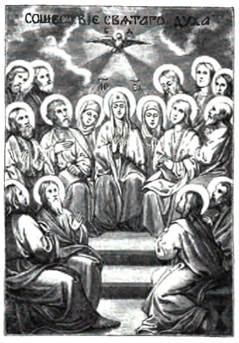
Сошествие Святого Духа совершилось в великий праздник, чтобы сие чудесное событие сделалось известно многим, – в Пятидесятницу, когда древле и закон Богооткровенный дан был народу Божию; ибо в 50 же день подобало излиться и Духу благодати, потому что Иисус Христос пожрен был во дни Ветхозаконной Пасхи. Там гора Синай, здесь горница; там огнь, здесь огненные языки. Вместо мрака и громов Синайских здесь с небесе шум, яко носиму дыханию бурну, дабы явно было, что один и тот же есть Дух Святый, тогда и ныне законополагающий, освящающий и совершающий. Сошествие Духа Святого было в видеязыков в ознаменование живого и действенного слова, которым Апостолы имели научить и обратить ко Христу вся языки. В виде огненных язык, в знак крещения Духом Святым и огнём, как предсказал Предтеча (Мф.3:11), и освящения учеников Христовых. По гласу Церкви сошествие Святого Духа есть решительное очищение грехов. А св. Григорий Двоеслов беседует: «когда извне явились огненные языки, тогда внутри начали пламенеть сердца искреннею любовью к Богу». В виде языков огненных и разделяемых – по причине разных дарований Святого Духа. Как древле Бог, смесив языки, разделил и рассеял говоривших одним языком; так ныне разделил языки и послал Апостолов во весь мир, дабы рассеянных людей по всей вселенной собрать во едину св. Церковь. В виде языков седших – в означение почивания Святого Духа во святых. Древле «языки смесились за дерзость столпотворения: ныне же языки разделились ради славы Боговедения». Надобно было, говорит Григорий Нисский, чтобы народы, рассеянные при вещественном столпотворении, снова соединились при духовном строительстве Церкви». В виде язык, седших на головы Апостолов, в освящение главного и владычествующего члена, и самого ума, силой которого говорит язык, или как бы – во образ рукоположения пастырей Церкви. Благословенный Дух, почив на Апостолах в виде огненных языков, утвердил в памяти их спасительные для человеков изречения Христа.
The descent of the Holy Spirit took place on a great feast, so that this miraculous event might become known to many—on Pentecost, when of old the divinely revealed law was given to the people of God; for on the 50th day it was fitting that the Spirit of grace should also be poured out, because Jesus Christ was sacrificed during the days of the Old Testament Pascha. There, Mount Sinai; here, the upper room. There, fire; here, tongues of fire. Instead of the darkness and thunders of Sinai, here suddenly there came a sound from heaven as of a rushing mighty wind, so that it might be evident that it is the same Holy Spirit, then and now legislating, sanctifying, and perfecting. The descent of the Holy Spirit was in the form of tongues as a sign of the living and effective word by which the Apostles were to teach and convert all nations to Christ. In the form of fiery tongues, as a sign of baptism with the Holy Ghost and with fire, as the Forerunner foretold (Mt. 3:11), and of the sanctification of Christ’s disciples. According to the voice of the Church, the descent of the Holy Spirit is the decisive cleansing of sins. And St. Gregory the Dialogist discourses: "When fiery tongues appeared outwardly, then hearts began to burn inwardly with sincere love for God." In the form of tongues of fire and cloven—because of the diverse gifts of the Holy Spirit. As of old God, confounding tongues, divided and scattered those who spoke one language; so now He divided tongues and sent the Apostles into all the world, that scattered people throughout the whole universe might be gathered into one holy Church. In the form of tongues resting—as a sign of the Holy Spirit’s resting upon the saints. Of old, "tongues were confounded for the audacity of the tower-building; now tongues are divided for the glory of the knowledge of God." It was necessary, says Gregory of Nyssa, "that the peoples scattered at the material tower-building should be reunited at the spiritual building of the Church." In the form of tongues resting upon the heads of the Apostles, for the sanctification of the chief and ruling member, and of the mind itself, by the power of which the tongue speaks, or as it were—in the image of the ordination of the shepherds of the Church. The blessed Spirit, resting upon the Apostles in the form of fiery tongues, confirmed in their memory the saving utterances of Christ for men.
Сошествие Святого Духа на Апостолов есть совершение нового вечного завета с человеками, о котором предсказал прор. Иеремия: се дние грядут, глаголет Господь, и совершу на дом Израилев и на дом Иудов завет новый. Сей завет, его же завещаю, дая законы Моя в мысли их и на сердцах их напишу их (Иер.31:31–34; Евр.8:8–12). Дух Святый, сшедший на Апостолов,Дух истины (Ин.16:13), Дух премудрости и откровения (Еф.1:17; Лк.11:20) начертал вместо Синайского новый Сионский закон, о котором предсказал прор. Исаия (2, 3), не на скрижалях каменных, а на скрижалях сердца плотяных (2Кор.3:3). Место закона Синайского заступила благодать Святого Духа, законополагающего, подающего силы к исполнению закона и верующим изрекающего оправдание не по делам, а по благодати (Рим.5:16).
The descent of the Holy Spirit upon the Apostles is the fulfillment of the new eternal covenant with men, of which the prophet Jeremiah foretold: Behold, the days come, saith the Lord, that I will make a new covenant with the house of Israel and with the house of Judah. This is the covenant that I will make, I will put My laws into their mind, and write them in their hearts (Jer. 31:31–34; Heb. 8:8–12). The Holy Spirit, Who descended upon the Apostles, the Spirit of truth (Jn. 16:13), the Spirit of wisdom and revelation (Eph. 1:17; Lk. 11:20), inscribed instead of the Sinaitic law a new Sion law, of which the prophet Isaiah foretold (2:3), not in tables of stone, but in fleshy tables of the heart (2 Cor. 3:3). The place of the Sinaitic law was taken by the grace of the Holy Spirit, Who legislates, gives power to fulfill the law, and pronounces justification to believers not by works, but by grace (Rom. 5:16).
«Святую Пятидесятницу прияхом от Еврейских книг, говорит синаксарь на этот праздник. Якоже бо они Пятьдесятницу празднуют, почитающе седьмое число и зане по Пасце пятьдесят дний прешедше, закон прияша: тако и мы по Пасце пятьдесят дний празднующе Всесвятаго Духа приемлем, законополагающаго и наставляющаго на всякую истину, и угодная Богу повелевающаго». «Иже древле, поёт Церковь, закон начертавый Моисею, Нового Завета величия и закон благодати излагает ясно, в Апостольских сердцах написав». Бл. Иероним пишет: «законоположение Синайское и Сионское было в 50 день по Пасхе. На Синае от землетрясения колебалась гора: на Сионе сотрясся дом Апостолов. Там среди пламени и сверкающих молний раздавались громы и глас бурный: здесь с огненным видом языков бысть*шум с небесе, яко носиму дыханию бурну.* Там звук трубный возгремел слова закона: здесь труба Евангельская возгласила устами Апостолов». Таким образом день Пятидесятницы, бывший древле ежегодным воспоминанием дарования закона Божия на горе Синае, и для христиан сделался ежегодным праздником торжественного открытия данной св. Апостолам власти учить, священнодействовать и управлять. В 50 день по воскресении Христа Господа Апостолы приняли Божественную силу Св. Духа и для всей вселенной соделались свидетелями Иисуса Христа (Деян.1:8).
"We have received Holy Pentecost from the Hebrew books," says the synaxarion for this feast. "For as they celebrate Pentecost, honoring the number seven and because after Pascha fifty days having passed, they received the law: so we, after Pascha celebrating fifty days, receive the All-Holy Spirit, Who legislates and guides into all truth, and commands what is pleasing to God." "He Who of old," sings the Church, "inscribed the law for Moses, sets forth clearly the greatness of the New Covenant and the law of grace, writing in the hearts of the Apostles." Blessed Jerome writes: "The lawgiving of Sinai and of Sion was on the 50th day after Pascha. On Sinai the mountain shook from the earthquake; on Sion the house of the Apostles was shaken. There, amid flame and flashing lightning, thunders and a stormy voice resounded; here, with the fiery appearance of tongues, there came a sound from heaven as of a rushing mighty wind. There, the sound of the trumpet thundered the words of the law; here, the trumpet of the Gospel proclaimed through the mouths of the Apostles." Thus the day of Pentecost, which of old was the annual commemoration of the giving of the law of God on Mount Sinai, also became for Christians an annual feast of the solemn revelation of the authority given to the holy Apostles to teach, to perform the sacred rites, and to govern. On the 50th day after the resurrection of Christ the Lord, the Apostles received the divine power of the Holy Spirit and became witnesses of Jesus Christ to the whole universe (Acts 1:8).
Новоначавшаяся Церковь христианская прежде сошествия Св. Духа уже предпразднствовала свою Пятидесятницу, ожидая предсказанного пророками и Спасителем сошествия Св. Духа, – при непрестанной и единодушной молитве (Лк.24:53; Деян.1:14). В самый день Пятидесятницы беша*вси Апостоли, единодушно вкупе: и исполнишася вси Духа Свята и начаша глаголати иными языки величия Божия* (Деян.2:1,4,11). По сошествии Св. Духа на Апостолов сила Божия к увеличению торжества Пятидесятницы тотчас открылась в могущественной проповеди Ап. Петра. Событие чудесного излияния даров Св. Духа на Апостолов в праздник Пятидесятницы привлекло к ним множество народа: тогда Ап. Пётр краткой Богодухновенной проповедью обратил к воскресшему Иисусу Христу 3,000 человек.
The newly-begun Christian Church, before the descent of the Holy Spirit, already pre-festively celebrated its Pentecost, awaiting the descent of the Holy Spirit foretold by the prophets and the Savior, in unceasing and unanimous prayer (Lk. 24:53; Acts 1:14). On the very day of Pentecost, they were all the Apostles with one accord in one place: and they were all filled with the Holy Ghost, and began to speak with other tongues the wonderful works of God (Acts 2:1, 4, 11). After the descent of the Holy Spirit upon the Apostles, the power of God for the increase of the solemnity of Pentecost was immediately revealed in the mighty preaching of the Apostle Peter. The event of the miraculous outpouring of the gifts of the Holy Spirit upon the Apostles on the feast of Pentecost drew a multitude of people to them: then the Apostle Peter, by a brief God-inspired sermon, converted 3,000 men to the risen Jesus Christ.
По сошествии Св. Духа, Апостолы ежегодно начали праздновать день Пятидесятницы и заповедали воспоминать его всем христианам ради сошествия Св. Духа.
After the descent of the Holy Spirit, the Apostles began to celebrate the day of Pentecost annually and commanded all Christians to commemorate it for the sake of the descent of the Holy Spirit.
В Апостольской истории действительно находим указания на празднование дня Пятидесятницы, собственно христианское, во времена Апостолов. Ап. Павел, положив намерение посетить Церковь Коринфскую, писал в послании к ней о сём намерении своём; но прибавлял, что он пробудет ещё в Ефесе до Пятидесятницы (1Кор.16:8), а выше, говоря об исправлении некоторых беспорядков в сей Церкви, сделал ясный намёк на празднование Пасхи, но не Иудейской, а христианской (1Кор.5:6–8). Если Пасха здесь разумеется христианская, и Пасха сия есть праздник; то, конечно, таков же и день Пятидесятницы. Для чего Апостолу, столько ревновавшему о свободе христиан от закона Иудейского, дожидаться в Ефесе праздника Иудейского? Вскоре после сего мы видим того же Апостола поспешающим на праздник Пятидесятницы в Иерусалим (Деян.20:16). Можно ли думать, что Апостол имел в виду при сём исполнить только требование закона Моисеева, который повелевал каждому Израильтянину являться в сей день к месту общественного Богослужения? Не справедливее ли допустить, что в том и другом случае разумеется день Пятидесятницы, который Апостол и в Ефесе и в Иерусалиме желал провести, как праздник христианский? Св. Епифаний и бл. Августин утверждают, что св. Ап. Павел и Евангелист Лука в указанных местах разумеют христианский, а не Иудейский праздник.
In the Apostolic history we indeed find indications of the celebration of the day of Pentecost, in a specifically Christian sense, in the times of the Apostles. The Apostle Paul, having formed the intention to visit the Church of Corinth, wrote to them of this intention; but he added that he would remain yet in Ephesus until Pentecost (1 Cor. 16:8), and earlier, speaking of the correction of certain disorders in that Church, he made a clear allusion to the celebration of Pascha, not the Jewish, but the Christian (1 Cor. 5:6–8). If Pascha is here understood as Christian, and this Pascha is a feast, then, of course, so also is the day of Pentecost. Why should the Apostle, who was so zealous for the freedom of Christians from the Jewish law, wait in Ephesus for a Jewish feast? Soon after this we see the same Apostle hastening to Jerusalem for the feast of Pentecost (Acts 20:16). Can it be thought that the Apostle had in view here only the fulfillment of the requirement of the law of Moses, which commanded every Israelite to appear on this day at the place of public worship? Is it not more just to admit that in both cases the day of Pentecost is meant, which the Apostle, both in Ephesus and in Jerusalem, wished to spend as a Christian feast? St. Epiphanius and Blessed Augustine affirm that St. the Apostle Paul and the Evangelist Luke, in the passages cited, mean the Christian, and not the Jewish, feast.
В постановлениях Апостольских есть прямая заповедь праздновать Пятидесятницу: «спустя десять дней по Вознесении бывает пятидесятый день от первого дня Господня (Пасхи); сей день да будет великим праздником. Ибо в третий час сего дня Господь Иисус послал дар Святого Духа». В другом месте Апостольских постановлений в числе дней, в которые рабы должны быть свободны от работ, после Пасхи и Вознесения упоминается и Пятидесятница: «в Пятидесятницу рабы должны быть свободны от работ ради пришествия Св. Духа, данного уверовавшим во Христа». Тертуллиан, употребляя слово Пятидесятница и в значении всего пятидесятидневного времени, в другом месте выражается так: «в день Господень мы считаем неприличным поститься, или преклонять колена: той же свободой пользуемся от дня Пасхи до Пятидесятницы (а die Paschae in Pentecostem usque)». Здесь под именем Пятидесятницы, очевидно, разумеется один определённый день, именно – сошествие Святого Духа, заключение всего пятидесятидневного времени, начинающегося Пасхой. Ориген, приводя возражения язычников против праздников христианских, упоминает вместе с Пасхой и о Пятидесятнице. Собор Эльвирский (около 306 г.) в отвращение беспорядков в Испанской Церкви, между прочим, постановил праздновать Пятидесятницу, на основании Писания, не в сороковой, а в пятидесятый день после Пасхи. В IV веке у Евсевия Кесарийского, у св. Василия Великого, Григория Богослова, Григория Нисского, Епифания и Златоуста, также у бл. Августина и др. часто встречается упоминание о празднике сошествия Св. Духа под именем Пятидесятницы.
In the Apostolic Constitutions there is a direct commandment to celebrate Pentecost: "Ten days after the Ascension comes the fiftieth day from the first day of the Lord (Pascha); let this day be a great feast. For on the third hour of this day the Lord Jesus sent the gift of the Holy Spirit." In another place of the Apostolic Constitutions, among the days on which slaves should be free from work, after Pascha and the Ascension, Pentecost is also mentioned: "On Pentecost slaves should be free from work for the sake of the coming of the Holy Spirit, given to those who believe in Christ." Tertullian, using the word Pentecost also in the sense of the entire fifty-day period, in another place expresses himself thus: "On the Lord's day we consider it improper to fast, or to bend the knee: we enjoy the same freedom from the day of Pascha until Pentecost (a die Paschae in Pentecostem usque)." Here by the name Pentecost, obviously, is meant one definite day, namely—the descent of the Holy Spirit, the conclusion of the entire fifty-day period beginning with Pascha. Origen, citing the objections of pagans against Christian feasts, mentions together with Pascha also Pentecost. The Council of Elvira (about 306 A.D.), to avert disorders in the Spanish Church, among other things decreed that Pentecost should be celebrated, on the basis of Scripture, not on the fortieth, but on the fiftieth day after Pascha. In the 4th century, in Eusebius of Caesarea, in St. Basil the Great, Gregory the Theologian, Gregory of Nyssa, Epiphanius and Chrysostom, also in Blessed Augustine and others, mention is often made of the feast of the descent of the Holy Spirit under the name of Pentecost.
Есть предание, что на месте сошествия Св. Духа на Апостолов устроен был первый христианский храм, который в IV веке возобновлён был св. Еленой.
There is a tradition that on the site of the descent of the Holy Spirit upon the Apostles, the first Christian church was built, which in the 4th century was restored by St. Helen.
Основание праздников в 50-й день по Пасхе Пресв. Троице указано в Писании, и начало этого празднования относится к началу христианства. Сам Иисус Христос, предрекая Апостолам о радостнейшем событии новозаветной Пятидесятницы, исполнение его приписал Троице Единосущной и Нераздельной; о сошествии Св. Духа Господь сказал:егдаже приидет Утешитель, Его же Аз послю вам от Отца, Дух истины, Иже от Отца исходит, Той свидетельствует о Мне (Ин.15:26). Притом явление Св. Духа, сходящего от Бога Отца и посланного Богом Сыном, распространило в мире благодатное познание о таинстве Св. Троицы (Ин.16:8–15,14:26). Посему со времени сошествия Св. Духа на Апостолов постоянно воздаётся в Церкви Православной, в день Пятидесятницы, богопоклонение и прославление С. Троице. Ап. Пётр в проповеди слова Божия к многочисленному народу, в день Пятидесятницы, объясняя явление огненных языков Апостолам, между прочим говорил:Сего Иисуса воскреси Бог, ему же вси мы есмы свидетели. Десницею убо Божиею вознесеся, и обетование Святого Духа прием от Отца, излия сие, еже вы ныне видите и слышите (Деян.2:32–33). В самый же день Св. Троицы 3,000 из слушателей Ап. Петра приняли слово Божие и крестились во имя Отца и Сына и Св. Духа (Деян.2:41). Так и сотворение и искупление и освящение мира совершилось любовью Бога Отца, пославшего Спасителя на землю, благодатью Сына Божия, искупившего человеков, и наитием Св. Духа, освящающего верующих (Деян.2:17). Посему день Пятидесятницы есть торжество и в славу Бога Отца, от Которого Дух Святый исходит, и Бога Сына, Который послал Духа Св. от Отца, и в славу Духа Святого, видимо сшедшего на св. Апостолов и учеников Христовых.
The foundation of the feasts on the 50th day after Pascha to the Most Holy Trinity is indicated in Scripture, and the beginning of this celebration dates back to the beginning of Christianity. Jesus Christ Himself, foretelling to the Apostles of the most joyful event of the New Testament Pentecost, ascribed its fulfillment to the Consubstantial and Undivided Trinity; concerning the descent of the Holy Spirit the Lord said: But when the Comforter is come, whom I will send unto you from the Father, even the Spirit of truth, which proceedeth from the Father, He shall testify of Me (Jn. 15:26). Moreover, the manifestation of the Holy Spirit, descending from God the Father and sent by God the Son, spread in the world the grace-filled knowledge of the mystery of the Holy Trinity (Jn. 16:8–15, 14:26). Therefore, from the time of the descent of the Holy Spirit upon the Apostles, divine worship and glorification of the Holy Trinity is constantly offered in the Orthodox Church on the day of Pentecost. The Apostle Peter, in his preaching of the word of God to the numerous people on the day of Pentecost, explaining the appearance of fiery tongues to the Apostles, said among other things: This Jesus hath God raised up, whereof we all are witnesses. Therefore being by the right hand of God exalted, and having received of the Father the promise of the Holy Ghost, He hath shed forth this, which ye now see and hear (Acts 2:32–33). And on the very day of the Holy Trinity, 3,000 of the hearers of the Apostle Peter received the word of God and were baptized in the name of the Father and of the Son and of the Holy Spirit (Acts 2:41). Thus the creation and redemption and sanctification of the world were accomplished by the love of God the Father, who sent the Savior to earth, by the grace of the Son of God, who redeemed men, and by the coming of the Holy Spirit, who sanctifies believers (Acts 2:17). Therefore the day of Pentecost is a solemnity also to the glory of God the Father, from whom the Holy Spirit proceeds, and of God the Son, who sent the Holy Spirit from the Father, and to the glory of the Holy Spirit, who visibly descended upon the holy Apostles and disciples of Christ.
Понедельник Пятидесятницы называется Духов день. Название дня произошло от древних свят. отцов в их словах в день Пятидесятницы. У св. Григория Богослова он называется днём Духа, у бл. Августина – праздником пришествия Св. Духа. Духов день есть продолжение праздника Пятидесятницы и установлен для того, чтобы после поклонения Пресвятой Троице воздать особое поклонение Св. Духу, видимо сшедшему на св. Апостолов и Своим сошествием призвавшему верующих к прославлению и Пресвятой Троицы.
The Monday of Pentecost is called Spirit Day. The name of the day originated from the ancient holy fathers in their homilies on the day of Pentecost. In St. Gregory the Theologian it is called the day of the Spirit, in Blessed Augustine—the feast of the coming of the Holy Spirit. Spirit Day is a continuation of the feast of Pentecost and was established so that, after the worship of the Most Holy Trinity, special worship might be offered to the Holy Spirit, who visibly descended upon the holy Apostles and by His descent called believers to the glorification also of the Most Holy Trinity.
«Вожделенный день воссиял нам, братия, говорит бл. Августин, и святая Церковь блистает ныне во взорах и пламенеет в сердцах верующих. Мы празднуем тот день, в котором Господь Иисус Христос, прославленный по воскресении вознесением, послал Св. Духа. Ибысть*внезапу с небесе шум, яко носиму дыханию бурну, и явишася им разделены язы́цы, яко огненни, седе же на едином коемждо их, и начата глаголати иными языки, яко же Дух даяше им провещавати* (Деян.2:2–4). Ибо как после потопа гордое нечестие людей создало высокую башню против воли Господа, и род человеческий тогда разделён на разные языки, чтобы каждый народ, говоря своим языком, не был понимаем другими: так смиренное благочестие верных различие языков обратило к единству Церкви, да рассеянное раздором соберёт любовь, да расточенные члены рода человеческого, как члены одного тела, соединятся под единой главой Христом, и огнём любви сплавятся в единое святое тело. Итак, сего дара Святого Духа совсем чужды те, кои ненавидят благодати мира, не сохраняют общения единства. Пусть они даже собираются ныне торжественно, пусть слышат и чтения, повествующие, как Дух Святый обещан и послан; они слышат сие в осуждение себе, а не на пользу. Ибо что пользы им принимать то слухом, что отвергают они сердцем, и праздновать тот день, коего свет им ненавистен? Но вы, братия мои, члены Христова тела, отрасли единства, сыны мира, вы проводите день сей радостно, празднуйте благонадёжно. В вас исполняется то, что предъизображалось в те дни, когда пришёл Святый Дух. Как тогда каждый приявший Святого Духа говорил всеми языками, так и ныне единство во всех народах говорит всеми языками. Пребывая в сём единстве, вы имеете Святого Духа, ибо никаким расколом не отделяетесь от Церкви Христовой, говорящей всеми языками».
"The longed-for day has shone upon us, brethren," says Blessed Augustine, "and the holy Church now shines in the eyes and burns in the hearts of believers. We celebrate that day on which the Lord Jesus Christ, glorified after the resurrection by the ascension, sent the Holy Spirit. And suddenly there came a sound from heaven as of a rushing mighty wind, and there appeared unto them cloven tongues like as of fire, and it sat upon each of them, and they began to speak with other tongues, as the Spirit gave them utterance (Acts 2:2–4). For as after the flood the proud impiety of men built a high tower against the will of the Lord, and the human race was then divided into different languages, so that each people, speaking its own tongue, might not be understood by others: so the humble piety of the faithful turned the diversity of languages to the unity of the Church, that love might gather what discord had scattered, that the scattered members of the human race, as members of one body, might be united under the one head Christ, and by the fire of love be fused into one holy body. Therefore, those who hate the grace of peace and do not preserve the communion of unity are utterly strangers to this gift of the Holy Spirit. Let them even gather now solemnly, let them hear the readings which tell how the Holy Spirit was promised and sent; they hear this to their condemnation, not to their profit. For what profit is it to them to receive with their hearing what they reject with their heart, and to celebrate that day whose light they hate? But you, my brethren, members of Christ's body, branches of unity, sons of peace, do you spend this day joyfully, celebrate it with good hope. In you is fulfilled that which was prefigured in those days when the Holy Spirit came. As then each one who received the Holy Spirit spoke in all tongues, so now unity in all peoples speaks in all tongues. Abiding in this unity, you have the Holy Spirit, for by no schism do you separate yourselves from the Church of Christ, which speaks in all tongues."
«Итак получили и мы Св. Духа, если любим Церковь, если связуемся любовью, если имеем имя кафолическое и веру. Верим, братия, что столько кто любит Церковь Христову, сколько имеет Св. Духа. Апостол предпочёл любовь языкам человеческим и ангельским, предпочёл чудесам веры, предпочёл знанию и пророчеству, предпочёл даже великому делу милосердия, – раздаянию всего имения бедным, наконец предпочёл её самому страданию тела (1Кор.13:1 и д). Имея любовь, будешь иметь всё. А что любовь принадлежит Св. Духу, внимай о том слову Апостола: любы Божия излияся в сердца наша Духом Святым, данным в нас (Рим.5:5). Почему же Сего Духа, Коим излита любовь Божия в сердца наши, Господь благоволил даровать по своём воскресении? Что сим означил? То, чтобы любовь наша пламенела в воскресении нашем, чтоб удаляла нас от любви мира, чтобы вся текла к Богу. Ибо здесь рождаемся и умираем, здешнего да не любим; любовью да преселяемся, и вселяемся горе, тою любовью, которую имеем к Богу. Господь не блага сего мира обещал нам, когда сказал: веруяй*в Мя да приидет и да пиет, и реки от чрева его истекут воды живы*. Обещал жизнь вечную, где нет места никакой болезни, никакому смущению, откуда не прейдём, где не умрём, где не оплакивают покойников и не ожидают наследников. Вот что обещал Он любящим; а потому и благоволил даровать Духа только по своём прославлении, да явит в своём теле жизнь, которой теперь не имеем, а ожидаем в воскресении».
"Thus we also have received the Holy Spirit, if we love the Church, if we are bound together by love, if we have the catholic name and faith. We believe, brethren, that as much as anyone loves the Church of Christ, so much does he have the Holy Spirit. The Apostle preferred love to human and angelic tongues, preferred it to the miracles of faith, preferred it to knowledge and prophecy, preferred it even to the great work of mercy—giving away all one's possessions to the poor, and finally preferred it to the very suffering of the body (1 Cor. 13:1 and following). Having love, you will have everything. And that love belongs to the Holy Spirit—attend to the word of the Apostle: the love of God has been poured out in our hearts by the Holy Spirit who is given to us (Rom. 5:5). Why then did the Lord deign to grant this Spirit, by Whom the love of God is poured out in our hearts, only after His resurrection? What did He signify by this? That our love might flame in our resurrection, that it might draw us away from love of the world, that it might all flow toward God. For here we are born and die; let us not love the things of this world; let us be translated by love, and dwell above, by that love which we have for God. The Lord did not promise us the good things of this world when He said: he who believes in Me, let him come and drink, and rivers of living water will flow from his belly. He promised eternal life, where there is no place for any sickness, any disturbance, from which we shall not depart, where we shall not die, where the dead are not mourned and heirs are not awaited. Behold what He promised to those who love Him; and therefore He deigned to grant the Spirit only after His glorification, that He might manifest in His body the life which we do not now have, but await in the resurrection."