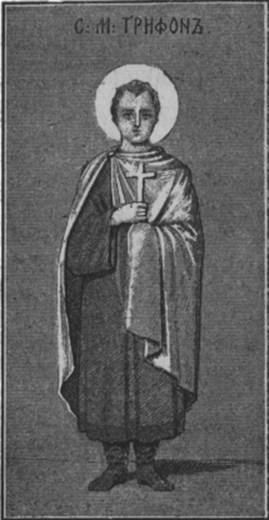
В гонение императора Декия (250–251 г.) правитель восточных провинций, Акилин, живший в Никее, послал во Фригию воинов разыскать Трифона, жителя селения Кампсад, близ города Апамеи (ныне Мунданьи), как распространителя христианской веры, ослушника царской воли и презрителя богов. Трифон не скрывался, сам отдал себя в руки посланных и, связанный, приведен в Никею. Правитель сидел на своем судейском месте, окруженный чиновниками, воинами и слугами, и сказал: «пусть представленный скажет нам имя свое, отечество, судьбу свою и веру свою».
During the persecution of the Emperor Decius (A.D. 250–251), the governor of the eastern provinces, Aquilinus, who lived in Nicaea, sent soldiers into Phrygia to seek out Tryphon, a resident of the village of Kampsada, near the city of Apamea (now Mudanya), as a spreader of the Christian faith, a disobeyer of the imperial will, and a despiser of the gods. Tryphon did not hide, but gave himself into the hands of those sent, and, bound, was brought to Nicaea. The governor sat on his judgment seat, surrounded by officials, soldiers, and servants, and said: "Let the one presented tell us his name, his fatherland, his fate, and his faith."
«Имя мне Трифон», отвечал узник; «отечество – селение Кампсада, близ города Апамеи. Судьбы у нас нет, и ей ничего не приписываем; ибо веруем, что все устрояется Божиим промыслом и смотрением, а не случаем, или судьбою, или влиянием звезд. По состоянию я свободный римский гражданин и служу только Христу, Который есть и начало и конец веры моей».
"My name is Tryphon," answered the prisoner; "my fatherland is the village of Kampsada, near the city of Apamea. We have no fate, and ascribe nothing to it; for we believe that all things are ordered by God's providence and oversight, and not by chance, or fate, or the influence of the stars. By station I am a free Roman citizen and serve only Christ, Who is both the beginning and the end of my faith."
«Думаю», сказал правитель, «что ты не слышал о царском повелении предавать смерти христиан и непокланяющихся богам. Оставь же веру свою, иначе будешь брошен в огонь».
"I think," said the governor, "that you have not heard of the imperial decree to put Christians and those who do not worship the gods to death. Abandon your faith, otherwise you will be thrown into the fire."
Так как святой не покорился повелению, то был сперва подвержен бичеванию, которое продолжалось три часа с перерывами для увещаний. «Покайся», говорил Акилин; «поклонись богам; никто из противников царского указа не мог избежать горькой смерти». – «И я тебе говорю», отвечал мученик: «никто из отвергшихся Христа, Царя Небесного, не наследует жизни вечной, а пребудет в огне неугасимом».
Since the saint did not submit to the command, he was first subjected to scourging, which continued for three hours with intervals for exhortations. "Repent," said Aquilinus; "worship the gods; none of the opponents of the imperial decree have been able to escape a bitter death." — "And I say to you," answered the martyr: "none who have denied Christ, the Heavenly King, will inherit eternal life, but will remain in unquenchable fire."
После сих истязаний, отправляясь на охоту, велел он вести за собою и Трифона, привязанного к коню. Была гололедица, так что подошвы ног расторгались и пальцы на ногах отрывались. Трифон терпел страшные муки и ободрял себя молитвенным пением псалмов Давида; после охоты снова был склоняем к идолослужению и отправлен в темницу.
After these torments, setting out for the hunt, he ordered Tryphon to be led behind him, tied to a horse. There was an icy glaze on the ground, so that the soles of his feet were torn and the toes were ripped off. Tryphon endured terrible sufferings and encouraged himself with the prayerful singing of the psalms of David; after the hunt he was again urged toward idol-worship and sent to prison.
Чрез несколько дней, возвратясь в Никею из путешествия в другие города и видя непоколебимость Трифона в вере, приказал в ноги его вбить гвозди и водить по улицам; а стояло зимнее время. Когда же и эта жестокая пытка не отвратила исповедника, то мучитель велел повесить его на дерево и после бичевания опалять бока свечами; небесный свет озарил и укрепил подвижника. Наконец мучитель изрек смертный приговор: «Трифон из Апамеи, противник царского повеления и непочтительный к богам, да будет обезглавлен».
After a few days, having returned to Nicaea from a journey to other cities and seeing Tryphon's steadfastness in the faith, he ordered nails to be driven into his feet and for him to be led through the streets; and it was wintertime. When even this cruel torture did not turn the confessor away, the tormentor ordered him to be hung on a tree and, after scourging, to have his sides burned with candles; a heavenly light illumined and strengthened the sufferer. Finally, the tormentor pronounced the death sentence: "Tryphon of Apamea, opponent of the imperial decree and disrespectful to the gods, shall be beheaded."
Приведенный на место казни, святой Трифон, обратясь к востоку, стал молиться ко Господу и умер прежде, чем коснулся его меч. Честное тело его, лежавшее на земле, взяли Никейские христиане и хотели похоронить у себя; но св. Трифон в видении повелел перенесть тело свое в Кампсаду, место своего рождения.
Led to the place of execution, St. Tryphon, turning to the east, began to pray to the Lord and died before the sword touched him. His honorable body, lying on the ground, was taken by the Christians of Nicaea, and they wished to bury it among themselves; but St. Tryphon in a vision commanded that his body be transferred to Kampsada, the place of his birth.
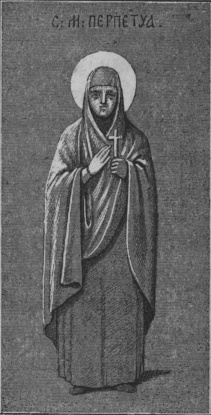
Св. Перпетуя, гражданка Карфагенская, дочь знатных родителей, отца-язычника и матери-христианки, супруга знатного человека, рано овдовела и дала обет жить только для Бога и воспитания единственного дитяти своего. Она еще не была крещена, но приготовлялась ко крещению, как 7-го марта 202 г., по указу императора Септимия Севера, в Карфагене ее схватили вместе с некоторыми другими, подобно ей оглашаемыми, то есть готовившимися ко крещению и изучившими истины веры христианской. В то время у Перпетуи были в живых родители преклонных лет и два брата, из числа оглашаемых. Она должна была и с ними расстаться, и оставить на чужих руках грудное дитя, которое кормила собственным молоком. Она сама описала жизнь свою в тюрьме и дальнейшие происшествия, а запись о мученической кончине сделана очевидцем и для очевидцев (см. Acta Sanctorum, Mart. I, 634).
St. Perpetua, a citizen of Carthage, daughter of noble parents—a pagan father and a Christian mother—wife of a nobleman, was widowed early and made a vow to live only for God and for the upbringing of her only child. She was not yet baptized, but was preparing for baptism, when on March 7, A.D. 202, by decree of the Emperor Septimius Severus, she was seized in Carthage together with certain others, like her catechumens, that is, those preparing for baptism and learning the truths of the Christian faith. At that time, Perpetua's parents were still alive, of advanced age, and she had two brothers, who were among the catechumens. She had to part with them as well, and to leave her nursing child, whom she was feeding with her own milk, in the care of others. She herself described her life in prison and the subsequent events, and the account of her martyric death was written by an eyewitness and for eyewitnesses (see Acta Sanctorum, Mart. I, 634).
«Мы были еще вместе с нашими тиранами, когда мой отец пришел употребить новые усилия для того, чтобы тронуть меня и убедить на перемену решимости. «Батюшка», сказала я, «видишь ли ты этот сосуд глиняный?» – «Вижу», сказал он. – «Можно ли», продолжала я, «дать ему другое название кроме того, какое он уже имеет?» – «Нет», ответил он. «Точно также», сказала я ему, «и я не могу быть иною, нежели какою существую теперь, т. е. теперь я христианка». При этом ответе моем, отец мой бросился на меня с целию выколоть мне глаза, но ограничился только грубым обращением со мной. Он растерялся, видя, что при всех хитростях, им употребляемых на совращение меня, он не в силах уговорить меня. Я возблагодарила Бога за то, что несколько дней не видалась с отцом, так как его отсутствие дозволило мне несколько успокоиться. Чрез несколько времени мы были крещены. Дух Святой, при моем выходе из воды, внушил мне ничего более не желать, как только терпения среди мучений.
"We were still together with our tyrants, when my father came to make new efforts to move me and persuade me to change my resolve. 'Father,' I said, 'do you see this clay vessel?' — 'I see it,' he said. — 'Can it,' I continued, 'be given any other name than that which it already has?' — 'No,' he answered. 'In the same way,' I said to him, 'I cannot be other than what I now am, that is, now I am a Christian.' At this answer of mine, my father rushed at me with the intention of gouging out my eyes, but he limited himself only to rough treatment of me. He was bewildered, seeing that with all the tricks he used to turn me, he was unable to persuade me. I gave thanks to God that I had not seen my father for several days, since his absence allowed me to calm down somewhat. After a short time we were baptized. The Holy Spirit, upon my coming out of the water, inspired me to desire nothing more than patience amidst sufferings.
Спустя несколько времени нас заключили в темницу; суровость, сырость и теплота места с первого раза поразили меня, потому что я не имела понятия о местах такого рода. Ох! как тяжек для меня тот день! Какой страшный жар! Там было душно и тесно; кроме того нам приходилось каждую секунду видеть и испытывать грубости от солдат, нас карауливших. Наконец, меня мучило особенно то, что моего малютки при мне не было. Но? спасибо Терцию и Помпону, двум добрым диаконам! они хоть за деньги, а все-таки достигли того, что нам дали помещение попросторнее, где мы начали дышать свободнее. Каждый хлопотал о себе. Что касается меня, то я только и заботилась кормить грудью свое дитя, которое мне уже принесли и которое было слишком слабо для того, чтоб долгое время быть без материнской груди. Все мои попечения остановились на нем. Я больше всего просила родителей только о том, чтобы они не оставляли мое дитя... Истинно, я была сильно тронута, увидевши, какую любовь они имели ко мне. Долго я тосковала; но, после усиленных просьб оставивши при себе младенца, я скоро успокоилась; я благодушествовала; тюрьма сделалась для меня приятным жилищем; мне хотелось умереть именно здесь, а не в другом месте.
After some time we were shut up in prison; the harshness, dampness, and heat of the place struck me at first, because I had no idea of places of that kind. Oh! how heavy that day was for me! What terrible heat! It was stuffy and cramped there; besides, we had to see and experience rudeness from the soldiers guarding us every second. Finally, I was especially tormented that my little one was not with me. But—thanks to Tertius and Pomponius, two good deacons! They, though for money, nevertheless achieved that we were given more spacious quarters, where we began to breathe more freely. Each was concerned for himself. As for me, I was only concerned with nursing my child, which had already been brought to me and which was too weak to be long without its mother's breast. All my cares were fixed on him. I begged my parents most of all only that they would not abandon my child... Truly, I was deeply moved, seeing what love they had for me. I grieved for a long time; but, after earnest entreaties, having kept the infant with me, I soon grew calm; I was cheerful; the prison became a pleasant dwelling for me; I wished to die precisely there, and not elsewhere.
Однажды брат мой сказал мне: «сестрица! я уверен, что ты имеешь много силы пред Богом: вопроси же Его – умоляю тебя! – о том, чтобы Он дал знать в сновидении, или иначе как-нибудь, – придется ли тебе пожертвовать жизнию, или ты будешь возвращена, отослана назад». Зная, что я иногда имела утешение сподобляться от Бога откровений и каждый день получала тысячу знаков Его благости ко мне, я обратилась с молитвою к Господу, Который сподобил меня сновидения. Вот оно.
One day my brother said to me: 'Sister! I am sure that you have much power before God: ask Him then—I implore you!—that He might make known in a dream, or in some other way, whether you will have to sacrifice your life, or whether you will be returned, sent back.' Knowing that I sometimes had the consolation of being vouchsafed revelations from God and received a thousand signs of His goodness toward me every day, I turned in prayer to the Lord, Who vouchsafed me a dream. Here it is.
Я видела золотую лестницу, чрезвычайно высокую, которая доходила от земли до неба, но столь узкую, что едва можно было восходить по ней только по одиночке; бока этой лестницы были увешаны и утыканы острыми мечами, охотничьими ножами, дротиками, косами, кинжалами и длинными пиками, так что если кто пойдет по ней без осторожности и не глядя постоянно вверх, тот не может остаться целым среди таких орудий, и невольно придется оставить среди их значительную часть своего тела. При нижнем конце лестницы был страшный дракон, который, казалось, постоянно готов был броситься на тех, которые покушались взойти. Сатир постоянно домогался этого, и он вошел первым. Дошедши благополучно до самой последней ступени лестницы, он обратился ко мне с словами: «Перпетуя! я жду тебя, но опасайся, чтобы дракон не поглотил тебя». Я ему ответила: «я не боюсь его», и тотчас решилась идти по лестнице во имя Господа нашего Иисуса Христа. Тогда дракон, как бы испугавшись, тихо отворотил свою голову и, когда я подняла ногу на лестницу, тогда он послужил для меня первою ступенькою. Взошедши на лестницу, я очутилась в огромном саду, посреди которого я увидела благообразного человека в пастушеской одежде; волосы у него белы, как снег. Тут при нем было стадо овец, которых он доил, и вокруг его было бесчисленное множество лиц, одетых в белое платье. Он увидел меня и, назвавши по имени, сказал мне: «дочь моя! ты благополучно прошла». И дал мне молока, которое он только что выдоил; оно было так густо, как свернувшееся молоко. Я приняла его, сложивши руки, и съела; бывшие тут сказали: аминь. Я проснулась при этом слове и, действительно, чувствовала во рту что-то очень сладкое. При первом свидании с братом, я ему рассказала свое сновидение, и мы из него заключили, что нам скоро придется умереть среди мучений. С этого времени мы всецело стали отрешаться от земных предметов, и все свои мысли сосредоточили в вечности.
I saw a golden ladder, exceedingly high, which reached from earth to heaven, but so narrow that one could barely ascend it only one at a time; the sides of this ladder were hung and studded with sharp swords, hunting knives, javelins, scythes, daggers, and long pikes, so that if anyone went up it without caution and without constantly looking upward, he could not remain whole among such instruments, and would involuntarily have to leave a considerable part of his body among them. At the lower end of the ladder was a terrible dragon, which seemed constantly ready to spring upon those who attempted to ascend. Saturus persistently sought this, and he went up first. Having reached safely the very last step of the ladder, he turned to me with the words: 'Perpetua! I am waiting for you, but beware lest the dragon devour you.' I answered him: 'I am not afraid of him,' and immediately resolved to go up the ladder in the name of our Lord Jesus Christ. Then the dragon, as if frightened, quietly turned his head away, and when I set my foot on the ladder, he served as the first step for me. Having ascended the ladder, I found myself in a huge garden, in the midst of which I saw a comely man in shepherd's clothing; his hair was white as snow. With him there was a flock of sheep, which he was milking, and around him was an innumerable multitude of persons dressed in white garments. He saw me and, calling me by name, said to me: 'My daughter! you have passed safely.' And he gave me some milk, which he had just milked; it was as thick as curdled milk. I received it, folding my hands, and ate it; those present said: Amen. I awoke at this word and, indeed, felt something very sweet in my mouth. At the first meeting with my brother, I told him my dream, and from it we concluded that we would soon have to die amidst torments. From that time we began wholly to detach ourselves from earthly things, and concentrated all our thoughts on eternity."
Чрез несколько дней, когда разнеслась молва, что нас поведут к допросу, приходит мой отец; печаль отпечатлевалась на его лице; смертельная скорбь снедала его. Он подходит ко мне и говорит: «дочь моя! сжалься над сединами своего отца, если я только стою того, чтоб называться твоим отцом! Если есть еще память в тебе о тех нежных и особенных заботах, которые я переносил при воспитании тебя, если ты еще признаешь, что моя крайняя любовь к тебе заставила меня предпочесть тебя обоим твоим братьям, то не будь виновницей того, чтобы я сделался предметом позора для целого города. Тронься взорами твоих братьев, посмотри на свою родную мать, на свекровь, на свое дитя, которое не останется в живых без тебя. Убавь несколько этой хвастливой отважности – упорства; подумай немножко, и не подвергай всех нас неизбежному стыду. Кто из нас посмеет выйти в люди, если ты кончишь жизнь от руки палача? Пощади свою жизнь для того, чтобы не погубить всех нас». Говоря это, он целовал у меня руки; после того он, в слезах бросившись к ногам моим, называл меня госпожою. Признаюсь, я проникалась сильною скорбию, когда размышляла, что только отец мой останется один таким, который не извлечет никакой пользы от моей кончины. «Батюшка! сказала я, не тоскуй так; пусть будет только то, что будет угодно Богу; мы не властны в себе, но зависим от Его воли». Со скорбию и в непонятном унынии удалился мой отец.
A few days later, when a rumor spread that we would be taken for interrogation, my father came; sorrow was imprinted on his face; mortal grief consumed him. He approached me and said: "My daughter! Have pity on the gray hairs of your father, if I am at all worthy of being called your father! If there remains in you any memory of those tender and special cares which I bore in raising you, if you still acknowledge that my extreme love for you made me prefer you to both your brothers, then do not be the cause of my becoming an object of shame for the whole city. Be moved by the looks of your brothers, look at your own mother, at your mother-in-law, at your child, who will not remain alive without you. Diminish a little of this boastful boldness—this stubbornness; think a little, and do not subject us all to inevitable disgrace. Which of us will dare to show himself among people, if you end your life by the hand of the executioner? Spare your life so as not to destroy us all." Saying this, he kissed my hands; after that, throwing himself in tears at my feet, he called me his lady. I confess, I was filled with great sorrow when I reflected that only my father would remain one who would derive no benefit from my death. "Father!" I said, "do not grieve so; let only that be which is pleasing to God; we are not masters of ourselves, but are dependent on His will." With sorrow and in incomprehensible despondency, my father departed.
Однажды, во время обеда, вдруг приказывают нам явиться к допросу. Лишь только по городу прошла об этом молва, в одну минуту зало, где допрашивают, наполнилось народом. Нас заставили взойти на что-то в роде сцены театральной, где судья имел свой стул. Все отвечавшие прежде меня громко исповедовали Иисуса Христа. Когда дошла очередь до меня и когда я уже приготовилась давать ответ в ту минуту явился мой отец с моим младенцем на руках слуги. Они отодвинул меня на несколько от судейского места, и в самых сильных словах умолял меня. «Ужели ты будешь, говорил он, бесчувственна к несчастиям, которые грозят этому невинному созданию, получившему жизнь от тебя?» Тогда председатель, по имени Иларий, преемник проконсула Минуция Тиминиана, недавно умершего, присоединился к моему отцу и обратился ко мне с такими словами: «ужели седые волосы отца, которого ты хочешь сделать несчастным, и невинность этого младенца, имеющего остаться круглым сиротою вследствие твоей смерти, ужели все это не в силах тронуть тебя? Только принеси жертву за здоровье императоров». Я ответила: «ни за что не принесу жертвы». Иларий возразил: «так ты христианка»? – «Да», – так ответила я. Между тем мой отец, все еще не терявший надежды уговорить меня и стоявший тут, получил удар палкою от привратника, которому Иларий приказал вывести его. Удар был чувствителен для меня. Я ахнула, увидавши, что из-за меня так грубо и низко обращаются с моим отцом, и сожалела о несчастной его старости.
One day, during dinner, we were suddenly ordered to appear for interrogation. As soon as the rumor of this spread through the city, in an instant the hall where interrogations were held filled with people. They made us ascend something like a theatrical stage, where the judge had his seat. All who answered before me loudly confessed Jesus Christ. When my turn came, and I was already prepared to give my answer, at that moment my father appeared with my infant in the arms of a servant. He drew me aside a little from the judge's seat, and in the strongest words implored me. "Will you be," he said, "insensible to the misfortunes that threaten this innocent creature, who received life from you?" Then the president, by name Hilarius, successor of the proconsul Minucius Timinianus, who had recently died, joined my father and addressed me with these words: "Can it be that the gray hairs of a father, whom you wish to make unhappy, and the innocence of this infant, who will be left an orphan by your death—can it be that all this is not able to move you? Only offer a sacrifice for the health of the emperors." I answered: "I will not offer a sacrifice for anything." Hilarius retorted: "Then you are a Christian?" "Yes," I answered. Meanwhile my father, who still had not lost hope of persuading me and was standing there, received a blow from a staff from the doorkeeper, whom Hilarius ordered to remove him. The blow was painful to me. I gasped, seeing that because of me my father was being treated so rudely and basely, and I pitied his unhappy old age.
В то же самое время судья произнес приговор, по которому мы должны быть брошены зверям. Выслушавши решение, мы сошли с трибуны и с радостию пошли по дороге, ведущей в темницу. Как только я вошла в тюрьму, тотчас послала диакона Помпона попросить дитя у моего отца, который никак не хотел мне дать его. И, по милости Божией, дитя более не имело нужды в молоке матери, и я нисколько не была расстроена от моего молока. Таким образом я была вполне спокойна в душе; ничто меня не опечаливало.
At the same time, the judge pronounced sentence, by which we were to be thrown to the beasts. Having heard the decision, we came down from the tribunal and joyfully went along the road leading to the prison. As soon as I entered the prison, I immediately sent the deacon Pomponius to ask my father for the child, but he absolutely refused to give him to me. And, by the mercy of God, the child no longer had need of his mother's milk, and I was in no way distressed by my milk. Thus I was completely calm in soul; nothing grieved me.
Не много прошло времени после того, и нас перевели в темницу, так как мы были назначены для представлений, которые должны были даваться в Кампе в день рождения Геты-Цезаря; на всех нас наложены были цепи до того дня, в который нас нужно было выдать зверям.
Not much time passed after that, and we were transferred to prison, since we were designated for the spectacles that were to be held in the Camp on the birthday of Geta Caesar; all of us were put in chains until the day when we were to be given over to the beasts.
По прошествии нескольких дней, начальник темничной стражи, замечая, что Бог покровительствовал нам обильно, сделал столь великую честь нам, что дозволил свободно входить к нам нашим братьям, которые приходили к нам, с одной стороны, с целию утешить нас, а с другой, самим получить утешение. Но, за несколько дней до представлений, я увидала: входит мой отец туда, где были мы, в таком тяжком и мрачном унынии, которого нельзя изобразить. Он рвал свою бороду, бросался на землю и лежал на ней, обернувшись к ней лицом, издавая крик и всячески проклиная тот день, в который он родился. Он горевал о том, что прожил так много времени; он называл свою старость несчастною; одним словом, он говорил так печально и трогательно, что доводил до слез слушавших его и возбуждал в них сочувствие к себе. Я умирала от скорби, смотря на жалкое его положение.
After several days, the chief of the prison guard, noticing that God was abundantly favoring us, did us the great honor of allowing our brothers to freely come to us; they came, on the one hand, to comfort us, and on the other, to receive comfort themselves. But a few days before the spectacles, I saw my father enter the place where we were, in such heavy and gloomy despondency that it cannot be described. He tore his beard, threw himself on the ground and lay face down upon it, uttering cries and cursing the day he was born. He grieved that he had lived so long; he called his old age unhappy; in a word, he spoke so sadly and movingly that he brought those who heard him to tears and aroused their sympathy for him. I was dying of grief, looking at his pitiable condition.
«Наконец, накануне представления, я видела сон. Мне показалось, будто диакон Помпон подошел к воротам нашей тюрьмы, застучался в них громко, и будто бы я выбежала за тем, чтобы отворить ему. Он был одет в белое платье очень богатой материи, увешанное по краям множеством золотых гранатов. Он сказал мне: «Перпетуя, я жду тебя; не хочешь ли ты идти?» В ту же минуту он подал мне руку, и мы отправились по узкой тернистой дороге. Наконец, сделавши весьма много поворотов, мы подошли к амфитеатру, почти задыхаясь. Помнон довел меня до средины сцены и сказал мне: «ничего не бойся, я с тобою теперь; и я приду ратовать вместе с тобою и за тебя». Сказавши это, он ушел, и я осталась одна. Так как я была уверена, что мне придется выступить к зверям, то я и не понимала, зачем медлили выпускать их против меня. В эту минуту явился эфиоп крайне отвратительной наружности, который пододвигался ко мне с толпою подобно ему безобразных, и предложил мне бороться. Тотчас молодые люди, весьма добрые, явились ко мне с услугами. С меня сняли одежду, и я чувствовала, что я стала мужественною, я сделалась ратоборцем сильным и могучим. Эти молодые люди вымазывали меня маслом, как нужно было мазаться тем, которые вступали в борьбу или бой. Но когда уже я была наготове вступить в рукопашный бой, один человек, высокого роста и осанистый, подошел ко мне. На нем была пурпуровая и длинная одежда, со множеством складок; застегивалась она бриллиантовою застежкою. У него была в руках трость, похожая на ту, какую имеют управители на играх; у него же в руках была зеленая ветвь, на которой висели золотые яблоки. Приказавши всем молчать, он сказал: «если эфиоп одержит победу над женщиною, то ему будет позволено убить ее. Но если женщина останется победительницею эфиопа, в таком случае она получит эту ветвь и эти золотые яблоки». Сказавши эти слова, он занял свое место. Мы схватились с эфиопом и начали сильную борьбу. Он употреблял все усилия свалить меня; я при осторожности избегала его хитростей, нанося ему множество ударов в лицо. Я чувствовала себя как бы поднявшеюся на воздух, откуда легко поражала своего противника. Наконец, видя, что борьба затянется слишком, я сложила свои обе руки так, что пальцы одной руки были промеж пальцев другой, и спустила их прямо на голову эфиопа; он упал на песок. Публика рукоплескала мне, и мои благородные защитники смешали мелодию своих песен с рукоплесканием народа. Что же касается до меня, то я подошла к надзирателю за играми, к чудному человеку, бывшему свидетелем моей победы, с целию требовать от него награды, и получила ветвь с золотыми яблоками. Вручая ветвь, он сказал мне: «дочь моя! да будет мир с тобою вечно!» Я вышла из амфитеатра теми воротами, которые назывались Санвивария. Так кончилось мое сновидение. Меня утешало только это видение, предсказывавшее мне борьбу и в то же время уверившее меня в победе.
Finally, on the eve of the spectacle, I had a dream. It seemed to me that the deacon Pomponius approached the gates of our prison, knocked loudly upon them, and that I ran out to open them for him. He was dressed in white garments of very rich material, trimmed along the edges with many golden pomegranates. He said to me: 'Perpetua, I am waiting for you; do you wish to come?' At that same moment he gave me his hand, and we set off along a narrow, thorny path. Finally, after making many turns, we approached the amphitheater, almost out of breath. Pomponius led me to the middle of the arena and said to me: 'Fear nothing; I am with you now; and I will come to fight together with you and for you.' Having said this, he left, and I remained alone. Since I was certain that I would have to face the beasts, I did not understand why they delayed in releasing them against me. At that moment an Ethiopian of extremely repulsive appearance appeared, who advanced toward me with a crowd of similarly ugly beings, and challenged me to wrestle. Immediately, very kind young men came to offer me their services. They removed my clothing, and I felt that I had become courageous; I had become a strong and mighty wrestler. These young men anointed me with oil, as was necessary for those who entered into wrestling or combat. But when I was already ready to engage in hand-to-hand combat, a man of tall stature and dignified bearing approached me. He wore a purple, long garment with many folds; it was fastened with a diamond clasp. In his hands he held a staff, like that which the overseers at the games have; he also held a green branch on which hung golden apples. Having commanded all to be silent, he said: 'If the Ethiopian defeats the woman, he will be allowed to kill her. But if the woman remains victorious over the Ethiopian, then she will receive this branch and these golden apples.' Having said these words, he took his place. We grappled with the Ethiopian and began a fierce struggle. He used every effort to throw me; I, with caution, avoided his tricks, striking him many blows to the face. I felt as if I had risen into the air, from where I easily struck my opponent. Finally, seeing that the struggle was dragging on too long, I clasped my two hands together so that the fingers of one hand were between the fingers of the other, and brought them down directly onto the Ethiopian's head; he fell onto the sand. The public applauded me, and my noble defenders mingled the melody of their songs with the applause of the people. As for me, I approached the overseer of the games, the wondrous man who had witnessed my victory, in order to demand my reward from him, and I received the branch with the golden apples. As he handed me the branch, he said to me: 'My daughter! May peace be with you forever!' I left the amphitheater through the gates called the Sanavivaria. Thus ended my dream. Only this vision comforted me, foretelling a struggle for me and at the same time assuring me of victory.
Вот я записала все, что происходило со мною до дня представлений; если кто захочет продолжить рассказ этот, что было после, он может это сделать».
"I have written down everything that happened to me up to the day of the spectacles; if anyone wishes to continue this account of what happened afterward, he may do so."
Продолжим же историю Перпетуи. Смотритель тюрьмы обращался со святыми страдальцами крайне сурово, потому что люди, или по злонамеренности, или по глупому суеверию, заставили его опасаться, чтобы они не ушли из тюрьмы посредством волшебства, в котором вообще тогда подозревали христиан. Перпетуя смело сказала ему: «а вы, вероятно, умеете хорошо обращаться с замечательными личностями, приближенными к цезарю и своими подвигами прославляющими день его рождения? Отчего же вы мешаете нам пользоваться этою маленькою льготою, которая дозволена им для этого дня?» При этих словах трибун покраснел и смешался и, желая, чтобы тюремники забыли о дурном с ними обращении, дал новое приказание, но которому с заключенными в тюрьме должно было обращаться благосклонно, – братьям давалась полная свобода посещать их и лицам всех званий дозволено было приносить им подарки и вспоможения.
Let us now continue the story of Perpetua. The prison warden treated the holy sufferers extremely harshly, because people, either out of malice or foolish superstition, had made him fear that they might escape from prison by means of sorcery, of which Christians were generally suspected at that time. Perpetua boldly said to him: "And you, no doubt, know how to treat well those remarkable persons who are close to Caesar and who glorify the day of his birth by their exploits? Why, then, do you prevent us from enjoying this small privilege which is allowed them for this day?" At these words the tribune blushed and became confused, and, wishing the jailers to forget their ill-treatment of them, gave a new order, according to which the prisoners were to be treated kindly—the brothers were given full freedom to visit them, and persons of all ranks were permitted to bring them gifts and assistance.
Вечером накануне представлений, по обыкновению, обреченным для зверей давался ужин, который называют свободным ужином. Святые страдальцы, насколько возможно, этот ужин сделали вечерию любви. Комната, в которой они вкушали, была полна народу. Мученики, хотя не вдруг, все-таки обратились к нему с речью. То говорили им с ужасающею силою об угрожающем гневе Божием, то объявляли им, что Бог взыщет от них ту невинную кровь, которую они намерены пролить; по местам, в виде иронии, упрекали народ в его зверском любопытстве. «Ужели завтрашний день не удовлетворит, говорит Сатир бесчеловечному народу этому, вашему любопытству и не доставит вам полного удовольствия от рассматривания нас; ужели он не в состоянии будет укротить ненависть, которую вы к нам питаете? Сегодня вы кажетесь тронутыми нашею судьбою, а завтра будете радоваться нашей смерти и станете рукоплескать нашим убийцам. Всмотритесь хорошенько в наши лица, чтобы вам было можно узнать нас в тот страшный день, когда все люди будут судимы». Эти слова, произнесенные с полным убеждением и со всею силою, какую дает только защита правого дела, навели ужас на большинство народа; одни удалились, объятые страхом, который, впрочем, прошел при первом благоприятном случае, но весьма многие остались для поучения и уверовали в Иисуса Христа.
In the evening before the spectacles, according to custom, a supper was given to those condemned to the beasts, which is called the free supper. The holy sufferers, as far as possible, made this supper a love-feast. The room in which they ate was full of people. The martyrs, though not all at once, nevertheless addressed them with speech. At one moment they spoke to them with terrifying force about the threatening wrath of God; at another, they declared to them that God would require from them that innocent blood which they intended to shed; in places, by way of irony, they reproached the people for their brutish curiosity. "Will not tomorrow's day," said Saturus to this inhuman people, "satisfy your curiosity and afford you full pleasure from gazing upon us? Will it not be able to tame the hatred which you bear toward us? Today you seem touched by our fate, but tomorrow you will rejoice at our death and will applaud our murderers. Look closely at our faces, so that you may be able to recognize us on that terrible day when all men shall be judged." These words, spoken with full conviction and with all the force that only the defense of a righteous cause can give, struck terror into the majority of the people; some departed, seized with fear, which, however, passed at the first favorable opportunity, but very many remained for instruction and believed in Jesus Christ.
Наконец, настал день, в который должно было открыться торжество наших великодушных подвижников и ратоборцев. Их вывели из тюрьмы за тем, чтобы представить в амфитеатр. Радость отпечатлевалась на их лицах; она сияла в их глазах, она выказывалась в их жестах, она же высказалась в их речах. Перпетуя шла позади всех. Спокойствие ее духа заметно было на ее лице и походке. Когда же пришли к воротам амфитеатра, на них хотели надеть одежды жрецов Сатурна, а на женщин одежду, какую носят жрицы Цереры. Но эти мужественные воины Бога истинного, всегда твердые и непоколебимые в верности, засвидетельствовали с клятвою и сказали: «мы пришли сюда добровольно, вследствие данного нам слова – не принуждать нас ни к чему такому, что неугодно Богу нашему». На этот раз несправедливость уступила справедливости. Трибун согласился на их предложение – явиться в амфитеатр в их обыкновенном платье. Перпетуя пела, помышляя об эфиопе, падение которого ей было уже предсказано. Ревокат, Сатурнин и Сатир грозили народу жестами и голосом. Когда они стояли насупротив балкона, где сидел Иларий, они кричали ему: «ты осуждаешь нас в этой жизни, но Бог осудит тебя на том свете!» Народ, будучи раздражен такою великодушною смелостью и желая оказать с своей стороны почтение консулу, требовал, чтобы их провели сквозь строй. Но святые радовались, что с ними так поступают, как поступали с Иисусом Христом, их Богом и Учителем.
At last the day arrived on which the triumph of our magnanimous athletes and combatants was to be revealed. They were led out of prison to be presented in the amphitheater. Joy was imprinted on their faces; it shone in their eyes, it was shown in their gestures, it was expressed in their words. Perpetua walked behind all. The tranquility of her spirit was noticeable on her face and in her gait. When they came to the gates of the amphitheater, they wanted to put on them the robes of the priests of Saturn, and on the women the garment worn by the priestesses of Ceres. But these courageous warriors of the true God, ever firm and unshaken in faithfulness, testified with an oath and said: "We have come here voluntarily, in consequence of the word given to us—not to compel us to anything that is displeasing to our God." This time injustice yielded to justice. The tribune agreed to their proposal—to appear in the amphitheater in their ordinary clothing. Perpetua sang, thinking of the Ethiopian whose fall had already been foretold to her. Revocatus, Saturninus, and Saturus threatened the people with gestures and voice. When they stood opposite the balcony where Hilary sat, they cried out to him: "You condemn us in this life, but God will condemn you in the next!" The people, being irritated by such magnanimous boldness and wishing on their part to show respect to the consul, demanded that they be led through the line of scourgers. But the saints rejoiced that they were treated as Jesus Christ, their God and Teacher, was treated.
Кроме того демон, предчувствуя, что самый слабый пол готовился одержать над ним победу, с досады сделал то, что против обыкновения назначили дикую и бешеную корову для борьбы с Перпетуею и другими женщинами. Вслед за тем сняли с них платье и пустили их нагими за решетку. Но весь народ, бывший на этом зрелище, был объят ужасом и сожалением, видя молодую, нежную и знаменитую по происхождению гражданку, верную своему покойному мужу вдову, сердобольную мать, твердую христианку. Поэтому ее снова увели за перегородку и позволили ей одеться в свое платье. Перпетуя тотчас выступила вперед; корова хватает ее; поднимает и бросает на спину. Молодая страдалица, усмиривши ее и заметив, что ее платье было изодрано, проворно закрылась, занятая не столько болью, которую ощущала, сколько опасаясь за свою честь, которая могла тут пострадать. Поднявшись, она собрала свои волосы, которые до того времени были распущены (потому что неприлично было мученикам во время ратоборства иметь лице закрытым, так как люди обыкновенно закрывали лицо в день печали). Фелицитата, заметивши, что свирепая эта корова худо действовала, а Перпетуя лежала на сцене, подбежала к Перпетуе и, подавши ей руку, помогла ей подняться. И обе они выставили себя готовыми выдержать новое нападение, но народ, хотя и оставался по-прежнему жестоким, не хотел их в те минуты вызвать на бой. Они пришли к воротам Санвивария, где Перпетуя была узнана одним оглашенным, имя которого Рустик. Эта достойная удивления женщина, как бы пробудившись после глубокого сна, спрашивала: когда ее избавили от той яростной коровы? Ей рассказали, как было дело: она ни за что не хотела этому верить и, только узнавши оглашенного и взглянувши на свое платье, изорванное во многих местах, и на несколько ран, на которые ей указали, только тогда она поверила. Затем, подозвавши к себе брата и оглашенного, она сказала: «пребывайте в вере, любите друг друга и не соблазняйтесь моими мучениями».
Moreover, the demon, foreseeing that the weakest sex was preparing to gain victory over him, in spite caused a wild and furious cow to be appointed, contrary to custom, for the struggle with Perpetua and the other women. Thereupon they removed their clothing and let them out naked behind the barrier. But all the people present at this spectacle were seized with horror and pity, seeing a young, delicate, and noble citizen by birth, a widow faithful to her deceased husband, a compassionate mother, a steadfast Christian. Therefore she was again led back behind the partition and allowed to put on her clothing. Perpetua immediately stepped forward; the cow seizes her, lifts her up and throws her onto her back. The young sufferer, having subdued it and noticing that her garment was torn, quickly covered herself, concerned not so much with the pain she felt as with fear for her honor, which might suffer thereby. Rising up, she gathered her hair, which until then had been loose (because it was improper for martyrs during the contest to have their faces covered, as people usually covered their faces on a day of sorrow). Felicitas, noticing that this fierce cow had acted poorly and that Perpetua was lying on the stage, ran to Perpetua and, giving her her hand, helped her to rise. And both of them presented themselves ready to endure a new attack, but the people, although they remained as cruel as before, did not wish to challenge them to battle at that moment. They came to the gate of Sanavivaria, where Perpetua was recognized by a certain catechumen named Rusticus. This admirable woman, as if awakening from a deep sleep, asked: when was she delivered from that furious cow? They told her how it had happened; she would not believe it at all, and only upon recognizing the catechumen and looking at her garment, torn in many places, and at the several wounds to which they pointed, only then did she believe. Then, calling to her brother and the catechumen, she said: "Stand fast in the faith, love one another, and be not offended by my sufferings."
В это время Сатир, удалившись в один из портиков амфитеатра, сказал Пуденту: «не говорил ли я тебе раньше, что звери мне ничего не сделают, что все мои желания, кроме одного, исполнятся? так веруй же ты от всего сердца в Того, в Кого я верую. Вот леопард в амфитеатре должен лишить меня жизни». И действительно, к концу представлений леопард, бросившись на него, ударом зубов так его ранил, что кровь полилась из него большою струею, так что народ кричал: «вот крещающийся в другой раз!» Тогда, обращая свои последние взоры к Пуденту, Сатир сказал: «прощай, мой друг! помни о моей вере и подражай ей, да не смущает тебя моя кончина, но, напротив, пусть ободряет и укрепляет она тебя на страдания». Затем, снявши с своего пальца перстень, он окунул его в своей крови и, подавая его Пуденту, сказал: «прими его, как залог нашей дружбы, носи его из-за любви ко мне, и пусть кровь, которою он обагрен, напоминает тебе о том, что я сегодня проливаю ее ради Иисуса Христа». После сего он был перенесен туда, где кончали жизнь те лица, которые не умирали от своих ран.
At this time Saturus, having withdrawn into one of the porticoes of the amphitheater, said to Pudens: "Did I not tell you earlier that the beasts would do nothing to me, that all my desires, except one, would be fulfilled? So believe you with all your heart in Him in whom I believe. Behold, the leopard in the amphitheater is to take my life." And indeed, toward the end of the spectacles, the leopard, springing upon him, wounded him with a blow of its teeth so that blood gushed from him in a great stream, so that the people cried out: "Behold, he is being baptized a second time!" Then, turning his last gaze to Pudens, Saturus said: "Farewell, my friend! Remember my faith and imitate it; let not my death disturb you, but rather let it encourage and strengthen you for sufferings." Then, taking a ring from his finger, he dipped it in his blood and, giving it to Pudens, said: "Receive it as a pledge of our friendship; wear it out of love for me, and let the blood with which it is stained remind you that I shed it today for the sake of Jesus Christ." After this he was carried to the place where those persons ended their lives who did not die from their wounds.
Но когда кровожадный народ потребовал, чтобы другие мученики, только слегка раненые, были снова выведены на сцену и уже на неизбежную смерть, тогда они сами собою все вместе поднялись с мест своих и, давши друг другу святое лобзание мира, взошли туда, куда народ требовал. Все они встретили смерть без малейшего волнения, не испустив ни одного звука жалобы, даже ни одного стона. Сатир, сообразно с видением Перпетуи, в котором он показался вперед всех взошедших на высоту чудной лестницы, скончался вперед всех; за ним – Перпетуя. К несчастию, она попала в руки гладиатора весьма не бойкого, которого дрожащая и непривычная рука, нанося Перпетуе только легкие раны, заставляла ее долго мучиться. Поэтому-то она была вынуждена сама поднести к своей шее меч этого неопытного ратоборца, указывая ему на место, где он должен воткнуть меч. Он так и сделал. (Извл. из соч. прот. В.Я. Михайловского).
But when the bloodthirsty people demanded that the other martyrs, only slightly wounded, be brought out again onto the arena and to inevitable death, then they themselves all together rose from their places and, having given each other the holy kiss of peace, went up to the place where the people demanded. All of them met death without the slightest agitation, without uttering a single sound of complaint, not even a single groan. Saturus, in accordance with Perpetua's vision, in which he appeared first of all to ascend the height of the wondrous ladder, died before all; after him—Perpetua. Unfortunately, she fell into the hands of a gladiator who was not at all skillful, whose trembling and unaccustomed hand, inflicting only light wounds on Perpetua, caused her to suffer long. Therefore she was forced herself to bring her neck to the sword of this inexperienced combatant, pointing out to him the place where he should thrust the sword. And he did so. (Extracted from the work of Prot. V.Ya. Mikhailovsky.)
Кто достойно восхвалит подвизавшегося девяносто два года и каждый день, каждую ночь выходившего победоносцем? Какое слово достаточно будет для того, чтобы пересказать о добродетелях, в каких он подвизался и в детстве, и в отрочестве, и в мужеском возрасте, и в преклонных летах, и в глубокой старости? Кто измерит капли его пота? Кто исчислит совершенные им в продолжение такого времени брани? Какое слово могло бы передать, сколько он посеял семян и сколько он собрал плодов? Кто бы имел такой высокий ум, чтобы мог вполне обнять те приобретения, которые собрал он от мудрого употребления дарованных ему талантов? Я знаю, как обширно море его добродетелей, и боюсь приступить к повествованию о них, как бы мне с своим словом не погибнуть под волнами. Поэтому, пойду около берега, выражу удивление свое и расскажу о том только, что увижу у берега. Самую же глубину оставлю Тому, Кто испытует глубины и ведает тайны»...
Who shall worthily praise him who struggled for ninety-two years and every day, every night came forth victorious? What word will suffice to recount the virtues in which he labored both in childhood, and in youth, and in manhood, and in advanced years, and in deep old age? Who shall measure the drops of his sweat? Who shall number the battles he waged over such a time? What word could convey how many seeds he sowed and how many fruits he gathered? Who would have so lofty a mind as to be able fully to comprehend those acquisitions which he gathered from the wise use of the talents given him? I know how vast is the sea of his virtues, and I fear to approach the narration of them, lest I perish with my word beneath the waves. Therefore I will go along the shore, express my wonder, and tell only of what I see by the shore. The depth itself I will leave to Him Who searches the depths and knows the secrets...
Так говорит о преподобном Петре блаженный Феодорит, епископ Киррский, современник его, пользовавшийся личными отношениями с ним. Из рассказа же блаженного Феодорита сообщаются здесь некоторые сведения о жизни великого подвижника, память которого чествуется сегодня св. Церковью.
Thus speaks of the Venerable Peter the blessed Theodoret, Bishop of Cyrrhus, his contemporary, who enjoyed personal relations with him. From the account of the blessed Theodoret, some information is here communicated concerning the life of the great ascetic, whose memory is honored today by the holy Church.
Избранный сосуд Духа Святого, с самого раннего возраста возлюбил Петр «единое на потребу» и неуклонно более девяноста лет проходил свое земное житие по избранной им узкой стезе. Оставив дом родителей, он сначала подвизался в Галатии, потом отправился в Палестину на поклонение местам, освященным стопами Воплотившегося Бога, и, проникнувшись и насытившись этими воспоминаниями, он прибыл в Антиохию, где тогда (во 2-ой четверти ΙV века) процветало благочестие, и потому юноша Петр пожелал и поселиться здесь, предпочитая жизнь в чужом городе с единоверными – жизни в отечестве своем, хотя и с единокровными и единоплеменными, но не единомысленными с ним. Он не устраивал себе, однакоже, в Антиохии никакого жилья; приютился в гробнице и долгое время прожил здесь в молитвенном уединении и строгом посте, питаясь только хлебом и водою. Подвизаясь таким образом из силы в силу, достиг Петр той степени духовности, которую Господь избирает почвою для Своих высших благодатных даров, и в молодости еще был удостоен дара чудотворений. Силою молитвы возвращал он рассудок беснующимся, исцелял болезни телесные, «даже одежда его, чрез прикосновение, действовала подобно одеждам божественного апостола Павла», рассказывает Феодорит.
An elect vessel of the Holy Spirit, from his earliest years Peter loved the “one thing needful” and unswervingly, for more than ninety years, passed his earthly life along the narrow path he had chosen. Leaving his parents’ home, he first struggled in Galatia, then went to Palestine to venerate the places sanctified by the footsteps of the Incarnate God, and, having been penetrated and filled with these memories, he arrived in Antioch, where at that time (in the second quarter of the fourth century) piety flourished, and therefore the young man Peter wished to settle there, preferring life in a foreign city with those of the same faith to life in his own fatherland, even if with those of the same blood and tribe, but not of the same mind as he. He did not, however, build himself any dwelling in Antioch; he took shelter in a tomb and lived there for a long time in prayerful solitude and strict fasting, nourishing himself only on bread and water. Struggling thus from strength to strength, Peter attained that degree of spirituality which the Lord chooses as the soil for His highest gracious gifts, and while still young he was vouchsafed the gift of wonderworking. By the power of prayer he restored reason to the possessed, healed bodily diseases, “even his clothing, through touch, acted like the garments of the divine Apostle Paul,” relates Theodoret.
Замечательно одно обстоятельство при знакомстве матери блаженного Феодорита с этим подвижником Антиохийским. Она услышала о нем от одной знакомой своей, супруги тогдашнего восточного правителя Пергамия, которая была исцелена блаженным Петром от опасной болезни глаз. Мать блаженного Феодорита, также страдая болезнию глаза, от которой никто не мог исцелить ее, решилась обратиться за помощью к известному уже тогда подвижнику гробницы. Молодая, не просвещенная еще духовно женщина, отправилась она к нему, разукрашенная, по обычаю, богатою одеждою. Увидев ее, блаженный пожелал исцелить ее сначала от любви к нарядам...
One circumstance is remarkable in the acquaintance of the mother of the blessed Theodoret with this ascetic of Antioch. She heard of him from a certain acquaintance of hers, the wife of the then eastern ruler Pergamius, who had been healed by the blessed Peter from a dangerous eye disease. The mother of the blessed Theodoret, also suffering from an eye disease which no one could heal, resolved to turn for help to the ascetic of the tomb, already well known. A young woman, not yet spiritually enlightened, she went to him, adorned, according to custom, in rich clothing. Seeing her, the blessed one wished to heal her first of her love for finery…
«Скажи мне, дочь моя, – заговорил он с нею, – если бы какой-нибудь живописец, весьма опытный в своем искусстве, написал какую-нибудь картину по всем правилам искусства и представил бы ее людям, желающим посмотреть, а другой кто-нибудь, не изучивший хорошо того искусства, а рисующий, как вздумалось, что пришло на мысль, пришел бы и, охулив ту художественную живопись, придал бы бровям и ресницам более длинное очертание, лице сделал бы белее, на щеках прибавил бы краски, – как ты думаешь, не справедливо ли вознегодовал бы прежний живописец на это оскорбление его искусства и на сделанные несведущею рукою ненужные прибавления? Так точно и Творец всяческих и нашего естества Содетель и Художник оскорбляется тем, что вы как бы обвиняете Его неизреченную мудрость в несовершенстве: иначе вы не покрывали бы себя краскою, или белою, или черною, если бы не думали, что вам недостает этой принадлежности. А думая, что телу недостает необходимого, вы как бы обвиняете Творца в некоторого рода бессилии, тогда как всякому известно, что Он имеет силу, равную хотению. Все, что восхотел Господь, то сотворил (Пс.134:6), дав всем все полезное, не дав только того, что вредно. Не искажайте же образа, предначертанного Богом, не усиливайтесь прибавлять то, чего не дал Премудрый, и не выдумывайте поддельной красоты, которая и целомудренных растлевает»...
“Tell me, my daughter,” he began speaking with her, “if some painter, very experienced in his art, had painted a certain picture according to all the rules of art and presented it to people wishing to look at it, and another person, not having well studied that art, but painting as it occurred to him, as came into his mind, came and, having disparaged that artistic painting, gave the eyebrows and eyelashes a longer outline, made the face whiter, added color to the cheeks—what do you think, would not the former painter justly be indignant at this insult to his art and at the unnecessary additions made by an unskilled hand? So also the Creator of all things and the Maker and Artist of our nature is offended that you, as it were, accuse His ineffable wisdom of imperfection: otherwise you would not cover yourselves with paint, either white or black, if you did not think that you lacked this attribute. But thinking that the body lacks what is necessary, you, as it were, accuse the Creator of a kind of powerlessness, whereas everyone knows that He has power equal to His will. All that the Lord willed, He did (Ps. 134:6), giving to all everything useful, but not giving only what is harmful. Do not, therefore, distort the image traced by God, do not strive to add what the Wise One has not given, and do not invent counterfeit beauty, which corrupts even the chaste”…
Как доброе семя на плодотворную почву, так залегли эти слова в добрую душу молодой женщины и внезапно просветили и преобразили ее. Припав к ногам святого, она со слезами умоляла его помолиться о ней, говорила, что она не оставит его, пока не получит исцеления и от болезни своей.
Like good seed on fruitful soil, these words lodged in the good soul of the young woman and suddenly enlightened and transformed her. Falling at the feet of the saint, she tearfully begged him to pray for her, saying that she would not leave him until she received healing also from her illness.
«Если имеешь веру искреннюю и твердую, то выздоровеешь, – сказал ей смиренный Петр. – Бог, всегда готовый исполнить прошение верующей души, исполнит и твое прошение, не мне даруя благодать, но видя веру твою. Если примешь это Богом дарованное лекарство, то выздоровеешь». И когда, вслед за этими словами, Петр положил больной руку на глаз и изобразил знамение креста, то болезнь исчезла.
“If you have sincere and firm faith, you will recover,” the humble Peter said to her. “God, always ready to fulfill the petition of a believing soul, will also fulfill your petition, granting grace not to me, but seeing your faith. If you accept this God-given remedy, you will recover.” And when, after these words, Peter laid his hand on the sick woman’s eye and made the sign of the cross, the disease disappeared.
«Такую-то пользу приобрела мать моя от наставлений Петра, – говорит Феодорит, – искала исцеления телу, а приобрела и здравие души. Вот что блаженный Петр совершал словом, вот что мог делать молитвою»...
“Such benefit did my mother obtain from Peter’s instructions,” says Theodoret, “she sought healing for the body, but obtained also health for the soul. This is what the blessed Peter accomplished by word, this is what he could do by prayer”…
«Имея множество и других повествований об этой блаженной душе, я весьма многие опущу, опасаясь за немощь многих, которые, судя по себе, не верят чудотворениям Боголюбивых мужей... Итак, просияв чудными лучами и просветив ими Антиохию, – заключает Феодорит, – Петр окончил подвиги в ожидании венца, уготованного победоносцам».
“Having many other accounts concerning this blessed soul, I shall omit very many, fearing for the weakness of many who, judging by themselves, do not believe in the wonderworkings of God-loving men… And so, having shone with wondrous rays and enlightened Antioch with them,” concludes Theodoret, “Peter ended his struggles awaiting the crown prepared for the victors.”
Житель г. Анаилии, по роду занятий – живописец, Анастасий был один из призванных запечатлеть своею смертью ту силу веры, которая таится глубоко и несокрушимо в сердцах угнетенного, но непобежденного нравственно христианского населения на Востоке.
A resident of the city of Anáyli, by occupation a painter, Anastasius was one of those called to seal with his death that power of faith which lies deep and indestructibly in the hearts of the oppressed but morally unconquered Christian population in the East.
Поводом к его страдальческому подвигу было первоначально одно житейское обстоятельство: он был обручен с дочерью одного местного христианина, но узнав случайно, что поведение ее небезукоризненно, он отказался от женитьбы на ней. Раздосадованные родственники невесты прибегнули к одному из средств, употребляемых невежественным народом для так называемого «причарования» жениха. И в этом случае, как и во многих нередких проявлениях подобного же зла, примеры которого, к несчастию, довольно распространены и в наше время в простом народе, возбудительное средство повлияло на мозг, довело Анастасия до расстройства рассудка, а в это время его болезненного бессознательного состояния мусульмане «потурчили» его...
The occasion for his suffering struggle was initially a domestic circumstance: he was betrothed to the daughter of a local Christian, but having accidentally learned that her conduct was not irreproachable, he refused to marry her. The annoyed relatives of the bride resorted to one of the means used by the ignorant for the so-called “enchantment” of the bridegroom. And in this case, as in many not infrequent manifestations of a similar evil, examples of which, unfortunately, are quite widespread even in our time among the common people, the stimulant affected the brain, brought Anastasius to mental derangement, and during this time of his painful unconscious state, the Muslims “Turkified” him…
Сильная природа Анастасия превозмогла однакоже действие возбудительного «зелья»; он выздоровел, пришел в себя и тогда с ужасом увидел на голове своей белую чалму мусульманина... С негодованием сбросил он ее на землю и воскликнул, видя себя окруженным турками: «Я – христианин, всегда был христианином и останусь им!»
Anastasius’s strong constitution, however, overcame the effect of the stimulating “potion”; he recovered, came to himself, and then with horror saw on his head the white turban of a Muslim… With indignation he cast it to the ground and exclaimed, seeing himself surrounded by Turks: “I am a Christian, I have always been a Christian, and I will remain one!”
Турки схватили его и представили судье. На увещания и на угрозы судьи Анастасий не обращал никакого внимания и только говорил: «Не отрекусь от Господа Иисуса Христа, моего истинного Бога; в Него Одного я верую и покланяюсь Ему, как Творцу и Спасителю моему; вашей же веры отрекаюсь, равно как и вас самих и пророка вашего, и не имею к ней ни малейшего влечения»...
The Turks seized him and brought him before the judge. To the exhortations and threats of the judge, Anastasius paid no attention and only said: “I will not deny the Lord Jesus Christ, my true God; in Him alone I believe and worship Him as my Creator and Savior; your faith I renounce, as well as yourselves and your prophet, and I have not the slightest inclination toward it”…
Слова эти не могли иметь иного последствия, как приговор к смертной казни. Но раздраженный фанатический народ не удовольствовался приговором к обезглавлению христианина; это казалось для него слишком легкою смертью. Турки с яростию бросились на Анастасия и палками, мечами, ножами избили и изрубили его на мелкие части.
These words could have no other consequence than a sentence of death. But the irritated fanatical people were not satisfied with the sentence of beheading for the Christian; this seemed to them too easy a death. The Turks furiously rushed upon Anastasius and with sticks, swords, and knives beat and hacked him into small pieces.
В тот же день преподобного Трифона Кольского. В сей день совершается память дня ангела его. О жизни преподобного см. 16 декабря.
On the same day, the Venerable Tryphon of Kola. On this day the memory of his name-day is celebrated. For the life of the Venerable one, see December 16.