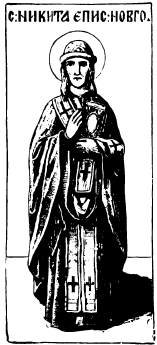
У одного Палестинского аввы спросили: «отчего святые смиряются более и более, по мере своего усовершенствования?» И авва отвечал: «оттого, что они не смотрят на то, что оставляют позади себя, а лишь на то, что впереди их; их правда представляется им ничтожной пред величием святости Божией». Потому-то не умна, преступна, опасна гордость наша, не только та, которая тешится земными преимуществами, но и та, которая самонадеянно принимает на себя духовные подвиги. Пример тому – Печерский подвижник Никита, который вместе показывает собою, что когда воля благая, невзирая на падения, с твёрдостью следует внушениям благодати, благодать Божия возводит душу на высокую степень духовного совершенства.
A certain Palestinian abba was asked: "Why do the saints become more and more humble as they advance in perfection?" And the abba answered: "Because they do not look at what they leave behind, but only at what lies before them; their righteousness appears to them as nothing before the majesty of God's holiness." Therefore our pride is unwise, criminal, and dangerous—not only that pride which delights in earthly advantages, but also that which self-confidently takes upon itself spiritual struggles. An example of this is the Pechersk ascetic Nikita, who at the same time shows that when the will is good, despite falls, and firmly follows the promptings of grace, the grace of God raises the soul to a high degree of spiritual perfection.
«В дни игумена Никона (1078–1088 г.), – пишет Поликарп, Печерский инок378, был брат, именем Никита. Искушаемый желанием славы пред людьми, избирая великое дело не для Бога, он просил у старца дозволения идти в затвор. Игумен не позволял ему. „Чадо! ты молод, – говорил он, и потому не полезно для тебя сидеть праздным; лучше тебе трудиться вместе с братьями, и ты не потеряешь твоей награды; сам ты видел брата нашего Исаакия, как он прельщен был; только великая благодать Божия спасла его, и он творит ныне чудеса“. Никита отвечал: „никогда не соблазнюсь я такой вещью, а прошу у Господа, дабы дал мне дар чудотворений“». «Выше сил твоих прошение твоё, – сказал Никон; – остерегись, брат, чтобы вознесшись не упасть. Смирение наше приказывает тебе служить братии».
"In the days of Hegumen Nikon (1078–1088)," writes Polycarp, a monk of the Kiev Caves378, "there was a brother named Nikita. Tempted by a desire for glory before men, choosing a great work not for God, he asked the elder for permission to enter seclusion. The abbot did not allow him. 'Child, you are young,' he said, 'and therefore it is not profitable for you to sit idle; it is better for you to labor together with the brethren, and you will not lose your reward; you yourself have seen our brother Isaac, how he was deceived; only the great grace of God saved him, and now he works miracles.' Nikita answered: 'I will never be tempted by such a thing, but I ask of the Lord that He grant me the gift of wonderworking.'" "Your request is beyond your strength," said Nikon; "take heed, brother, lest being exalted you fall. Our humility commands you to serve the brethren."
Никита настоял на своём. Но не прошло года, как стал он добычей искусителя. Явившийся в виде ангела дал ему совет оставить молитву и заниматься только книгами, а на себя принял молиться за него и молился в виду его. Скоро стал Никита прозорливым и учительным. Он послал сказать Изяславу: «ныне убит Глеб Святославович в Заволочье, пошли скорее сына твоего Святополка на Новгородский престол». Как сказал он, так и было. И по летописи князь Глеб точно был убит 1078 г. мая 30 дня379. Это оправдавшееся прозрение обратило внимание всех на Никиту; князья и бояре стали приходить к нему для слушания наставлений. Никто не мог сравниться с ним в знании книг Ветхого Завета, он знал их на память380; но книг Нового Завета никак не хотел он слушать, ни беседовать по ним. По этой последней странности поняли, что он обольщён. Любовь отцов не могла быть равнодушной к несчастью брата. Преподобные игумен Никон, Иоанн, бывший после него игуменом, постник Пимен, Матфей прозорливый, св. Исаакий печерник, Агапит врач, Григорий чудотворец, Николай, бывший после епископом Тмутараканским, Нестор, написавший летопись, Григорий, творец канонов, Феоктист, бывший потом епископом Чернигова, – пришли все к прельщённому и, помолившись, отогнали от него беса. Они вывели его (из затвора) и спрашивали о Ветхом Законе, желая что-нибудь слышать от него. Но он с клятвою уверял, что никогда не читал книг. И тот, который прежде знал на память Ветхозаветные книги, теперь не знал ни слова. Преподобные отцы едва научили его грамоте. С того времени он посвятил себя посту и чистому, смиренному и послушливому житию, так что превзошёл он других добродетелями. Поставленный в епископа Новгороду, он сотворил много чудес; молитвой низвёл дождь и погасил пожар. И ныне чтут со святыми блаж. Никиту. Так писал Поликарп381.
Nikita insisted on his own way. But within a year, he became the prey of the tempter. One who appeared in the form of an angel gave him counsel to leave off prayer and occupy himself only with books, while he himself would pray for him, and he prayed in his sight. Soon Nikita became clairvoyant and instructive. He sent word to Izyaslav: "Now Gleb Svyatoslavich has been killed in Zavolochye; send your son Svyatopolk quickly to the throne of Novgorod." As he said, so it came to pass. And according to the chronicle, Prince Gleb was indeed killed on May 30, 1078379. This fulfilled prophecy drew everyone's attention to Nikita; princes and boyars began to come to him to hear his teachings. No one could compare with him in knowledge of the books of the Old Testament; he knew them by heart380; but the books of the New Testament he absolutely refused to hear or to discuss. By this last peculiarity, they understood that he was deluded. The love of the fathers could not be indifferent to the misfortune of a brother. The Venerable Hegumen Nikon, John (who became hegumen after him), Pimen the Faster, Matthew the Clairvoyant, St. Isaac of the Caves, Agapit the Physician, Gregory the Wonderworker, Nicholas (later Bishop of Tmutorakan), Nestor the Chronicler, Gregory the Composer of Canons, and Theoctistus (later Bishop of Chernigov)—all came to the deluded one and, having prayed, drove the demon away from him. They led him out (of the seclusion) and questioned him about the Old Law, wishing to hear something from him. But he swore with an oath that he had never read the books. And he who had formerly known the Old Testament books by heart now knew not a single word. The Venerable Fathers barely taught him to read. From that time, he devoted himself to fasting and a pure, humble, and obedient life, so that he surpassed others in virtues. Appointed bishop of Novgorod, he worked many miracles; by prayer he brought down rain and quenched a fire. And now the blessed Nikita is honored among the saints. Thus wrote Polycarp381.
По другим памятникам, св. Никита посвящён в епископа Новгородского в 1096 году на место почившего блаж. Германа, а в 1097 г. Мстислав, князь Новгородский, «молитвами преподобного епископа Никиты», благополучно возвратился в Новгород после долгой войны с Олегом382. Поныне ещё цел каменный корпус, построенный св. Никитой для Новгородского владыки; он и в памятниках и в народном предании известен под именем Никитинского, как построенный св. Никитой383. Святитель-подвижник имел утешение благословить блаж. Антония на основание новой обители. Железные вериги, снятые с мощей святителя, весом в 14 ф., – верный свидетель тому, что святитель до самой кончины своей ревностно подвизался против плоти384. Блаж. пастырь скончался 31 января 1108 года, «а на весну, – говорит древняя летопись, – почата писати (расписывать стены) св. Софью, стяжанием святого владыки», – по его завещанию385.
According to other records, St. Nikita was consecrated Bishop of Novgorod in 1096, in place of the reposed blessed Herman, and in 1097, Mstislav, Prince of Novgorod, "by the prayers of the Venerable Bishop Nikita," returned safely to Novgorod after a long war with Oleg382. To this day, the stone building built by St. Nikita for the Novgorod bishop remains intact; it is known in records and in popular tradition by the name of Nikitinsky, as built by St. Nikita383. The Hierarch-ascetic had the consolation of blessing the blessed Anthony to found a new monastery. The iron chains, weighing 14 lbs., removed from the relics of the Hierarch, are a faithful witness that the Hierarch zealously struggled against the flesh until his very end384. The blessed shepherd reposed on January 31, 1108, "and in the spring," says the ancient chronicle, "they began to paint (the walls of) St. Sophia, by the bequest of the holy bishop"—according to his testament385.
Уже во время Поликарпа, в начале XIII в., чтили память преп. Никиты в числе святых. Но мощи святителя открыты были только в 1553 году386.
Already in the time of Polycarp, at the beginning of the 13th century, the memory of the Venerable Nikita was honored among the saints. But the relics of the Hierarch were uncovered only in 1553386.
Лицо святителя, как увидели тогда, сохранило на себе отпечаток небесного покоя, с каким он заснул навеки. Облачение его, остававшееся в земле 450 лет, осталось цело, во всей древней красоте; его составляли фелонь, епитрахиль, поручи и палица штофные, кофейного цвета, пояс гарусный, тканый, омофор белого люстрина с крестами из штофа, митра (шапочка) гродетуровая с горностаевой опушкой387. Современный повествователь об открытии и прославлении мощей святителя справедливо заметил, что этим прославлением святителя посрамлена «безбожная ересь Башкина», отвергавшего всё сверхъестественное – и благодать Божию и все чудеса христианства. По словам очевидца, в день торжественного открытия мощей до 10 больных получили исцеление. Замечательная особенность в чудесах святителя: преимущественно больные глазами, слепые, с испорченным зрением, получают исцеление от него388.
The face of the Hierarch, as was then seen, preserved the imprint of heavenly peace with which he had fallen asleep forever. His vestments, which had remained in the earth for 450 years, remained intact, in all their ancient beauty; they consisted of a phelonion, epitrachelion, epimanikia, and palitsa of coffee-colored damask, a woven worsted belt, an omophorion of white lustrine with crosses of damask, and a mitre (cap) of grodetour with an ermine trim387. The contemporary narrator of the uncovering and glorification of the Hierarch's relics rightly observed that by this glorification of the Hierarch, "the godless heresy of Bashkin" was put to shame—he who rejected everything supernatural, both the grace of God and all the miracles of Christianity. According to an eyewitness, on the day of the solemn uncovering of the relics, up to 10 sick people received healing. A remarkable feature of the Hierarch's miracles: especially those with eye ailments, the blind, and those with impaired vision receive healing from him388.
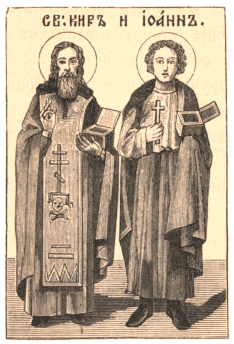
Кир родился в Александрии. В этом же городе, славившемся образованием, Кир получил воспитание и изучил врачебное искусство. Своим врачевством он оказывал помощь ближним и притом безвозмездно. Подавая больному врачевство против телесной болезни, он об имени Иисуса Христа увещевал больных избегать грехов, как частых причин телесных недугов. Обращая внимание на психические причины телесных болезней, и стараясь с помощью Божией исцелять душевные болезни, св. Кир так прославился врачебным искусством, что затмил славу других врачей. Язычники обращались к нему за врачевством и, получая наставления в вере в Иисуса Христа, подающего вечное здравие человеку, обращались в христианство. Врачебное искусство, при помощи Божией, исцеляло больных, внимавших проповеди св. Кира.
Cyrus was born in Alexandria. In this same city, famed for its learning, Cyrus received his upbringing and studied the art of medicine. By his healing, he rendered help to his neighbors, and that without payment. While giving the sick a remedy for bodily illness, in the name of Jesus Christ he exhorted the sick to avoid sins, as frequent causes of bodily ailments. Paying attention to the psychic causes of bodily illnesses, and striving with God's help to heal spiritual illnesses, St. Cyrus became so renowned in the art of medicine that he eclipsed the fame of other physicians. Pagans turned to him for healing, and receiving instruction in faith in Jesus Christ, who grants eternal health to man, they converted to Christianity. The art of medicine, with God's help, healed the sick who heeded the preaching of St. Cyrus.
Наступило для христиан жестокое гонение Диоклитиана. Св. врач Кир, проповедуя другими заботу о жизни и здоровье, как о даре Божьем, убежал от гонения из Александрии в Аравию. Этим он исполнил и заповедь Спасителя о самосохранении аще гонят вы во граде сем, бегайте в другий.
A fierce persecution of Diocletian came upon Christians. St. Cyrus the physician, preaching to others care for life and health as a gift of God, fled from the persecution from Alexandria into Arabia. By this he fulfilled the Savior's commandment concerning self-preservation: When they persecute you in this city, flee into another.
Иоанн сначала был воином. Узнав о подвигах в пользу ближних и вообще о добродетелях Кира, Иоанн оставил военное звание и просил себе дозволения всегда быть при Кире. Он, можно сказать, сначала был фельдшером при враче Кире. И вот Кир и Иоанн врачевствами своими совместно действуют на пользу ближних.
John was first a soldier. Learning of Cyrus's labors for the benefit of his neighbors and of his virtues in general, John left the military calling and asked permission to be always with Cyrus. He was, one might say, first a medic under the physician Cyrus. And so Cyrus and John together with their healings acted for the benefit of their neighbors.
Пользуя ближних врачебным искусством и проповедуя им учение Христово, св. врачи действовали самоотверженно и, где было нужно, готовы были за благо ближних положить жизнь свою. Однажды они узнали, что гонители христиан схватили для мучений одну мать с тремя дочерями. Невзирая ни на какие опасности, они решились идти в г. Канопу, в нижнем Египте, чтобы своей верой утвердить веру и терпение страдалиц. Св. врачи вместе с ними вкусили мученическую смерть при Диоклитиане в 311 году. Св. церковь празднует память их 31 января; а 28 июня воспоминается перенесение мощей их из Канопы в селение Мануфин в 412 году.
Healing their neighbors by the art of medicine and preaching to them the teaching of Christ, the holy physicians acted self-sacrificingly and, where necessary, were ready to lay down their lives for the good of their neighbors. Once they learned that the persecutors of Christians had seized a mother with three daughters for torture. Regardless of any danger, they resolved to go to the city of Canopus in Lower Egypt, in order to strengthen the faith and patience of the sufferers by their own faith. The holy physicians together with them tasted a martyr's death under Diocletian in the year 311. The holy Church celebrates their memory on January 31; and on June 28, the translation of their relics from Canopus to the settlement of Manuthin in the year 412 is commemorated.
В тот же день св. мучеников Викторина, Виктора, Клавдия, Диодора и Папия. Пострадали за исповедание Христа в Египте в 284 г., в царствование Нумериана.
On the same day, Sts. Martyrs Victorinus, Victor, Claudius, Diodorus, and Papias. They suffered for confessing Christ in Egypt in the year 284, in the reign of Numerian.
Следуем ркп. сказанию. Пишут: «при самом начале Печерской обители, одним из первых её подвижников был преп. Никита». Нет, не то говорится у блаж. Поликарпа. «Ты молод», – говорит игум. Никон (1078–1088 г.) Никите. Никита видел Исаакия в бедственном состоянии, и след., был в Печерской обители с 1067 г., но уже не раньше того.
We follow the manuscript account. Some write: "at the very beginning of the Pechersk monastery, one of its first ascetics was the Venerable Nikita." No, that is not what the blessed Polycarp says. "You are young," says Hegumen Nikon (1078–1088) to Nikita. Nikita saw Isaac in a grievous state, and consequently was in the Pechersk monastery from 1067, but not earlier.
Поликарп по ркп.: «а не можаше никто стязатися с ним книгами Ветхого Завета, весь бо из уст умеяше – бытие, исход, левити, числа, судии, царства и вся пророчества по чину и вся книги жидовскы».
Polycarp according to the manuscript: "and no one could dispute with him in the books of the Old Testament, for he knew the whole by heart—Genesis, Exodus, Leviticus, Numbers, Judges, Kingdoms, and all the prophecies in order, and all the Jewish books."
Ркп. послание к Акиндину. Лет. относительно пожара указывает на кондак: «в кондаке его написано: прилежно моление за люди своя принося, овогда и граду запаление угасил еси». Собр. л. 3, 213.
Manuscript epistle to Akindinus. The chronicle concerning the fire points to the kontakion: "in his kontakion it is written: 'offering fervent prayer for your people, at times you also quenched the burning of the city.'" Collection of Chronicles 3, 213.
Собр. л. 1, 109; 3, 122, 179, 213. Годом поставления св. Никиты в епископа во 2 Новгород. л. в росписи владык, в Воскр. л. (собр. л.7:9), в Никон. л. показан 6604 и только в 3 Новг. л. 6605.
Collection of Chronicles 1, 109; 3, 122, 179, 213. The year of St. Nikita's consecration as bishop is shown as 6604 in the 2nd Novgorod Chronicle in the list of bishops, in the Resurrection Chronicle (Collection of Chronicles 7:9), and in the Nikon Chronicle, and only in the 3rd Novgorod Chronicle as 6605.
Собр. л. 3, 3. Тот же год кончины в Воскр. л. Собр. л. 7, 21. В 3 Новгор. л. (стр. 213) повторено известие 1 лет. о расписании стен собора, но кончина поставлена под 1615 г. и вместе сказано: «бысть во епископии 13 лет». Одно с другим несогласно. Древние известия несомненны, тем более что св. тело Никиты, обретённое 30 апреля 1558 г., пробыло в земле 450 л. и 3 месяца. Опис. Новгор. соб. стр. 95, 99.
Collection of Chronicles 3, 3. The same year of his repose is in the Resurrection Chronicle. Collection of Chronicles 7, 21. In the Third Novgorod Chronicle (p. 213) the account from the First Chronicle concerning the painting of the cathedral walls is repeated, but his repose is placed under the year 1615, and it is also said: "he was in the episcopacy for 13 years." The one contradicts the other. The ancient accounts are beyond doubt, all the more so because the holy body of Nikita, uncovered on 30 April 1558, had lain in the earth for 450 years and 3 months. Description of Novgorod Cathedral, pp. 95, 99.
Собр. л. 3, 158. Минея янв. 31. Никита «Новоявленный чудотворец» – в грамоте 1563 г. (ист. акт I, 550. 551). Ещё цела железная лампада, устроенная усердными Новгородцами при открытии мощей святителя. Она с надписью: «свеча великого Новгорода, всех православных хресиян, поставлена новому чудотворцу Никите в л. 7076 (1558) апреля в 1 день при архиепископе Пимене». Древн. гос. Росс. 1, 80. Служба св. Никите – у Толстого III, № 50, Царского № 364.
Collection of Chronicles 3, 158. Menaion for January 31. Nikita "the Newly-revealed Wonderworker" – in a charter of 1563 (Historical Acts I, 550, 551). The iron lampada, set up by the zealous Novgorodians at the uncovering of the hierarch's relics, is still intact. It bears the inscription: "Candle of Great Novgorod, of all Orthodox Christians, placed for the new wonderworker Nikita in the year 7076 (1558) on the 1st day of April, under Archbishop Pimen." Antiquities of the Russian State 1, 80. The service to St. Nikita – in Tolstoy III, No. 50, Tsarsky No. 364.
Ркп. житие «о переменении риз телеси св. Никиты». Ризы и шапку святителя возили показывать царю Иоанну вслед за открытием мощей. Соб. л. 3, 159. В ризнице Софийского собора показывают ещё святительский жезл св. Никиты. В настоящем виде, составляют его три жимолостные тросточки, соединённые тремя яблоками, и поперечина, одетая моржовой костью, на которой вырезаны святые: митр. Пётр и преп. Сергий. Но так как сии святые прославлены, один в 1330 г., другой в 1427 г., то украшения посоха, без сомнения, не принадлежат св. Никите. Древн. Росс. гос. 1, № 97–100. Опис. Новг. соб., стр. 190–192.
Manuscript Life "concerning the changing of the vestments upon the body of St. Nikita." The vestments and the mitre of the hierarch were taken to be shown to Tsar John immediately after the uncovering of the relics. Collected Chronicles 3, 159. In the sacristy of the Cathedral of St. Sophia they also show the hierarchal staff of St. Nikita. In its present form, it consists of three honeysuckle rods joined by three knops, and a crosspiece covered with walrus ivory, on which are carved saints: Metropolitan Peter and Venerable Sergius. But since these saints were glorified, the one in 1330, the other in 1427, the ornaments of the staff undoubtedly do not belong to St. Nikita. Antiquities of the Russian State 1, Nos. 97–100. Description of Novgorod Cathedral, pp. 190–192.
О некоторых чудесах замечено в летописи под 1552, 1558 и 1571 гг. Собр. л. 3, 156, 158, 165. Ркп. опис. жития и чудес у Румянцева, стр. 206.
Concerning certain miracles, mention is made in the chronicles under the years 1552, 1558 and 1571. Collection of Chronicles 3, 156, 158, 165. Manuscript description of the life and miracles in Rumyantsev, p. 206.